• Blog
  • Shop
  • Resources
  • FAQ (Ask TGS)
  • About
  • Archive
  • Contact
  • Sign In My Account
Menu

The Gentleman Stationer

Vintage Living in the Modern World.
  • Blog
  • Shop
  • Resources
  • FAQ (Ask TGS)
  • About
  • Archive
  • Contact
  • Sign In My Account

Most of my recent Schon DSGN acquisitions!

Happy Holidays 2022: The Indie Gift Guide

November 26, 2022

As we enter not only the 2022 holiday shopping season but the final month of the year, I’ve been pulling together my plans for both the annual gift guides and the 2022 year-end recaps. Today’s post, on the Saturday after “Black Friday”, is going to be a bit of both. I’ve been encouraged by a much greater focus this Thanksgiving on supporting small and independent businesses, both inside and outside the pen community, and honestly, that’s how it should be, because independent makers and retailers are what make this hobby great. When you’re considering how to spend your hard-earned dollars on gifts for yourself or others, consider setting aside a portion for smaller retailers and makers who can offer truly exclusive products and a more personalized shopping experience.

The format for this “guide” might strike some as unusual. I’m not going to simply list all of the different independent makers out there - there are too many to do that in any coherent fashion - but rather will spend today’s post discussing my own acquisitions from the past year, the makers from whom I’ve personally purchased, and why I enjoy their pens and the reasons you might enjoy them too.

Two Schon DSGN Faceted Pocket Six Fountain Pens!

Schon DSGN

Ranked purely in terms of number of pens acquired this year, Schon DSGN tops the list, as I picked up two of the Full-Size fountain pens and a hammered copper Pocket Six with added patina, to join the three pens from the Engineered Plastics collection that I purchased towards the end of 2021. Known not just for original, ergonomic designs but dedication to quality, Schon DSGN pens are among my favorite everyday writers.

My two most recent Kanilea Acquisitions: a Lewa Lani and a Kai Huli.

Kanilea Pen Company

The second-most represented independent maker in my personal collection is Kanilea Pen Company. For more than six years now, Kanilea has been producing pens themed around places and locations in Hawaii. You can read more about the background of this brand in my prior reviews, but I love their clean design and ergonomics (particularly the “Classic Flush” shape), in addition to the unique materials chosen to match a specific image. I recently acquired the Lewa Lani fountain pen, as well as a pen show-exclusive “Kai Huli” in a coral and yellow-veined material, pictured below.

Three “Navigator” Models from Penzbydesign.

Stacy Robinson (Penzbydesign)

A long-time penmaker, Stacy Robinson brought ebonite and Conway Stewart acrylic versions of his “Navigator” fountain pen to this year’s Atlanta Pen Show. I ended up purchasing three: one in striated beige ebonite and two in relatively uncommon Conway Stewart acrylics that I had been looking to add to my collection for years. The workmanship on these pens is excellent, and the size nearly perfect for my hand, as with the Schon DSGN Engineered Plastics and Full-Size fountain pens. While Penszbydesign has a storefront, it may be easier to inquire via e-mail or social media, since some photos were posted recently of new Navigator pens similar to the ones I purchased, and they don’t currently appear on the website.

Two Kasama Una fountain pens.

Kasama Pens

Currently sold only directly via Instagram and social media, Kasama is based in the Philippines and, to my knowledge, makes two models of pens: the larger “Una” and the more streamlined “Tala”. I’ve acquired two Una fountain pens, one in Ultem and another in a combination of Peek and anodized titanium. While not inexpensive, Kasama fountain pens are unique - there’s nothing quite like them on the market, in terms of design or material combinations.

My Hinze Pen in “Five O’Clock Somewhere” Acrylic

Hinze Pens

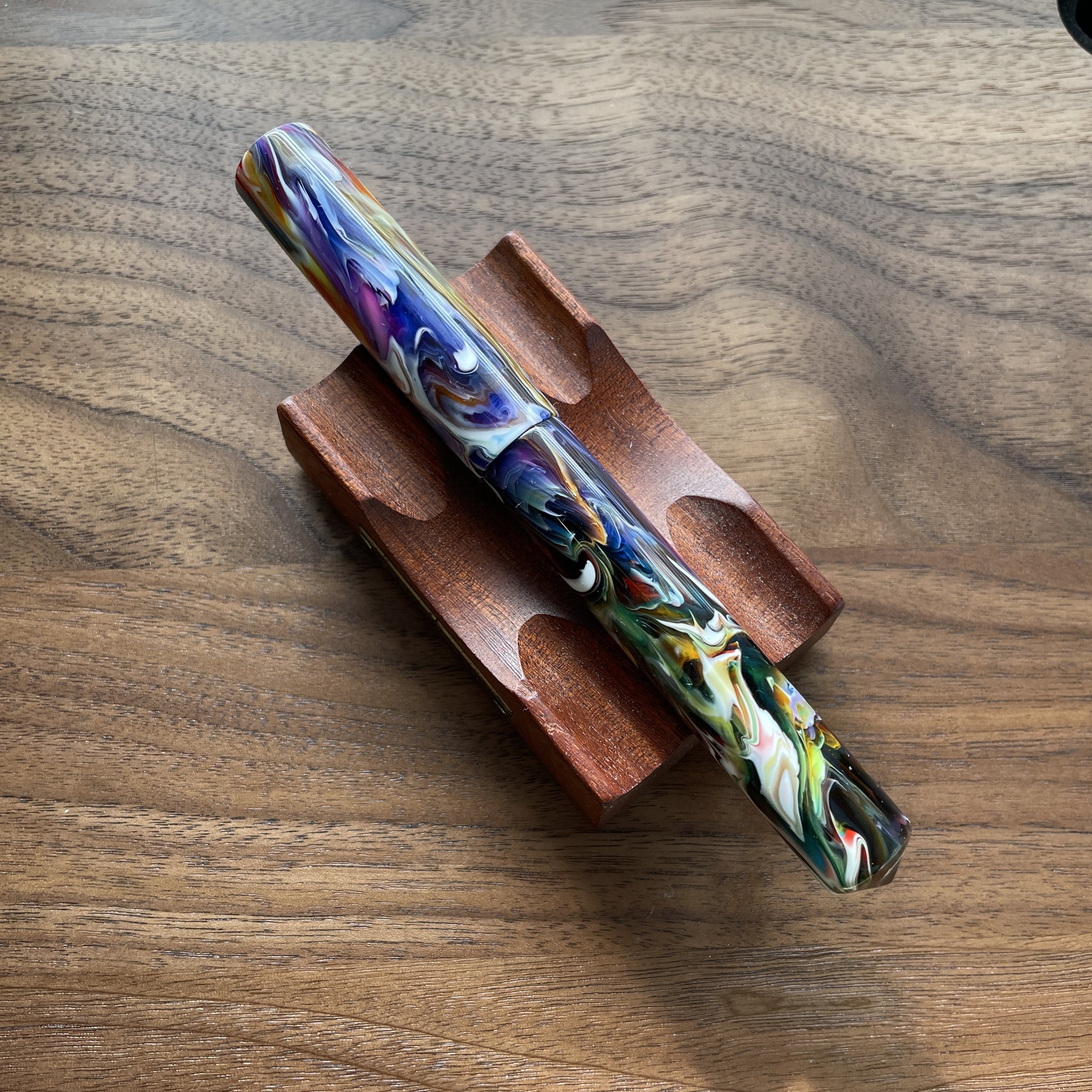
Hinze Pens made perhaps my favorite - and most unpredictable - acquisition of the year, my “Five O’Clock Somewhere” pen in this wild acrylic from Starry Night Resins. Like the Kanilea Classic Flush, this is a well-balanced pen with a comfortable section, and what makes Hinze Pens particularly unique is their anodized nibs, available in a range of colors.
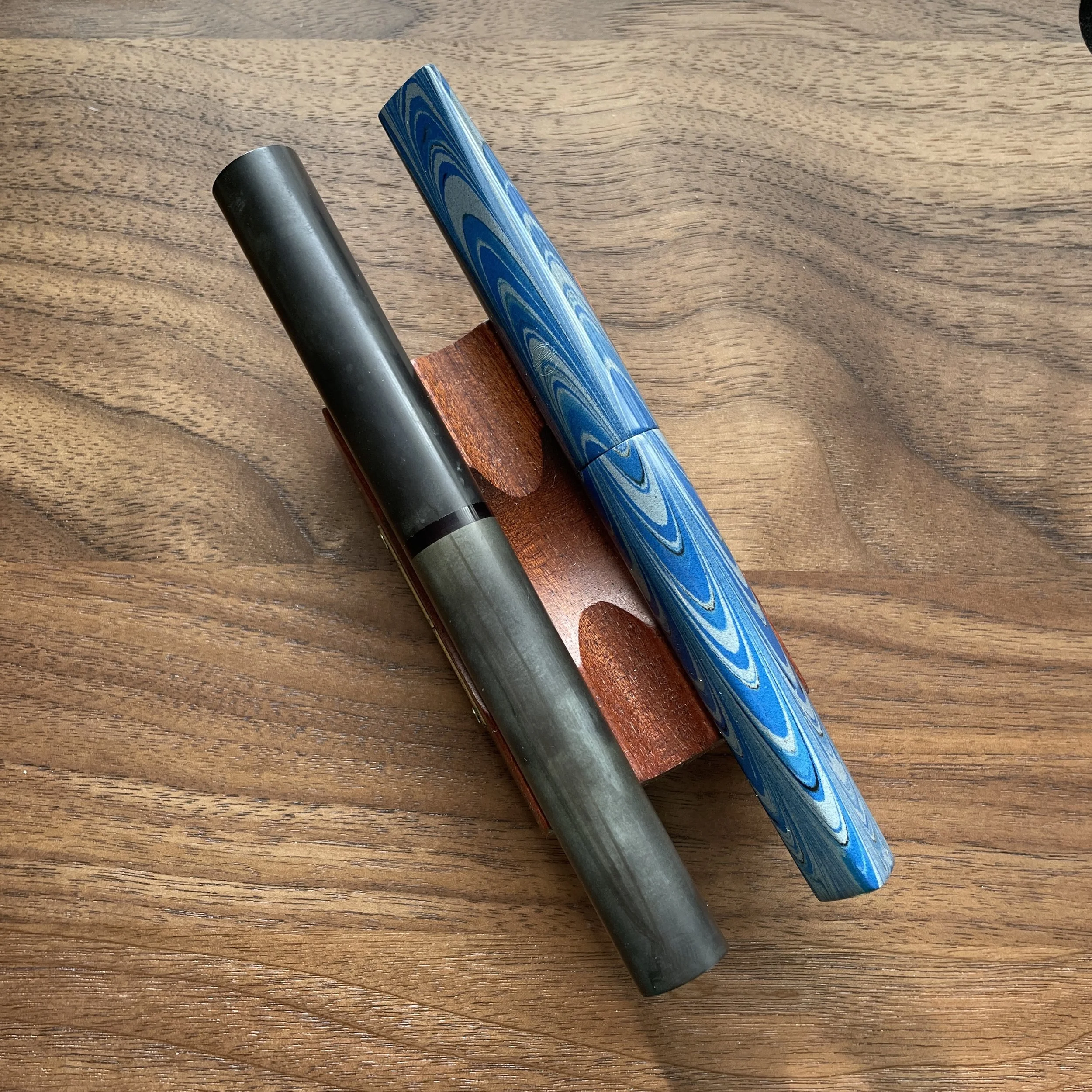
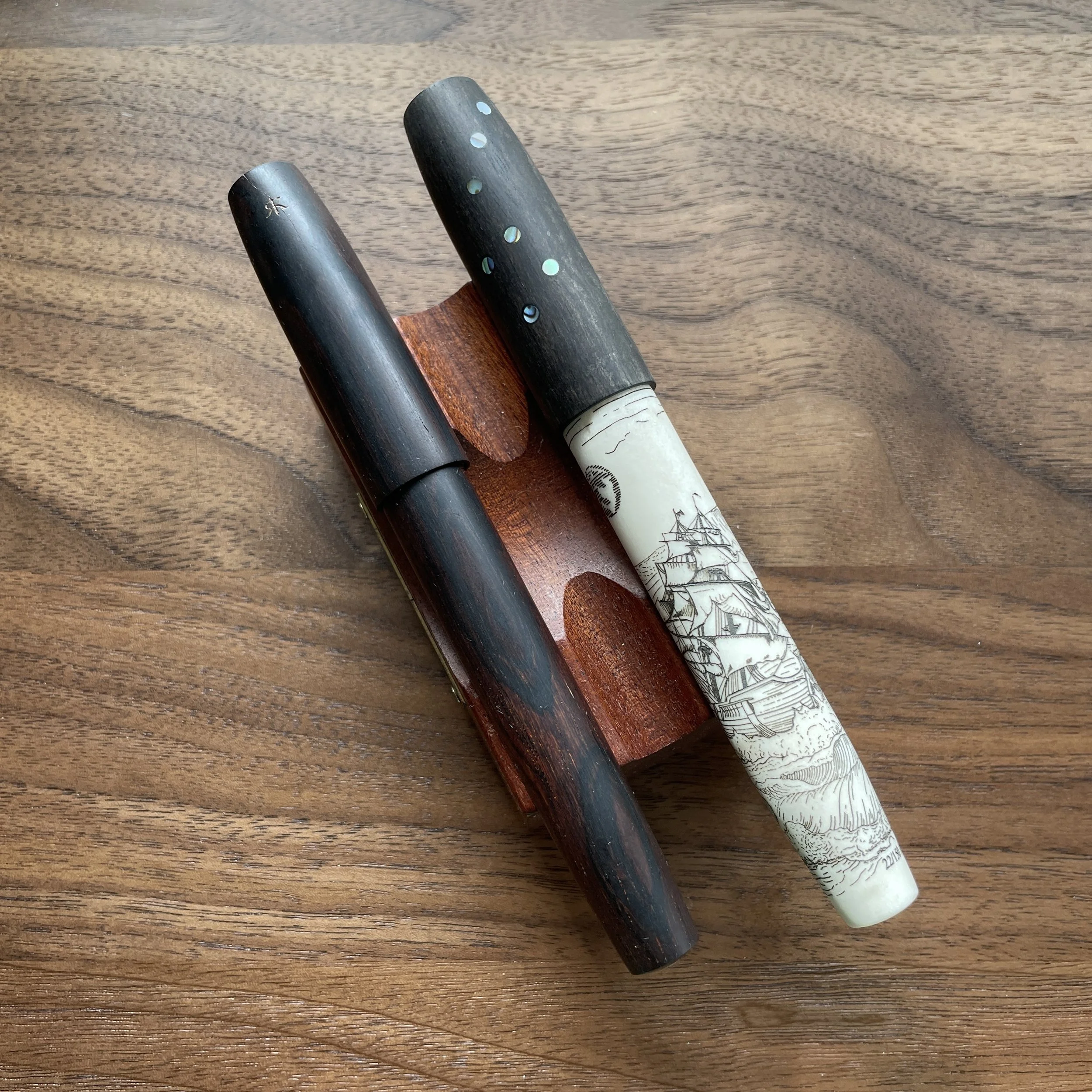
View fullsize Newton Pens
Newton Pens
View fullsize Ryan Krusac Studios
Ryan Krusac Studios
View fullsize Pens by Pasquale in Primary Manipulation
Pens by Pasquale in Primary Manipulation

Other Makers to Consider

As I mentioned above, I can’t list everyone (nor can I buy from everyone, because, well, $$$), but I do want to mentions several makers who do excellent work, some of which are on my “short list” of pens to acquire in 2023, for review or otherwise. Also, while some of the makers listed here do custom/bespoke work, many also have inventory currently available for purchase, which you can purchase, and which they will likely be wanting to sell, heading into the holiday season.

  • Newton Pens (Shawn Newton). A fixture on the pen show circuit and the creator of some truly unique designs (such as the Prospector shown here), Shawn Newton usually has a healthy stock of pens ready to go.

  • Pens by Pasquale (Nicholas Pasquale). A relative newcomer to the bespoke pen scene, Nic is local to me and I acquired a pen in dark “Primary Manipulation” at this year’s Nashville-area Pelikan Hub. I love supporting new makers! Check out his Instagram (linked here).

  • Edison Pens (Brian Gray). Like Shawn Newton, Brian Gray is a longtime penmaker whose production-line Edison designs are now widely available at many major pen retailers. I have my eye on the new Collier Grande featuring a No. 8 nib.

  • Ryan Krusac Pens. One of the few penmakers whose work with wood truly appeals to me, Ryan Krusac combines wood with other materials such a stone and antler. His scrimshaw work is incredibly detailed.

  • Mayfair Pens. Pens with a “Lord of the Rings” theme? Count me in. Lately I’ve been more interested in penmakers who are exploring different shapes and contours, and I had the opportunity to handle these at the 2022 D.C. Pen Show.

Please Consider Supporting T.G.S. This Holiday Season

We’re also a small business, and entirely supported by purchases from our shop and pledges via the T.G.S. Patreon Program. Last week, we launched our own 2022 Holiday Gift Guide, focused on products from our own shop, which makes an effort to focus on and carry products that might necessarily be overlooked by larger stores. We appreciate your support, as it allows us to remain independent and advertiser/affiliate free! Through Monday at 11:59pm, take 10% off all TGS Shop orders with the coupon code “GIVETHANKS”!
In Guide, Editorial Tags 2022 Gift Guide, Gift Guide, Indie Gift Guide
1 Comment

Even though the gift guide is live, I couldn’t post a Christmas photo. Not yet. Here are some Pelikan’s that I took to the Hub last night.

The 2022 T.G.S. Holiday Gift Guide is Live!

November 19, 2022

As part of my recovery from last night’s Pelikan Hubs festivities, I updated the annual T.G.S. Holiday Gift Guide this morning! Each year’s gift guide is slightly different from the last, featuring an annually updated selection of stationery-themed gift ideas. As you’ll discover in the guide itself, I generally don’t give fountain pens as gifts, since fountain pen lovers are hard to buy for, so the guide tends to focus heavily on accessories and other items with a wide appeal to those who appreciate analog-living in general. Enjoy!

P.S. - for those who missed out on the Pelikan Hubs, I have some of the “Pelikan Passion” magazines and the T.G.S. party favors left over. I’ll plan to add them to orders over $50 until they’re gone (with the price threshold set due to the higher cost of shipping the magazines). They are nice magazines and I don’t want to just throw them out, plus the T.G.S. goodie bag will get you a store coupon and a button + sticker.

In Guide Tags Holiday Gift Guide, 2022 Holiday Gift Guide
Comment

Guide to Notebook Systems, Part IV: Single Notebooks, or the "Non-System System"

October 22, 2022

In the first installment of our ongoing “Guide to Notebook Systems” series, we discussed a few different categories, one of which was a “single bound notebook” category. This group, which I’ll discuss today, includes the Midori MD and Stàlogy brands. While you can argue that it’s a broad catch-all, the main reason I personally consider this particular group to be self-contained notebook “systems”, as opposed to simply different brands of notebooks (such as Rhodia or Clairefontaine), is the well-developed ecosystem of brand-specific accessories that allow you to customize your experience. If you stick with a particular notebook long-term, you can take advantage of these accessories to offer you more structure (though perhaps not as much customizability as a system like Traveler’s Notebook might offer). You can also avail yourself of the dedicated community of users who regularly share their tips and hacks for maximizing use and enjoyment of your favorite system.

Midori’s covers are known for their durability and relatively reasonable price points. Left is the “Paper” cover, which uses a thick Japanese craft paper that many believe ages like leather. On the right is my Gfeller undyed natural leather, which isn’t Midori-branded but ages in a similar manner to the Midori goat leather.

What Separates a “Notebook System” from “Just a Notebook”?

Before we get started, I need to insert a disclaimer here - everything I’ve been writing about in this particular series, from the categories themselves to recommendations as to whom each system might be a good fit for, represents my opinion. Since there are so many different notebook brands out there, these categories of different types of notebook systems are a construct I created for purposes of making sense of the different options and organizing my recommendations on the blog. That said, I consider a true notebook “system” to require, at a minimum, the ability to pair the notebook itself (or notebooks) with brand-specific accessories that you can carry over from book to book, hopefully year-after-year.

In other words, it implies more continuity and more of a long-term commitment to a specific notebook than simply keeping, say, a bullet journal and using whatever notebook you have on hand. At the same time, you can still consider these types of systems as “Non-system Systems”, in the sense that the notetaking and organization itself takes place in a standard notebook, and doesn’t require you to adopt any particular method of organizing your notes, such as buying a brand-specific hole punch, adopting a new organization strategy, or figuring out the best way to rig together different Traveler’s Notebook refills.

Midori MD Undyed goat leather, prior to any use. This particular product is the A5 vertical sleeve, designed to hold standard A5 MD and MD Light notebooks.

Example: The Midori MD Line of Notebooks and Accessories

The Midori MD line is probably the best example of what I’m talking about here (or at least the example that I’m personally the most familiar with). You can of course use Midori MD notebooks and other products on their own, without ever delving into the “system” aspect, and they’re excellent for that purpose. MD paper is among the most fountain pen friendly, relatively inexpensive, and it comes in most formats and sizes, ranging from A6 to A4 bound notebooks to writing pads to sticky notes, as well as lined, grid, dot grid, blank, and specialty layouts such as the A5 “Framed” Journal and the 365-day Codex, day-to-a-page journal.

Where this particular system begins to get interesting, at least for me, is when you delve into the available accessories. Midori makes a line of covers specially designed to fit both the MD and MD Light notebooks, in options that combine the utilitarian (the inexpensive plastic covers), the unique (durable Japanese paper covers, which actually age in a manner similar to leather), and the outright luxurious (natural undyed goat leather covers, which take on an amazing patina with long-term use). You can also use Midori’s brass tabs and notebook dividers to create a multi-subject notebook or to mark important pages, and Midori sells fountain-pen friendly sticky notes and even calendar/diary stickers if you want to incorporate planner functionality into your notebook. All of the paper products use the same MD paper (even the sticky notes and diary stickers) for a consistent experience across the line.

Advantages to Using This Sort of Notebook System

  • Flexible, unstructured layout that allows you to experiment with different notetaking systems and otherwise use your notebook however you like.

  • Notebooks and covers typically come in a variety of nonproprietary sizing, including A6, A5, and the somewhat uncommon A4.

  • Accessories such as notebook tabs, dividers, and even covers can typically be used with other stationery products or systems (though YMMV with the covers, as there can be slight variations even in standard sizing between brands requiring you to trim the notebook).

Who This Type of Notebook System is For

  • Someone who doesn’t necessarily need to compartmentalize their notes or writing in a way that requires moving individual pages or sections. If this sounds like you, you may want to check out a ring-based or modular system.

  • Someone who doesn’t need a lot of accessories such as pouches, moveable pen loops, dedicated planner inserts, etc., but at the same time enjoys having a dedicated cover and a few other items designed to work with their favorite notebook.

  • Someone who organizes their journals and notes by notebook, and keeps separate notebooks dedicated to specific subjects, yet still wants consistency in the form of interchangeable covers, tabs, etc.

I’ll plan to discuss further in a future post in this series, but I am a HUGE proponent of borrowing accessories from different notebook systems and customizing your own notebook to best suit your own purpose. (Shown here: a Traveler’s Notebook with a cut-down Stàlogy notebook insert, divided into sections using Midori sticker tabs)

Where to Buy Midori and Similar Brand Recommendations

As I mentioned, I used Midori as the example in this post because it’s the brand I’m most familiar with. The purpose of this post isn’t to serve as an advertisement for Midori - though I obviously think Midori is great. The goal is give you an idea of the depth of options available within a specific brand. As a relatively long-time Midori retailer, I have access to the different size and paper options, as well as the accessories. There are similar options out there on the market, some of which I sell directly and many of which I don’t, including Stàlogy, Maruman Mnemosyne, Nanami Paper’s “Seven Seas” and “Cafe Note” series, the Baron Fig Confidant, and even arguably the Hobonichi Techo and Kokuyo Jibun Techo Planners, which were designed as planners but many people use as notebooks and journals. Go with what works best for you!

Further Reading

i’ve enjoyed writing this series on Notebook Systems, and if you missed the earlier installments in this series, get caught up here! Recent posts include:

  • Guide to Notebook Systems, Part I: What Is a Notebook System/System Techo? The first post is an overview of what I consider a “Notebook System” to be, how I use them, and the general goals of the series. Start here!

  • Guide to Notebook Systems, Part II: Plotter Is NOT a Planner. This installment specifically looks at the popular “Plotter” System Techo, which arrived from Japan last year and exploded in popularity at this year’s San Francisco Pen Show. Note that the Plotter store still has stock of the 5th Anniversary Limited Edition Bible Size cover in Olive Green (and other accessories). I received mine literally 10 minutes before I left the house and will be setting it up while I’m away.

  • Guide to Notebook Systems, Part III: Traveler’s Notebook and the “Modular Approach”. The latest installment looks at one of my favorite systems, Traveler’s Notebook, and similar “modular” systems that allow you to combine multiple notebook inserts and accessories with a single cover.

In Editorial, Guide Tags Notebook Systems, Guide
Comment

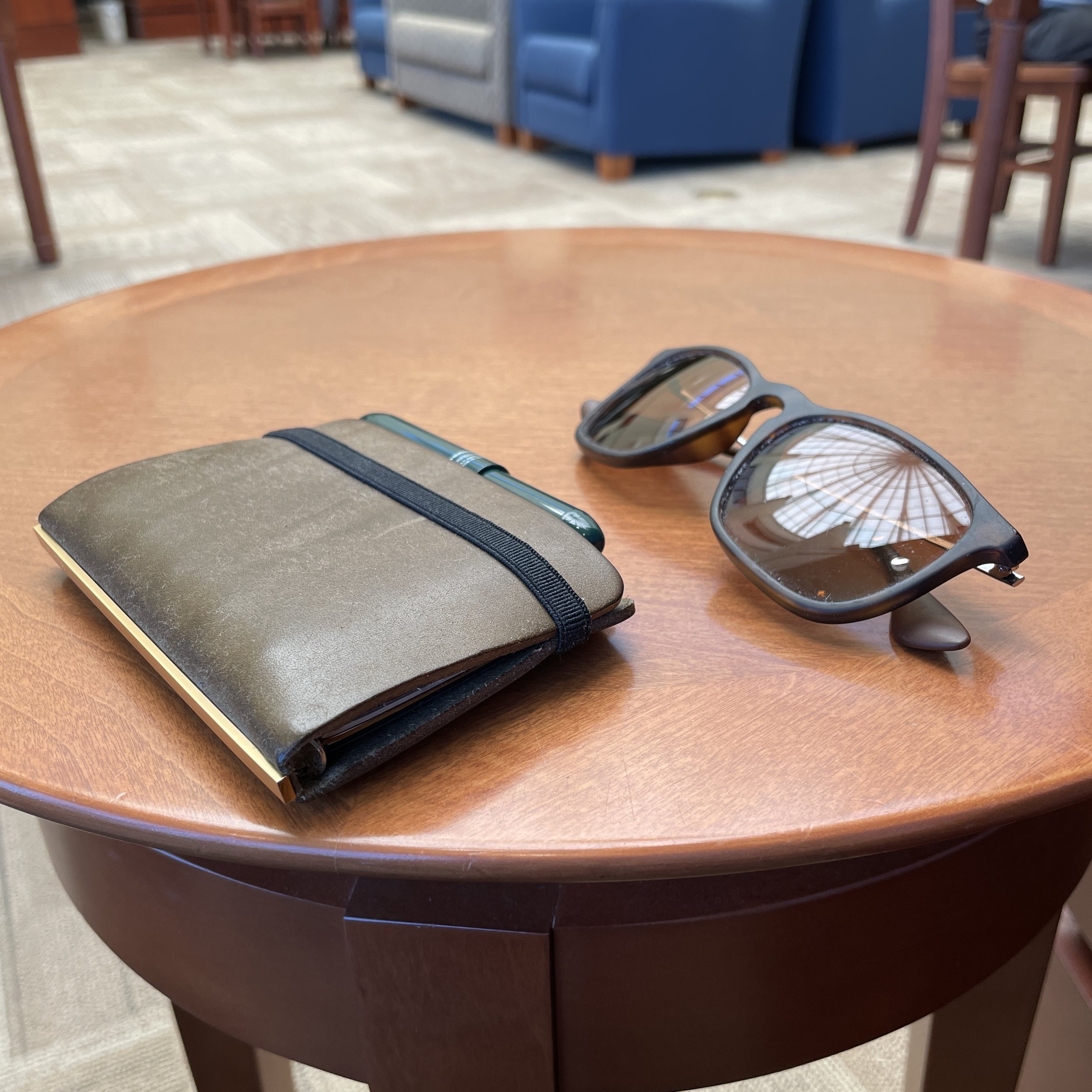
This year I decided to take a minimalist approach and only bring a few pens with me on vacation.

Guide To Notebook Systems: Vacation Week Recap

October 8, 2022

As I mentioned yesterday, I’m currently on vacation, so this coming week the content will be limited. To kick things off I thought I would recap the first three installments of our ongoing series on Notebook Systems. I’ve been extremely happy with the reaction so far to what I hope to be a comprehensive “guide” once completed. These recent posts include:

  • Guide to Notebook Systems, Part I: What Is a Notebook System/System Techo? The first post is an overview of what I consider a “Notebook System” to be, how I use them, and the general goals of the series. Start here!

  • Guide to Notebook Systems, Part II: Plotter Is NOT a Planner. This installment specifically looks at the popular “Plotter” System Techo, which arrived from Japan last year and exploded in popularity at this year’s San Francisco Pen Show. Note that the Plotter store still has stock of the 5th Anniversary Limited Edition Bible Size cover in Olive Green (and other accessories). I received mine literally 10 minutes before I left the house and will be setting it up while I’m away.

  • Guide to Notebook Systems, Part III: Traveler’s Notebook and the “Modular Approach”. The latest installment looks at one of my favorite systems, Traveler’s Notebook, and similar “modular” systems that allow you to combine multiple notebook inserts and accessories with a single cover.

Store Updates and Travel Schedule

I’ll be traveling from Friday, October 7 through Saturday, October 15, so any orders placed during this time will ship upon my return. As always, I’ll plan to include extras in your packages and, oh, what the heck, let’s do 10% off most of our paper brands on all orders placed in the T.G.S. Curated Shop this week. Use the coupon code “VACAY10” to claim your discount!

The Gentleman Stationery is supported entirely by purchases from the T.G.S. Curated Shop and pledges via the T.G.S. Patreon Program. Many thanks for all your support!

In Guide Tags Notebook Systems, Editorial, Guide
Comment

Guide to Notebook Systems, Part II: Plotter is NOT a Planner!

September 24, 2022

Last week’s post, “Guide to Notebook Systems/System Techo, Part I”, offered a brief introduction to different types of notebook systems on the market. One of those categories was the “System Techo,” a Japanese term for a notebook system built around a ringed binder. “System Techo” is not as popular or pervasive in the U.S. as it is in Japan. At one point, Filofax was extremely popular, yet most consider it to be a planner/calendar as opposed to a broader notebook or information management system, and dismiss it as something outdated that they’ll never use. The reality is that ring-based systems can be extremely powerful tools for creativity and organization, especially for those of us who enjoy working on looseleaf paper and notepads but lack a convenient way to organize and archive our ideas. The advantages to a system like this is that you can move around and group together individual pages of notes, as opposed to more modular systems that limit you to bound refills.

With a hole punch, a ring binder can become a powerful tool for collecting and organizing all the ideas many of us collect on random scraps of paper.

What Is Plotter? (Hint: Don’t Write It Off as “Just a Planner System”)

The star of this year’s San Francisco Pen Show was Plotter, a Japanese notebook system that can be used as a planner or organizer, but is actually designed to be something much more open-ended. Since I own three Plotter binders/notebooks, all in different sizes and with different use cases, I plan to walk you through the design of the system, give a brief overview of how it’s intended to be used, and talk a bit about how I’ve been using it in my own life. Whether Plotter is something that could work for you, well, that’s up to you!

Plotter refills and notepads are well designed, and I especially love the bound notepads that can be used as stand-alone notebooks with removable sheets.

The Plotter system is organized around three main components. First, you have the excellent paper, which is DesignPhil’s own proprietary formula, and which I would compare to a slightly thinner version of Midori MD. While certain refills ship in packages of looseleaf sheets, Plotter refills also come bound in pads or notebooks. This convenient design allows you to use the refill as a stand-alone notebook that you can carry with you, tearing out individual sheets to incorporate into your binder as needed. Yes, there is also a diary refill, so you can use your Plotter as a traditional six-ring planner, but that’s not necessarily how the Plotter system was conceived. (More on that below.)

Plotter paper comes in a variety of rulings (dot, lined, grid, and blank), so that you can assemble a notebook with multiple types of paper to use whenever different needs arise.

The second component of the Plotter system is the binder (i.e.,the leather notebook cover). Currently, Plotter users in the U.S. can select from five different sizes: A5, Bible, Narrow, Mini, and Mini 5. The Plotter binder itself is a fairly simple six-ring organizer sold by itself. To build out your Plotter into something that you can personally use everyday, you will use the paper refills and “Accessory Refills” to customize the system. As you can imagine, this is both a blessing and a curse: A blessing because you aren’t necessarily forced into purchasing an overly complex notebook system if all you want is a nice leather binder that holds looseleaf sheets; a curse because if you do want to take advantage of all the (excellent) Plotter components and accessories, you can spend money quickly. For that reason, I would recommend starting simply, purchasing your binder, maybe a set of dividers, and an elastic cord and/or penholder. You can always add more functionality as you go. (Note: Plotter ring spacing is NOT proprietary, so if you have, for example, Filofax refills, dividers, rulers, etc. in the correct size, they should fit your Plotter. Similarly, if you have a Filofax binder and merely want to test out the Plotter accessories and organizational system, everything should fit your existing cover, though no guarantees.)

All Plotter binders feature six rings and a metal bar on the spine. It’s a minimalist design that I find quite attractive.

Finally, the third Plotter component is the “archiving” aspect of the system. Because the Plotter binder is, by design, not necessarily all that capacious, you may need a larger notebook or refill binder to hold spare refills and older notes and other materials that are no longer immediately relevant but that you still want to keep. Plotter does sell a refill binder for archiving, but you can easily use something like a spare six-ring planner with the same ring size. (I have an older Filofax that I’ve been using to hold A5 Plotter sheets and spare refills that don’t currently live in my binder.)

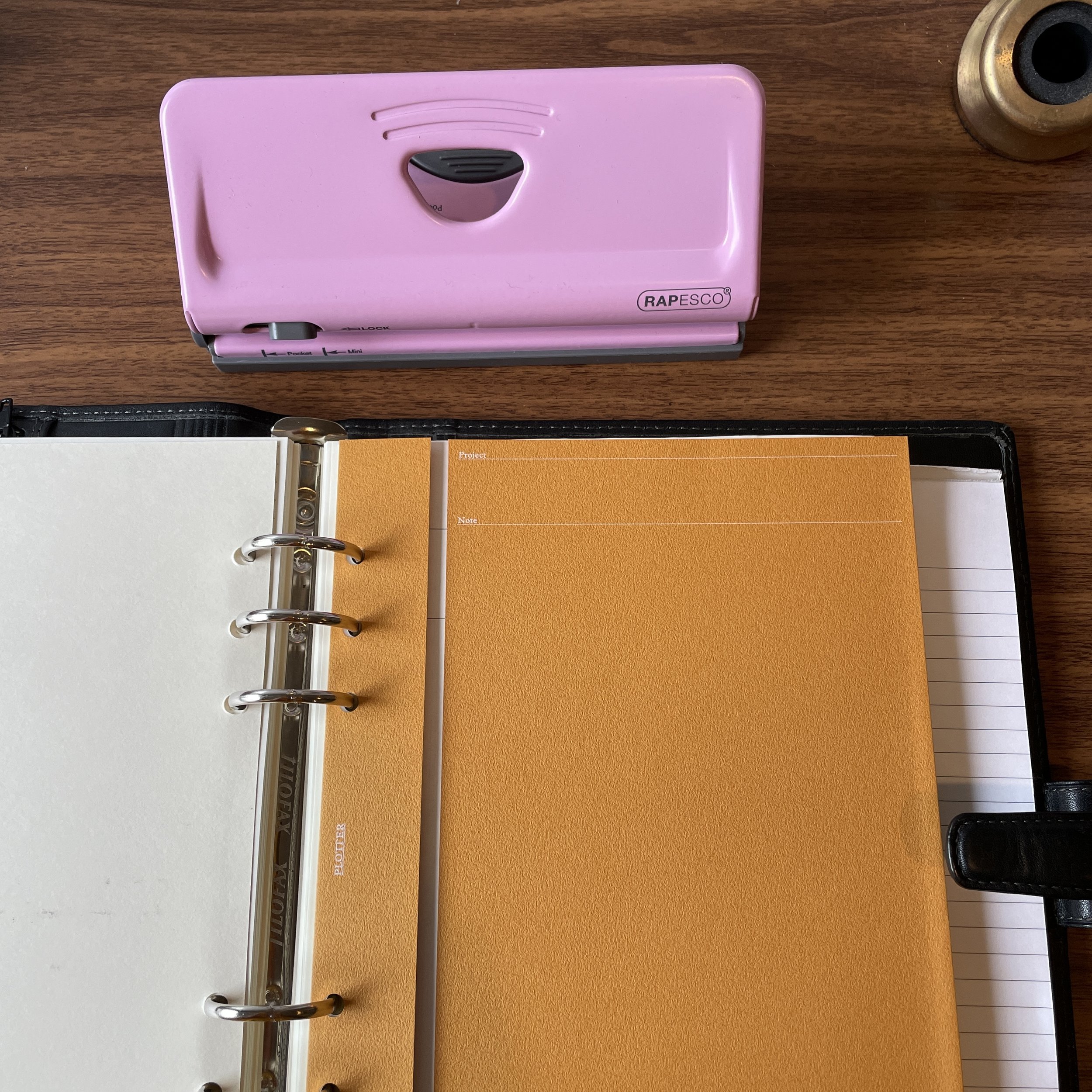
Adding a hole punch (like the inexpensive Rapesco version shown here) will allow you to use paper that you already have on hand. I’m a huge fan of Midori MD Cotton, and I’ve been punching holes in sheets from a standard A5 pad and using it in my Plotter. Also pictured here is the A5 Filofax I use for archiving and refill storage.

How the Plotter System Is Designed to Be Used

To start, there is no “correct” way to use Plotter, or any notebook system or stationery item for that matter. You should incorporate your stationery into your life in a way that works for you, and which will give you maximum utility and enjoyment. That said, there is a specific philosophy informing the design of the system, and when I was at the San Francisco Pen Show last month, I had the opportunity to sit in on a Plotter seminar in which April from DesignPhil (and Penguin’s Creative and Stationery Cafe!) explained the general principles behind Plotter:

  • Facilitating idea capture and note taking

  • Refining your notes and ideas, with a focus on identifying the most essential ideas and/or information to keep on you at all time

  • Providing a flexible, customizable platform that allows you to work creatively in a format that works specifically for you

In other words, the Plotter system was built to make it easy to (1) capture notes and ideas on paper, (2) organize (or at least retain) those ideas in the binder while you develop them, (3) periodically review and revisit your ideas, archiving what you need while disposing of what you don’t. The slim binder design is therefore intentional, encouraging a minimalist approach to notetaking and workflow. This can be a lifesaver for work projects that have a tendency to spiral out of control. How many of you (like me) have notebooks stuffed with months’ or years’ worth of research and meeting notes, of which a dozen or so pages are actually useful to keep long-term?

My three Plotter notebooks: Mini 5 (top); Narrow (center), and A5 (bottom).

How I Use My Three Plotter Notebooks

So who do I think Plotter is for? For someone involved in too many different things (like me) who tends to be kind of scatterbrained (like me) and who works primarily on pads of paper and notepads for the majority of their writing (like me). I’m both an organized and, at the same time, an extremely disorganized person. While I’m generally “organized” in the sense that I do make a regular effort to collect my thoughts related to different projects I’m working on and group them together in some way, I feel disorganized in the sense that I’m seemingly always working on too many things at the same time, often in the same notebook or notepad, and sometimes I’m not sure where the ideas and concepts I’m working on at the time will go, or even whether they ultimately will amount to anything at all. It can feel like I’m carrying around a chaotic mess of paper and it stresses me out. Enter the Plotter as a “creative inbox”, providing just enough structure to keep me sane. I heard someone describe Plotter as “the place to loosely you organize thoughts and ideas until you figure out where they will live long-term,” and that’s an excellent way to describe the system. I have three Plotters:

  • Plotter A5 (My main “inbox,” containing notes for T.G.S. content and other personal research and writing projects)

  • Plotter Narrow (Notes, lists, and ideas relating to T.G.S. business operations)

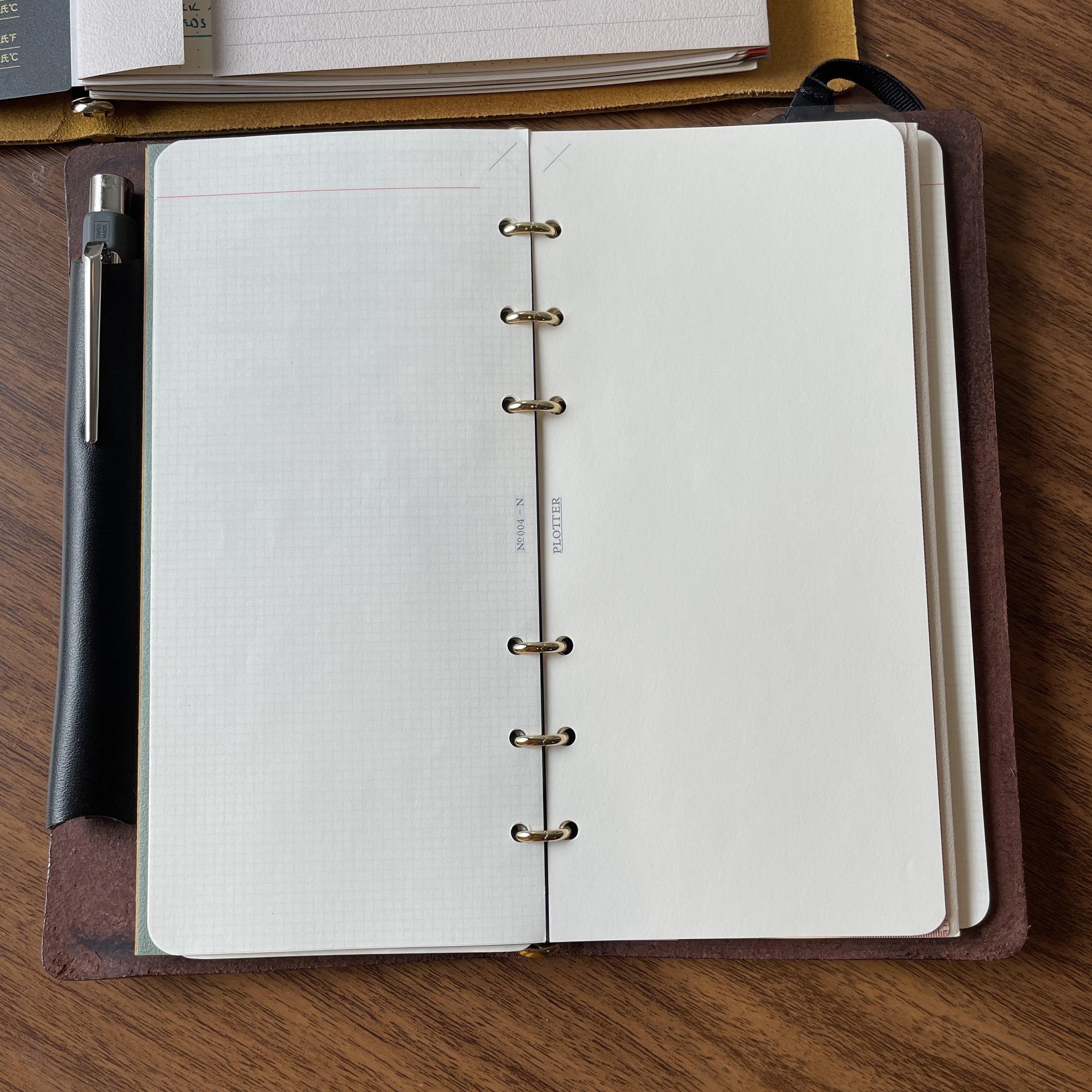
  • Plotter Mini 5 (I use as a wallet and a pocket notebook/jotter that I carry around at all times)

Each of my Plotters includes a handful of “Project Manager” folders, which allows you to organize sheets by topic. The folders themselves are hole-punched, so if you want to devote a folder to a specific project and move it in and out of your binder as you work on it, you can just pull the entire folder and stick it in your archiving system.

Using my own workflow as an example, I typically think of a half-dozen or so ideas for T.G.S content over the course of any given day. I might sketch out the idea on a sheet of A5 paper, stick it in the “TGS Articles” section of my A5 Plotter (grouped with other similar ideas if applicable), and either build the idea out in the Plotter or transfer it to a dedicated notebook or to the computer if it’s something I actually want to publish or incorporate into one of my longer-form writing projects. Every so often, I’ll review the notes in the Plotter and decide whether they warrant archiving or recycling, if they don’t seem like something I’ll be working on in the near future.

My Plotter Mini 5 goes everywhere with me. This particular notebook is used less for content management than for lists and reference notes that I want to have on me at all times (lists of books to check out from the library, pens I’m looking for at shows, etc.), as well as just a general purpose jotter with removable pages.

Takeaways and Where to Buy

Plotter offers flexibility in a convenient and elegant format, and I personally enjoy using this system more than other ringed organizer systems I have tried. I own three different Plotters, and have been using one of them for well over a year, so for me it has staying power. Over the past month, I’ve seen my Mini 5 notebook in particular become a core piece of my everyday carry, and my A5 Plotter also sees daily use. While Plotter is not an inexpensive system to buy into, as long as I actually continue to use the Plotter regularly over a multi-year period, it will be well worth the money spent. The refills themselves are not actually that expensive, and priced commensurately with other paper products of similar quality, so any expense is mainly associated with the initial setup.

If I had to recommend that new Plotter users purchase one accessory, it would be one of the “lifters” with either a pen loop or an elastic band. The “Lifters” can be placed anywhere in the notebook to serve as either a divider, or as a pencil board or firm surface for writing. For a discussion of which pens fit the Plotter, see this post.

Currently, Plotter can only be purchased through the Plotter USA store, which recently restocked after selling out in the wake of the post-San Francisco Pen Show hype. Binders range anywhere from $96 to $250, depending on the size and the type of leather you select. Looseleaf refills are generally priced in the $6 to $8 range, and Plotter-branded stand-alone notebooks and A4 writing pads are priced at $18. (Tip: you can punch an A4 sheet across the top and fold it in half to include in an A5 binder.) Accessories such as the penholder and elastic “lifters,” project manager dividers, etc. range from $6 to $15, approximately.

Again, the Plotter system is not inexpensive, but these prices are comparable both to other binder systems (like Filofax) and high-end Japanese leather notebook covers such as those from Midori. Moreover, the cost of a $250 notebook setup that you wind up using all-day, every day for years vanishes into the background pretty quickly. That said, anything can - and should - be considered “too expensive” if you never use it.

System Techo can be a powerful tool for those who like to work on multiple projects within a single binder, and value the flexibility to move around individual sheets of paper. In the coming weeks, we’ll be looking at other notebook systems that use different refill options and are built around different philosophies.

Disclaimer: I purchased the A5 and Mini 5 Plotters with my own funds at full price, though I was gifted the Narrow version a year ago as part of Plotter’s U.S. market testing. I was not compensated for this review and this post does not contain any affiliate links.

In Notebook Review, Editorial, Guide Tags Notebook Systems, System Techo, Plotter
6 Comments
← Newer Posts Older Posts →
Store Hours and Location
Visit the T.G.S. Curated SHOP
Updated "Best Pens" Guide
On the Paper Trail Podcast
TGS x Roterfaden TGS_25
Hierarchies of Fountain Pen Friendly Paper

Join Our Patreon!
Subscribe to the TGS E-mail List

Featured Posts

Featured
Cover On the Paper Trail Intro Clip.jpeg
Dec 3, 2025
Introducing "On the Paper Trail," a New Podcast/Video Collaboration with Lisa Vanness of Vanness Pens!
Dec 3, 2025
Dec 3, 2025
Iro-Utsushi-Fine-Dip-Pens.jpeg
Oct 1, 2025
The Pilot Iro-Utsushi Dip Pen (and in General, Simple vs. Fancy Dip Pens)
Oct 1, 2025
Oct 1, 2025
Levenger-Annotation-Pad.jpeg
Sep 20, 2025
Five Boutique Paper Brands I'm Watching Closely and Why
Sep 20, 2025
Sep 20, 2025
The Gentleman Stationer RSS

© Digital Divide Media, LLC, 2014-present.

All content is the exclusive property of Digital Divide Media, LLC, d/b/a The Gentleman Stationer, including “The Gentleman Stationer” website and trademark, and should not be reproduced without express written permission.  All rights reserved.

All content containing paid advertising, affiliate links, or sponsored content will be plainly disclosed by a disclaimer when/if featured.

Contact Information

Store Shipping Policy and Return Policy

Privacy Policy

Cookie Policy

Terms and Conditions

Powered by Squarespace