• Blog
  • Shop
  • Resources
  • FAQ (Ask TGS)
  • About
  • Archive
  • Contact
  • Sign In My Account
Menu

The Gentleman Stationer

Vintage Living in the Modern World.
  • Blog
  • Shop
  • Resources
  • FAQ (Ask TGS)
  • About
  • Archive
  • Contact
  • Sign In My Account

New Notebook Alert: Yoseka Stationery

September 11, 2019

My friend Cary Yeager - of both Fountain Pen Day and Kenro fame - introduced me to this notebook at a pen show earlier this year. I can’t remember exactly which one, but I believe it was the Arkansas Pen Show in Little Rock. A few weeks later, this sample notebook showed up in the mail from Yoseka Stationery, and I have to apologize for how long it’s taken me to do a review, especially since this is such an interesting product. Cary explained to me that the owners of Yoseka Stationery had just opened a brick-and-mortar shop in Sunnyside, Queens, and had designed this notebook from scratch after sourcing the paper from Taiwan.

You can read the full description here on the Yoseka website, but in short this notebook contains 85gsm “KBU2” paper from Conifer, a Taiwanese company that has been around since 1955 and apparently experiments quite a bit with different paper properties. Yoseka chose this particular paper because “it encourages a quick dry and it perfectly reflects the sheen of the pen ink with minimal bleeding.” Since the paper is fairly absorbent, it does dry quickly, with no smearing once the ink is dry - something those who love “sheeny” inks will appreciate since many of those tend to smear even days later.

I had minor issues with bleed-through in the Yoseka notebook, but I’m beginning to suspect that the primary culprit is one particular ink (Lamy Crystal Peridot), which has been temperamental on several different papers. I experienced serious bleed-through with that ink on a Rhodia pad.

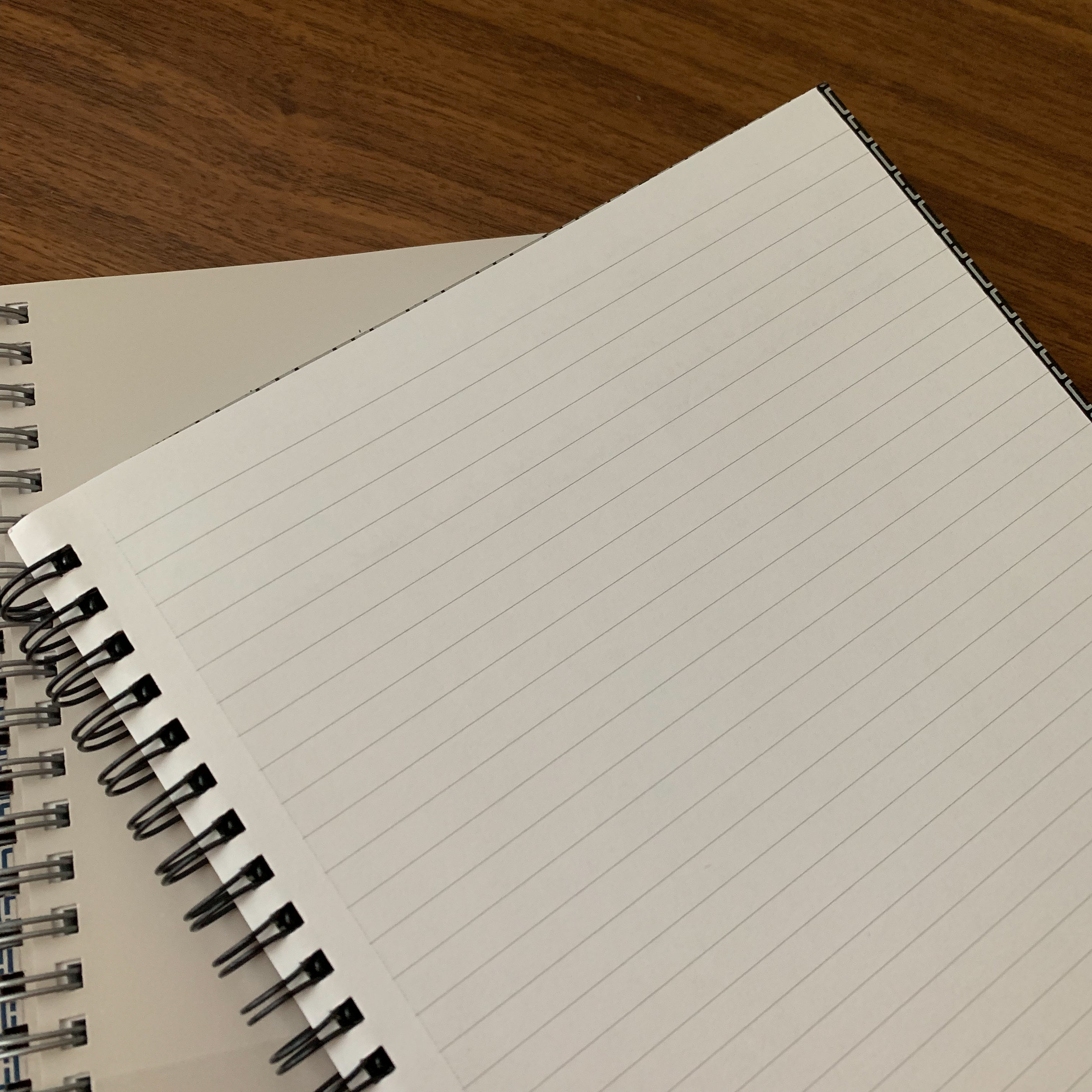
The design of the notebook itself merits some discussion. Yoseka uses a plain “cement grey cardboard hardcover”, which reminds me of the thick chipboard covers used on the Doane Paper notebooks, as well as a “naked binding” that shows off the stitching and gluing. Yoseka describes the cover and binding as “durable,” but that characterization will, of course, depend on how hard you use your notebooks. Fans of minimal design will like the look, and the binding allows the notebook to lay completely flat.

A true lay-flat binding!

Takeaways and Where to Buy

Yoseka Stationery makes a nice notebook featuring a simple design and durable construction. This notebook also contains a lot of paper, which should handle most fountain pen inks relatively well and show off any inks that sheen. I’d offer a note of caution for those who anticipate writing on both sides of the page with very wet nibs and inks, as you might experience a touch of “pinpoint” bleedthrough (pictured above). Otherwise, this notebook should meet most people’s needs, and generally has been well-received by fountain pen users.

You can purchase the Yoseka Notebook directly from Yoseka Stationery in Queens, New York, either via their online store or in person at their brick-and-mortar location in Sunnyside. It’s reasonably priced at $20, and I definitely plan to make a visit when I’m in New York City next month (along with visits to my other favorite NYC stationery shops)!

Disclaimer: The notebook featured in this review was sent to me free of charge by Yoseka Stationery. Many thanks to them for making this review possible!
In Notebook Review Tags Notebooks, Yoseka Stationery, Yoseka, Taiwanese Paper, Notebook Review
Comment

My 2019 Journaling Setup: Nanami Paper Cafe Note and Midori 5-Years Journal

July 17, 2019

I was on the Hobonichi Techo bandwagon for a while, using everyone’s favorite A6 Japanese planner as a one-page-a-day journal. I actually have three of them filled up from 2016-2018. Although I liked the Hobonichi, I wanted something slightly less structured, that offered me the flexibility to write more than a page on one day, and sometimes skip a day with less “journaling guilt.” Some days absolutely nothing of note happens, right, much less nothing that justifies wasting a full page of precious Tomoe River!

Enter the Nanami Paper Cafe Note B6. I’ve long enjoyed the Nanami Paper Seven Seas series, both the original “Writer” and the “Crossfield,” but a couple years back they released the “Cafe Note,” which is a smaller Tomoe River notebook measuring roughly 4 x 7 inches in what is referred to as the Japanese “Shinsho” size. You can read more about the background of the notebook on the Nanami Paper website, but what’s notable is that this size book was “created for rail commuters that spend a lot of time standing in trains and hanging out in cafes between trains or after work.” In other words, if you’re looking for a highly portable notebook that’s easy to slip into a bag and write with in a coffee shop, on a train or airplane, or anywhere else space is at a premium, consider the Cafe Note.

Small grid ruling with lots of boxes for organizing/summarizing notes? Count me in.

This layout works much better for me than the A6 Hobonichi. For starters, I appreciate that the Cafe Note is rather long and narrow, like these hardback Kunisawa “Find” notebooks, since I do much of my writing and note-taking in list or bullet format. Some people dislike the boxes at the top and bottom, but I find it convenient for organizing my notebook entries by date and topic. Finally, the grid/graph ruling is pretty small, but I have small handwriting so it works for me. Nanami Paper makes a lined version if grid isn’t your thing.

At the end of the day, I did miss having a classic diary or “daily journal” to record the mundane happenings of life. For Christmas my family gave me a Vanness gift card, which I cashed in on a Midori 5-Years Diary. To me, the beauty of this particular journal is how easy it is to use consistently. There’s a page for each day of the month (including February 29 for those years), with each page broken down into five sections containing five lines each. I don’t care how boring the day was, you can always find one thing to record, and I recall that after I had used my old Levenger 5-Year Journal for a few years it was quite enjoyable to write each day’s entry and see exactly what I was doing and/or thinking one or two years earlier. I don’t have a perfect record of daily entries, but I’ve been pretty good so far.

Noticing a trend here, size-wise?

Takeaways and Where to Buy

This particular setup has worked well for me in 2019, and in all likelihood I will continue it next year. The great thing about the Midori 5-Years Diary is - wait for it - that you only have to purchase it every five years, and the Nanami Paper Cafe Note has so many pages that it will also last you a long time. I do use an annual paper planner, the Jibun Techo 3-in-1 A5 Slim, for tracking tasks and logging things, but I plan to hold the review on that particular tool until the 2020 versions are released in the Fall.

I purchased my Midori 5-Year Diary from Vanness Pens, and it comes with either a red or black cover. At first glance, it’s not inexpensive at $42, but then again you’re only purchasing the Diary once every five years, so that’s $8 annually. The Nanami Paper Cafe Note “Slim B6” can be purchased directly from Nanami Paper, priced at $18, which to me represents an exceptional bargain given that you’re getting 384 pages of Tomoe River Paper. A ruled version is also available. If you’d like to add the Gfeller natural leather cover shown in my pictures, you can purchase it separately for $68.

Disclaimer: This post contains links to paid sponsors and affiliates.

In Planner, Notebook Review Tags Journal, Nanami Paper, Midori, Midori 5 Year Diary, Nanami Cafe Note, B6 Notebook, Notebooks
Comment

Kickstarter Alert: Tomoe River A5 Cahier by Pebble Stationery Co.

June 25, 2019

Many readers of this blog backed the first Pebble Stationery Kickstarter, for their Pocket Tomoe River notebooks. Now Pebble Stationery Co. is back with a new project: larger A5 notebooks that pack 120 pages of ultra-thin, fountain pen friendly Tomoe River paper into a slim, understated notebook that Pebble describes as “designed for busy professionals who would like a lot of pages, but don’t want to drag around a large notebook, particularly commuters and mobile office/hot desk type set ups.” I particularly like the idea of this notebook as a potential insert for portfolios like the Galen Leather A5 Zipfolio or the Bellroy Workfolio. With the Tomoe River paper, you will get a larger page count than if you used a standard softcover, slim A5, and I appreciate the understated branding and demure linen-weave finish on the grey cover. The paper is dot grid - a personal favorite!

Visit the Pebble Stationery Co. Kickstarter page to check out this project, and if you’re interested in purchasing the original pocket notebooks, they are available for sale on the Pebble Stationery website. This particular Kickstarter has a tight two-week time frame, so if you’re interested, you’ll have to back relatively quickly (unless you don’t mind waiting for these to hit stores). Many thanks to Lois at Pebble Stationery for supplying the production sample pictured here!

Disclaimer: Pebble Stationery Co. sent me the notebook pictured here free of charge. I have not otherwise been compensated for this post.

In Notebook Review Tags Pebble Stationery, Tomoe River, Notebook Review
2 Comments

New Product Alert: Staples TRU RED Notebooks

May 15, 2019

Staples surprised me a couple of weeks ago by reaching out and asking whether they could send me some products to review from their “TRU RED” lineup, which ended up including two spiral-bound notebooks and an assortment of gel pens, permanent markers, and highlighters. Knowing that Staples has, in the past, been capable of sourcing inexpensive, relatively fountain pen-friendly paper, the notebooks interested me the most. On the whole, I wasn’t disappointed, and one notebook was excellent, though I predict there will be inconsistency in paper performance for those who want to exclusively use fountain pens or wet rollerballs in these notebooks.

The inside of each TRU RED notebook features a “catch-all” folder, which I find useful for work.

The TRU RED notebooks come in both softcover and hardcover variants, in medium and large sizes. Both notebooks sent to me by Staples were mediums (6.5” x 9.5"), which roughly equate to an A5 size. These spiral-bound notebooks look and feel premium-quality and durable - the hardcover notebooks feature a heavy chipboard cover, while the “softcover” versions sport a flexible plastic cover similar to what you would find on a Miquelrius notebook. The double spiral bindings feel like they will hold up in a bag, and haven’t bent despite some rough treatment.

The covers are thick and durable, and the double spiral binding should hold up well.

The paper is a mixed bag, and the packaging on these notebooks doesn’t provide much specific information other than that they are made in Taiwan. (The only information regarding weight, etc. is the designation as “Premium Heavyweight Paper,” which the Staples website indicates is 27-32 lbs.) Staples offers several different ruling options, including narrow (college) ruled, blank, “meeting”, and “project”. I’d personally love to see dot grid, but I’ll happily use a ruled notebook as long as the ruling is narrow enough. The best part? Perforated pages. For the notebooks I use at my day job, I need to be able to shred/scan/file notes, and the ability to easily remove pages is essential.

The first notebook I tested (the softcover) performed exceptionally well with fountain pens.

Not a hint of bleedthrough - or even show-through - on the reverse, despite the fact that I was using a very wet medium gold nib with an ebonite feed!

Not a hint of bleedthrough - or even show-through - on the reverse, despite the fact that I was using a very wet medium gold nib with an ebonite feed!

So what about paper quality? Well, it’s a bit of a mixed bag. The first notebook I opened (the softcover) had me really excited, because the paper was excellent, showing zero bleedthrough or feathering even with very wet fountain pen nibs. That initial thrill was tempered a bit when I tested out the hardcover notebook, because the paper - while OK - wasn’t nearly as good as the paper in the softcover notebook, despite the softcover notebook costing less money and nothing on the label to indicate that the two notebooks contained different paper. To me, the discrepancy in performance suggests batch variability, meaning that Staples is purchasing the paper for these notebooks from multiple sources, which makes perfect sense given the numbers. If you’re producing tens of thousands of these things, it’s unlikely that a single paper supplier will be able to meet demand.

On the hardcover notebook, the paper bled through, especially with a stub nib fountain pen, though it remained well within my “zone of usability” for everyday work purposes.

Good thing I don’t write with a stub nib at my day job.

Takeaways and Where to Buy

It’s hard for me to offer a single verdict on the “TRU RED” notebooks given the inconsistency in how the paper behaves, but on the whole I will say they are good for the price point. I’ll probably run by Staples this weekend and pick up one or two more of the black softcover notebooks, and if the paper is consistently good in that version, stock up because it’s some of the best inexpensive fountain pen-friendly paper I’ve used recently. Regardless, I’d wouldn’t hesitate to pick up more of these notebooks for work purposes, especially given the durability, professional look, and the attractive $9.99 price point for the medium softcover.

You can purchase these notebooks at Staples, either in their brick and mortar stores or online. Though it looks like the promotion ends today, Staples is currently offering a coupon code for 15% off purchases of $75 or more from their “Business Essentials” line. I have a few more of these products queued up for review, so stay tuned!

Disclaimer: Staples provided me with the notebooks featured in this review free of charge, for review purposes. I was not otherwise compensated for this review.

In Notebook Review Tags Notebook Review, Spiral Notebook, Staples, Tru Red
2 Comments

Journal Review: Trigg Life Mapper

December 15, 2018

I’m going to go ahead and call this a “journal review” to dispel any illusion about what I feel is a common misconception about this product: that it’s a “daily planner” intended to be carried around as a calendar replacement. No, the Trigg “Life Mapper” is what the company describes as a “productivity and mindfulness diary that transforms your goals into success,” by bringing “planning, habits, and mindfulness to a full journal format.” In other words, it’s a journal designed to guide your periodic (yearly, monthly, weekly, daily) reflection on your personal and professional goals, not to track your schedule. The Life Mapper has generally been favorably received, winning awards including “Best Diary” at the 2018 UK Calendar awards (which may have contributed towards some misconceptions about the product), and “Best New Product” at the 2017 London Stationery Show.

Sure, there’s an annual calendar at the front, but as you can see it’s for big-picture stuff only (unless you write really small).

So Who Is The Targeted Audience for the Trigg and How Does This Thing Work?

The Life Mapper has been around for a few years, and was originally a Kickstarter project designed, and since tweaked, with input from the internet productivity community. If you follow productivity blogs and podcasts (which I’ll admit to dabbling in), you will recognize many of the goal-setting and “life mapping” concepts from books like Getting Things Done, The Seven Habits of Highly Effective People, The One Thing, and others. (By the way, another excellent online resource organized around of many of these same ideas is Shawn Blanc’s “The Focus Course,” especially if you’re looking for a more open-ended tool than the fairly rigid, condensed Life Mapper.)

The front section of the Life Mapper has a section to set annual, big-picture goals in each of four broad categories: self, work, passion, and relationships.

The Life Mapper uses the following process, summarized at a very high level:

  • Annual Forecast. At the beginning of each year, you do an “annual forecast” or planning session and set “big picture” goals for what you want to accomplish.

  • Goal-Setting and Progress-Tracking. Using the Life Mapper, you put these goals into four categories, which Trigg labels “Self,” “Work,” “Passion,” and “Relationships.” You set annual and weekly sub-goals, using the weekly and daily planning pages to make progress towards the “big picture.”

  • Regular Reviews. Periodically take stock of your progress. The Life Mapper includes sections for six-month and year-end self-assessments, though you can do this as often as you want.

The daily layout in the Trigg Life Mapper, which includes an inspirational quote or productivity tip, a space to organize tasks and goals in order of urgency, a section for “appointments,” and a blank space for open-ended writing/reflection/notes.

I’ve obviously not had time to work my way through the “process” set out in the 2019 Life Mapper, but I’ve used similar productivity techniques in the past and found that they do tend to work for me. The year that this blog really took off was actually the year that I was pretty strict in terms of setting goals and benchmarks for my writing and regularly tracking my progress. If you juggle multiple side hustles, or work in a job where you have to track multiple projects and/or develop new business and manage relationships with multiple long-term clients, you might find the techniques reflected here helpful. Even if you don’t adhere to the somewhat rigid structure set out in the Trigg, any sort of process that forces you to distill and refocus on those tasks and goals that are truly important (as opposed to a lot of the busywork that fills our days) can be quite useful, and even powerful.

In the middle and at the end of each year, the Trigg Life Mapper contains a section where you can assess your progress in the various categories.

So enough about productivity. How does the Trigg Life Mapper work as a stationery product? For starters, the 90 gsm paper is great. I tested a few fountain pens in the blank pages at the back, including one very wet stub nib, and while the paper is absorbent there was no bleed-through or feathering. The binding also appears durable, and I can see this sturdy book easily lasting a year, even if you lug it around with you day-to-day.

A few additional observations, both pros and cons:

  • Each daily page features a productivity tip or motivational quote, something I really enjoyed from my time with the Hobonichi Planner.

  • While I like the embossed design on the front, I do wish there were additional color schemes other than the turquoise/yellow.

  • While you can interpret the four categories however you want, based on your own personal goals and objective, I would have liked a couple of open categories to add a bit more flexibility, though this is likely impractical given that it would add bulk to an already thick journal.

  • The “Appointments” section on the daily page seems a bit incongruous. The Life Mapper clearly isn’t a calendar, and if an appointment is important enough to write down here, I would think that it would fall within the urgent/non-urgent task boxes. The extra space could have been used for more open “journaling” space (though of course you can just ignore the “appointments” section and do this anyway).

The Trigg Life Mapper is one thick notebook: check it out compared against a Baron Fig Confidant in leather cover!

Takeaways and Where to Buy

I’m the target audience for the Trigg Life Mapper, so I like the product. I may even use it this year, since it dovetails with the type of planning and goal-setting I do already. That said, it’s not for everyone, and if you’re considering making a purchase you should be aware that it’s a very structured product, unlike something like the Hobonichi Techo.

You can purchase the 2019 Trigg Life Mapper directly from Trigg. They have an Etsy Store as well, and The Gentleman Stationer is an Etsy affiliate, so if you’d like to help support the blog one easy way to do it is to purchase via my affiliate links, with no added cost to you. Either way, the price looks to be around $40 US shipped. I would get your order in soon to ensure delivery by January 1, especially if you are outside the UK, where Trigg is located.

Disclaimer: Trigg provided me with the journal featured here for review purposes, free of charge. This post contains affiliate links.

In Paper Products, Notebook Review Tags Productivity, Trigg Life Mapper, Trigg, Journal, Notebook Review
Comment
← Newer Posts Older Posts →
Store Hours and Location
Visit the T.G.S. Curated SHOP
*New* Updated "Best Pens" Guide (2025)
T.G.S. 2025 Holiday Gift Guide
TGS x Roterfaden TGS_25
Hierarchies of Fountain Pen Friendly Paper

Join Our Patreon!
Subscribe to the TGS E-mail List

Featured Posts

Featured
Cover On the Paper Trail Intro Clip.jpeg
Dec 3, 2025
Introducing "On the Paper Trail," a New Podcast/Video Collaboration with Lisa Vanness of Vanness Pens!
Dec 3, 2025
Dec 3, 2025
Iro-Utsushi-Fine-Dip-Pens.jpeg
Oct 1, 2025
The Pilot Iro-Utsushi Dip Pen (and in General, Simple vs. Fancy Dip Pens)
Oct 1, 2025
Oct 1, 2025
Levenger-Annotation-Pad.jpeg
Sep 20, 2025
Five Boutique Paper Brands I'm Watching Closely and Why
Sep 20, 2025
Sep 20, 2025
The Gentleman Stationer RSS

© Digital Divide Media, LLC, 2014-present.

All content is the exclusive property of Digital Divide Media, LLC, d/b/a The Gentleman Stationer, including “The Gentleman Stationer” website and trademark, and should not be reproduced without express written permission.  All rights reserved.

All content containing paid advertising, affiliate links, or sponsored content will be plainly disclosed by a disclaimer when/if featured.

Contact Information

Store Shipping Policy and Return Policy

Privacy Policy

Cookie Policy

Terms and Conditions

Powered by Squarespace