• Blog
  • Shop
  • Resources
  • FAQ (Ask TGS)
  • About
  • Archive
  • Contact
  • Sign In My Account
Menu

The Gentleman Stationer

Vintage Living in the Modern World.
  • Blog
  • Shop
  • Resources
  • FAQ (Ask TGS)
  • About
  • Archive
  • Contact
  • Sign In My Account

Notebook Review: Oxford USA Hardcover Journal

December 18, 2019

Those of you who spent your youth (and let’s be honest, still spend their adulthood) stalking the aisles of stationery stores will probably be familiar with Oxford, a brand with a reputation for making high-quality stationery that’s attractively priced and widely available. A representative for Oxford’s parent company reached out several weeks ago to ask whether I’d be interested in reviewing their new hardcover notebook/journal. Oxford has partnered with Monadnock, one of the oldest family owned and operated paper mills in the U.S. According to the contact who sent me the journal, this book is entirely sourced, printed, and bound in the U.S.A.

Since this journal is bound like a regular hardcover book, it won’t lay flat, but it’s sturdy and will last for quite some time.

The Oxford USA Journal contains 192 pages of the aforementioned Monadnock paper, in a Smyth-sewn binding with a charcoal grey, hardback linen cover embossed with an American flag logo. It has a sturdy, well-made feel to it, and the super-picky among us will be glad to know that the end of the ribbon bookmark appears to be heat-fused to reduce fraying. It’s a tastefully designed notebook/journal that I would have no problem carrying anywhere, including at work.

A bit more background information is included inside the back cover.

But of course, as with any higher-end notebook, what everyone wants to know about is how the paper performs with various inks and fountain pen nibs. The answer: Surprisingly well, and better than expected. I tested the paper with a Retro 51 rollerball (.7mm Schmidt refill), a Lamy 2000 EF nib, and a Sailor fine nib, and while there was some show-through with very minor bleed-through, I could still use both sides of a page. A wet Graf von Faber-Castell medium nib pushed the paper a bit too far, and feathering/bleed-through became an issue. If I had to make a comparison, I would equate the performance to the heavier-grade paper used in certain Field Notes editions like “Lunacy” or “America the Beautiful.”
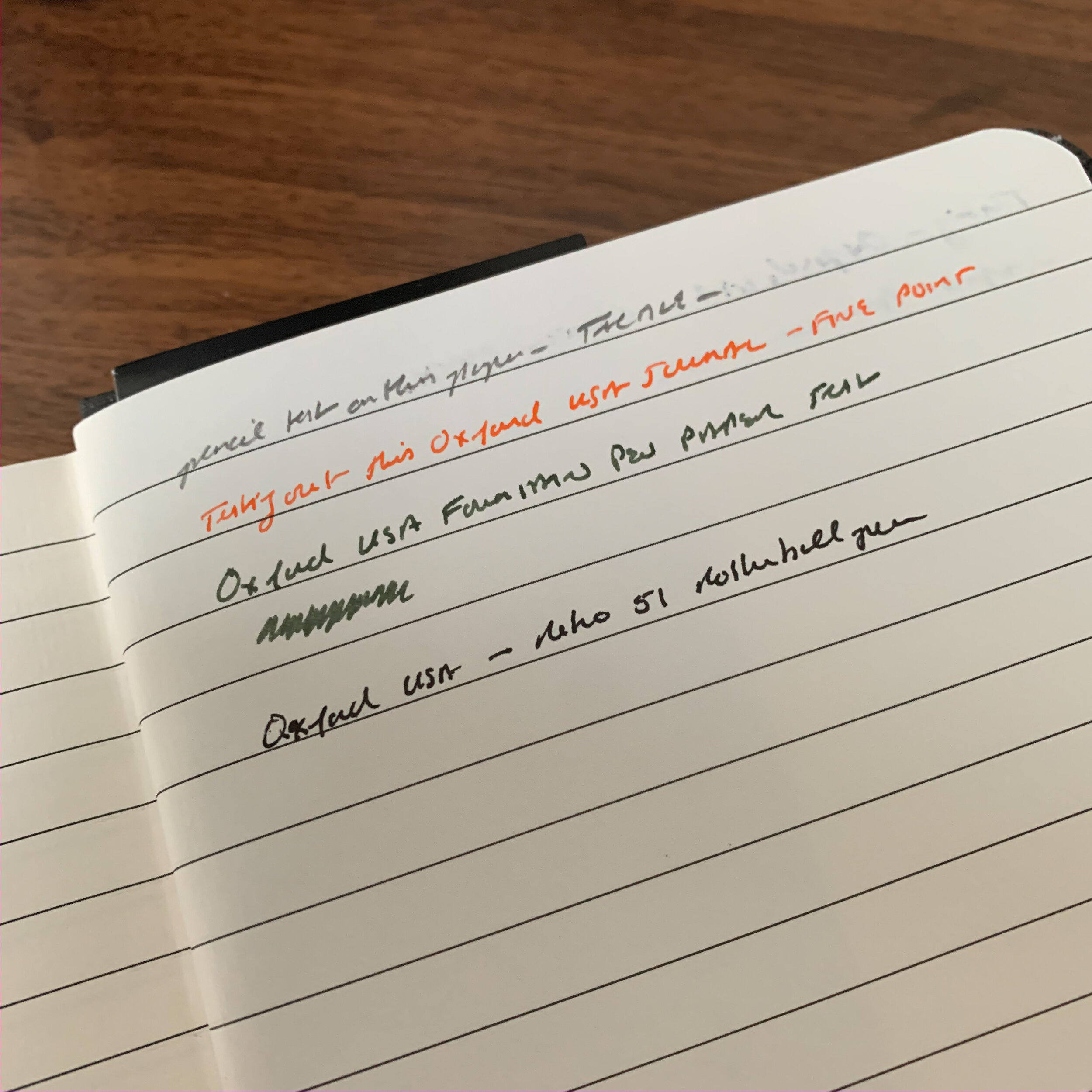
View fullsize Writing Sample
View fullsize Writing Sample: Reverse Side

Takeaways and Where to Buy

Oxford apparently shares common ownership with TOPS stationery (maker of the famed “Double Docket” legal pad), which makes me hopeful that this notebook will receive a wide release. If this journal were to appear at Staples, Target, etc., I’d venture that it would do really well. The cover feels solid and the paper will meet the needs of the overwhelming majority of people. I do wish the ruling were slightly narrower and not quite as dark, but that’s a personal preference.

Currently the only place I’ve been able to locate these notebooks for sale is Amazon, and even there they appear to be sold through third-party office supply wholesalers. Priced at just under $20 (shipping included), this seems reasonable for a quality hardbound notebook. I plan to keep my eye out for this notebook in stores in the coming year. Curiously, these books are not yet featured on the TOPS website, which leads me to believe that they have not yet officially launched. Many thanks to Oxford for sending me this product and making this review possible!

Disclaimer: Oxford USA sent me this journal for review purposes, free of charge. This post contains affiliate links.

In Notebook Review Tags Notebooks, Oxford USA
1 Comment

Notebook Review: Filofax Notebook and Clipbook

December 11, 2019

Last week I reviewed some new products from Letts of London, and in that same shipment I received a couple of samples from Filofax, Letts’ sibling brand. I’ve been a regular Filofax user over the years - their A5 organizer was my go-to organization system through college, law school, and for the first few years of work after graduation. I fell away from the Filofax as most of my professional calendaring went digital, and my binder-style paper planner was replaced by books like the Hobonichi Techo, which I would use more as a journal.

Filofax Notebook in “Architexture” cover, A5 size.

Presumably sending shifting trends, Filofax has evolved as a company over the past decade. In addition to their classic organizers, they have launched a series of notebooks that not only feature extremely high-quality paper but are flexible in how you can use them. Taking a cue from disc-bound notebook systems such as Levenger Circa or Staples Arc, the Filofax notebooks feature “movable” pages that can be rearranged within a sturdy wire binding. The 100gsm paper feels and performs similar to Rhodia, and is available in blank, dot grid, lined, and graph rulings. The key selling point of this notebook system is its flexibility over the traditional Filofax organizer: you can certainly use it as a dated planner if you want (Filofax sells “Diary” refills), but I would envision using the included dividers as a way to organize research notes for a work project or a longer piece of writing. Since the notebook is a standard A5 size, you can use Filofax’s proprietary punch to clip in notes from your own A5 notepad. (Other sizes are available, though you’ll have to purchase A4 from Europe as it appears the U.S. store doesn’t carry it.)

For those who prefer the traditional Filofax six-ring binding, Filofax also sells the “Clipbook,” a similar product with a flexible structure but only 80gsm paper, which won’t work as well for my own personal use. While liquid ink pens such as fountain pens and rollerballs work ok, you will see some minor bleedthrough and feathering. That said, if you already have a Filofax Organizer and the “punch” accessory, you know that you can create your own paper refills using whatever paper you prefer.

Filofax Clipbook in A5. While some people might be sold on the ringed-binder system, I definitely prefer the more streamlined look of the Notebook.

The Clipbook binding will look familiar to devoted Filofax users.

While I found the 100gsm Filofax Notebook paper superb, the standard 80gsm paper in the Clipbook does not hold up as well to fountain pens.

Takeaways and Where to Buy

Of these two products, the Notebook is the clear winner for me. The 100gsm paper handles fountain pen ink quite well, and Filofax’s “movable” page system is more convenient than disc-bound notebooks, since the Filofax binding covers the back of the binding and you don’t have the discs sticking out and at risk of coming loose in your bag. Though the Filofax Notebook does not allow you to upgrade the size of the notebook by substituting in a higher-capacity binding, in my experience these sort of moveable-page notebooks become unwieldy to the point of being unusable once you pass a certain point. (It becomes nearly impossible to flip through the notebook without pages falling out.) Thus, I don’t feel that I would be losing anything by moving to the Filofax Notebooks over a Circa or an Arc, which do let you substitute in bigger discs if you need them to hold more paper.

Filofax Notebooks are available in A4, A5, Executive, Letter, and Pocket sizes, ranging from roughly $14-26, depending on size and design. The “Architexture” A5 Notebook pictured here is priced at $23.95 and comes with 56 sheets of ruled paper, four dividers and a ruler included. The Clipbook is more expensive, with the A5 version shown here priced at $29.99 and larger sizes priced at $49.99 or more. All products can be purchased directly from Filofax. For whatever reason, the 100gsm Notebook paper is less expensive than the 80gsm paper sold for the Clipbook: A5 notebook refills cost $4.99 for 32 sheets, whereas the A5 Clipbook refill costs $5.39 for 30 sheets. If you’re planning to invest in this system for the long run, however, by far the most economical choice would be to purchase a Filofax notebook punch and make your own refills.

Disclaimer: Filofax sent me the two notebooks featured in this review free of charge, for review purposes. I was not otherwise compensated for this review. Many thanks to Filofax for making this review possible.

In Notebook Review Tags Notebooks, Discbound Notebooks, Filofax, Notebook Review
Comment

Notebook Review: Updated Notebooks from Letts of London

December 4, 2019

I have a penchant for classic stationery design. On the notebook front, any sort of leather or hard-bound notebook with gilded pages immediately gets my attention, and if the notebook is fountain pen friendly it’s a no-brainer. Letts of London - a UK stationery brand that is now under the same ownership as Filofax - has always appealed to me from a design standpoint but the lack of US availability and a reputation for simply being “ok” for fountain pens kept them off my radar.

Recently, that has changed. Letts was kind enough to reach out and send me two of their larger A5 notebooks featuring excellent 90gsm paper. This upgraded paper, available in Letts’ “Legacy” and “Icon” notebook lines, performed flawlessly, with zero bleedthrough or feathering (even with a stub nib) and good dry time. The only drawback, for some, will be that the notebooks are lined, though the ruling is narrow enough for my tendency to write small.

Letts also sent me a handful of other notebooks: a travel journal that uses the same 90gsm paper as the Legacy, and two pocket notebooks (standard and travel) which use a 3x6-ish “long and slim” format similar to the Kunisawa Find notebook that I’ve been using as my preferred pocket notebooks for the past year or so. The Letts pocket notebooks (both Legacy and Travel) only use 45gsm and 70gsm paper, respectively, so I have no expectations that fountain pens will perform perfectly, but that’s not something I necessarily look for in a pocket notebook, and in any event each comes with a slim ballpoint pen concealed in the spine of the notebook. Not only is this a clever touch from a design standpoint, but the ballpoint refill writes extremely well, and you can purchase refills directly from Letts.

I love the cream-colored paper in the Letts Legacy notebooks. You get 230+ pages, even in the pocket notebooks.

Not a hint of feathering or bleed!

Takeaways and Where to Buy

I’ve always admired the classic (and classy!) design of Letts notebooks, though I’d previously heard that their paper didn’t always play well with fountain pens. Now that Letts has introduced versions of their larger notebooks containing the heavier 90gsm paper, that’s no longer the case. The good thing about Letts, and to a lesser extent their sibling brand Filofax, is their notebooks’ relatively widespread availability at brick-and-mortar retail. I hope to see that expand in the future, especially here in the U.S.

You can purchase all of the notebooks featured in this review directly from the Letts website. The pricing is reasonable given how much paper you get, with both the larger and pocket “Legacy” notebooks running $24.99. The travel journals are priced at $16.99 for the larger notebook and $22.99 for the pocket. The price on both pocket notebooks could be a bit lower, in my opinion, given the lesser paper weight, but I assume the price also accounts for the included pen. I will reiterate that currently only the “Legacy” and “Icon” A5 notebooks feature the 90gsm fountain-pen friendly paper, while the other products contain paper ranging from 45gsm to 80gsm. Be sure to check the specifications before submitting your order, if the heaviest-grade paper is important to you.

Disclaimer: Letts sent me the notebooks featured in this review free of charge, for review purposes. I was not otherwise compensated for this review.

In Notebook Review Tags Notebooks, Letts of London, Travel Journals
1 Comment

Notebook Review: Endless Recorder Notebook

October 2, 2019

Back in the day, when I still wrote on lined paper and didn’t prefer graph or dot grid, my hardbound notebook of choice was the Quo Vadis Habana, which at the time did not come in a dot grid format. For whatever reason, that notebook became difficult to find, and I moved on to other things, but the format always stuck in the back of my mind - a slim, A5-ish notebook with a leatherette cover, elastic closure, and exceptionally fountain pen friendly paper. I used several Habanas as my personal journals over a multi-year period, and still have them on my shelf.

The Endless Recorder, the product of a relatively new company based in India called Endless Works, has updated this format by incorporating 187 numbered pages of 68 GSM Tomoe River dot grid paper into a compact notebook with a similar faux-leather cover. The notebook comes in four colors: black, blue, red, and green, each with a sky blue elastic closure.

The specs of the Endless Recorder. The only possible complaint I have is that I wish the elastic were a bit tighter. I have some concern that it will loosen up over time.

The Endless Recorder feels well-made, and lays flat - a relatively uncommon feature in a notebook this thin. As for the paper, this is my first experience with 68 GSM Tomoe River. Most “Tomoe River” notebooks use the lightweight 52 GSM paper, which handles fountain pen ink quite well but which I’ve personally found less durable and subject to tears. If you put a lot of ink on the page, you can also experience extremely long dry times, in addition to the “crinkling” effect which I personally dislike. Though I have several 52 GSM Tomoe River notebooks that I use regularly, I do wish that this 68 GSM version would receive more attention and make its way into more products. The heavier paper is more absorbent, allowing ink to dry quicker, and also has a bit of tooth to it, which I prefer over the glassy-smooth texture of “standard” Tomoe River paper. (Added texture is one of the reasons I enjoy Baron Fig’s paper so much.) While the 68 GSM Tomoe River isn’t quite that toothy, it’s still very pleasant to use with pencils. Many pencil aficionados dislike the 52 GSM variant because it’s too smooth and doesn’t offer enough feedback when writing with graphite.

You don’t sacrifice the signature thinness of Tomoe River notebooks by opting for the heavier 68 GSM paper. Shown here (bottom) compared against the Baron Fig “Gather” Review Journal.

It’s relatively uncommon to find a smaller bound notebook that lays completely flat without breaking the spine or holding it open, much less one with 187 pages (16 of which are perforated).

Takeaways and Where to Buy

I’m impressed with the Endless Recorder, and plan on picking up a couple to use for work. Given the slimmer profile and general absence of bulk, these notebooks would also make excellent travel journals. Since the pages are numbered, this notebook could also easily be converted into a bullet journal.

You can purchase the Endless Recorder directly from Endless via their online shop. Pen Chalet also carries the standard journal, priced at $22.95, as well as a Pen Chalet special edition in “Rust”, currently priced at $17.99.

Disclaimer: Many thanks to Endless for sending me this notebook to review, free of charge. This post contains affiliate links.

In Notebook Review Tags Endless Recorder, Endless Works, Notebook Review, Tomoe River
Comment

Notebook Review: Baron Fig Gather Review Journal

September 25, 2019

Baron Fig ended their quarterly limited edition subscription program a few years ago, but continues to release special editions of their Confidant notebook at regular intervals. The Gather “Review Journal” is the latest in a string of special-purpose notebooks issued by Baron Fig that they call “Guided Editions”, including the well-received Clear Habit Journal (a habit tracker), the Grow Daily Journal (designed to help you “form and keep a journaling habit”), the Savor Recipe Journal (self-explanatory), and the Wander Dream Journal (dream tracking). While each of these latter notebooks was a bit too specialized for me, and I took a pass, “Gather” intrigued me because, well, I spend a large part of my time reviewing products, and a notebook structured to help you track your notes on whatever it is you may be reviewing - pens, movies, books, music, wine, beer, etc. - struck me as potentially useful.

I love the olive green fabric, and wish Baron Fig would sell the standard Confidant in this color.

How I Intend to Use the Gather Review Journal

As I work to grow The Gentleman Stationer and ensure that I maintain a steady flow of content that people want to read, I’ve made an effort to improve my systems - namely, keeping better track of notes and thoughts on the various products I’m using and other topics that I want to write about. Gather intrigued me because I immediately saw the case for a structured notebook that I could use to collect my notes on different products at various stages of the review process. Overall, I can see this working out, and not just for pen reviews. I purchased a couple Gather journals, and I’m also considering dedicating one to keeping a logbook of other things, probably books I’ve been reading because I’d like to do a better job of retaining what I’ve read.

My only quibble is that I would have preferred either narrower ruling or a dot grid. There’s not much space to write your reviews, and I will probably end up using two pages for some products.

A Note on Paper Performance

Baron Fig has made my preferred “daily use” paper over the past few years, given it’s relatively low cost (at least in the standard Confidant), it’s reasonable performance with most pens and inks, and the texture, which I absolutely love for both pens and pencils. Paper is a highly personal preference, and what works for me may not be the best choice for you. Lately I’ve read a couple of comments about inconsistency in Baron Fig’s paper quality. While I’ve not personally noticed any significant drop-off over the past year, I would note that I don’t believe Baron Fig (or their manufacturer) single-sources their paper, so there may be slight batch variations in notebooks. For the most part, I would compare the performance of Baron Fig’s paper to something like Leuchtturm 1917 - it’s fine for most people, but you will start seeing some feathering and bleed-through if you use broader nibs, particularly wet-writing stubs or flex pens. Due to the slight texture, I find Baron Fig paper especially pleasant to use with pencils, and have since the beginning.

Takeaways and Where to Buy

Like all Baron Fig Confidants, the Gather Review Journal is a well-made hardcover notebook, and Baron Fig designed this particular release with a specific purpose in mind. While I have a use-case for this notebook, I do question how broad the appeal will be for this layout, and whether it’s playing too much into the current trend of encouraging everyone to “track” everything, from money to habits to, now, hobbies. I’ve always been a tracker and list-maker, but sometimes I wonder whether it might be better to just sit back and enjoy things without trying to quantify or “review” them.

You can purchase the Gather Review Journal directly from Baron Fig’s online store. This “Guided Edition” Confidants start at $24, with a 5% discount if you purchase two and a 10% discount if you purchase three. The pricing represents a markup over the standard $18 Confidant, but it’s understandable given the additional work that went into designing and producing a special purpose notebook with a custom layout.

You can read my initial review of the original Baron Fig Confidant, titled “Perfect Paper for Pencils? Agreed” here. It’s hard to believe Baron Fig has been around for nearly five years!

Disclaimer: I purchased the notebook featured in this review with my own funds, for my own use.

In Notebook Review Tags Baron Fig, Baron Fig Guided Edition, Baron Fig Gather Review Journal
Comment
← Newer Posts Older Posts →
Store Hours and Location
Visit the T.G.S. Curated SHOP
*New* Updated "Best Pens" Guide (2025)
T.G.S. 2025 Holiday Gift Guide
TGS x Roterfaden TGS_25
Hierarchies of Fountain Pen Friendly Paper

Join Our Patreon!
Subscribe to the TGS E-mail List

Featured Posts

Featured
Cover On the Paper Trail Intro Clip.jpeg
Dec 3, 2025
Introducing "On the Paper Trail," a New Podcast/Video Collaboration with Lisa Vanness of Vanness Pens!
Dec 3, 2025
Dec 3, 2025
Iro-Utsushi-Fine-Dip-Pens.jpeg
Oct 1, 2025
The Pilot Iro-Utsushi Dip Pen (and in General, Simple vs. Fancy Dip Pens)
Oct 1, 2025
Oct 1, 2025
Levenger-Annotation-Pad.jpeg
Sep 20, 2025
Five Boutique Paper Brands I'm Watching Closely and Why
Sep 20, 2025
Sep 20, 2025
The Gentleman Stationer RSS

© Digital Divide Media, LLC, 2014-present.

All content is the exclusive property of Digital Divide Media, LLC, d/b/a The Gentleman Stationer, including “The Gentleman Stationer” website and trademark, and should not be reproduced without express written permission.  All rights reserved.

All content containing paid advertising, affiliate links, or sponsored content will be plainly disclosed by a disclaimer when/if featured.

Contact Information

Store Shipping Policy and Return Policy

Privacy Policy

Cookie Policy

Terms and Conditions

Powered by Squarespace