• Blog
  • Shop
  • Podcast
  • Resources
  • About
  • Archive
  • Contact
  • Cart
  • Sign In My Account
Menu

The Gentleman Stationer

Vintage Living in the Modern World.
  • Blog
  • Shop
  • Podcast
  • Resources
  • About
  • Archive
  • Contact
  • Cart
  • Sign In My Account

Introducing the Caran d'Ache Swiss Collection

August 18, 2020

Over the weekend I wrote in my Instagram Stories about how I choose brands to stock in the T.G.S. Curated Shop. One key factor, at least for me, is the brand’s sense of identity. Caran d’Ache prides itself on its origins in Geneva, Switzerland, where the company has been based since 1915, and nothing exemplifies that more than the Caran d’Ache Swiss collection, including the “Totally Swiss” 849 ballpoint and “Swiss Wood” pencil. If the Swiss Cross has come to be seen as a mark of quality, well, you can’t do much better.

Please visit the T.G.S. Curated Shop for a selection of Caran d’Ache items, including limited and special edition pens and pencils, as well as other carefully selected goods for the thoughtful reader and writer.

The Gentleman Stationer is an authorized retailer of all Caran d’Ache products. Don’t forget to enter our current end-of-summer giveaway, which includes a chance to win Caran d’Ache Swiss Wood pencils and more!
In TGS Curated Shop Tags Caran d'Ache, Caran d'Ache 849, TGS Curated Shop
Comment

First Impressions: Leonardo Momento Zero in Primary Manipulation

August 15, 2020

It’s been a while since any pen has received as much acclaim as the recent collaboration between Leonardo Officina Italiana and Jonathon Brooks of the Carolina Pen Company. Jonathon’s “Primary Manipulation” acrylic features more than six pigments mixed to create a swirled pattern of incredible depth, and back when we still had pen shows, pens made from these materials were always the subject of an early rush at the Carolina Pen Company table. So, when Leonardo first teased this collaboration a couple of months ago, you can imagine the hype. I was lucky enough to snag a pen in each of the two patterns: “Stromboli” (with green as the predominant color) and “Vesuvio” (where red predominates).

I’ve previously reviewed the Leonardo Momento Zero and the Momento Zero Grande, with the special edition Arlecchino making my list of favorite products from the first half of the year. The “Primary Manipulation” MZG easily knocks that one off the list (though the Arlecchino is still a great pen). Leonardo did justice to this unique material, in that the design and finish on the Momento Zero Grande really shows off its depth and vibrancy.

The depth on this particular area of my Stromboli pen is absolutely stunning. Check out that purple swirl! Given the nature of this material, no two pens are alike.

In addition to the unique materials, this version of the Momento Zero Grande is the first pen in my collection to feature Leonardo’s new high-capacity piston filler, which holds 1.5ml of ink. Prior versions of the Momento Zero Grande, such as the Arlecchino, featured a “captured converter,” which still held a good amount of ink but wasn’t a true integrated piston. I believe that going forward, new models of the Momento Zero Grande will feature the high-capacity piston.

The “Vesuvio” model in-hand. Despite its size, the Momento Zero Grande feels incredibly light posted.

As I’ve mentioned before, the Momento Zero Grande shows that an oversized fountain pen can still be comfortable to use, provided the pen is well-balanced and steps are taken to keep the weight down. Comparing the two pens in hand, the Primary Manipulation featuring the integrated piston is actually lighter and less back-weighted than the Arlecchino, making it the easier pen to post. (Overall, the Primary Manipulation weights 1.2oz inked, while the Arlecchino weighs in at 1.4oz. Neither is particularly heavy as far as larger pens go.)

I’m developing quite a collection of special edition Leonardo’s in rare materials. From left, the Arlecchino Momento Zero Grande, a standard Momento Zero in OMAS “Burkina” celluloid, the Stromboli, a standard Momento Zero in OMAS “Burlwood” celluloid, the Vesuvio, and a standard Momento Zero in OMAS “Arco Verde” celluloid. The three pens in OMAS materials formed part of a limited edition “Maestro” set of which only 15 were made.

Takeaways and Where to Buy

Everything that Leonardo continues to do impresses me, and hopefully this collaboration with Jonathon on the “Primary Manipulation” model is the beginning of a trend where pen companies and smaller artisan makers like Jonathon collaborate to bring some truly unique pens to the market. Personally, things have seemed a bit stale lately, and this project was just what I needed to rekindle my interest.

The two Primary Manipulation models shown here with the Arlecchino limited edition (far left).

The standard Momento Zero Grande is priced at $329 for a steel nib version, and $549 for a 14kt version, which I consider very good value for a pen of this quality. Special editions such as the Momento Zero Primary Manipulation are priced slightly higher, with Goldspot selling it from $599 (an incredible value given the uniqueness and current limited availability). While Leonardo produced a relatively small number of pens for this initial run, the Primary Manipulation pens form a non-numbered special edition, and the word on the street is that more pens are on the way. I ended up having to hunt for my pens, since this edition was in high demand, and ordered my Stromboli and Vesuvio pens from Appelboom in the Netherlands and Casa della Stilografica in Italy, respectively.

Disclaimer: I purchased both pens pictured here with my own funds for my own collection. I did not receive any discount unavailable to the general public and paid standard retail. This post contains links to paid sponsors and affiliates.

In Pens Tags Pen Review, Leonardo Officina Italiana, Leonardo Momento Zero Grande
2 Comments

Back to School and Back to Work: Finding a "Work From Home" Setup that Works for You

August 12, 2020

I think we can all agree that this is one of the strangest “back-to-school” seasons in recent memory, and I for one was convinced that we would all be “back to work” as well. Right now, I’m convinced I will be operating remotely for the remainder of 2020, and possibly beyond as my employer decides whether it makes sense to retain the type of office space they once did. In light of what looks like a fundamental shift, I’ve been re-evaluating my own home office setup and routines.

When I talk about setup, I’m not referring to technology like printer, computer, and scanner, or even office furniture. I’ve always maintained a home office, and the “infrastructure” is there. I personally needed to focus on how I managed tasks and structured my time and environment in a way that ensured (1) I wasn’t working around the clock because I’m now living “at the office”; and (2) I wasn’t perpetually distracted and could maintain focus long enough to accomplish meaningful work.

Step One: Actually Using My Planner

No pointless in-person meetings on the schedule? No draining business travel sapping away at your time at home? Sounds great, in theory, until you realize that having large blocks of unstructured time is a double-edged sword. Sure, it can provide the flexibility you need to get caught up on a backlog of neglected projects or tasks, but if you’re like me, you can also find yourself spinning in circles, uncertain where to focus your energy, or even where to get started.

The Jibun Techo’s weekly layout packs a lot of information into a small format - perfect for commuting or travel but perhaps now an unnecessary compromise?

Lately, I’ve made more of an effort to add some structure to each day by planning out what I want to accomplish, sitting down each morning with my planner (currently a Kokuyo Jibun Techo) and loosely mapping out what I want to get done and how I want to allocate my time. I don’t plan down to the minute - in my line of work things tend to come up - but it’s helpful to pick two “key tasks” that will be the focus of my attention during the 9-12 and 1-6 time blocks, respectively. Of course, as I mentioned, myriad little things inevitably arise, such as phone calls, e-mail responses, and questions from colleagues, but as long as I complete or make meaningful progress on these two key items I consider the day a success.

It may be time for me to upgrade into a more spacious landscape format.

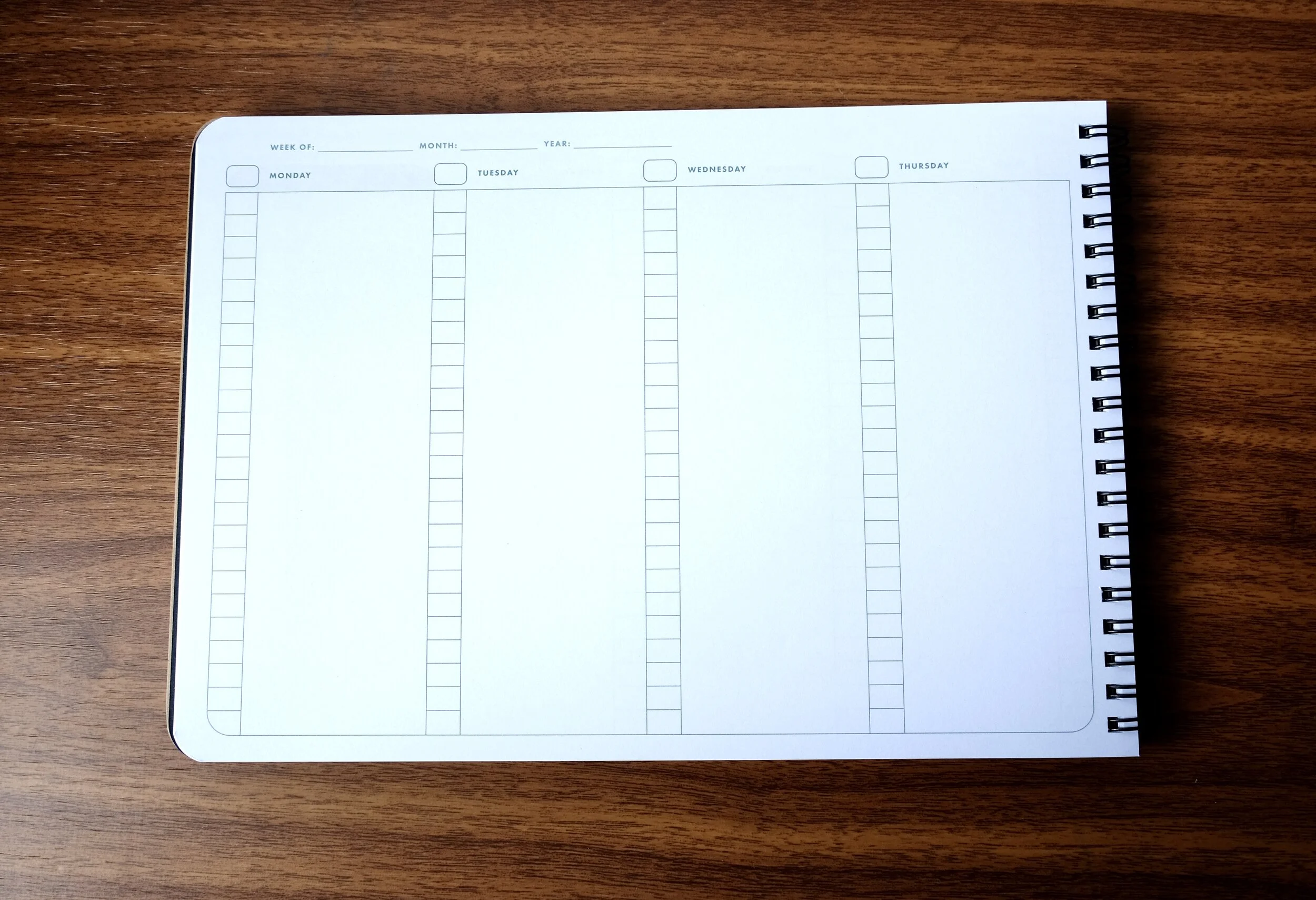
View fullsize Write Notepads Weekly Planner Monday-Thursday
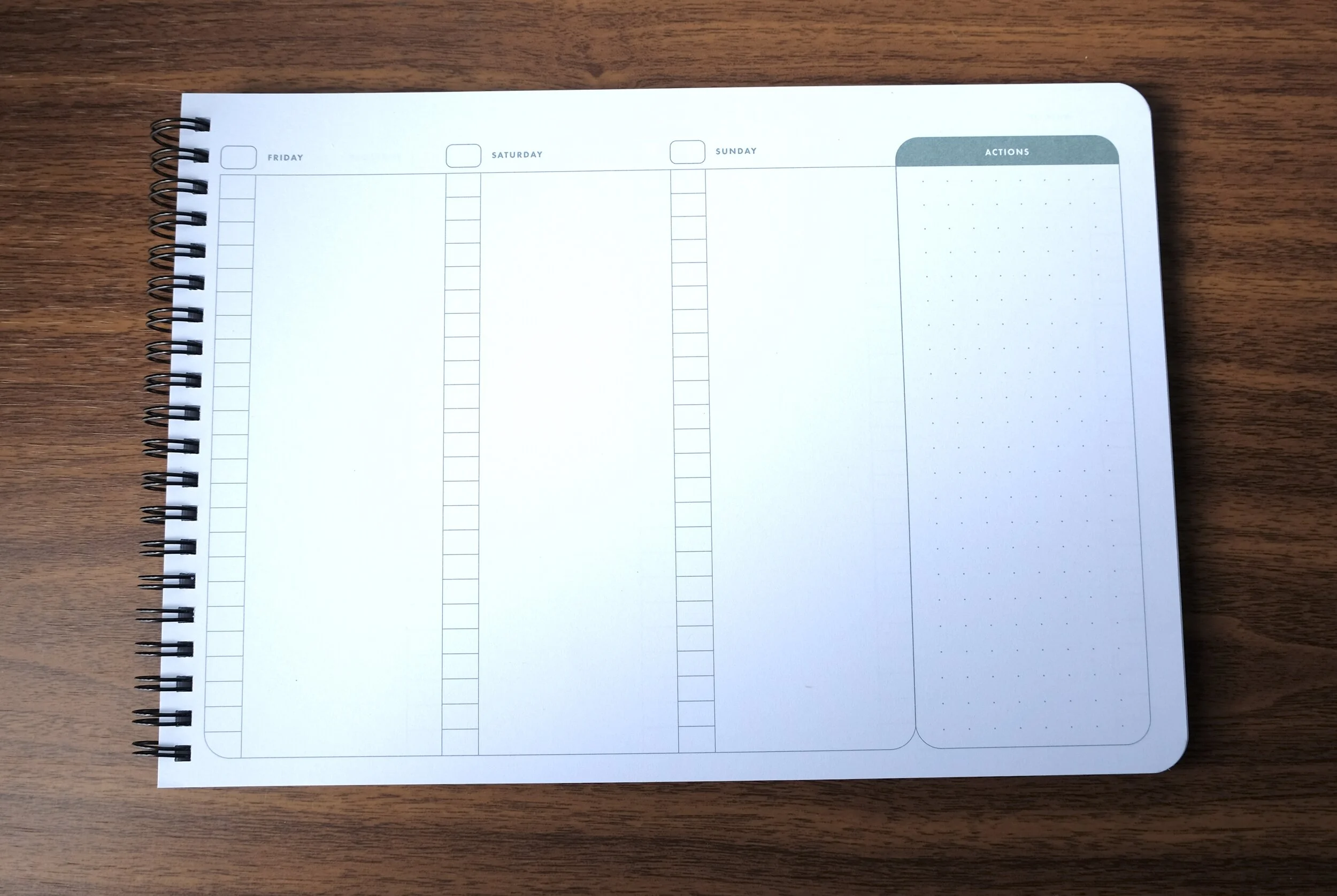
View fullsize Write Notepads Weekly Planner Friday-Sunday

In light of how I’m working, I may shift to a different planner format. While I love the Jibun Techo, primarily because it packs a ton of information into a very compact format that’s helpful if you commute or travel a lot, in my current work situation I feel a bit constrained. Part of this is because I no longer track time on paper. My office moved to an app-based timekeeping and billing system, which is not only more convenient and efficient, but eliminated my need for a traditional dated, hours-based paper planner. Now that I use the Jibun Techo to plan tasks and projects, I find myself wishing that I had more space to make notes and break projects and tasks down into sub-parts. I’m strongly considering moving to a larger format such as the Write Notepads Weekly Planner Notebook, which actually has a somewhat similar layout to the Jibun Techo but is undated and offers a larger week-to-two-pages landscape format. Because I can’t bear to abandon a planner in the middle of the year, I’ll likely finish 2020 with the Jibun Techo and switch over for 2021.

With this sitting on my desk, it gives new meaning to paralysis-by-choice.

Eliminating Distraction (As Much As I Can)

While working from home can be convenient, it can also be endlessly distracting. In addition to partners, kids, and pets all (mostly) wanting you to be available, you have to contend with being surrounded by your own unfinished books, video games, and home improvement projects, all of which are probably going to look a lot more interesting than whatever business you’re working on at the moment. Personally, I find myself trying to practice law while sitting in the middle of the world’s most disorganized stationery store, constantly tempted to switch pens or ink or paper or otherwise “just try something new.” This week I decided to challenge myself by picking one writing instrument in the morning- whether that be a fountain pen, ballpoint, or pencil - and committing to use that one thing for the entire workday. No changes. Honestly, this simple change has made a huge difference in my focus and productivity, which in turn ends up giving me more time with my hobbies after hours. If you don’t work on paper like me, you can substitute “writing instrument” for “writing app,” “keyboard,” or whatever tends to distract you during the day.

Today’s choice: Lamy 2000 Bauhaus 100th Anniversary edition.

Though I’m far from a hardcore productivity geek, I love tinkering with analogue tools, note-taking setups, and, yes, even technology. Though this may be a dangerous question to ask, I’m interested in hearing from you, readers. What changes have you made if you’ve had to start working from home? What worked? What didn’t? Feel free to post in the comments or contact me directly (through the site or via joe@gentlemanstationer.com). I'm also planning on opening up a discussion via Instagram.

Disclaimer: I purchased all products featured in this review with my own funds. I am an authorized retailer of Write Notepads products via the T.G.S. Curated Shop.

In Editorial Tags Editorial, Working from Home, Productivity
2 Comments

Introducing The Write Notepads Weekly Planner Notebook

August 11, 2020

I intend to write more on this topic in the future, but one thing I’ve noticed over the past five months of remote work is that it absolutely helps to provide some structure to your day. Whether this amounts to using an actual planner to schedule blocks of time, or simply being more organized with your to-do list, what’s key is finding a durable, well-made notebook in a format you like that will stand up to daily use.

For those who desire a little bit of structure to their weekly planning sessions but don’t want to purchase a formal dated planner, consider the Write Notepads Weekly Planner Notebook. This spiral bound notebook features 60 weeks’ worth of versatile, fountain-pen friendly paper in a week-on-two-pages format. Since the planner is undated, it makes for a flexible tool that you can use weekly or simply as needed. If you don’t plan out every week, this notebook may last you much more than a year. The layout also includes full days for Saturday and Sunday for those who work a non-traditional schedule or otherwise like to schedule out their weekends.

You can purchase the Write Notepads Weekly Planner directly from the T.G.S. Curated Shop, and like many of the Write Notepads products I stock, comes available in black and pistachio covers. Remember, all domestic U.S. orders over $50 ship free.

In TGS Curated Shop Tags TGS Curated Shop, Write Notepads, Planner
Comment

When is a Fountain Pen Too Big? Considerations on "Oversized" Pens

August 8, 2020

Setting aside filling systems, if someone asked me to identify the key difference between vintage pens of 75-100 years ago and modern pens currently on the market, I would have to say size. Extremely popular vintage pens such as the Parker 51 and the standard Parker Vacumatic Maxima, not to mention something like the Sheaffer Snorkel, appear tiny when compared against the majority of modern fountain pens. Even looking at pens from just 20 years ago (still considered “modern” in most circles), size has steadily increased. I have a set of Waterman Man 100 Patricians from the early 1990s, which were considered large pens at the time. and while they’re still not small, they compare to a standard Esterbrook Estie or Diplomat Aero.

Notwithstanding my concerns about what seems to be the ever-increasing size of modern fountain pens, I still found a way to add three Momento Zero Grandes to my collection over the past year. From left, the “Arlecchino,” “Primary Manipulation Vesuvio,” and “Primary Manipulation Stromboli”. All three are limited editions, though I would say that the Momento Zero Grande will remain one of my pens of the year.

I first noticed the oversized trend with the Edison Collier, which I considered huge when it was first announced several years ago but which today seems relatively modest. Pen companies haven’t slowed down. Before they went under, Delta and OMAS made oversized versions of their Dolcevita and Paragon fountain pens, respectively. Leonardo has released the Momento Zero Grande, a larger version of its already substantial Momento Zero. Esterbrook is killing it with the Estie “Oversized,” and apparently is selling so many that they have started to release special edition versions. These days, even the Montblanc 149 - once considered a “huge” pen - no longer seems that big at all.

What’s Driving the “Oversized” Trend?

I’ve heard a few different things in the course of years worth of conversations with both users and penmakers:

  • The fountain pen community is aging. While more young people are coming into the hobby, those who grew up using fountain pens - still the core audience - are moving into their 60s and 70s, and larger pens are more comfortable for those with conditions such as RSI (repetitive stress injury) or arthritis. (A recommendation for “a large pen for arthritic hands” is actually one of the most frequently received requests here at T.G.S.)

  • As fountain pens have become less utilitarian objects and more luxury accessories, the focus has shifted from the pen as a “daily writer” to the pen as a vehicle to showcase unique materials. Some companies have managed to navigate this shift remarkably well. For example, both Kanilea Pen Company and Leonardo Officina Italiana make fountain pens that are both gorgeous to look at and exceptionally comfortable to use. On the other hand, the past several years have seen an explosion of uber-expensive pens so large that they look like nightsticks, primarily made from rare celluloids. Personally, I have a hard time seeing how those pens can be used practically as everyday writers by anyone save those with extremely large hands.

  • Vintage pens were manufactured in factories as objects for mass consumption, as opposed to turned by hand on a lathe, as many pens are today. My understanding is that it can be more difficult and labor-intensive to hand-turn a smaller or more slender fountain pen, and it results in more wasted materials (which can be expensive). I’m not a penmaker, so I have no experience in this regard, but I’ve had multiple individuals mention this at shows over the years.

  • Sometimes it’s as simple as a shift in consumer preferences. Especially in the U.S., everything has upsized over time: cars, houses, watches, and, yes, pens. If larger pens sell, manufacturers will keep making them, especially if consumers equate “bigger” with “more expensive", and remain willing to pay top dollar for giant pens.

The Leonardo Momento Zero Grande is incredibly well-designed for such a large pen. If you’re a poster like me, you’ll want to consider this model because the cap adds little to no weight to the pen.

I haven’t held a vintage Parker Vacumatic in quite some time. Is the Sailor Pro Gear Slim the closest thing on the market right now? It’s somewhat astonishing how small this pen feels.

Considerations on Buying a Large Fountain Pen

If you’ve also noticed the shift towards larger pens, and are curious about trying one, keep a few things in mind. First, whether any pen will make a comfortable daily writer is less about pure length or diameter and more about shape and balance (i.e. weight distribution). For example, what makes the Leonardo Momento Zero Grande an extremely comfortable pen, despite its size, is the fact that the pen has a subtle hourglass shape with most of the girth towards the front. Slightly tapering the back end allows you to post the cap deeply, without throwing off the balance and back-weighting the pen too much. It helps that the cap is extremely light.

Second, while piston filling systems are seen by some as a sort of litmus test as to whether or not a pen is truly “high-end,” they can add weight. I would love to add a Pelikan M1000 to my collection, but the added weight from the filling system makes this a hard pen for me to use. On oversize pens, I tend to prefer cartridge-converter systems, though I will add that Leonardo’s has developed an extremely lightweight piston on the Momento Zero Grande.

Finally, if you’re thinking about purchasing an oversized fountain pen for the first time, consider visiting a pen shop in person or waiting until pen shows resume. (It’s currently hard to predict exactly when that will happen in light of current events, but I remain confident that this too shall pass.) If you can’t wait, be sure to purchase from a retailer who allows returns, and handle the pen to make sure you find the size comfortable before you ink it up.

A comparison of five modern fountain pens against a vintage Parker Vacumatic Major (far right). Starting from the left, a Sailor Pro Gear Imperial Black, Momento Zero Grande Arlecchino, Delta Fusion 82 in Pompeii Celluloid, Kanilea Pen Company Mauna Kea, and Leonardo Momento Zero standard in Burkina Celluloid.

Final Thoughts

I started thinking about these issues while watching the pens in my collection gradually get larger. While I can appreciate an oversized fountain pen, especially one made by a craftsman who enjoys the act of writing and how a pen should fit the hand for maximum comfort over long sessions, I would love to see more pens made in the size and shape of the classic Parker Vacumatic. Delta made a run of celluloid Fusion 82s in conjunction with Bryant Greer of Chatterly Luxuries several years ago, and those ended up just about perfect (though as you can see from the pictures, the pens were still larger than a vintage Vac). Conway Stewart’s excellent Model 100 is another vintage-inspired option, though difficult to find in the U.S. Waterman, with its flagship Expert and Carene models, seems to be losing ground. Don’t even get me started on the disappearance of the Parker Sonnet. Currently, Japanese companies are holding out, with Pilot, Sailor, and Platinum still sizing their flagship collections for the everyday user, though you can see the “big pen” trend working its way into their lineups with pens such as Pilot’s massive “Custom Urushi” and Sailor’s “King of Pen.”

At the end of the day, I appreciate variety, but I have some concern based on the trends I’m seeing that reasonably sized, practical fountain pens are losing ground to larger “show ponies.” Personally, I would like to see more vintage-inspired design, not only in terms of shape and materials but also in terms of size. Taking things too far in any one direction can only restrict the appeal of the hobby, which is good for no one and risks jeopardizing the progress we’ve made towards a broader pen community.

Disclaimer: The pens featured in this review are from my own personal collection.

In Editorial Tags Editorial
2 Comments
← Newer Posts Older Posts →
Store Hours and Events
Shop T.G.S. Online
Updated 2026 "Best Pens" Guide
No results found
On The Paper Trail: Live In Nashville Event Tickets Now Available!
TGS_25 Roterfaden Restock Notification
Hierarchies of Fountain Pen Friendly Paper

Join Our Patreon!
Subscribe to the TGS E-mail List

Featured Posts

Featured
Pilot-Custom-Heritage-92.jpg
June 6, 2026
Workhorse Pens: Pilot Custom Heritage 92 Fountain Pen
June 6, 2026
June 6, 2026
Kakimori-Inkstand-Before.jpeg
May 30, 2026
Japan Trip Journal: A Visit to Kakimori, Including Custom Notebooks and the InkStand!
May 30, 2026
May 30, 2026
Five-Foundational-Fountain-Pens.jpeg
April 22, 2026
T.G.S. 12th Anniversary: 5 Fountain Pens Everyone Should Experience
April 22, 2026
April 22, 2026
The Gentleman Stationer RSS

View Cart

© Digital Divide Media, LLC, 2014-present.

All content is the exclusive property of Digital Divide Media, LLC, d/b/a The Gentleman Stationer, including “The Gentleman Stationer” website and trademark, and should not be reproduced without express written permission.  All rights reserved.

All content containing paid advertising, affiliate links, or sponsored content will be plainly disclosed by a disclaimer when/if featured.

Contact Information

Website Terms and Conditions

Store Shipping Policy and Return Policy

Privacy Policy and Cookie Policy

Accessibility Statement

Powered by Squarespace