• Blog
  • Shop
  • Podcast
  • Resources
  • About
  • Archive
  • Contact
  • Cart
  • Sign In My Account
Menu

The Gentleman Stationer

Vintage Living in the Modern World.
  • Blog
  • Shop
  • Podcast
  • Resources
  • About
  • Archive
  • Contact
  • Cart
  • Sign In My Account

Stationery as a Inexpensive Way to Relive Your Childhood and The Blackfeet Indian Pencil: My Favorite Pencil of All-Time

February 12, 2020

All this recent hubbub over the return of Dunkaroos has me in a bit of a nostalgic mood. Not necessarily because of Dunkaroos - I was a bit too old for that fad -but it did get me thinking about things from childhood and why we collect and get fixated on certain items. Take stationery. I’d venture that if you ask yourself why you’re stationery obsessed (and if you’re reading this blog, “stationery obsessed” is an accurate description), two things come up: (1) You’ve always been this way, going to back to when you were a kid; and (2) as you’ve grown, you have, at times, found yourself thinking back to certain pens/pencils/notebooks that you remember fondly and wondering whatever happened to them. For me, this resulted in a six-month eBay quest to accumulate a full gross of my favorite school pencil, the Blackfeet Indian Pencil. While reason eventually took hold and I managed to stop myself after buying up six dozen, I don’t regret this little adventure at all.

Background on the Blackfeet Indian Pencil

Those of us who grew up in the 1980s and 1990s probably may remember the Blackfeet Indian Pencil for its promotional gift set, featuring a dozen pencils in a cedar box stamped with a Remington-esque logo. The pencils were made by the Blackfeet Indian Writing Company, founded in 1972 and located on the Blackfeet Indian Reservation in Browning, Montana. Until its closure in the late 1990s, the Blackfeet Indian Writing Company manufactured writing pencils, art pencils, pens (which I’ve never seen but are also available on eBay). Apparently the company passed from tribal control into private hands around 1992, and subsequently went out of business not too long after.

The Blackfeet Indian Pencil Company released multiple versions of their pencil over the years. Shown here are two, with both black and gold writing/ferrule combinations. The font and graphics on the pencils themselves also changed. The particular box shown here was a promotional gift for a building supply wholesaler in Montana and North Dakota.

I received a dozen of these pencils, in the commemorative box, for Christmas one year when I was 12 or 13, which must have placed the timing towards the end of the company’s run. I remember seeing these for sale at The Nature Company and museum gift shops, which I assume is where my parents (probably my Dad) picked these up. I mostly used yellow No. 2 pencils (Faber-Castell Americans) throughout my school years, so the fact that these are natural pencils probably made them stand out in my mind as something different. I loved the fact that they wrote darker than the Faber-Castell American, which has a firmer core, yet lasted a long time. I had a few of these pencils left well into college, so I probably picked up a few dozen more along the way after that initial batch.

I’m not the only to stockpile this pencil. I didn’t know this when I set out on my journey to track it down, but apparently the Blackfeet Indian Pencil has developed its own cult following over the years. For example, the composer John Luther Adams disclosed in a Facebook post a couple of years ago that he uses Blackfeet Indian Pencils to compose, and Ticonderogas for general writing. The “Blackfeet craze” isn’t quite as pronounced as the hype surrounding the original Blackwing, but eBay pricing has steadily risen. Good thing I have 6 dozen.

In terms of lacquered finish, the closest match is the USA-made Ticonderoga Natural on the left. Yes, I have a mini-stash of those too. No, they’re not for sale, and if you make me a trade offer, it had better be good.

So What’s the Verdict, and Where Do I Get This Pencil?

Is the Blackfeet Indian Pencil as good as I remember it? Yes, it is. While certainly not a luxury pencil on par with a Blackwing or a Palomino, this pencil holds its own with its contemporaries (the Ticonderoga Natural) as well as modern equivalents like the General’s Cedar Pointe and Musgrave’s new “Tennessee Red” (discussed further below). Honestly, unless you have a nostalgic connection to this pencil or are a collector who wants to own a piece of history, you can find similar pencils for MUCH less money, and at around $20-30 per dozen (what I’d consider the reasonable eBay rate for Blackfeet Indian Pencils) the Blackwing Natural probably gives you better performance and feel at that price point. In my case, however, I have no regrets due to the personal connection. I’m glad I’ll have a stash of these pencils for a long time to come.

The graphite on the Blackfeet Indian Pencil, the General’s Cedar Pointe No. 2, and the Ticonderoga Natural appear close to identical, though the feel of the Blackfeet and the Cedar Pointe is so close that it has me thinking they might even share a core. Both the Blackwing Natural “extra firm” and the Musgrave Tennessee Red feature much darker graphite.

If you’d like to source a box of Blackfeet Indian Pencils for your own collection, you’re probably reduced to scouring flea markets, garage sales, and eBay. At any given time, there are multiple eBay listings for Blackfeet Pencils. While some sellers are asking $60-100 for a set of pencils in the cedar box, it’s still relatively easy to find loose pencils and even full packs for $20-30 if you’re patient, which can be less than the cost of a Blackwing Volumes edition, so we’re not talking vintage Blackwing money or anything close.

If you’d like a set of beautiful cedar pencils in a commemorative box, and don’t want to pay out the nose on eBay, I’d suggest that you opt for a set of two dozen Musgrave “Tennessee Reds.”

Alternatives to the Blackfeet Indian Pencil

General’s Cedar Pointe No. 2 is the closest match. While the Blackfeet Indian Pencil is coated in a clear lacquer and General leaves the Cedar Pointe unfinished, the pencil offers a similar aesthetic (natural pencil, black ferrule) and the cores are so close on the two (at least the two specific pencils I’m using) that it makes me wonder whether the Blackfeet Writing Company might have sourced them from General.

For a natural pencil with a lacquered finish, you can of course try the Blackwing Natural, which has a softer core despite containing Blackwing’s “firm” graphite, and also the new Musgrave “Tennessee Red,” which has its own lacquered cedar aesthetic, made even more interesting by the fact that Musgrave is now using actual red cedar - a pencil-making material common more than a hundred years ago - as opposed to the incense cedar commonly used to make modern pencils. I just purchased a box of these in their own commemorative cedar packaging and they’re gorgeous.

Pencil reviews are some of the most popular content here at The Gentleman Stationer, and I promise I’ll try to do more, as I use a lot of pencils (and have quite a stockpile).

Disclaimer: I purchased the pencils featured in this review with my own funds, for my own use.
In Pencil Review Tags Pencil Review, Vintage, Vintage Pencils, Blackfeet Indian Pencil
12 Comments

From left, the Moonman C1, the Moonman C3, and the Moonman M2 eyedroppers.

Brand Profile: Taking a Look at Moonman's Emergence and Current Direction

November 21, 2019

Despite Chinese pens having been widely available for a decade or more - since I’ve been in this hobby - none of the brands have ever caught my interest the way Moonman has. The Moonman M2 is the first Chinese pen that legitimately impressed me, to the point where I think it’s a better writing instrument that many pens that cost five times as much. Why? The nib. Any pen company, anywhere in the world, can churn out mass-produced plastic tubes that look decent. Budget pens that write exceptionally well are true gems, and I’ve yet to experience a bad Moonman nib.

Look familiar?

What do we know about the company itself? Not much. From what I can gather by way of Chinese pen experts such as Frank Dong of FrankUnderwater, Moonman is one of several brands manufactured by a large Shanghai-based pen company, Shanghai Jingdian. What differentiates Moonman from other “budget” pen companies is that they have chosen to focus their attention on factory-tuning nibs to a level that most pen companies never reach, while still maintaining a sub-$20 price point.

The nib quality has remained consistent even as Moonman’s product line has expanded. On the M2, Moonman uses a gold-plated No. 5 nib with a basic “Iridium Point German” engraving. So-called “IPG” nibs have garnered - deservedly - an atrocious reputation for quality, but mine arrived tuned to perfection. On newer models such as the C1 and the C2, Moonman has opted for a larger No. 6 nib that still writes well, but quite obviously “borrows” design elements from Conklin and Monteverde. Not only is this tactic unnecessary to sell these pens, but the mishmash of design elements doesn’t work and cheapens the overall look.

Sure, it’s technically a different pattern, but how hard is it to come up with a basic logo that distinguishes your brand?

As much as I enjoy Moonman pens for the fact that they are true bargain-basement workhorses, recent developments have me questioning how much I should support them going forward. Need another example? Well, I probably should have noticed it before now from the promotional photos, but the recently released Moonman C1 is an obvious attempt to replicate Shawn Newton’s Shinobi, particularly the clear models with different color sections. I’m not sure whether this would qualify as technical infringement - the Shinobi design is rather basic and minimalist, after all, and I believe it originates from a custom design proposal submitted to Shawn by a customer - but this goes a step beyond “inspiration.” Is this where Moonman is headed now?

Does the “C” in the “C series” pens stand for “copycat”? The Moonman C2 moves ever closer to Franklin-Christoph territory.

Once you have it in hand, you’re not going to mistake the feel of a C1 for a Newton Shinobi. Shawn’s pens have a much more substantial feel in hand.

Design issues notwithstanding, there’s nothing wrong with the nibs on these pens. Both are excellent writers.

You can see the facet on one side of the pen. The one thing Moonman has perfected here over the Shinobi is that the cap is double-threaded so that the facet on the cap and barrel line up perfectly every time you cap the pen. On the Shinobis you have to guess.

Takeaways and Where to Buy

As much as I enjoy bargain-hunting, recent developments with Moonman as a brand have bothered me a bit, and I’m not sure I like the direction in which this company is moving. Sure, we can debate the extent to which transparent plastic cylinders can/should be protected as proprietary designs, but PenBBS has shown that it’s possible to be successful at this price point without blatant copycatting, which just makes your brand look cheap. Moreover, if I’m going to spend money supporting a company, I want to see them putting effort into bringing something unique to the market, not just inexpensive versions of other peoples’ pens. The irony in this, of course, is that Moonman’s design decisions create a completely unnecessary distraction for the brand. Moonman nibs are more than capable of standing on their own, and the company doesn’t need to churn out knock-offs to be successful.

I’ve acquired all of my Moonman pens via eBay. Currently, Moonman’s “eyedropper” lineup includes the Moonman M2, the Moonman C2, and the Moonman C1, all of which cost less than $20. The only one I can in good faith recommend is the M2, for the reasons I’ve discussed, and the M2 remains an exceptionally nice pen for the money. That said, unless I see the brand moving in a drastically different direction I will certainly lose interest if they continue to release more of the same.

Disclaimer: This post contains affiliate links.

In Pencil Review Tags Moonman, Moonman M2, Moonman C1, Moonman C2, Chinese Pens, Pen Review
4 Comments

Pencil Review: Dry Highlighters and Double-Ended Editing Pencils

November 28, 2018

It’s been a looong time since I’ve posted any pencil-related content around here, but pencils are something I certainly love and use a lot, as do many of my readers, so I need to make more of an effort to diversify. First up is a short piece on a category of pencils that plays a key part in my workflow: highlighting pencils, also sometimes referred to as “dryliners.” Why, you might ask? First of all, I find that they last longer than traditional ink-guzzling liquid highlighters, they don’t dry out, and I would think they’re also a more eco-conscious choice because you’re not stuffing landfills with discarded plastic bodies. Second depending on how you sharpen these pencils, you can adjust the tip size to make it narrower or broader, per your preference. The downside, of course, is lighter pigment than in traditional liquid ink, and some might find sharpening inconvenient because the core is soft, like a colored pencil. If you want to keep a point or a narrow tip, you’ll have to sharpen a lot.

The Caran d’Ache Graphicolor Highlighter/HB Combo, which combines a highlighter/dryliner pencil with a standard HB graphite half, to make notes while you highlight without switching writing implements. It’s great for when you’re reading!

“The Editor” by CW Pencil Enterprise and Caran d’Ache, as well as the more economical Milan highlighter/HB graphite combo.

Similarly, so-called double-ended editing pencils combine two different colors of graphite, traditionally blue and red. CW Pencil Enterprise, however, recently released their latest collaboration with Caran d’Ache, “The Editor,” which is a double-ended pencil featuring red and HB graphite - a more convenient combination. I haven’t quite figured out a use case for this pencil yet. I mostly prefer to edit in ink as opposed to red pencil, but Caran d’Ache’s red pigment is excellent and very visible.

Takeaways and Where to Buy

Unfortunately, those of us who are into quirky stationery items like these know that the only place to get them are via highly specialized shops. CW Pencils carries the Caran d’Ache Graphicolor HB/Highlighter combo, the Milan graphite/highlighter combo, and of course, “The Editor”. Of these three, the Milan is the one that’s most likely to make its way into my daily rotation. At $1 each, it’s a more economical choice for a workhorse than the Caran d’Ache pencils, which run a pricey $3 per pencil. I do like the editor though, and I’ll likely keep them tucked into books I’m reading for annotations. That way they’ll last longer!

Another option for highlighter pencils are Faber-Castell Textliners, which can be extremely difficult to source in the States, so I stock up on them whenever I place an order to UK retailer Cult Pens, which sells them by the box in all available colors. These also aren't double-ended pencils - they’re quite long, triangular jumbo grip highlighters that last a while, which defrays the cost a bit.

Disclaimer: I purchased the products featured in this review with my own funds, for my own use.
In Pencil Review Tags Pencils, Highlighters, Editing Pencils, Highlighter Pencils, CW Pencils
Comment

Platinum 3776 Revisited: My Thoughts 2+ Years Later

September 26, 2018

Now that this blog is more than four years old, I’ve come to a point where I can start revisiting pens I reviewed in the “early days,” such as the Platinum 3776 “Century”. I previously reviewed the standard models of the Platinum 3776 Century back in 2016, and my overall impressions from that review still hold true. Moreover, Platinum has dropped the U.S. price of the standard 3776 to a more competitive price point that hovers in the $150 range, depending on where you shop and the availability of store-specific discount codes.

The Shungyo limited edition in my favorite color (red!) on the left, and the crystal clear Oshino demonstrator on the right.

Since that review, however, my personal collecting has focused more on the special and limited edition 3776 models, particularly the “Mt. Fuji” series of limited editions. I have two of these pens, pictured here: The “Shungyo” Limited Edition, which is part of the "Fuji Shunkei” (seasonal) series where the pens are inspired by seasonal views of Mt. Fuji; and the “Oshino” Limited Edition, named for the Oshino Hakkai spring under Mount Fuji. (You may have also seen pictures of the recent Kumpoo (“Balmy Breeze”) model, which I passed on because the color just isn’t my thing - not necessarily because of the somewhat cringe-inducing name.

Unlike the standard Mt. Fuji special editions, the Fuji Shunkei editions have added texture on the body. While my Oshino demonstrator is completely smooth, the Shungyo pictured here features lightly etched lines, which I find relatively subtle. The texture on the recent Kumpoo limited edition is more pronounced.

So why do I enjoy this pen so much? Like other favorites such as the Parker Sonnet, the Pelikan M400/M600, and the Montblanc Meisterstuck Classique, the 3776 Century is a perfect size for me, especially when posted. It’s a touch larger than the Sonnet, but smaller than the Montblanc 146. And the fact that the Platinum 3776 features a cartridge-converter filling system means that it’s extremely lightweight. These pens are made to write, and perfect for long workdays.

The Platinum 3776 is an ideal size and weight for me posted. I rarely use this pen unposted, but I’ve added a picture below to give a sense of the size.

Note: Though not something I focus on, since I tend to use my pens pretty extensively and it would be nearly impossible for me to let a pen sit this long, all Platinum 3776 “Century” pens feature Platinum’s “Slip and Seal” cap, which supposedly prevents the ink from drying out in the nib for 24 months. (I say “supposedly” only because I’ve never tested it nor do I have any intention of doing so - I have no reason to believe that Platinum’s claim is inaccurate.)

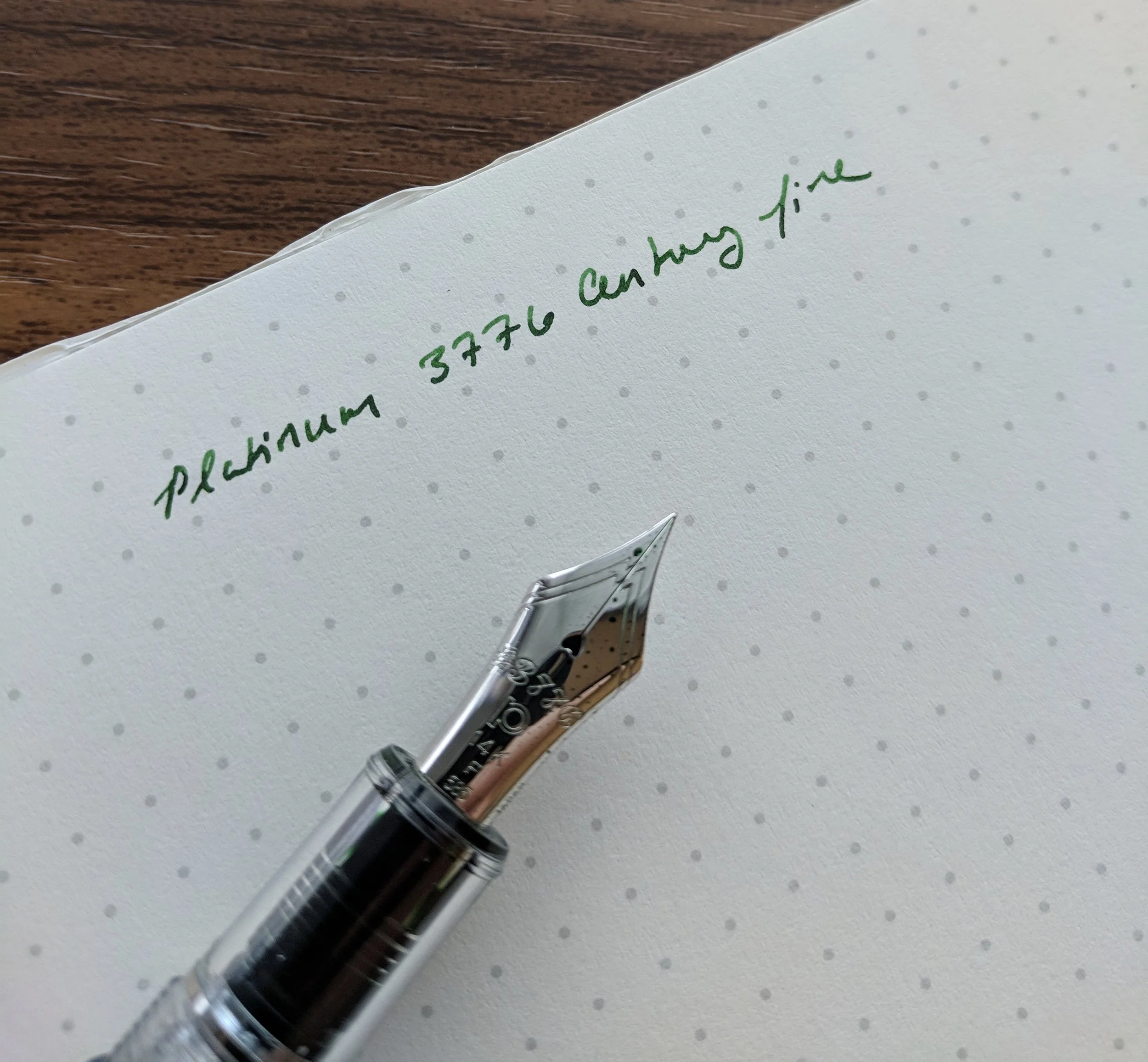
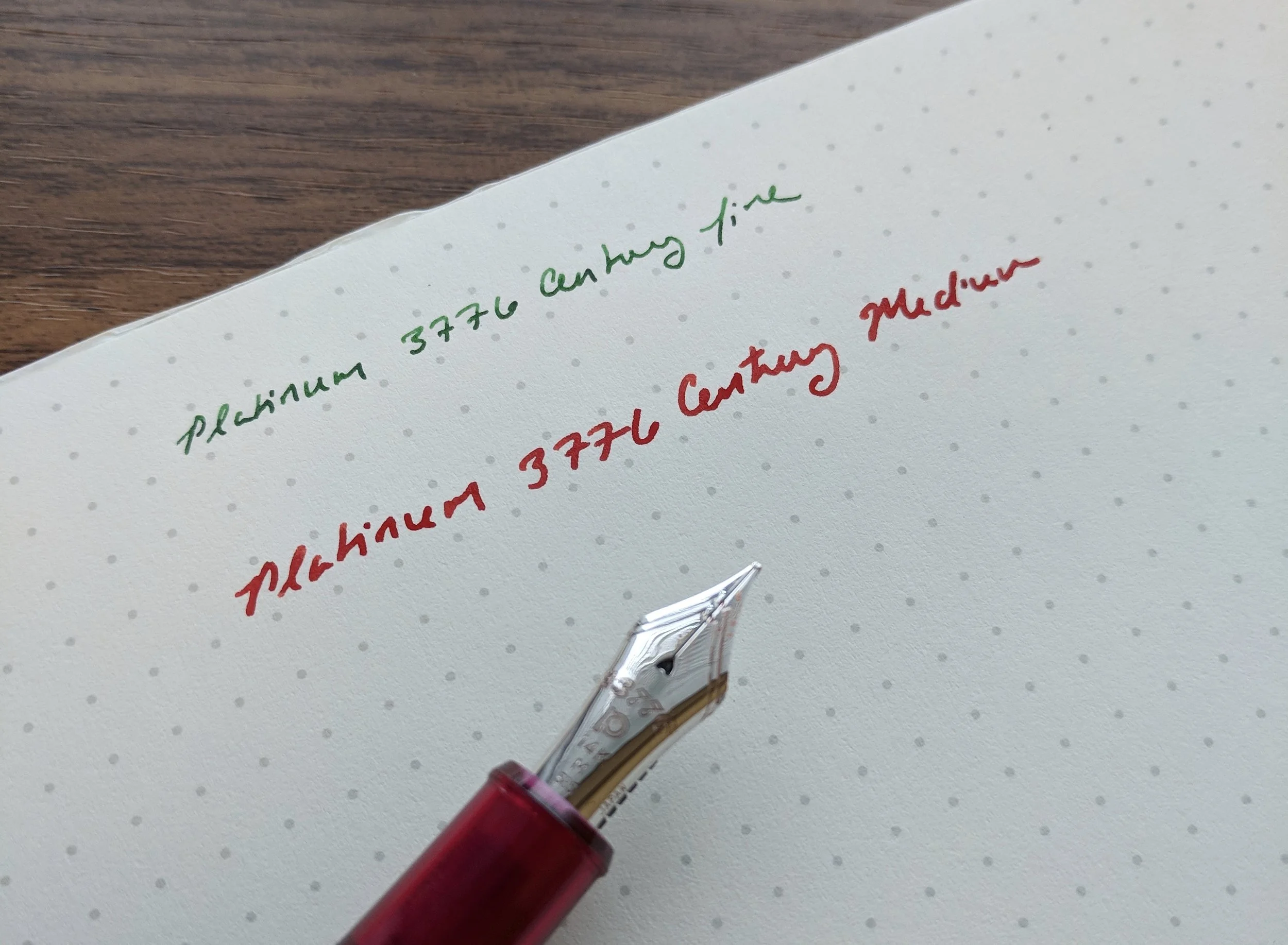
View fullsize Platinum 3776 Fine Nib Writing Sample
View fullsize Platinum 3776 Medium Nib Writing Sample

Oddly enough, the only problems I’ve experienced have been with the nibs - supposedly Platinum’s strong point. Both the UEF (“ultra extra fine”) nib on my Chartres Blue demonstrator and the fine nib on my Oshino wrote extremely dry out of the box, and needed to be adjusted. I’ve heard mixed reports from other people. Some nibs apparently write perfectly, others have the same issue that I did. I’m not sure whether it’s a quality control problem, or that my writing style might be incompatible with how Platinum’s standard fine nibs are tuned. On the other hand, the medium nib on my Shungyo wrote flawlessly out of the box.

Takeaways and Where to Buy

Though Platinum still receives less acclaim in the broader pen community than its “sibling brand” Nakaya, Platinum pens feature essentially the same nibs and offer a compelling value proposition on both their standard and “special edition” pens. They’ve also become more widely available in recent years, with most major pen retailers stocking Platinum and receiving an allocation of the latest limited and special editions. I purchased both pens pictured here from site sponsor Pen Chalet.

The Oshino demonstrator is still available, and currently on sale at a very attractive price. The Shungyo Pen, however, has been sold out for quite some time in regular retail channels, but they still come up occasionally on Amazon. They are starting to appear less frequently as several new models have come and gone since the Shungyo’s original release.

Disclaimer: This post contains links to paid sponsors and affiliates. I purchased both pens featured in this review using store credit from Pen Chalet that I earned through their affiliate program.

In Pencil Review Tags Pen Review, Platinum, Platinum 3776
5 Comments

Pencil Review: The (Palomino) Blackwing Pearl

November 1, 2017

The Blackwing Pearl is the third and - so far - final iteration of CalCedar’s Blackwing revival. Ironically, this was the Blackwing release that I was most excited about, yet it’s also the one that was the biggest letdown in terms of performance. On paper, the Pearl should be my favorite pencil. I love the pearlescent white lacquer, and white pencils are uncommon. Per Blackwing’s description, the Pearl also features “a balanced and smooth graphite core that is softer than the graphite found in the Blackwing 602, but firmer than the graphite found in the Blackwing.” In other words, a dark pencil like the original Blackwing with better point retention for writers. So what gives?

Multiple people have observed that the graphite core in the Pearl smears more than the core in the original Blackwing, despite being firmer. I’ve had the same experience, and for that reason alone I prefer the original Blackwing and/or the 602. I have a thing about being able to write on both sides of a piece of paper, and a pencil that smears and ghosts drives me crazy.

A writing sample of all three Blackwing pencils, plus a "one pass" smear test. Notice the Pearl at the bottom, 

That’s not to say that the Pearl is a bad pencil - far from it - it’s much less smeary than a lot of other pencils, but if I’m shelling out $22 for a dozen Blackwings, and can get a darker line and less smearing and ghosting with the original and a perfectly adequate dark line with the 602, that leaves the Pearl as the odd-pencil-out. (I can actually tell very little difference between the point retention on the original Blackwing pencil and the Pearl, by the way, though the Pearl is slightly harder.)

The three Blackwing finishes, from top: (1) Blackwing original; (2) Blackwing 602; and (3) Blackwing Pearl

As with their other pencils, Blackwing recently revised the design of the Pearl, which now differs from the pencil pictured here. While the Pearl still features the white finish, Blackwing has changed the imprint from black to gold and swapped in a white eraser. I’ve not seen the “new Pearl” in person, so I can’t say for sure how I feel, but this seems like a mixed bag. The white eraser looks nice, but the gold imprint…? I think I might prefer the black.

Takeaways and Where to Buy

Like the other pencils, Blackwing has featured the Pearl’s “smooth and balanced” graphite core in its series of limited edition “Blackwing Volumes” pencils, including the recently released Volume 1, a tribute to the singer-songwriter Guy Clark, and Volume 725, the initial limited edition Blackwing with a “sunburst” finish, based on Bob Dylan’s electric guitar at the Newport Music Festival. For some reason, the Pearl core has appeared in the music-themed editions. Intentional?....

As of 2024, The Gentleman Stationer is now an authorized retailer of Blackwing, so you can purchase directly from us and show your support!

The Pearl (top) compared against the Blackwing Volumes 1, which is a round pencil with a gray wash. 

This review is the third installment of an anticipated multipart review of the various Blackwing pencils on the market today. If you liked this post, please check out Part I - my review of the original Palomino Blackwing with some background on the revival of the brand, Part II - my review of the Blackwing 602, as well as my earlier review of the Blackwing line of notebooks.

Disclaimer: I purchased the pencils featured in this review with my own funds, for my own use. This post contains affiliate links.

In Pencil Review Tags Pencils, Blackwing, Blackwing Volumes, Blackwing Pearl
Comment
← Newer Posts Older Posts →
Store Hours and Location
Visit the T.G.S. Curated SHOP
Updated "Best Pens" Guide
On the Paper Trail Podcast
TGS_25 Roterfaden New Stock Available
Hierarchies of Fountain Pen Friendly Paper

Join Our Patreon!
Subscribe to the TGS E-mail List

Featured Posts

Featured
Pilot-Custom-Series-Pens-overview.jpg
Mar 14, 2026
The Pilot "Custom" Series: An Overview of Some of My Favorite Fountain Pens
Mar 14, 2026
Mar 14, 2026
Pentel-Sign-Pen-Cover.JPG
Feb 28, 2026
Pen Review: The Pentel Sign Pen (Craft Design Technology Version)
Feb 28, 2026
Feb 28, 2026
Cover On the Paper Trail Intro Clip.jpeg
Dec 3, 2025
Introducing "On the Paper Trail," a New Podcast/Video Collaboration with Lisa Vanness of Vanness Pens!
Dec 3, 2025
Dec 3, 2025
The Gentleman Stationer RSS

View Cart

© Digital Divide Media, LLC, 2014-present.

All content is the exclusive property of Digital Divide Media, LLC, d/b/a The Gentleman Stationer, including “The Gentleman Stationer” website and trademark, and should not be reproduced without express written permission.  All rights reserved.

All content containing paid advertising, affiliate links, or sponsored content will be plainly disclosed by a disclaimer when/if featured.

Contact Information

Store Shipping Policy and Return Policy

Privacy Policy

Cookie Policy

Terms and Conditions

Powered by Squarespace