• Blog
  • Shop
  • Podcast
  • Resources
  • About
  • Archive
  • Contact
  • Cart
  • Sign In My Account
Menu

The Gentleman Stationer

Vintage Living in the Modern World.
  • Blog
  • Shop
  • Podcast
  • Resources
  • About
  • Archive
  • Contact
  • Cart
  • Sign In My Account

Perfect Pairings: TWSBI Eco Transparent Orange and Pen Addict/Robert Oster Fire on Fire Ink

May 8, 2019

I don’t typically try to “match” inks to pens - there are only a handful of pens in my collection that have “one” ink that fits them so perfectly I won’t use anything else. The new TWSBI ECO Transparent Orange might just have become one of them, with the recent release of the much-awaited Pen Addict/Robert Oster collaboration “Fire on Fire.” Read on as I take a look at the ink, as well as TWSBI’s latest special edition from its Eco lineup!

First, the Pen

TWSBI has slowed down their releases of new products over the past couple years. Apart from the TWSBI Go and the very recently released TWSBI Aurora (which only appeared in limited quantities), most of their efforts have gone into releasing variations on their standard lineup, including the 580 AL series, the Diamond Mini AL series, the Vac 700R/Vac Mini, the Precision technical pens/pencil, and TWSBI’s entry-level piston filler, the TWSBI Eco. The Eco has been a success story for TWSBI in the years since it’s release, with limited edition colors flying off the shelves at retailers, and TWSBI even releasing an “ECO-T” with a triangular grip section. It wouldn’t surprise me to learn that the ECO has overtaken the standard 580 as the most popular TWSBI model, as the ECO offers users TWSBI’s excellent high-capacity piston filling mechanism at a much lower price point. Sure, you lose the ability to easily swap nibs using TWSBI’s screw-in nib units for the 580, but if you’re someone who prefers a single nib size for most of your writing (which I venture are most people), interchangeable nib units aren’t a selling point anyway. You can read my prior review of the TWSBI ECO, which I published shortly after the pen’s release and which still holds up three years later. The Eco has also retained a spot on my “Best Fountain Pens for Beginners” list.

I successfully restrained myself from purchasing any of the first Transparent or Color ECOs, or the ECO-T, mainly out of a desire to avoid accumulating more pens. (At this price point, it’s easy to fall into the “catch-’em-all” mindset.) I couldn’t pass up the orange, however, especially since I’ve experienced major seller’s regret after letting go of my Amber Diamond 540 and Orange 580AL. TWSBI makes a great orange pen, and I may end up having to pay “stupid tax” on the secondary market to get those other two back. If you’re looking to unload an Amber 540 or a 580 AL Orange via sale or trade, hit me up….

The TWSBI Eco, while long, is still usable posted due to the light weight. I also think the chunky, faceted Eco cap looks better in a transparent material.

And on to the Ink…

Moving on to the ink that drove this pen purchase: Earlier this year Brad Dowdy at the Pen Addict released his first ink in collaboration with Australian ink maker Robert Oster, who has become known for his “Fire” series of inks that feature a red sheen. “Fire on Fire” is just that - a bright, pure orange ink that offers a hint of red sheen in especially broad or wet nibs. While I haven’t found the sheen particularly pronounced, this is still a great orange ink, and perhaps one of the best I’ve used in a long time.

In order to earn a regular spot in my rotation, an orange ink has to check a few boxes:

  • Visibility. The ink can’t be too yellow for me to use in a fine or extra-fine nib. I like to use orange inks for annotating documents, and if the ink appears too pale it’s illegible.

  • Dryness. Depending on the dye used to make the ink, certain oranges end up drier than others. This not only makes visibility issues worse, but also can make the ink scratchy and unpleasant to write with. In the past, I’ve passed on inks that I’ve found too dry, but going forward this may be less of an issue as Vanness Pens is now selling the “White Lightning” ink additive, a drop of which can significantly improve performance.

  • Minimal Precipitate, or “Nib Crud.” I know nib crud is supposed to be the harmless result of dye precipitating out of highly saturated inks, but it’s one of those things that annoys me and that I can’t be bothered to tolerate. The dye used in red and orange inks are particularly prone to nib crud, and I generally avoid those inks that have a reputation for “crusting up” on the nib.

Tested in three pens: From left, Kanilea Pen Company Hanauma Bay with a fine nib from Nibs on Point; a JoWo 1.1mm Stub in an Additive Pens Double Helix Eyedropper, and the TWSBI Eco Transparent Orange pictured here.

Since receiving this bottle directly from Brad at this year’s Baltimore Pen Show, I’ve used Fire on Fire in three different pens and it has performed flawlessly in all of them. The ink flows well, with zero nib crud noticeable on any of the pens and one of them was an eyedropper that has held the ink for months. But my favorite thing is the color - Brad and Robert Oster nailed the tone on this orange ink, which is the closest to a “pure” orange that I’ve used. (Note: what constitutes a “pure” orange may differ from person to person. To me a “pure” orange leans towards the red end of the spectrum.) The “fire” comes out as hints of red around the edges of your writing in broader or wetter nibs, and the ink remains highly visible even in a finer nib. It’s a perfect “daily user” orange ink for me, and I can’t wait for Brad to start selling it in the massive 100ml Oster bottles! (If he can take a hint….)

A writing sample in three different nib sizes shows that Fire on Fire won’t lose its visibility when writing a finer line.

Takeaways and Where to Buy

Since I’m an orange (and red) pen and ink fanatic, both of these items were “must have” purchases for me. The fact that you can get both the pen and the ink for less than $50 made them no-brainers.

The TWSBI ECO in Transparent Orange is generally available from most TWSBI retailers. While I’ve heard the Transparent ECOs described as “special editions,” TWSBI seems to have made a lot of them, with all of the previously released colors (blue, green, red) still available as of the time of publication of this review. I don’t think there’s any immediate danger of this one disappearing, but TWSBI is known for retiring popular pens without much notice, so keep that in mind. [UPDATE: The ECO in transparent orange is no longer available, though you can now purchase TWSBI fountain pens, including other colors of the TWSBI ECO demonstrators, directly from the T.G.S. Curated Shop.]

Pen Addict/Robert Oster Fire-on-Fire Ink is available exclusively at the Pen Addict Shop, along with lots of other great Pen Addict branded goods.

Disclaimer: I purchased the pen featured in this review with my own funds, for my own use, and the ink was provided to me free of charge by Brad at the Baltimore Pen Show for review purposes.
In Pens Tags Pens, Ink Review, Fire on Fire, Robert Oster, Pen Addict, Perfect Pairing
Comment

More from the Bargain Bin: KACO Retro Fountain Pen

May 4, 2019

So, Joe, why have you been reviewing so many inexpensive fountain pens lately? Why have you been scouring Amazon and eBay for $20 pens when you presumably have cases and drawers full of perfectly nice, much more expensive and higher-quality fountain pens at home, not to mention a zillion other things to review?

Fair questions, all of them. And ones I can easily answer: with a few notable exceptions, I'm getting bored with what the old "mainline" pen companies have been releasing (or not releasing), especially where enthusiasts are being asked to pay ever-increasing prices for products characterized by what I view as a general lack of creativity and innovation. So, as I see new Chinese pen companies moving well beyond the "$1.99 eBay pen" market or Montblanc knockoffs and releasing their own original designs, with legitimately good nibs, I've begun to enjoy exploring the so-called "lower-end" of the market.

Each color version of the pen ships with a different color plastic ball

Some brands stand head and shoulders above the rest. Two of my favorites are Wing Sung and KACO, which in my opinion make some of the better inexpensive pens on the market, to the point where some U.S. retailers are starting to carry them as part of their regular stock. I recently reviewed the KACO Edge, a Makrolon fountain pen that vaguely resembles something that Lamy might have made had they foregone the misguided Aion and created a product for those of us who don't want to write with a metal nightstick. At the same time I purchased the Edge, I picked up the KACO Retro, an even less expensive hooded-nib pen that I think I actually prefer.

Ink window! A nice touch at the price point.

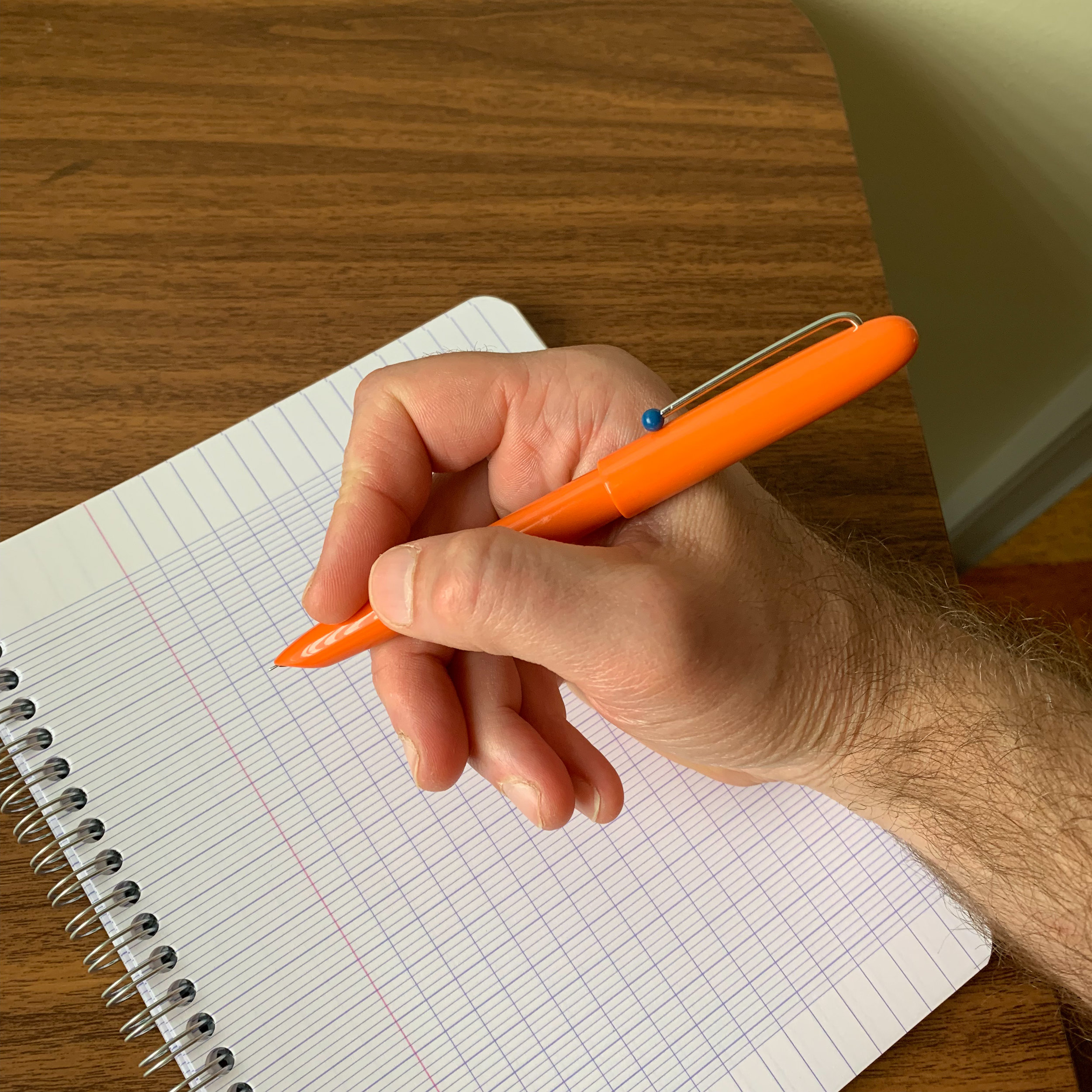
Why do I like this pen so much? For starters, I like hooded nib fountain pens, for both their design and functionality. With the Retro, KACO actually made an effort to design a pen that's not just another inexpensive Parker 51 clone (there are already plenty of those out there). The name "Retro" fits the pen well, from the hooded nib to the injection molded mid-century modern design to the colors that come straight out of the 1960s. I even like the minimalist wire clip, with a contrasting plastic ball acting as the "keeper" on the end.

The hooded steel nib arrived with both the feed and the tines properly aligned, which can be a problem-area with low-cost hooded-nib pens.

The KACO Retro definitely isn't a fancy pen. It feels lightweight and inexpensive, uses a generic yet sturdy plastic converter, and at this price point is something you could give to an older child or just throw in your bag to use as a work or travel pen. But it also writes quite well, better in fact than not only all of the cheap Parker 51 clones I've tried, but better than many of the Parker Super 21 and 51 Special fountain pens I've used. (For those of you who are not vintage pen aficionados, the Super 21 and the 51 Special were lower-end, alloy-nib versions of the Parker 51 that Parker released at a lower price point.)

Sure, it’s a generic plastic converter, but it seems pretty sturdy compared to what I’ve seen on other cheap pens. I do find it odd that this pen comes packaged with a converter, but the KACO Edge (which is more expensive) does not.

The stainless steel nib writes a slightly wider and wetter line than the nib on the Moonman N3, comparable to the KACO Edge though it’s a different nib.

View fullsize KACO Retro Posted
View fullsize KACO Retro Unposted

Takeaways and Where to Buy

The KACO Retro isn't going to become my daily writer, but it's a good enough pen that a student or budget conscious fountain pen lover could easily use it as one. Fans of vintage-style hooded-nib pens might consider the KACO Retro as a travel pen, for those who don't want to deal with the risk of using their vintage pens on an airplane, or worry about losing a prized pen at conferences or in an office or hotel room. The barrier to entry is very low, and I have no problem recommending the Retro given the price point.

I purchased this pen from Amazon, and it arrived quickly because it was Prime-eligible. Of course, I went with the orange version, but there are turquoise, burgundy, blue, white, black and turquoise pens available as well.

If companies such as KACO, Moonman, and Wing Sung keep this up, and can sustain a decent level of quality at their current price point, Lamy, Pilot, Pelikan, and a few others will have something to worry about with their mid-tier and entry-level offerings, especially since the trend has been towards higher pricing and spottier quality control. If nothing else, it adds variety and a bit of competition to a segment that traditionally has been dominated by a few pens - not just a few companies - and in my opinion more choice for the consumer is always a good thing.

Editor’s Note and Follow-up

I'm going to take a minute here to supplement my review of the KACO Edge and my thoughts on lower-end pens in general. Despite the overall good quality of both Wing Sung and KACO pens, I've experienced cap cracks with both, which I accept as par for the course in this price bracket. At sub-$20, you're going to have to accept a lower level of manufacturing quality control on the front end, and what becomes important is the extent to which the retailers and manufacturers will support their customers on the back end. In the case of the KACO Edge, I was warned by a reader to be on the lookout for cap cracks, and a week or so after finalizing my review, I found one. I reached out to the Amazon Seller (who I assume is affiliated with KACO), who literally responded within 5 minutes offering to mail me a new cap, and requesting that I send her a photo of the crack with details of its location so she could share with the factory. A far cry from the service you would get when you used to receive a bag of five $2 Jinhaos, and you were lucky if two of them actually wrote.

Disclaimer: This post contains links to paid sponsors and affiliates. I purchased the pen featured in this review with my own funds, for my own use.

In Pens Tags KACO, KACO Retro, Chinese Pens, Amazon, Inexpensive Pens, Pen Review
2 Comments

Adventures in the Bargain Bin: Moonman N3 Fountain Pen

May 1, 2019

Up on the blog today: more adventures in the online stationery bargain bin, with this entry examining a recent release out of China, the Moonman N3. I discovered this pen via Frank’s “Chinese Pen News You Need to Know” update for January and February, and the blue striated material, which Moonman refers to as “celluloid,” jumped out at me. Despite some immediate skepticism of the claim of “celluloid” at this price point - confirmed by the fact that I have seen this particular material used elsewhere and NOT labeled celluloid - I bought one because I wanted to see if Moonman could justify the (slightly) higher price than the sub-$20 market of the M2 eyedropper.

Let’s get this out of the way first: this pen is definitely not “celluloid,” despite how it’s described in the listings, but to be honest I didn’t expect to spend $35 and receive a real celluloid fountain pen. I suspect this might be more of a translation issue than anything else, because in other listings I’ve seen Moonman pens labeled as “celluloid resin acrylic” or “celluloid acrylic",” which just doesn’t make any sense. In any event, the material is still nice, and appears to be the same acrylic used in more expensive pens like the special edition FPN “Blue Pearl” Bulkfiller from Conid, as well as Monteverde’s “Giant Sequoia” pen.

I understand that Moonman uses mostly Chinese-manufactured nibs, none of which are labeled the typical “Iridium Point Germany,” but rather have a custom Moonman imprint. The Moonman nibs I have used have all been excellent and well-tuned out of the box.

Product description issues aside, Moonman has done a nice job with the N3. The fit and finish exceeds that of much more expensive pens in my collection, and the nib comes well-tuned, which is something of a Moonman hallmark and uncommon at this price point. Note that the N3 is on the slimmer side - I’d personally prefer a wider-diameter barrel, but the pen has a nice balance, posts ok (though a little long), and is lightweight. The generic converter is just that - generic - but I haven’t experienced any inkflow issues.

Even the somewhat generic pen box feels much nicer than what typically comes with pens at this price point.

Moonman continues the trend of Chinese pen companies targeting a segment of the market that previously has been dominated by TWSBI and neglected by other companies: the $20-50 range. It’s certainly rare to see a pen with a more traditional, “professional” design cost this little money, and for it to be of decent quality, well, that’s even more uncommon. At least two other Moonman offerings take this same approach: the M200 and the M300, which hit a slightly higher price point and apparently feature Schmidt nibs.

The Moonman Logo on the cap finial adds a bit of class, and makes this pen look more upmarket.

View fullsize Moonman N3 Unposted
View fullsize Moonman N3 Posted

Takeaways and Where to Buy

I’ve been favorably impressed with every Moonman pen I’ve tried. From the original M2 eyedropper to the slightly more elaborate N3, these pens easily outperform their price point. I also appreciate the fact that they aren’t “homage” (much less knockoff) pens, and that Moonman appears to be attempting to do something original with their designs. Given that I know I’m not the only one who feels this way, it’s only a matter of time before Moonman makes its way into the mainstream. Depending on their distribution chain, it’s easily a brand that pen retailers should consider stocking.

Currently, you can purchase the Moonman N3 and other Moonman pens via various eBay sellers. While the N3 is slightly more expensive than the company’s other offerings, the pen is nicely finished and the nib is well-tuned. This one will stay in the collection.

Disclaimer: This post contains links to paid sponsors and affiliates. I purchased the pen featured in this review with my own funds, for my own use.

In Pens Tags Moonman, Moonman N3, Chinese Pens, Amazon, Pen Review
Comment

New from Inventery: Interchangeable Mechanical Pen and Pencil

April 24, 2019

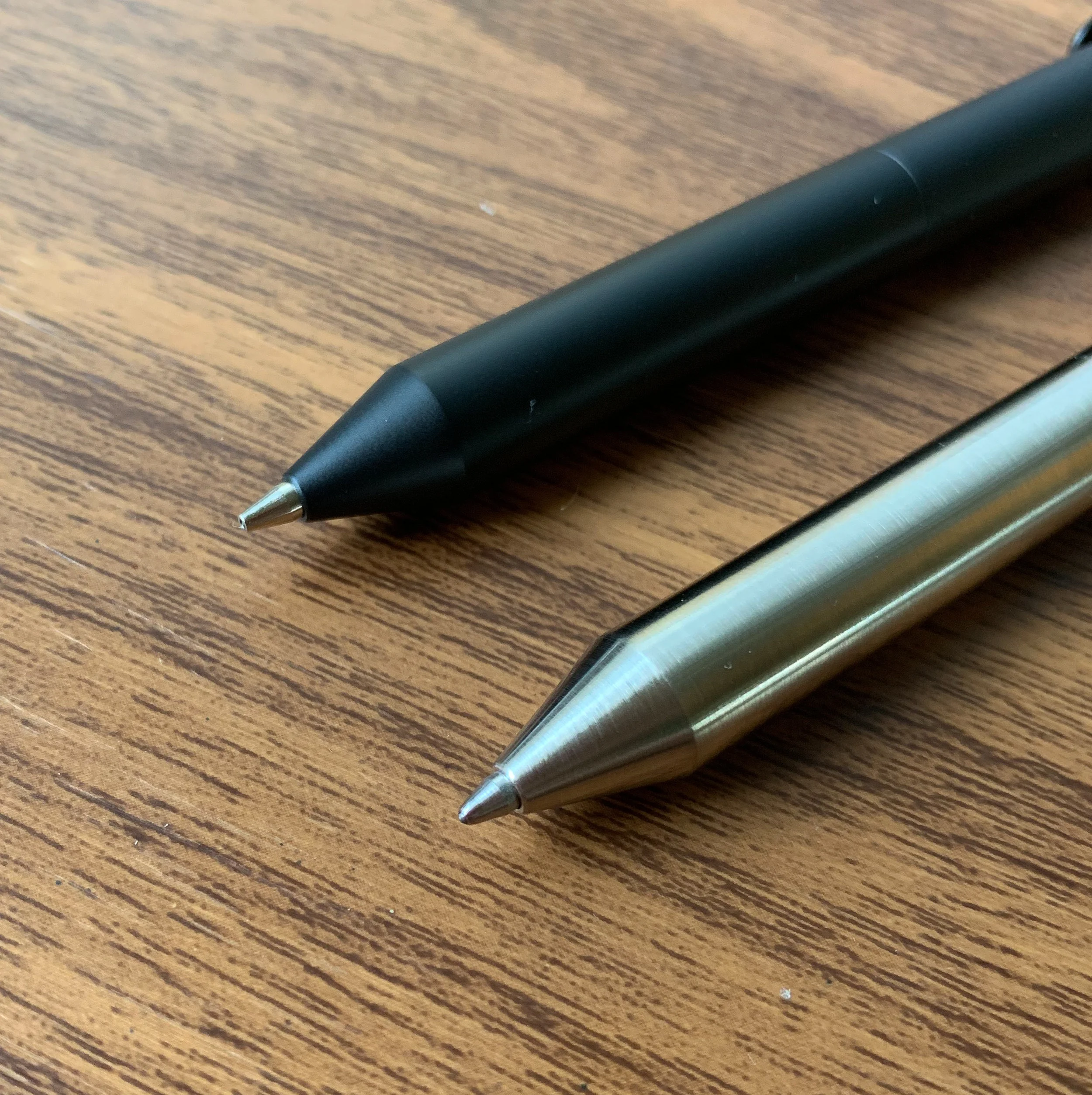
I’ve reviewed many products from Los Angeles-based design house Inventery over the years, starting with their Mechanical Pen. which still sits on my desk years later. I’ve also had the opportunity to test out their Bolt Action Pen and Pocket Fountain Pen, both of which continued Inventery’s trend of great design and high-quality manufacturing. Yesterday on Indiegogo, Inventery launched a follow-up: the Interchangeable Mechanical Pen and Pencil, which allows you to swap out the internal components and alternate between a retractable pen and a mechanical pencil.

Two great refills: the Schmidt Easyflow 9000 ballpoint refill and Schmidt’s .5mm mechanical pencil refill.

Two great refills: the Schmidt Easyflow 9000 ballpoint refill and Schmidt’s .5mm mechanical pencil refill.

The aesthetic and functionality of the Interchangeable Mechanical Pen/Pencil is very similar to Inventery’s previous products. It features a removable clip, and the clip design is the same as on the Bolt-Action Pen, which has more spring and tension than the clip on the Pocket Fountain Pen. For its pencil option, the Interchangeable Pen/Pencil uses a .5mm Schmidt mechanism that threads securely into the pen body, and otherwise accepts Parker-style pen refills, shipping with the excellent (and inexpensive) Schmidt Easyflow 9000 ballpoint refill.

Inventery’s clip design has progressed, including increasing the tension and adding a small ball to the end to make the clip “grippier.” Also, check out the engraving on the inside with the numbering of the pen! A nice touch.

Like Inventery’s other products, each Mechanical Pen/Pencil is engraved with the “I” logo on the top of the knock. And, as with Inventery’s other products, the Interchangeable Pen/Pencil is available in three finishes: brass, brass with a black oxide coating, and brass with a nickel coating.

Some assembly required: it’s not as hard as it looks!

Takeaways and Where to Buy

I’m a fan of Inventery’s writing instruments, particularly because they allow you to customize the pen to fit your needs. For example, most of their pens allow you to easily remove the clip, and certain models (Pocket Fountain Pen and Bolt Action Pen) either let you adjust the length using extenders or come in different sizes. The only possible drawback is the brass construction, which adds weight and can be too heavy for some, though the black and nickel coating does keep your hands from smelling like brass. I’d also note that the stock mechanical pencil lead that shipped with the pens broke very easily, probably due to the extra stress and pressure the brass pen body added, so you’ll need to be sure to use high-quality, durable leads. I swapped in some Pentel Ain Stein .5 lead in “B” hardness, which worked like a charm.

You can back the Interchangeable Mechanical Pen and Pencil on Indiegogo, with rewards for a single pen/pencil starting as low as $42. I consider this excellent value for a pen/pencil of this quality, with pricing below any of Inventery’s other offerings to date. As of the time of writing, Inventery has already doubled its funding goal of $3000 with 29 days left! If crowdfunding sites aren’t your thing, check out the Inventery store, where you can purchase their other products, and presumably the Mechanical Pen/Pencil once the Indiegogo campaign closes.

Disclaimer: Inventery provided me with the pens featured in this post free of charge, for review purposes. This post contains affiliate links.

In Pens Tags Inventery, Inventery Interchangeable Pen/Pencil, Mechanical Pencil, Ballpoint, Machined Pens, Indiegogo
Comment

Pen Review: KACO Edge Fountain Pen

April 17, 2019

I don’t know much about KACO as a Company - what little I do know comes from reading Frank Dong’s (Frank Underwater) series of articles on the best Chinese fountain pens on the market, many of which not only good writers, but extremely inexpensive. According to Frank, KACO is based in Shanghai and is a relatively longstanding stationery manufacturer known for their gel pens. I must say that they make a mean fountain pen as well.

KACO makes three fountain pens that are readily accessible in the U.S., through either Amazon or eBay: the KACO Sky/Sky II, the Retro, and the Edge. (New models are appearing every day as KACO expands its offerings, but these three have received the most attention so far.) While I’ve owned a KACO Sky the longest, my personal favorite thus far is the KACO Edge: a funky looking Makrolon fountain pen with a “blade” clip (hence the name).

KACO’s packaging looks clean and sophisticated, while still remaining appropriate to the price-point of the pen.

For those unfamiliar with the name “Makrolon,” it refers to a polycarbonate material known for its strength and light weight. Most notably, Lamy has manufactured it’s iconic “Lamy 2000” pen from Makrolon since the 1960s, but for some reason other manufacturers have shied away. Tactile Turn featured the material in its initial run of Gist fountain pens, but apparently had trouble sourcing quality raw material and ended up substituting Delrin, a durable plastic with a similar aesthetic.

Brushed Makrolon (polycarbonate) is comfortable to hold and may offer a bit more grip than stainless steel.

Brushed Makrolon (polycarbonate) is comfortable to hold and may offer a bit more grip than stainless steel.

So what do I like about the KACO Edge (besides the price point)? Several things spring to mind:

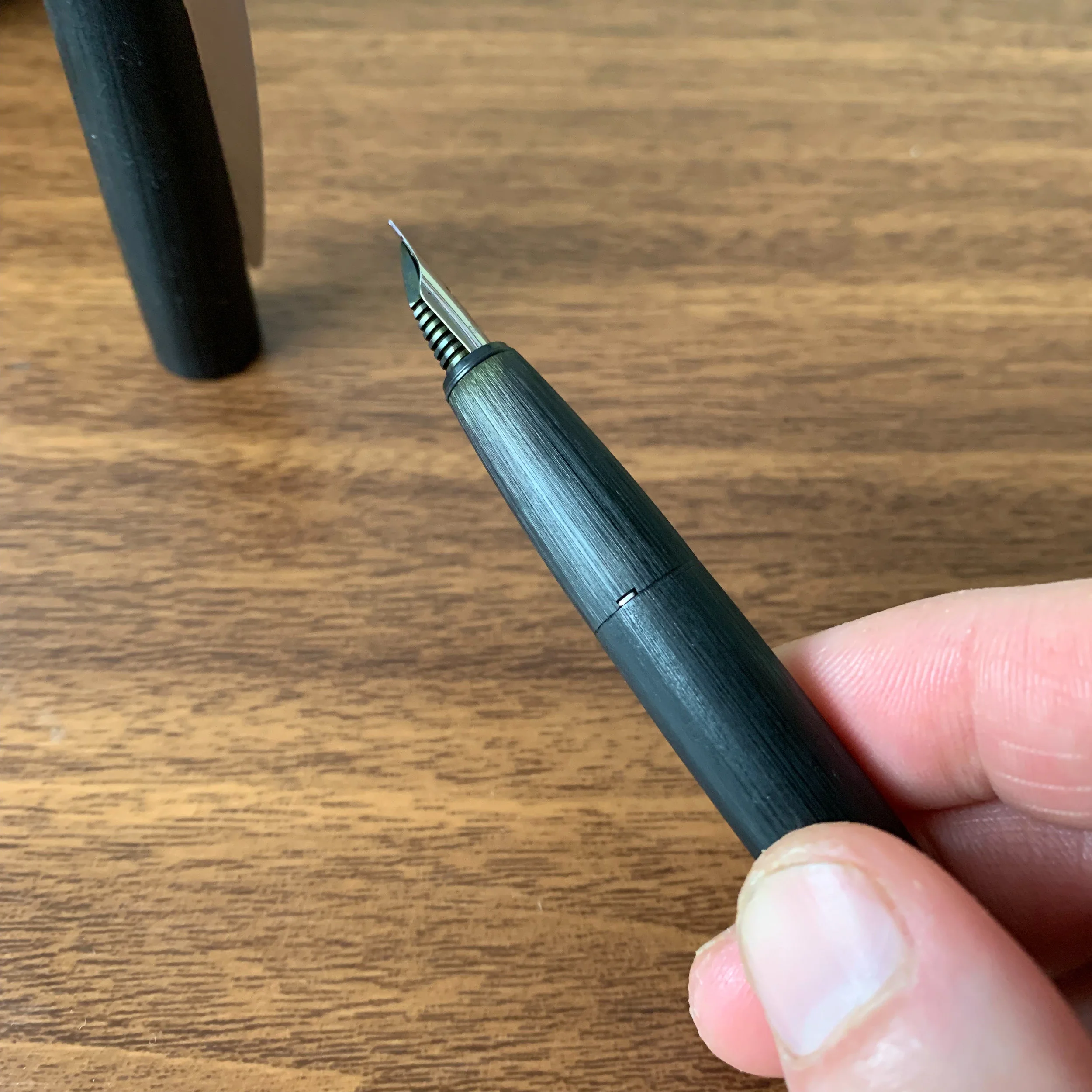
  • The Brushed Finish. One of the things I love about the Lamy 2000 is that the finish is brushed, not just matte, and the KACO Edge incorporates that same technique. I wish more pen manufacturers would explore this technique, as it provides a comfortable, secure gripping surface.

  • Makrolon Grip Section. If you’ve previously passed on the Lamy 2000 because of it’s metal grip section, but appreciate the overall look of the Makrolon pen, the KACO Edge offers you an all-Makrolon alternative. While I ultimately prefer the brushed metal grip on the Lamy 2000, I’ve found the Edge to be a very comfortable pen to use as well.

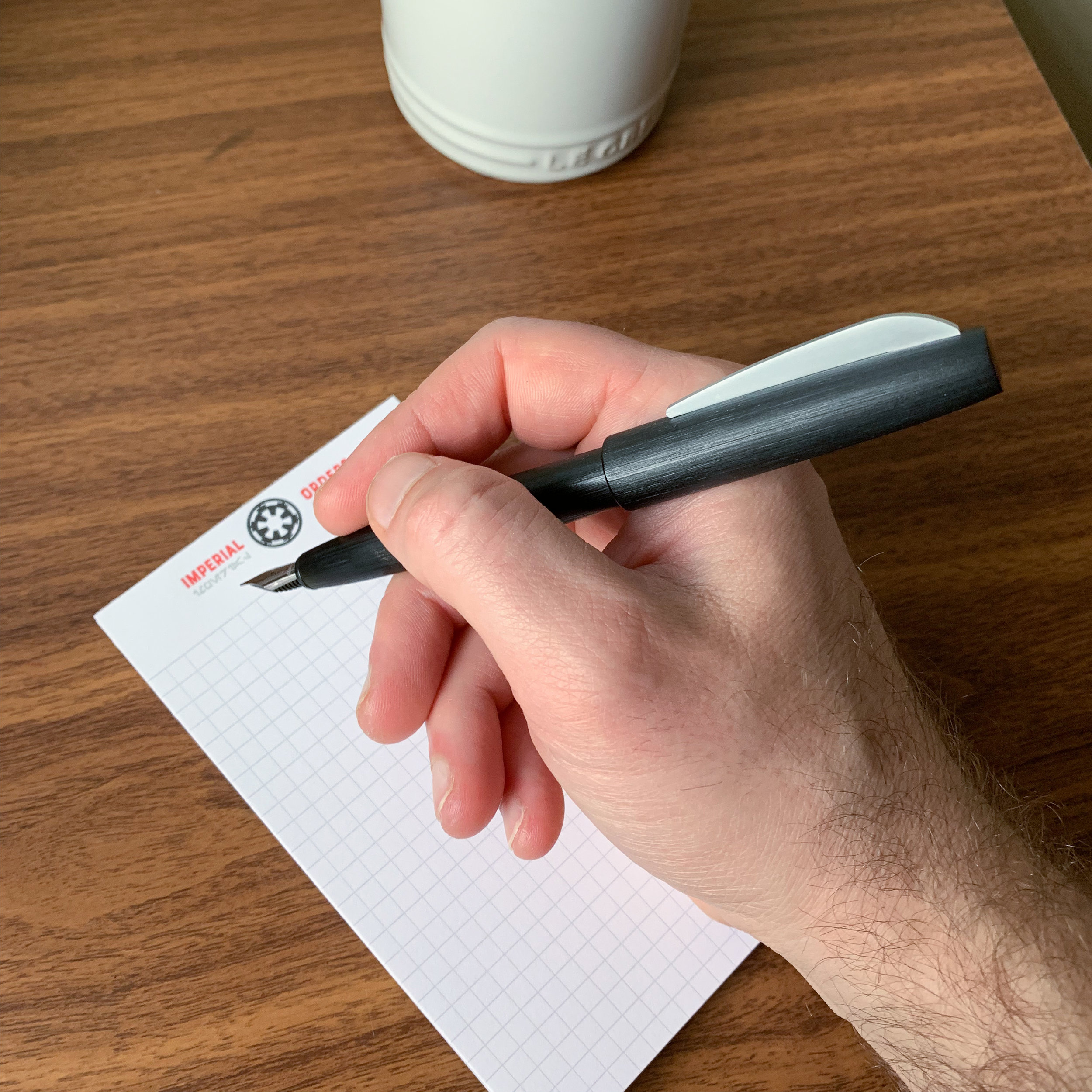
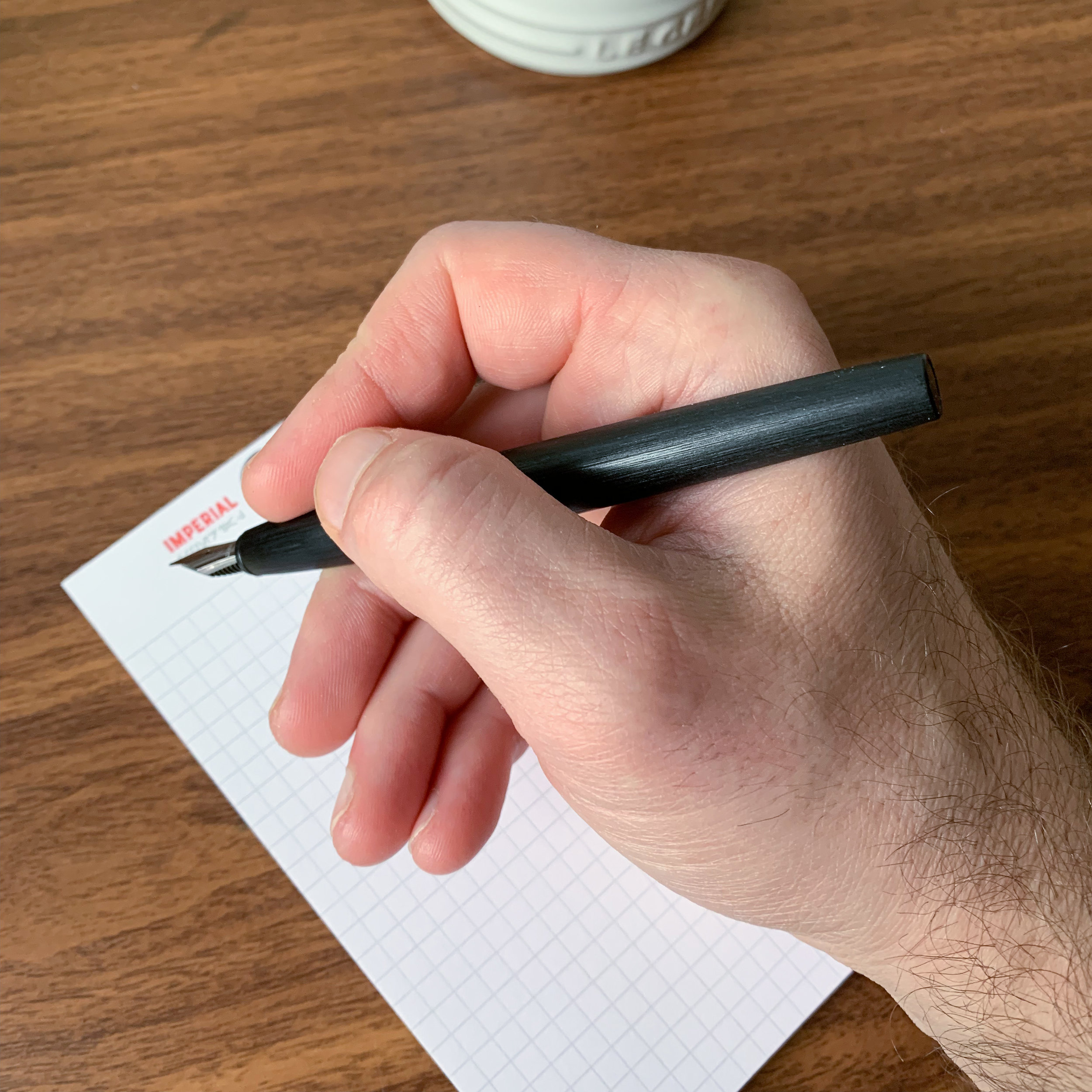
  • Good Balance and Securely Posting Cap. The KACO Edge is well-balanced and comfortable to write with either posted or unposted. The cap closure uses small metal teeth (like the Lamy), which provides a secure friction fit, with the cap posting securely as well.

  • Schmidt Nib. By far the riskiest proposition for most inexpensive fountain pens is the nib, which can be maddeningly inconsistent from pen to pen. I’ve written with two or three KACO Edge fountain pens, and all three feature a smooth-writing Schmidt nib that has worked well every time. The fact that the pen uses a German stainless steel nib is what sets this pen apart from a $3 Jinhao, and it’s easily worth paying the (relatively small) premium.

  • General Quality Control. While there will be some minor quality control issues at any price point - and especially as you move towards the lower end of the spectrum - I’ve found the quality of KACO pens to be surprisingly consistent. As I noted above, I own three KACO pens, and have tried many more lent by friends, and all of them write very well.

The KACO Edge features a stock Schmidt Nib that is quite a nice writer.

Like any good German steel nib, the Schmidt “EF” writes a broader line that you would expect from an “extra fine” nib. It’s more like a standard fine, or even some mediums. (The “Imperial Orders” pad is another Skylab Letterpress creation, available from either Skylab directly or from the Well-Appointed Desk shop!)

A Note on Design: I generally dislike pens that are blatant copies of something else, and in my opinion, the KACO Edge borrows from the Lamy 2000’s design aesthetic without ripping it off. Other than the combination of a Makrolon pen body and a brushed metal cap, these pens look nothing alike, and behave differently in terms of performance, so the Edge shouldn’t be dismissed as “just another knockoff.” The “blade clip” is actually quite distinctive, and will be something that people either love or hate. One potential issue with this pen is that it can be difficult to clip to thicker fabrics or into pen cases, as the clip isn’t springy at all.

KACO Edge Posted
KACO Edge Unposted

Takeaways and Where to Buy

The KACO Edge has impressed me so far, and I’ve also had positive experiences with my KACO Sky and KACO Retro fountain pens. Look for additional reviews to follow. You certainly can’t argue with the price point of any of these pens (generally the sub-$20 category), which punch well above their weight in terms of design, components, and overall writing experience. I would grade the KACO Edge as the best of the bunch, due to the materials used, manufacturing quality, and the fact that the pen sports a reliable Schmidt nib.

As noted, you can easily acquire the KACO Edge via Amazon, which is how I purchased the pen pictured here. Most KACO products are Prime-eligible (at least as of the time of this review), meaning that they will be in your hands a couple of days after placing your order, if not the same day. Note that the KACO Edge does not ship with a converter in the box, so if you’re interested in using bottled ink with this pen, you will need to purchase a Schmidt converter separately, or you can sometimes find sellers who will throw in a KACO-branded converter.

Follow-Up and Editor’s Note

Despite the overall good quality of both Wing Sung and KACO pens, I've experienced cap cracks with both, which I accept as par for the course in this price bracket. At sub-$20, you're going to have to accept a lower level of manufacturing quality control on the front end, and what becomes important is the extent to which the retailers and manufacturers will support their customers on the back end. In the case of the KACO Edge, I was warned by a reader to be on the lookout for cap cracks, and a week or so after finalizing my review, I found one. I reached out to the Amazon Seller (who I assume is affiliated with KACO), who literally responded within 5 minutes offering to mail me a new cap, and requesting that I send her a photo of the crack with details of its location so she could share with the factory. I was quite happy with this level of service!

Disclaimer: This post contains links to paid sponsors and affiliates. I purchased the pen featured in this review with my own funds, for my own use.

In Pens Tags KACO, KACO Edge
1 Comment
← Newer Posts Older Posts →
Store Hours and Location
Visit the T.G.S. Curated SHOP
Updated "Best Pens" Guide
On the Paper Trail Podcast
TGS_25 Roterfaden New Stock Available
Hierarchies of Fountain Pen Friendly Paper

Join Our Patreon!
Subscribe to the TGS E-mail List

Featured Posts

Featured
Pilot-Custom-Series-Pens-overview.jpg
Mar 14, 2026
The Pilot "Custom" Series: An Overview of Some of My Favorite Fountain Pens
Mar 14, 2026
Mar 14, 2026
Pentel-Sign-Pen-Cover.JPG
Feb 28, 2026
Pen Review: The Pentel Sign Pen (Craft Design Technology Version)
Feb 28, 2026
Feb 28, 2026
Cover On the Paper Trail Intro Clip.jpeg
Dec 3, 2025
Introducing "On the Paper Trail," a New Podcast/Video Collaboration with Lisa Vanness of Vanness Pens!
Dec 3, 2025
Dec 3, 2025
The Gentleman Stationer RSS

View Cart

© Digital Divide Media, LLC, 2014-present.

All content is the exclusive property of Digital Divide Media, LLC, d/b/a The Gentleman Stationer, including “The Gentleman Stationer” website and trademark, and should not be reproduced without express written permission.  All rights reserved.

All content containing paid advertising, affiliate links, or sponsored content will be plainly disclosed by a disclaimer when/if featured.

Contact Information

Store Shipping Policy and Return Policy

Privacy Policy

Cookie Policy

Terms and Conditions

Powered by Squarespace