• Blog
  • Shop
  • Resources
  • FAQ (Ask TGS)
  • About
  • Archive
  • Contact
  • Sign In My Account
Menu

The Gentleman Stationer

Vintage Living in the Modern World.
  • Blog
  • Shop
  • Resources
  • FAQ (Ask TGS)
  • About
  • Archive
  • Contact
  • Sign In My Account

Strategic Paper Replacement: Adventures in E-Ink, Part I (The Physical Writing Experience)

January 6, 2024

I have a love-hate relationship with so-called “digital paper”, both the idea and the reality. I've owned some version of Apple's iPad Pro for years, but stopped upgrading it after a while due to general disuse. While it occasionally comes in handy when I need to sign something electronically, mark up a longer document for my day job, or where a hand markup needs to be easily distributed to a wider group via e-mail, I otherwise find the writing experience on the iPad to be (1) far less satisfying than writing on real paper due to the lack of a tactile experience; and (2) subject to the same distractions as a computer, to the point where it's much harder to lose yourself in the work than with a notebook and a pen.

But I'm a reader, researcher, and notetaker by nature, so I’ve continued to experiment. I accumulate a LOT of paper, and the idea behind a digital writing device still intrigues me. I'm not opposed to digital tools where they are the best option and solve a real need, such as minimizing the volume of "junk paper" I generate, and anything that streamlines the process of organizing and archiving handwritten notes is a plus.

To that end, I acquired two e-ink devices last year, Amazon's Kindle Scribe and the Remarkable 2 e-ink tablet. While I can't say that I've fully bought in to either system, both devices pleasantly surprised me with the extent to which they duplicate, physically and mentally, the experience of writing on paper. While I originally sought to write a single comprehensive post discussing my thoughts on e-ink and these devices as a whole, I quickly realized that such a piece would quickly get too long and unwieldy, so I'm going to break it out into multiple installments. First up: my thoughts on the physical writing experience, including available pen options.

  1. Writing on both the Kindle and Remarkable 2 feels more like actual paper than the iPad. The matte screens simply feel better than writing on glass. While the friction requires you to periodically replace the tip of the stylus as it wears down, replacements are generally inexpensive. (As an aside, I have tried the Paperlike screen protector for the iPad, and still prefer the feel of both e-ink tablets.)

  2. The pens/styli I have used are more comfortable to use for longer writing sessions than the Apple Pencil. Of the two "stock" options available, I actually prefer the Kindle Scribe Premium Pen ($59.99) over the much more expensive Remarkable Marker Plus ($129). Recently, I've been using aftermarket options, including the Lamy EMR AL-Star and the Lamy Safari "Twin Pen" (a multi pen that also includes a D1 ballpoint refill for when you want to switch writing modes). All of these options use Wacom's EMR (Electromagnetic Resonance) technology - no batteries are involved, so you don't have the battery anxiety that can be an issue with the Apple Pencil during a long working session or if you forget to charge it.

  3. I find the writing experience nearly as distraction-free as physical paper. Personal experience may vary, but I can "lose myself" in reading and writing with an e-ink tablet in a way that I've never experienced with an iPad. Whether it's due to digital distraction always being a click away, blue light, or something else, I don't know, but that's the reality.

The Remarkable 2 allows you to choose from a variety of line options, and vary both style and width. EMR technology is responsive to pressure, creating line variation that corresponds to light/heavy writing pressure. You will also see the “color option” I discuss below.

EMR pens feature different nib sizes - this is the round tip on the Lamy AL-Star.

For those who want to write a finer line (or who want to write on “glossy surfaces”, such as a Samsung device), Lamy makes a pointier nib. It will likely wear down quicker on matte surfaces.
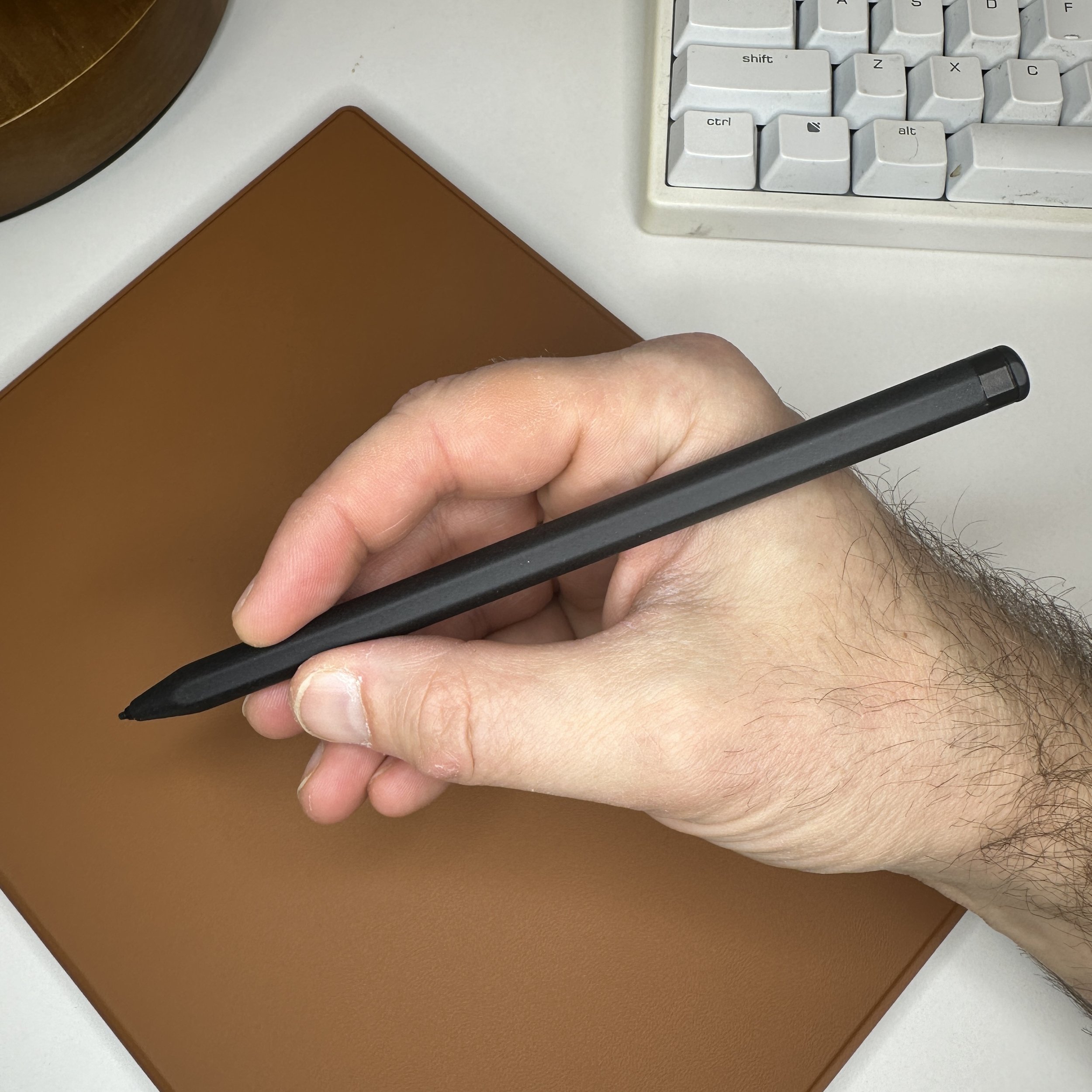
Remarkable 2 Marker

The standard Remarkable and Kindle styli both feel very much like a pencil. I prefer their weight and balance to that of the Apple Pencil.

Potential Drawbacks To Consider

  1. While there is very little latency ("lag") in the current generation of e-ink tablets, it's still there. I've not found it to interfere with my enjoyment of the overall experience, and I would describe it as “minimal” with both the Scribe and the Remarkable 2.

  2. The lack of a color display limits the ability to highlight and annotate documents in different colors. While the settings do allow you to change colors, you'll only be able to view color in exported documents, not on the device. (I know you can change colors with the Remarkable 2 - I've not tried on the Kindle Scribe as Amazon's software makes it fairly difficult/inconvenient to import and organize PDFs and other documents for annotation purposes so I generally don’t use it that way. More on that in a later installment.) Other companies have recently released tablets with color e-ink screens, but they are expensive (i.e., approaching $700).

  3. Some might find the technology expensive for a single use device. That said, with as much as I read and write (hours per day), $300 for the tablet doesn't strike me as outrageous. Remarkable-branded accessories can be pricey and raise the price of the device to around $600 if you opt for the most expensive pen and folio, but if all you want is a simple no-keyboard folio cover and a Wacom-compatible pen, there are much less expensive generic options out there that don’t compromise the experience.

So What's Still to Come?

In addition to recommitting to a journaling habit, one of my goals for 2024 is to be a bit more systematic in how I use paper, and especially in how I organize notes so that I'm able to locate them for reference later. I've been using the Remarkable 2 as both a digital notebook and e-reader (mainly for articles that I want to highlight and annotate in pdf form), with the Kindle Scribe as my primary reading device for longer books that I can annotate yet don't want to carry with me when I'm traveling. Both devices allow me to export markups to my computer for archiving.

The Remarkable 2 software syncs your handwritten notes with the desktop app, and has functions that include handwriting conversion and the ability to type annotations directly into the document from your computer. I’ll go into the functionality in more depth at a later date, but you can export the documents in PDF form to save elsewhere or distribute to others as necessary.

At some point I will do more in-depth installments on the ins and outs of each tablet, including my thoughts on the software and any friction points encountered while integrating these devices into a workflow. To that end, if you're considering purchasing an e-ink tablet, I would carefully consider how you want to use it before making a decision. If you're essentially looking for an e-reader with a large screen that you can use to make handwritten notes and highlights, and use occasionally as a digital notebook, the Kindle Scribe gives you access to Amazon's large library (including Kindle book you already own) with basic e-ink notebook functionality. On most Kindle books the handwriting function is generally limited to "sticky notes" (picture below), but this is already changing as Amazon tweaks their software, and “write anywhere” books are being made available in the Kindle Store. At the moment, the Remarkable 2 has more out-of-the-box functionality and a more intuitive interface, allowing you to read (and annotate) DRM-free e-books, PDFs, and online articles sent to the Remarkable via a Chrome extension. If you spring for the (pricey) keyboard cover, you even can turn the Remarkable 2 into an e-ink typwriter similar to a Freewrite. For those whose primary goal is notetaking and handwriting, I would recommend starting with the Remarkable or something like it.*

As with standard Kindle highlights and typed notes, Amazon allows you to export a pdf of your notes and annotations.

*Note: I recognize other options are available. I know many people who enjoy their Supernote and Boox tablets, but I'm not currently interested in the ability to add Android apps and I otherwise don't see enough of a difference in the handwriting functionality to convince me to buy another device.

This post does not contain affiliate links. TGS is supported via purchases from the T.G.S. Curated Shop and pledges via the T.G.S. Patreon Program. If you enjoyed this content, please consider supporting us!
In Editorial, Pens Tags Remarkable 2, Kindle Scribe, E-Ink Devices, Digital Divide
3 Comments

Pen Review: TWSBI Kai Limited Edition Fountain Pen

November 15, 2023

TWSBI rarely adds new pens to their lineup, with the last completely new shape being the TWSBI Swipe. While some might view the recently released TWSBI Kai as a “new addition”, that’s not entirely true: TWSBI previously released limited runs of similar acrylic piston fillers, spaced approximately 2-3 years apart. The first, the TWSBI “Aurora”, was a green pen in short supply, while the second, the TWSBI “Draco”, received a broader release and more people were able to get their hands on them. The Kai seems to be more widely available, though TWSBI continues to describe it as a limited release. That’s not unusual - most TWSBI editions such as the special edition ECO and Diamond 580 fountain pens are made for a period of time and then retired, but the standard (i.e., clear acrylic, black/white, rose gold) versions remain available. What is unusual is the absence of this otherwise unnamed acrylic piston filler from the regular lineup. It’s solely a limited edition pen.

The TWSBI logo is subtly engraved on the finial, as opposed to the inlaid red plastic logo.

I Would Love to See More Regular Higher-End TWSBI Fountain Pens

I’ve really enjoyed working with the TWSBI Kai for the past couple of weeks. Having missed out on the Draco, I made sure to reserve a Kai for myself as part of my larger order for the shop. The pen has not disappointed - the Kai both looks great and serves as a comfortable workhorse with a shape somewhat reminiscent of the Aurora Optima. The Kai shares the same streamlined flat-top profile - an all-time favorite - though the Kai does not post as deeply as the Optima. Fortunately, like most TWSBI piston fillers, it’s also lightweight and well-balanced even unposted.

No surprises here. The Kai uses the same nib as the Diamond 580, which offers the same reliable writing experience I’ve come to expect.

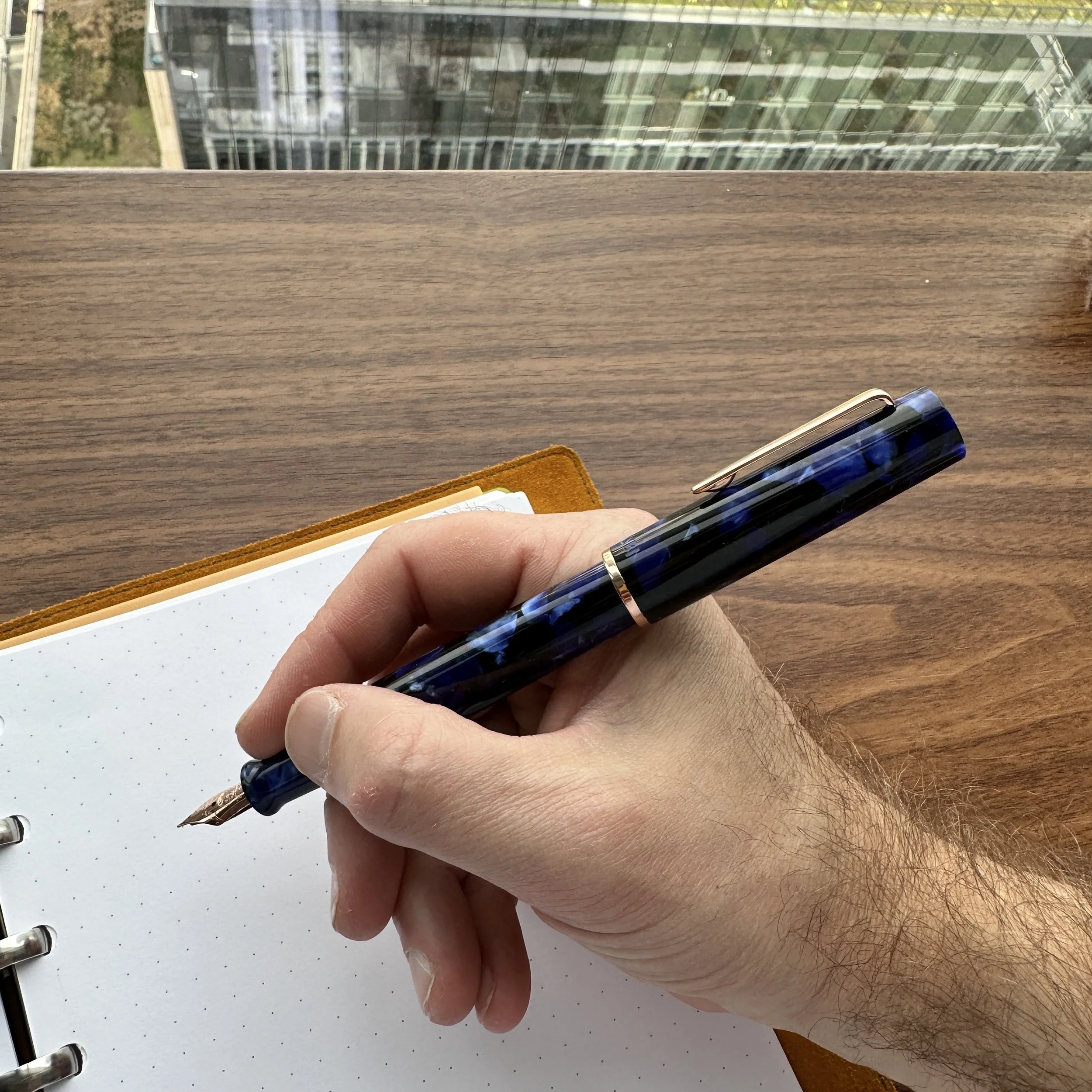
There’s nothing particularly remarkable or unexpected about the writing experience itself - the Kai is classic TWSBI, and uses the same reliable nib as found in the Diamond 580 series. (The Kai doesn’t use the interchangeable nib units, however, as the nib is friction-fit.) What does make this pen stand out, however, are the visuals. I’ve always admired this series of TWSBI releases, and remain puzzled by their irregularity. The Kai is a beautiful pen, featuring a deep indigo blue-flecked acrylic trimmed in rose gold, which TWSBI always does extremely well. The material has a lot of depth, and I’d venture that the pen looks more expensive than its price point would suggest.

As a more general matter, I’ve noticed that TWSBI’s nib consistency has improved in recent years, and that there is more delineation between the sizes. This EF nib actually writes an extra-fine line. Not a fine (or even a medium like some I’ve used in the past), but a true extra-fine.

A few design touches distinguish the Kai from other TWSBIs. First, there’s no red anywhere on the pen. Most TWSBI models feature the signature red TWSBI finial on the cap, yet the logo on the Kai is engraved. I go back and forth on whether I would prefer the Kai with a pop of red, but at the end of the day feel that TWSBI made the right choice by not adding additional plastic to a higher-end offering.

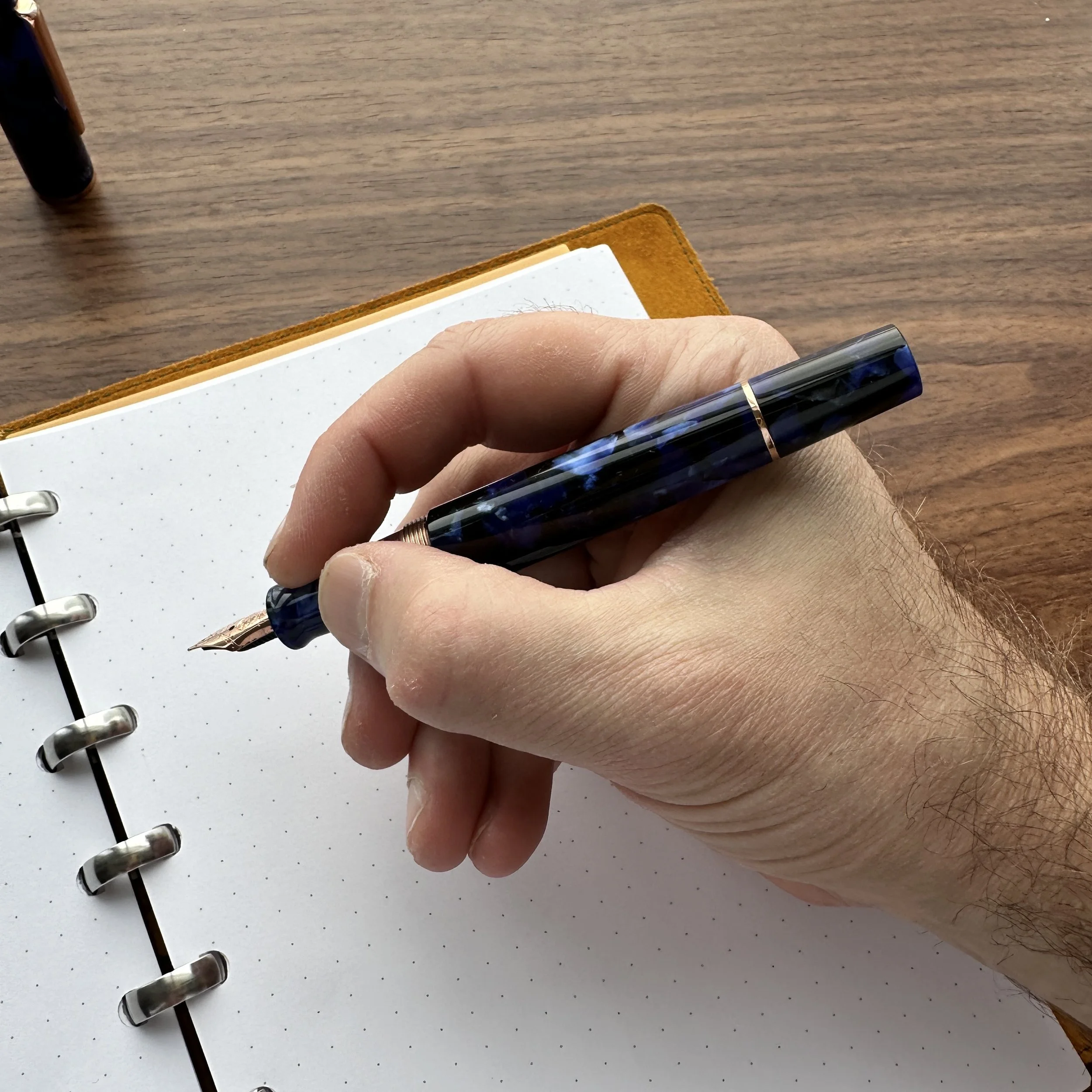
View fullsize TWSBI Kai Unposed In-Hand
View fullsize TWSBI Kai Posted In-Hand

Second, the barrel and inner cap feature metal rose-gold threads, which work smoothly without any grating noise or excess friction. The pen uncaps in two turns, allowing for quick deployment, and the threads sit high enough on the barrel (behind the ink window) that they don’t interfere with my grip. If I had one critique of the design, it would be the posting issue I mentioned above. Flat-top pens such as this one - including favorites like the Aurora Optima and Sailor Pro Gear - seem especially suited for posting. Could TWSBI have slimmed down the barrel just a bit more? Perhaps, but apart from the Diamond Mini and Vac Mini, TWSBI has never designed pens that post well, and the fact that the Kai is no exception doesn’t surprise me. (Note: As shown above, like most TWSBIs, the Kai does technically post, just not deeply, and I find it uncomfortably long and awkward to use this way.)

The metal threads just work here. I find the pop of rose gold on the barrel visually interesting.

So Where Exactly Does the Kai Fit into TWSBI’s Lineup?

I would organize the current TWSBI fountain pen lineup as follows:

  • Entry Level Pens: TWSBI Go ($18.99); Swipe ($26.99); and TWSBI ECO and ECO-T “Standard” ($32.99)

  • Mid-Range: TWSBI ECO and ECO-T “Special Trim” editions ($49.99 - $70), TWSBI Diamond 580 and Diamond Mini “Standard” ($50-$65); Vac Mini ($60); Vac700R ($65)

  • Upper Mid-Range: TWSBI Diamond 580 Rose Gold Editions ($80-$85); Vac700R Iris ($80); Precision ($80)

  • “High End”: TWSBI Kai, Aurora, and Draco Special Editions ($130 - the Draco and Aurora were actually priced higher at $150(?))

As you can see, that’s a pretty compressed range in terms of price point, with even the “high-end” TWSBI pens not breaking the bank. TWSBI is known for never having targeted the gold-nib market or the “luxury” price point, hence their fairly dominant market position in the sub-$100 fountain pen segment. I would like to see the Kai, or some version thereof, become a permanent offering. Even if there’s no standard version, having one special or limited pen always available would round out TWSBI’s lineup and expand their appeal beyond those who enjoy the demonstrators.

One of these things is not like the others.

Takeaways and Where to Buy

I’m enjoying the TWSBI Kai, and I’m glad I picked one up to compensate for missing out on the Draco (though I’d love to see them bring back that burgundy and black combination). While the Kai is a bit more expensive than other TWSBI piston-fillers, the price is consistent with higher-end pens from brands like Opus 88 and Nahvalur, and maybe even a little lower. It would be great to be able to recommend the Kai as a workhorse fountain pen to those seeking a slightly more traditional design than the Diamond 580 or Vac700R. There’s certainly demand - the Kai has sold well, and I’ve seen Dracos selling on the secondary market for hundreds of dollars!

The Kai is a classy pen that wouldn’t look out of place next to pens twice the price.

As TWSBI retailers, we carry the TWSBI Kai in the T.G.S. Curated Shop, and have a selection of these pens currently in stock. It’s unclear when the next run will be made available after these sell out, though I seem to recall that the Draco stuck around for six months or so. The Kai is priced at $130.00, which is the top of the TWSBI range, though in line with the price point of many other similarly-styled resin piston fillers.

Further Reading on twsbi

I’ve managed to review most TWSBI pens, with a couple exceptions, over the years. If you’d like to review previous content, please check out the Fountain Pen Review Archive, which is organized by brand, including TWSBI.

The Gentleman Stationer is supported by purchases from the T.G.S. Curated Shop and pledges via the T.G.S. Patreon Program. This post does not contain paid advertising or third-party affiliate links.

In Pens Tags TWSBI, TWSBI Kai, Fountain Pens
4 Comments

A New Take on an Old Favorite: The Kobe Affection Kyomachi Legend Blue 1911L Fountain Pen

November 8, 2023

Well, that’s quite a name! As I may have mentioned, one of the many things I got to see first-hand during my August pen show excursions was the development of a new partnership between our friends at Vanness Pens and Nagasawa Stationery in Kobe, Japan. What does that mean to me? Well, for starters I have access to a ton of exclusive Nagasawa Stationery special edition Sailor fountain pens to review, including the “Kobe Affection Kyomachi Legend Blue 1911L Fountain Pen,” a royal blue and gold-themed fountain pen that adopts the same general format as the Sailor 1911 Black Luster, a long-time favorite and one of my more comfortable everyday writers.

The gold flecks in the blue acrylic make for a stunning, yet still understated, material.

Three Things That Make This Pen Stand Out from the Rest of My Collection

Three things make this particular fountain pen something of an outlier for me personally, almost to the point where I’m surprised I chose to review it. (Almost.)

  1. The pen not only has gold trim, but gold flecks throughout the royal blue acrylic, creating a shimmery appearance or, per the current lingo, “chatoyance.” I typically don’t go for gold, but I couldn’t pass up this combination and it literally grew on me within minutes of inking it up.

  2. The pen has a broad nib. While medium (or a medium stub) is typically as wide as I’ll go with my everyday writers, lately I’ve experimented with broad nibs and this broad Sailor 21k nib might be the best of the lot. More on that below.

  3. The pen has a metal section. While I don’t consider a metal section “disqualifying”, I tend to be quite picky about which metal sections I’ll use. At a minimum, they need to have some texture, and I find the plating on Sailor’s metal sections to have a more tactile feel that avoids slippage during longer writing sessions.

I reviewed the Sailor 1911 Black Luster back in 2017, and everything I enjoy about that pen still holds true today, especially with respect to the weight and balance. The only difference I would call out is that for whatever reason, the non-black-ion-plated Sailor 21k nibs (such as the gold one here) feel much more substantial and less “fragile”. As I noted in my prior review, I’ve bent two black Sailor nibs in the past with minor bumps and table drops, but this broad seems more durable and less “soft” for lack of a better term, though I still wouldn’t describe it as a stiff nib.

The Sailor Kobe fountain pens are also notable because they feature Nagasawa’s weathervane logo. I enjoy this design, probably more than the standard Sailor scrollwork.

With respect to the nib, I love how it writes. When most people think of Japanese fountain pens, they focus on the extra-fine and fine nib sizes, but often neglect the mediums and especially the broads. I find such oversights unfortunate. If you’re a fan of medium 14k nibs from German makers such as Bock and JoWo, the Sailor broad nib has similar line width yet offers a smoother writing experience. I’ve heard the same about Pilot, and I’ll be looking to try one of their broad nibs soon.

For those who will ask, this paper ruling is Clairefontaine Seyes-Ruled, or “French Ruled”. The review ink is Sailor Souboku pigmented blue-black. Here, I’ve compared a writing sample from the Sailor 21k broad nib to a writing sample from a JoWo extra-fine Stainless Steel nib. While noticeable, there’s much less of a difference between a German stainless EF nib and a Japanese 21k Broad nib than I would have expected.

Notes on the Name: Why “Kyomachi Legend Blue?”

The name “Kobe Affection Kyomachi Legend Blue” continues Nagasawa’s trend of naming their special edition pens and inks after specific locations in Kobe, Japan and the immediate vicinity, which is where Nagasawa Stationery is based. Per the information provided by Nagasawa, Kyomachi is the area where the Kobe City Museum is located. If there’s one thing that will catch my interest about a line of limited edition fountain pens or inks, it’s when the product has a strong sense of “place” and reflects something of its designer/creator. Every time I research a Nagasawa product, I learn something new about Kobe, which makes me want to visit all the more. (If you’re curious, the popular “Sailor Kobe Ink” series is also developed for Nagasawa, and you learn a lot researching the origin of the various names in the lineup and how the specific colors were carefully matched to each theme or location.)

The balance of this pen, when posted, is nearly perfect for my hand size and writing style.

Takeaways and Where to Buy

Like the 1911 Black Luster, I love this pen and it makes for a great daily writer. That said, you’ll have to really love Sailor and their Japanese special editions in order to spring for it. Sailor pricing is what it is, and doesn’t seem to be changing anytime soon. Once I have one of their pens in hand, however, I tend to forget about the cost. Sailor delivers a quality high-end writing experience and the “Kyomachi Legend Blue” is no exception.

With the Black Luster priced at $392, the Nagasawa Kyomachi Legend Blue in the 1911L format tops that and goes for $450. The 1911S (“standard” or “slim” size) version lacks the metal section and is priced at $300, and, yes, there is a King of Pen version (again without the metal section) priced at $880. Vanness Pens is the exclusive U.S. retail partner for Nagasawa Stationery, and you can view the rest of their current stock here.

Further Reading

If you’d like to see a video of this pen, including a writing sample, please check out this short video that I filmed for our YouTube channel. For reviews of other Sailor Pens, check out the “Sailor” page in our Fountain Pen Review Archive.

The Gentleman Stationer is supported by purchases from the T.G.S. Curated Shop and pledges via the T.G.S. Patreon Program. As always, many thanks to our friends at Vanness for providing this pen for review.

In Pens Tags Nagasawa, Sailor 1911, Vanness Pens, Pen Review
2 Comments

Pen Review: The Libra Fountain Pen from Santini Italia

October 25, 2023

Even after all these years, I love that I can still discover new makers, and come away as excited as I was back when I first encountered fountain pens. Santini Italia is not necessarily a new brand - the company and its principals have been manufacturing pens since 1998 - but their current line has just started to gain traction in the United States, culminating in their attendance at the D.C. Pen Show back in August. While I didn't get to spend an extended amount of time at their table, and most of their wares had sold by the time I was able to make it over, a friend from my local pen club was kind enough to lend me her Santini Libra in ebonite for review!

I don’t believe this particular ebonite is still available for purchase, but it features multiple shades of blue and turquoise, along with red, pink, and beige mixed in. The combination is gorgeous.

About Santini Italia

Santini Italia is headquartered in Turin, Italy, the same city as famed Italian penmaker Aurora. As I mentioned above, Founder and manager Giovanni Santini has been involved in pen manufacturing for many years. (You can read more on his and the Company's background on their website, which also links to two excellent Pen World profiles.) What makes Santini unique? Their pens are 100% made in-house, from the pen bodies themselves to the nibs and feeds. In today's marketplace, this is rare. Most smaller makers lack the knowledge and/or resources to make their own nibs profitably and with the necessary level of quality control. Santini's 18k in-house nib is entirely their own, comes paired with an in-house ebonite feed, and is also offered with custom nib grinds. Frankly, I’m impressed.

The Libra sports a wide coin-edge cap band inscribed with “Santini Italia".

About the Libra Fountain Pen

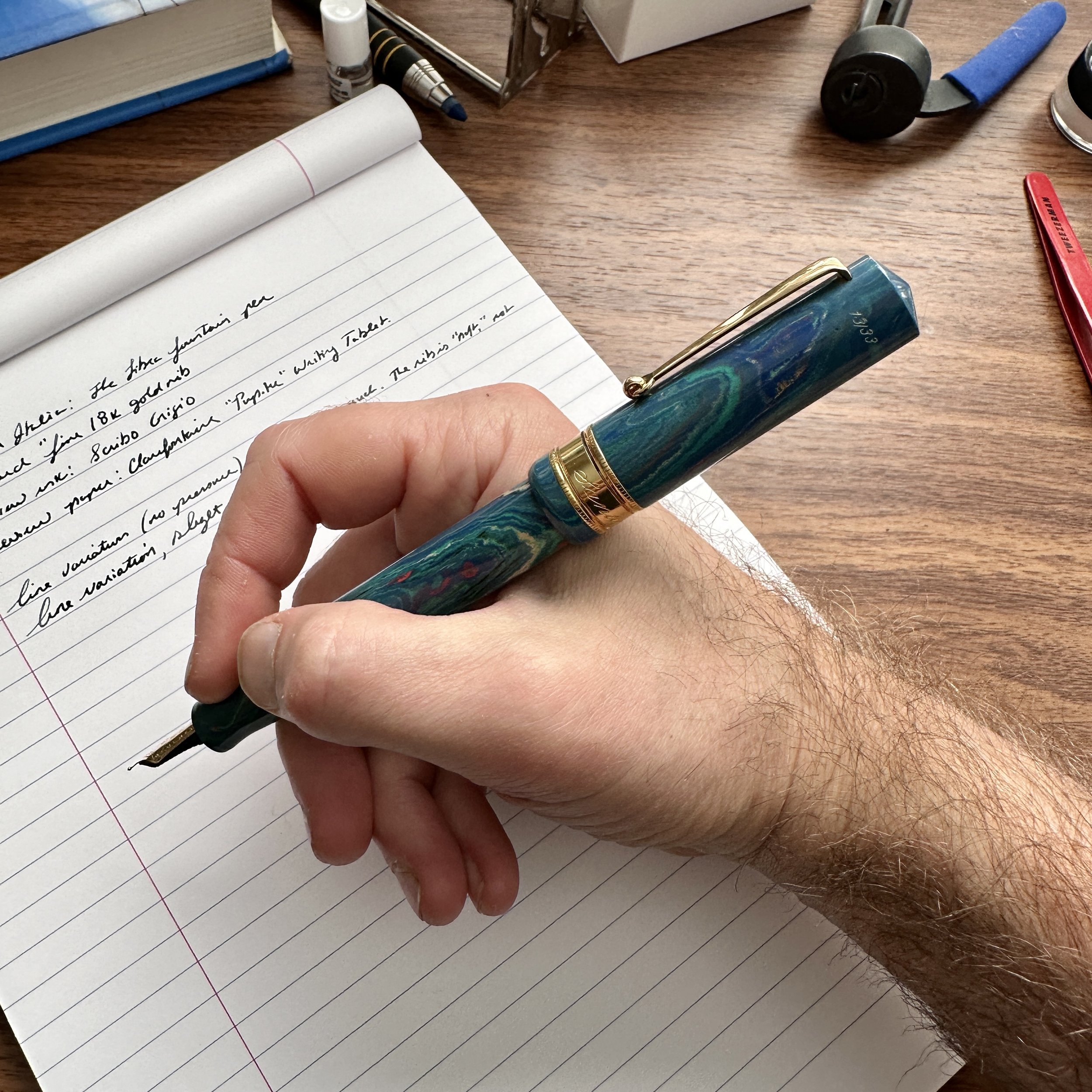
Santini describes the Libra fountain pen as "classic, elegant, and light." I would agree with all of that, from the form of the pen itself to the materials chosen. While the Libra features a piston filling system, it's not a heavy pen, leading me to believe that Santini uses something other than brass for their filling mechanism. (Perhaps ebonite or titanium?). I would characterize the profile as classic and vintage-inspired, with a slightly oversized cap and peaked ends, a wide cap band with coin edges, and a roller clip. "Santini Italia" is engraved on the cap band, and while prominent, doesn't appear out-of-place in the overall design of the pen. The Libra is definitely a larger pen, and while it will technically post, I found the pen way too long to be usable posted.

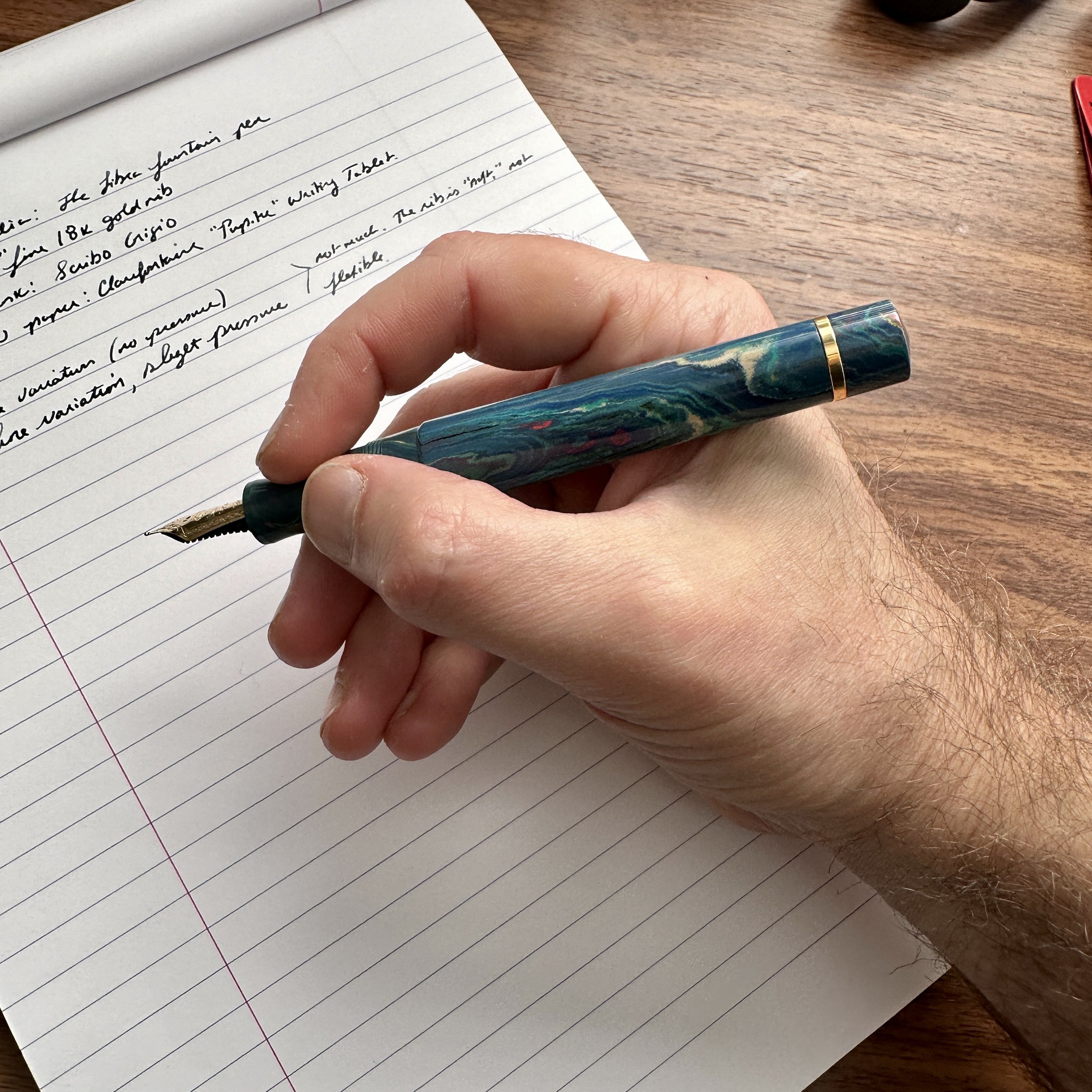
View fullsize Santini Libra In-Hand
View fullsize Santini Libra Posted

My Santini Writing Experience - All About the Nib

While the pen world's move toward "standard" nibs manufactured by German companies JoWo and Bock certainly has its upside (lower pricing due to economies of scale, interchangeability, ease of repair and customization, etc.) it has also resulted in what some would consider a “uniform” (some would say “consistently boring”) writing experience. Don't get me wrong - I consider JoWo nibs to be reliably smooth writers, and it's hard to beat a well-tuned Bock fine-nib - but at the same time, I love the unique, one-of-a-kind writing experience that you can only get from a nib made and individually tuned in-house.

Though on the ornate side, Santini nibs are tastefully engraved with the company’s “S” logo and 1998, the year in which they started making pens. I also appreciate that the nib size designation is visible on the nib - something that many pen companies omit these days and which I find inconvenient, especially when trying to easily compare nibs.

It took a bit of time to get used to the Santini nib, with its combination of softness and tactile feel. I reviewed a standard 18k fine nib, paired with Santini's ebonite feed. Overall, I would describe the Santini writing experience as "bouncy", and you of course have the option of a true flex nib if you'd like more line variation. It definitely writes on the wetter side. The closest comparison I can make to another nib would be Scribo, though I found the Santini fine nib more tactile than my extra-fine Scribo, akin to a fine Aurora if the Aurora nib was a bit less stiff. (If you'd like to read previous reviews of both Scribo and Aurora fountain pens, visit the T.G.S. Fountain Pen Review Archive.) Personally, I enjoy my nibs when they’re on the more tactile side: with Santini, those looking for a more "glassy smooth" feeling should probably opt for a nib that lays down more ink, possibly a medium, broad, or even a stub.

A writing sample from the Santini Libra: The paper is a ruled Clairefontaine “Pupitre” writing tablet, and the ink shown here is Scribo Grigio, a dark grey-blue.

Santini Price Points and Where to Buy

As one might expect from a luxury, small-batch maker that designs and manufactures their pens 100% in-house, Santini pens are not inexpensive, though the Libra remains relatively accessible. In fact, the Libra sits at the lower end of Santini's product range. Available in either acrylic (269 Euros) or ebonite (369 Euros), this pen - at least to me - represents incredible value for the combination of materials, craftsmanship, and artistry, especially compared to many other European makers whose price increases only seem to have accelerated in recent years. Santini makes several other models as well, including the Toscana (starting at 269 Euros), the nine-sided faceted Nonagon (starting at 460 Euros), and the Giant (which sports a No. 8 nib and sells for 630 Euros). While not inexpensive, I found none of these prices particularly eye-popping, considering they all include 18k gold nibs and most include an integrated filling system. All pens can be purchased directly from Santini Italia via their online shop, and I was not compensated in any way for this review.

Santini’s ebonite pens are typically released in runs of 33, and numbered on the cap.

Conclusions and Takeaways

While I would ordinarily want to spend more time with a fountain pen before reviewing it, especially a pen from a brand I've never used, this pen doesn't belong to me and it sadly needs to go home. That said, I've seen enough to know that I will eventually want to acquire at least one Santini pen for my personal collection, and I'd love to be able to compare the Libra against one of Santini’s higher-end offerings such as the faceted Nonagon or the Giant with that magnificent looking nib. Here's to hoping that Santini returns to the D.C. Pen Show (or better yet, another show before August), though I suspect I will have another Santini Pen in hand well before then!

The Santini Italia Libra, shown here compared to the Montblanc 146 Ultra Black and the Aurora 88 Sigaro Blu.

Further Information: Check Out Our YouTube Channel!

I’ve decided to supplement this review by filming a short video showcasing a few of the pen’s attributes discussed in this review, namely the ebonite material and the nib. The video also includes a writing sample. You can view the video here on our YouTube Channel!

Did you find this review enjoyable and/or informative? If so, please consider supporting us by visiting the T.G.S. Curated Shop, and/or consider joining the T.G.S. Patreon Program! Patreon members enjoy exclusive content, access to meetups, sample sales and more.

In Pens Tags Pen Review, Santini Italia, Santini Libra, Fountain Pens
4 Comments

Expanding the Pocket Fountain Pen Lineup: A First Look at the Wingback Fountain Pen

September 16, 2023

Pocket fountain pens are hard to get right. For starters, it’s extremely difficult to design a pocket fountain pen that works for for a broad swath of the market, because once you start reducing the size and weight of the pen to so-called “pocket-sized” you limit the number of people who can use it. On the other hand, if you make a “pocket” fountain pen too big, it may no longer be truly “pocketable.”

Wingback is a UK-based designer/manufacturer of writing instruments and personal accessories, and I’ve previously reviewed their Mechanical Pencil that won a 2023 Red Dot design award. A hallmark of Wingback’s design is their ability to avoid the pitfalls of so many manufacturers who attempt to work with heavier materials such as brass and stainless steel, by striking a near-perfect balance of width, length, and weight. I now have a full set of the Wingback writing instruments - Mechanical Pencil, Mechanical Pen, and Fountain Pen - and all of them are exceptionally useable in addition to being beautiful design pieces.

The Wingback Fountain Pen in stainless steel, shown next to the Wingback Mechanical Pen in black stainless steel. Both come with a nice cotton sleeve that you can use for pocket carry. I plan to review the Mechanical Pen in the near future.

The Wingback Fountain Pen, which recently launched on Kickstarter, adopts the cylindrical profile that’s probably familiar to many pocket pen enthusiasts, but in a size that’s somewhat uncommon and, in my opinion, fills a need in the market. For example, I loved the idea of the Kaweco Liliput, but that particular pen ultimately ended up being too small for anything more than quick notes. I’d place the Wingback Fountain Pen between the Liliput and the larger Kaweco Supra size-wise, which could be a sweet spot for those who love this type of design but have had a hard time finding a pocket pen that balances well in their hand.

The Wingback Fountain Pen adopts a minimal, streamlined design with no branding other than the subtle “Wingback” engraved on the cap. Diamond knurling is perfectly centered on the barrel when the pen is capped, and well-executed in the sense that it’s comfortable to hold this pen for long periods of time. (More on that below.) Finally, both ends of the section feature an o-ring on the threads, which protects the user from any ink leakage and prevents the nib from drying out. Interestingly, Wingback implies that this pen can be eyedroppered, stating that with the o-ring, “you can convert the pen’s chamber within its body into a reservoir for your ink of choice,” and that “we have tested and approved the stainless steel for corrosion resistance to inks, and are currently testing brass and titanium in longer long term trials.” I don’t personally eyedropper metal pens, but I do know people who have done so without incident, and as long as the metal resists corrosion long-term you should be fine. I lump this one under the header of “proceed at your own risk.”

Three of the four finishes. Sorry, I don’t have an example of the titanium (yet).

The Wingback Fountain Pen is available in four materials/finishes to start: stainless steel (pictured here), brass, tungsten-carbide coated black stainless steel, and titanium. Custom laser engraving of up to 50 characters is also available, if you would like to personalize your pen.

Nib and Overall Writing Experience

The Wingback Fountain Pen uses a standard Bock 076 stainless steel nib, and the one I received (a fine?) arrived perfectly tuned. According to the Wingback Kickstarter page, five standard nib options will be available, including extra-fine, fine, medium, broad, or double/extra-broad. I would consider the Wingback a pure cartridge pen - while one of the mini converters from Kaweco or Monteverde might fit, those don’t hold much ink and you’re likely better off refilling a standard short international cartridge via syringe if ink choice is important to you.

The Wingback Fountain Pen measures 95mm unposted / 135mm posted.

Though I personally find them well-balanced, some have remarked that the Wingback Mechanical Pencil and Mechanical Pen are a touch short. The Wingback Fountain Pen is indeed quite short unposted, but offers a workaround since the cap posts, much like the Schon DSGN Pocket Six or the aforementioned Liliput. While the Wingback Fountain Pen might be just long enough to jot quick notes unposted, longer writing sessions will probably require posting the cap unless you have very small hands.

I’ve been using the Wingback Fountain Pen for the past two weeks, and haven’t experienced any of the hand fatigue that sometimes comes with machined metal pens of this weight. The knurled grip eliminates any slippage, while remaining subtle enough not to hurt your fingers. This pen will stay in my pocket pen rotation, and I’m considering whether to back the Kickstarter for a Black Steel or Titanium version.

Read More on Pocket Writing at T.G.S.

I jumped at the chance to review this pen because pocket pens (and pocket fountain pens) are what I consider to be one of the last categories where there is a lot of room for innovation. As fountain pens become more mainstream, enthusiasts want to be able to carry their writing instrument of choice everywhere they go, which has led to an explosion of more compact, pocket-sized options over the years. I periodically update the site’s “Guide to Top Pocket Pens”, and once the Wingback Fountain Pen is released, I see a clear path to that pen being prominently featured on that list.

The Wingback Fountain Pen shown with, from left, the Schon DSGN Pocket 6, TWSBI Mini in White + Rose Gold, the Kaweco AL Sport in Red, the Kaweco Supra in Stainless Steel, and the Schon DSGN Full-Sized Metal Fountain Pen.

Details on How to Get the Wingback Fountain Pen

As of the date of publication of this post (September 16, 2023), you have 19 days remaining to back the Wingback Fountain Pen on Kickstarter. While pledges are listed in £, they start at around $120 (which may fluctuate a bit due to the exchange rate). Wingback estimates that this will represent a 25% discount off the eventual retail price, which seems about right since both the standard versions of the Mechanical Pencil and the Mechanical Pen currently retail for around $158 USD.

Yes, for those of you who will ask, the Wingback Fountain Pen does fit in the Plotter Pen Holder!

Wingback is a company with a long track record of successful Kickstarters, so I have no concern about backing this one, but anyone considering backing a crowdfunded a project should of course be aware that Kickstarter offers no guarantee of timely delivery (or of any delivery, for that matter). Projects do hit delays, and by funding a project you are supporting the project itself, as opposed to “purchasing” a unit. That said, this project already has raised nearly $78,000 of its $2,500 funding goal, so I wouldn’t anticipate any issues here.

Disclaimer: Wingback sent me the Wingback Fountain Pen pictured here for review purposes, free of charge. T.G.S. has not otherwise been compensated for this review and is not being paid for referrals or advertising. T.G.S. is supported financially via purchases from the T.G.S. Curated Shop and pledges via the T.G.S. Patreon Program.

In Crowdfunding, Crowdfunding Projects, Pens Tags Wingback, Wingback Fountain Pen, Kickstarter, Pocket Pen, Pocket Pens, Pocket Fountain Pen
3 Comments
← Newer Posts Older Posts →
Store Hours and Location
Visit the T.G.S. Curated SHOP
*New* Updated "Best Pens" Guide (2025)
T.G.S. 2025 Holiday Gift Guide
TGS x Roterfaden TGS_25
Hierarchies of Fountain Pen Friendly Paper

Join Our Patreon!
Subscribe to the TGS E-mail List

Featured Posts

Featured
Cover On the Paper Trail Intro Clip.jpeg
Dec 3, 2025
Introducing "On the Paper Trail," a New Podcast/Video Collaboration with Lisa Vanness of Vanness Pens!
Dec 3, 2025
Dec 3, 2025
Iro-Utsushi-Fine-Dip-Pens.jpeg
Oct 1, 2025
The Pilot Iro-Utsushi Dip Pen (and in General, Simple vs. Fancy Dip Pens)
Oct 1, 2025
Oct 1, 2025
Levenger-Annotation-Pad.jpeg
Sep 20, 2025
Five Boutique Paper Brands I'm Watching Closely and Why
Sep 20, 2025
Sep 20, 2025
The Gentleman Stationer RSS

© Digital Divide Media, LLC, 2014-present.

All content is the exclusive property of Digital Divide Media, LLC, d/b/a The Gentleman Stationer, including “The Gentleman Stationer” website and trademark, and should not be reproduced without express written permission.  All rights reserved.

All content containing paid advertising, affiliate links, or sponsored content will be plainly disclosed by a disclaimer when/if featured.

Contact Information

Store Shipping Policy and Return Policy

Privacy Policy

Cookie Policy

Terms and Conditions

Powered by Squarespace