Pen Review: Omas 360 (Old Version)

Over the past two weeks or so I've been writing with my primary Atlanta pen show acquisition, a classic model Omas 360 fountain pen.  (Side Note:  I've used the term "classic" as opposed to "vintage."  Omas introduced the 360 in the 1990s, so it's not been around as long as other Company designs such as the Ogiva or the Paragon, which I believe date to the 1930s, if not earlier.)   

I love the lines on this pen.  It's triangular in shape, so it won't roll off the desk.  I'm also a huge fan of the Omas "greek key" trim. 

A few years back, Omas changed the design of the 360, omitting the rounded cap-top in favor of an angled-flat top that more prominently displays the Omas "O" logo.  They also changed the pen from a piston filler to a cartridge-converter model, horrifying many traditionalists.  I like the new look, and I don't mind CC model pens.  I travel a lot for work, and if I want to take a fountain pen with me on the road a pack of cartridges is perfectly adequate.  Given my terrific experience with this pen, I fully intend to pick up the newer model at some point.

For my first 360, however, I wanted the original.  From listening to the Anderson Pens podcast I had heard that Atlanta featured a prominent dealer in vintage/discontinued Omas pens.  The 360 was actually far down my list of pens to acquire at this show, but I've always wanted one (black, with silver trim), and the price was way, way, way too good to pass up.  I managed to negotiate a small additional discount because of some pretty severe nib misalignment, but fortunately I was third on Mike Masuyama's list (following Mr. Pen Addict himself, Brad Dowdy) so the nib was no deal-killer.  

Build Quality

The 360 is a solid, well made pen.  It's made of resin, so it's not particularly heavy, and it's a good size (slightly under 6 inches capped).  The 360 is large enough to comfortably use unposted.  You can post the pen, and the cap fits perfectly onto the back, but posting transforms the 360 into a long pen and the balance is somewhat off due to top-heaviness.  I've been using the pen both ways, but generally unposted.  The piston is smooth, and it holds a reasonable amount of ink.  

Nib

Omas nibs are known for their smoothness, and for being slightly "springy."  This one is no exception.  The one trouble spot with these pens is that they are often set to write extremely wet right out of the box.  This has been was my experience (I have an Omas Ogiva that is currently being worked on), and I've seen this issue commented on elsewhere.  http://tinyurl.com/8kbhmud.  I immediately took the pen to Mike Masuyama and had him smooth the nib and reduce the flow.  The pen now writes a beautiful, smooth, fat medium line. 

A nice, standard Medium Nib.  Silky Smooth.

Triangular Section    

One thing that people either love or hate about this pen is the fact that the section, like the rest of the pen, is triangular.  Personally, I've got a thing for triangular writing instruments, both pens and pencils, so this wasn't an issue for me.  The pen sits well in the hand, given how I hold a pen, but I can see that it's a love-it or hate-it thing.  If you hold the pen in a way that causes the triangular section to dig into you fingers, this won't work for you.  In the new 360, Omas apparently has rounded off the section so that it will appeal to more people.  I've not seen or held the new version, so I can't comment further.

The Verdict

So far, I really like this pen.  I can see it making its way into the regular rotation.  It's a great pen to keep on your desk, since it doesn't roll, and the unique shape and styling almost makes it a piece of art.  The Masuyama nib seals the deal.
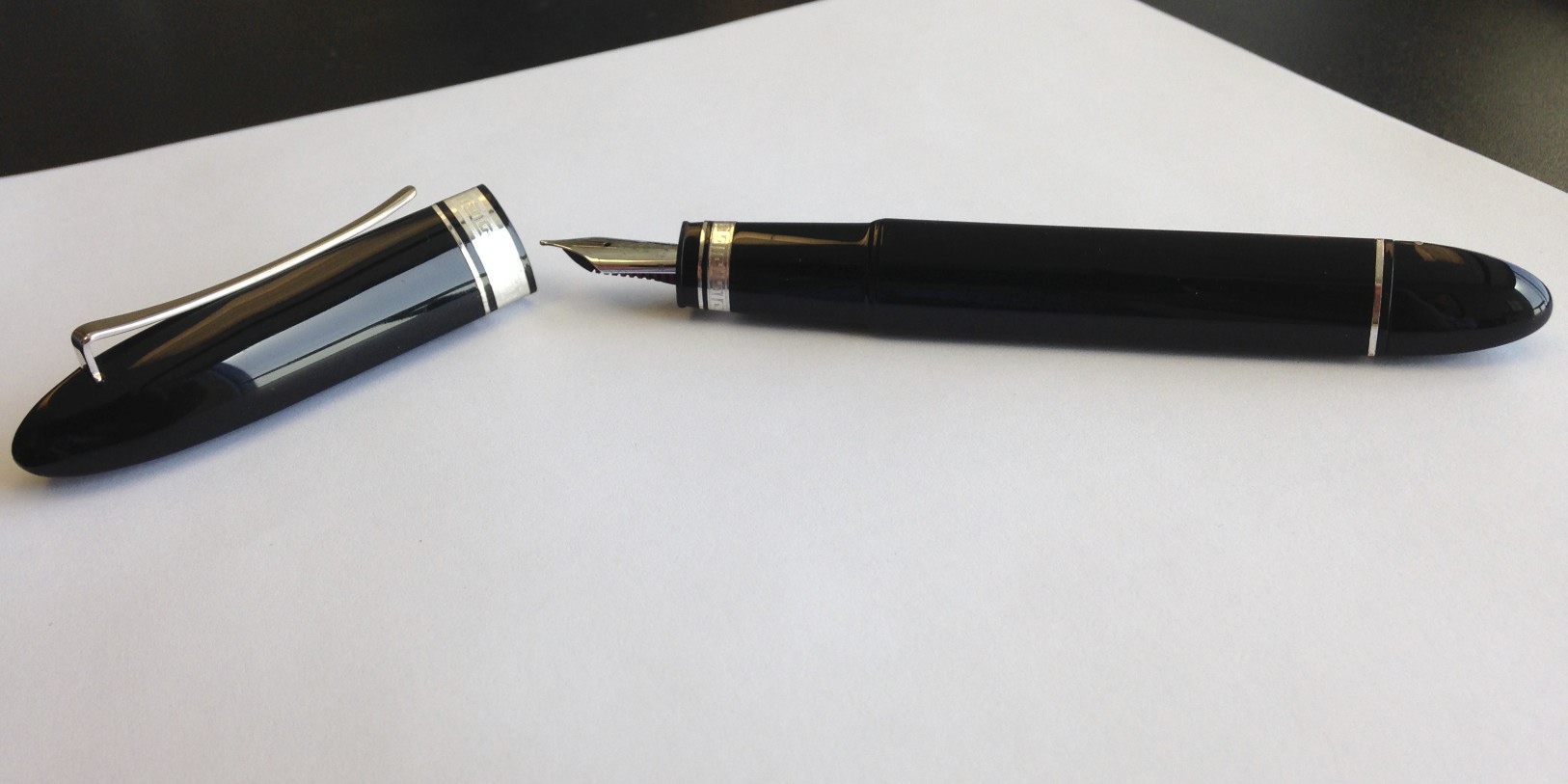
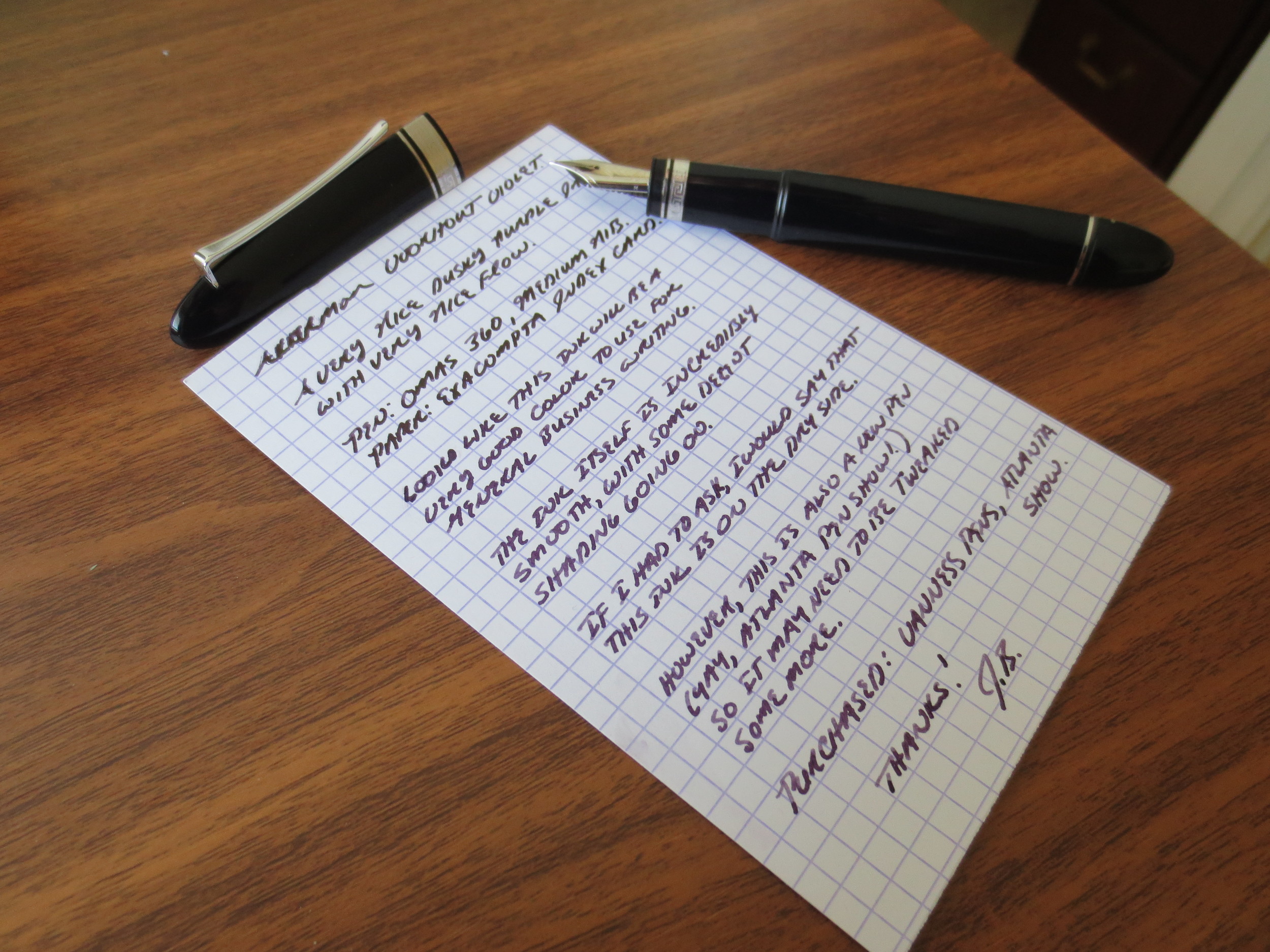
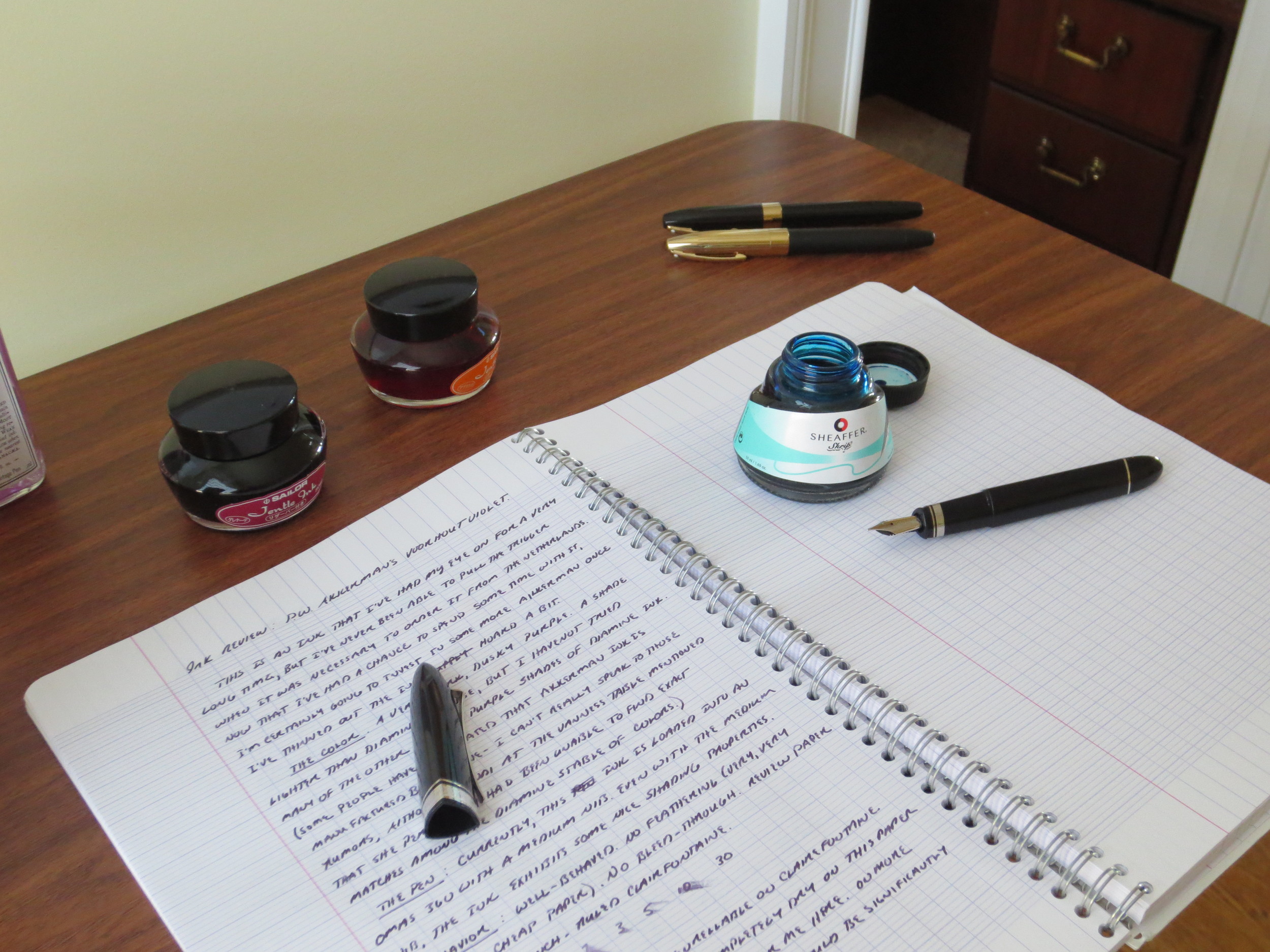
Three photos, from left to right:  The pen uncapped, a writing sample with P.W. Akkerman Voorhout Violet, and how I spent my Saturday morning. 
Ink Review: Noodler's Air Corps Blue-Black

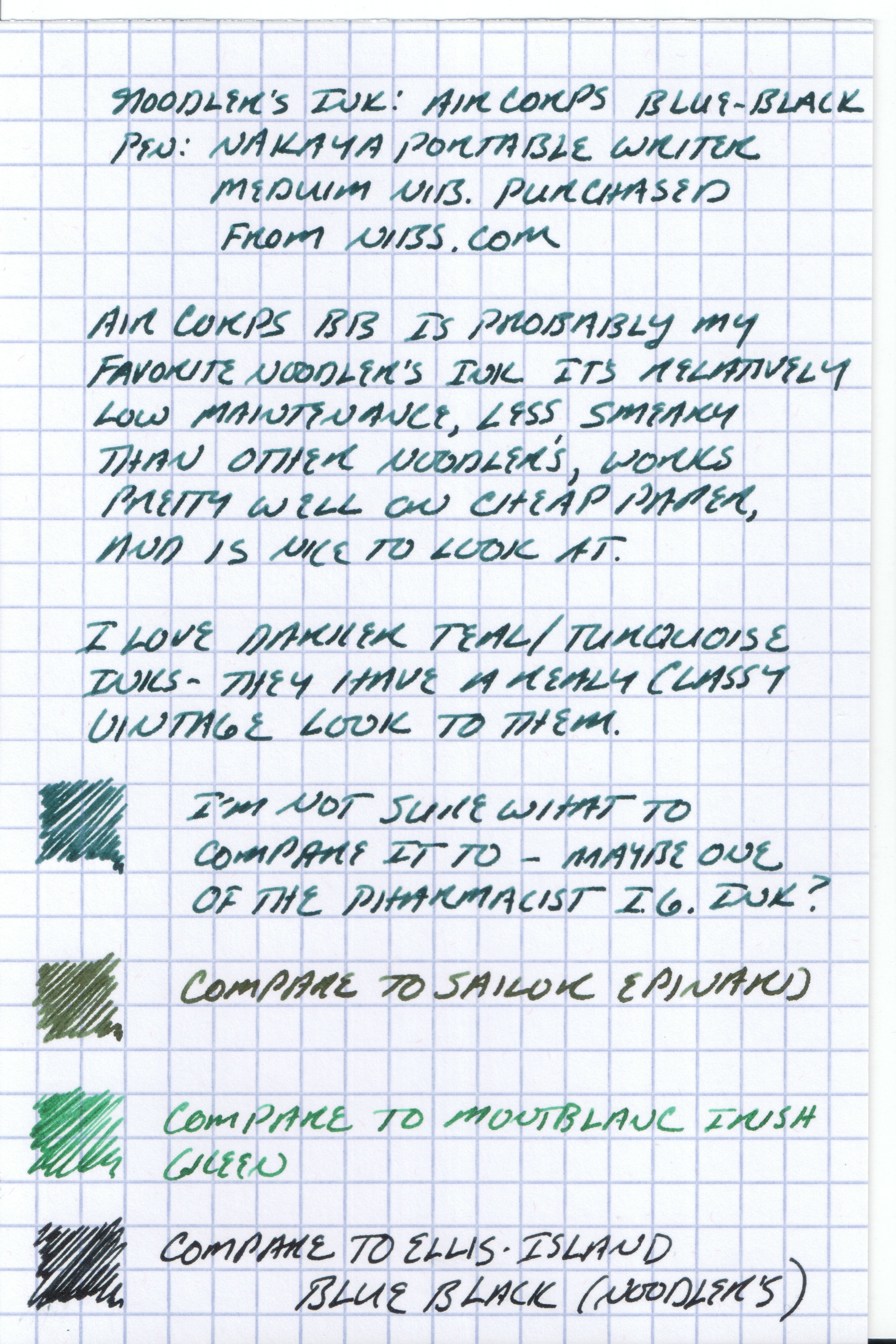
This ink was a surprise.  I've not been a huge fan of Noodler's ink.  I've found that with certain exceptions, Noodler's never dries, transfers ("ghosts") onto previous pages when you try to write on both sides of a notebook page, and stains pens.  Reading some of the pen forums, people have resorted to diluting the ink with distilled water in order to eliminate some of these undesirable characteristics, but that's always seemed like too much trouble for me.  I'm all for fiddling around with this hobby, but as far as ink goes, I've always expected it to "write right out of the bottle." I was pleasantly surprised to discover that this ink was, to me, one of the Noodler's exceptions. 

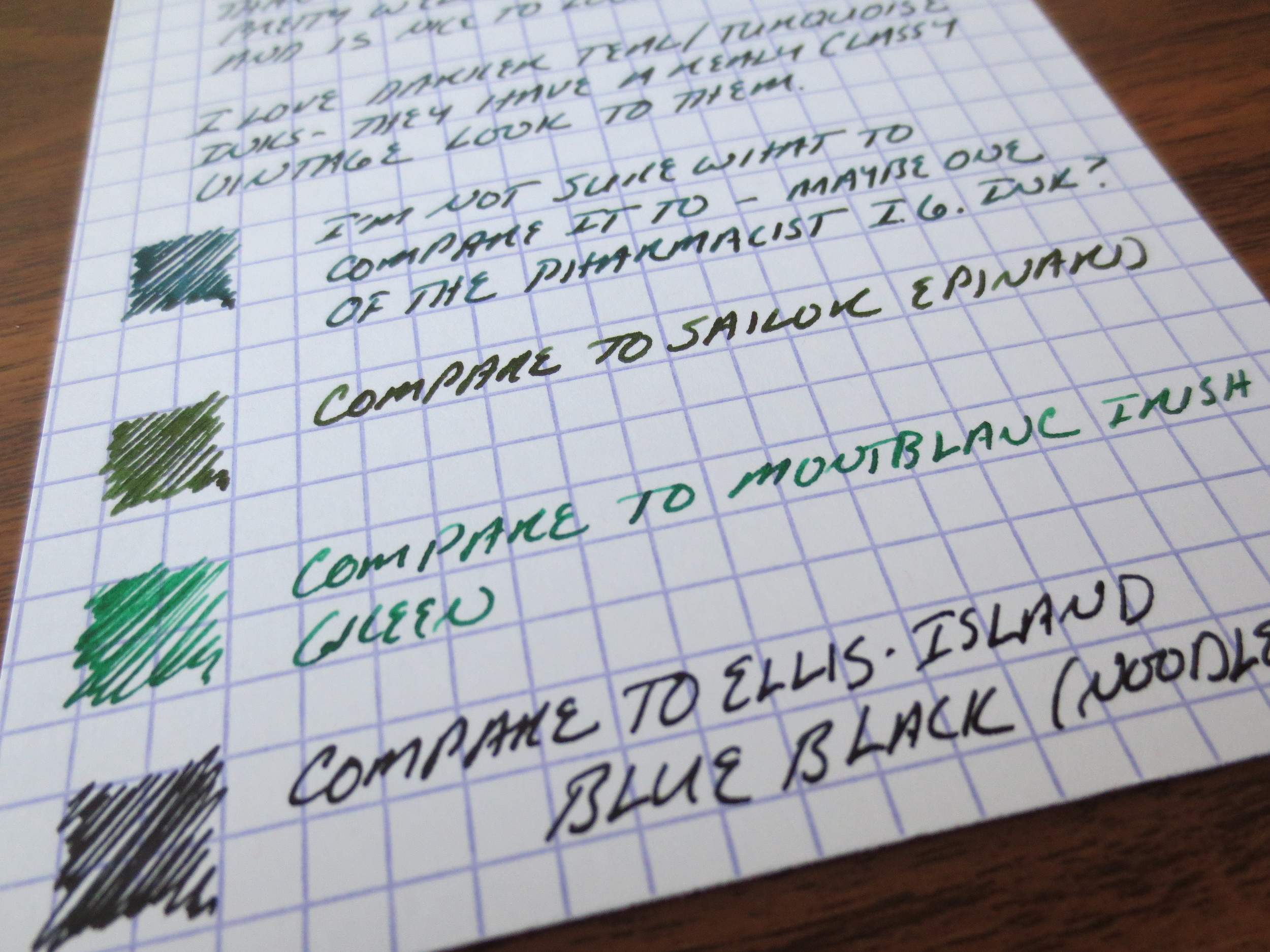
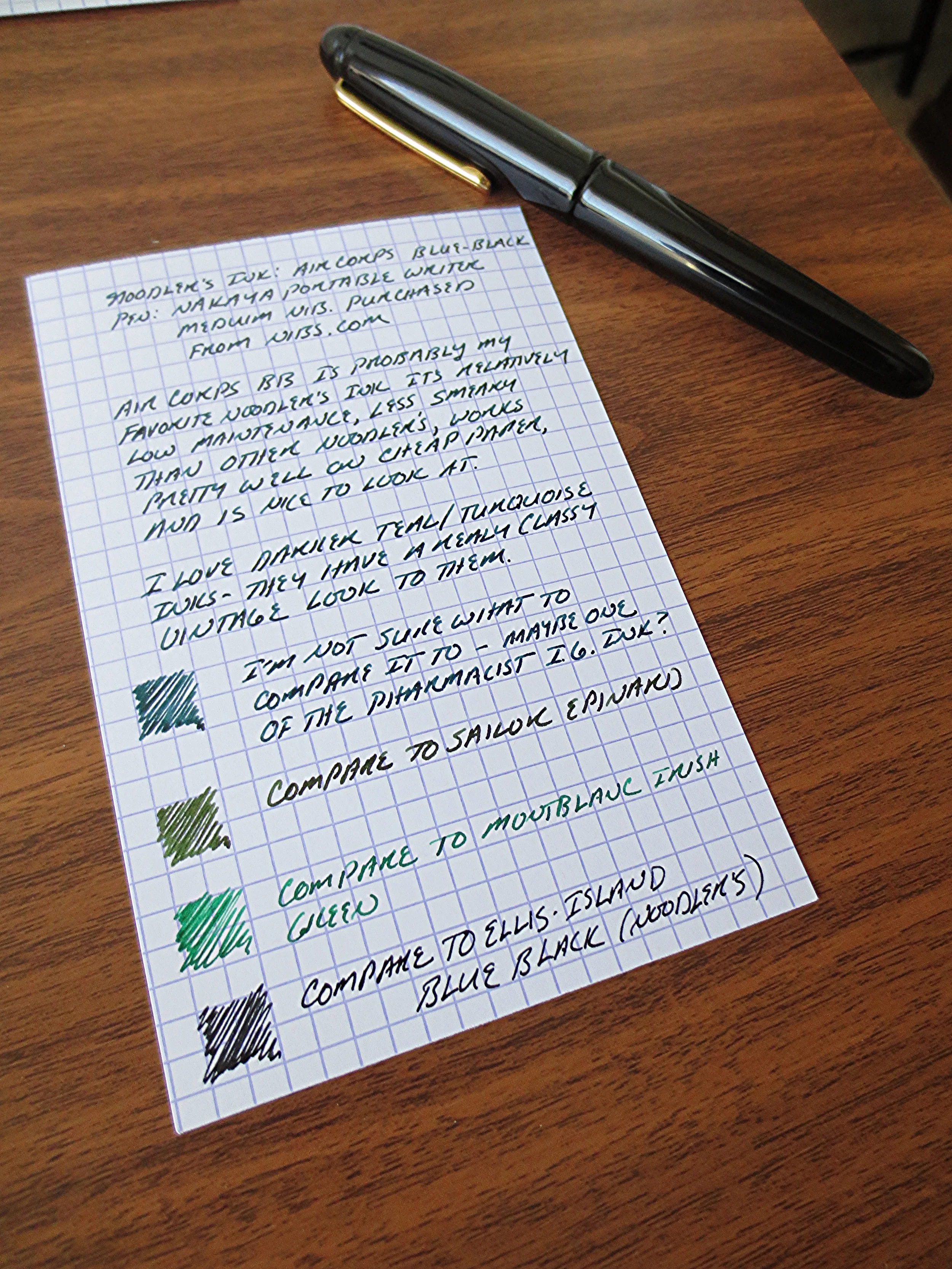
I compared this to three other inks I had loaded up:  Montblanc's Irish Green, Sailor's Epinard, and Noodler's Ellis Island Blue-Black, all of which I like, and the latter of which I really want to love, if not for the fact that it seemingly ne…

I compared this to three other inks I had loaded up:  Montblanc's Irish Green, Sailor's Epinard, and Noodler's Ellis Island Blue-Black, all of which I like, and the latter of which I really want to love, if not for the fact that it seemingly never dries (in a fine nib, no less).  Grrrr...

The pen I used for this review as a Nakaya Portable Writer (with clip) in Solid Black.  The nib's a medium, which translates into a Western fine, maybe an extra-fine depending on the brand.  This ink worked well in the pen.  No hard starts, and no staining the converter.  The paper is an Exacompta index card.  

I will say that this ink is more of a dark teal as opposed to a true blue-black, leaning heavily towards the blue-green end of the spectrum.  If I had to compare it to anything, I might choose Pharmacist's Turkish Night.  (I know, I know, I never finished the Pharmacist series of reviews that I started a year or so ago.  Those are in the queue.)   

Ink Review: Franklin-Christoph Olde Emerald

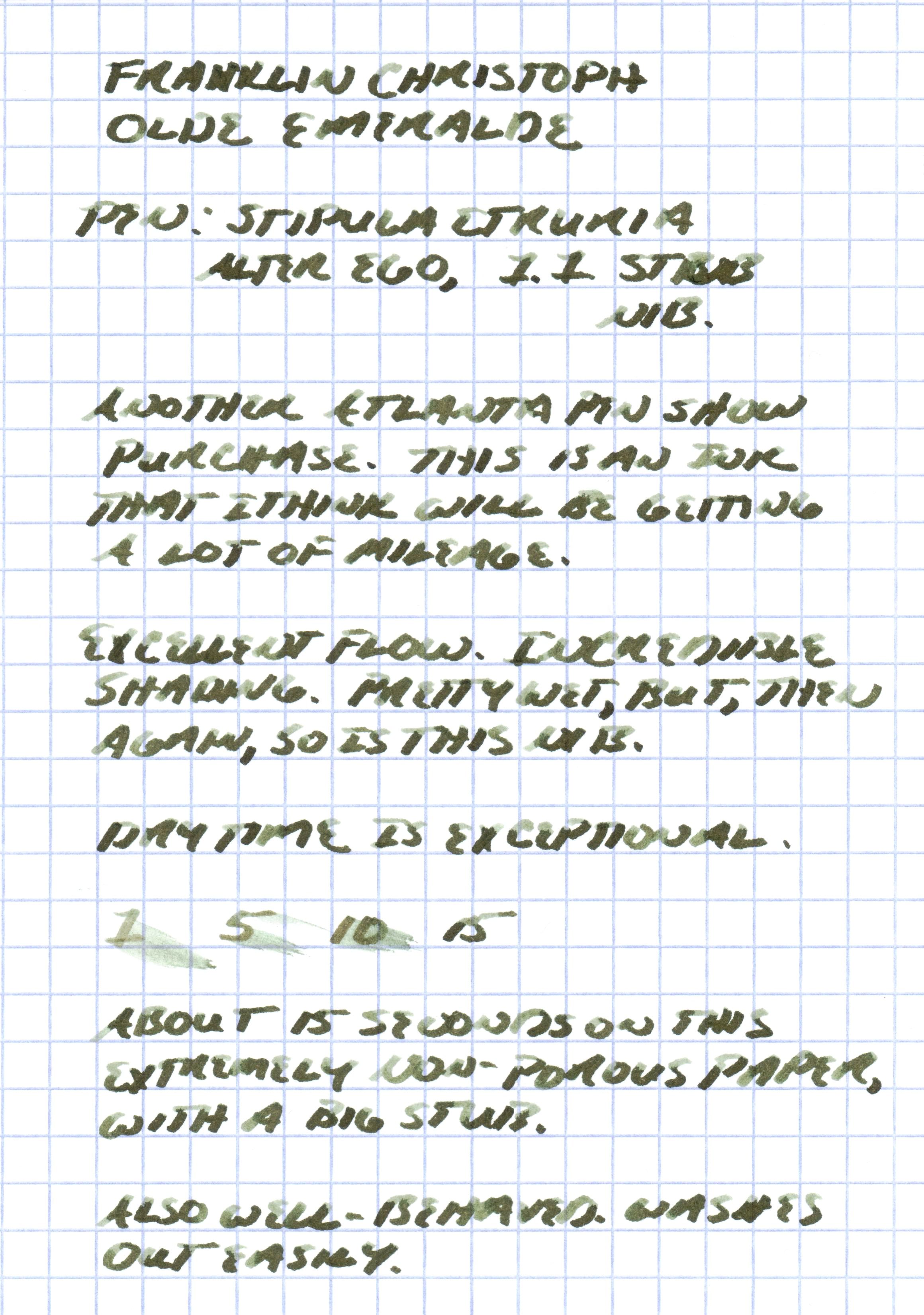
This ink is another that I have been wanting to pick up for a long time, but just now bit the bullet and got around to doing so.  Franklin-Christoph introduced their line of inks last year, and they've received rave reviews so far.  I can see why:  they're classy dark shades of blue, purple, green, and red, and from what I've seen so far they are incredibly low maintenance and safe.  At one of the pen shows last year I took note that Mike Masuyama was using the Dark Denim to test the pens he was working on, and he was telling everyone sitting at his table that he is very careful what inks he puts in his customers' pens.  Anyhow, I picked up two bottles at the Atlanta Pen Show:  Olde Emerald (Green) and Syrah, Syrah (Red/Burgundy).  I have not inked up a pen with the Syrah, Syrah, but here is my take on the Green, and it's a good one. 

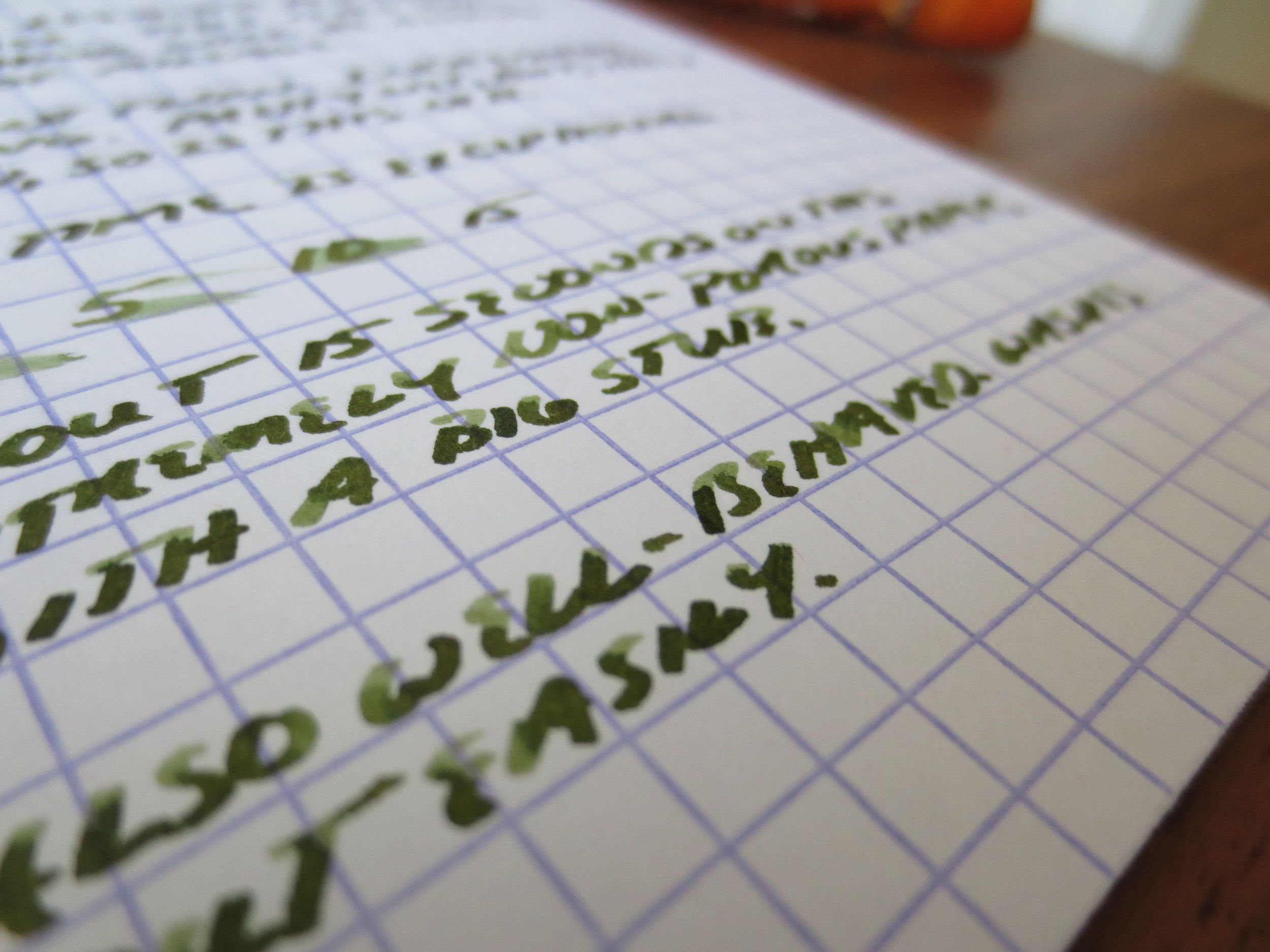
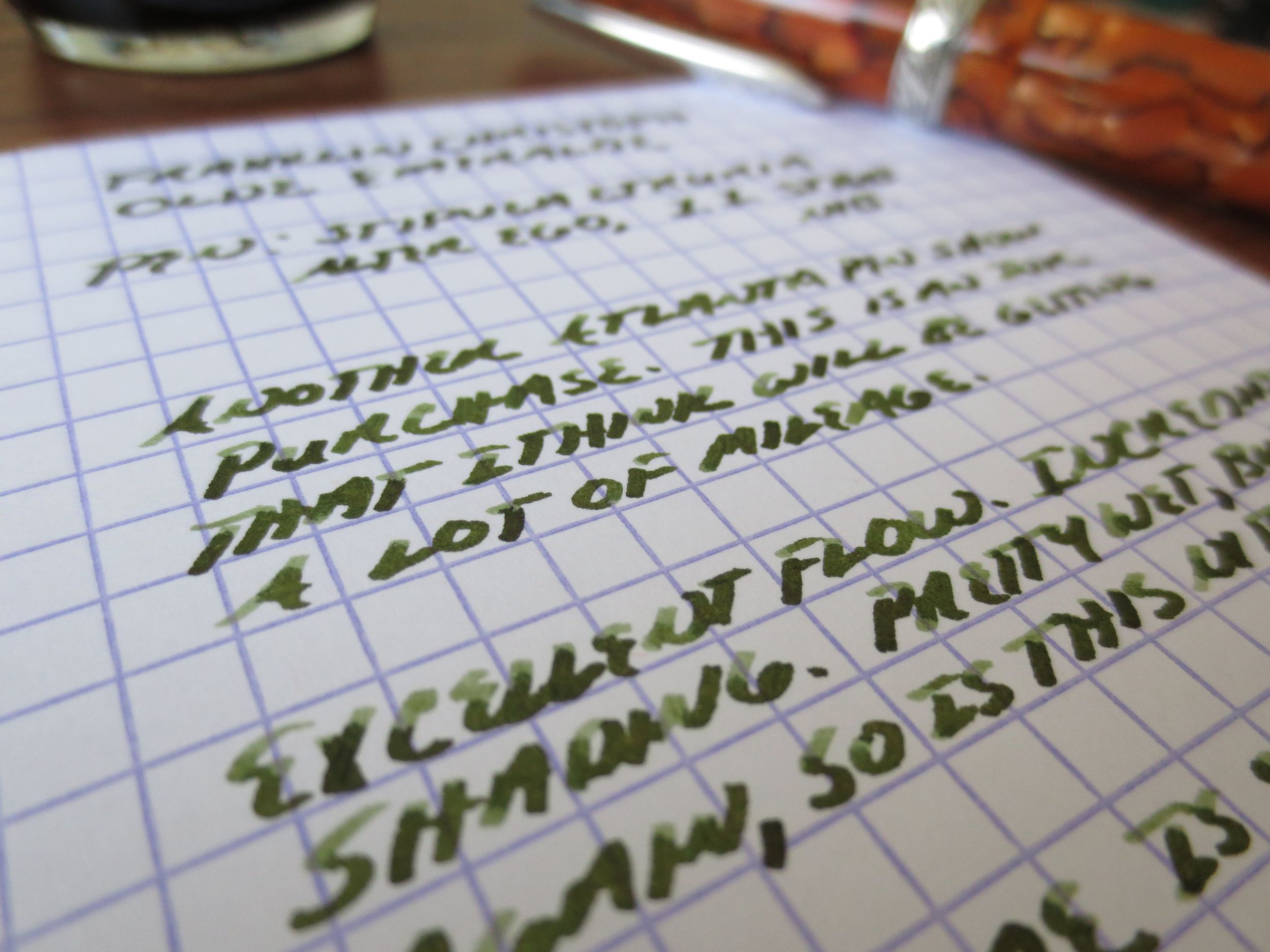
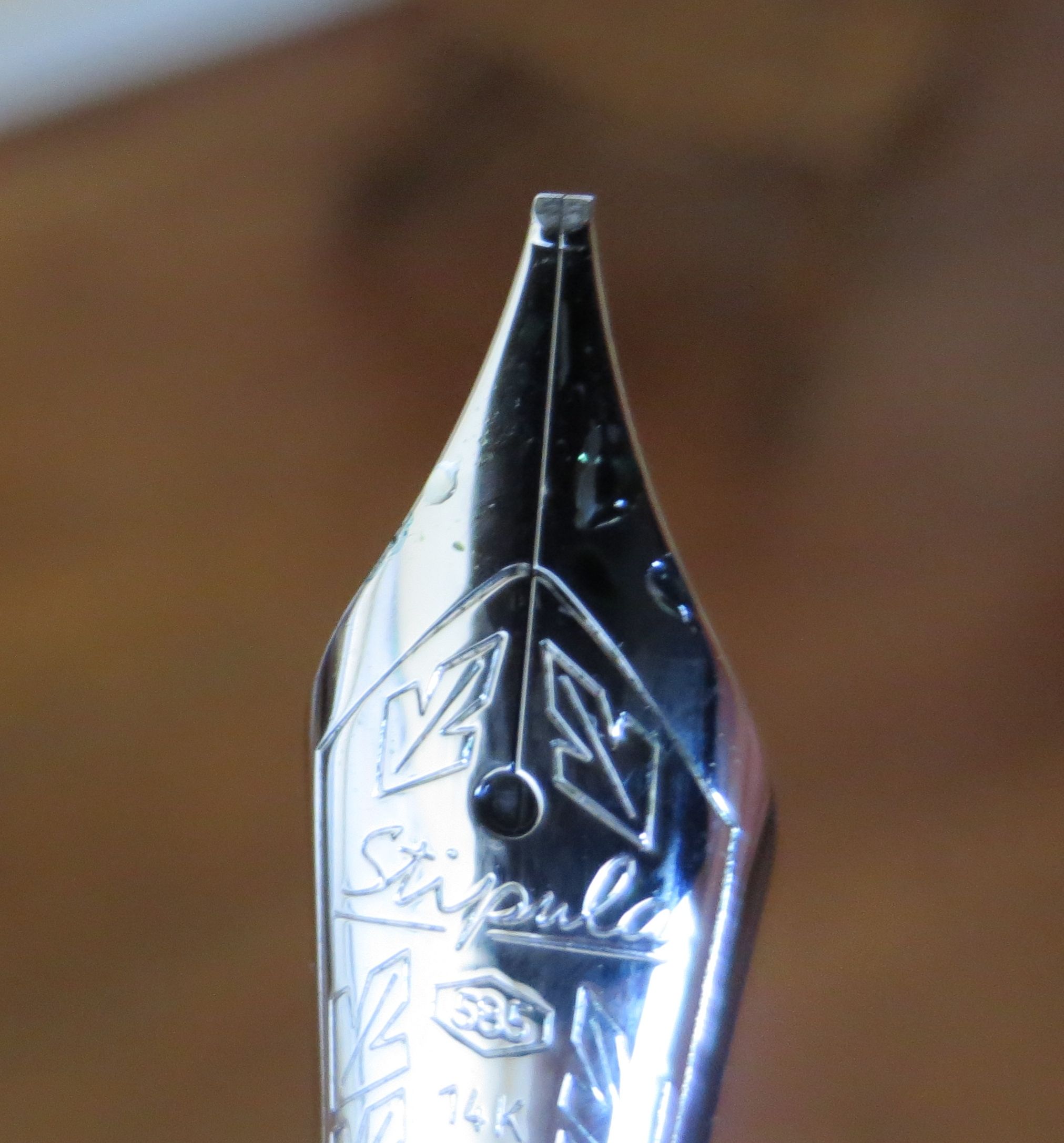
This review was written with a Stipula Etruria Alter Ego with a 1.1 mm Stub on an Exacompta Index Card.  The Stub is pretty wet, and the Index Card not exactly absorbent, so the dry time on this ink is slower than it would be on typical daily use paper.  

This is a fairly wet ink, but it dries quickly.  The dry time reflected on my written review is somewhat misleading.  I've found that this ink dries within 5-10 seconds on most papers, and it was dry at 15 seconds on this Exacompta index card.  As you can see from the photos, the ink shades beautifully.  The color has been described as "the color of money," which from what I've seen, is pretty accurate.  I've found myself using this ink on a daily basis!  

Ink Review: Akkerman Chinatown Red and Voorhout Violet

My first stop at last weekend's Atlanta Pen Show was the Vanness Pens table.  I drove down from Nashville for the day, pretty much worrying the whole way that Vanness would be sold out of Akkerman by the time I arrived.  I shouldn't have worried!  Lisa and Wendi brought 75 bottles, which I think covered the full spectrum of colors, and while I hear the ink went fast, there was plenty of it left on Saturday morning when I got there.  Chinatown Red and Voorhout Violet were the two colors I had come for, so I snapped them up and took them out to my car for safekeeping.  And, of course, when I got back to the hotel that night, they were the first two that I inked up.  

These are the "baby Akkermans," (60ml), not the 150ml bottles.  The large bottles have been discontinued. 

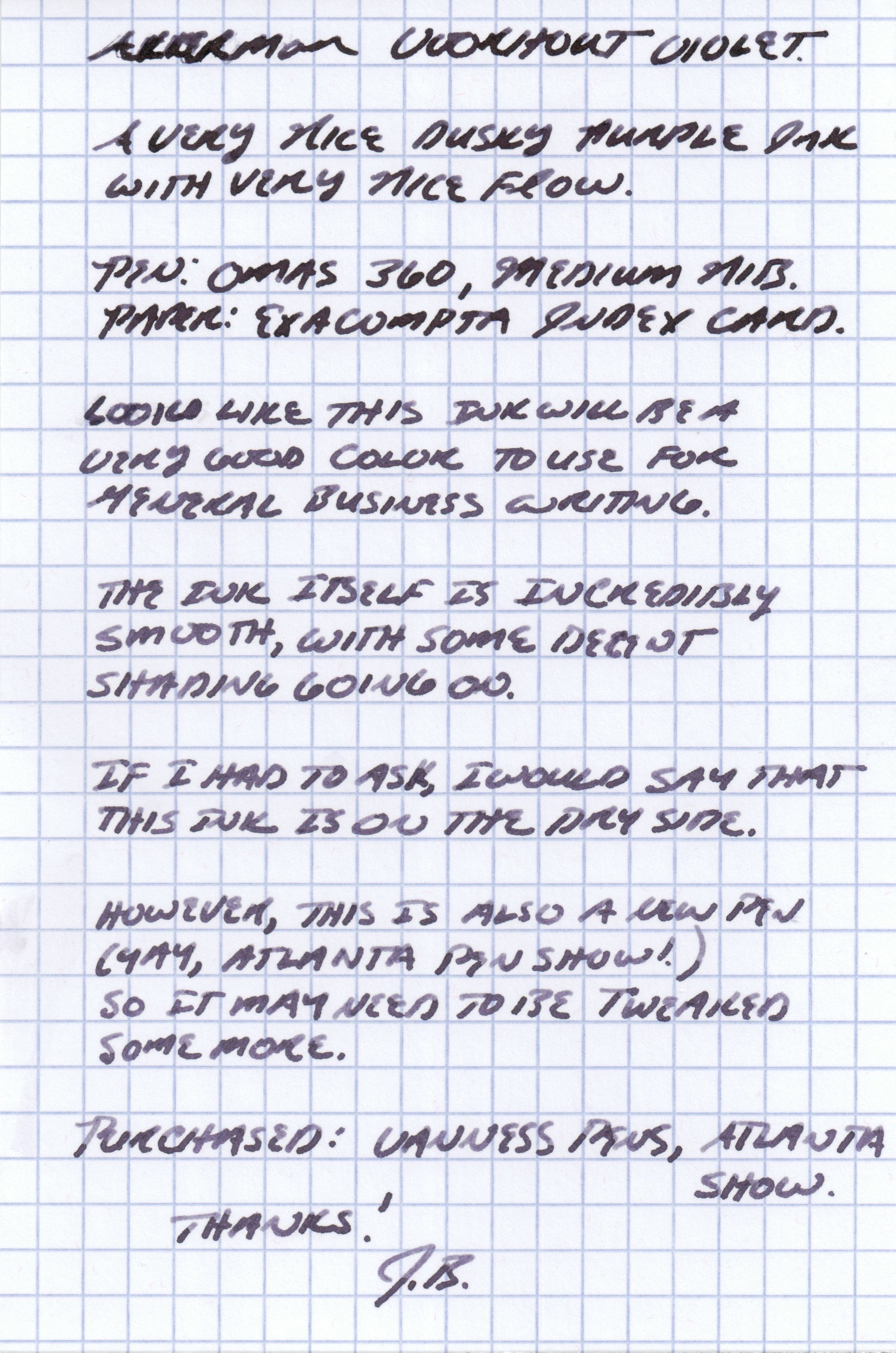
Which ink to review first?  The Voorhout violet is definitely the most interesting of the two, at least to me.  I love dark purple inks, and have been looking for a purplish black that I can use professionally on a daily basis.  I have Pharmacist's Purpura Imperialis, which is nice, but the IG formulation is a little too high maintenance for my routine use.  This ink, on the other hand, is nearly perfect for work.  Even in a wet pen, it's well-behaved on cheap paper, does not feather or bleed through, and dries quickly.  I would say the ink itself is slightly "dry."  There's great shading, as you can see in the gallery photos below.

Akkerman Voorhout Violet exhibits some nice shading properties.  Written on an Exacompta Index Card. 

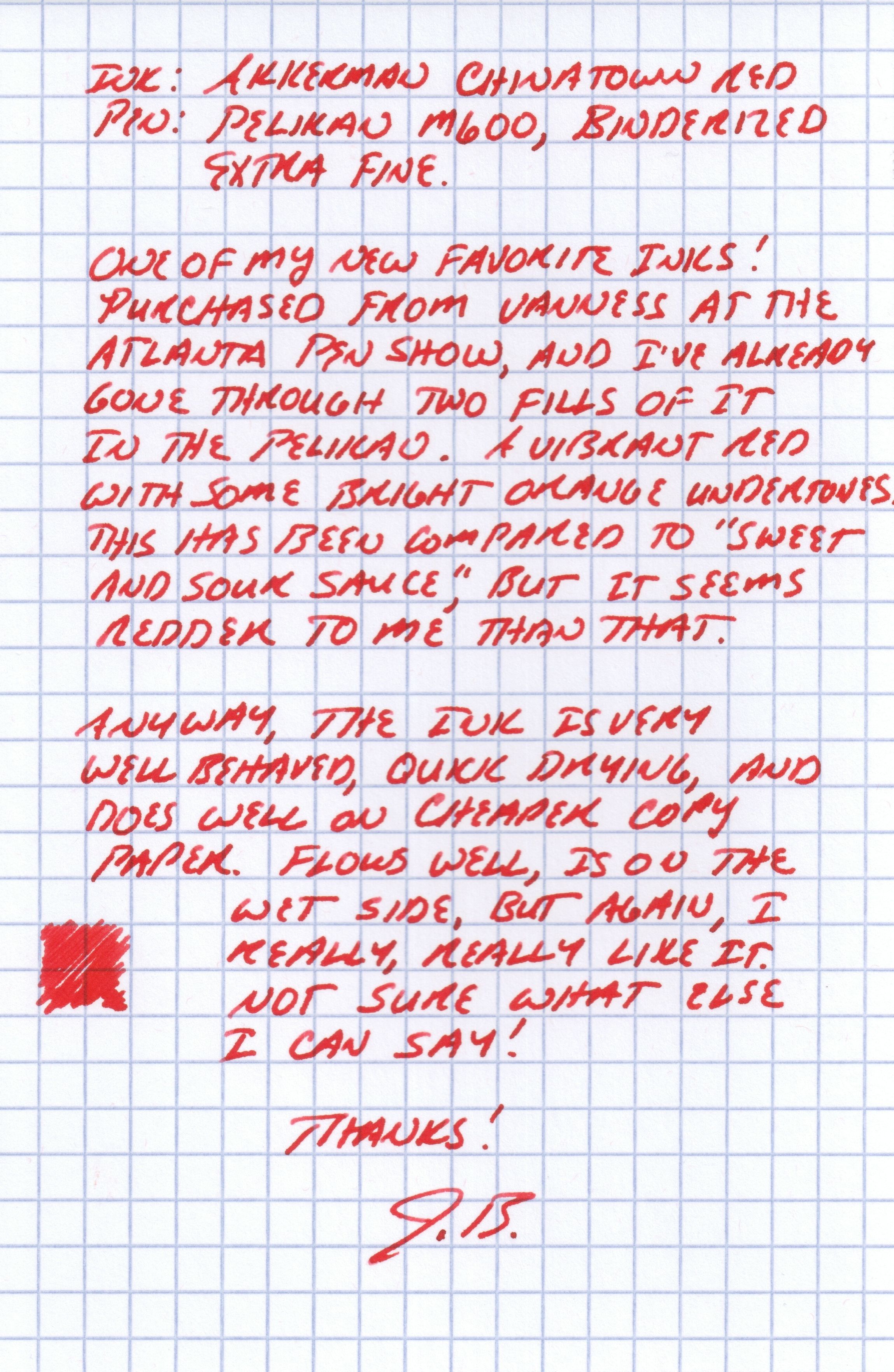
The Chinatown Red is very different.  It's much more saturated, does not shade as much, and is a "wetter" ink.  Even though the Chinatown Red flows more freely, it is still well-behaved and does not bleed through or feather too much on copy paper.  The scan below does a fairly decent job of capturing the color.  It's a bright red with orange undertones.  I spent all of last week editing a 75-page report and went through two fills of this color in my Pelikan M600 EF. 

Both of these inks will make it into my general rotation.  I always have one or more shades of red (my preferred color), and the voorhout violet is dark enough to make it into my family of "business inks."  Now that I have my two desired Akkerman colors, I can lay off the ink purchases for a while! 

Ink Review: Vintage Carter's Tulip Purple

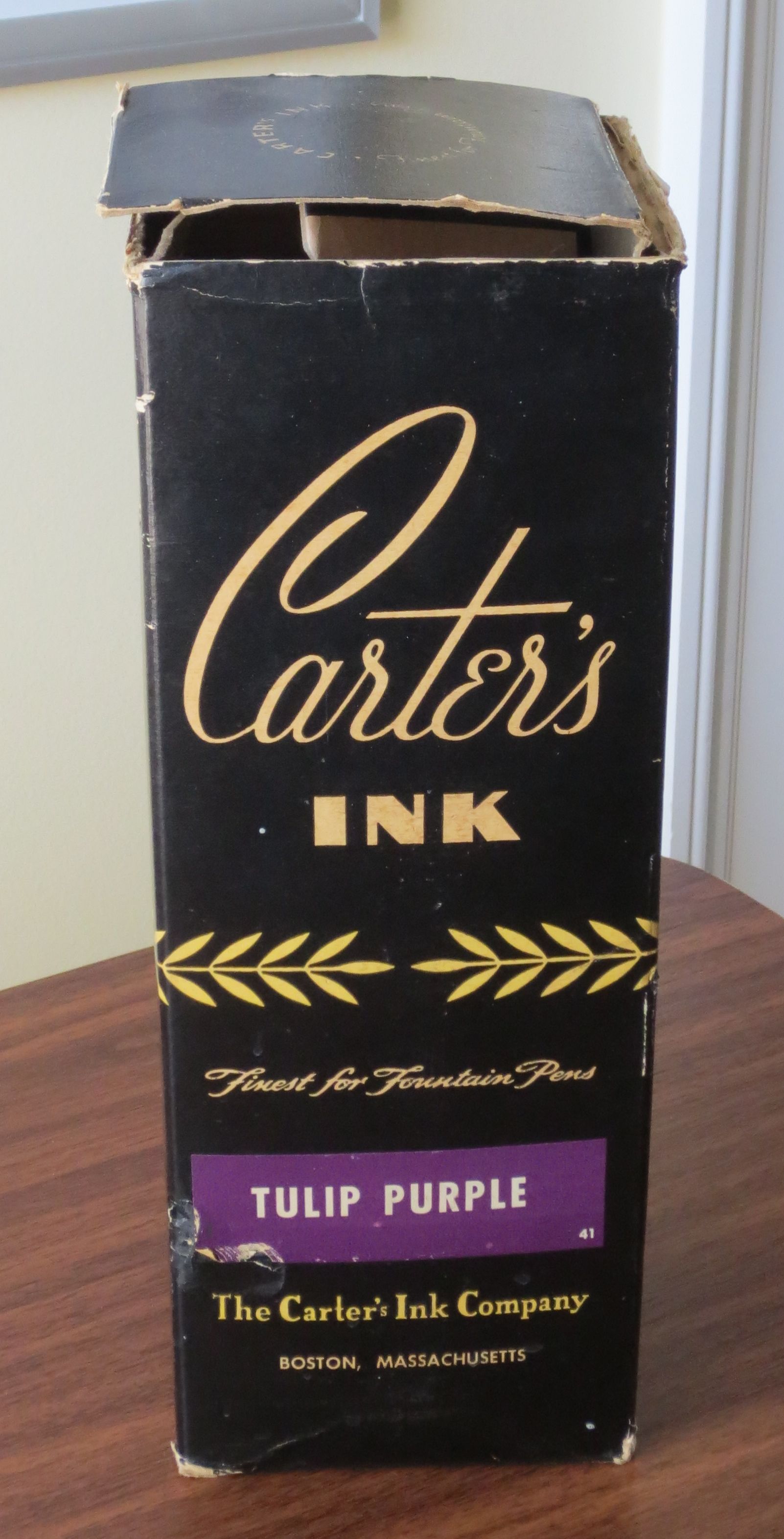
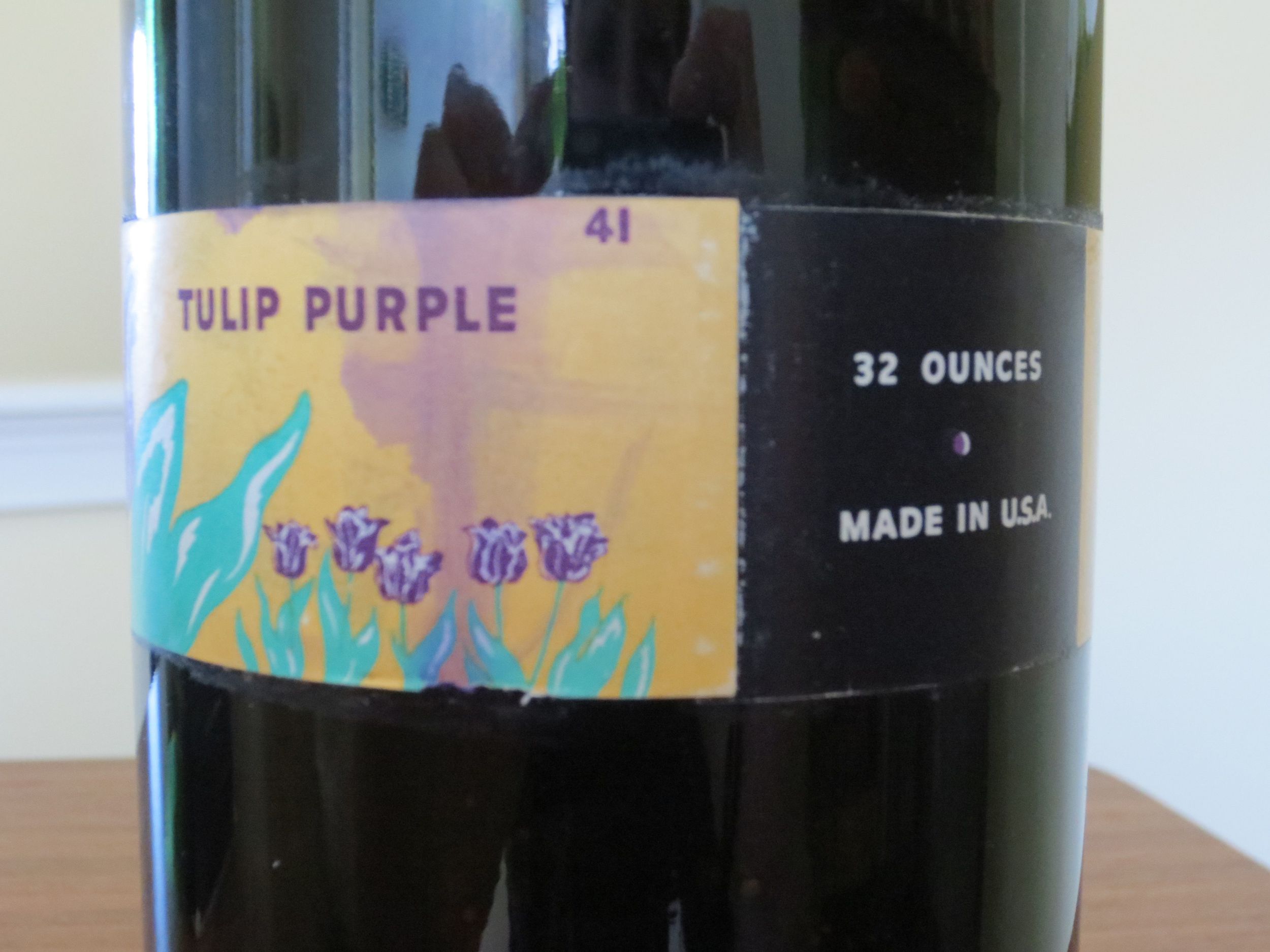
I have a moderately large stash of vintage ink, including a quart-size bottle of Carter's Tulip Purple from the 1930's or 1940's that I won on an eBay auction a year or so back.  The Carter's Ink Company, based in Boston, Massachusetts, was one of the largest ink manufacturers in the world.  It was acquired by Avery Dennison in the 1970s, which effectively ended all of their fountain pen-related ink operations and resulted in the destruction of all of Carter's records dating back to the 1860s.  Presumably, all of Carter's formulas, etc. are lost.

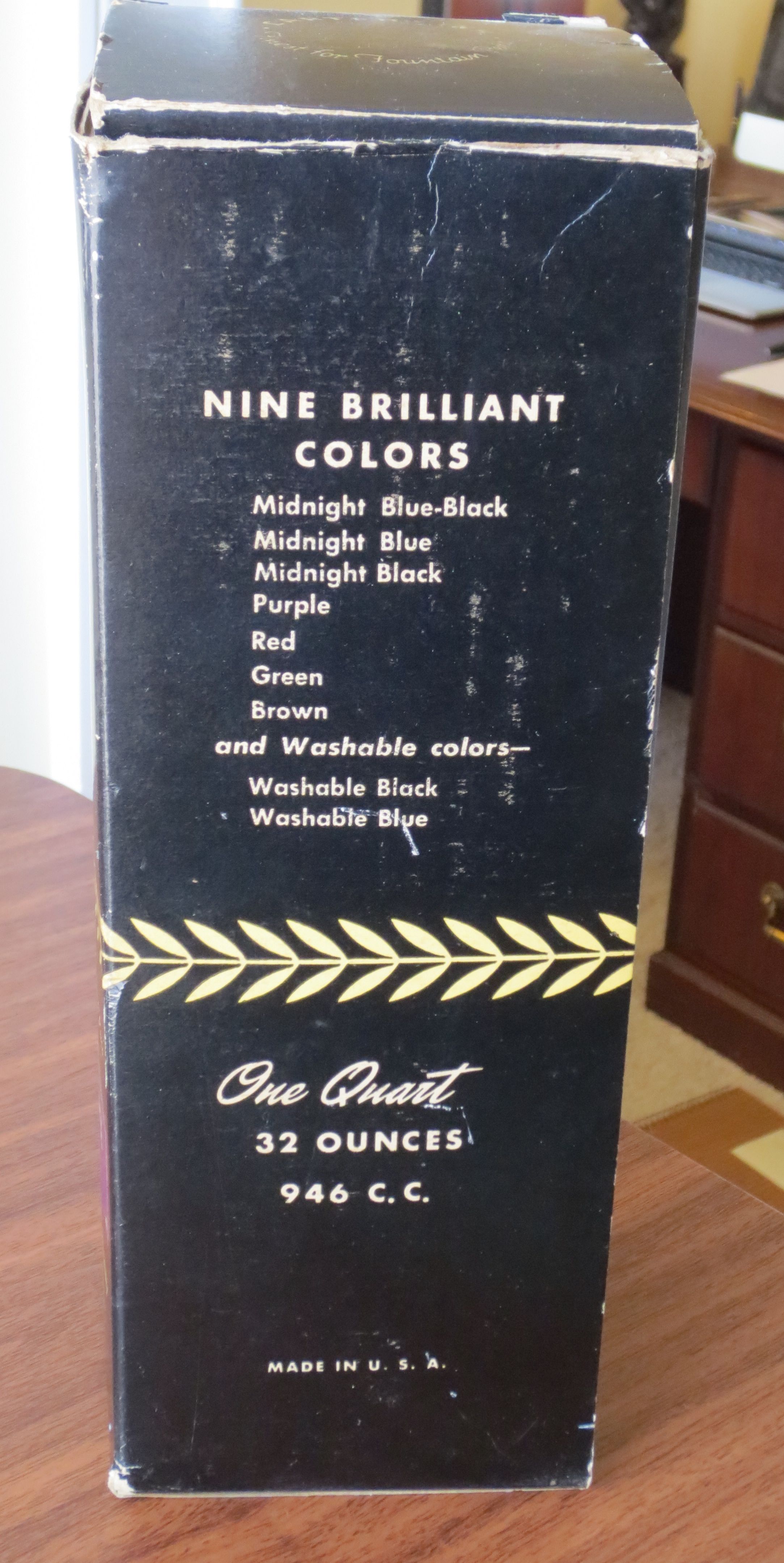
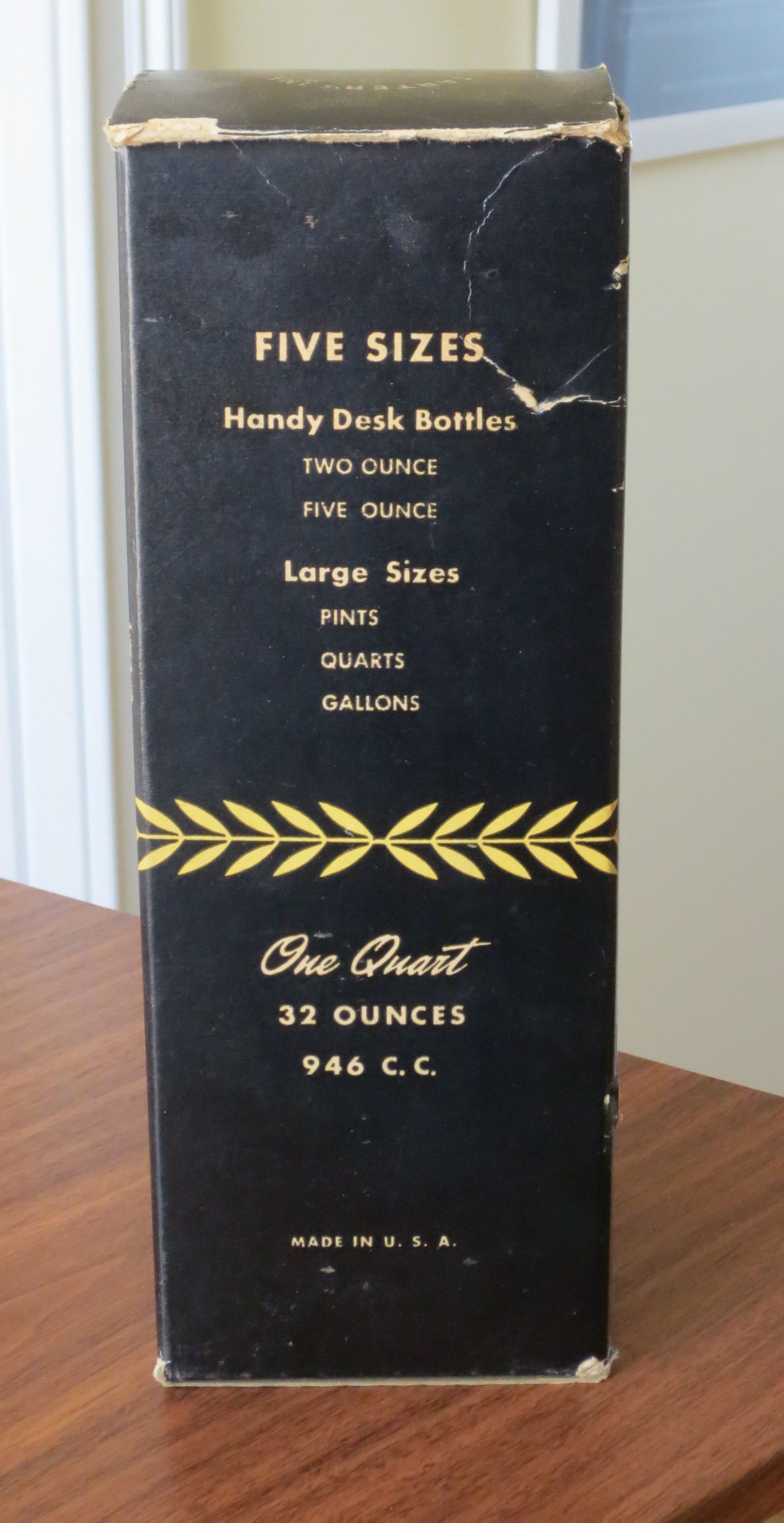
The bottle and package itself are quite impressive.  The packaging was in relatively good condition when I received it.  You can see the entire Carter's line of ink listed on the sides, along with a list of ink properties and other sizes available.  (gallons, anyone?)

This is a very vibrant, relatively well-behaved vintage ink--meaning no feathering or bleed-through--although I found that it stains like crazy.  I used to have a Noodler's Ahab, and it turned the clear converter into a dark blue-purple color.  For this review, I used, what else, a Carter's vintage ink cube desk pen. 

Vintage Carter's Ink Cube Inkwell with a fine point.  Another great eBay find! I had been looking for one of these for a long time and finally found one in decent shape.

As you can see, this is a purple that tends to be on the violet blue side once it dries. 

My observations on the ink:  It's a nice purple-blue color.  It appears much more like a traditional purple when wet, and dries to a bluish tinge, as you can see from the scan above, which was done with doxie flip on the highest-resolution setting.  The ink does not feather, and will not bleed through on the cheap paper that I've used, which is a heavier-weight inkjet paper I bought on special at Costco (i.e., nothing fancy).  I've had really good results on both Doane and Scout Books.  There is some show through on Field Notes, but nothing that to me would render the paper unusable.  Dry time is approximately 10 seconds on fairly nice paper such as Rhodia or the Exacompta index card that I used for the review.

Thank you for reading!  

Imagine this . . . a quart of ink.  Noodler's does custom runs of larger bottles, from what I hear, as does Pelikan.  I've read that the primary use of these larger ink bottles were teachers using them to fill inkwells on student desks. 

When I purchased this, the bottle was about 95% full, but had previously been opened and used.  There was no film floating around in the ink or sediment resting on the bottom, so I said what the hey... and used it.  Overall, I've been pleased with the results, although I would not recommend using this ink in a very expensive pen or one that is prone to staining.       

The Ink Cube Inkwell came with an empty bottle of Carter's that I was able to refill with the Tulip Purple and reuse.  Carter's inkwells were proprietary, in that you had to use Carter's special ink bottle to refill them.  Carter's bottles are now highly collectible.