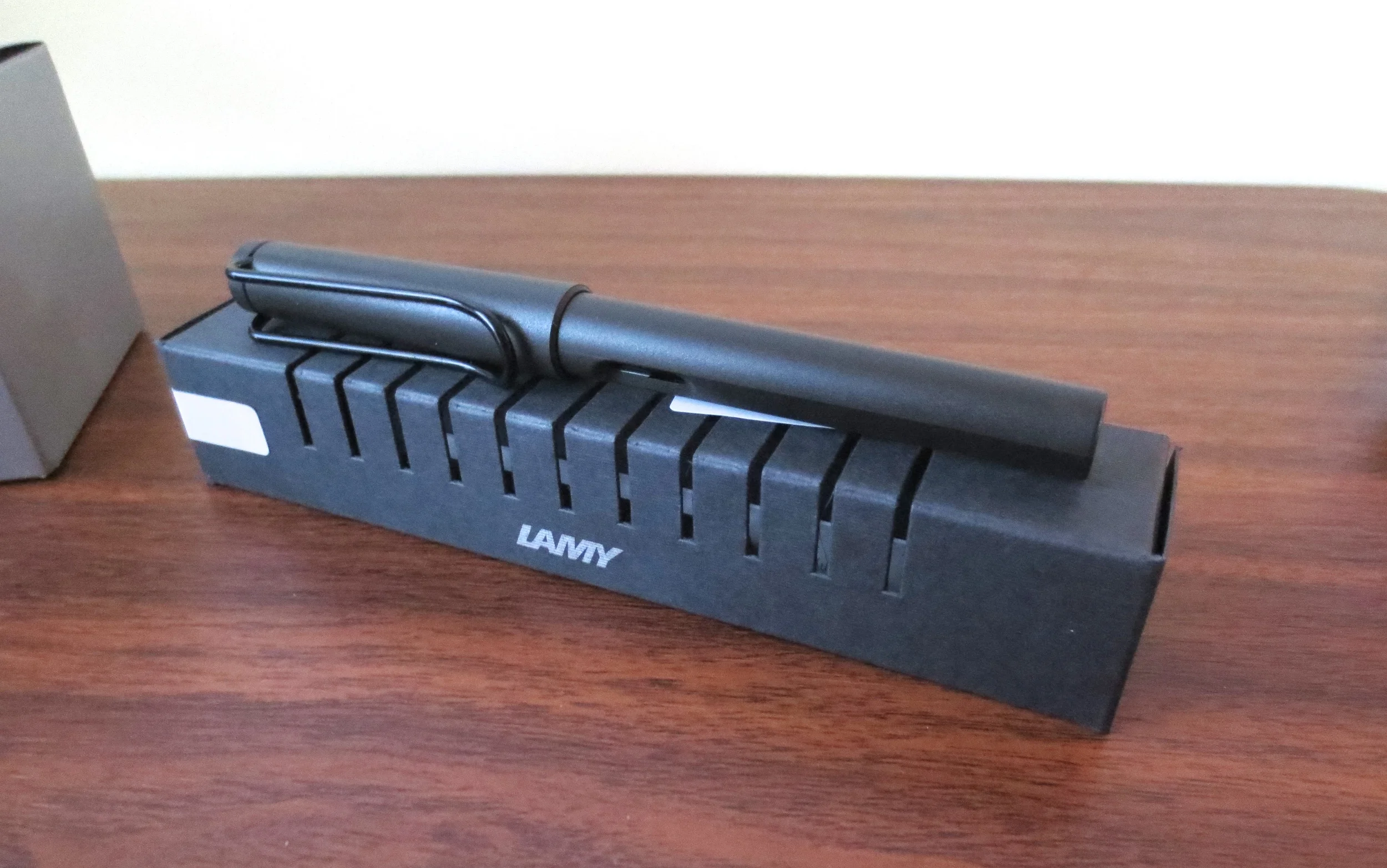
Crossing the $100 threshold is a big step. Not only is it a lot of money, but many people question whether there's any real difference between a $20 pen and a $100 pen, or even a $500 pen. Or even a pencil? They all write, right?
The Lamy 2000 tops my list for your first trip over the $100 price point.
To me, there is a difference, and it lies in the writing experience. While there are a few steel nibs out there that are excellent writers, I prefer the feel of gold nibs. Gold fountain pen nibs are (mostly) "springier," meaning that they feel softer than a steel nib on paper; they typically write a wetter line and will show off the ink you are using to a greater degree. I do agree, however, that beyond a certain price point (say, $250), with the limited exception of certain high-end pens such as Nakaya or custom pens purchased from a craftsman who tunes nibs, you are unlikely to see much more improvement in nib quality. At the upper end of most manufacturers' product lines you are paying for design features (i.e., a limited edition design), branding (i.e., Montblanc), or a costly/rare material used to make the pen (i.e., celluloid). So where to start? Here are my top five fountain pens for someone looking to break into the "luxury" market:
- Lamy 2000. My default recommendation for a "first really nice pen" has always been the Lamy 2000. I've already reviewed the pen, and I own two of them, so consider me a fan of its minimalistic, Bauhaus-inspired styling. The Lamy 2000 has a very wet, 14k gold nib that most consider soft and springy. Be aware that the 2000 nib sizes run much broader than a lot of other pens. I have both a custom stub (formerly a medium), and an extra-fine. In my opinion, both the medium and the EF run one size broader than normal (i.e., the medium writes more like a broad). In recent years, many bloggers and commenters have noted a prevalence of nib issues with this pen, such as scratchiness, misaligned or uneven tines, and even bent nibs. While I wouldn't rule out some deterioration in Lamy's quality control over the years, I've not personally experienced any issues, and I sometimes wonder whether this is just a function of how popular this pen is, with some problems being inevitable once so many of them hit the market. The Makrolon Lamy 2000 is the least expensive pen on this list, (from Amazon), or you can opt for more deluxe the brushed stainless steel model.
- Sailor Pro Gear. At no. 2, you have the most expensive pen on this list, but it's possibly my favorite pen of all time. Sailor's 1911 Professional Gear (dubbed the "Pro Gear") is a relatively compact fountain pen that sports excellent Sailor 21k nibs. I promise that I won't go on about Sailor at length--you can read my reviews of my two Limited Editions here and here--but in short Sailor is a Japanese company known for its nibs. To achieve maximum smoothness and perfection, I've had both my Sailor nibs tuned by Mike Masuyama (who worked for Sailor for 25 years or so), but all Sailor pens that I have purchased have written just fine out of the box. Starting at $250 for the standard version at PenChalet, and if you have smaller hands the Pro Gear Slim might be a better option at $156.
- Pilot Vanishing Point. The go-to option for a retractable nib fountain pen. Of all the modern pen companies, I've found that Pilot nibs write the best out of the box, and the Vanishing Point is another easy recommendation with one caveat: many people have a hard time with the clip. Due to the fact that a retractable fountain pen needs to be stored nib-up, the clip ends up on the writing end of the pen, attached to the "section." (Take a look at some photos of the pen, and you'll see what I mean). I personally am not sensitive about grip sections, and the matte-black VP model is one of my most used work pens. The Vanishing Point is available in a wide array of colors, and start at $140 pretty much everywhere (pre-discount code).
- Pilot Custom 74. A pen that I don't personally own anymore, but that I enjoyed while I had it. The Pilot Custom 74 is a full-size pen that features a nice rhodium-plated gold nib, and in the United States is available as a clear, blue, orange, smoke, or violet demonstrator. The Custom 74 also comes with Pilot's high-capacity Con-70 pump converter, which is just flat-out cool. Starting at $160 from most retailers. NOTE: I have not reviewed either the Vanishing Point or the Custom 74 for this site, but both pens have been reviewed to death, and you can easily locate reviews of both using the Pennaquod search engine.
- Franklin-Christoph. Your "gateway" into custom nibs. Franklin-Christoph has taken the fountain pen industry by storm in recent years, offering an array of unique designs that use JoWo interchangeable nib units, some of which have been customized by Mike Masuyama. You can purchase a Masuyama Ground cursive italic or stub nib for your pen at a slight upcharge. For example, the Model 20 "Marietta" starts at $165, and comes in at $180 for a Masuyama nib. Most will want to stick with a steel nib for their first Franklin-Christoph, but gold nibs are available as well. Note that Franklin-Christoph checks and tunes all nibs before they ship, and they have excellent customer service if you are not satisfied. I really like their demonstrator models, which look absolutely awesome when converted to eyedroppers.
Again, this list contains just like, my opinion, man, so if you think I've left anything off, reach out through the "Contact Me" link or via twitter. I've received some great suggestions following the prior posts, and haven't had a chance to get back to everyone yet. I will try!
DISCLAIMER: This post contains affiliate links, through which I may be compensated a small amount if you purchase a pen from any of the sites linked to in this article. While I'd greatly appreciate it if you use these links to purchase a pen you are interested in, you are, of course, under no obligation to do so. Many thanks!