• Blog
  • Shop
  • Podcast
  • Resources
  • About
  • Archive
  • Contact
  • Cart
  • Sign In My Account
Menu

The Gentleman Stationer

Vintage Living in the Modern World.
  • Blog
  • Shop
  • Podcast
  • Resources
  • About
  • Archive
  • Contact
  • Cart
  • Sign In My Account

Pen Review: Lamy Safari "Candy" Special Editions

May 14, 2020

Lamy remains one of my favorite all-around stationery brands, particularly for those of us who both use our pens on a daily basis, and appreciate the ability to dabble in the special and limited edition fun from time to time. While Lamy's implementation of its limited edition strategy has been hit and miss over the years, they regularly release some exceptional pens, and the 2020 Safari special editions are no exception.

I love Safari’s with coated clips, especially those that match the pen barrel.

For the second year in a row, Lamy chose to release not one, but three, special edition Safaris. Building on last year's "Pastels,” the company chose "Candy" as this year's theme, and released three pens in shades of purple ("Violet"), turquoise ("Aquamarine"), and yellow ("Mango"). Mango is my favorite, probably because the yellow-orange hue is completely different from anything Lamy has released in the past. While I love the standard yellow Safari, the matte texture and matching clip lend the Mango a warmth the yellow fountain pen lacks.

The three “Candy” Safaris on the left; the three 2019 “Pastel” editions on the right.

What will be curious to see going forward is whether Lamy continues the three-pen releases. Amid growing economic uncertainty for much of the world, will we see companies scale back the number of special and limited editions pens, and maybe even discontinue certain slower-selling items from their standard lines? Lamy tends to make fairly large runs of Safaris, and it's not unusual to see last year's special edition pens on sale a year (or more) later. For example, the 2019 "Pastel" special editions continue to be available for purchase. In the case of Lamy, however, I wouldn't be surprised if things stayed status quo (or if sales even increased) since the company's lower price point pens might actually see an uptick in demand as pen enthusiasts look for less costly ways to indulge in their hobby.

This time around I purchased the matching ballpoints for two of the pens:

The standard Lamy Safari in yellow, on the left, and in Mango (with matching ballpoint) on the right.

Takeaways and Where to Buy

This is a great Lamy Safari release. As a proud member of #teamsafari (as opposed to #teamalstar), I immediately sprung for all three pens to add to my collection of recent special editions. In my opinion, the Mango pen in particular has the potential to be one of the better Safari's Lamy has made.

A combination of high demand and Covid-19 related shipping issues delayed the initial launch of the Candy Safaris, but most Lamy retailers now have them available for purchase. I purchased the pens featured in this review from site sponsor Pen Chalet, which currently has all three fountain pens available, in addition to the rollerball and ballpoint versions. The fountain pen is priced at just under $30, the rollerball $20, and the ballpoint $16. I'm something of a latecomer to the Safari ballpoint, and plan on reviewing that pen separately soon. If you’re interested in picking up one of the Pastel fountain pens, Pen Chalet is currently offering a free converter with purchase.

Disclaimer: This post contains affiliate links. I am a participant in the Pen Chalet affiliate program, which allows me to earn store credit that I can use to acquire items for review on the blog, like the pens featured here.
In Pens Tags Lamy, Pen Review, Safari, Candy Safari, Special Edition, Lamy Special Editions
1 Comment

Write Notepads Spiral Notebook: How Far Can I Push This Paper?

May 9, 2020

Before I get started, I wanted to let you know, in the interests of complete transparency, that today I’m going to be talking about a product I sell. That said, my “retail” operation at TGS is relatively small, and for the time being is limited to those products about which I feel strongly enough to keep in my own regular rotation, including the current TGS “house paper” from Write Notepads. I don’t think my opinion on the product is colored by my interests as a retailer, but again, transparency is important. With that out of the way, on to the review.

If you read my recent series on the Best Paper for Everyday Writing, Write Notepads paper makes numerous appearances. Their standard spiral notebook and landscape notebooks have earned a regular place in my workflow, simply because the paper is among the best-performing paper for fountain pens that’s I’ve used. It helps that I have a thing for vintage-inspired design, and their pistachio-colored notebooks remind me of the vintage supplies I used to “borrow” from my Dad's office supply closet when I was a kid. So, bonus points for nostalgia.

I’ve never done a “proper” review of this paper, and wanted to post some pictures demonstrating why I like these notebooks so much. Write Notepads has found a source of paper that, for me, strikes the perfect balance of absorbency and smoothness. It’s not heavily coated like Clairefontaine, so you get that same tactile feel reminiscent of Baron Fig paper (another favorite), but with better performance with wet fountain pens. I’ve experienced absolutely no bleed-through, little to no feathering, and a reasonable dry time that’s similar to Rhodia.

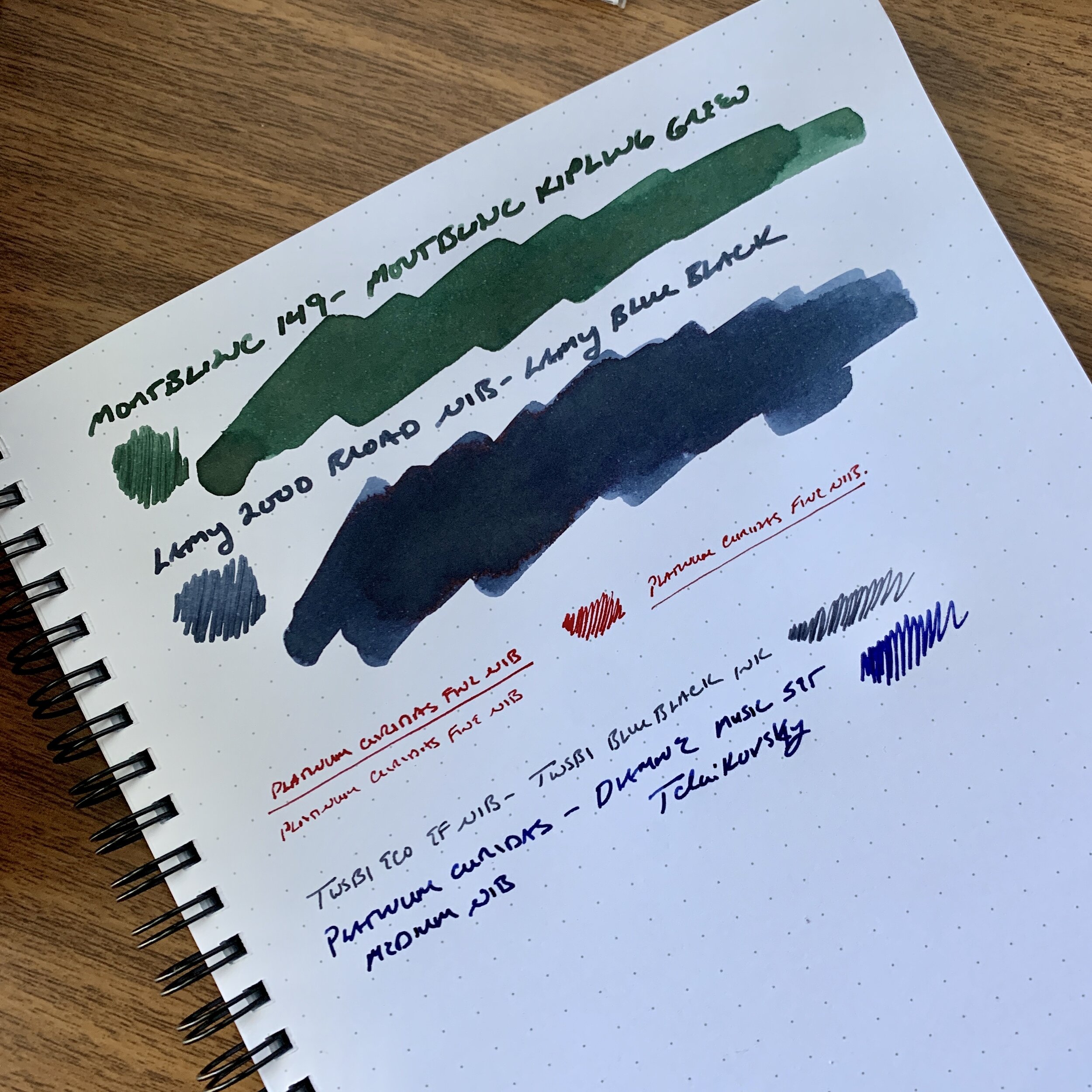
Sometimes I find that extra fine nibs will feather and bleed more than broader nibs, especially needlepoints that can dig into the fibers. I tried this paper out with the Platinum Curidas fine nib with both heavy pressure (top) and light pressure (b…

Sometimes I find that extra fine nibs will feather and bleed more than broader nibs, especially needlepoints that can dig into the fibers. I tried this paper out with the Platinum Curidas fine nib with both heavy pressure (top) and light pressure (bottom). Neither bled through but the heavy pressure writing sample feathered a bit. With normal writing pressure I did not have this issue.

Absolutely NO bleedthrough or show-through whatsoever, even with a really wet swab where I made multiple passes. I was, of course, able to make a Sharpie bleed through to the back side.

Final Thoughts and Where to Buy

As I mentioned above, this paper works so well for me that I’ve largely switched over to Write Notepads paper as my primary general purpose writing paper. With the exception of some of their pocket notebooks, Write Notepads uses this high-performance stock in all of their offerings, and I like that the full-size spiral notebooks come in both standard and landscape orientation.

You can purchase Write Notepads notebooks (including the spiral dot grid notebook pictured here) in the TGS Curated Shop, and I also carry the Landscape Notebook, Steno Pad, Reporter Notebook, Paper Journal, and Copper Anniversary Edition Pocket Notebooks (which has the higher quality paper). For items I don’t carry, you can order directly from Write Notepads, though I appreciate all the support you can throw my way!

In Paper Products Tags Write Notepads
1 Comment

Pen Review: Vintage Kaweco Sport

May 6, 2020

I've dabbled in vintage pens over the years, but always as a user, and never really as a collector. It's not that I dislike vintage - on the contrary, I love old things, especially practical items that have survived a century or more of heavy use and remain in nearly as good of shape as they were the day they were made. It's more that by the time I arrived in this hobby, I was struck by a feeling that I was too late to comfortably “collect” within my means. Antique store dealers, flea market vendors, and eBay Sellers had all gotten wind of the resurgent interest in fountain pens and prices seemingly went through the roof, even on pens in so-so condition that needed restoration. While I'm always game to start from scratch and learn about a new hobby, including restoring old pens myself, I didn't have much interest in perfecting my skills at $50-150 a pop. While I’ve learned to do basic repairs like changing sacs and Vacumatic diaphragms, that's the limit of my competence, and I would never feel confident enough to work on pen of any significant value.

So, my experience in vintage largely has been limited to purchasing already restored, nicer pieces that are ready for writing, as opposed to the more "completist" approach to collecting that you might see at pen shows. While I mostly own modern pens, I have a few vintage examples, including a couple of Parker Vacumatics, Pilot Myus, some late-model (1980s-1990s) Watermans and Sheaffers, and now my most recent addition, a vintage Kaweco Sport.

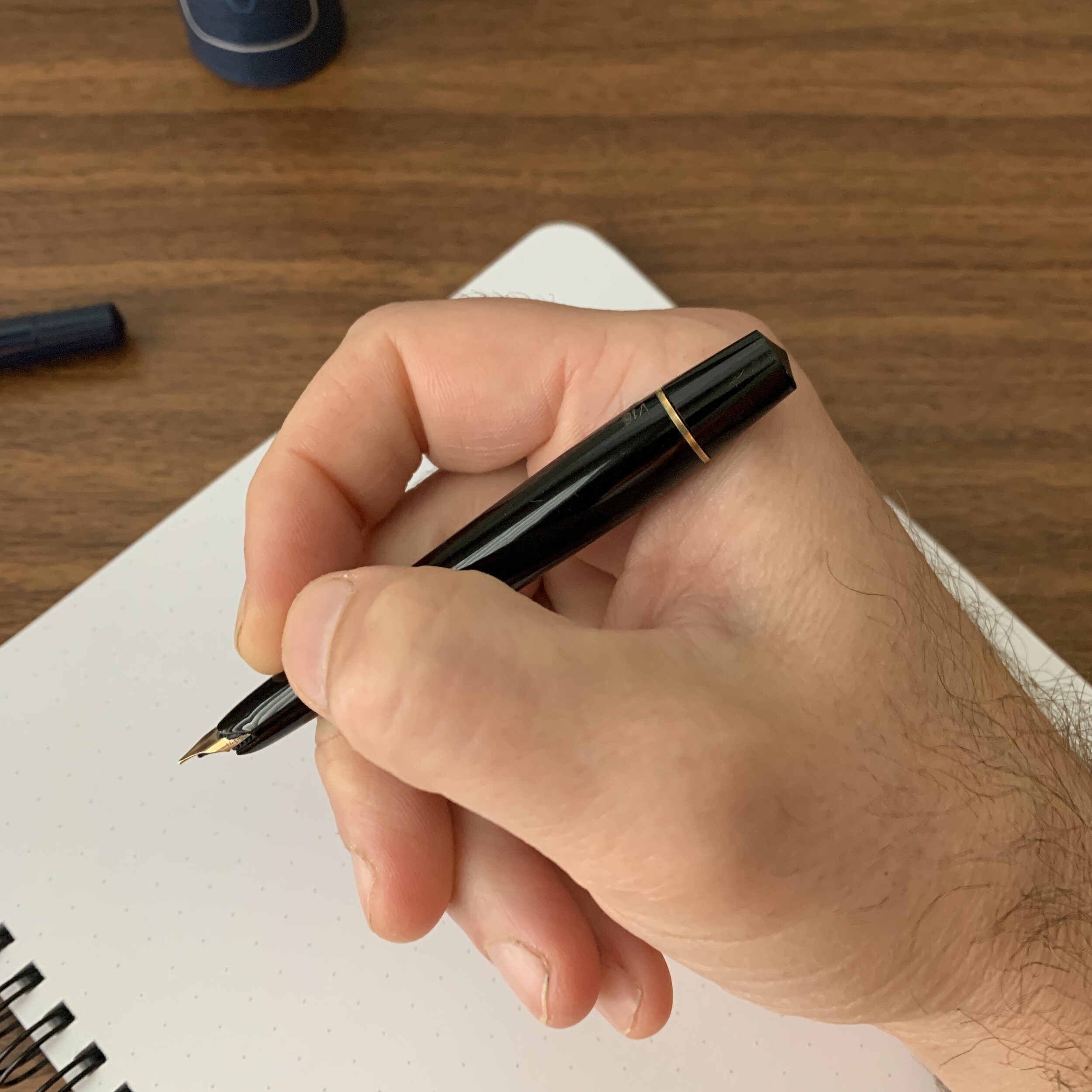
As you can see from the inscription, this is a Kaweco Sport model “V16,” with a “Fine” nib. The facets on this version are more subtle, more akin to the Art Sport than the standard model.

Kaweco Sport: Vintage vs. Modern

Before we dive into a comparison of the vintage Kaweco Sport and the modern pen that you can still purchase today under that name, some brief background on the company itself may be helpful. The original Kaweco (a contraction of Koch, Weber & Co) operated from the late 1800s until the early 1970s, and manufactured several models of pens in addition to the Sport, including the Special, the Elite, and the Dia, all of which you may recognize since the modern company, resurrected in 1994, has released pens under those names. Kaweco actually made multiple versions of the Sport over the years, and the version I own is the last version made in the early 1970s before the original company went out of business. It's part of a commemorative fountain pen and ballpoint set made for the 1972 Munich Olympics, complete with a leather case and medallion.

The modern Kaweco Sport is generally a larger pen than the vintage model that I own. It's longer and more substantial, and from what I can tell based on studying the pictures in Andy Lambrou's Fountain Pens of the World, was based on a 1930s version of the Sport with more pronounced facets on the cap. The vintage Sport feels quite small in comparison, though when extended and posted for writing it's actually a touch longer than the modern Sport.

View fullsize Vintage Kaweco Sport In Hand
View fullsize Vintage Kaweco Sport Posted

What else is different? While the modern Kaweco Sport has developed a well-deserved reputation as an inexpensive pocket pen with a steel nib perfect for both beginning fountain pen enthusiasts and experienced users, the vintage Sport featured a 14k gold nib and a piston filling system. The weight of the vintage pen shocked me a bit - despite the integrated piston, it's only slightly heavier than the modern pen. I really wish Kaweco would reissue this classic design, even though the cost of the piston (and the gold nib, if they decided to go that route) would likely require a significant price increase, which I suspect is the main reason it hasn't happened yet.

The nib on this vintage Kaweco Sport writes well, and leaves a moderately wet line, though I’d call it more of a fine-medium than a true fine. Check out that ink window!

I love how Kaweco retained the same script on its modern Sport series. The ballpoint has aged better than the fountain pen, probably due to the fountain pen seeing heavier use.

The finial/medallion on top of the pen is another vintage design element that Kaweco retained on the modern Sport.

Final Thoughts and Where to Buy

I love this little pen. Despite being nearly 50 years old, it feels as sturdy and well-made as a modern Kaweco, though I likely won't tempt fate by using it for true pocket carry. And while I have no plans to dive back into vintage pen collecting, it's tempting to pick up a few more examples of vintage Kawecos, especially if the pens remain as functional as this one. The Munich Olympics connection also makes for a cool piece of history to own.

I purchased this vintage Kaweco pen set from Maria, who sells through her Etsy store MaryMagicBox, which I discovered thanks to a tip from a member of our local Nashville-area pen group. Maria stocks a wide range of restored vintage pens, along with some gently used modern pens, with a focus on German brands such as Montblanc, Pelikan, and Kaweco, along with other lesser known marks including Osmia (later acquired by Faber-Castell). Though vintage Kaweco Sports are less common, they do come up from time to time in Maria’s shop, and she has other models of Kaweco pens available for purchase. If I do get the itch to acquire more vintage, I wouldn’t hesitate to order from Maria again.

Disclaimer: This post contains Etsy affiliate links.

Though this particular refill still works, could someone do me a solid and let me know whether you can still purchase these today? Or maybe hacking another refill (D1?) to get it to work in a vintage Sport ballpoint?

In Pens Tags Kaweco Sport, Vintage Kaweco Sport, Kaweco Sport Munich Olympics
7 Comments

Classy Carry: The Esterbrook Pen Nook Six Pen Case

May 2, 2020

Do I really need another pen case? That’s sort of like asking myself whether I really need another pen. Of course I do! After all, where am I going to put the pens? If you’re looking for a classy pen storage option that not only looks nice on a desktop but is secure enough to double as a daily carry, you should consider the Esterbrook Pen Nook.

The “New Esterbrook” Expands Its Offerings

Since Kenro Industries acquired the Esterbrook brand a couple of years ago, the company has released a steady stream of well-received products, all of which are targeted at the rapidly expanding $150-200 fountain pen segment. These include the Esterbrook “Estie” fountain pen, the “Camden” fountain pen (check out the new “Composition” edition for one of my favorite releases of the past few months), the Phaeton, and now, the “Pen Nook” pen case.

The Nook represents Esterbrook’s first foray into accessories, and I have to say, like all of their other releases, it’s well-conceived, well-designed, and well-executed. Instead of leather, Esterbrook went with what it refers to as “saddle fabric,” which has the appearance of tan saddle leather but the feel and durability of the material that they use to make car interiors. My guess is nuluxe or another vinyl derivative - I have no inside information here. Either way, it’s quite soft and looks nice.

I opted to showcase the Esterbrook Pen Nook with pens in a range of different sizes. From left: Lamy 2000; TWSBI 580; Montblanc 149; Lamy 2000 Stainless Steel; TWSBI ECO Yellow; and Platinum Curidas.

The inside of the Pen Nook is lined with paisley-patterned fabric and holds six pens in individual slots, which are large enough to accommodate pens as fat as a Montblanc 149 and as long as a Platinum Curidas. The fabric liner, which feels like cotton or silk, gives me a bit of pause, but so far it has held up well. The true test will come after the pen nook has seen a year or so of use, and whether the friction from opening and closing the case causes the fabric to wear.

Takeaways and Where to Buy

The Esterbrook Pen Nook comes in multiple sizes, and can be purchased from most Esterbrook retailers, including site sponsor Pen Chalet (where I purchased this one). At $150 MSRP / $120 retail for the six-pen version, the Nook is not inexpensive, which places it in direct competition with Franklin-Christoph’s Covered Pen Tray, a similar product that I love, features real Napa leather, and holds 12 pens. Which case works for you will likely depend on (1) whether you like the “saddle leather” look of the Esterbrook and (2) how you want to use the pen case. To me, the Covered Pen Tray is the clear winner if you’re looking for desktop storage because the lid folds back for use as a desktop “display.” The Pen Nook, however, would be much more secure in a bag, and is the option I’d recommend for daily carry.

Disclaimer: This post contains links to paid sponsors and affiliates. The Gentleman Stationer is a participant in Pen Chalet’s affiliate program, which generates store credit that I use to acquire pens and other products for review. It’s one of several ways I support the blog.

In Pen Storage Tags Esterbrook, Esterbrook Pen Nook, Pen Cases, Desk Accessories
2 Comments

Initial Thoughts: The Platinum Curidas

April 30, 2020

With an emergency court proceeding blowing up this week (which means lots of writing!) my two new Platinum Curidas fountain pens received the proverbial baptism by fire. I’m happy to offer you my initial impressions. The general takeaway: The Curidas is a solid retractable fountain pen that feels well-built and is fun to use, but at the end of the day it’s definitely over-engineered and targeted to the pen geek, and certain design choices will almost certainly keep Platinum’s latest release from becoming something that most people are going to want to use every day. I’ll break down my reactions into three categories.

First, The Positives:

  • Writing Comfort. Based on how I hold the pen, I easily find the Curidas more comfortable than it’s main (or only) competitor, the Pilot Vanishing Point. Whereas the clip on the V.P. runs all the way down to the nib and basically forces you to wrap your fingers around it, Platinum opted to leave additional space for those with a more traditional grip to hold the pen naturally without adjusting for the “bumps” created by a clip or the plastic nub on the bottom of the pen, which also serves as a roll-stop. This is hard to explain, so take a look at the pictures below. If you use a similar grip, you’ll probably be fine. If your grip is different, YMMV.

  • Build Quality. Platinum makes excellent pens, and the Curidas is no exception. To keep the price below $100, Platinum went with mostly plastic construction, but the pen feels sturdy - not at all inexpensive or flimsy. While I have my own thoughts on the design of the knock (discussed further below), the mechanism deploys and retracts the nib smoothly, and it’s admirable that Platinum managed to keep the price down on a pen with so many moving pieces, all of which must have been custom designed.

  • Colors and Transparent Materials. I love Platinum’s 3776 demonstrator pens. The colors they use always seem to pop, and the plastic never looks cheap. The Curidas is no exception. I opted for the “Gran Red” and “Urban Green” pens, both of which look great. I normally prefer red pens, but the Urban Green is particularly stunning in person.

View fullsize Platinum Curidas with Nib Extended
View fullsize Platinum Curidas Grip Close-up

The Negatives:

  • Convoluted and Difficult Assembly. In order to refill the Curidas, you have to completely disassemble the pen, which is no small undertaking. As show in the photo gallery below, this entails removing the back half of the barrel (not a big deal); removing the spring-loaded nib assembly (a little more complicated, since Platinum uses a tongue-and-groove system to secure it); and removing yet another metal piece covering the converter and/or cartridge. It’s a remarkable feat of design and engineering, and it allows you to use the standard Platinum converter, but it creates a lot more complications than the average fountain pen user is going to want to deal with.

  • Awkward Sizing. With the knock depressed and the nib deployed for writing, the Curidas fits my hand perfectly. The pen is properly weighted and well-balanced for longer writing sessions. The issue I have is with the size of the pen with the nib retracted. I have average-sized hands, and I really have to stretch to use the knock. Plus, it just makes the pen look awkward. Couldn’t they have reduced the length by a centimeter or so?

View fullsize Platinum Curidas Disassembly, Stage 1
View fullsize Platinum Curidas Disassembly, Stage 2
View fullsize Platinum Curidas Disassembly, Stage 3

With the knock extended, the Curidas is an extremely long, and even awkward pen, both in terms of looks and feel. I don’t find the mechanism all that comfortable to use. It’s a stretch to get my thumb over the end.

The So-So:

  • The Nib. The medium stainless steel nib on the green pen is exceptional, and the fine nib was not. So, overall, a mixed bag. Let’s start with the good; the medium wrote a relatively wide, wet line, that others have accurately described as stubbish. For a stock steel medium nib - typically a very boring option - my green Curidas offers a spectacular writing experience, as long as you get a good one. Now for the bad: the fine nib on my red pen was extremely dry and scratchy out of the box. Curiously, I had the same experience with my Platinum 3776 Ultra-Extra Fine (UEF) nib. Platinum generally has an excellent reputation when it comes to nibs, especially fine and extra-fines, and I’m surprised I’ve had this happen to me on a pen with as much pre-launch hype as the Curidas.

View fullsize Platinum Curidas Medium Nib
View fullsize Platinum Curidas Fine Nib

Takeaways and Where to Buy

Obviously, I haven’t had the Curidas in my rotation for very long, but I did put Platinum’s latest release through the paces during a particularly strenuous week of work that involved a lot of writing. Retractable nib fountain pens are generally going to have a very specialized target audience - true pen geeks - and as long as Platinum realizes that casual users may be turned off by the pen’s complexity, I can appreciate Platinum’s efforts to grow the category. That said, the knock design bothers me a lot, both functionally and aesthetically, and I plan to withhold final judgment until I get a better sense of how much I’ll actually use this pen on a day-to-day basis, and whether I hear additional reports of spotty nib quality.

I acquired the Platinum Curidas fountain pens featured in this review from site sponsor Pen Chalet, which still has several colors in stock priced at $80. Platinum does not allow discounting on this pen. Other Platinum retailers (such as site sponsors Vanness Pens, Goldspot, and Appelboom), also carry the Curidas, but availability will likely be uneven given delays in distribution and shipping in light of current events.

Disclaimer: This post contains affiliate links. I am a participant in the Pen Chalet affiliate program, which allows me to earn store credit that I can use to acquire items for review on the blog, like the pens featured here.

In Pens Tags First Impressions, Platinum, Platinum Curidas, Retractable Fountain Pens, Pen Review
1 Comment
← Newer Posts Older Posts →
Store Hours and Events
Shop T.G.S. Online
Updated 2026 "Best Pens" Guide
No results found
On The Paper Trail: Live In Nashville Event Tickets Now Available!
TGS_25 Roterfaden Restock Notification
Hierarchies of Fountain Pen Friendly Paper

Join Our Patreon!
Subscribe to the TGS E-mail List

Featured Posts

Featured
Pilot-Custom-Heritage-92.jpg
June 6, 2026
Workhorse Pens: Pilot Custom Heritage 92 Fountain Pen
June 6, 2026
June 6, 2026
Kakimori-Inkstand-Before.jpeg
May 30, 2026
Japan Trip Journal: A Visit to Kakimori, Including Custom Notebooks and the InkStand!
May 30, 2026
May 30, 2026
Five-Foundational-Fountain-Pens.jpeg
April 22, 2026
T.G.S. 12th Anniversary: 5 Fountain Pens Everyone Should Experience
April 22, 2026
April 22, 2026
The Gentleman Stationer RSS

View Cart

© Digital Divide Media, LLC, 2014-present.

All content is the exclusive property of Digital Divide Media, LLC, d/b/a The Gentleman Stationer, including “The Gentleman Stationer” website and trademark, and should not be reproduced without express written permission.  All rights reserved.

All content containing paid advertising, affiliate links, or sponsored content will be plainly disclosed by a disclaimer when/if featured.

Contact Information

Website Terms and Conditions

Store Shipping Policy and Return Policy

Privacy Policy and Cookie Policy

Accessibility Statement

Powered by Squarespace