• Blog
  • Shop
  • Podcast
  • Resources
  • About
  • Archive
  • Contact
  • Cart
  • Sign In My Account
Menu

The Gentleman Stationer

Vintage Living in the Modern World.
  • Blog
  • Shop
  • Podcast
  • Resources
  • About
  • Archive
  • Contact
  • Cart
  • Sign In My Account

Guide to Notebook Systems, Part II: Plotter is NOT a Planner!

September 24, 2022

Last week’s post, “Guide to Notebook Systems/System Techo, Part I”, offered a brief introduction to different types of notebook systems on the market. One of those categories was the “System Techo,” a Japanese term for a notebook system built around a ringed binder. “System Techo” is not as popular or pervasive in the U.S. as it is in Japan. At one point, Filofax was extremely popular, yet most consider it to be a planner/calendar as opposed to a broader notebook or information management system, and dismiss it as something outdated that they’ll never use. The reality is that ring-based systems can be extremely powerful tools for creativity and organization, especially for those of us who enjoy working on looseleaf paper and notepads but lack a convenient way to organize and archive our ideas. The advantages to a system like this is that you can move around and group together individual pages of notes, as opposed to more modular systems that limit you to bound refills.
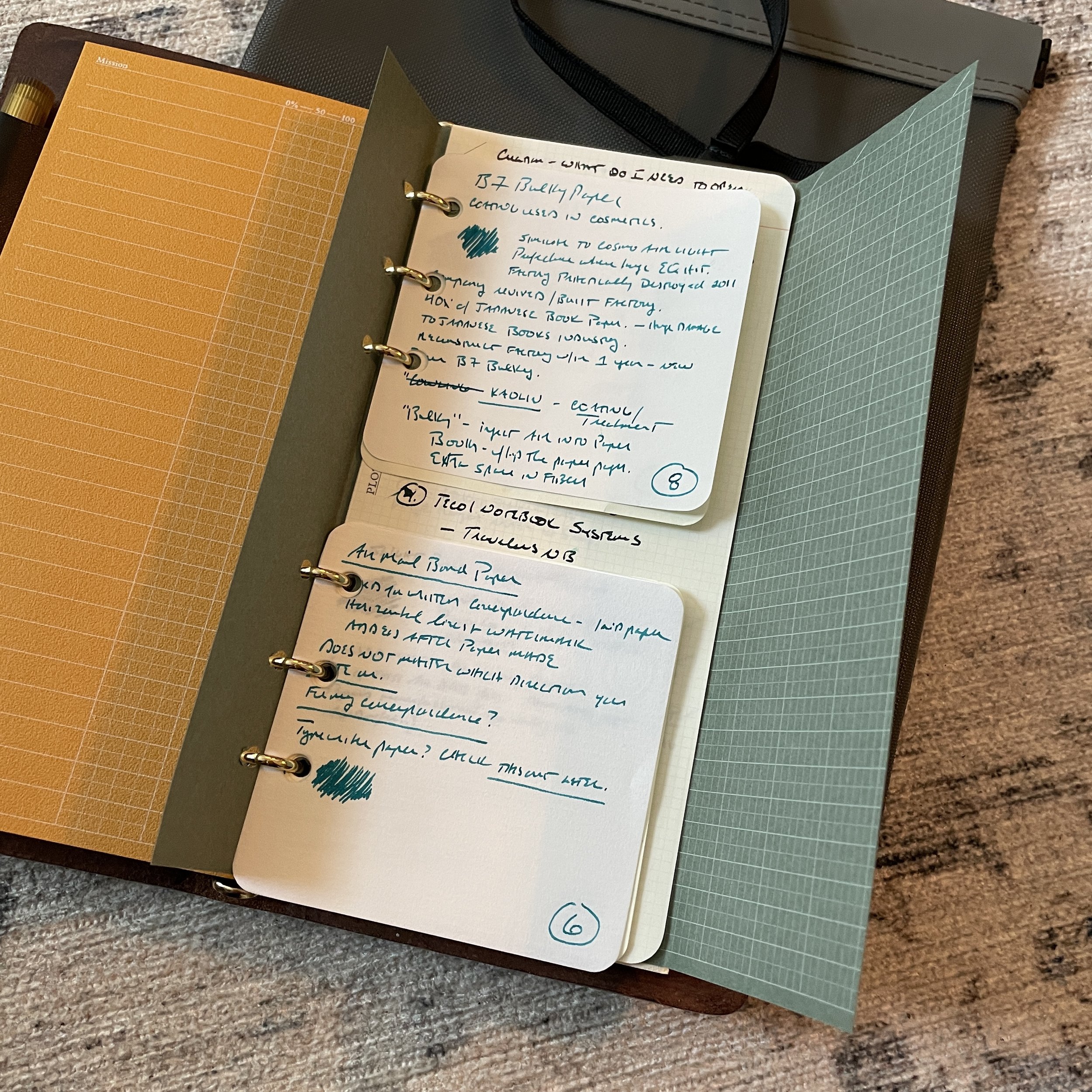
With a hole punch, a ring binder can become a powerful tool for collecting and organizing all the ideas many of us collect on random scraps of paper.

What Is Plotter? (Hint: Don’t Write It Off as “Just a Planner System”)

The star of this year’s San Francisco Pen Show was Plotter, a Japanese notebook system that can be used as a planner or organizer, but is actually designed to be something much more open-ended. Since I own three Plotter binders/notebooks, all in different sizes and with different use cases, I plan to walk you through the design of the system, give a brief overview of how it’s intended to be used, and talk a bit about how I’ve been using it in my own life. Whether Plotter is something that could work for you, well, that’s up to you!

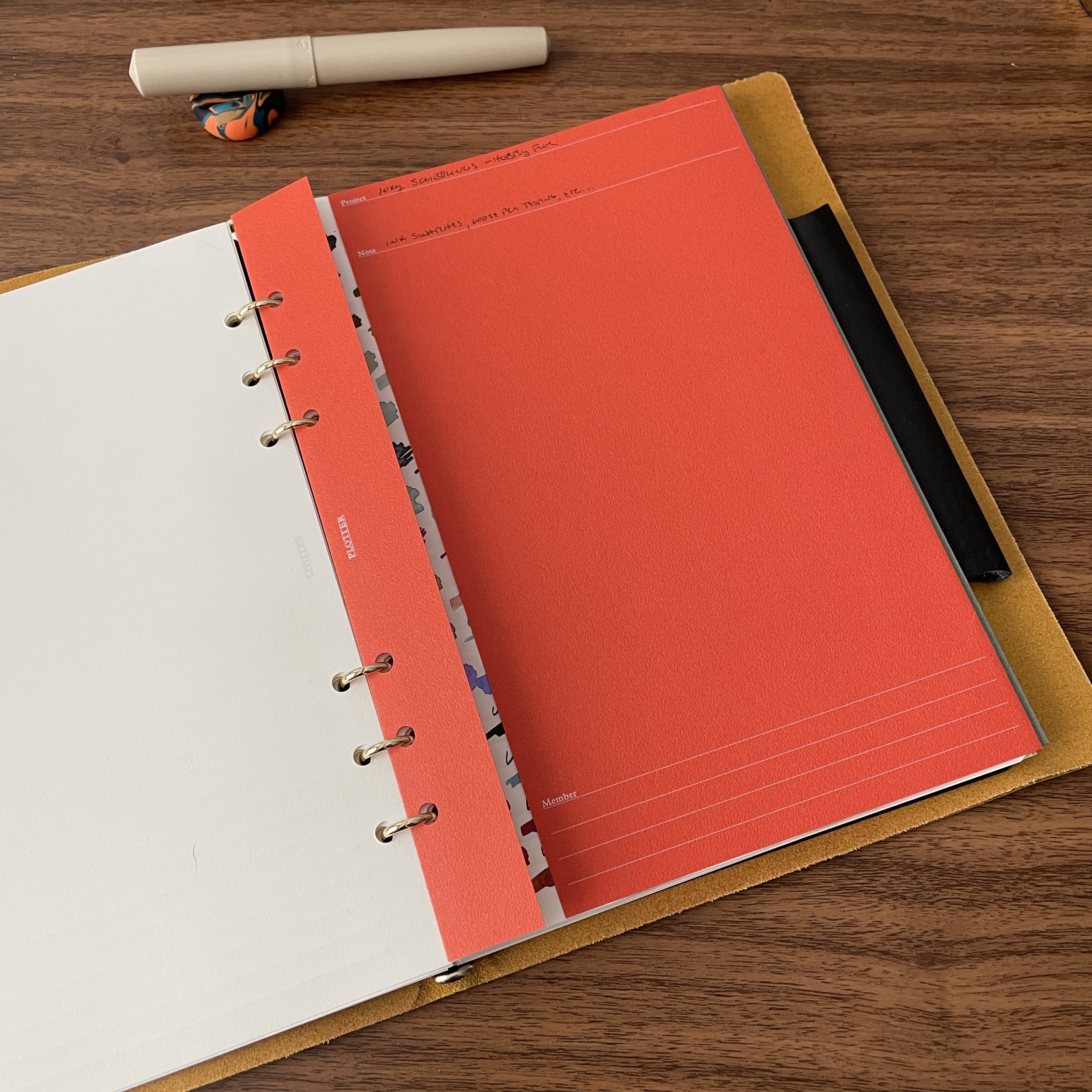
Plotter refills and notepads are well designed, and I especially love the bound notepads that can be used as stand-alone notebooks with removable sheets.

The Plotter system is organized around three main components. First, you have the excellent paper, which is DesignPhil’s own proprietary formula, and which I would compare to a slightly thinner version of Midori MD. While certain refills ship in packages of looseleaf sheets, Plotter refills also come bound in pads or notebooks. This convenient design allows you to use the refill as a stand-alone notebook that you can carry with you, tearing out individual sheets to incorporate into your binder as needed. Yes, there is also a diary refill, so you can use your Plotter as a traditional six-ring planner, but that’s not necessarily how the Plotter system was conceived. (More on that below.)
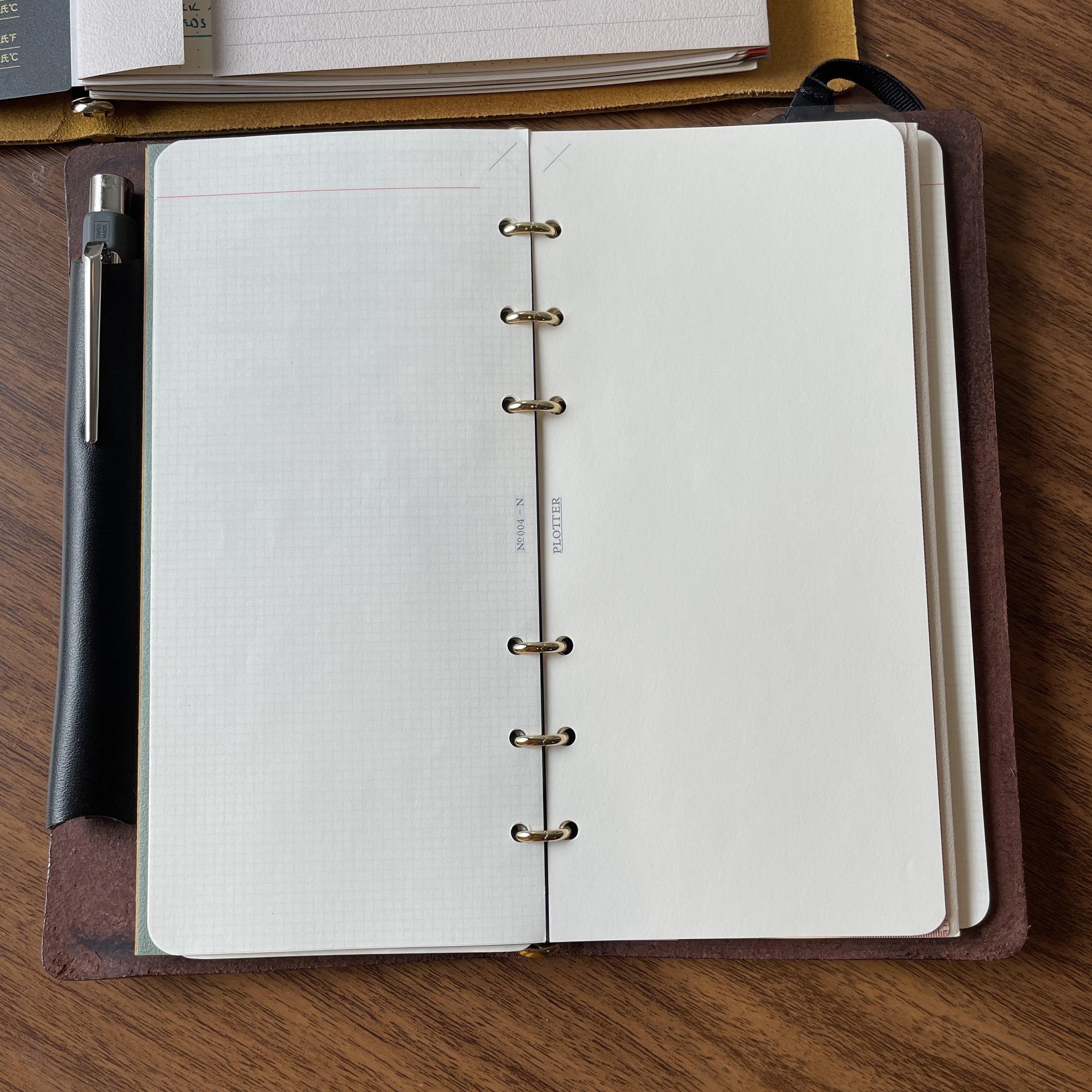
Plotter paper comes in a variety of rulings (dot, lined, grid, and blank), so that you can assemble a notebook with multiple types of paper to use whenever different needs arise.

The second component of the Plotter system is the binder (i.e.,the leather notebook cover). Currently, Plotter users in the U.S. can select from five different sizes: A5, Bible, Narrow, Mini, and Mini 5. The Plotter binder itself is a fairly simple six-ring organizer sold by itself. To build out your Plotter into something that you can personally use everyday, you will use the paper refills and “Accessory Refills” to customize the system. As you can imagine, this is both a blessing and a curse: A blessing because you aren’t necessarily forced into purchasing an overly complex notebook system if all you want is a nice leather binder that holds looseleaf sheets; a curse because if you do want to take advantage of all the (excellent) Plotter components and accessories, you can spend money quickly. For that reason, I would recommend starting simply, purchasing your binder, maybe a set of dividers, and an elastic cord and/or penholder. You can always add more functionality as you go. (Note: Plotter ring spacing is NOT proprietary, so if you have, for example, Filofax refills, dividers, rulers, etc. in the correct size, they should fit your Plotter. Similarly, if you have a Filofax binder and merely want to test out the Plotter accessories and organizational system, everything should fit your existing cover, though no guarantees.)

All Plotter binders feature six rings and a metal bar on the spine. It’s a minimalist design that I find quite attractive.

Finally, the third Plotter component is the “archiving” aspect of the system. Because the Plotter binder is, by design, not necessarily all that capacious, you may need a larger notebook or refill binder to hold spare refills and older notes and other materials that are no longer immediately relevant but that you still want to keep. Plotter does sell a refill binder for archiving, but you can easily use something like a spare six-ring planner with the same ring size. (I have an older Filofax that I’ve been using to hold A5 Plotter sheets and spare refills that don’t currently live in my binder.)
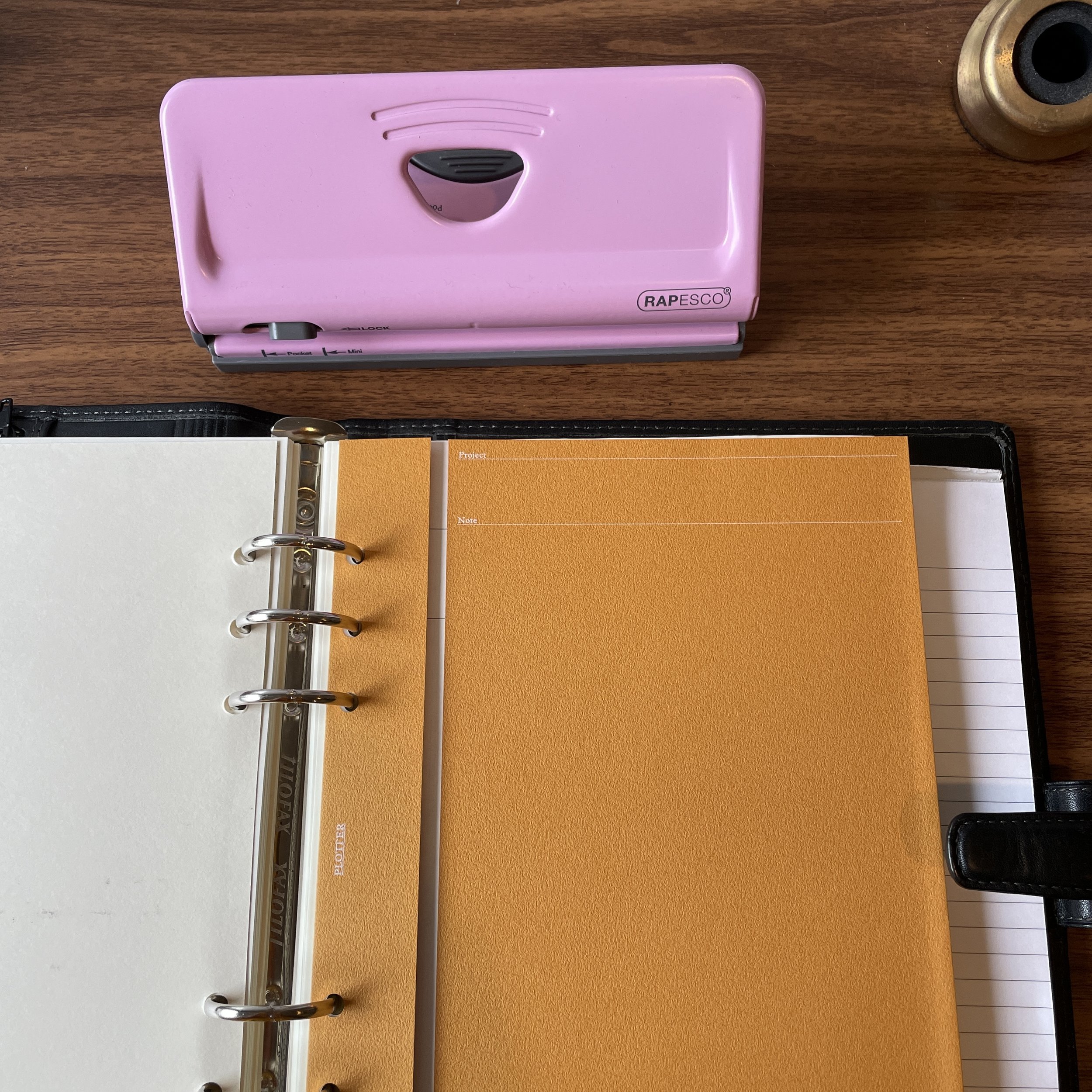
Adding a hole punch (like the inexpensive Rapesco version shown here) will allow you to use paper that you already have on hand. I’m a huge fan of Midori MD Cotton, and I’ve been punching holes in sheets from a standard A5 pad and using it in my Plotter. Also pictured here is the A5 Filofax I use for archiving and refill storage.

How the Plotter System Is Designed to Be Used

To start, there is no “correct” way to use Plotter, or any notebook system or stationery item for that matter. You should incorporate your stationery into your life in a way that works for you, and which will give you maximum utility and enjoyment. That said, there is a specific philosophy informing the design of the system, and when I was at the San Francisco Pen Show last month, I had the opportunity to sit in on a Plotter seminar in which April from DesignPhil (and Penguin’s Creative and Stationery Cafe!) explained the general principles behind Plotter:

  • Facilitating idea capture and note taking

  • Refining your notes and ideas, with a focus on identifying the most essential ideas and/or information to keep on you at all time

  • Providing a flexible, customizable platform that allows you to work creatively in a format that works specifically for you

In other words, the Plotter system was built to make it easy to (1) capture notes and ideas on paper, (2) organize (or at least retain) those ideas in the binder while you develop them, (3) periodically review and revisit your ideas, archiving what you need while disposing of what you don’t. The slim binder design is therefore intentional, encouraging a minimalist approach to notetaking and workflow. This can be a lifesaver for work projects that have a tendency to spiral out of control. How many of you (like me) have notebooks stuffed with months’ or years’ worth of research and meeting notes, of which a dozen or so pages are actually useful to keep long-term?

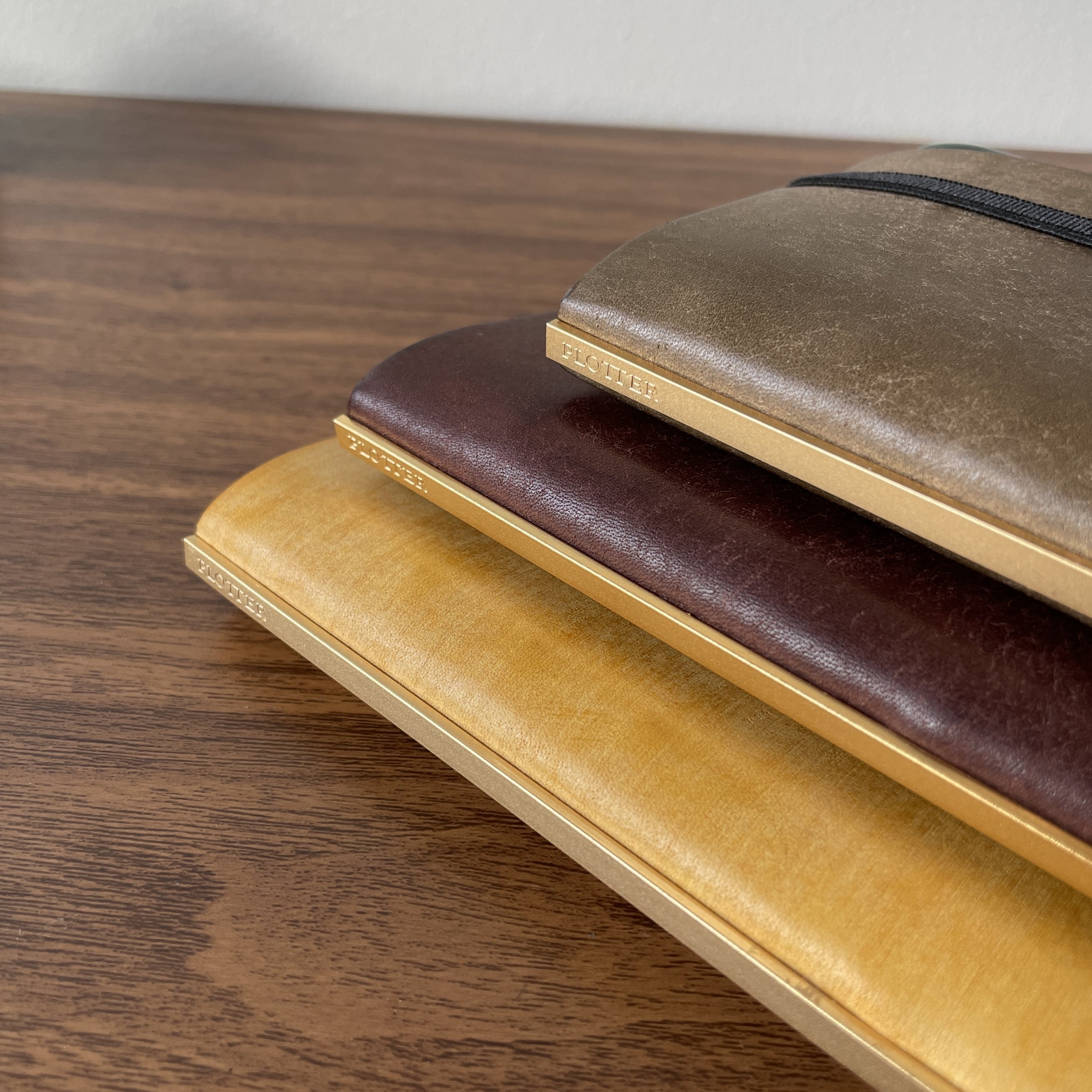
My three Plotter notebooks: Mini 5 (top); Narrow (center), and A5 (bottom).

How I Use My Three Plotter Notebooks

So who do I think Plotter is for? For someone involved in too many different things (like me) who tends to be kind of scatterbrained (like me) and who works primarily on pads of paper and notepads for the majority of their writing (like me). I’m both an organized and, at the same time, an extremely disorganized person. While I’m generally “organized” in the sense that I do make a regular effort to collect my thoughts related to different projects I’m working on and group them together in some way, I feel disorganized in the sense that I’m seemingly always working on too many things at the same time, often in the same notebook or notepad, and sometimes I’m not sure where the ideas and concepts I’m working on at the time will go, or even whether they ultimately will amount to anything at all. It can feel like I’m carrying around a chaotic mess of paper and it stresses me out. Enter the Plotter as a “creative inbox”, providing just enough structure to keep me sane. I heard someone describe Plotter as “the place to loosely you organize thoughts and ideas until you figure out where they will live long-term,” and that’s an excellent way to describe the system. I have three Plotters:

  • Plotter A5 (My main “inbox,” containing notes for T.G.S. content and other personal research and writing projects)

  • Plotter Narrow (Notes, lists, and ideas relating to T.G.S. business operations)

  • Plotter Mini 5 (I use as a wallet and a pocket notebook/jotter that I carry around at all times)

Each of my Plotters includes a handful of “Project Manager” folders, which allows you to organize sheets by topic. The folders themselves are hole-punched, so if you want to devote a folder to a specific project and move it in and out of your binder as you work on it, you can just pull the entire folder and stick it in your archiving system.

Using my own workflow as an example, I typically think of a half-dozen or so ideas for T.G.S content over the course of any given day. I might sketch out the idea on a sheet of A5 paper, stick it in the “TGS Articles” section of my A5 Plotter (grouped with other similar ideas if applicable), and either build the idea out in the Plotter or transfer it to a dedicated notebook or to the computer if it’s something I actually want to publish or incorporate into one of my longer-form writing projects. Every so often, I’ll review the notes in the Plotter and decide whether they warrant archiving or recycling, if they don’t seem like something I’ll be working on in the near future.
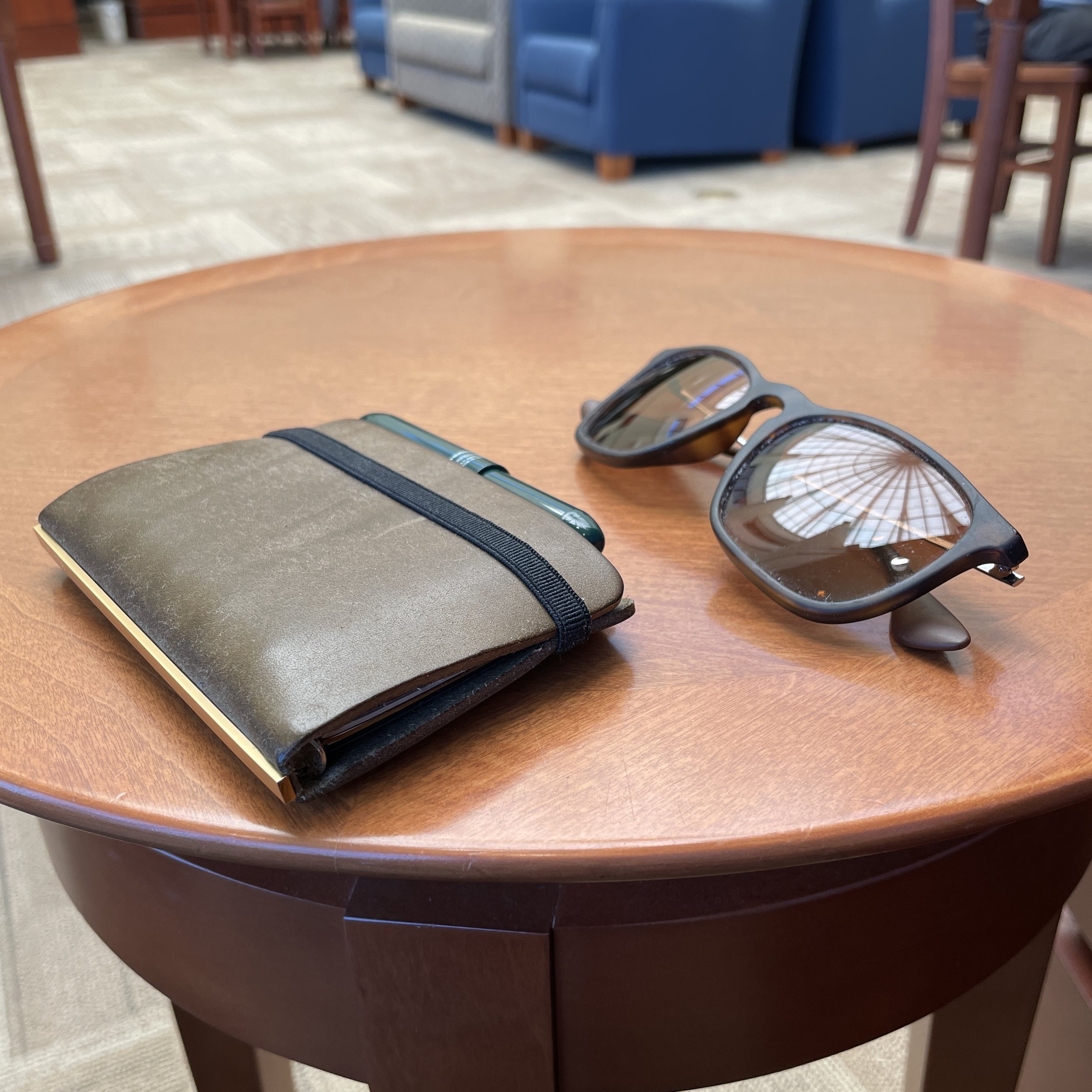
My Plotter Mini 5 goes everywhere with me. This particular notebook is used less for content management than for lists and reference notes that I want to have on me at all times (lists of books to check out from the library, pens I’m looking for at shows, etc.), as well as just a general purpose jotter with removable pages.

Takeaways and Where to Buy

Plotter offers flexibility in a convenient and elegant format, and I personally enjoy using this system more than other ringed organizer systems I have tried. I own three different Plotters, and have been using one of them for well over a year, so for me it has staying power. Over the past month, I’ve seen my Mini 5 notebook in particular become a core piece of my everyday carry, and my A5 Plotter also sees daily use. While Plotter is not an inexpensive system to buy into, as long as I actually continue to use the Plotter regularly over a multi-year period, it will be well worth the money spent. The refills themselves are not actually that expensive, and priced commensurately with other paper products of similar quality, so any expense is mainly associated with the initial setup.

If I had to recommend that new Plotter users purchase one accessory, it would be one of the “lifters” with either a pen loop or an elastic band. The “Lifters” can be placed anywhere in the notebook to serve as either a divider, or as a pencil board or firm surface for writing. For a discussion of which pens fit the Plotter, see this post.

Currently, Plotter can only be purchased through the Plotter USA store, which recently restocked after selling out in the wake of the post-San Francisco Pen Show hype. Binders range anywhere from $96 to $250, depending on the size and the type of leather you select. Looseleaf refills are generally priced in the $6 to $8 range, and Plotter-branded stand-alone notebooks and A4 writing pads are priced at $18. (Tip: you can punch an A4 sheet across the top and fold it in half to include in an A5 binder.) Accessories such as the penholder and elastic “lifters,” project manager dividers, etc. range from $6 to $15, approximately.

Again, the Plotter system is not inexpensive, but these prices are comparable both to other binder systems (like Filofax) and high-end Japanese leather notebook covers such as those from Midori. Moreover, the cost of a $250 notebook setup that you wind up using all-day, every day for years vanishes into the background pretty quickly. That said, anything can - and should - be considered “too expensive” if you never use it.

System Techo can be a powerful tool for those who like to work on multiple projects within a single binder, and value the flexibility to move around individual sheets of paper. In the coming weeks, we’ll be looking at other notebook systems that use different refill options and are built around different philosophies.

Disclaimer: I purchased the A5 and Mini 5 Plotters with my own funds at full price, though I was gifted the Narrow version a year ago as part of Plotter’s U.S. market testing. I was not compensated for this review and this post does not contain any affiliate links.
In Notebook Review, Editorial, Guide Tags Notebook Systems, System Techo, Plotter
6 Comments

Guide to Notebook Systems, Part I: What Is a Notebook System / System Techo?

September 17, 2022

The stationery community has many different sub-communities organized around specific interests, ranging from fountain pens to pencils to inks to paper. One common theme running through all the various groups, however, is an interest in notebooks, and more specifically Notebook Systems. Everyone seemingly has their own preference, but it’s easy to get lost in the different options available, especially with new brands and “systems” hitting the market every year. I hope my latest project, a multi-installment look at different Notebook Systems and how they can be used, will prove helpful.

Three Plotter leather binders, in different sizes. Plotter is a Japanese system recently introduced in the United States.

This first installment is definitional. As in, what are people referring to when they talk about “Notebook Systems” or “System Techo”? As far as I know, there’s no true “definition” of either term. Personally, I use “Notebook System” to broadly describe any line of notebook covers and compatible refills and accessories, typically (but not always) sold by a single company and designed to work in combination. “System Techo” is a term used mainly to refer to Japanese-style organizer systems, such as Plotter or Knox, which feature removable pages in a ring binder, or Hobonichi or Jibun Techo, which are bound dated diaries in a traditional book format. In this series of posts, I don’t intend to be overly rigid with how I characterize different brands and products. My goal is to more to familiarize you with the different systems and brands, group them together by what I consider to be common features, and give you some examples of how they can be used and how I personally use them.

The interior of a Plotter ring binder.

Binder Systems

Included in this category is really any notebook system that allows you to move individual pages around a notebook or binder, typically using either rings or discs with punched paper. While many people will recognize these as the “personal organizers” and calendar systems that were extremely prevalent here in the U.S. in the 1990s and early 2000s before the advent of smartphones, they remain extremely popular in Japan and are making a resurgence worldwide. The modern systems are much more versatile than a traditional planner. For professional reasons I won’t get into here, I don’t keep a paper calendar. Instead, I use my Plotters (the current preferred system) as more traditional notebooks that allow me to move around individual sheets and organize ideas I’m working on.

Examples of ring/disc-binder notebook systems include:

  • Plotter, which you’ll be reading more about in the future. Other brands include Filofax, perhaps the most popular brand of personal organizer in the world, Knox, and Rayman Davinci. (The latter two are Japan-only and as of the time of writing, do not have U.S. based retail options as-of the time of writing.)

  • Disc-bound Notebooks such as Levenger Circa, Staples Arc, and William Hannah.

Hobonichi Techo in A6, English version.

“Single Use” Bound Books

I place in this category the annual “diaries” such as the Hobonichi Techo series and those offered by other brands like Kokuyo and Midori. Originally intended to serve as dated planners, they’ve developed a devoted following around the world, and many people use them for journaling, habit-tracking or logging, or simply as dated notebooks. I’ve used the standard A6 Hobonichi Techo as a personal journal on-and-off over the years. I’ve also placed Stalogy and Midori MD in this category, since both have “day-to-a-page” or dated versions, as well as a range of accessories that allow users to set up undated notebooks as planners or otherwise customize them for specific needs.

Examples of these types of systems include:

  • Hobonichi and Jibun Techo

  • Stalogy and Midori MD

  • Sumkin (Formerly Soumkine) Agendas

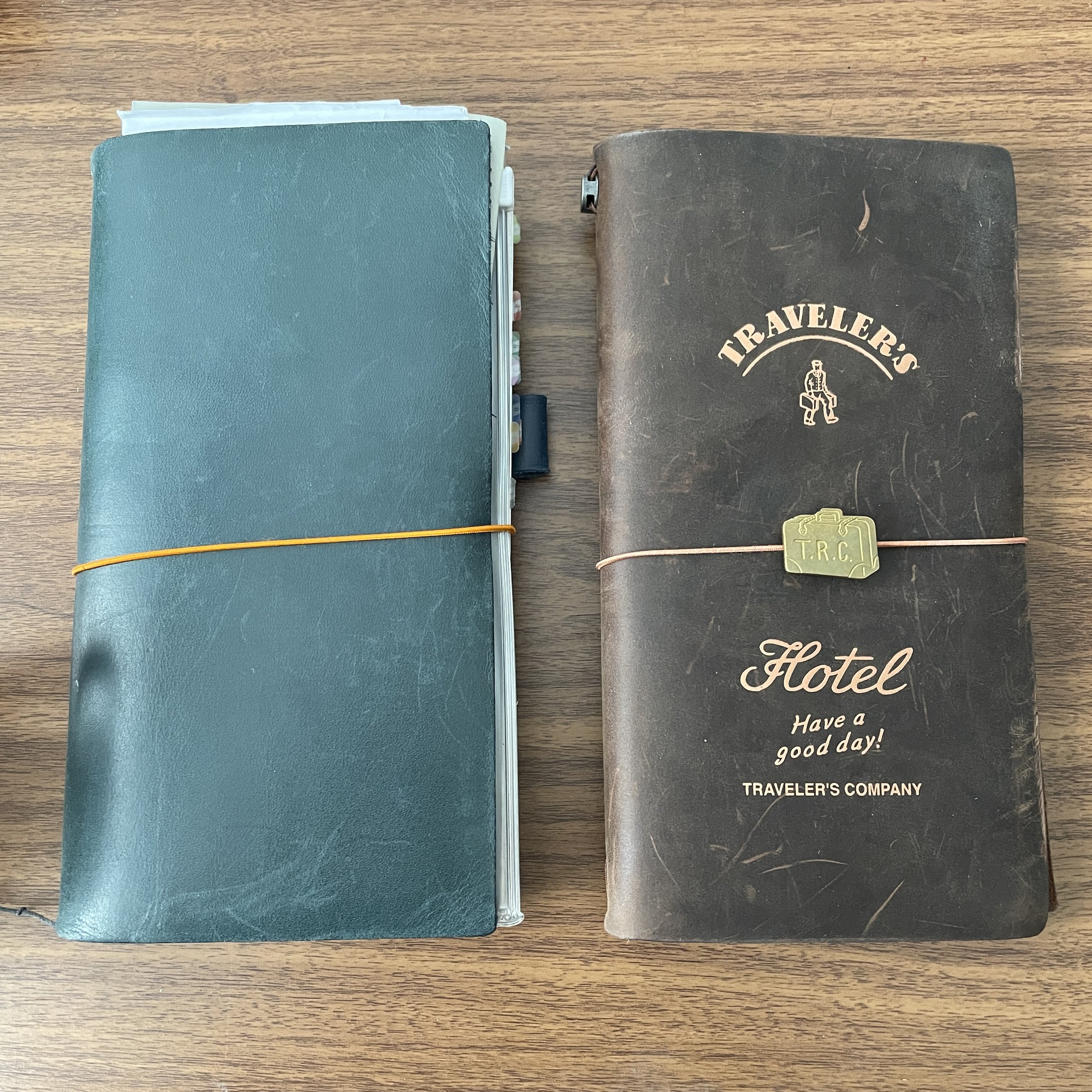
My two Traveler’s Notebooks. The one on the left is years-old and well-used. The one on the right is one of this year’s 2022 Limited Editions.

Cover + Refill Systems

If systems such as Plotter and Filofax offer flexibility by allowing you to move around individual sheets of paper, others are built around smaller individual bound notebooks that can be swapped in and out of a specific cover or binder using cords and/or clips. I tend to use these types of systems for journaling (both personal and professional) and some drawing, and have long favored Traveler’s Notebooks due to their tall/narrow paper format. The Lochby Field Journal uses a similar cord-based binding for standard A5 refills, while Roterfaden relies on metal clips and comes in a variety of different sizes. Of the three systems discussed here, Traveler’s Notebook has the most active community, given that it’s the longest-tenured option with a robust line of accessories that includes folders, penholders, pouches, etc.

Examples of these types of systems include:

  • Traveler’s Notebook

  • Lochby

  • Roterfaden Taschenbegleiter

I use my notebooks on a daily basis.

Myths About Notebook Systems / System Techo

I use at least one example from each of the aforementioned categories on a near-daily basis. Part of why I wanted to do this series is to talk about how these notebooks aren’t just “collectibles” for me - I really do use them to manage my everyday work and personal life, and certain of them have proven invaluable as I find different systems appropriate for different types of writing. That said, I regularly get questions about “whether I actually use all these notebooks,” or other comments referencing one of many misconceptions about notebook systems and stationery in general. I’ll briefly address a few of them below.

Myth No. 1: Notebook Systems Are Extremely Expensive and Not Worth the Money.

First, anything is “expensive” if you pay money for it and never use it. Similarly, whether something is “worth the money” depends entirely on the value you personally derive from it. While there is an up-front investment required in some of the more intricate systems such as Plotter, Filofax, or Traveler’s Notebook, I use them so much on a daily basis that the $50-$250 I spent years/months ago to set up the system eventually fades into the background. That said, I would caution that it’s very easy to get carried away purchasing add-on accessories that you will never use. A solid strategy is to start with the standard binder and a few refills, and add to it as your needs evolve.

Myth No. 2: Notebook Systems Lock You into Proprietary Products.

Several years ago, that may have been the case. Today, however, nearly all of these systems offer a wide array of compatible refills in multiple papers and layouts. With respect to the ring and disc-based systems, purchasing a compatible hole-punch that allows you to use your own paper that you already have on hand can save you a lot of money over time while also increasing the flexibility of the system. I’ll plan to discuss this more when I talk about how I use Plotter and some of my Filofax notebooks. It’s also important to remember that if you’re willing to experiment, you can absolutely use accessories from one system with another. For example, I’ve cut down Stalogy notebooks to fit inside a Traveler’s Notebook cover, and regularly use the Midori MD system of tabs and sticky notes across brands.

Honestly, I use my various notebook systems for everything from day-job work to creative writing to managing my hobbies like ink-collecting :)

Myth No. 3: Notebook Systems Stifle Creativity.

This one I don’t really understand, but I think it’s derived from the belief that you shouldn’t buy nice/complex notebook systems because you start caring more about the system itself than the work that goes into it, paying more attention to the tool than putting words/art/work on paper. Honestly, I don’t feel like this is a valid reason not to buy notebook because that logic can be applied to anything: pens, computers, phones, or any other object. If you buy it as a tool, use it as such. Don’t worry about getting it dirty or maintaining it in pristine condition or setting up the “perfect” workflow - through regular use the object itself eventually disappears and just becomes part of your everyday.

Myth No. 4: In the Age of Phones, “Planners” Are Obsolete.

In certain occupations where managing deadlines and seamlessly coordinating multiple schedules is essential, it’s extremely difficult, if not impossible, to use a paper planner as your primary calendar. That said, while setting alerts and electronic notifications on your phone is an excellent failsafe, I’ve found that it helps me to track, manage, and prioritize tasks if I maintain a handwritten list that I revisit daily. And, as I’ll discuss further in this series, nearly all of these “systems” are much more than calendars or planners, and it’s unwise to simply write them off as such.

Always invest in the pen loop.

What to Expect from This Series Going Forward

I don’t have a clear idea how many different installments this particular series of articles will entail. At a minimum, I want to discuss each of the three rough categories of Notebook Systems discussed above, what I like/dislike about each one, and how I use them. That said, I can envision those articles getting very long, so I might break a couple of them into multiple articles where I discuss specific brands individually. Stay tuned!

The Gentleman Stationer is supported entirely by purchases from the T.G.S. Curated Shop and pledges via the T.G.S. Patreon Program. The Gentleman Stationer does sell certain of the products discussed in this article, though this post does not contain any paid third-party sponsorships or affiliate links.

In Notebook Review, Guide, Editorial Tags Notebook Systems, System Techo, Editorial, Traveler's Notebook, Roterfaden, Plotter, Midori MD, Stalogy, Hobonichi Techo
5 Comments

Top Five Pens for Planner Use

August 24, 2022

Since I’m getting ready to leave for the San Francisco Pen Show, and a large part of that show is devoted to planner/Japanese techo notebook systems, I’m loading up nearly all of my notebook covers with different papers, refills, and accessories to have available for both after-hours show-and-tell as well as several classes I’ll be taking. I’ve also been working on better organizing my various notebooks and planners to ensure that everything I’ve decided to keep following my “great summer purge” gets used for a specific purpose. When you’re playing with this many notebooks, it’s hard to avoid thinking about pens - namely, what’s the best “planner pen” or pen to keep alongside your primary everyday notebook system or system techo? Here, I talk about five select pens that are excellent for this type of use, with the selections driven primarily by size, versatility, and the ability to let me write small in compact spaces.

The pens discussed here, clockwise from left: Lamy 2000 4-Color Ballpoint, TWSBI Swipe Fountain Pen, Traveler’s Company Brass Ballpoint (standard version), Pilot Capless Decimo, Pilot Hi-Tec-C-Coleto Lumio, and the CW+T Pen Type-C (in front).

  1. Fountain Pen Recommendation: Pilot Decimo. For “planner purposes,” and for most writing in general, I remain a fan of the Pilot Decimo over the larger standard Vanishing Point. Not only is the Decimo easier to slip into pen loops in notebooks and planners, but I find the slimmer body more comfortable to write with and easier to manage with one of Pilot’s excellent EF or F nibs. In addition to compact size, one other attribute I look for in a “planner” fountain pen is a high-capacity cartridge, so that I can carry a few with me when traveling and not have to worry about constantly refilling in a hotel, on an airplane, or even at the office. Of course, if you prefer a slightly larger pen, the standard Vanishing Point is excellent and uses the same Pilot proprietary cartridges, but it may be too wide to fit in certain pen loops.

  2. Fountain Pen Recommendation: TWSBI Swipe. Since it’s release, the Swipe has continued to surprise me with how much I enjoy this pen. I keep my Prussian Blue Swipe with an EF nib tucked into one of my “go” notebooks at all time. While TWSBI made it’s name with piston fillers, the Swipe added cartridge/converter capability to the lineup, and TWSBI also offers a high-capacity ink cartridge though some might find the color selection basic. The Swipe is currently available in four distinct colors (all currently available in the T.G.S. Curated Shop), and I understand that more are on the way as the company continues to expand this segment.

  3. Ballpoint/Gel Recommendation: Lamy 2000 4-Color Ballpoint/Multi-Pen. Personally, I feel strongly that every stationery enthusiast - and particularly those who use their pens and notebooks for work, research, school, and other “productivity-related” functions - have at least one mutifunction pen in their collection. I enjoy the Lamy 2000 version due to its refill versatility (it accepts D1 refills) and streamlined look. I recently revisited my original review of this pen, and as you can see, it’s received a lot of use over the years.

  4. “Writing Small” Recommendation: Pilot Hi-Tec-C Coleto. Ok, many people don’t like to recommend the standard Hi-Tec-C gel pen since the full-size refill can be extremely temperamental if you get a bad one. That said, I’ve had good luck with the Coleto multi-pen refills (Pilot also offers a Coleto mechanical pencil insert), which are available in tip sizes ranging from .3mm to .5mm. The .4mm version is my personal preference as it strikes a good balance of smoothness and precision. If the ability to change colors on the fly isn’t important to you, CW+T makes a flat “bookmark” pen (the Pen Type-C) that accepts single Coleto refills.

  5. General Form-Factor Recommendation: Traveler’s Company Brass Pens/Pencils. Since they’re designed to complement the Traveler’s Notebook lineup, it’s only natural that the compact and durable Traveler’s Brass pens (and pencil) would make their way onto this list. Borrowing from the vintage “bullet pencil” format, Traveler’s Company makes pencil, ballpoint, fountain pen, and rollerball versions, with the ballpoint being my personal favorite due to its excellent needle-tip refill and fast-drying ink. (Editor’s Note: If you’re at the San Francisco Pen Show this weekend, stop by the Traveler’s Company booth to customize your own limited edition Brass Ballpoint in two show-exclusive colors!)

Assuming I don’t hit the bag weight limit (and/or can get my carry-on closed), all of these are coming to San Francisco with me this week.

Pen Recommendations Looking Forward

I’m considering revamping my “Best Pens” list to include new categories organized around different use cases. For years I’ve had the list organized by price point and/or product category, which tends to focus more on the process of acquisition rather than what one does with the pen once it’s purchased. Lately, most of the questions I get seek recommendations on a pen for a specific use case, not in a particular price bracket. Stay tuned as I work through a few more of these questions and perhaps look for a revised/expanded general resource in the future.

This post does not contain links to paid sponsors or affiliates, though a few of the pens on this list may be stocked in some form in the T.G.S. Curated Shop. The Gentleman Stationer is supported entirely by purchases from the T.G.S. Curated Shop and pledges via the T.G.S. Patreon Program.

In Editorial Tags Editorial, Planner, Notebook Systems
1 Comment

Market Watch: What's Up With All the Rainbow Pens? (NOT A COMPLAINT)

August 17, 2022

Unless you’ve been completely ignoring new releases over the past two years, you’ll have noticed that nearly every pen company, ranging from larger manufacturers down to small-batch makers, has begun to release pens in a “rainbow” finish. How this coating is described varies from company to company: TWSBI has dubbed their Diamond 580 and Vac700R models as the “Iris” finish, Conklin and Fisher Space Pen both use the “Rainbow” moniker, and Ben Walsh of Gravitas Pens has branded the finish “Skittles.” Even Leonardo has released a limited edition Momento Zero (the “Prisma”) in collaboration with Italian retailer Stilo e Stile.

Gravitas pens offers a wide variety of “Skittles” finishes. The two shown here are Matte Paisley (center), as well as the darker TiSiNX finish (right), discussed further below.

So how exactly do companies achieve the “rainbow” effect? While most companies protect their exact processes - trade secrets and all - from what I read it appears to be achieved by applying a Titanium Nitride PVD coating, with different companies varying the formula to achieve unique looks. For example, Ben Walsh is releasing the Gravitas TiSiNX, which adds Silicon Nitride to the coating in order to achieve a darker blue/purple tone, and I was lucky enough to take home one of these pen from the D.C. Pen Show.

Comparing the standard Gravitas “Skittles” finish to the TiSiNX finish (right).

The coloring on the Conklin All-American is pretty intense, and also leans much more orange/yellow than the TWSBI Iris finish, which has a pink/purple/magenta tone. I think I prefer the more subtle options.

Because PVD coating is extremely durable, you shouldn’t have to worry about the finish wearing away. In my experience to date, the PVD coating has not affected writing performance, even where the nibs have been treated. And while the special finish typically comes with a small upcharge to the standard pen, it’s not much. The prices I’ve seen have remain reasonable, ranging from $80 for the TWSBIs to around $180 for the Leonardo.

Takeaways and Where to Find This Finish

I’m actually enjoying the “rainbow” trend far more than the “glitter pen” trend that preceded it, especially as companies such as Gravitas experiment with darker tones. Of course, any trend can suddenly seem overdone (looking at you, shimmer ink), and given how successful these pens have been, I think we can expect more pen manufacturers to release their own titanium nitride pens if they haven’t done so already. So far, most companies have exercised retraint, trying to differentiate themselves with unique design touches. For example, Leonardo paired the “Prisma” trim with a bead-blasted, matte acrylic. Kaweco has even released an “Iridescent Pearl” acrylic that achieves something of the same look, and it’s safe to assume that at some point, a rainbow AL Sport or Steel Sport will follow.

The variations in tone between the various models is not necessarily apparent until you compare different pens from different companies side-by-side.

What are your thoughts? Do you find this trend played out, or do you want to see more? Personally, as long as companies keep experimenting, I’m interested to see what manufacturers can do. I generally love PVD coated pens for their durability, and it’s interesting to see colors other than black.

This post does not contain links to paid sponsors or affiliates, though the T.G.S. Curated Shop is an authorized retailer of TWSBI, which is featured here. T.G.S. is supported entirely by purchases from the T.G.S. Curated Shop and the T.G.S. Patreon Program.

In Pens, Editorial Tags Titanium Nitride, Rainbow Finish, Fountain Pens
2 Comments
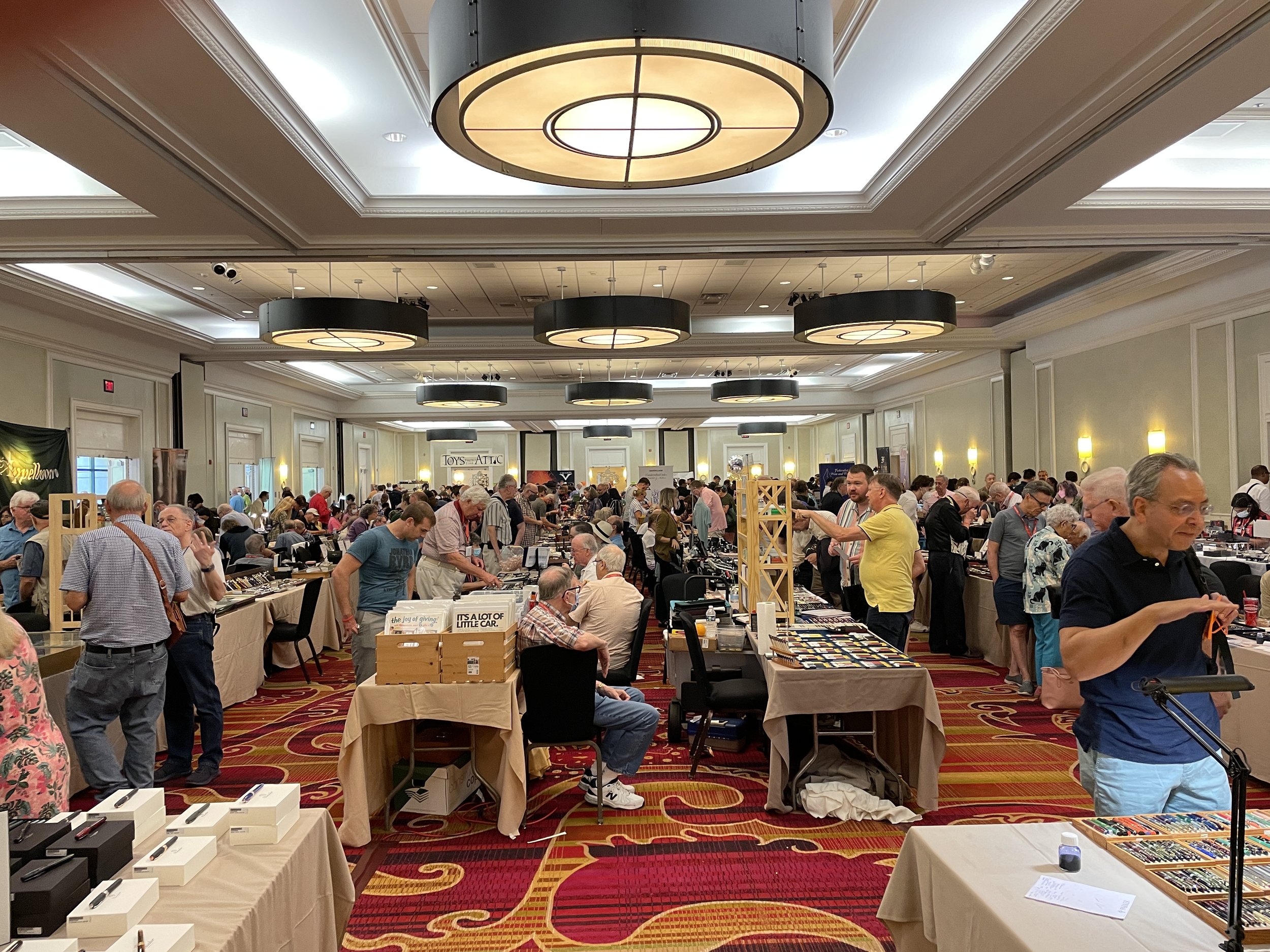
2022 DC Pen Show Main Ballroom

2022 D.C. Pen Show Recap: Is "The Big Show" Still "The Big Show"?

August 10, 2022

For many people, the D.C. Pen Show has been, and always will be, “The Big Show,” (or “The Fountain Pen Supershow”, as it’s long been dubbed). For years, it billed itself as the premier pen event in the world, and certainly in the United States. It’s true - the D.C. Pen Show is quite large, and if what you’re looking to do is shop, it offers an unparalleled opportunity to meet makers, vendors, and retailers.

Shawn Newton had all kinds of custom pens available for in-person viewing (and purchase!) in D.C.

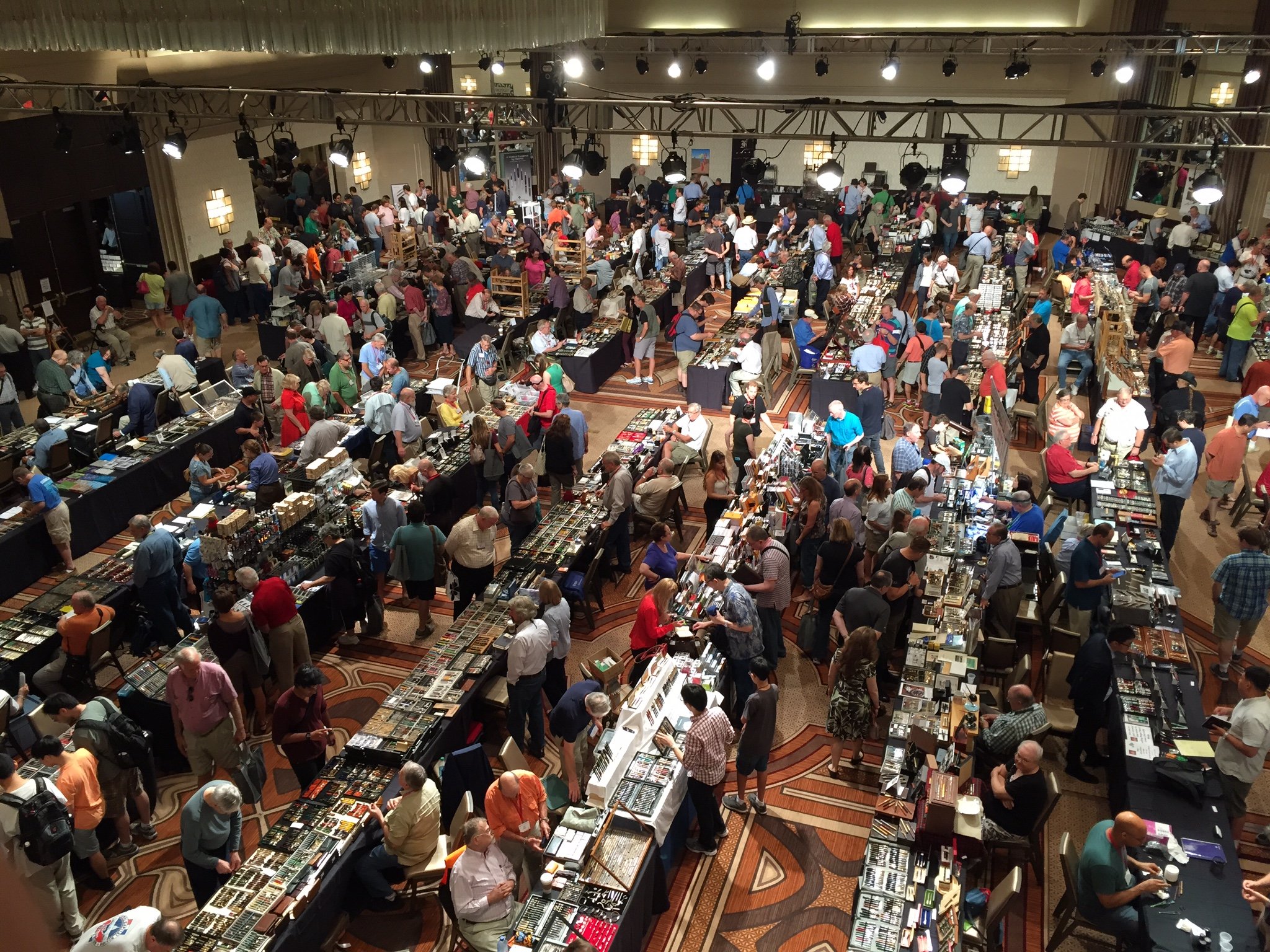
The issue I have is that I can’t stop myself from comparing recent D.C. Pen Shows - say 2018-present - with the shows from the mid-2010s, at the old location. I also can’t help comparing the D.C. Pen Show, in its current form, to the Baltimore and San Francisco Shows, all of which have maintained the “destination event” cachet that D.C. unfortunately seems to have lost. Certainly, some of this is beyond the control of the D.C. Pen Show and its organizers. The D.C. Pen Show gave up the rights to its old location after 2016, which I believe was the last show in Tyson’s Corner, after which the show moved to the Marriott Fairfield Park in Falls Church, Virginia. In the years since, there has been organizer turnover, with founder Bob Johnson passing away; the COVID pandemic, which forced cancellation of the 2020 show and continues to affect people’s willingness to travel; and this year, major construction at the hotel that closed the restaurant, deprived attendees of any real area to hang-out after-hours, and forced the show to operate on two different levels.

Aerial shot from the 2015 D.C. Pen Show.

Even after accounting for all of these logistical challenges, the D.C. Pen Show feels different than it used to, and the trend has been noticeable over the past several years. Fridays are much slower, with less visible foot traffic, even after they started opening the show to the public at noon. While Saturday this year was packed at points in the morning and mid-afternoon, there were times when it slowed down dramatically to levels I had not seen before on a Saturday in D.C. (While I had to leave the show on Sunday at noon, I don’t typically draw much of a conclusion from a show’s Sunday turnout, since last day traffic at any show is notoriously unreliable and always has been.) The majority of vendors I spoke with felt that both Friday and Saturday at the show were slower than usual and their numbers were down. This issue hasn’t been unique to D.C. - many people have expressed to me a general concern that attendance, as well as overall spend by attendees, has been declining at other shows as the year proceeds.

Schon DSGN brought the goods, as always!

How Much of The Change Is Driven by the Economy vs. Changes in the Pen Community and What We Expect from Pen Shows?

A big question I’ve been asking myself, over the weekend and in the days since, is whether the slowdown is the result of structural and economic factors, problems with how shows are run, or whether it represents a permanent shift in how people are attending and interacting at pen shows. Several people asked me for my opinion on “what the issue was” over the weekend, and I’m not sure I have a clear answer. I did spend some time thinking on possible factors contributing to lower traffic and sales, and this is what I came up with:

  • “It’s the Economy, Stupid.” You can’t ignore the effect of inflation, gas prices, travel chaos, and the lingering possibility of contracting COVID. People still aren’t traveling as much as they were in 2019, and certainly aren’t shopping as much, because they simply can’t afford to and are cutting back on discretionary travel and purchases. As much as we hate to admit it, things like pens, inks, and paper are largely discretionary purchases, and it’s difficult for many to justify taking an entire weekend at a hotel to attend what amounts to a three-day binge on pens. That said, I think it’s a mistake to write off all of these changes as “just the economy” and assume that things will return to the prior status quo once things go back to normal (whatever that is).

  • The Cost of this Hobby Is Rising. This is in part due to inflation, but also because in recent years manufacturers, retailers, and secondary market resellers have been pushing the boundaries of what people are willing to pay for pens. I’m not saying any particular cost is necessarily unjustified, but if the baseline price for a custom pen with a steel nib now pushes $250-300, if Sailor Pro Gears now cost $300+, if the new Esterbrook Camden “Polar Lights” is priced at $350 (I could go on), then people are understandably going to take their time in making a purchase, and will probably buy fewer pens overall, both at shows and online. What concerns me more is the secondary market and how the community interacts with it, raising the possibility that the pen community is in danger of becoming more like the watch community, where absurdly high secondary market prices on certain trendy pens and inks, as well as snobbery on the part of some of those who partake in the hobby, intimidate others from joining in the fun. (This is another post for another time.)

  • Some Shows No Longer Feel Like a Destination Event. In light of the economic constraints most people are feeling in their everyday lives, when they DO attend a show, they expect a lot from it. Not just in terms of opportunities to shop, but they also look for unique seminars, organized after-hours gatherings, and a friendly, welcoming environment focused on building a community. In my opinion, this is why the Baltimore and the San Francisco Pen Shows have continued to thrive. If anything, this year in D.C. confirmed that a pen show without a central gathering point for attendees, such as a functional lobby bar or easily accessible restaurants, is not an event that I enjoy attending. Sure, people attempted to organize smaller events after hours, but in a few instances these were done in a way intended to create the perception of an “in-crowd,” or the events/gatherings were dropped to select people on an “invite only” basis to create an air of exclusivity. That’s not what this community has ever been about (at least for me).

  • “Waves” of New Hobbyists/Enthusiasts Are Still Finding their Niche. A LOT of people discovered, or rediscovered, pens and inks during the Pandemic, when they were spending more time at home. Until relatively recently, their only interaction with the community was online. Many have shown up at their first pen shows, and have absolutely no idea what to do and where to go, how much things should cost, etc. It’s only natural to have some hesitation. We need to focus on creating a welcoming atmosphere at shows for new community members, and give them a reason to keep coming back to shows, as opposed to griping that the newbies “aren’t buying anything.” That will happen, as long as they stay in the hobby and want to keep coming back. Personally, it took me at least two shows to feel comfortable. In a way, I feel like we are “between waves” of new enthusiasts entering the hobby. Many of the “experienced” crowd that attends pen shows discovered pens in the mid-2010s, and are now scaling back on acquisitions because they are in a place where they (1) have nearly all of the “standard” pens in their collection they could ever want or reasonably use; and (2) are selective in terms of what they add to their collection. As I mentioned above, the new customers who would take their place are still finding their footing, and this will take time.

This year’s haul from the D.C. Show, focusing on brands I’ve not yet experienced, including Troublemaker Inks and Gravitas Pens, who where attending from Ireland.

What’s Next for Pen Shows?

The San Francisco Pen Show takes place at the end of August, and last year’s show was one of the best I’ve attended, despite COVID and fires and other logistical challenges. While San Francisco offers an excellent opportunity to shop from a wide array of vendors, it also has free seminars and after-hours events in the hotel for weekend attendees. I have a reservation to attend, and barring any last minute work or family conflicts, I plan to be there. I’m looking at this year’s pen show calendar as a sort of experiment documenting what works, and what doesn’t work, in a “new normal” environment and a community that continues to evolve.

I’ll close by saying this - if there’s a show you enjoy, and that you want to continue, go to the show, buy a weekend pass if you can, and support the vendors who attend. That does not necessarily mean that you need to spend a ton of money, or even that you purchase something on-site. If you value pen shows, however, you should make an effort to buy from those retailers who do attend the shows (nearly everyone sells online these days), invest their own time and money in making it a great experience, and when you do, let them know that you met them at the show, saw their work or table, and that the show played a role in your decision to buy from them. I suspect a lot of people are questioning whether its worth it to continue to attend every show, or shows in general, and this sort of feedback is invaluable.

I enjoyed actually just having samples on-site in D.C., relying on the website to actually conduct any sales, which freed me up to visit with attendees and other vendors. I enjoyed meeting many of you! The cases I had at my table were made by Lochby, one of the main lines we carry, and I have links to all products saved in my Instagram Story Highlights.

T.G.S. Will NOT Have a Table in San Francisco

Assuming I’m at the San Francisco Pen Show later this month, I will be attending in my personal capacity. For those of you who picked up a T.G.S. Pen Show Promo Code at the table in D.C., it will be valid through 11:59pm on Sunday, August 21. If we met at the show and you picked up a card and lost it, just contact me through social media or via the “Contact” link on the blog and I will send you the code. (Honor System - Don’t share, as I want to maintain something special for show attendees. I do plenty of general promos for everyone throughout the year.)

The Gentleman Stationer is supported entirely by purchases from the T.G.S. Curated Shop and pledges via the T.G.S. Patreon Program.

In Pen Shows, Editorial Tags Pen Show, DC Pen Show 2022, Editorial
19 Comments
← Newer Posts Older Posts →
Store Hours and Location
Visit the T.G.S. Curated SHOP
Updated "Best Pens" Guide
On the Paper Trail Podcast
TGS_25 Roterfaden New Stock Available
Hierarchies of Fountain Pen Friendly Paper

Join Our Patreon!
Subscribe to the TGS E-mail List

Featured Posts

Featured
Pilot-Custom-Series-Pens-overview.jpg
Mar 14, 2026
The Pilot "Custom" Series: An Overview of Some of My Favorite Fountain Pens
Mar 14, 2026
Mar 14, 2026
Pentel-Sign-Pen-Cover.JPG
Feb 28, 2026
Pen Review: The Pentel Sign Pen (Craft Design Technology Version)
Feb 28, 2026
Feb 28, 2026
Cover On the Paper Trail Intro Clip.jpeg
Dec 3, 2025
Introducing "On the Paper Trail," a New Podcast/Video Collaboration with Lisa Vanness of Vanness Pens!
Dec 3, 2025
Dec 3, 2025
The Gentleman Stationer RSS

View Cart

© Digital Divide Media, LLC, 2014-present.

All content is the exclusive property of Digital Divide Media, LLC, d/b/a The Gentleman Stationer, including “The Gentleman Stationer” website and trademark, and should not be reproduced without express written permission.  All rights reserved.

All content containing paid advertising, affiliate links, or sponsored content will be plainly disclosed by a disclaimer when/if featured.

Contact Information

Store Shipping Policy and Return Policy

Privacy Policy

Cookie Policy

Terms and Conditions

Powered by Squarespace