• Blog
  • Shop
  • Podcast
  • Resources
  • About
  • Archive
  • Contact
  • Cart
  • Sign In My Account
Menu

The Gentleman Stationer

Vintage Living in the Modern World.
  • Blog
  • Shop
  • Podcast
  • Resources
  • About
  • Archive
  • Contact
  • Cart
  • Sign In My Account

Three workhorse ballpoints: The Gravitas Twist in Ultem; the Caran d’Ache 849 “Rollerball”, and the Caran d’Ache Infinite 888.

Ranking My Favorite Ballpoint Refills in 2022

November 12, 2022

Continuing my personal celebration of the ballpoint pen this week, I thought it might be fun to do something that I haven't done in a while: rank my favorite ballpoint refills. Despite what people may think, there’s actually quite a bit of variation between the different writing experiences available. Refills vary in terms of darkness, smoothness, and line width, though you’ll admittedly have a hard time finding the same range of bright colors as you can with gel pens. As my ballpoint usage has increased heavily in recent years, I’ve discovered some new favorite refills that I’d like to bring to the attention of ballpoint fans, especially those workhorse cartridges that don’t receive nearly the amount of attention they deserve.

  1. Schmidt P900. At this year’s Washington D.C. Pen Show, I picked up one of the Gravitas “Twist” ballpoints in Ultem (which unfortunately does not appear to be available except in the standard clear polycarbonate finish). While most ballpoints that accept a Parker-style cartridge tend to ship with the Schmidt Easyflow 9000 (discussed further below), Ben Walsh includes the Schmidt P900F, which writes a finer, less “gloppy” line than the Easyflow. Sure, the latter is a smooth writer, but I prefer more precision. Lanier Pens on Amazon sells a four pack containing different colors in the F (.6mm) tip size, which costs just under $9. In addition to the Gravitas ballpoint, I now have these in all of my Baron Fig Squire pens.

  2. Uniball Jetstream SXR-600. My second favorite refill, especially when I want to write small, is the Uniball Jetstream Parker-style cartridge in the .5mm tip size. (While it also comes in .38mm and .7mm sizes, the .5mm hits the sweet spot for me.) This particular refill lives in my Caran d’Ache 849 Rollerball. Though an excellent writer, the downside is that the cartridge can be pricey, ranging from $5 - $ 8.50 apiece depending on where you buy them. A similar writing experience can be found in the Jetstream D1 refills, as well as the white-labeled D1 refills used in the Penco “Perfection” series of pocket ballpoint pens.

  3. Caran d’Ache Infinite 888 “Swissglide”. For longer writing sessions, you can’t beat Caran d’Ache’s “Swissglide” refill, which is sold only in the Caran d’Ache Infinite 888 pen. True to its name, the Swissglide writes a darker, smoother line than Caran d’Ache’s signature “Goliath” cartridge, and it’s almost as long lasting. Though the refill is proprietary to this particular pen, the Infinite ballpoint costs a mere $6.25, and additional refills only $3.

  4. Ohto Needle-Tip (Mark’style Tous les Jours and Traveler’s Brass Ballpoint). I’ve written before on how I love needle-tip ballpoint pens for working in my planners, and for making tiny marginalia and annotation when I’m reading. The Japanese Ohto refills (which I know are used in the Mark’style pens and which I suspect are used in the Traveler’s Pens) are among my favorites, behaving similarly to Jetstream ink yet offering even more precision for writing and drawing due to the needle-tip. These refills are also incredibly inexpensive and long-lasting.

  5. Caran d’Ache “Goliath” (i.e., the proprietary Caran d’Ache 849 Refill). If you’re looking for a rock-solid ballpoint that lays down a medium wet, moderately dark line and can go for years without drying out, the Caran d’Ache “Goliath” is an excellent choice. While on the expensive side, they are durable, don’t dry out easily, and therefore tend to last for an extremely long time. Plus you get the comfortable hexagonal writing experience of the iconic Caran d’Ache 849 ballpoint.

Writing samples from all five pens listed here, including four colors of the Schmidt P900F.

Takeaways and Final Thoughts

Of the five refills discussed in today’s post, the “new discoveries” that I’ve enjoyed using the most are the P900F and the Swissglide. Both are inexpensive workhorses that should tempt even the most die-hard gel or rollerball fan, namely because they require much less pressure to write than your typical ballpoint.
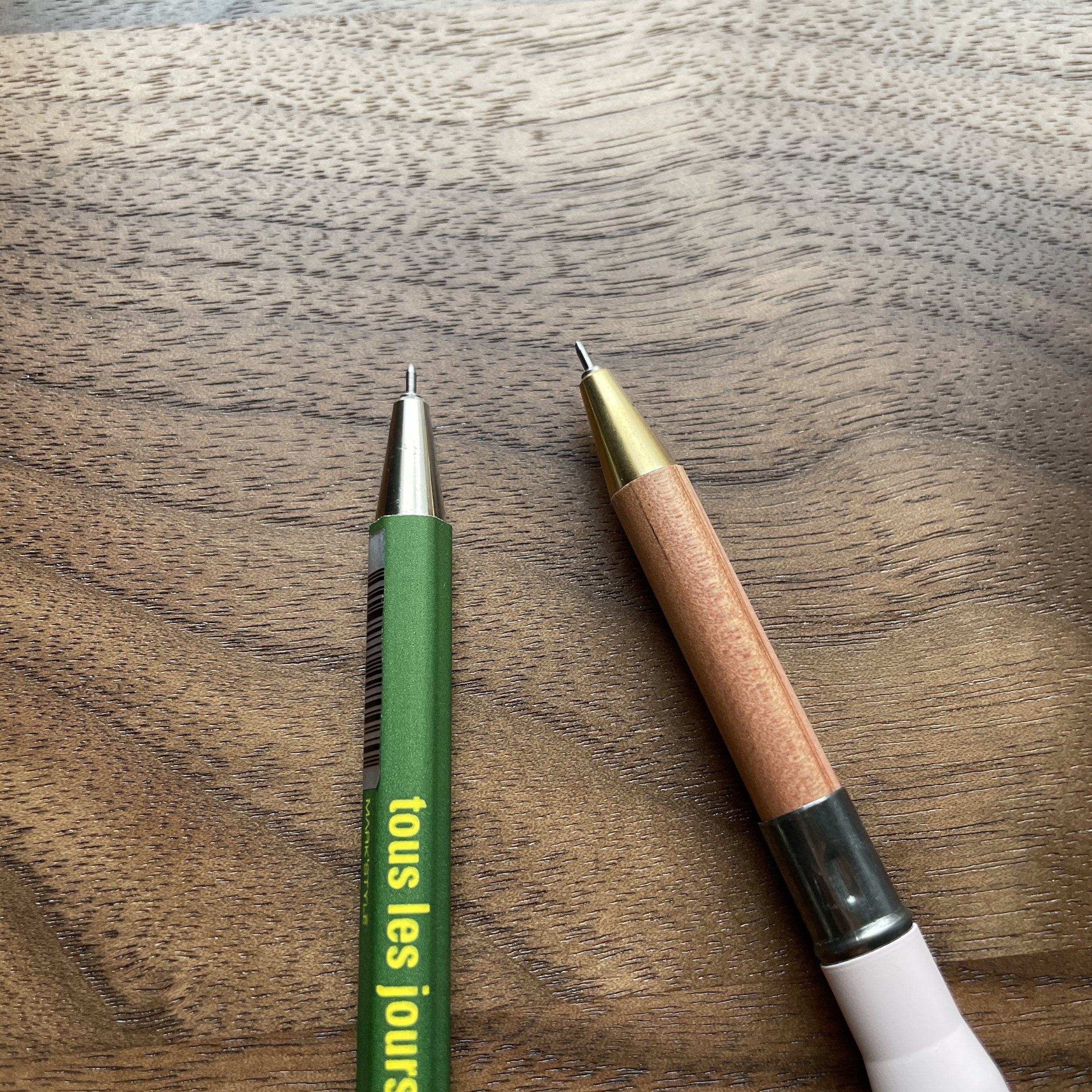
Though maybe a touch dry for pages of longhand writing, for annotating books and taking notes on thin journal/planner paper, it’s hard to beat a needle-tip pen.

Another encouraging trend that has emerged over the past few years has been better Parker-style ballpoint options. Pens such as the Caran d’Ache 849 Rollerball (which can transform into a “big 849 ballpoint”) and the Gravitas Twist both use this type of refill, as do many other kit pens and more generic ballpoints that people receive as gifts. The Schmidt P900 and Jetstream SXR-600 have not only allowed me to pull my “gift” pens - many of which have sentimental value - back into my regular rotation, but I’ve also converted many of my rollerballs because liquid ink rollerballs are among my least favorite writing options as they tend to bleed through everything.

The Schmidt Easyflow 9000 is a long-time favorite for many looking for a rollerball-like dark line, but in exchange for darkness you get smearing and a fair bit of “tip crud”.

Finally, why is the Schmidt Easyflow 9000 not on the list? Isn’t it the “best rollerball replacement option”? Not anymore, at least not to me. I personally find the Easyflow too oily, and it tends to gum up around the tip and leave streaks on the page. I consider both the P900F and the Jetstream to be superior options for pens that take Parker-style refills, but those who value “smoothness” above all else may still want to consider the Easyflow.

How about you? Is there a ballpoint refill option that I should be considering that doesn’t appear on this page? I’m interested, so leave a comment!

While this post does contain links to Amazon and other third parties, there are no paid affiliate links. The Gentleman Stationer is supported exclusively through purchases from the T.G.S. Curated Shop and the T.G.S. Patreon Program.
In Editorial, Pens Tags Ballpoint, Guide, Editorial
15 Comments

Unfortunately, these Traveler’s Company ballpoints in the exclusive colors were exclusive pre-orders from the San Francisco Pen Show. If they sold well, hopefully they may be coming to the standard lineup?

My Annual Paen for the Ballpoint Pen

November 9, 2022

Now that we’re all fully saturated with fountain pen purchases and fountain pen-related content after last week’s Fountain Pen Day celebration, why don’t we talk about something a bit different? I often get asked, “If you’re not writing with a fountain pen, then what are you using?” The answer is that it’s almost always either a ballpoint pen or a pencil, with ballpoints stealing an increased role from the gel pens and rollerballs in my collection. Today I’ll discuss five reasons why I enjoy ballpoint pens, particularly for work-related writing and annotation.

  1. Ballpoints are true “write anywhere” pens. If you need to get work done, and you don’t want to worry about the kind of paper you’re using, the ballpoint gives you the most versatility. For many, office copy paper is tissue-thin (like mine), and sometimes you’ll want to annotate something like a shiny-sheet magazine article or professional journal. Ballpoint is pretty much your only option.

  2. Ballpoint ink dries quickly and offers permanence. Taking a lot of notes on documents where you need to flip through pages, and don’t want to worry about your fountain pen ink smearing? Not only does ballpoint ink dry near-instantaneously, but it’s also waterproof, which is why many in the medical and legal professions are actually required to use ballpoint pens on a daily basis in certain contexts.

  3. Needle-tip ballpoint pens are excellent for annotation. I would say that half of the ballpoints I currently have in rotation are Japanese needle-tip ballpoints that I use to write in my Plotters (particularly the Mini-5 model), and to take notes in books that I’m reading. My number one recommendation for this category has always been the Traveler’s Company Brass Ballpoint and the arrival of my pen show special editions, pictured above, is actually what prompted this post. Smaller pens such as the Traveler’s ballpoint and the Penco Perfection series clip easily to a pocket notebook or paperback, allowing for portability and ease of deployment, but if you prefer something larger, consider any of the pens that use the Ohto needle-tip ballpoint refill, such as the Mark’style “Tous les Jours.”

  4. Refills can last for years, and are relatively inexpensive. Though more expensive on a per-cartridge basis than fountain pen ink cartridges, ballpoint refills last much, much longer. (They similarly last much longer than liquid-ink rollerball refills, which I consider to be among the worst value propositions.) I currently have ballpoint pen cartridges that have been in use for years, with the “Goliath” cartridge in the workhorse Caran d’Ache 849 leading the way, and needle-tip pens using so little ink to the point that the refill in my first Traveler’s Ballpoint is still halfway full despite three years of use.

  5. Ballpoint pens are largely distraction free. I say “largely” only because many ballpoints are click-pens, and the knock can serve as a fidget device both annoying and fascinating, but a ballpoint often allows me to focus on highly technical work or writing more than a fountain pen. Despite best intentions, it’s easy to find yourself more focused on the nib, ink, finish, etc. of a fountain pen than on the writing you’re actually doing. With a ballpoint, there just aren’t as many variables.

For all of these reasons and more, if someone asks me for a “nice pen recommendation” for a person who’s NOT already a known fountain pen user, that recommendation will almost always include one or more ballpoint options. As we enter the holiday gift season, it’s especially important to pay close attention to the needs of the person you’re buying for - while many of us love our fountain pens, they aren’t for everyone, and a nice ballpoint could be the best option for them. Stay tuned for more recommendations and discussion in the full holiday gift guide, coming later this month.

Ballpoint pens I’ve used over the past week, from left: The Caran d’Ache 849 (first two); Rotring 600 ballpoint, old Levenger edition; Studio Neat Mark One (with Schmidt Easyflow ballpoint refill); Bic Cristal; Caran d’Ache “Infinite” ballpoint, which I actually consider one of the biggest steals on the market right now; the Lamy 2000 ballpoint, and my two new Traveler’s pens.

The Gentleman Stationer is supported entirely by sales through the T.G.S. Curated Shop and pledges via the T.G.S. Patreon program. If you’re interested in shopping for a quality ballpoint pen for yourself or a gift recipient, we’d appreciate your support!

In Editorial, Pens Tags Ballpoint, Editorial
2 Comments

No, that’s not how a Traveler’s Notebook is “supposed” to look.

Hacking Stationery: Don't Be Afraid to "Personalize" Your Products! (They're Yours, After All)

October 29, 2022

One of my favorite topics to write about - though I don’t necessarily do it often - is “hacking” stationery products. As it’s used in the pen community, “hacking” can mean anything from using a different brand of paper refill in your Traveler’s Notebook to “actual hacking” away at a pen or notebook with an X-Acto knife to create a “personalized” product. Many people are understandably hesitant to experiment in this way, but if you go slowly and don’t attempt anything too crazy, the rewards are great and the risk relatively low.

One of the simplest “hacks” of all is a hole punch, creating your own refills from the paper of your choice for use in ring or disc-based notebook systems.

A Few Things to Keep In Mind When Modifying Your Own Products

  • Start Small. Maybe it’s trimming down a favorite brand of notebook to fit a specific case/cover, mixing two favorite inks together to create a new color, or clipping the end of a favorite gel refill so that it’s just a touch shorter and will fit in your preferred machined pen. Either way, these are small “hacks” that are easily accomplished at home with tools/materals that you have around the house, and will build your confidence to try more complex projects.

  • For More Complex Projects, or Those Involving Expensive Pens, Do Your Research. There’s a wealth of information out there on the internet, whether on pen-specific forms and blogs or on YouTube or Tiktok. For example, if you’re considering swapping nibs or feeds on pens from two different brands, the chances are somebody (like me) has done that before and failed, and has passed along and documented their wisdom, or lack thereof, for posterity. (I’ve linked to a post on my adventures swapping Platinum nibs into Opus 88 pens below.)

  • Don’t Worry About “Hurting Resale Value”. A common question I get from someone hacking a pen is “what will this do to the resale value”? Honestly, if you’re having to ask yourself this question, and you’ve purchased a pen for investment purposes, you shouldn’t be modifying it (or probably even writing with it). On the other hand, if you bought your pens to use them, you should feel free to do whatever you think will make you more likely to use the pen, and make the experience more enjoyable. Which brings me to…

  • You Will Void The Warranty. Recognize that you are taking some degree of risk anytime you modify a pen or any other product in a way not contemplated by the manufacturer. In other words, while it’s pretty difficult to break a pen beyond all hope of repair, if it happens in the context of you creating the Frankenpen of your dreams it’s going to be your fault, and you shouldn’t expect the manufacturer to replace it.

At the end of the day, if you purchased these products to use, and if you’re goal is to actually use them for work, pleasure, or otherwise, you shouldn’t be afraid to make changes that will allow you to maximize your own enjoyment and the overall experience.

Platinum Frankenpen!

And One More Thing… (A New Hack!)

An hour before I left on vacation a couple of weeks ago, an idea struck me. I recently discovered the Platinum Desk Pen on a recommendation from my friend Ana over at the Well-Appointed Desk. It has a smooth extra-fine gold-plated steel nib, which you can’t seem to find on any of Platinum’s other low-cost offerings like the Preppy or the Plaisir. The good thing is that the Desk Pen uses the exact same feed as these other models, and you can swap them out by gently pulling both the nib and feed to remove them, and inserting the nib from the Desk Pen into the Plaisir (and vice-versa), as shown in the photos.

Further Reading

To read more on how I’ve customized my own pens, inks, and notebooks, you may want to consider giving these posts a read:

  • Opus 88 Fountain Pens for Maximum Versatility. I’ve long enjoyed the ability to use any JoWo-compatible nib unit with Opus 88’s Japanese-style eyedropper filling system. With JoWo-threaded nib housings from Flexible Nib Factory, you can pair nibs from your favorite brand (such as Platinum) with Opus 88 or any JoWo compatible fountain pen.

  • Creating Your Own Notebook Refills. Over the past year I’ve shown off my cut-down Stàlogy notebook that I’ve trimmed to fit into a Traveler’s Notebook cover. I’m coming to the last few pages of the notebook as the year winds down, and I’m already thinking of what my next “project” will be.

  • Ink Mixing. One inexpensive “hack” that can be a lot of fun is mixing your own inks from the hoard of different colors that you already have on hand. Platinum also makes a line of inks specifically designed to be mixed, so that you can experiment with how different colors interact with one another without worrying about whether the different inks are compatible.

The Gentleman Stationer is supported entirely by purchases from the T.G.S. Curated Shop or pledges via the T.G.S. Patreon Program. Many thanks for your support!

In Editorial, How To Tags Editorial, How To
1 Comment

Guide to Notebook Systems, Part IV: Single Notebooks, or the "Non-System System"

October 22, 2022

In the first installment of our ongoing “Guide to Notebook Systems” series, we discussed a few different categories, one of which was a “single bound notebook” category. This group, which I’ll discuss today, includes the Midori MD and Stàlogy brands. While you can argue that it’s a broad catch-all, the main reason I personally consider this particular group to be self-contained notebook “systems”, as opposed to simply different brands of notebooks (such as Rhodia or Clairefontaine), is the well-developed ecosystem of brand-specific accessories that allow you to customize your experience. If you stick with a particular notebook long-term, you can take advantage of these accessories to offer you more structure (though perhaps not as much customizability as a system like Traveler’s Notebook might offer). You can also avail yourself of the dedicated community of users who regularly share their tips and hacks for maximizing use and enjoyment of your favorite system.

Midori’s covers are known for their durability and relatively reasonable price points. Left is the “Paper” cover, which uses a thick Japanese craft paper that many believe ages like leather. On the right is my Gfeller undyed natural leather, which isn’t Midori-branded but ages in a similar manner to the Midori goat leather.

What Separates a “Notebook System” from “Just a Notebook”?

Before we get started, I need to insert a disclaimer here - everything I’ve been writing about in this particular series, from the categories themselves to recommendations as to whom each system might be a good fit for, represents my opinion. Since there are so many different notebook brands out there, these categories of different types of notebook systems are a construct I created for purposes of making sense of the different options and organizing my recommendations on the blog. That said, I consider a true notebook “system” to require, at a minimum, the ability to pair the notebook itself (or notebooks) with brand-specific accessories that you can carry over from book to book, hopefully year-after-year.

In other words, it implies more continuity and more of a long-term commitment to a specific notebook than simply keeping, say, a bullet journal and using whatever notebook you have on hand. At the same time, you can still consider these types of systems as “Non-system Systems”, in the sense that the notetaking and organization itself takes place in a standard notebook, and doesn’t require you to adopt any particular method of organizing your notes, such as buying a brand-specific hole punch, adopting a new organization strategy, or figuring out the best way to rig together different Traveler’s Notebook refills.

Midori MD Undyed goat leather, prior to any use. This particular product is the A5 vertical sleeve, designed to hold standard A5 MD and MD Light notebooks.

Example: The Midori MD Line of Notebooks and Accessories

The Midori MD line is probably the best example of what I’m talking about here (or at least the example that I’m personally the most familiar with). You can of course use Midori MD notebooks and other products on their own, without ever delving into the “system” aspect, and they’re excellent for that purpose. MD paper is among the most fountain pen friendly, relatively inexpensive, and it comes in most formats and sizes, ranging from A6 to A4 bound notebooks to writing pads to sticky notes, as well as lined, grid, dot grid, blank, and specialty layouts such as the A5 “Framed” Journal and the 365-day Codex, day-to-a-page journal.

Where this particular system begins to get interesting, at least for me, is when you delve into the available accessories. Midori makes a line of covers specially designed to fit both the MD and MD Light notebooks, in options that combine the utilitarian (the inexpensive plastic covers), the unique (durable Japanese paper covers, which actually age in a manner similar to leather), and the outright luxurious (natural undyed goat leather covers, which take on an amazing patina with long-term use). You can also use Midori’s brass tabs and notebook dividers to create a multi-subject notebook or to mark important pages, and Midori sells fountain-pen friendly sticky notes and even calendar/diary stickers if you want to incorporate planner functionality into your notebook. All of the paper products use the same MD paper (even the sticky notes and diary stickers) for a consistent experience across the line.

Advantages to Using This Sort of Notebook System

  • Flexible, unstructured layout that allows you to experiment with different notetaking systems and otherwise use your notebook however you like.

  • Notebooks and covers typically come in a variety of nonproprietary sizing, including A6, A5, and the somewhat uncommon A4.

  • Accessories such as notebook tabs, dividers, and even covers can typically be used with other stationery products or systems (though YMMV with the covers, as there can be slight variations even in standard sizing between brands requiring you to trim the notebook).

Who This Type of Notebook System is For

  • Someone who doesn’t necessarily need to compartmentalize their notes or writing in a way that requires moving individual pages or sections. If this sounds like you, you may want to check out a ring-based or modular system.

  • Someone who doesn’t need a lot of accessories such as pouches, moveable pen loops, dedicated planner inserts, etc., but at the same time enjoys having a dedicated cover and a few other items designed to work with their favorite notebook.

  • Someone who organizes their journals and notes by notebook, and keeps separate notebooks dedicated to specific subjects, yet still wants consistency in the form of interchangeable covers, tabs, etc.

I’ll plan to discuss further in a future post in this series, but I am a HUGE proponent of borrowing accessories from different notebook systems and customizing your own notebook to best suit your own purpose. (Shown here: a Traveler’s Notebook with a cut-down Stàlogy notebook insert, divided into sections using Midori sticker tabs)

Where to Buy Midori and Similar Brand Recommendations

As I mentioned, I used Midori as the example in this post because it’s the brand I’m most familiar with. The purpose of this post isn’t to serve as an advertisement for Midori - though I obviously think Midori is great. The goal is give you an idea of the depth of options available within a specific brand. As a relatively long-time Midori retailer, I have access to the different size and paper options, as well as the accessories. There are similar options out there on the market, some of which I sell directly and many of which I don’t, including Stàlogy, Maruman Mnemosyne, Nanami Paper’s “Seven Seas” and “Cafe Note” series, the Baron Fig Confidant, and even arguably the Hobonichi Techo and Kokuyo Jibun Techo Planners, which were designed as planners but many people use as notebooks and journals. Go with what works best for you!

Further Reading

i’ve enjoyed writing this series on Notebook Systems, and if you missed the earlier installments in this series, get caught up here! Recent posts include:

  • Guide to Notebook Systems, Part I: What Is a Notebook System/System Techo? The first post is an overview of what I consider a “Notebook System” to be, how I use them, and the general goals of the series. Start here!

  • Guide to Notebook Systems, Part II: Plotter Is NOT a Planner. This installment specifically looks at the popular “Plotter” System Techo, which arrived from Japan last year and exploded in popularity at this year’s San Francisco Pen Show. Note that the Plotter store still has stock of the 5th Anniversary Limited Edition Bible Size cover in Olive Green (and other accessories). I received mine literally 10 minutes before I left the house and will be setting it up while I’m away.

  • Guide to Notebook Systems, Part III: Traveler’s Notebook and the “Modular Approach”. The latest installment looks at one of my favorite systems, Traveler’s Notebook, and similar “modular” systems that allow you to combine multiple notebook inserts and accessories with a single cover.

In Editorial, Guide Tags Notebook Systems, Guide
Comment

Guide to Notebook Systems, Part III: Traveler's Notebook and the "Modular" Approach

October 1, 2022

Welcome to the third Saturday installment of my “Guide to Notebook Systems” Series! Today we’ll be talking about Traveler’s Company, a brand I’ve actually written about a lot, since it’s been on the market for many years, and the Traveler’s Notebook, which represents one of the longest-standing items in my stationery toolkit. The Traveler’s Notebook falls into what I would call the “notebook cover plus modular refill” category of notebook systems, meaning that the central component is the leather cover starter kit, which you can customize by adding different refill booklets and functional accessories, all held in place with elastic cords. The main difference between these types of systems and a “System Techo” like Plotter is, of course, that you have to operate at the “notebook level” rather than with individual pages.

My two Traveler’s Notebooks, which contain both my pen show journal (top) and work notebook (bottom).

The Traveler’s Notebook is versatile, and I’ve used it in many different ways over the years as my needs have changed. When I first started out, I used it as a traditional paper planner. The Traveler’s Company undated “Weekly + Memo” planner refills usually lasted me a little over six months, and if you prefer the day-to-a-page format, the “Free Diary,” lasted around three. These days, I don’t use a paper planner to keep a calendar, so my Traveler’s Notebooks have morphed into more of a “journal”. Here’s what I mean:

  • For work (as in, my day job), I like to keep a written record of what I work on each day. My current writing setup isn’t a Traveler’s Notebook refill, but rather a cut-down Stalogy half-year journal that I’ve combined with these Midori MD Calendar stickers and section divider stickers to create some sort of “planner”-BuJo (bullet journal) hybrid. Essentially, I’ll use 2-3 pages for a week and write brief summaries of how I’ve spent my time and what I’ve accomplished on each day, while also including important meeting notes and tracking longer term tasks. At the back of my “work” Traveler’s Notebook, I’ve included a standard blank refill that’s essentially used as scratch paper.

  • I also keep a second “personal” Traveler’s Notebook that I recently added, which is one of the “Traveler’s Hotel” 2022 limited editions. I’m more of a hotel enthusiast than an aviation or train buff, so the choice was fairly easy. For 2022, this notebook has become my “pen show” journal, and it contains stickers, photos, writing samples, and personal notes from all of my pen show travel. I’m honestly not sure what I will use this for in 2023, or whether I will consolidate my Traveler’s Notebook carry under a single cover as I rely more on Plotter.

Traveler’s Company undated planner refills are insanely versatile. The Weekly+Memo Refill is a favorite.

So who is this sort of notebook system for, and what are its advantages and disadvantages?

  • Someone who likes to journal, especially creatively. The major advantage to these modular systems, and especially established ones like Traveler’s Notebook, is that there is a wide array of existing refills and accessories for pretty much any use case. Would you like to watercolor in your journal? There’s a refill for that. Prefer thicker drawing or sketch paper? Ditto. There are even kraft paper refills for scrapbooking.

  • Someone who travels a lot (hence the name) and doesn’t want to carry multiple notebooks with them. With modular systems, you can carry your planner, journal, and sketchbook all in a single cover yet in separate “notebooks”. There are a variety of pouch and folder accessories to carry things like printed tickets, itineraries, and receipts. The Standard Traveler’s Notebook has a tall, narrow format that’s easy to slip into a bag, and the smaller Passport version is even more compact. If you prefer something that uses larger refills with more writing surface, both the Lochby Field Journal and the Roterfaden covers operate on a similar principle (though Roterfaden uses clips instead of cords).

  • Someone who doesn’t need to move around, file, or dispose of individual pages of notes. This is what makes the Traveler’s Notebook system difficult for me to use for things like meeting and research notes, and why I will likely lean more heavily on “System Techo” ring-based systems in the future for these purposes. But if you have fairly specialized job responsibilities, or don’t need to segregate your notes by a large number of clients or projects, a Traveler’s-style system may work just fine.

If the “tall narrow” notebook format isn’t your thing, Lochby (shown here) and Roterfaden both make A5 modular covers capable of holding multiple refills (or even multiple full-size notebooks).

Further Reading and Retail Options

I’ve previously written several different posts on the Traveler’s Notebook system, which describe various layouts I’ve used over the years, how I went about cutting down the Stalogy half-year notebook, and a short guide on how to attach multiple refills and literally stuff the notebook to the gills. In short, there’s a lot out there if you’re curious. (Pro Tip: These notebooks are capable of holding MUCH more than two refills, and I can’t emphasize enough the versatility of the system. The benefit of having a large established community of users is that you can run a simple internet search and immediately discover dozens of ways to set up the notebook.)

I do have to admit, I’m biased towards this system because I love the aesthetic, the spirit behind it, and the “go-anywhere” functionality. When I started up the T.G.S. Curated Shop, one of the products on my shortlist of things I wanted to carry was the Traveler’s Notebook, and Traveler’s Company was kind enough to immediately approve me as a retailer even though I was small and just starting out. I’m glad so many people seem to agree that this is a wonderfully versatile system that can bring you years of enjoyment even as your needs evolve over time. If this system interests you, you can check out the full range of Traveler’s Notebooks and Accessories in our curated selection of goods.

This post is part of a larger ongoing series on Notebook Systems. If you missed the first two installments, you can get caught up starting with Part I, which gives a general overview of Notebook Systems and System Techo in general, and Part II, which specifically discusses the Plotter ring-based system and how I’ve been using it. This post does not contain third-party affiliate links or paid sponsorships, as the Gentleman Stationer is supported entirely by purchases from the T.G.S. Curated Shop and pledges via the T.G.S. Patreon Program.

In Editorial, Notebook Review Tags Notebook Systems, Traveler's Notebook, Guide
Comment
← Newer Posts Older Posts →
Store Hours and Location
Visit the T.G.S. Curated SHOP
Updated "Best Pens" Guide
On the Paper Trail Podcast
TGS_25 Roterfaden New Stock Available
Hierarchies of Fountain Pen Friendly Paper

Join Our Patreon!
Subscribe to the TGS E-mail List

Featured Posts

Featured
Pilot-Custom-Series-Pens-overview.jpg
Mar 14, 2026
The Pilot "Custom" Series: An Overview of Some of My Favorite Fountain Pens
Mar 14, 2026
Mar 14, 2026
Pentel-Sign-Pen-Cover.JPG
Feb 28, 2026
Pen Review: The Pentel Sign Pen (Craft Design Technology Version)
Feb 28, 2026
Feb 28, 2026
Cover On the Paper Trail Intro Clip.jpeg
Dec 3, 2025
Introducing "On the Paper Trail," a New Podcast/Video Collaboration with Lisa Vanness of Vanness Pens!
Dec 3, 2025
Dec 3, 2025
The Gentleman Stationer RSS

View Cart

© Digital Divide Media, LLC, 2014-present.

All content is the exclusive property of Digital Divide Media, LLC, d/b/a The Gentleman Stationer, including “The Gentleman Stationer” website and trademark, and should not be reproduced without express written permission.  All rights reserved.

All content containing paid advertising, affiliate links, or sponsored content will be plainly disclosed by a disclaimer when/if featured.

Contact Information

Store Shipping Policy and Return Policy

Privacy Policy

Cookie Policy

Terms and Conditions

Powered by Squarespace