• Blog
  • Shop
  • Resources
  • FAQ (Ask TGS)
  • About
  • Archive
  • Contact
  • Sign In My Account
Menu

The Gentleman Stationer

Vintage Living in the Modern World.
  • Blog
  • Shop
  • Resources
  • FAQ (Ask TGS)
  • About
  • Archive
  • Contact
  • Sign In My Account

Never underestimate the humble Platinum Preppy, which punches far above its price point.

Ask TGS: Buying My First Fountain Pen

January 10, 2026

Question: I’ve recently rediscovered an interest in writing by hand, and while I’ve always appreciated a good pen, I’ve never used a fountain pen and don’t know where to begin with all the different nib and filling system options. And what do I do about paper? Help!

I get this question all the time, and while I’ve probably answered it before in blog posts and/or videos, it tends to be timely right after the New Year when everyone has purchased their fresh planner or notebook and many consider whether they should pick up a fountain pen for the first time. But where to begin? Here’s my “two minute speech” that I typically give people in the shop or at a show:

Don’t Spend a Lot of Money

If you’ve never used a fountain pen before, don’t start at the $200 price point. In fact, you probably don’t even want to start at the $50 price point. There are plenty of excellent fountain pens that cost $25 or less, which will allow you to get a feel for writing with a fountain pen nib, cleaning the pen, changing the ink, etc. without a huge sunk cost. In my own store, I have plenty of people who come in having never written with a fountain pen at all, and I almost always direct them to the Platinum Preppy, the Pilot Kakuno, or the Pilot Explorer (the latter if they really insist on having the ability to use bottled ink immediately since the Explorer ships with a converter). The Preppy is a great option for those uncertain about nib sizes and how different fountain pen nibs will work with their handwriting, since Preppy’s are inexpensive without being “disposable”, and you can buy them in multiple sizes to experiment. Our “Best Pens” post highlights these options and several more.

Start with a basic ink, but even cartridges come in a range of colors.

Start with a Basic Blue, Black, or Blue-Black Fountain pen Ink

While experimenting with inks is a huge part of the fountain pen hobby, get used to writing with fountain pens first. Standard blue, black, and blue-black inks usually flow well, dry relatively fast, and come in both bottles and cartridges. (I usually recommend cartridge pens for true beginners.) It’s especially important to pay attention to ink if you’re left-handed, since many lefties hold the pen in a way that causes their hand to smear the ink if it takes too long to dry. Making sure the pen and ink combo is compatible with your handwriting style is the formula for success.

Our B5 and A4 paper sorter, which we keep stocked with many different fountain pen friendly paper brands.

Be Sure You Have Some Decent Fountain Pen Friendly Paper

The same paper that you can use for ballpoints, gel pens, rollerballs, and pencils won’t necessarily work well with fountain pens. Most fountain pen ink is water-based, meaning that it may feather and bleed-through on particularly absorbent paper, especially recycled papers or office stock. Purchasing some slightly better paper with a heavier paper weight or coating will make for a more enjoyable writing experience. While Clairefontaine, Rhodia, Maruman, and Leuchtturm1917 are the usual go-to recommendations for solid paper that is easy to source, there are many smaller brands as well. For several years I’ve tracked paper brands and their relative “fountain pen friendliness” in this evergreen blog post that gets updated annually.

Give Yourself Some Time to Adjust to the Pen (and Writing with Fountain Pens in General) Before You Start Buying More

It’s easy to get carried away with online recommendations - everyone has their own opinion on “the best” fountain pen, often driven by their own personal preferences and experiences. That said, there’s only one way to figure out what your own preferences are, and that’s to gain as much experience as you possibly can by using pens for an extended period of time before moving on to something else. Obviously, if a pen truly doesn’t work for you (i.e., it doesn’t write, is falling apart, hurts your hand after more than a day or two), move on immediately, but try to avoid the “I-like-this-but-wonder-if-there-is-something-better” mentality that often leads to an acquisition mindset rather than the thoughtfulness or creativity many are seeking out in the first place.

A huge part of why I decided to open the physical T.G.S. shop in Nashville is to give people the opportunity to come in and experience fountain pens in person and to have conversations like this one before picking out a pen and deciding which one is right for you! We are open Thursdays and Fridays from 1-6pm and Saturdays from 10-6pm.

In Ask TGS, Editorial, Guide, How To Tags Ask TGS, First Fountain Pen, Editorial, How To, FAQ
Comment

Cartridges from left: Pilot, Platinum, Sailor, Lamy, and “Standard” International

Proprietary Ink Cartridges: Endearing or Annoying?

June 21, 2023

It doesn't take long for new fountain pen users to recognize that all fountain pen ink cartridges aren't created equal. While there is such a thing as a "standard international" ink cartridge and converter, it’s neither “standard” nor particularly “international”, as that term has essentially come to mean that the standard version "fits pens with JoWo, Bock, or Schmidt nib/feed assemblies." Nearly all of the Japanese brands, as well as some European brands like Lamy, use their own proprietary cartridge/converter format. Today I'll talk a bit about why I tend to prefer the Japanese-style cartridges to the standard international format.

Note: Whenever you buy a new pen from a brand you haven't previously used, ALWAYS check whether you also need a specific converter and/or cartridge to go with that brand.

Pilot pens such as the Custom Heritage 912, the Custom 74, and the Vanishing Point all take the proprietary Pilot Cartridge.

Pilot Makes My Favorite Ink Cartridge, Followed By Platinum

Why these two, you might ask? Capacity. While each format is unique to each brand, these cartridges hold a LOT of ink. Moreover, the "wide mouth" format of the cartridge both ensures better ink flow than the typical international cartridge (which has a narrower opening) and makes the cartridge easier to refill with ink of your choice using a pipette or small eyedropper rather than a syringe. Of course, part of the reason why these cartridges tend to work so well may be due to the proprietary nature itself, with the cartridge engineered to fit the brand's specific nib and feed.

Pilot cartridges are among the easiest to refill, so there’s even an “aftermarket” for things like these small rubber stoppers if you want to refill a full set. (Search eBay or your online marketplace of choice.)

As an aside, there has been a lot of speculation as to why Pilot recently released the Iroshizuku Inks in cartridge form, and why they believe they can price these cartridges at the relatively high price point of $14 for six. Personally, I think it's because a large portion of users write with fine or extra-fine nibs (if not finer). Given that Pilot cartridges hold a decent volume of ink, six of these cartridges could last someone up to a year, especially if they don't write extensively by hand and, for example, use their pen to make occasional notes in a planner. (Standard Pilot cartridges are much less expensive, as are Platinum cartridges, and are sold in boxes of one dozen.)

While Sailor cartridges also feature a proprietary format with a wider opening similar to Pilot and Platinum, and work just fine, they don't hold as much ink. On the other hand, I find that Lamy cartridges have narrower openings similar to the Western-style Standard International cartridge. As a result, the ink doesn't flow quite as well, and Lamy cartridges can be difficult to puncture to the point where I sometimes worry I'm about to break the pen.

Don’t be like me. Use your cartridges.

Takeaways and Lessons Learned Over the Years

At the end of the day, the proprietary systems of cartridges and ink converters can be both a pain to navigate and part of the charm of using fountain pens. Sure, it would be much more convenient to have a single universal format for all brands, and to not have to worry about stocking refills from multiple brands, but over time I've just come to accept that "the cartridge singularity" is not going to happen and learned to love the different shapes and peculiarities of each cartridge. My own opinion is that the Japanese pen companies make better cartridges than Western manufacturers. Not only do I get better performance - mainly ink flow - when I use these cartridges, but the cartridges seem to last longer on the shelf. My insanely busy week/weekend of work saw me cycling through several cartridges on the fly, and the number of half-evaporated cartridges I discovered in my office desk drawer stash (mostly standard short international) reminded me that these things don't last forever. Use 'em if you got em'!

The Gentleman Stationer is supported by purchases from the T.G.S. Curated Shop and pledges via the T.G.S. Patreon Program.

In Ink Reviews, How To, Editorial Tags Fountain Pen Inks, Ink Cartridges
4 Comments

Fountain Pen Basics: Updated "Educational" Content and Informational Resources

May 20, 2023

It’s been a while since I’ve taken a pause to consolidate and update some of the years' worth of articles, lists, and how-to guides from the T.G.S. Archives. Since we surpassed nine years of T.G.S. last month, I’ve spent time revisiting some of this material and updating it, as much of it is out of date. (I ended up deleting the hopelessly out-of-date content, which mostly discussed products that never launched or no-longer exist, as well as retailers/manufacturers long out-of-business or who are no longer relevant to the community.)

This morning, I created a new section under the “Resources” Tab, titled “Fountain Pen Basics,” that contains links to fundamental information and content regarding fountain pens. On this page, I’ve linked to the YouTube Channel, which now contains the first series of “Fountain Pen Basics” videos on filling fountain pens with various filling systems. (More will be on the way.) I’ve surprised myself at how much I’ve enjoyed making the YouTube content, and wish I started years ago. While I’m certainly no master videographer, I’m working on technique, upgrading (within reason) my equipment, and hope to continue with more visual demonstrations that people find helpful. If you’re on YouTube, please consider giving us a follow so that we can expand our reach.

My Take on Endless Summer

Where T.G.S. Is Going, How We Plan to Grown, and How You Can Support T.G.S. Going Forward (AND A Beginning of Summer sale!)

You may have noticed that our focus this year has evolved. While we still produce informational and educational content, we have also launched a retail shop, which we are continuing to expand by bringing in brands such as Pilot, Kaweco, Lamy, TWSBI, and Nahvalur. As I’ve been hinting in recent months, I also have some big plans in the works which will result in T.G.S. becoming a bigger part of my professional life, and will see a lot more involvement by my family in helping me run the day-to-day so that I can focus on content creation and overall direction of the site.

So to thank everybody for their support, we are starting our annual Memorial Day sale one week early! Use the coupon code “SUMMER23” at checkout to get an extra 10% off your order. Those of you in the Nashville, Tennessee area now have the option of selecting local pickup at checkout, rather than using a separate coupon code. Just message me through the “Contact” link to arrange pickup or delivery. The code will remain good through Monday, May 29 at 11:59pm CT. Some exclusions (i.e. TWSBI) will apply due to manufacturer and distributor restrictions.

Finally, for those of you who would like to take advantage of “extras,” you can support us on Patreon. The main feature of our Patreon program is our monthly Zoom meetup (including one tonight at 8:30pm CT!) along with access to exclusive content, discounts, early access to exclusive TGS collaborations, and periodic sample/gently used sales (though in full disclosure these are going to be more semi-annual rather than monthly or quarterly, due to the simple fact that I’ve reduced my own acquisition and consumption over the past year and have less unused stuff lying around). Patreon is completely optional at either $3 or $5 monthly levels of support, and as I’ve always said, T.G.S. will remain free and not get stuck behind a paywall (but Patreon and the Shop help keep this possible on an advertising and affiliate-free basis). Again, many thanks to all of you! You don’t know how much we appreciate it!

In Editorial, How To Tags Support T.G.S., Fountain Pen Basics, How To
Comment

Fountain Pen Basics: 5 Best Practices for Fountain Pen Users

May 17, 2023

If there's one thing I really enjoy after nearly a decade in the business, it's knowing that appreciation of pens, ink, and paper isn't some hipster fad, that analog tools aren't going anywhere despite the pressure to digitize everything, and there are still many people out there who have only recently discovered our little niche on the internet. Given the volume of new readers and the large number of questions I've received about "Fountain Pen 101"-type topics, it's helpful to revisit the basics, for both new users and even those of us who are more experienced. Below are five pointers I always offer to new users who ask about fountain pens, particularly those who seem hesitant due to the fountain pen’s reputation for being fussy and high-maintenance. At the end of the day, it's fairly easy to care for a fountain pen, keeping a few things in mind.

Cleaning Fountain Pens

Clean Your Pens Regularly

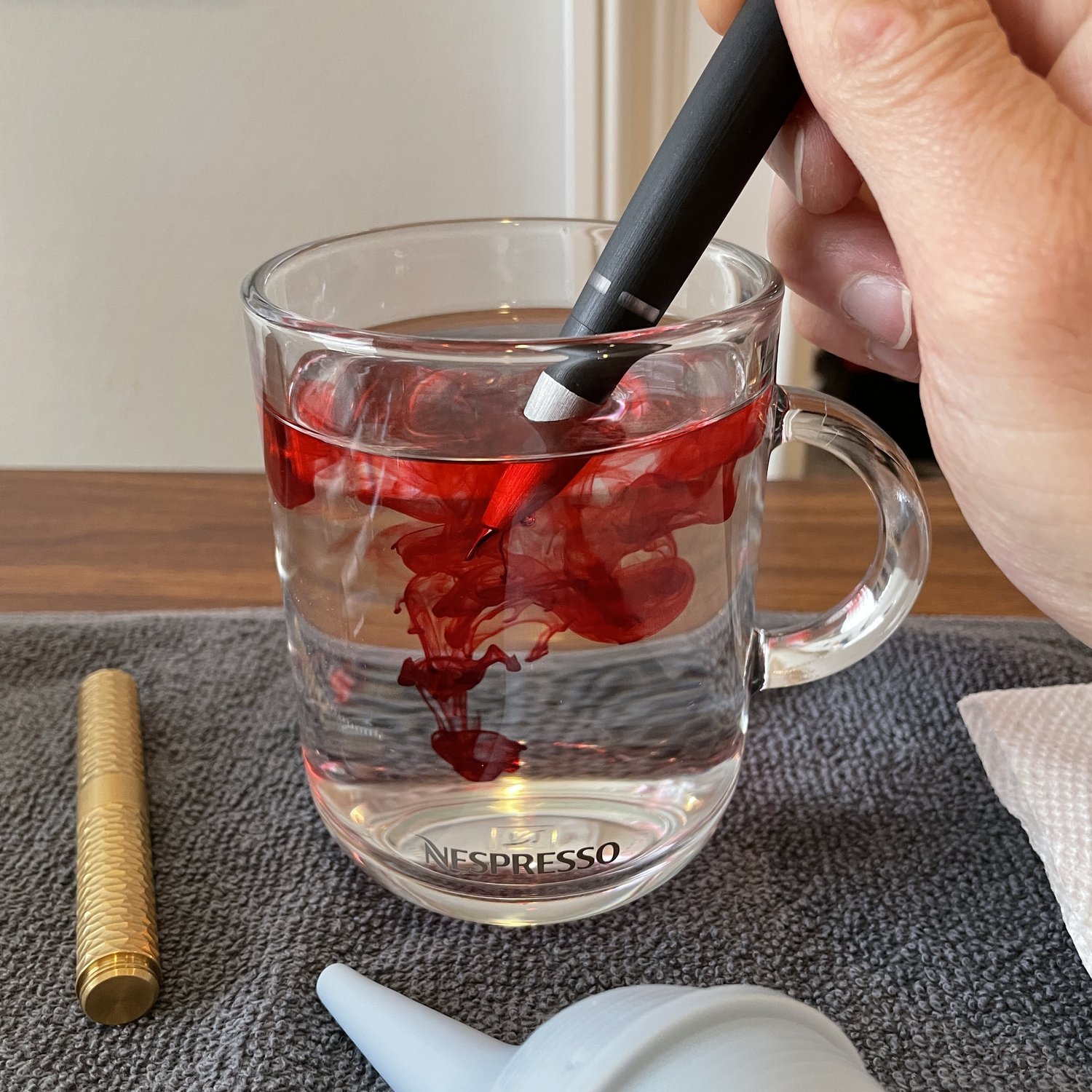
Pen cleaning routines range from the ad hoc ("whenever the ink runs out - every week/month/YEAR?") to the highly regimented ("once a week whether the pen is empty or not"). Personally, I'm not very strict about cleaning, but I try to keep it to once every two months at a minimum. I plan to write a longer resource on pen cleaning techniques for different filling systems, but 90% of the time I simply flush the pen with water. The other 10% of the time, a bath in the ultrasonic cleaner normally does the trick, and it’s rare that I ever use anything other than water mixed with a tiny drop of dish soap to flush a stubborn pen. You can read more about my basic process for cleaning most fountain pens here.

Use Water-Based Inks Intended for Fountain Pens

If you spend any amount of time on the pen internet, you'll read countless "blacklists" of inks that aren't "safe", that stain, or that will "dissolve plastic." Many of these horror stories are apocryphal tales that started with a grain of truth but are mostly exaggerated. At the end of the day, if an ink is marketed as being "for fountain pens", it is mostly likely ok to use in your pen. If you have an especially rare or precious pen that you don't want to stain or damage, I strongly recommend using only blue or black ink made by a pen manufacturer. Otherwise, there can be no guarantee that dyes uses in red, orange, purple, or other color inks won't stain your pen, and you proceed at your own risk with inks marketed as “permanent”, “super sheening,” “shimmering” or featuring other “special properties.”

For the most part, staining is the real risk. Even if a fountain pen ink dries out in a pen and the ink no longer flows, you typically can fix the problem by flushing the pen with water. UNDER NO CIRCUMSTANCES SHOULD YOU USE INDIA INK, CALLIGRAPHY INK, OR ANY INK MARKED AS BEING FOR ART OR DIP PENS ONLY, AS THESE CAN PERMANENTLY DAMAGE PENS IF THEY DRY INSIDE THE FEED OR THE FILLING SYSTEM. SOME ARE ESSENTIALLY PAINT. All of the inks we carry in our shop are intended for fountain pens. You can read more about inks that I consider “safe” here, and why sometimes “boring is better.”

Invest in a Well-Made Pen Case

Protect your pens when you're not using them, or when you're carrying them to and from work. I strongly encourage people to actually use their pens as intended - some dings and scratches are inevitable - but you don't want to risk a pen getting dropped, stepped on, or cracked because it rolls off a desk when not in use. You don't need to spend a lot of money here. Not only do we live in a modern "golden age" of pens, ink, and paper, but the number of pen cases and case designs readily available has absolutely exploded in recent years and you can find anything from single-pen sleeves to 36-pen albums, to handcrafted wooden pen boxes that look great on a desk or bookshelf. Read more on different types of cases here.

If someone asks to try my fountain pen, I always start with two questions: (1) Have you ever used one before? and (2) Show me how you hold your pen. If the answer to question two is anything like this picture, continue reading below.

Don’t Lend Your Nice Pens to People Who Don’t Know What They’re Doing

This is a controversial "rule", but it's one that I follow. I keep a few inexpensive steel nib fountain pens on me to lend out to those who want to try writing with a fountain pen or express curiosity, but I'll politely decline to lend my nicer pens, especially those with gold nibs. It's something of a myth that you shouldn't allow others to write with your pens because the nib "adjusts to your hand" and letting someone else use the pen ruins it - the real risk is damage. People who are used to writing with modern ballpoint or gel pens that require a lot of pressure can bend the tines, requiring a costly repair.

That said, DO share your pens at pen club or a pen show. There's little to no risk in allowing a knowledgeable person to test out a fountain pen.

USE Your Pens Regularly

In my experience, any nib writes better after a short "break-in" period, and to a certain extent, a pen will adjust to your hand over time (but the effect is just not as dramatic as some would have you believe). Making sure your pens get used therefore not only ensures that you'll get the best value from your purchase, but I've found that it does help keep things writing smoothly. Note: If you use your pens regularly, and/or have some sort of system for rotating through your collection, you'll also remember to clean them.

I'm listening!

If you're a new user, or someone still relatively new to fountain pens, what would you like to know? For experienced users, what do you wish someone had told you about pens early on - perhaps something that would have saved you a lot of trouble, heartbreak, or money? Drop a suggestion in the comments or via the “Contact” link up top!

This post does not contain paid third-party advertising or affiliate links. The Gentleman Stationer is supported by purchases from the T.G.S. Curated Shop and pledges via the T.G.S. Patreon Program.

In Editorial, How To Tags Editorial, Fountain Pens 101, Fountain Pen Maintenance, How To
12 Comments

Currently Inked for Monday, April 17, 2023: A Demonstration on Swapping Lamy Nibs

April 17, 2023

Happy Monday! As I mentioned last night on Instagram, I wanted to do a quick video demonstration of how to change the nib on a Lamy Safari/AL-Star/Studio/LX. It’s typically a pretty straightforward process, using the technique of wrapping a small piece of cellophane sticky tape (Scotch Tape for those of us in the states) around the nib and pulling it off. I say “typically,” because as you will see in the Youtube video, sometimes things don’t go according to plan. On one of my Lamy Studios, the nib simply would not come unstuck, so I ended up pulling the entire nib/feed assembly and sliding them together into the section of another Studio. (It’s not as scary as it sounds. You really have to manhandle any of the lower-priced Lamy pens in order to break them. All of my gold-nibs survived the process shown in the video, but for good measure do practice on the stainless steel version first!)

The Lamy “Cursive” Calligraphy nib features narrower downstrokes and slightly wider cross-strokes, similar to an architect grind.

Lamy Replacement Nibs (Including the Cursive Calligraphy nibs) Are Now Available in the Shop

Yesterday I announced that the T.G.S. Curated Shop is an authorized Lamy retailer! We carry the full line of Lamy 2000 models (fountain pen, ballpoints, rollerballs, multipens, and mechanical pencils), select pens from the Safari and AL-Star lineup, and all of the refills. Look for us to add additional items in the future. As I note in the video, we stock stainless steel Lamy replacement nibs in most sizes, as well as the Cursive Calligraphy nib, which is ostensibly intended to write cursive script such as Chinese and Japanese characters, but is ground similarly to an architect/Kodachi/Naginata-style nib. If you’ve been interested in trying one of these nib styles, but have hesitated to sacrifice a pen on a nib grind that you don’t know you’ll like, one of these nibs could be a relatively inexpensive experiment. I’ve enjoyed it enough to swap the cursive nib onto two of my personal pens and will be definitely writing more in the weeks to come.

The Gentleman Stationer is supported entirely by purchases from the T.G.S. Curated Shop, and pledges via the T.G.S. Patreon Program.

In How To, TGS Curated Shop, Video Tags Lamy, Lamy Nibs, TGS Curated Shop, How To
4 Comments
Older Posts →
Store Hours and Location
Visit the T.G.S. Curated SHOP
Updated "Best Pens" Guide
On the Paper Trail Podcast
TGS x Roterfaden TGS_25
Hierarchies of Fountain Pen Friendly Paper

Join Our Patreon!
Subscribe to the TGS E-mail List

Featured Posts

Featured
Cover On the Paper Trail Intro Clip.jpeg
Dec 3, 2025
Introducing "On the Paper Trail," a New Podcast/Video Collaboration with Lisa Vanness of Vanness Pens!
Dec 3, 2025
Dec 3, 2025
Iro-Utsushi-Fine-Dip-Pens.jpeg
Oct 1, 2025
The Pilot Iro-Utsushi Dip Pen (and in General, Simple vs. Fancy Dip Pens)
Oct 1, 2025
Oct 1, 2025
Levenger-Annotation-Pad.jpeg
Sep 20, 2025
Five Boutique Paper Brands I'm Watching Closely and Why
Sep 20, 2025
Sep 20, 2025
The Gentleman Stationer RSS

© Digital Divide Media, LLC, 2014-present.

All content is the exclusive property of Digital Divide Media, LLC, d/b/a The Gentleman Stationer, including “The Gentleman Stationer” website and trademark, and should not be reproduced without express written permission.  All rights reserved.

All content containing paid advertising, affiliate links, or sponsored content will be plainly disclosed by a disclaimer when/if featured.

Contact Information

Store Shipping Policy and Return Policy

Privacy Policy

Cookie Policy

Terms and Conditions

Powered by Squarespace