• Blog
  • Shop
  • Resources
  • FAQ (Ask TGS)
  • About
  • Archive
  • Contact
  • Sign In My Account
Menu

The Gentleman Stationer

Vintage Living in the Modern World.
  • Blog
  • Shop
  • Resources
  • FAQ (Ask TGS)
  • About
  • Archive
  • Contact
  • Sign In My Account

Guide to Notebook Systems, Part I: What Is a Notebook System / System Techo?

September 17, 2022

The stationery community has many different sub-communities organized around specific interests, ranging from fountain pens to pencils to inks to paper. One common theme running through all the various groups, however, is an interest in notebooks, and more specifically Notebook Systems. Everyone seemingly has their own preference, but it’s easy to get lost in the different options available, especially with new brands and “systems” hitting the market every year. I hope my latest project, a multi-installment look at different Notebook Systems and how they can be used, will prove helpful.
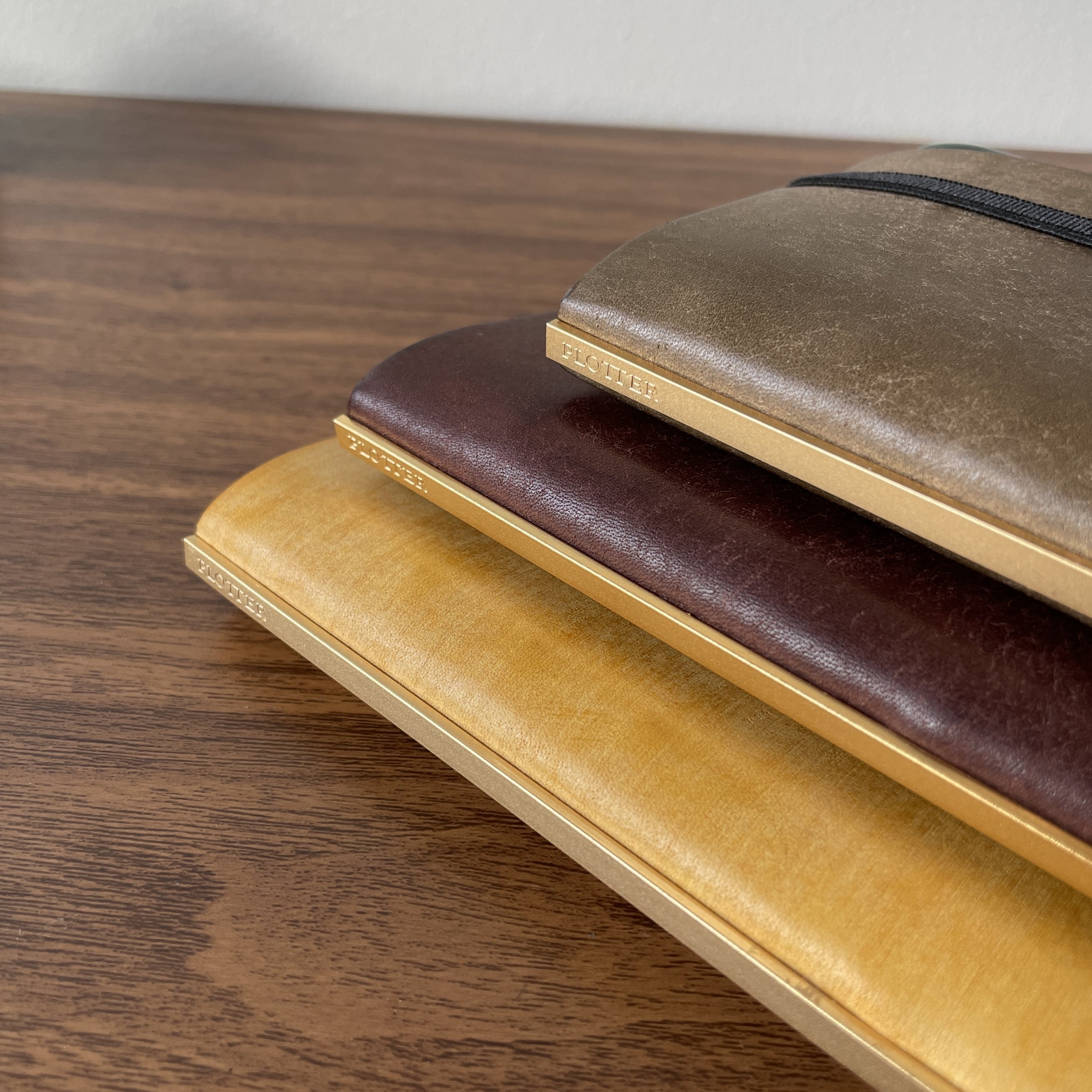
Three Plotter leather binders, in different sizes. Plotter is a Japanese system recently introduced in the United States.

This first installment is definitional. As in, what are people referring to when they talk about “Notebook Systems” or “System Techo”? As far as I know, there’s no true “definition” of either term. Personally, I use “Notebook System” to broadly describe any line of notebook covers and compatible refills and accessories, typically (but not always) sold by a single company and designed to work in combination. “System Techo” is a term used mainly to refer to Japanese-style organizer systems, such as Plotter or Knox, which feature removable pages in a ring binder, or Hobonichi or Jibun Techo, which are bound dated diaries in a traditional book format. In this series of posts, I don’t intend to be overly rigid with how I characterize different brands and products. My goal is to more to familiarize you with the different systems and brands, group them together by what I consider to be common features, and give you some examples of how they can be used and how I personally use them.
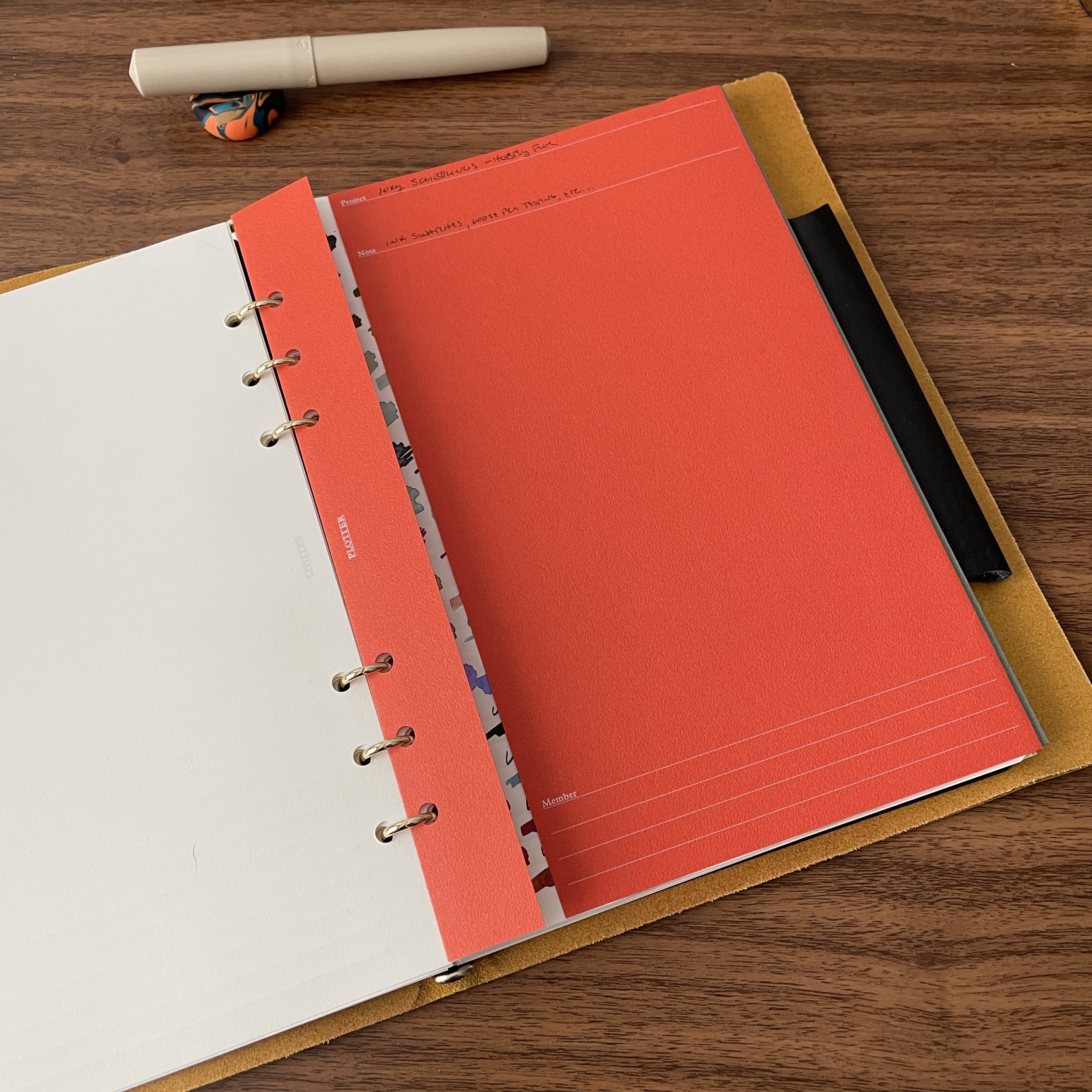
The interior of a Plotter ring binder.

Binder Systems

Included in this category is really any notebook system that allows you to move individual pages around a notebook or binder, typically using either rings or discs with punched paper. While many people will recognize these as the “personal organizers” and calendar systems that were extremely prevalent here in the U.S. in the 1990s and early 2000s before the advent of smartphones, they remain extremely popular in Japan and are making a resurgence worldwide. The modern systems are much more versatile than a traditional planner. For professional reasons I won’t get into here, I don’t keep a paper calendar. Instead, I use my Plotters (the current preferred system) as more traditional notebooks that allow me to move around individual sheets and organize ideas I’m working on.

Examples of ring/disc-binder notebook systems include:

  • Plotter, which you’ll be reading more about in the future. Other brands include Filofax, perhaps the most popular brand of personal organizer in the world, Knox, and Rayman Davinci. (The latter two are Japan-only and as of the time of writing, do not have U.S. based retail options as-of the time of writing.)

  • Disc-bound Notebooks such as Levenger Circa, Staples Arc, and William Hannah.

Hobonichi Techo in A6, English version.

“Single Use” Bound Books

I place in this category the annual “diaries” such as the Hobonichi Techo series and those offered by other brands like Kokuyo and Midori. Originally intended to serve as dated planners, they’ve developed a devoted following around the world, and many people use them for journaling, habit-tracking or logging, or simply as dated notebooks. I’ve used the standard A6 Hobonichi Techo as a personal journal on-and-off over the years. I’ve also placed Stalogy and Midori MD in this category, since both have “day-to-a-page” or dated versions, as well as a range of accessories that allow users to set up undated notebooks as planners or otherwise customize them for specific needs.

Examples of these types of systems include:
  • Hobonichi and Jibun Techo

  • Stalogy and Midori MD

  • Sumkin (Formerly Soumkine) Agendas

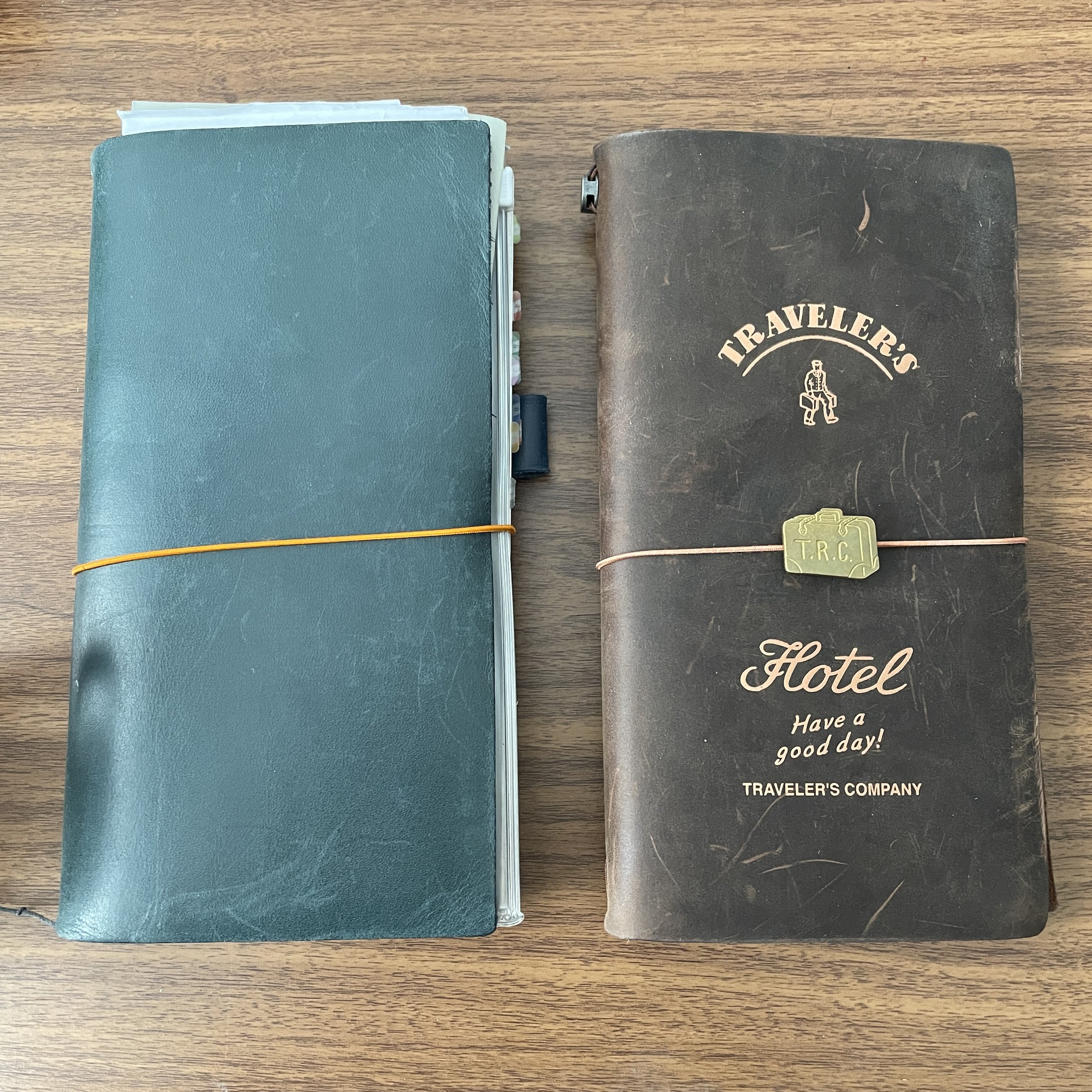
My two Traveler’s Notebooks. The one on the left is years-old and well-used. The one on the right is one of this year’s 2022 Limited Editions.

Cover + Refill Systems

If systems such as Plotter and Filofax offer flexibility by allowing you to move around individual sheets of paper, others are built around smaller individual bound notebooks that can be swapped in and out of a specific cover or binder using cords and/or clips. I tend to use these types of systems for journaling (both personal and professional) and some drawing, and have long favored Traveler’s Notebooks due to their tall/narrow paper format. The Lochby Field Journal uses a similar cord-based binding for standard A5 refills, while Roterfaden relies on metal clips and comes in a variety of different sizes. Of the three systems discussed here, Traveler’s Notebook has the most active community, given that it’s the longest-tenured option with a robust line of accessories that includes folders, penholders, pouches, etc.

Examples of these types of systems include:

  • Traveler’s Notebook

  • Lochby

  • Roterfaden Taschenbegleiter

I use my notebooks on a daily basis.

Myths About Notebook Systems / System Techo

I use at least one example from each of the aforementioned categories on a near-daily basis. Part of why I wanted to do this series is to talk about how these notebooks aren’t just “collectibles” for me - I really do use them to manage my everyday work and personal life, and certain of them have proven invaluable as I find different systems appropriate for different types of writing. That said, I regularly get questions about “whether I actually use all these notebooks,” or other comments referencing one of many misconceptions about notebook systems and stationery in general. I’ll briefly address a few of them below.

Myth No. 1: Notebook Systems Are Extremely Expensive and Not Worth the Money.

First, anything is “expensive” if you pay money for it and never use it. Similarly, whether something is “worth the money” depends entirely on the value you personally derive from it. While there is an up-front investment required in some of the more intricate systems such as Plotter, Filofax, or Traveler’s Notebook, I use them so much on a daily basis that the $50-$250 I spent years/months ago to set up the system eventually fades into the background. That said, I would caution that it’s very easy to get carried away purchasing add-on accessories that you will never use. A solid strategy is to start with the standard binder and a few refills, and add to it as your needs evolve.

Myth No. 2: Notebook Systems Lock You into Proprietary Products.

Several years ago, that may have been the case. Today, however, nearly all of these systems offer a wide array of compatible refills in multiple papers and layouts. With respect to the ring and disc-based systems, purchasing a compatible hole-punch that allows you to use your own paper that you already have on hand can save you a lot of money over time while also increasing the flexibility of the system. I’ll plan to discuss this more when I talk about how I use Plotter and some of my Filofax notebooks. It’s also important to remember that if you’re willing to experiment, you can absolutely use accessories from one system with another. For example, I’ve cut down Stalogy notebooks to fit inside a Traveler’s Notebook cover, and regularly use the Midori MD system of tabs and sticky notes across brands.

Honestly, I use my various notebook systems for everything from day-job work to creative writing to managing my hobbies like ink-collecting :)

Myth No. 3: Notebook Systems Stifle Creativity.

This one I don’t really understand, but I think it’s derived from the belief that you shouldn’t buy nice/complex notebook systems because you start caring more about the system itself than the work that goes into it, paying more attention to the tool than putting words/art/work on paper. Honestly, I don’t feel like this is a valid reason not to buy notebook because that logic can be applied to anything: pens, computers, phones, or any other object. If you buy it as a tool, use it as such. Don’t worry about getting it dirty or maintaining it in pristine condition or setting up the “perfect” workflow - through regular use the object itself eventually disappears and just becomes part of your everyday.

Myth No. 4: In the Age of Phones, “Planners” Are Obsolete.

In certain occupations where managing deadlines and seamlessly coordinating multiple schedules is essential, it’s extremely difficult, if not impossible, to use a paper planner as your primary calendar. That said, while setting alerts and electronic notifications on your phone is an excellent failsafe, I’ve found that it helps me to track, manage, and prioritize tasks if I maintain a handwritten list that I revisit daily. And, as I’ll discuss further in this series, nearly all of these “systems” are much more than calendars or planners, and it’s unwise to simply write them off as such.

Always invest in the pen loop.

What to Expect from This Series Going Forward

I don’t have a clear idea how many different installments this particular series of articles will entail. At a minimum, I want to discuss each of the three rough categories of Notebook Systems discussed above, what I like/dislike about each one, and how I use them. That said, I can envision those articles getting very long, so I might break a couple of them into multiple articles where I discuss specific brands individually. Stay tuned!

The Gentleman Stationer is supported entirely by purchases from the T.G.S. Curated Shop and pledges via the T.G.S. Patreon Program. The Gentleman Stationer does sell certain of the products discussed in this article, though this post does not contain any paid third-party sponsorships or affiliate links.
In Notebook Review, Guide, Editorial Tags Notebook Systems, System Techo, Editorial, Traveler's Notebook, Roterfaden, Plotter, Midori MD, Stalogy, Hobonichi Techo
5 Comments

June is Almost Here! Father's Day and Graduation Gift Ideas

May 31, 2022

Believe it or not, June is upon us, and many of us find ourselves in the market for a graduation or Father’s Day gift. Whether you’re looking for a gift for someone else or responding to requests for “gift ideas”, our shop carries many different options for the analog-minded, from pens and notebooks to reading accessories. As we all settle in following the long weekend, I thought it might be helpful to point out a few of our favorites.

  • Traveler’s Company Brass Pens and Pencils. A highly functional piece of stationery with a dash of history and Americana thrown in, the Traveler’s Company brass pens and pencils are inspired by the vintage “bullet pencils” of the early-to-mid 20th Century. The classic Brass Ballpoint is one of my favorite travel tools, and can frequently be found clipped to the front of whatever book I’m reading on the beach in the summer. Pair with a leather Traveler’s Notebook for an excellent gift set.

  • CW+T Pen-Types A through C. Love the idea of the Traveler’s Company Brass Pens, but want to up the game a bit with something that will stand out and probably last forever? Consider one of these three releases from CW+T. Pen Type A combines a stainless steel ruler and straightedge with a pneumatic-fit pen that accepts Pilot’s Hi-Tec-C refill. Pen Type-B offers the same pneumatic fit technology in a more portable form and additional finishes, while Pen Type-C is a fabulous bookmark-style pen that you can take anywhere with you!

  • Write Notepads Classic Hardcover Notebook. For the journaler, commonplace booker, or someone who would enjoy a fine hardbound notebook with excellent paper, consider this hardcover book from Write Notepads, featuring their fountain pen friendly lined or dot grid paper. Of course, the rest of the Write Notepads lineup features many other highly giftable, classically styled stationery options.

  • Lochby Tool Roll. While I use it as a pen case, the versatile Lochby Tool Roll is capable of much more. Stash anything from bike repair tools to wrenches to, yes, fountain pens or mechanical pencils and still have room for odds and ends in its various pockets and pouches. The durable waxed-canvas construction makes for a true go-anywhere piece of EDC kit.

  • Fine Bookmarks and Reading Accessories. A classic graduation or Father’s Day gift for a reader is a sterling silver or brass bookmark, and I speak from personal experience because I have nearly a dozen myself, accumulated over the years, treasuring every one! We carry anything from sterling “Page Points” and “Page Markers” to a pack of smaller. .1mm-thin bookmarks perfect for sticking inside a card.

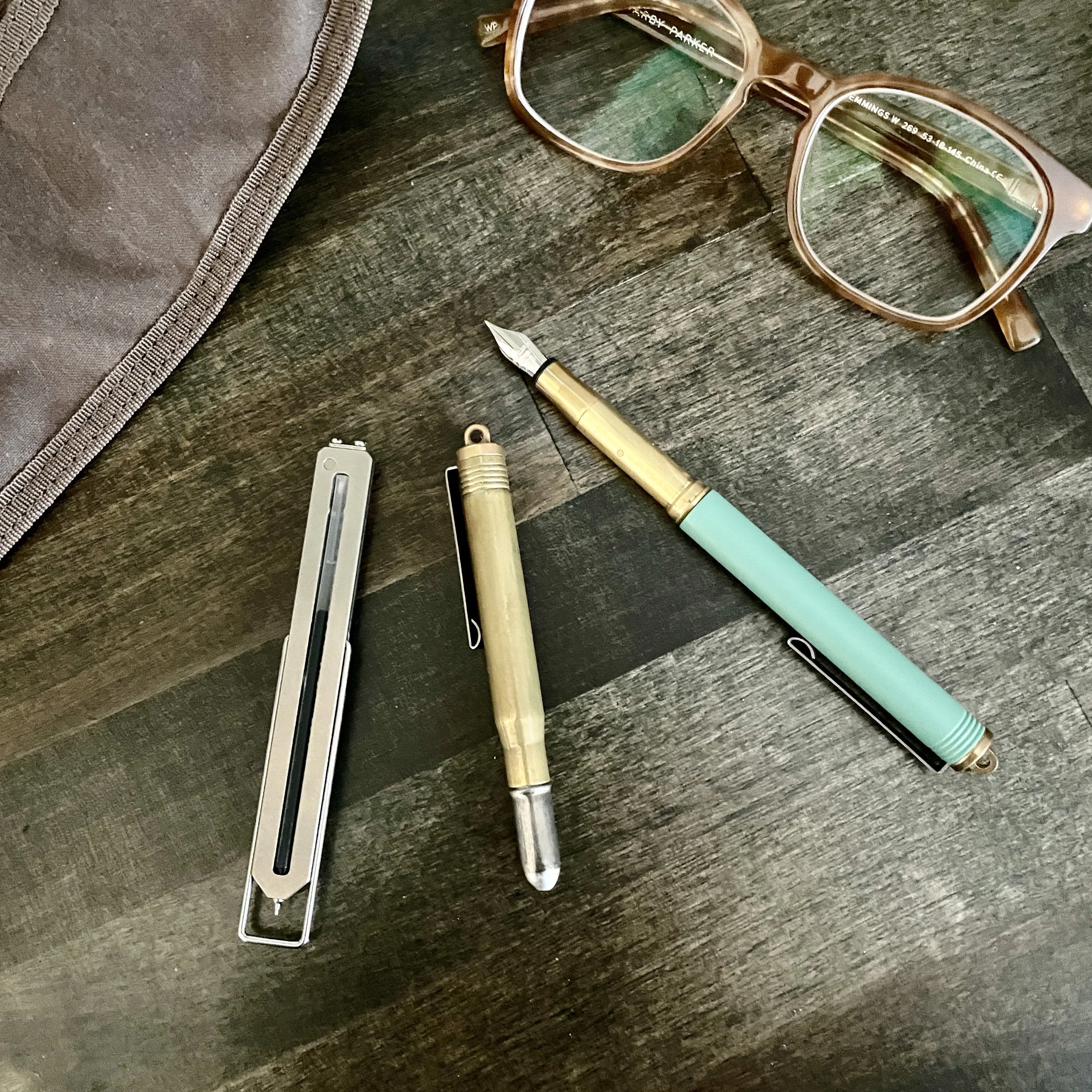
From left, CW+T Pen Type-C, The Traveler’s Company Brass Ballpoint, and the Traveler’s Company Brass Fountain Pen in the “Factory Green” finish.

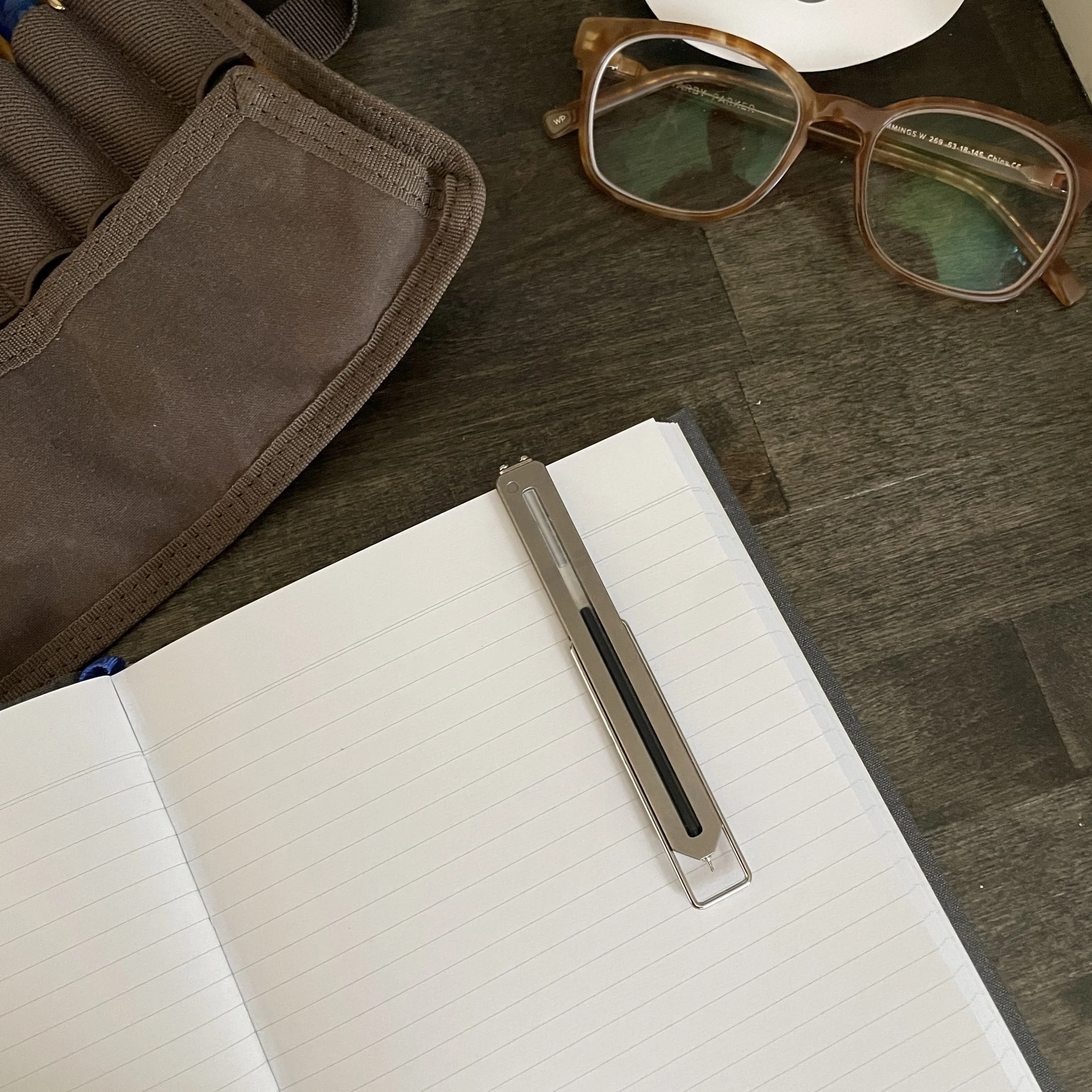
The Write Notepads Classic Hardcover Notebook with the CW+T Pen-Type C clipped in.

The T.G.S. Curated Shop is an authorized retailer of all brands we stock, including those featured here. The Gentleman Stationer is supported entirely by shop purchases and pledges through the T.G.S. Patreon Program.

In Guide, Editorial Tags Gift Ideas, Father's Day Gift Ideas, Graduation Gift Ideas
Comment

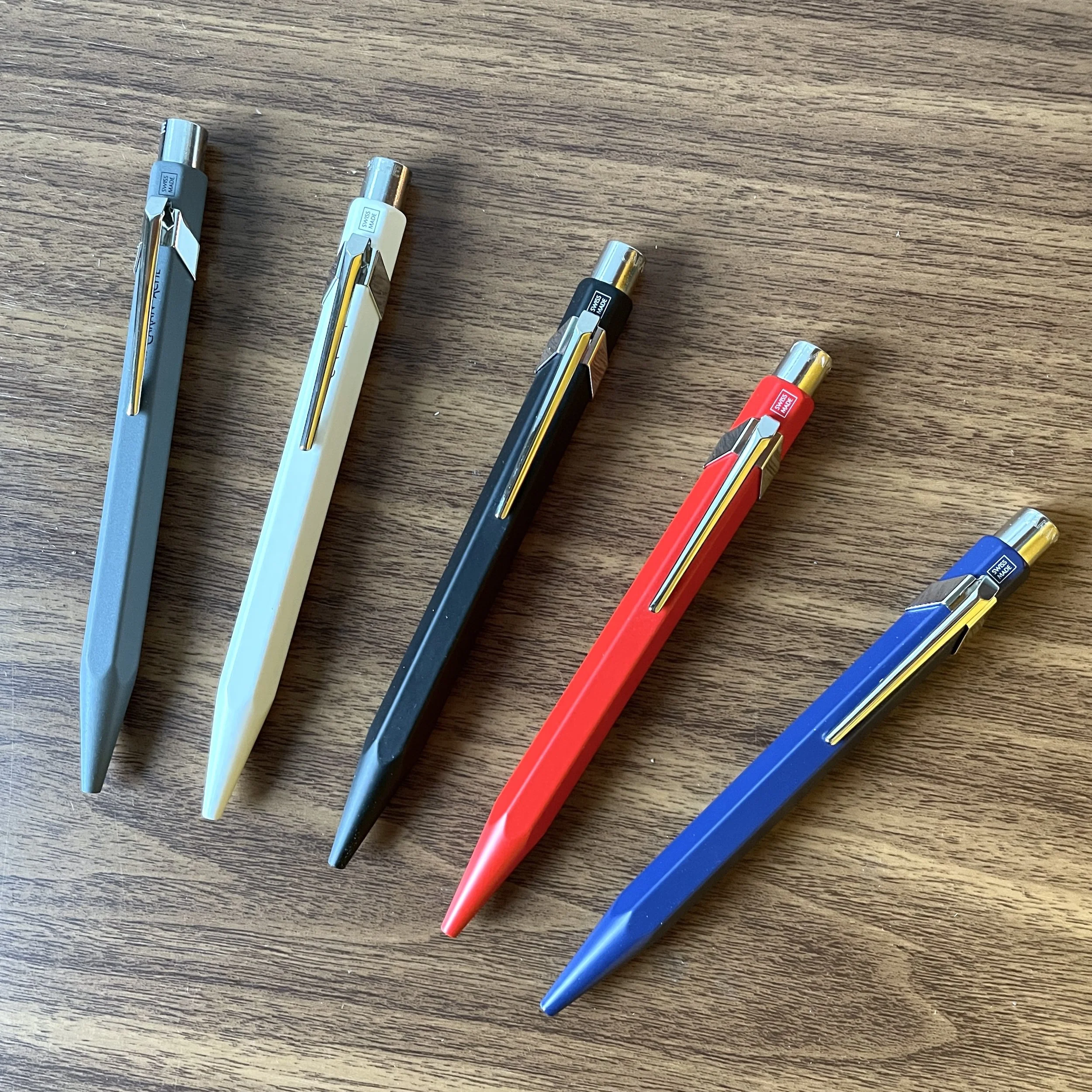
The five fountain pens discussed in this post, from left: Platinum Preppy; Platinum Plaisir; TWSBI Swipe; Caran d’Ache 849; and Midori MD. Through Monday (11/29), don’t forget to use the coupon code “BLACKFRIDAY” to get 10% off all orders in the T.G.S. Curated Shop (excluding TWSBI), as well as the “Gently Used” Sale!

Five Knockaround Fountain Pens for the Office and Beyond

November 27, 2021

While Black Friday weekend continues, and everyone is doing their shopping with all the different promotions available, I had the idea to do a short post containing some ideas beyond those in this year’s T.G.S. Gift Guide. I’ve become mildly obsessed with the idea of finding the perfect “knockaround” fountain pen for the office: a functional fountain pen that you can leave in your bag, on your desk at work, or stuck in the loop in your planner and not worry excessively about whether it’s going to “walk away” or get damaged. This category isn’t the same for everyone, since we all operate at different price points, but for reliable fountain pens this category typically starts around $20 (excluding the Platinum Preppy, which is much less expensive).

  1. Platinum Preppy. I know several people who keep a fistful of these pens inked up at all times, either to give away to the fountain pen curious or eyedropped with inks they’re “experimenting” with. Preppies are also extremely inexpensive everyday writers, starting at around $4.50 for the standard version, with even the limited edition “Preppy Wa” pens priced at just over $7.

  2. Platinum Plaisir. Though they feature the same nib, the Platinum Plaisir is a slight upgrade over the Preppy in terms of both looks and durability, since the pen sports an aluminum barrel that comes in a wide array of colors and will take more of a beating than the Preppy. Honestly, the Plaisir will often be my choice over the Preppy (unless I’m eyedroppering to test inks), since I appreciate the added splash of color. Available starting at $22.

  3. TWSBI Swipe. Honestly, TWSBI’s latest low-cost fountain pen has blown me away with its value proposition. Not only do you get a reliable nib from a reputable brand, but unlike any other pen on this list, it ships with a converter (actually, two converters) to allow you to fill with bottled ink, in addition to using a cartridge. Available priced at $26.99.

  4. Caran d’Ache 849 Fountain Pen. Looking for a fountain pen to match your classic Caran d’Ache 849 ballpoint pen or rollerball? The Caran d’Ache 849 fountain pen features a springy stainless steel nib that’s pleasant to write with, and is also somewhat slimmer, allowing it to fit in planner pen loops that might otherwise be too small to fit bulkier fountain pens. Available at $52.

  5. Midori MD Fountain Pen. Sure, the plastic barrel isn’t much to write home about (even if it is tastefully color-matched to the Midori MD aesthetic), but the nib on this pen is exceptional. Midori has taken the same nib used in the Traveler’s Company brass bullet pens and tweaked it so the nib turns slightly downward, supposedly to better hold up to the harder writing pressure of modern users (and probably those inexperienced with fountain pens). The firm writing experience reminds me of a wider (M) posting nib. Available priced at $38.

Please note that of the fountain pens on this list, the Caran d’Ache 849 and the Midori MD Fountain pen take standard international cartridges, while the Platinum Pens and the TWSBI Swipe accept proprietary cartridges sold by those specific brands. If you’re looking for refills for these particular pens, either for yourself or to include with a gift for someone else, we carry standard international cartridges by Caran d’Ache and Traveler’s Company, as well as both TWSBI Cartridges and bottled ink. Platinum Preppy pens ship with one Platinum ink cartridge included.

As always, you can check out other pen recommendations here, as well as posts discussing my thoughts on fountain pen inks and fountain pen friendly paper. Links here are to the T.G.S. Curated Shop or our friends at Vanness Pens, which are not paid affiliate links but merely friendly recommendations. Many thanks for your support!

In Editorial, Guide Tags Guide, Office Tools, Pens
1 Comment

The T.G.S. 2021 Holiday Gift Guide is Live!

November 16, 2021

It’s that time of year again, and consistent with my firmly held belief that Halloween and Thanksgiving are still holidays, I’ve held off on issuing the T.G.S. Holiday Gift Guide until the second half of November! (Personally, I’d love to wait until Black Friday, but given shipping delays, everyone should be getting a head start on orders.) As with last year, the 2021 Holiday Gift Guide features a selection of products from the fully restocked T.G.S. Curated Shop.

While the gift guide has more than a dozen different gift ideas, if I had to pick three personal favorites for gift-giving this year, they would be the following:

  • Caran d’Ache 849 Rollerball Pens. These have now started shipping in the Caran d’Ache metal clamshell cases, so they make an impressive gift presentation that won’t break the bank. While the 849 Rollerball ships with an excellent Caran d’Ache Rollerball refill, the pen accepts any Parker-style refill, ballpoint or rollerball. Your recipient will be able to easily use this pen for a long time.

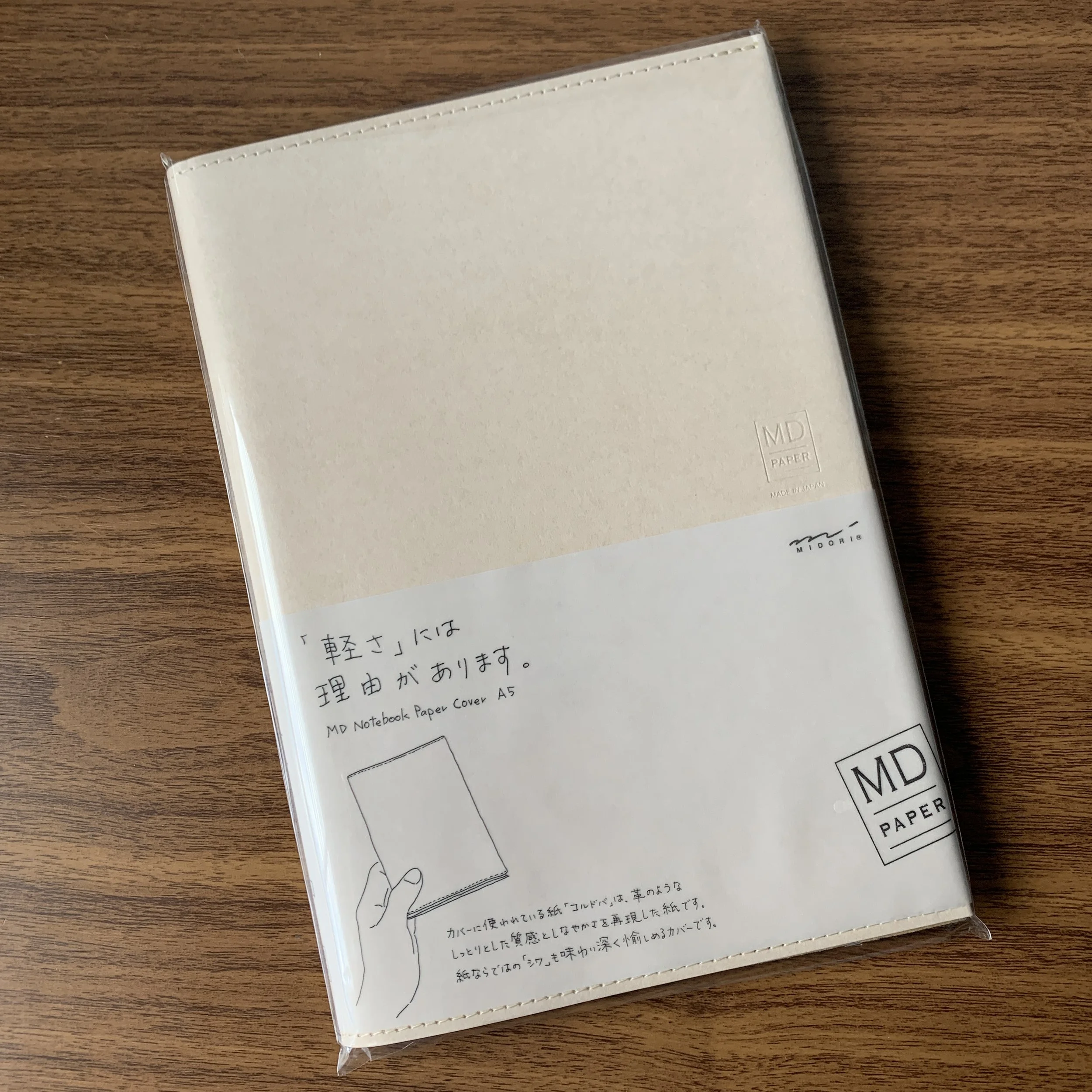
  • A Midori MD Notebook with a Natural Goat Leather Cover. I’ve found that few gift ideas are more universally loved than nice notebooks, because even non “pen people” use notebooks in one way or another. The Midori MD brand combines both high-quality paper and a universal size cover that can probably be refilled not only with easily available MD notebooks but other similarly-sized refills.

  • Hightide Co. Desktop Hourglass and/or Folding Metal Book Stand. I LOVE analog timers that don’t feature a jarring buzzer, and these Hightide Co. desktop sandglasses/hourglasses are one of my favorite items in the shop. They’re useful and they look great in an office. Similarly, the folding metal book stands make an inexpensive, yet thoughtful, gift for the reader or office worker, who can use it to hold anything from a book to a notepad or electronic tablet.

Check out these and more in the 2021 Gift Guide. We’ve been receiving a high volume of orders lately, but don’t be concerned if something is sold out - We are constantly restocking and recently placed a couple of large orders so please keep checking back.

View fullsize 971FC604-F473-48DC-8AED-F8E5D1B7FF96_1_201_a.jpeg
View fullsize F47F7B62-E852-4608-A0C0-97533D163646.jpeg

The T.G.S. Curated Shop is an authorized retailer of all brands sold. By shopping with us directly, you are supporting original content, pen reviews, pen show events, etc. from The Gentleman Stationer. If you would like to support us even further, please consider checking out the T.G.S. Patreon Program, which offers access to online meetups, exclusive discounts and pre-orders, and more!

In Guide, TGS Curated Shop Tags 2021 Gift Guide, T.G.S. Curated Shop
Comment

Swapping Fountain Pen Nibs: From Easy to Expert

October 13, 2021

One thing that most enthusiasts love about fountain pens is the ability to customize your pen for your writing style and aesthetic preferences. Whether it’s having a custom pen turned from a favorite material, in a shape that’s the perfect size for your hand, or a nib ground to showcase your own style of handwriting, the options are essentially limitless. At the same time, the idea of physically pulling the nib and feed out of your fountain pen and putting it back together again intimidates many people, even seasoned users who have written with fountain pens for years. There’s no reason to be afraid. While changing nibs on your own does merit a degree of caution (just like disassembling a pen for cleaning or filling from an ink bottle), it’s something that most fountain pen users can do without risk of seriously damaging their pen. Today I plan to walk through a few different options, ranging from easily swappable pre-assembled nib units to more complex modifications.

When changing nibs (or doing any sort of pen-related maintenance), I typically like to work on a towel or other soft/grippy surface to keep pens and loose parts from rolling off the table.

Getting Started: Create Your Workspace

Necessary precautions are minimal. Basically, you need a well-lit workspace with a towel or other no-roll surface to hold your pens and nibs. The number-one danger when performing any sort of work or maintenance on fountain pens is dropping a pen onto the floor and cracking the pen barrel and/or bending the nib, so make sure your pens are secure. I typically unroll a towel onto a sink or standing desk and use that as my work surface.

Swapping out interchangeable nib units (discussed further below) doesn’t require any special tools. Otherwise, you will likely need a square of rubber to help grip the nib and feed, and possibly a loupe or other magnifier to align nib tines.

Franklin-Christoph fountain pens use JoWo nibs, so it’s easy to amass a large collection of custom-ground F-C nib units that you can swap between all of your JoWo-compatible pens.

Easy: JoWo, Bock, and TWSBI Interchangeable Nib Units

These days, the majority of pen makers no longer manufacture their own nibs in-house, and instead purchase nibs from third-party companies JoWo, Bock, and to a lesser degree, Schmidt (though I find Schmidt nibs excellent and don’t know why they’re not more widely used). While some people complain about monotony and the lack of expressiveness in how these modern nibs write, there is one key advantage to this uniformity: interchangeability. Many, if not most, pens that accept standard JoWo or Bock nibs use a default nib unit (i.e., a nib and feed seated in a threaded housing) that can easily be unscrewed and used in another compatible pen. Once you start custom-grinding these nib units or gather the range of nib sizes, it becomes a very versatile platform that can allow you to thoroughly enjoy your pen collection.

The process for swapping out a JoWo or Bock compatible nib unit is mostly the same between brands. Gently grasp the nib and feed and turn counter-clockwise to unscrew the unit.

The process for swapping out a JoWo or Bock compatible nib unit is mostly the same between brands. Gently grasp the nib and feed and turn counter-clockwise to unscrew the unit.

The process itself is simple. First, if the pen you are working on is a cartridge-converter model, remove the converter. Then, gently grasp the nib and feed and turn the nib unit counter-clockwise to remove it. Select your new nib unit, insert it into the section, and rotate clockwise until secure. Do not overtighten, as this can misalign the tines of the nib, at best, and cause stress damage to the nib housing, at worst, in which case you will need a replacement.

Opus 88 pens, which are Japanese-style eyedroppers, add one slight wrinkle to the process. There is a small o-ring attached to the bottom of the nib unit housing. If replacing with a non-Opus nib unit, don’t forget to transfer the o-ring as well. It sits on the plastic “stem” and is easily removable.

TWSBI nib units are slightly different, though still simple. On the TWSBI Diamond 580, you simply unscrew the front section of the pen and slide the nib unit out of the plastic cover (shown here in red but clear on most current 580 models). Insert your new nib unit and reassemble. Because TWSBI sells spare nib units for the express purpose of allowing you to easily switch nibs between pens, you don’t have to worry about voiding your manufacturer’s warranty or otherwise causing unintended damage. I own several spare TWSBI nibs, some of which have been custom ground to specialty nibs such as architects.

View fullsize 35633B67-7AE5-4CB2-AABE-0FD988432538_1_201_a.jpeg
View fullsize FE53EEC6-E337-43D7-9DAC-77A8521F41D3_1_201_a.jpeg

Editor’s Note: There has been a lot of press recently about a manufacturing defect that has caused cracks in JoWo nib housings. While I’ve been lucky and have not yet found the issue in any of my personal pens, JoWo has released a series of announcements discussing how they plan to fix the problem. If you have been inspecting your JoWo nib units and discover cracks, please reach out to Meister Nibs, the U.S. JoWo distributor.

Intermediate: Pulling and Setting Friction-Fit Nibs

But what about pens that don’t use interchangeable nib units? Well, the nibs on those pens are, for the most part, equally “swappable” and the process is no more mechanically complex than taking a small square of rubber or other grippy material, grasping the nib and feed, and pulling both out of the front end of the pen’s section using a steady motion. You replace a nib the same way, though you need to be pay attention when reinserting the nib and feed as some pens have grooves or “guides” that determine exactly how the nib is supposed to fit.

The nibs on some pens, especially those with proprietary in-house nibs like this Platinum 3776, do not come in a housing, meaning that the nib and feed sit directly inside the custom section.

So why do I have this categorized as requiring an “intermediate” skill level? Honestly, it’s more about confidence than skill. Sometimes, things don’t go 100% as expected. Old ink residue may cause the nib and feed to get stuck in the section, and you may find yourself having to pull fairly hard or jiggle the nib a bit (gently!) to dislodge it from the pen. Any time you apply force, you run some risk of misaligning the nib tines or cracking the feed. Changing friction-fit nibs properly requires some patience, a willingness to engage in a bit of trial-and-error, and an “intermediate” understanding of how fountain pens work. Finally, keep in mind that if your pen breaks and you can’t fix it on your own, the manufacturer might consider removing or swapping the nib on a pen without an interchangeable nib unit to be a “modification” that voids your warranty. That’s not to say that you won’t be able to find someone who can fix the pen, but you will likely have to pay for it.

From the top: Platinum 3776 UEF in Schon Black Ultem, via Flexible Nib Factory JoWo housing; Pilot PO Nib in Newton Shinobi, via same housing; Platinum 3776 in an Opus 88 Jazz, via same housing.

Expert: Custom Nib Housings for Maximum Pen Hacking

The last topic I plan to discuss combines the two techniques discussed above in a manner that allows you to create your own custom nib units. Flexible Nib Factory sells custom nib housings designed to pair proprietary nibs and feeds (i.e. Platinum, Pilot, Pelikan, Sailor, etc.) with JoWo and Bock-compatible pens. For example, I pulled a friction-fit medium 14k Platinum nib from a standard Platinum 3776 fountain pen, and inserted both the nib and feed into a JoWo-compatible Flexible Nib Factory housing, which I then seated in an Opus 88 Jazz. The one drawback is that these custom housings won’t accept a converter, so you will need to use a piston filler, eyedropper, or bulkfiller-style (i.e. Conid) pen. Opus 88 pens work great for these types of modifications, though with certain brands like Platinum you may have to trim the plastic end on the back of the feed in order to allow the Japanese-style eyedropper system to close.

A nib unit disassembled. Using Flexible Nib Factory housings, you can pull, for example, a nib and feed from a Platinum 3776 and insert it into the custom housing designed to fit a JoWo or Bock pen. It’s less complex than it looks.

A word of caution: customizing fountain pens in this way is addictive. Since building my FrankenJazz, I’ve also moved another Platinum 14k UEF (Ultra Extra-Fine) nib and a Pilot PO (Posting) nib into JoWo housings, which are now in a Schon Black Ultem and Shawn Newton Shinobi. I’m eyeing several other nibs in my collection that don’t get much use in their current setup…

This post does not contain affiliate links. I purchased the pens, nibs, and nib units featured in this post with my own funds, for my own collection. The Gentleman Stationer is reader-supported. If you would like to support us, please consider purchasing from the T.G.S. Curated Shop or checking out the T.G.S. Patreon Program, which offers access to online meetups, exclusive discounts and pre-orders, and more!

In Editorial, Guide Tags Nib Modification, Nib Grinding, Nib Swapping
16 Comments
← Newer Posts Older Posts →
Store Hours and Location
Visit the T.G.S. Curated SHOP
Updated "Best Pens" Guide
On the Paper Trail Podcast
TGS x Roterfaden TGS_25
Hierarchies of Fountain Pen Friendly Paper

Join Our Patreon!
Subscribe to the TGS E-mail List

Featured Posts

Featured
Cover On the Paper Trail Intro Clip.jpeg
Dec 3, 2025
Introducing "On the Paper Trail," a New Podcast/Video Collaboration with Lisa Vanness of Vanness Pens!
Dec 3, 2025
Dec 3, 2025
Iro-Utsushi-Fine-Dip-Pens.jpeg
Oct 1, 2025
The Pilot Iro-Utsushi Dip Pen (and in General, Simple vs. Fancy Dip Pens)
Oct 1, 2025
Oct 1, 2025
Levenger-Annotation-Pad.jpeg
Sep 20, 2025
Five Boutique Paper Brands I'm Watching Closely and Why
Sep 20, 2025
Sep 20, 2025
The Gentleman Stationer RSS

© Digital Divide Media, LLC, 2014-present.

All content is the exclusive property of Digital Divide Media, LLC, d/b/a The Gentleman Stationer, including “The Gentleman Stationer” website and trademark, and should not be reproduced without express written permission.  All rights reserved.

All content containing paid advertising, affiliate links, or sponsored content will be plainly disclosed by a disclaimer when/if featured.

Contact Information

Store Shipping Policy and Return Policy

Privacy Policy

Cookie Policy

Terms and Conditions

Powered by Squarespace