• Blog
  • Shop
  • Resources
  • FAQ (Ask TGS)
  • About
  • Archive
  • Contact
  • Sign In My Account
Menu

The Gentleman Stationer

Vintage Living in the Modern World.
  • Blog
  • Shop
  • Resources
  • FAQ (Ask TGS)
  • About
  • Archive
  • Contact
  • Sign In My Account

Personal Obsessions: My Quest for the Perfect Blue Writing Paper

February 15, 2023

Despite having access to about as wide a range of stationery products as humanly possible, there are still certain things I’ve been looking for over the years that remain elusive. Chief among these is a reliably fountain-pen-friendly blue writing paper. Smythson of Bond Street seems to be the gold standard for many, and their notebooks are indeed gorgeous, but I’ve had trouble locating reviews of their paper from the perspective of a fountain pen user, and in any event the price point makes the paper hard to justify for everyday writing outside of formal correspondence.
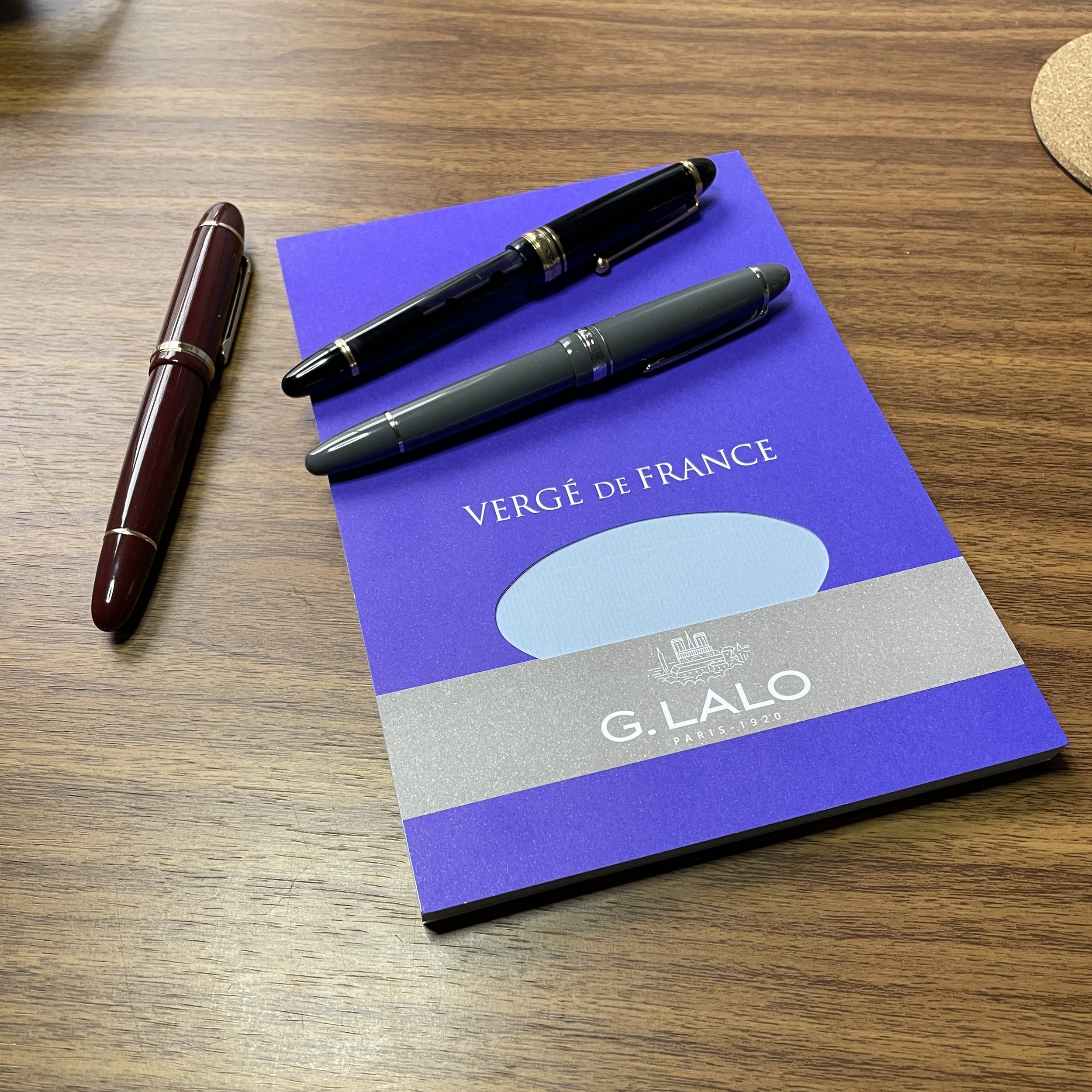
G. Lalo Paper comes in 50-sheet tablets. As shown from the picture at the top of the page, shading won’t look the same, but the blue doesn’t distort the ink color as much as I expected. In fact, it gives it a nice vintage look. G. Lalo paper has a laid texture (meaning that it’s not smooth), so if you prefer super-smooth paper you should be aware of this.

Since the past few years saw a steep drop off in my work travel, depriving me of regular opportunities to loot hotel rooms of “low cost” light blue stationery, I’ve been on the lookout for a replacement and have found two options that I enjoy. The first, G. Lalo Vergé de France writing paper, is typically recommended for written correspondence, but I’ve also enjoyed using it as a standard writing tablet, similar to the Midori MD Cotton Paper. While a touch darker than what I originally expected, I’ve been enjoying this as a solid general purpose writing paper, especially since the price point ($14 for a 50-sheet A5 tablet) is fairly reasonable for paper of this quality and the paper is easy to get a hold of, especially now that we stock G. Lalo Paper in our own shop.
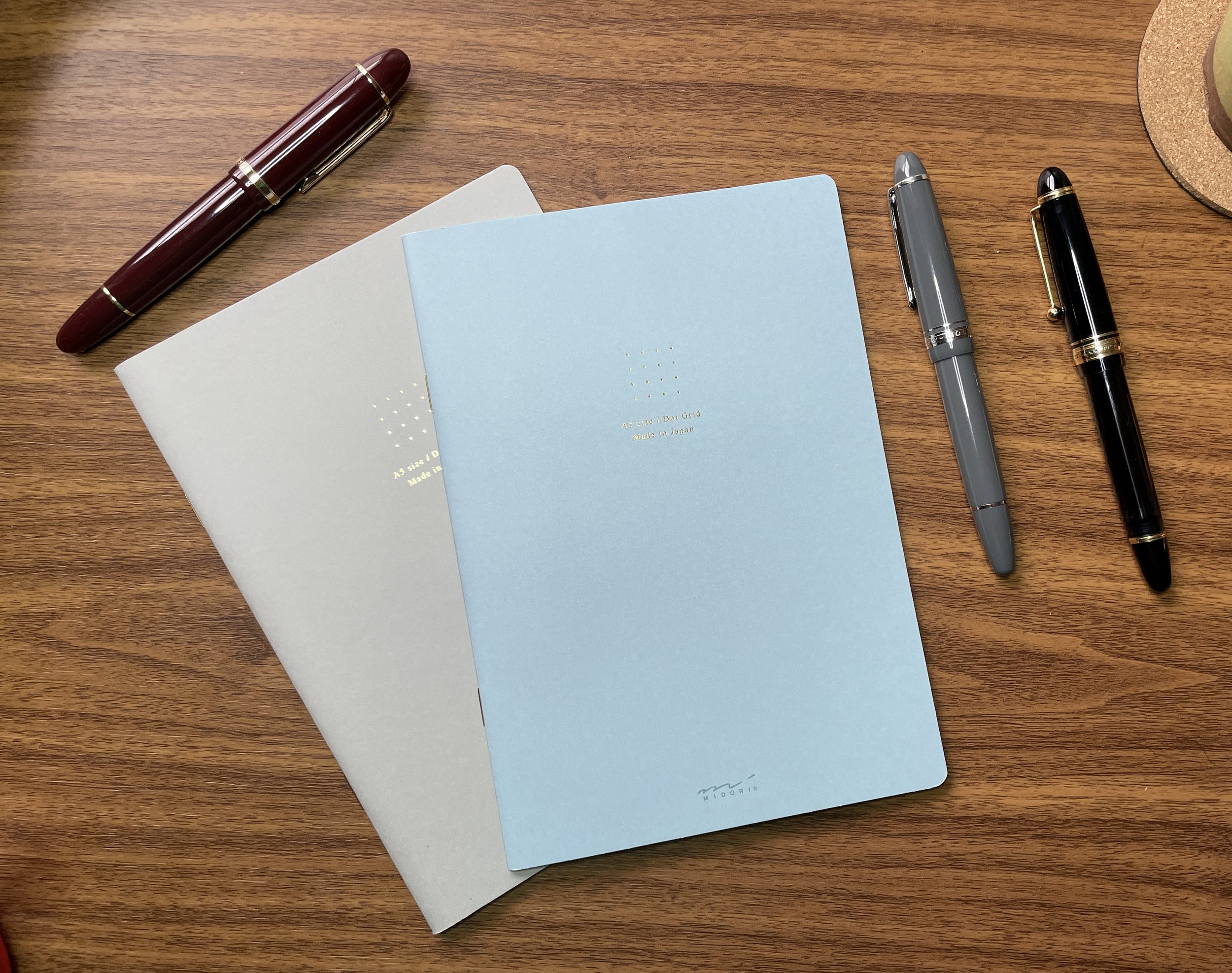
The Midori Soft Color A5 Notebooks come in four shades (grey + three pastels) that aren’t so loud they overwhelm your writing. Some people match the notebook to their ink color, but I prefer a bit of contrast.

I discovered the second blue paper option when I was in New York City last week and found myself browsing the back wall at Kinokuniya bookstore off Bryant Park. (For those of you who haven’t visited Kinokuniya, it’s the NYC outpost of the Japanese bookstore that has a massive stationery section in the basement, and the back wall contains nothing but notebooks.) I noticed that they had a couple piles of Midori A5 “Soft Color” notebooks in blue, grey, green, and yellow, priced at $4 each. Seeing that they contained dot grid paper, I figured that was a no-brainer purchase at that price and grabbed one in blue and one in grey. I spent ten minutes jotting in these notebooks in a coffee shop, realized the paper lost none of the excellent qualities of the standard Midori MD Paper, and promptly contacted my distributor to stock all four colors for the shop.

Midori Soft Color Notebook in blue, with dot grid paper. Testing inks are three of my favorite colors from the Laban Greek Mythology series.

Midori Soft Color Notebook in Grey (shown with the blue notebook for contrast). These notebooks are standard A5 so they fit covers like the Lochby Field Journal.

Many people have requested recommendations for colored paper options in the past, but it’s a tricky thing to get right. Often, companies will apply a coating to give the paper its color, which works fine as long as you’re not trying to write with a fountain pen, rollerball, or other liquid ink, since most coated paper isn’t particularly absorbent and the ink tends to never dry. That’s not an issue with either of the two papers shown here. Both G. Lalo and Midori Soft Color dry fairly quickly, and behave essentially like standard white or ivory writing papers. There is a third option - Original Crown Mill - that makes a light blue laid paper I want to try, and yes, I probably will eventually splurge on some Smythson. (“For science.”)
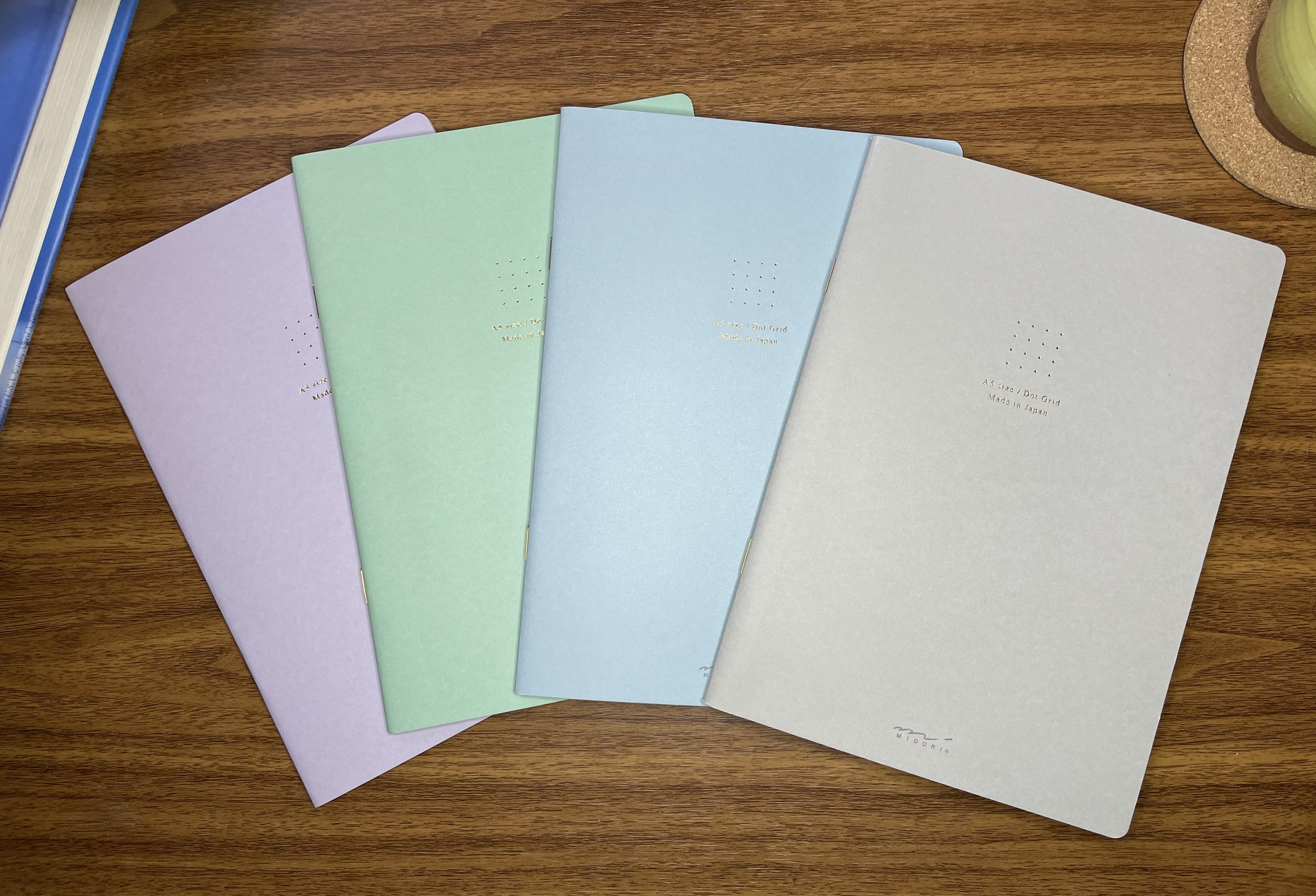
For the time being, however, these two will work fine, and I no longer have to worry about exhausting my dwindling stash of blue notepads. If you’re interested in trying out some of this stationery for yourself, we currently have G. Lalo writing paper and envelopes available for sale in the shop in white, ivory and blue, along with the Midori Soft Color A5 notebooks in blue, grey, green, and yellow.

The Gentleman Stationer is supported entirely by purchases from the T.G.S. Curated Shop and pledges via the T.G.S. Patreon Program.
In Paper Products, TGS Curated Shop Tags Blue Paper, Colored Paper, Midori, Midori Soft Color, G. Lalo
5 Comments

In Praise of Perforated Pages: The Nebula Note "Casual Note" Notebook

June 29, 2022

Colorverse Ink, with their numerous “seasons” of ink and interesting colors, have established themselves as a stalwart in the ink world, and it was only a matter of time before they turned to paper. Featuring 120 pages of ink-friendly, 90gsm paper, Colorverse’s “Nebula Note Casual Note” notebook offers yet another excellent fountain pen friendly option. The notebook shown here features a durable twin-ring spiral binding, a fairly sturdy kraft/cardstock cover, three different ruling options, and - wait for it - PERFORATED PAGES.

The perforations tear easily and cleanly.

I sometimes feel like I’m shouting into the void with paper companies and perforations. For those of us with day jobs that require us to be able to organize, file, and, yes, sometimes destroy specific pieces of notes or writing, perforations are key. (Unless you’re one of those strange people who loves picking paper scraps out of a spiral binding. Anyone who used a Mead notebook in high school knows what I’m talking about.) Currently, this “Casual Note” notebook and the Maruman Mnemosyne series are my perforated options of choice.

I experienced no feathering with the Nebula Note paper, and since it’s textured and slightly absorbent, fairly quick dry times.

As one would expect from an ink company, Nebula Note notebooks features very good paper. I would compare the feel to a thicker, slightly more textured 68gsm Tomoe River. Colorverse markets this paper as “ink proof,” meaning that you’re supposed to be able to use it to write and swatch inks. I can’t dispute their characterization - I really pushed this paper scribbling with fairly wet pens and a sharp needlepoint and couldn’t get the paper to bleed.

Zero bleed-through, and not much show through even with darker inks. You can easily use both sides of a page.

Here you can see the texture. If you’re not a fan of toothy paper, you may not enjoy the writing experience, but I found it tactile without being “scratchy”.

Takeaways and Where to Buy

My overall opinion is that this is excellent paper, and I wish that more spiral notebooks featured perforated pages like this one. While things are getting better, those “ink proof” spiral notebooks that are also practical enough to use at work remain few and far between, and I’ve been tearing through this one fast enough that I’ll probably look to pick up a few more at the D.C. Pen Show in August.

Some people may not like the “nebula” hologram on the cover, but I think it sets off my Platinum Karakusa (shown in the top photo) nicely!

You can purchase the Colorverse Nebula Note Casual Note from our friends at Vanness Pens, priced at $15. The Casual Note comes in three different rulings: dot grid, lined, and blank. The cover pictured here is called “oil green”, but other options exist, as well as additional notebooks that I look forward to trying out in the future.

This notebook was sent to me by Luxury Brands, the Colorverse U.S. distributor, free of charge for review purposes. I was not compensated for this review. This post does NOT contain affiliate links.

In Paper Products, Notebook Review Tags Colorverse Nebula Note, Notebooks, Spiral Notebook, Perforated Pages
Comment

Just Landed: Maruman Mnemosyne Notepads, Notepad Covers, Label Stickers & More!

June 21, 2022

One of the more undersung fountain pen friendly paper lines, Maruman’s Mnemosyne notebooks and notepads are among the most versatile, and we’re happy to announce that we’ve expanded our selection of Mnemosyne products to include additional paper sizes and formats, as well as the Mnemosyne label stickers to help you further customize your notes! As of this morning, you can purchase the Mnemosyne spiral notebooks in sizes ranging from A4 to A6 to B5, and we have also added A5 Notepads, a handy A5 Notepad Cover that includes not just a classic padfolio but five pockets for organizing, and two different top-bound steno pads. Label stickers are available in “Tab,” “Task,” and “Flow” formats.

You can view additional Mnemosyne photos and writing samples in the shop listings, or by visiting this past post. As I mentioned above, Maruman Mnemosyne paper unfortunately doesn’t get mentioned as often as brands such as Rhodia or Clairefontaine, though I find it handles fountain pen ink just as well. The perforated pages, durable covers, and attractive price point make this a paper worthy of your consideration.

If you’re interested in reading further on fountain pen friendly paper recommendations, we maintain a running list of fountain pen friendly brands, which also has an active comment section because we can’t test them all!

In Paper Products, TGS Curated Shop Tags Maruman Mnemosyne, T.G.S. Curated Shop
Comment

Paper Review: First Impressions of the New Sanzen Tomoe River Paper

May 7, 2022

Fans of the original lightweight Tomoe River Paper were disappointed to hear last year that it was being discontinued. After a lot of back-and-forth over whether the paper was truly gone forever, it was announced that Japanese paper company Sanzen had purchased the formula and naming rights from Tomoegawa, and Tomoe River Paper would go back into production. But would it be the same? That’s the big question.

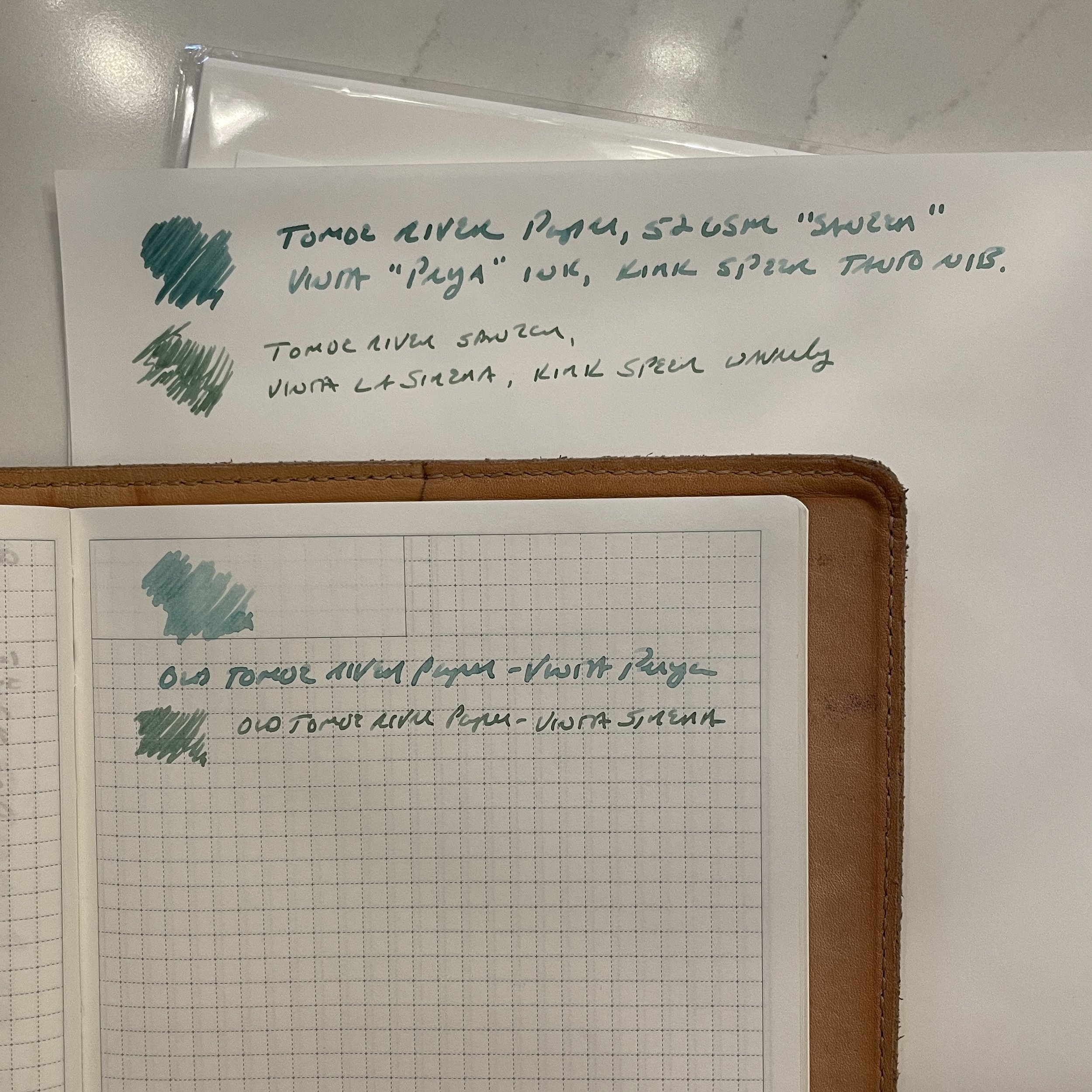
A comparison of the original Tomoe River (top) vs. the new Sanzen version (bottom). I have more comparisons of writing samples below.

A good friend of mine placed a large order direct from Yamamoto Paper in Japan, and was kind enough to add a package of A4 Sanzen Tomoe River sheets to his order for me. I’ve had a week or so to test this paper out, and can offer you my initial thoughts. Short Answer: Those looking for an exact replica of classic 52gsm Tomoe River Paper (in terms of both feel and how the paper showcases ink colors) are going to be dissatisfied, those who appreciate any lightweight writing paper that handles fountain pen ink without feathering or bleeding will like this paper just fine, and those who use pencils in addition to fountain pens might strongly prefer the new paper over the old. Let me break this down:

  • Sanzen Tomoe River Paper feels stiffer and has more tooth. While it still manages to have that “crinkly” feel that some people loved about the original, the Sanzen version feels different - more like a traditional writing paper such as Midori MD. It also has more feedback - it’s not rough or scratchy, but the feedback is definitely noticeable when you do a side-by-side comparison with the original. I’ve heard some people complain about the paper “dragging” on nibs, and while I personally would not describe the feel as “draggy,” that may depend on the specific nibs you use and how sensitive you are to writing feel.

  • Sanzen Tomoe River Paper showcases ink much differently than the original. It’s neither good nor bad, but inks look different on the Sanzen paper than on the original: darker with less shading and sheen, and less-pronounced color variation in multi-chromatic inks. You will either like or dislike this property/feature, depending on how you want your inks to look, but there’s really no way to tell other than trying some for yourself. I tend to use less exciting inks for my daily writing than most people, and I don’t use my papers for art and/or calligraphy where ink properties might be more important, but if you do, you may end up disappointed.

  • Sanzen Tomoe River Paper may have less show-through and “ghosting.” I’ve had several questions via Instagram about whether there is “ghosting” with the new Sanzen version. For purposes of answering this question, I’ll equate “ghosting” to “show-through”, meaning that you can still see the writing on the reverse side of the page, even if the ink technically doesn’t bleed through. The short answer is yes, there is still show-through (as you would have with any thin paper - it’s unavoidable), but it’s not as pronounced. I say “may” above because it will likely depend heavily on the ink you use.

    • Note: I personally define “ghosting” differently, and use it to refer to the transfer of ink or graphite from one page to another when you write on the back of a page that already has writing on it. With pencil, it’s near certain that you’ll experience some ghosting with anything HB or softer. With pens, it’s more a function of the ink used rather than the paper, but ultra-smooth paper will exacerbate the tendency of highly saturated or slow-drying inks to ghost.

  • Sanzen Tomoe River Paper will likely be more durable than the original. If I had one complaint about original Tomoe River Paper, it’s that the paper could be so thin and crinkly (especially in looseleaf form), that it could tear easily. For this reason, I often avoided using Tomoe River paper at work, and in situations where I needed a notebook or writing pad to travel in a backpack or briefcase. While far from scientific, I did a “tear test” on both the original Tomoe River and the Sanzen Tomoe River, and the Sanzen version feels stronger and rip-resistant.

  • Sanzen Tomoe River Paper is better for pencil. Given the additional tooth/texture, those of us who use pencils as much as fountain pens may well prefer the Sanzen version to the original, which could be a bit too “glassy smooth” for pencils. Because of the lack of texture, many found that the original Tomoe River Paper smeared with darker pencil, probably because ultra-smooth papers don’t hold the graphite as well as toothier versions.

In this picture, you can see a pronounced difference in color between the inks on Sanzen Tomoe River Paper (top) and the original 52gsm paper (bottom). The two inks are Vinta Perya and Vinta Sirena, respectively, both of which typically have multi-chromatic shading, which is not as visible on the Sanzen paper. To be fair, the lighting in my kitchen makes the Sanzen writing look darker than in real life, and the effect is more pronounced on the blue Perya than the more green-ish Sirena.

Note: In comparing Sanzen Tomoe River Paper with the “original” Tomoe River Paper, I am not distinguishing between any of the formulation changes in the original. Prior to being discontinued, the original paper changed at least once (to much discussion among paper connoisseurs). Because I could never tell a difference between the “new” and “old” original Tomoe River, and because the different versions are not easily identified, I’m not taking that into account in this comparison.

Takeaways and Where to Buy

Sanzen Tomoe River Paper is not widely available at the moment, though that will likely change as it works its way through the supply chain. Personally, I think I’ll be perfectly happy with this new version, should I ever need to purchase additional Tomoe River notebooks, or should companies like Traveler’s Company and Musubi decide to start using this paper in their notebooks. (I have a lifetime supply of pretty much any sort of paper in existence, so I’m not particularly concerned about running low on original Tomoe River.) That said, the Sanzen Paper is different, and if you’re a die-hard fan of the original you shouldn’t expect it to duplicate the experience you’ve grown to love. This is essentially an entirely new paper, and should probably be considered on its own merits.

So where can you get this paper? The Yamamoto Paper Etsy Shop is currently the only source I’m aware of. It’s currently priced at $6.50 for a pack of 50 A4 sheets, with shipping costs of nearly $20 so you’ll want to stock up and make your order count. I expect I’ll be able to offer this paper in the Curated Shop at some point, though if you’re a die-hard fan of old Tomoe River you’ll be happy to know that I still have some 52 gsm paper available in the Traveler’s Notebook “Lightweight Paper” Specialty Refills, in both Standard and Passport sizes. (I tried to stock up on these while they’re still available for purchase). Lochby A5 and pocket notebook refills also feature the 68gsm Tomoe River, and I hear this paper will remain available but that’s by rumor only.

This post does not contain affiliate links. The Gentleman Stationer is supported entirely by purchases from the T.G.S. Curated Shop and pledges/donations via the T.G.S. Patreon Program.

In Paper Products Tags Paper Review, Tomoe River, Sanzen Tomoe River
9 Comments

Essential Stationery: For Me, It's Sticky Notes

April 23, 2022

Over the past couple of weeks, I’ve basically been forced into stationery minimalism. Three quarters of my stash has been packed away, and while I don’t have as large a stockpile as many, and tend to keep only what I might reasonably use, it’s definitely given me a sense of what’s truly essential and what’s a luxury. Here, I define “essential” as “What have I had to go back into storage to dig out of boxes because I can’t function without it?” The number one thing? My stash of sticky notes and page markers.

I use a broad range of sticky notes and page markers for everything from making notes to myself, to creating makeshift bookmarks, to annotating documents at work, to marking up books I’ve been reading where I want to go beyond marginalia. Honestly, for my day job, I probably do just as much writing on Post-its as I do on traditional legal pads or notebooks.

A real-time shot of my work desk from this week. Lots of Post-It flags. Always.

So What’s In My Stash?

I keep a wide variety of stationery readily available for this purpose, ranging from your classic Post-Its (purchased in bulk every couple of years at Costco), to 3M document flags, to fountain pen friendly stickies from Midori and Traveler’s Company, to repurposed washi tape. For books that I plan to keep (as opposed to library books I can’t mark up), I’ll use Book Darts and more expensive paper tabs such as those from Duncan Shotten. Here are a few of my favorite options, chosen by what’s actually on my desk at this very moment:

  • Classic Post-It. While overall performance with fountain pens definitely varies by batch (and especially by paper color), on the whole I’ve had a decent experience using standard 3M Post-It notes with fountain pens and most other writing instruments. The classic yellow are my favorite, and as I mentioned, I usually buy them in bulk at Costco.

  • Midori MD Sticky Notes or Traveler’s Company Sticky Notes. I don’t use these on “throw away” notes for work, since they’re more expensive, but when I’m reading a book or wanting to add a sticky note to my journal, and intend the note to last for posterity, I’ll definitely use one of these higher-quality, fountain pen friendly sticky notes. The Traveler’s Company sticky notes come in a handy insert with plastic protector so you can store them as a refill inside your Traveler’s Notebook. The Midori MD versions are slightly larger (A7 size), so they can really double as “sticky memo pads.”

  • 3M Post-It Flags. I probably wouldn’t buy these myself (b/c you can’t really write on them well), but I work at a law office and they have them lying all over the place so they’re always in my bag and sometimes “whatever’s available” (or “whatever’s free”) is what you use.

  • Book Darts. These classic metal page markers are infinitely useful, and I never find myself without a tin of them in my bag or next to the chair I’m reading in. While they’re reusable, I typically only use them in books I’m reading and plan on saving, since I like to leave them in long-term to revisit certain passages. (They’re archivally safe and won’t degrade paper over time.) You can also use them to create a multi-subject notebook divided into sections.

  • Duncan Shotten Sticky Page Markers. I have several packs of these quirky sticky page markers in various themes. (Lately I’ve been using the “alien” ones.) They’re great for when you want to show more personality than a Post-It flag allows.

  • Folded-over Washi Tape. If you ever want to mark a page in a book or notebook, and don’t have a Book Dart or other page marker handy, you can always fold a small piece of washi tape over the edge of a page. I forget who told me this trick but it’s stuck for years!

Anything I’m missing? What are your favorite sticky notes and page markers?

Book Darts on Tomoe River Paper!

In Editorial, Paper Products Tags Post-It Notes, Sticky Notes, Essential Office Supplies
1 Comment
← Newer Posts Older Posts →
Store Hours and Location
Visit the T.G.S. Curated SHOP
*New* Updated "Best Pens" Guide (2025)
T.G.S. 2025 Holiday Gift Guide
TGS x Roterfaden TGS_25
Hierarchies of Fountain Pen Friendly Paper

Join Our Patreon!
Subscribe to the TGS E-mail List

Featured Posts

Featured
Cover On the Paper Trail Intro Clip.jpeg
Dec 3, 2025
Introducing "On the Paper Trail," a New Podcast/Video Collaboration with Lisa Vanness of Vanness Pens!
Dec 3, 2025
Dec 3, 2025
Iro-Utsushi-Fine-Dip-Pens.jpeg
Oct 1, 2025
The Pilot Iro-Utsushi Dip Pen (and in General, Simple vs. Fancy Dip Pens)
Oct 1, 2025
Oct 1, 2025
Levenger-Annotation-Pad.jpeg
Sep 20, 2025
Five Boutique Paper Brands I'm Watching Closely and Why
Sep 20, 2025
Sep 20, 2025
The Gentleman Stationer RSS

© Digital Divide Media, LLC, 2014-present.

All content is the exclusive property of Digital Divide Media, LLC, d/b/a The Gentleman Stationer, including “The Gentleman Stationer” website and trademark, and should not be reproduced without express written permission.  All rights reserved.

All content containing paid advertising, affiliate links, or sponsored content will be plainly disclosed by a disclaimer when/if featured.

Contact Information

Store Shipping Policy and Return Policy

Privacy Policy

Cookie Policy

Terms and Conditions

Powered by Squarespace