• Blog
  • Shop
  • Resources
  • FAQ (Ask TGS)
  • About
  • Archive
  • Contact
  • Sign In My Account
Menu

The Gentleman Stationer

Vintage Living in the Modern World.
  • Blog
  • Shop
  • Resources
  • FAQ (Ask TGS)
  • About
  • Archive
  • Contact
  • Sign In My Account

Pen Review: RIIND Pen

January 13, 2018

There's no shortage of machined metal pens on the market these days. From the Karas Kustoms Retrakt to the Ti2 Techliners to the ultra minimalist Ateleia, it's become a category unto itself. Seemingly every time you turn around, someone is Kickstarting their new idea. So what separates the  best machined pens from the also-rans? To me, it's a mix of functional design, comfort over long writing sessions, and refill compatibility. The RIIND Pen earns a high score in all three categories, and I'd be shocked if this pen didn't receive a lot of attention as it becomes more widely available. 

The RIIND Pen is currently available in three colors: Black, Gray, and Clear Anodized. You can order the black pen with either a black or polished clip. 

Design

What surprised me the most, at least at first, was the size of this pen. Most of the machined pens out there are on the slimmer side in order to cut down on weight. The RIIND measures about 5.5 inches in length, and isn't particularly slender, but the combination of lightweight aluminum construction and good design make this one of the most comfortable metal pens that I've ever used.

At 5.5 inches in length and anodized aluminum construction, the RIIND pen has excellent balance and won't tire your hand out if you decide to use it for long form writing or as your daily workhorse. 

The RIIND website discusses several key aspects of the pen's design that make it stand out: 

  • The "ContinuousCam" Technology: "ContinuousCam" refers to the knock mechanism that rotates 360 degrees to extend/retract the refill. On most pens that use this sort of rotating mechanism, like a Retro 51 Tornado or a Baron Fig Squire, the mechanism only moves a half turn in a single direction, and you're then required to move it back to retract the tip. On the ContinuousCam, you can rotate the knock 360 degrees in either direction, with the tip extending/retracting with every 180 degree turn. While this may not seem like a significant innovation on paper, it makes the RIIND an extremely quick pen to deploy, and eliminates just one more little thing you need to think about before you get down to work.
  • The "Super Clip": I wasn't sure how I'd end up liking the large, sort of funky styling of the RIIND's clip, but at the end of the day it's extremely functional and the design works well for this particular pen. This clip strikes the rare balance between being strong and being easy to use. It slides easily onto shirt pockets and slots in pen cases and bags, but there's enough tension that the pen isn't going to come loose. 
  • The "Texture Grip": Better known to pen fans as "knurling." The grip area on this pen is quite comfortable, and isn't rough or sharp. In my opinion, some texture is necessary on the grip area of metal pens to avoid slippage during long periods of use. It also gives the RIIND pen an industrial aesthetic that I like.   
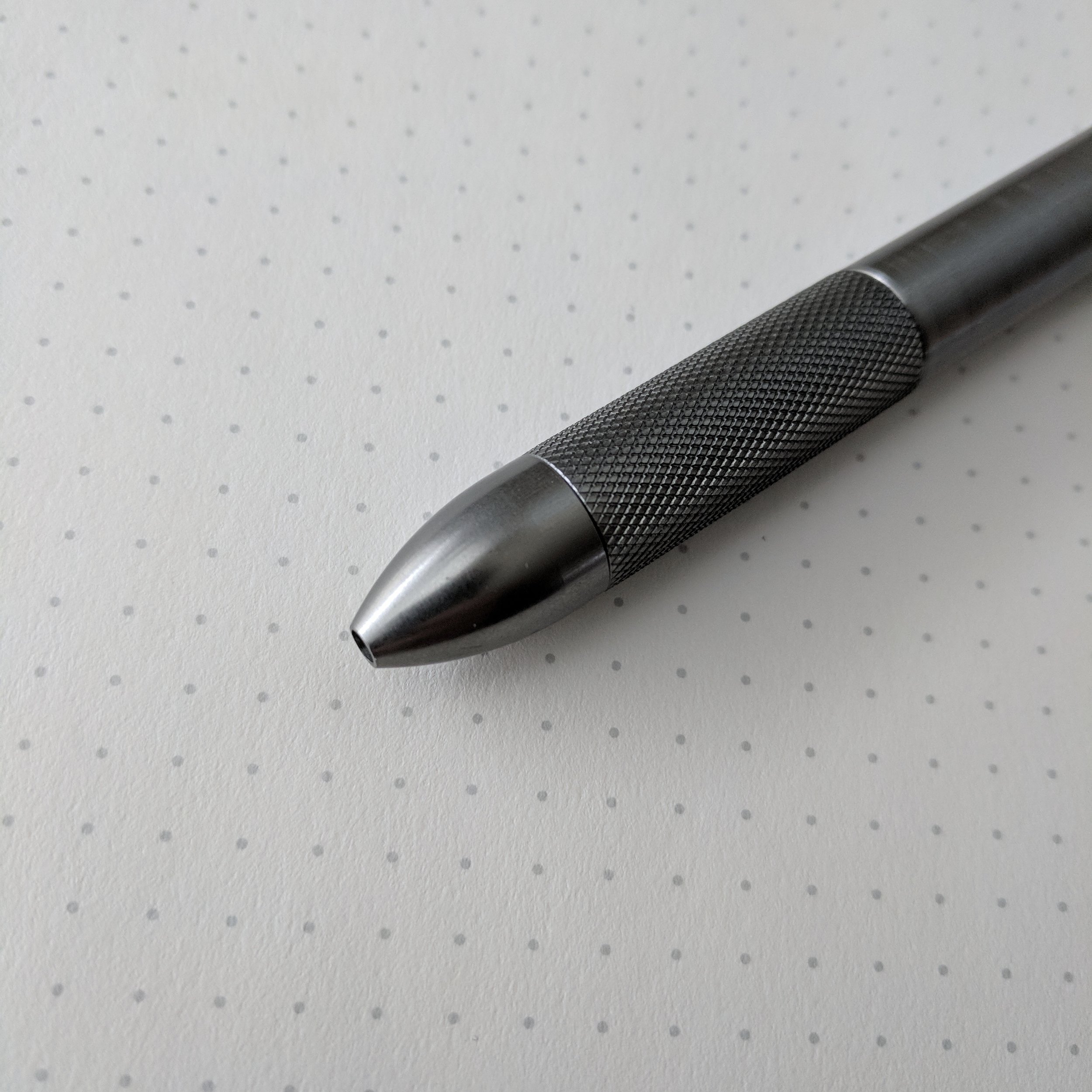
View fullsize Textured Grip on Gray Pen
View fullsize Tip with G2 .38mm Refill
View fullsize RIIND Branding on Reverse of Pen
View fullsize Super Clip and ContinuousCam

Refills

I didn't pay much attention to refill compatibility until a couple days ago. I'm perfectly happy with the stock Pilot G2 .38mm refill that ships with the pen. People tend to criticize the G2, but personally it's one of my favorites, and I suspect that much of the "criticism" has more to do with the G2's status as a somewhat boring workhorse that's neither trendy nor flashy, rather than poor quality. For example, in terms of getting dud refills that won't write or are super scratchy, I've had MUCH better luck with the .5mm and .38mm G2 than with the Pilot Juice, the Hi-Tec-C, or even the Schmidt liquid ink rollerball refills. But that's my own experience and I digress. Whether you like the G2 or not, the RIIND website states that the pen accepts over 35 different refills without any hacking or modification whatsoever, which includes basically all of my favorite mainstream retractable gel refills. The ones that I tested that worked included: the Uniball Signo 207, the Signo RT, the Pentel Energel, the Pilot Precise RT, the Papermate Inkjoy, the TUL needlepoint, and the Zebra Sarasa Clip. Since the Pilot Juice refill has the same dimensions as the G2, it should work as well, though I don't currently have one on hand. Stick pens such as the Signo DX and the Pilot Hi-Tec-C generally don' t fit, though the Pilot Hi-Tec-C Cavalier refill will fit, per RIIND.

Correction: Clayton at RIIND reached out and pointed me to a list of compatible refills on the RIIND website.   

I love it when you change the refill through the tip, as opposed to having to unscrew the knock mechanism. It's an easy system to use, and reduces the risk of the mechanism breaking. 

Takeaways and Where To Buy

I can highly recommend the RIIND Pen. I've reduced the number of non-fountain pens that I own, and I could be very happy with the RIIND Pen, the Ti Arto, and the Baron Fig Squire as the only non-fountain pens in my tool kit. This set would give you the ability to use pretty much any pen refill in existence, in both retractable and non-retractable formats.  

The RIIND packaging is minimal AND reusable. I love these pen tubes, which come in handy for storing and protecting pens should you need to ship them. 

You can purchase the RIIND Pen directly from the RIIND website. All pens are $99, which is eminently reasonable for a pen of this quality. Currently, RIIND only offers one model in three colors (black, gray, and standard aluminum), but I'm hoping that they have more on the way. I'd love to see color anodized versions, as well as a slightly shorter, pocketable version of this pen, which would immediately make it's way into my daily carry. 

Disclaimer: RIIND Pens loaned me this pen for review purposes. Many thanks to Clayton at RIIND for making this review possible. This post contains affiliate links. 

In Pens Tags Machined Pens, RIIND Pen, Pen Review
Comment

Pen Review: Giuliano Mazzuoli Moka Fountain Pen

January 10, 2018

It’s rare that you find a product that embodies three of your favorite things - coffee, fountain pens, and unique design - but Giuliano Mazzuoli has done it with the Moka, an attractive, pocketable fountain pen inspired by the iconic Bialetti “Moka Pot” stovetop coffee/espresso maker. You may recall my review of the Mazzuoli “Officina” series from last year, in which I looked at both the fountain pen and the ballpoint/clutch pencil combo. While I won’t repeat myself too much here, Giuliano Mazzuoli is a line of Italian-made pens from the eponymous designer. The brand has been around for some time, but recently has become more visible in the United States with both the Officina and Moka series receiving a lot of attention.

Consistent with how much coffee I drink ("too much"), I don't have the smaller, faceted version of the Bialetti that inspired the pen. I own the larger ten-cup model, pictured here. 

While the Moka is a beautiful pen, and I absolutely love the design, the section is too narrow for me and I therefore couldn’t use it for more than the shortest of notes. That said, on a pen of this size, short note-taking is likely it’s intended purpose. If you have smaller hands, or are looking for a pocket fountain pen that doesn’t sport the admittedly banal design of many “pocket pens", the Moka might be a great option for you. The medium nib on my pen was smooth and well-tuned, reminiscent of high-quality German steel nibs from Faber-Castell and Otto Hutt.

There is no scrollwork or adornment on the stainless nib, lending the pen a very clean look that doesn't distract from the faceted body and hourglass shape. 

As with the Officina series, Mazzuoli’s packaging and presentation are top-notch. The Moka comes with a small rubber “grip sheet” (sort of like a jar opener) to help unscrew the section, which has an extremely tight fit.  Also, while the Moka does allow you to post the cap onto threads recessed into the back of the pen - a nice design touch - I didn't really like the look and preferred to use this one unposted. (Note: my photograph of the pen posted came out blurred, which I didn't notice until after I had already returned the pen. Pen Chalet has some shots of the pen with the cap posted on the back.) 

What I referred to as the "jar opener" that was included with the pen to help you open the section. Note that the section has less girth than a standard international cartridge. It's that skinny.

I'd purchase a full-size version of this pen in a heartbeat. Think Lamy Aion with the Bialetti styling! Brushed black aluminum and chrome trim form a great combination, reminiscent of my Otto Hutt Design 06. 

The Moka comes in both aluminum and resin models. The pen featured in this review is crafted from brushed aluminum, and is available in black, ivory, and red. The resin version, dubbed the “Moka Chiaroscuro”, is available in red, black, blue, orange, and white. While one of the various mini converters might fit this pen, I've never found a good one. Therefore, I'd consider the Moka to be cartridge-only.

View fullsize Giuliano Mazzuoli Moka Black
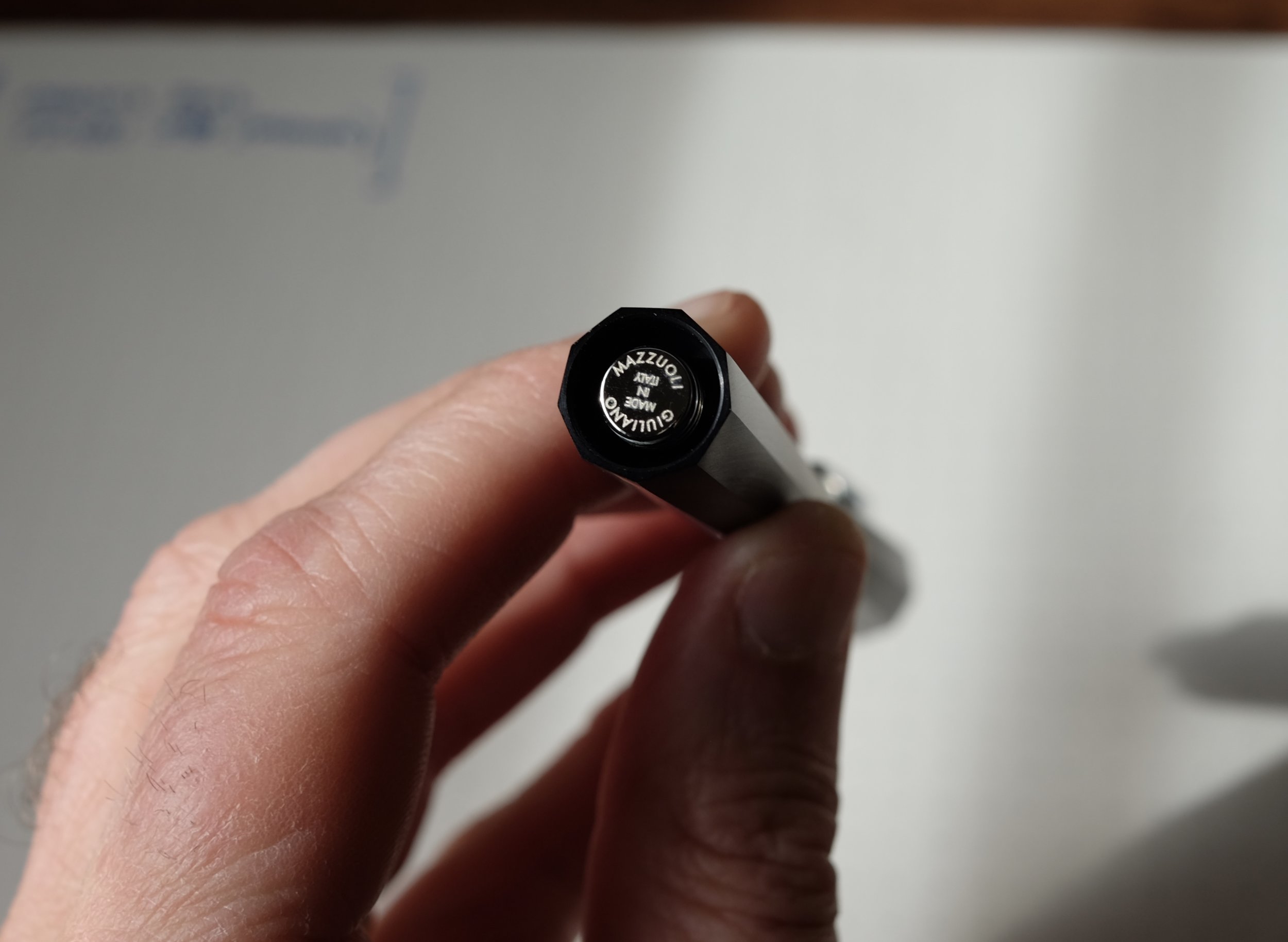
View fullsize Mazzuoli Medallion
View fullsize Mazzuoli Moka in-hand

Takeaways and Where to Buy

Since this pen was a loaner, I didn’t test it extensively “in the wild,” but from what I've seen so far I continue to be impressed with the quality of Mazzuoli pens. As I mentioned, given the slim section, whether this pen could serve as a comfortable daily writer depends on hand size. The nib, however, is quite nice, and having this pen on your desk at work would be quite the conversation-starter.

The Mazzuoli Moka has a MSRP of $156, with most retailers listing the pen for somewhere around $125, such as our site sponsor Pen Chalet. This price seems fair to me, given the quality of both the build and the design. Many thanks to Carol and the team at Luxury Brands for loaning me this pen for review!

Disclaimer: Luxury Brands loaned me the pen featured in this review free of charge, for review purposes. This post contains affiliate links.

In Pens Tags Giuliano Mazzuoli, Pens, Pocket Pens
1 Comment

On the Low End: The Nemosine Singularity and the Monteverde Monza

January 6, 2018

“Low-End” here refers to price, not quality - well, at least that’s what I hope for. Fortunately, there’s a bounty of lower-priced pens on the market right now, including many great options that you can find for less than $20. Today I’ll take a look at two pens I recently picked up for the first time: the Nemosine Singularity and the Monteverde Monza. The Singularity has been around for a while, developing what turns out to be a well-deserved cult following, but I can’t see Monteverde getting any traction with the Monza (much less their more expensive pens like the Giant Sequoia) unless they improve the quality control on their nibs.

Nemosine Singularity: A Solid Budget Option

My review of the Nemosine Singularity is pretty straightforward: at the $20 or less price point, it’s a great pen. For a while now I’ve heard about Nemosine’s stub nibs: how they are narrower than you’re typical stainless steel stock stub (this one is .6mm, my sweet spot for stubs/italics), and are relatively smooth writers. All true, and the pen itself seems well-built and should hold up fairly well for a sub-$20 plastic demonstrator.

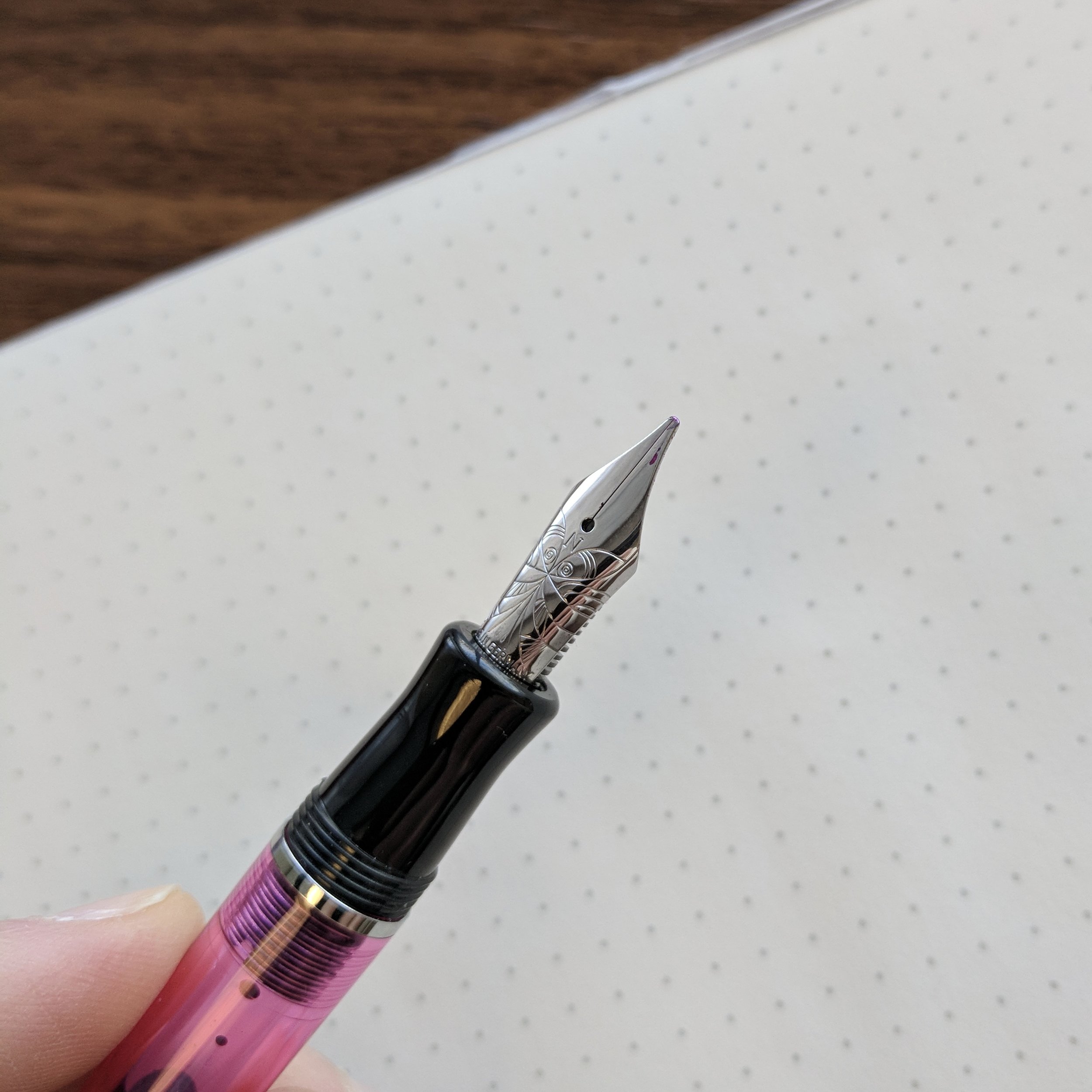
I enjoy the detailing and scrollwork on the Nemosine nib, but that's personal preference. Some might find it "busy". 

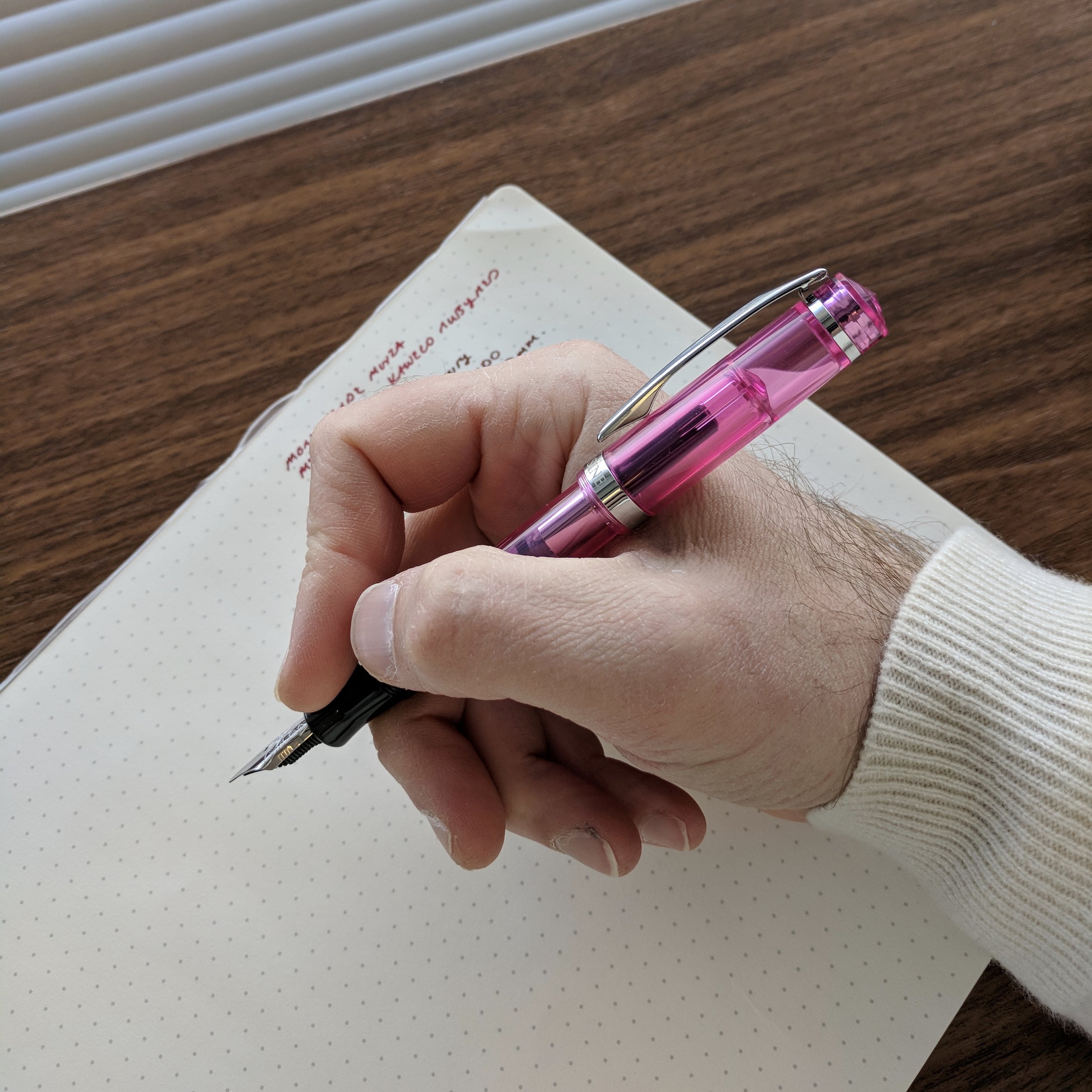
One of the Singularity’s key selling points is the wide range of available colors. I opted for the pink “Azalea” demonstrator, but the Singularity is also available in Aqua, Clear, Magenta, and Onyx. With the exception of the “Clear” and “Onyx” versions, these are brightly colored pens that manage to pull off pastel colors without seeming childish or cheap.  The plastic feels thick and relatively durable, though I wouldn’t expect a $20 pen to last forever, and you may have issues with the threads or cap cracking over time. (I’ve not experienced this or heard an inordinate number of complaints, it’s just a general observation about how less-expensive pens seem to wear. This would apply to basically any plastic pen at this price point, and even TWSBI has not been able to avoid the issue with much higher-priced products.)  

View fullsize Nemosine Singularity Posted
View fullsize Nemosine Singularity .6mm Stub
View fullsize Nemosine Singularity Unposted

The Singularity fits nicely in my hand, posted or unposted, though the pen’s light weight lends itself more to posting.  The black plastic section is slightly concave and comfortable, though if I had one gripe I’d like to see just a touch more length to avoid rubbing up against the threads.

No issues here. The Singularity sports one of the best inexpensive stub nibs that I've used, though it's actually a .6mm, not a .9mm. I may need to revisit and supplement my article on steel stub nibs at a later date. 

If I had been deep into fountain pens as a college student, the Singularity would be up there with the Pilot Metropolitan and the Lamy Safari as a great student pen that would offer a serviceable writing experience without breaking the bank.  The Monteverde Monza, on the other hand….  

Monteverde Monza: Save Your Money  

Monteverde has gone on a bit of a tear recently, releasing multiple new pens at various price points. The Monza is apparently Monteverde’s attempt to break into the “inexpensive plastic demonstrator” segment, and rather than develop an original design they’ve gone with what appears to be an “homage” to cigar-shaped pens like the Sailor 1911 Standard and the Montblanc 144/146. That said, the Monza looks nice, and I opted for the “Honey Amber” demonstrator. Other color options include “Gray Sky”, “Island Blue”, and “Crystal Clear”.

My frustration with the Monza started early. First of all, I went to ink it up and the converter didn’t fit in the pen. Based on what I’ve read online, some retailers advise to “push really hard” to seat the converter on the back of the feed, but I had no luck. Maybe I didn’t push hard enough, but I was already so skeptical of the quality that I didn’t want to risk shattering the feed (or even the section itself). That gives you some idea of how bad the fit was.

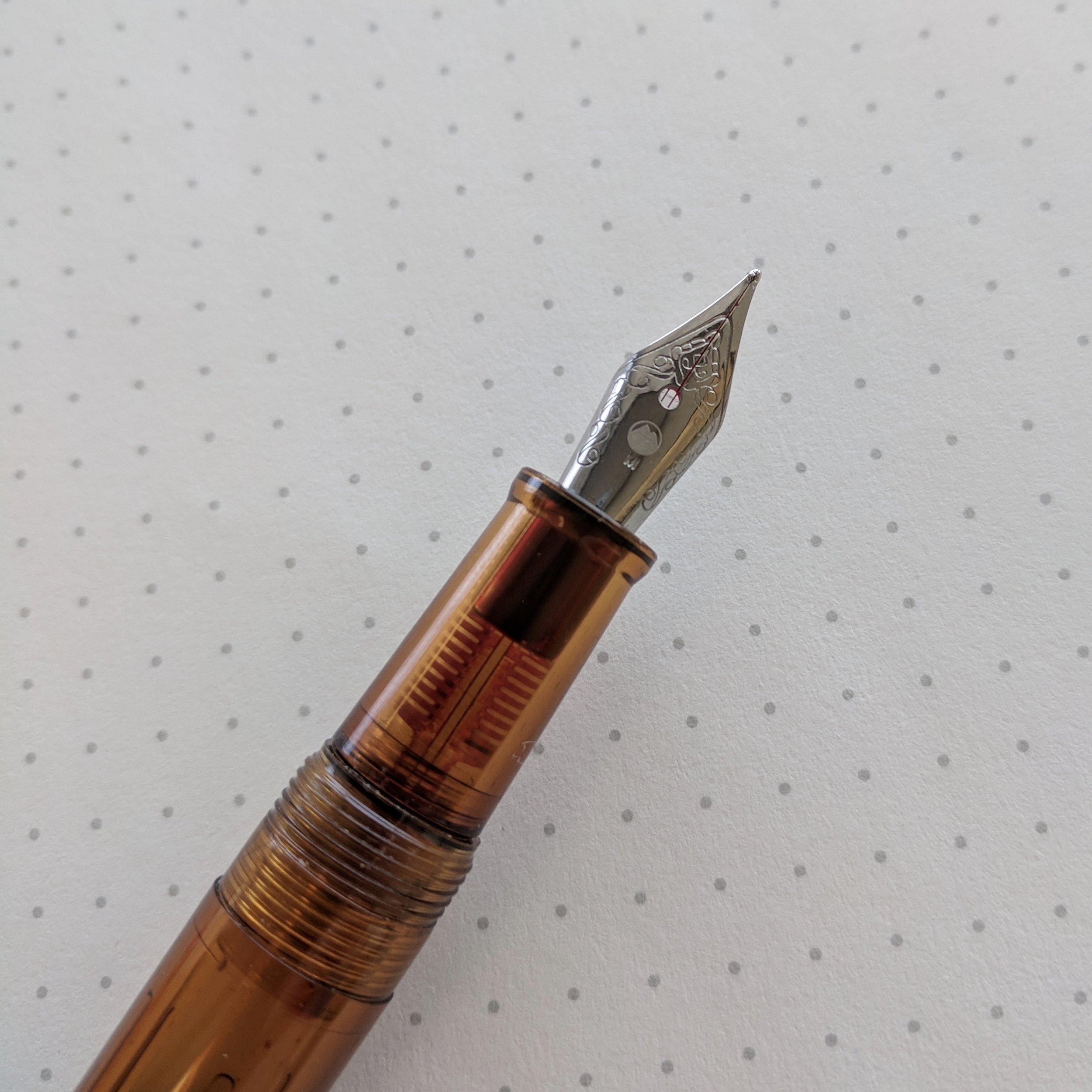
The Monteverde Monza features a clear feed, much like some of the old third-tier vintage fountain pens like Wearever. I do like the look because it shows you how the ink flows to the nib.

After tossing the converter aside, I ended up going with a cartridge (Kaweco Ruby), and spent a solid 10 minutes attempting to get ink to flow. The nib barely wrote out of the box. The culprit was a misaligned feed, inserted so poorly that it caused the tines to twist. In other words, what looked like a complete absence of quality control on the part of the manufacturer. This isn't an isolated incident with Monteverde nibs, and it's not limited to their lower-priced pens.)

Note: If I recall correctly, my Monza box came shrink-wrapped in plastic. If you like the look of this pen, and want to go ahead and buy one, be sure to request that your retailer open it up so they can check the nib, unless you’re comfortable doing adjustments yourself.

I frankly don’t understand how Monteverde can put so much effort into making their pens - packaging included - look pretty good, but apparently take no steps to make sure they actually write. I’d gladly pay $10-15 more for a pen if it meant the pen had been tested, though I’m not sure such a drastic price increase would be necessary, given that Nemosine can sell the Singularity for $3 more.

View fullsize Monteverde Monza Unposted
View fullsize Monteverde Monza Posted
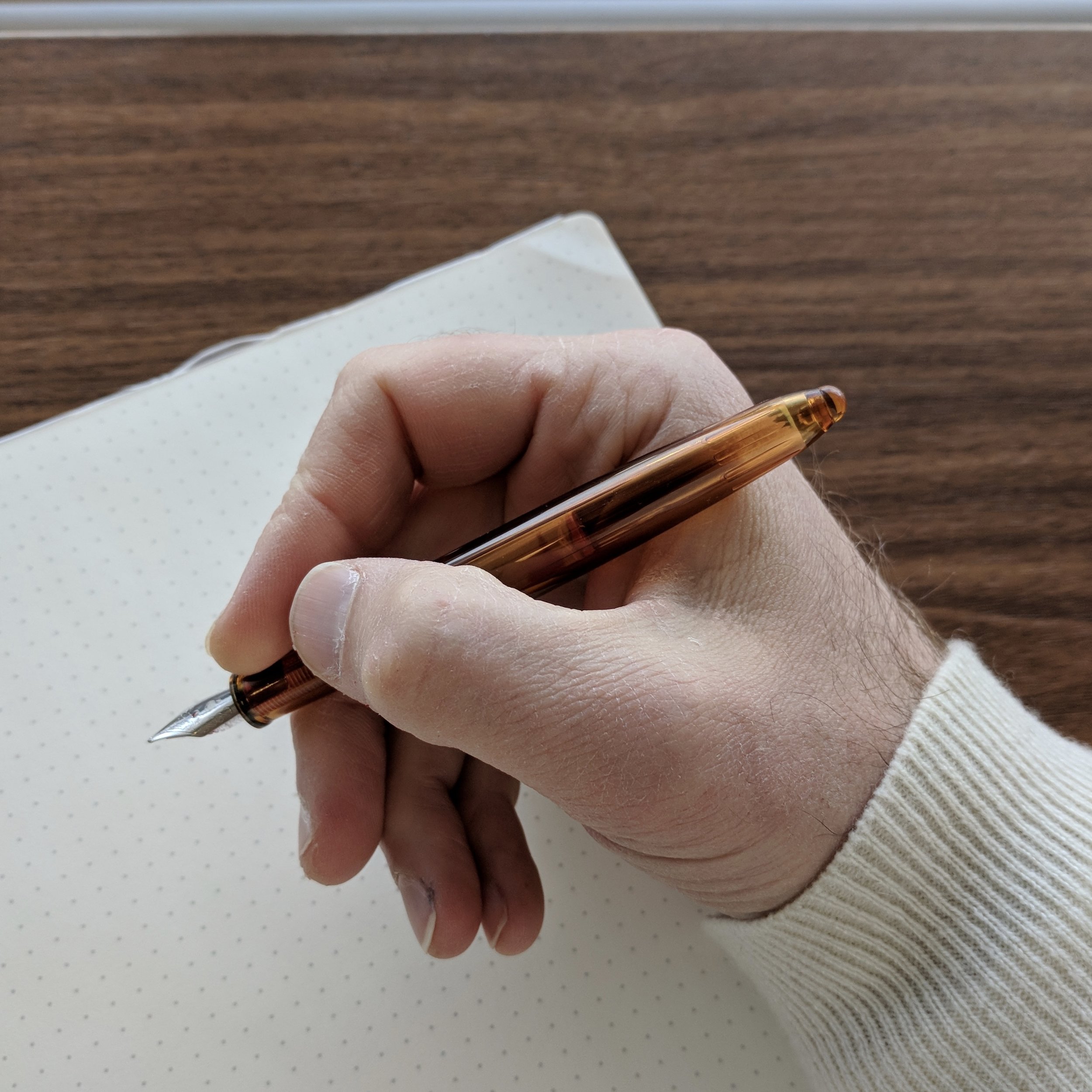
View fullsize Monteverde Monza Medium Nib

Why should Monteverde invest the time and resources into quality control? Because once I pulled, reset, and aligned the nib, the Monza is actually a very good writer. The stock medium steel nib is nothing to write home about in terms of line variation or character, but this one is very smooth, and the pen itself - once it was fixed - makes a great knockaround pen: one that I would have loved to have had as a student. Even now, it's one I'll keep around in my travel bag. 

A nice writer, but after waaay too much effort on my part. 

Takeaways and Where to Buy

Of these two pens, the Nemosine Singularity is the clear winner and would get my recommendation. The relatively solid build and excellent stub nib for this price point makes it pretty much a no-brainer for someone looking for a colorful demonstrator in the beginner / “student pen” category, or simply anyone looking for an inexpensive fountain pen that they don't have to worry about losing or damaging. 

The Monteverde Monza, on the other hand, has some potential but the quality control is far below what I’ve seen elsewhere at (or even below) this price point. The fact that I had to pull, reseat, and straighten the nib, in addition to the fact that the supplied converter didn’t fit the pen, drops this into the “yes, if you’re prepared to tinker with it” category along with the Noodler’s pens and $0.99 Chinese pens from eBay. I suspect, however, that most in this pen’s target audience would either return the pen or throw it away if they received it in the shape that I got this one.

You can purchase both pens from Pen Chalet. The Nemosine is currently priced at $19.99 and the Monza goes for $16 (both before any applicable coupon codes).

Disclaimer: This post contains affiliate links. While I purchased these pens from Pen Chalet, I did receive a discount due to my sponsor/affiliate relationship.
In Pens Tags Nemosine, On the Low End, Monteverde, Monteverde Monza, Nemosine Singularity, Pen Review
2 Comments

The Bic Cristal Is (Arguably) The Greatest Pen Ever Made.

December 13, 2017

Clickbait headline? Especially coming from a dedicated fountain pen user, who at one point would regularly lament how the ballpoint and the gel pen contributed to the downfall of polite civilization by driving the fountain pen to the brink of extinction? But from a sheer numbers and longevity perspective, you can easily make the case. Bic has sold over 100 billion of these pens since they were first launched in 1950. The pen sits in the permanent collection of the Museum of Modern Art. And it’s become the gold standard for how a basic ballpoint pen should look and write.

Though Europe gets the awesome orange barrels, in the States we’re “stuck” with what to me is the "classic" Bic Cristal, featuring a clear plastic hexagonal barrel and a plastic cap that matches the ink color. The design hasn’t changed much in the nearly 70 years this pen has been in existence, and the history of the Bic Cristal makes for fascinating reading.

For awesome write-anywhere portability (like in the car), I don't think you can beat the Cristal, especially if you tend to lose a lot of pens outside the house. 

People tend to hate cheap ballpoint pens for one of two reasons: they require too much pressure to write, and/or the ink won’t leave a solid line. The oil-based ink in really cheap ballpoints can also blob and smear all over the page (or in your pocket), making a serious mess. Of all the pure ballpoints out there on the market, however, I consider Bic Cristal and the Schmidt Easyflow 9000 to be the best options, because you don’t usually see any of these issues. (As with any mass-produced product at a lower price point, there are exceptions.)

Two current Bic Cristal models: on the left the .8mm Xtra Precision, which sports a needle tip, and on the right, the most common Bic Cristal available, the 1.0mm "medium". 

Though it certainly doesn’t write the same dark line as a gel or hybrid-gel pen, the Bic Cristal performs pretty well for a ballpoint. Bic’s shade of blue ink is much more vibrant than what you’ll find in a Papermate Write Bros., or the various store-brand generics. The 1.0mm “medium” tip can even show some line variation, depending on the pressure you use. For this reason, many artists use Bic pens to draw insanely detailed portraits. While I find gel pens pretty much unusable in tip sizes above .7mm, I have no trouble writing relatively small with the 1.0mm Bic Cristal, since oil-based ink doesn't feather and bleed.

Though ballpoint ink is never going to be as dark as gel, liquid rollerball, or most other types of ink, Bic's formulation is among the best. It also dries near-instantaneously on non-coated paper, including cheap office-supply stock. 

Takeaways and Where to Buy

In a world where pen companies and big box stores are starting to charge $15 for a dozen mediocre gel pens, there’s something to be said for taking the opposite approach by picking up a pack of Bic Cristals. Sure, you'll probably lose the pen, give it away, or the plastic barrel may crack long before you use up the ink, but like the most basic woodcase pencils, sometimes you just want to get some work done with a reliable tool that presents the least amount of distraction. Moreover, with the concept of handwriting generally under attack, we should be doing all we can to preserve it by promoting the entire range of writing tools available. The Bic Cristal offers a low-cost, zero-barrier-to-entry option. Anyone can jump online or run down to the corner store, and get started handwriting.  

As I mentioned, the 1.0mm medium point will probably give you the smoothest writing experience, and is generally my recommended starting point. For editing and annotation (or if you just write really small), the “Xtra Precision” needle-tip pens are fantastic. If you write large, there's even an "Xtra Bold" 1.6mm version, though I've not tried them. 

Finally, if the Bic Cristal interests you from a design or historical perspective, both Philip Hensher's The Missing Ink and James Ward's The Perfection of the Paper Clip discuss the history and development of the Bic ballpoint pen in some detail (as well as diving deep into other aspects of stationery minutiae). I highly recommend both books. 

Disclaimer: I purchased the pens featured in this review with my own funds, for my own use.

In Pens Tags Bic, Bic Cristal, Cristal Xtra Precision
13 Comments

New Pen Alert: Lamy Studio in Racing Green

December 9, 2017

I hardly ever "re-review" pens, and I won't really do that here, but I did want to take the opportunity to talk about Lamy's absolutely gorgeous new special edition Studio, in Racing Green. 

Everything that I wrote about in my previous review of the Lamy Studio remains true: It's a sleek, modern, nicely balanced pen with a metal section that offsets the weight of the cap when the pen is posted. The pen caps and posts securely, using a clutch mechanism that has an audible "click" or "snick" (choose your adjective). Lamy has chosen not to sell the Racing Green Studio with the 14K nib, opting instead to travel at a lower price point using the same stainless nib featured on the Safari, AL-Star, and Studio. 

The sub-$80 Lamy Studio features the same stainless steel nib as on the Safari, AL-Star, LX, etc. For another $90, you can separately purchase one of Lamy's 14kt nibs, which are outstanding, but the price is pretty steep. 

I previously reviewed another special edition Studio (the Ruby/Royal Red), which I regrettably sold off a couple years back. (Regrettable because I can't find another one.) Lamy seems to make fewer special edition Studio pens than they do special edition Safaris or AL-Stars. You can typically still find the latter in stock at retailers up to a year later, but the Studios tend to sell out relatively quickly. I imagine this is due to the higher price point and the lower profile of the Studio translating into lower demand; Lamy likely has an easier time selling the less-expensive Safaris and AL-Stars than the $70-plus Studio. Thus, it's also more difficult to find special edition Lamy Studios on the secondary market. 

I touched up this photo a bit to try to bring out some of the iridescence.  It's not noticeable at first, but when the light hits this pen in a certain way....

The Racing Green studio is an incredibly attractive pen, coated in an almost iridescent dark green matte finish. It remains to be seen how the matte finish on this pen will hold up over time. My red Studio looked pretty beat after a while, with the powdered coating wearing off underneath the clip and around the edges of the cap, which ultimately frustrated me and led me to sell the pen despite the excellent nib. I will say that the coating on the Racing Green feels thicker, and I haven't seen any dings or scratches yet despite carrying this pen in a bag for a week. 

Takeaways and Where to Buy

I stand by my previous review of the Lamy Studio as a great option in the sparsely populated "great pens under $100 category" that TWSBI typically dominates. The Studio is also widely available and relatively easy to find, and with a coupon code you can get some colors for as low as $65. To me, that's a no-brainer (provided you can live with the metal section).

As I mentioned, the "Racing Green" Lamy Studio pictured here is a special edition, meaning that they will be made for a short time. Currently available from Pen Chalet at $79 retail (less with a coupon code), these may not last long, given how quickly past special edition Studios have sold out. Pen Chalet currently only has medium nibs in stock, but fines are still available on special order.

In Pens Tags Lamy, Lamy Studio, Special Edition, Pens
3 Comments
← Newer Posts Older Posts →
Store Hours and Location
Visit the T.G.S. Curated SHOP
Updated "Best Pens" Guide
On the Paper Trail Podcast
TGS x Roterfaden TGS_25
Hierarchies of Fountain Pen Friendly Paper

Join Our Patreon!
Subscribe to the TGS E-mail List

Featured Posts

Featured
Cover On the Paper Trail Intro Clip.jpeg
Dec 3, 2025
Introducing "On the Paper Trail," a New Podcast/Video Collaboration with Lisa Vanness of Vanness Pens!
Dec 3, 2025
Dec 3, 2025
Iro-Utsushi-Fine-Dip-Pens.jpeg
Oct 1, 2025
The Pilot Iro-Utsushi Dip Pen (and in General, Simple vs. Fancy Dip Pens)
Oct 1, 2025
Oct 1, 2025
Levenger-Annotation-Pad.jpeg
Sep 20, 2025
Five Boutique Paper Brands I'm Watching Closely and Why
Sep 20, 2025
Sep 20, 2025
The Gentleman Stationer RSS

© Digital Divide Media, LLC, 2014-present.

All content is the exclusive property of Digital Divide Media, LLC, d/b/a The Gentleman Stationer, including “The Gentleman Stationer” website and trademark, and should not be reproduced without express written permission.  All rights reserved.

All content containing paid advertising, affiliate links, or sponsored content will be plainly disclosed by a disclaimer when/if featured.

Contact Information

Store Shipping Policy and Return Policy

Privacy Policy

Cookie Policy

Terms and Conditions

Powered by Squarespace