• Blog
  • Shop
  • Podcast
  • Resources
  • About
  • Archive
  • Contact
  • Cart
  • Sign In My Account
Menu

The Gentleman Stationer

Vintage Living in the Modern World.
  • Blog
  • Shop
  • Podcast
  • Resources
  • About
  • Archive
  • Contact
  • Cart
  • Sign In My Account

Pen Review: TWSBI ECO Yellow and ECO White Rose Gold

May 23, 2020

Last month, I wrote a piece about how TWSBI recently has made a major push to expand the ECO lineup, seemingly at the expense of the TWSBI 580, it’s “flagship” fountain pen. While I remain a die-hard fan of the 580, I also appreciate what the ECO brings to the table: a high-quality, high-capacity piston filling fountain pen with a reliable nib at roughly $31. And now, the TWSBI ECO is available in a wide range of colors and designs.

My two soft spots in this hobby are red and yellow pens, meaning that if a company releases a model I like in either of these two colors, I’ll likely buy it. So when TWSBI announced the ECO Yellow earlier this year, it was pretty much a foregone conclusion. Now that I have the pen in hand, I have no regrets. The bright yellow acrylic really pops, and the EF nib writes a smooth, wet line. I’ve not had much experience with TWSBI EF nibs in the past, and while this one pleasantly surprised me, it’s definitely a wider, “German” EF, and definitely not a needlepoint or Japanese-style nib.

The Rose Gold Eco is actually branded the “ECO RG,” thought I’ve not seen it referred to as such in marketing releases.

The more unique release, which sold so quickly it was out of stock at most retailers until recently, is the TWSBI ECO White Rose Gold. Years ago, TWSBI released a 580 fountain pen featuring rose gold trim, which, while extremely popular, was plagued by reports of the trim wearing off over time. I understand that TWSBI reformulated the rose gold plating not only to increase durability, but to offer a bit more shine and “rose” tone. Whatever they did, the end result looks great, especially paired with the white acrylic.

The rose gold nib is absolutely gorgeous.

For a full review of the ECO fountain pen, check out this post here. I won’t rehash the specifications, etc. in detail, but I continue to believe that the TWSBI ECO is a well-made, reliable fountain pen that represents outstanding value at its price point.

There’s no discernible difference in line width between the standard Eco steel nib and the rose gold plated nib. Both nibs write on the wider side for an extra-fine.

Takeaways and Where to Buy

TWSBI remains a brand to watch. The company has not only demonstrated its devotion to innovation and continual improvement as it tweaks its product lines in response to customer feedback, but it’s adherence to a reasonable pricing scheme has positioned the company to thrive in all sorts of market conditions, as fountain pen enthusiasts look for affordable ways to indulge in their favorite hobby. You can purchase both the TWSBI ECO Yellow and White Rose Gold and still spend well under $100.

You can currently purchase TWSBI ECO fountain pens in the T.G.S. Curated Shop, starting at $30.99 for the standard line, and $49.99 for the pens with rose gold trim. While some might balk at the premium for rose gold, which sees the pen approaching the cost of a standard TWSBI 580, keep in mind that a TWSBI 580 with rose gold trim actually costs $84.99.
In Pens Tags TWSBI, TWSBI ECO, TWSBI ECO Yellow, TWSBI ECO Rose Gold, Fountain Pen
4 Comments

Lamy Safari "Candy" Special Edition Part II: The Ballpoint

May 21, 2020

The Lamy Safari ballpoint gets little love or attention, and it’s not fair. At $16 retail, this pen is not only a must-have for the Lamy fan who needs a functional writer for “everyday” use, but it also makes a great gift for someone who appreciates fun writing instruments but may not necessarily be ready to dive into the world of fountain pens. Honestly, I’m a little embarrassed to be writing this review six years into this blog, having never owned, or even used, one of these pens until now.

The Lamy Safari ballpoint features the same triangular grip as the fountain pen, but it’s much more subtle and less pronounced.

This pen is nothing fancy - just a plastic retractable ballpoint that uses Lamy’s proprietary M16 refill. At one time, Lamy ballpoints had a reputation for being dry writers that failed to leave a solid, visible line on the page. (If you’ve ever written with a really cheap ballpoint pen that “skips,” you’ll know what I’m talking about.) In recent years, these refills have performed remarkably better, to the point where my Lamy Pico pocket ballpoint and Lamy 2000 ballpoint have become favorites. Based on how much I’ve been enjoying these Safaris, I suspect they will also find a regular spot on my desk.

The only durability question I have about this pen relates to the rubber knock. Does this rubber harden and crack over time? Has anyone used one of these pens long-term?

“Lamy” branding opposite the clip.

Takeaways and Where to Buy

Look, the Lamy Safari ballpoint pen doesn’t offer anything especially unique in terms of a writing experience, but at the $16 price point, you’re getting a solid writer with the Lamy aesthetic, and there’s not much risk to the purchase. Personally, I always get frustrated because ballpoint pens are either really narrow/skinny, making them uncomfortable to write with for long periods of time, or super chunky and inelegant. The Safari strikes a midpoint and is extremely comfortable to grip. Combined with the accessible price, that’s a major selling point.

I purchased these Lamy Safari ballpoint pens from Pen Chalet, as part of the same order where I picked up the recently reviewed Lamy Safari Special Edition “Candy” fountain pens. Lamy currently has the “Candy” ballpoints in stock, as well as the standard Safari ballpoints (which are, curiously, slightly more expensive than the special editions). As I mentioned above, these are relatively inexpensive purchases, so if you haven’t tried one, it’s a fun add-on to your next order.

Disclaimer: This post contains affiliate links. The Gentleman Stationer is a participant in the Pen Chalet affiliate program, which allows me to earn store credit from referrals and is one way I support the blog and acquire new products for review.

In Pens Tags Lamy Safari, Lamy Safari Ballpoint, Ballpoint
Comment

More Stock Nibs That Offer Line Variation

May 17, 2020

One fountain pen rabbit hole that many people tumble down quickly is nib modification. The emergence of a new generation of nib grinder, nibmeisters, nib workers, nib technicians, whatever your preferred term, has formed a major part of the resurgence in fountain pens and fine writing accessories over the past few years. Having a nib ground makes for a great way to add more personality to your writing, and even a simple nib tuning can improve ink flow and performance on some pens that write “inconsistently” out of the box. While it’s great to have these services available, it can add anywhere from $20-80 to the cost of your pen, depending on what work you have done.

I’ve written before on “stock” stub nibs - that is, nibs available from the factory pre-ground or shaped into a stub italic, which adds line variation to your writing in the form of narrow cross-strokes and wider downstrokes. You can read more about these types of nibs, which are advertised as stubs, in this series of posts titled “Stock Stub Nibs: Exploring Specialty Nibs” and “Exploring Stock Stub Nibs, Part II: Higher-End Options.”

A close-up of the slightly squared off, “stubbish” broad nib on my Montblanc 149.

What I would like to write about today is a bit different: those nibs sold by pen companies as standard extra-fines, mediums, or broads, but which don’t write like a typical rounded nib. Here are a few of my own “secrets”:

  • Lamy Studio 14k Extra-Fine Nib. I have no idea whether other 14k Lamy “Z” nibs exhibit this characteristic, because they tend to be a bit too wet for me and I stick to the extra-fine, but I’ve noticed that this nib shows subtle architect-like qualities. “Architect” or “Hebrew Italic” nibs are essentially the reverse of your classic stub or italic, and show broad cross-strokes and narrow downstrokes. It’s a relatively expensive grind, so if you’d like a pen that writes with this style of line variation, especially one with a gold nib, the “premium” version of the Lamy Studio is an option that I can highly recommend.

  • Platinum Curidas Stainless Steel Medium Nib. One of the more pleasant surprises of 2020 (and there have been relatively few of them), was the medium stainless steel nib on Platinum’s new Curidas retractable fountain pen. Though I had to replace a scratchy, dry fine nib, the medium nib arrived with perfect ink flow and subtle, yet still stubbish, line variation.

  • Lamy 2000 Broad Nib. Sometimes described as a “shovel,” the 21k Lamy 2000 broad nib leaves a broad, wet line with definite stubbish characteristics. I’ve written many pieces on my love for the Lamy 2000 fountain pen (as well as the other versions) in the past, so I won’t repeat myself here.

  • Montblanc Broad, BB, and BBB Nibs. Many high-end pen companies such as Montblanc don’t offer a “stock” stub option, at least not in name. It can be scary to spends as much as $600-$1000 on a brand new Montblanc pen and send it off for nib work that automatically voids the warranty. Standard Montblanc broad, double-broad, and triple-broad nibs can be extremely stubbish to begin with, so if you want a stub, before you make an appointment with a nib grinder, consider ordering one of these stock nib sizes and trying it out unmodified first.

The fairly sharp, squared-off broad nib on my Lamy 2000 Stainless Steel model.

“Stub” Writing Samples

This particular Studio 14k nib isn’t the absolute best example, but you can still see the subtle architect-like shaping of the tipping material. Others I have in my collection might be slightly more pronounced.

Note the slightly broader cross-strokes on the writing sample from the Lamy Studio.

As you can see from these writing samples (all done on Baron Fig Mastermind paper, for reference), if you’re thinking of one of these nib modifications, consider trying stock nibs first. You may be pleasantly surprised. Of course, YMMV with each individual nib, and there is always the chance that you’ll get one that isn’t stubbish at all, or that writes a more or less pronounced line than the ones pictured here. It always helps to let the pen store know exactly what you’re looking for, especially with brands like Montblanc, and they try their best to pick out the best nib for your needs.

These are just examples that I pulled from pens in my own collection. I want to open this up for comments! Are there any other nibs you’re aware of that should be on this list?

Disclaimer: This post contains links to paid sponsors and affiliates.

In Pens Tags Stock Stubs, Architect Nibs, Stub Nibs
2 Comments

Pen Review: Lamy Safari "Candy" Special Editions

May 14, 2020

Lamy remains one of my favorite all-around stationery brands, particularly for those of us who both use our pens on a daily basis, and appreciate the ability to dabble in the special and limited edition fun from time to time. While Lamy's implementation of its limited edition strategy has been hit and miss over the years, they regularly release some exceptional pens, and the 2020 Safari special editions are no exception.

I love Safari’s with coated clips, especially those that match the pen barrel.

For the second year in a row, Lamy chose to release not one, but three, special edition Safaris. Building on last year's "Pastels,” the company chose "Candy" as this year's theme, and released three pens in shades of purple ("Violet"), turquoise ("Aquamarine"), and yellow ("Mango"). Mango is my favorite, probably because the yellow-orange hue is completely different from anything Lamy has released in the past. While I love the standard yellow Safari, the matte texture and matching clip lend the Mango a warmth the yellow fountain pen lacks.

The three “Candy” Safaris on the left; the three 2019 “Pastel” editions on the right.

What will be curious to see going forward is whether Lamy continues the three-pen releases. Amid growing economic uncertainty for much of the world, will we see companies scale back the number of special and limited editions pens, and maybe even discontinue certain slower-selling items from their standard lines? Lamy tends to make fairly large runs of Safaris, and it's not unusual to see last year's special edition pens on sale a year (or more) later. For example, the 2019 "Pastel" special editions continue to be available for purchase. In the case of Lamy, however, I wouldn't be surprised if things stayed status quo (or if sales even increased) since the company's lower price point pens might actually see an uptick in demand as pen enthusiasts look for less costly ways to indulge in their hobby.

This time around I purchased the matching ballpoints for two of the pens:

The standard Lamy Safari in yellow, on the left, and in Mango (with matching ballpoint) on the right.

Takeaways and Where to Buy

This is a great Lamy Safari release. As a proud member of #teamsafari (as opposed to #teamalstar), I immediately sprung for all three pens to add to my collection of recent special editions. In my opinion, the Mango pen in particular has the potential to be one of the better Safari's Lamy has made.

A combination of high demand and Covid-19 related shipping issues delayed the initial launch of the Candy Safaris, but most Lamy retailers now have them available for purchase. I purchased the pens featured in this review from site sponsor Pen Chalet, which currently has all three fountain pens available, in addition to the rollerball and ballpoint versions. The fountain pen is priced at just under $30, the rollerball $20, and the ballpoint $16. I'm something of a latecomer to the Safari ballpoint, and plan on reviewing that pen separately soon. If you’re interested in picking up one of the Pastel fountain pens, Pen Chalet is currently offering a free converter with purchase.

Disclaimer: This post contains affiliate links. I am a participant in the Pen Chalet affiliate program, which allows me to earn store credit that I can use to acquire items for review on the blog, like the pens featured here.

In Pens Tags Lamy, Pen Review, Safari, Candy Safari, Special Edition, Lamy Special Editions
1 Comment

Pen Review: Vintage Kaweco Sport

May 6, 2020

I've dabbled in vintage pens over the years, but always as a user, and never really as a collector. It's not that I dislike vintage - on the contrary, I love old things, especially practical items that have survived a century or more of heavy use and remain in nearly as good of shape as they were the day they were made. It's more that by the time I arrived in this hobby, I was struck by a feeling that I was too late to comfortably “collect” within my means. Antique store dealers, flea market vendors, and eBay Sellers had all gotten wind of the resurgent interest in fountain pens and prices seemingly went through the roof, even on pens in so-so condition that needed restoration. While I'm always game to start from scratch and learn about a new hobby, including restoring old pens myself, I didn't have much interest in perfecting my skills at $50-150 a pop. While I’ve learned to do basic repairs like changing sacs and Vacumatic diaphragms, that's the limit of my competence, and I would never feel confident enough to work on pen of any significant value.

So, my experience in vintage largely has been limited to purchasing already restored, nicer pieces that are ready for writing, as opposed to the more "completist" approach to collecting that you might see at pen shows. While I mostly own modern pens, I have a few vintage examples, including a couple of Parker Vacumatics, Pilot Myus, some late-model (1980s-1990s) Watermans and Sheaffers, and now my most recent addition, a vintage Kaweco Sport.

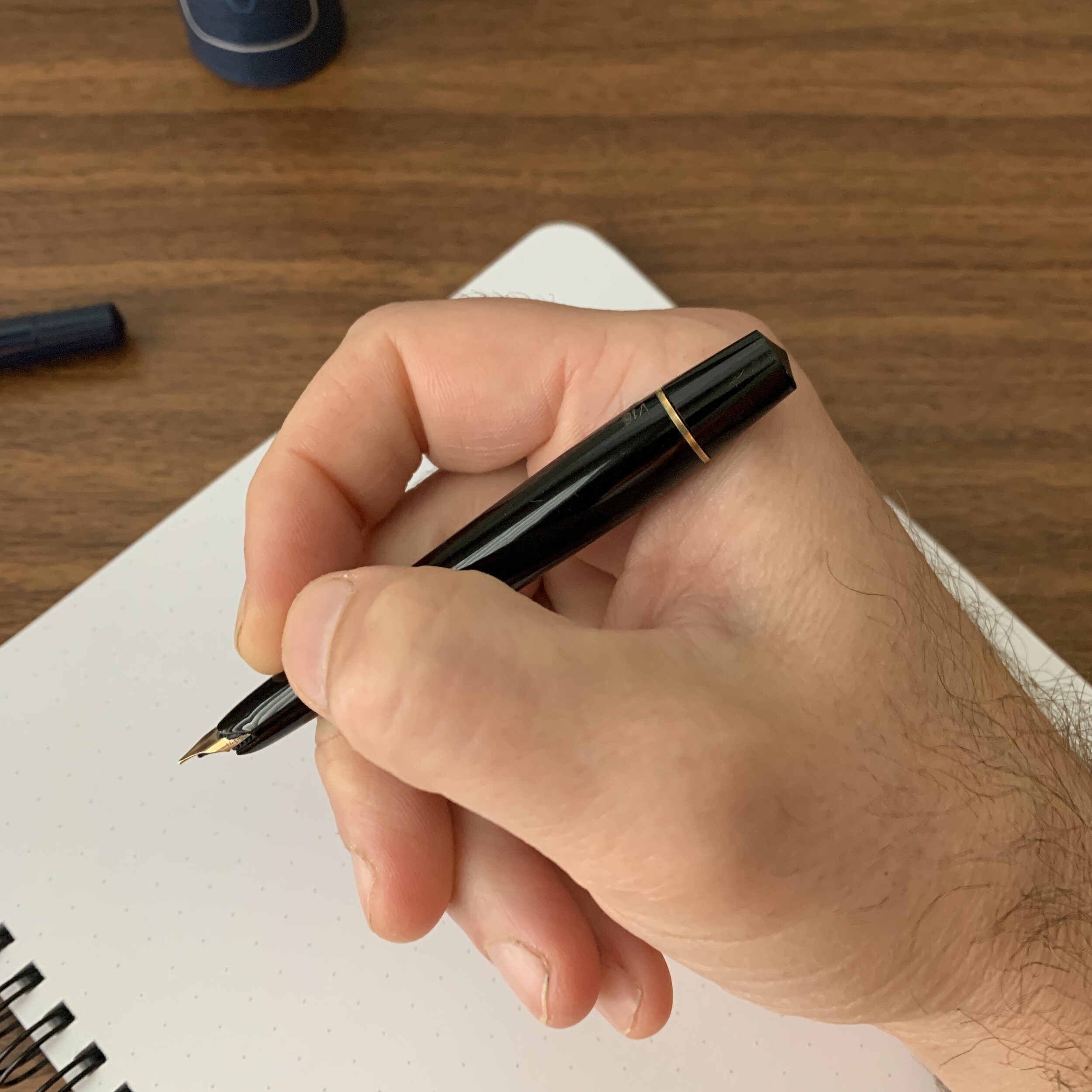
As you can see from the inscription, this is a Kaweco Sport model “V16,” with a “Fine” nib. The facets on this version are more subtle, more akin to the Art Sport than the standard model.

Kaweco Sport: Vintage vs. Modern

Before we dive into a comparison of the vintage Kaweco Sport and the modern pen that you can still purchase today under that name, some brief background on the company itself may be helpful. The original Kaweco (a contraction of Koch, Weber & Co) operated from the late 1800s until the early 1970s, and manufactured several models of pens in addition to the Sport, including the Special, the Elite, and the Dia, all of which you may recognize since the modern company, resurrected in 1994, has released pens under those names. Kaweco actually made multiple versions of the Sport over the years, and the version I own is the last version made in the early 1970s before the original company went out of business. It's part of a commemorative fountain pen and ballpoint set made for the 1972 Munich Olympics, complete with a leather case and medallion.

The modern Kaweco Sport is generally a larger pen than the vintage model that I own. It's longer and more substantial, and from what I can tell based on studying the pictures in Andy Lambrou's Fountain Pens of the World, was based on a 1930s version of the Sport with more pronounced facets on the cap. The vintage Sport feels quite small in comparison, though when extended and posted for writing it's actually a touch longer than the modern Sport.

View fullsize Vintage Kaweco Sport In Hand
View fullsize Vintage Kaweco Sport Posted

What else is different? While the modern Kaweco Sport has developed a well-deserved reputation as an inexpensive pocket pen with a steel nib perfect for both beginning fountain pen enthusiasts and experienced users, the vintage Sport featured a 14k gold nib and a piston filling system. The weight of the vintage pen shocked me a bit - despite the integrated piston, it's only slightly heavier than the modern pen. I really wish Kaweco would reissue this classic design, even though the cost of the piston (and the gold nib, if they decided to go that route) would likely require a significant price increase, which I suspect is the main reason it hasn't happened yet.

The nib on this vintage Kaweco Sport writes well, and leaves a moderately wet line, though I’d call it more of a fine-medium than a true fine. Check out that ink window!

I love how Kaweco retained the same script on its modern Sport series. The ballpoint has aged better than the fountain pen, probably due to the fountain pen seeing heavier use.

The finial/medallion on top of the pen is another vintage design element that Kaweco retained on the modern Sport.

Final Thoughts and Where to Buy

I love this little pen. Despite being nearly 50 years old, it feels as sturdy and well-made as a modern Kaweco, though I likely won't tempt fate by using it for true pocket carry. And while I have no plans to dive back into vintage pen collecting, it's tempting to pick up a few more examples of vintage Kawecos, especially if the pens remain as functional as this one. The Munich Olympics connection also makes for a cool piece of history to own.

I purchased this vintage Kaweco pen set from Maria, who sells through her Etsy store MaryMagicBox, which I discovered thanks to a tip from a member of our local Nashville-area pen group. Maria stocks a wide range of restored vintage pens, along with some gently used modern pens, with a focus on German brands such as Montblanc, Pelikan, and Kaweco, along with other lesser known marks including Osmia (later acquired by Faber-Castell). Though vintage Kaweco Sports are less common, they do come up from time to time in Maria’s shop, and she has other models of Kaweco pens available for purchase. If I do get the itch to acquire more vintage, I wouldn’t hesitate to order from Maria again.

Disclaimer: This post contains Etsy affiliate links.

Though this particular refill still works, could someone do me a solid and let me know whether you can still purchase these today? Or maybe hacking another refill (D1?) to get it to work in a vintage Sport ballpoint?

In Pens Tags Kaweco Sport, Vintage Kaweco Sport, Kaweco Sport Munich Olympics
7 Comments
← Newer Posts Older Posts →
Store Hours and Location
Visit the T.G.S. Curated SHOP
Updated "Best Pens" Guide
On the Paper Trail Podcast
TGS_25 Roterfaden New Stock Available
Hierarchies of Fountain Pen Friendly Paper

Join Our Patreon!
Subscribe to the TGS E-mail List

Featured Posts

Featured
Pilot-Custom-Series-Pens-overview.jpg
Mar 14, 2026
The Pilot "Custom" Series: An Overview of Some of My Favorite Fountain Pens
Mar 14, 2026
Mar 14, 2026
Pentel-Sign-Pen-Cover.JPG
Feb 28, 2026
Pen Review: The Pentel Sign Pen (Craft Design Technology Version)
Feb 28, 2026
Feb 28, 2026
Cover On the Paper Trail Intro Clip.jpeg
Dec 3, 2025
Introducing "On the Paper Trail," a New Podcast/Video Collaboration with Lisa Vanness of Vanness Pens!
Dec 3, 2025
Dec 3, 2025
The Gentleman Stationer RSS

View Cart

© Digital Divide Media, LLC, 2014-present.

All content is the exclusive property of Digital Divide Media, LLC, d/b/a The Gentleman Stationer, including “The Gentleman Stationer” website and trademark, and should not be reproduced without express written permission.  All rights reserved.

All content containing paid advertising, affiliate links, or sponsored content will be plainly disclosed by a disclaimer when/if featured.

Contact Information

Store Shipping Policy and Return Policy

Privacy Policy

Cookie Policy

Terms and Conditions

Powered by Squarespace