• Blog
  • Shop
  • Resources
  • FAQ (Ask TGS)
  • About
  • Archive
  • Contact
  • Sign In My Account
Menu

The Gentleman Stationer

Vintage Living in the Modern World.
  • Blog
  • Shop
  • Resources
  • FAQ (Ask TGS)
  • About
  • Archive
  • Contact
  • Sign In My Account

Review Revisited: The Pilot Custom 74 Fountain Pen

June 3, 2023

One downside to blog longevity is the need to ensure that all of the content on your site remains relevant. Certain of the older pen reviews here on T.G.S. are out of date: the pricing discussion might no longer be accurate, the original retailer out-of-business, or - as is the case today - the manufacturer has completely overhauled the lineup and selection of pens available. Today we revisit the Pilot Custom 74: a fountain pen that's regularly appeared in posts and "Best Pen" lists over the years, but which hasn't received any stand-alone in-depth treatment in quite a while.
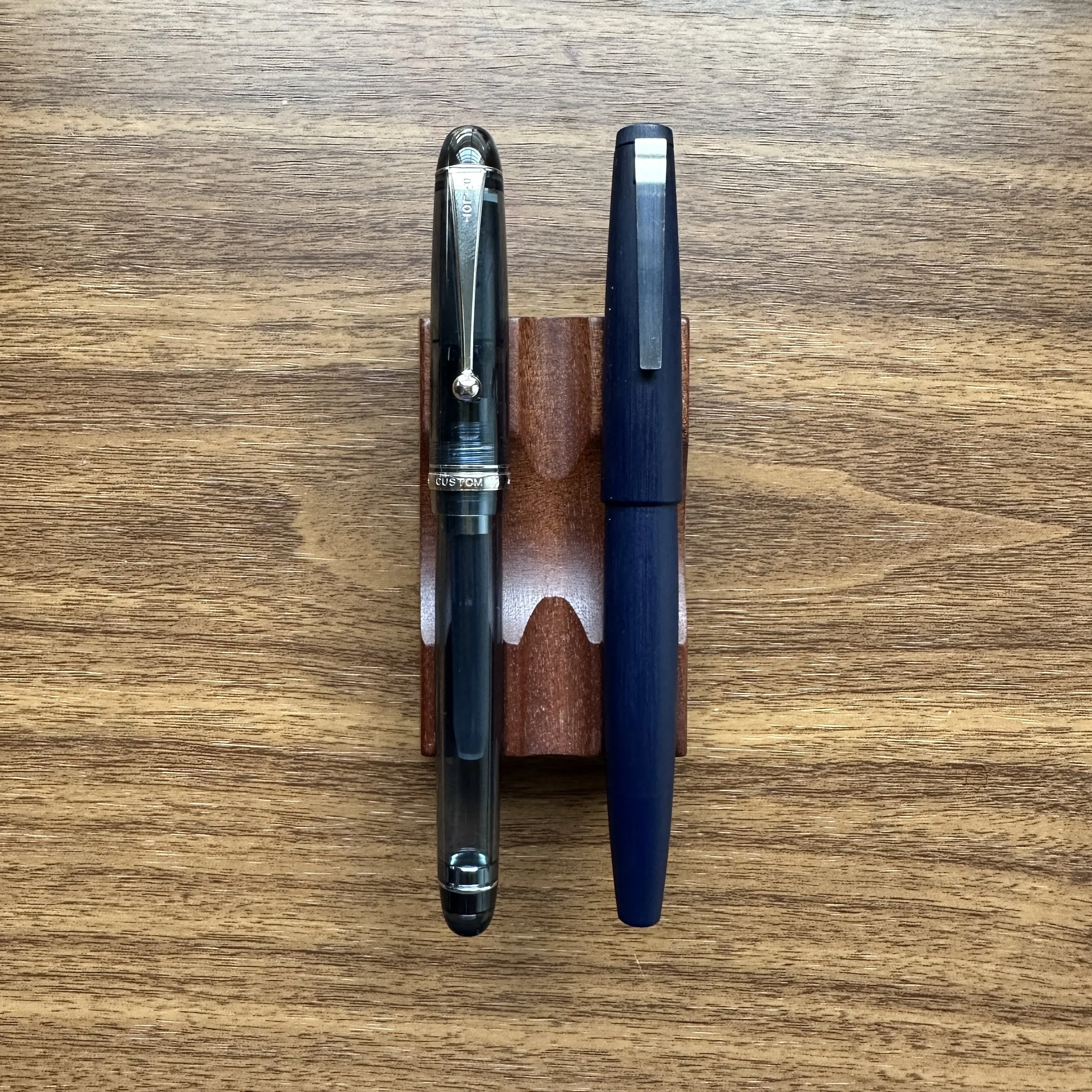
Pilot Custom 74 Lamy 2000 comparison

The Pilot Custom 74 + Lamy 2000

The Pilot Custom 74: A Highly Underrated Deep Value Proposition for a Workhorse fountain Pen

Along with the Lamy 2000, the Pilot Vanishing Point, and the Pelikan M205/M200, the Pilot Custom 74 was among the first "nice" fountain pens that I purchased in the early 2010s. It may actually have been the first 14k gold nib pen I bought, and I opted for the Violet demonstrator. (The original review has my only remaining photo of this that pen I deeply regret selling - so it goes.) Since then, Pilot has leaned heavily into the Custom 74 in the North American market, with eight different demonstrator colors currently available, as compared to the former four. It remains an excellent - and highly underrated - everyday writer.

Today, the Pilot Custom 74 fountain pen sits in the same market "sweet spot" that it has for years, and potentially has developed into an even more competitive price/value proposition as your options for gold nib pens under $200 dwindle to basically nothing else. While Pilot doesn't expressly advertise it as such, I would peg the Custom 74 as Pilot's answer to the Platinum 3776 and the Sailor 1911, albeit at a price point $30-50 lower than these other two. The Custom 74 is a mid-size pen that will fit most hands comfortably due to its ability to be used posted or unposted, and features a smooth and reliable 14k gold nib. Pilot, of course, doesn't play the limited edition strategy to the same degree as Platinum and Sailor, so for the moment you're limited to the "stock" colors, but that may be changing.

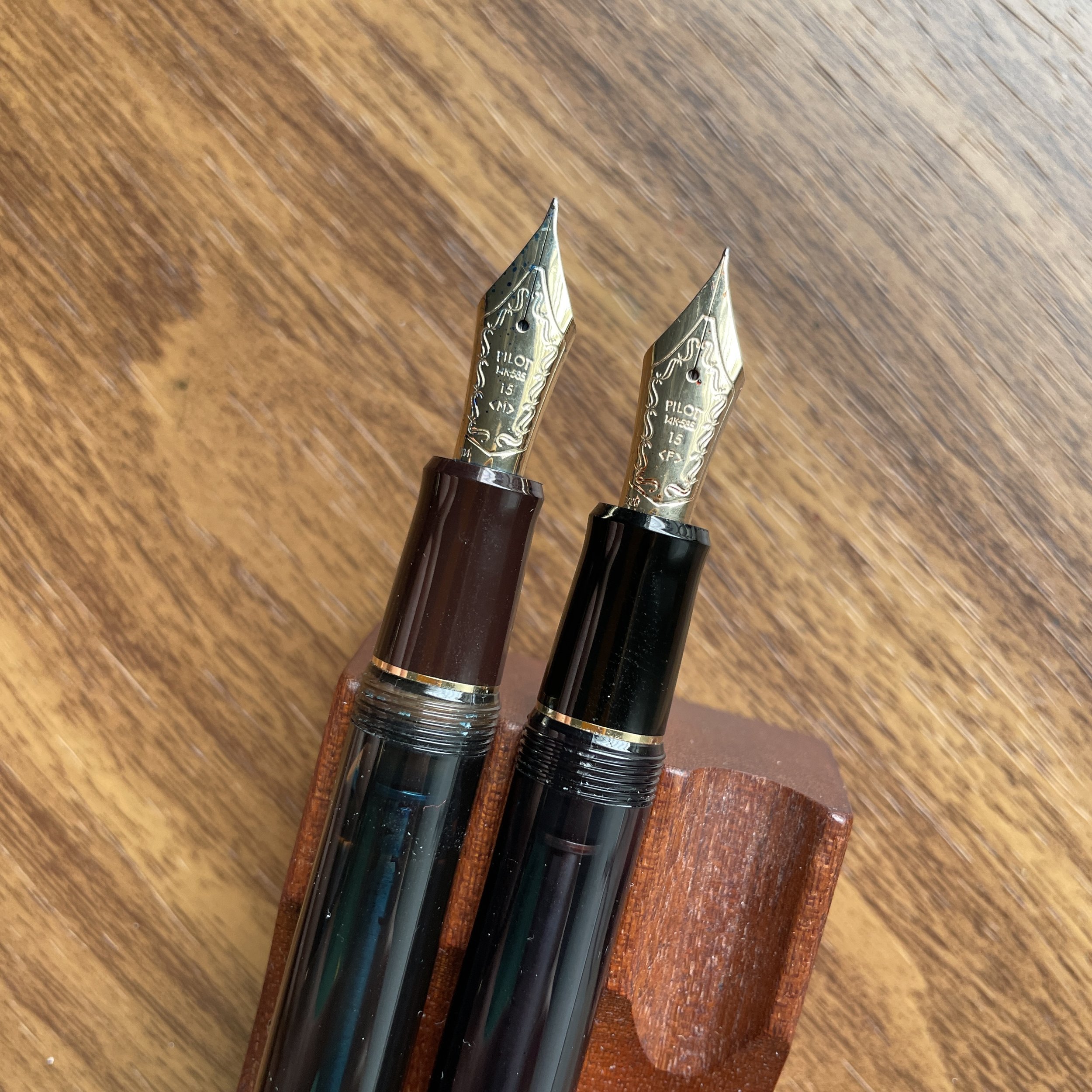
The sweet Pilot No. 5 nib on the Custom 74. All current models feature rhodium plated trim with no gold trim options available.

What makes the Custom 74 stand out? The combination of excellent writing experience and the fact that it still maintains its $176 street price at most retailers. You heard that correctly: a sub-$200 price point for an exceptionally reliable Japanese fountain pen with a 14k gold nib. Even back in the early 2010s, when I purchased my first Custom 74 for around $150, I thought this pen represented great value, and that continues to be the case for the following reasons:

  • Overall Writing Experience. Pilot nibs are consistently among the best standard nibs on the market - if not the best. In all my years writing with fountain pens, I don't think I've ever received a bad one. I can't say that about any other brands, as nearly all companies have their hiccups and in more than a decade buying and selling fountain pens I've had at least one dud from each brand (other than Pilot) that just didn't write perfectly out of the box. The Custom 74’s nib paired with the lightweight, comfortable barrel easily lends itself to longer writing sessions.

  • Versatility. I mentioned above that the Custom 74's size makes it a versatile writing option that fits a wide range of hands. Prefer a shorter, slimmer pen? The barrel is long enough to comfortably use unposted. Have larger hands? The Custom 74 posts deeply, while not adding too much bulk. It's slim enough to fit most pen cases, shirt pockets, and even some planner loops and notebook cover pen holders. The pen fills with a cartridge-converter filling system, allowing you to use bottled ink or Pilot cartridges.

  • Better Variety. Over the years, one big knock on this model was the lack of color options. Many people didn't want a clear demonstrator, and some found the orange, smoke grey, blue, and purple pens limiting. (Or "too wild" in the case of the orange and purple. I disagree, but hey, at least they added six new colors!) Today, you can chose from eight different pens: clear, blue, and smoke are still available, but Pilot has also added five additional demonstrators that include some gorgeous options that you don't see very often such as the "Blue Stone" (shown here), Teal, and Grenadine.

The Custom 74 posts nicely, and features a traditional streamlined design with rounded ends. Like other Pilot pens such as the Custom 823 and Custom Urushi, the cap sports Pilot's triangular ball clip.

Takeaways and Where to Buy

The Custom 74 has maintained a slot on my Best Pens list for years as one of my go-to recommendations not just for those looking to purchase their first fountain pen over $150, but for anyone looking for a reliable daily writer. It's up there with the Lamy 2000 and other workhorses. Is there any downside to adding one to your rotation? Not really, other than personal preference. Some may not like the design, and there's currently no non-demonstrator option in the U.S. market. Those who want a larger pen or higher-capacity filling system might want to opt for a bigger Pilot model like the Custom 743 or Custom 823, both of which also feature larger nibs (with accordingly larger price points). But again, these are preferences than true pros and cons.

When I decided to bring the Custom 74 and the Custom 823 into the shop, I knew that I wanted to set one aside as a tester/demo pen that would also replace the Violet pen I regret selling all those years ago. I chose the "Blue Stone" model, which is a stunning blue-black color that, to me, complements both Pilot's standard blue-black ink, as well as Iroshizuku Shin-kai. ( I do wonder whether this is intentional on Pilot's part: you can find some near-identical parallels between the Custom 74 color offerings and the Iroshizuku ink lineup.)

After years of recommending this pen, we are proud to sell the Pilot Custom 74 directly in our shop, alongside the Pilot Custom 823, the full range of Iroshizuku Inks, and hopefully more Pilot options in the near future. The Custom 74 is currently priced at $176, is available in all eight colors and nib sizes extra fine through broad, and includes free domestic U.S. shipping.

My Pilot Custom 74 in Blue Stone (top) with the rest of my “Workhorse Pen” kit from this week: The Lamy 2000 (right), the Cortex Brand Sidekick Notepad, and the Lochby Quattro pen case.

Further Reading

If you're interested in the Pilot Custom 74, you are likely exploring “Workhorse Pens” that you can use in your everyday writing. In that case, check out our “Workhorse Pens” series, which discusses similar options such as the Pilot Custom 823, the Lamy 2000, the Lamy Studio (with 14k gold nib), and more!

The Gentleman Stationer is an authorized reseller of all brands sold, including Pilot Pens. We are supported entirely by purchases through the T.G.S. Curated Shop, as well as pledges via the T.G.S. Patreon Program.
In Pens, Workhorse Pens Series Tags Pilot Custom 74, Workhorse Pens, Fountain Pens, Pen Review
4 Comments

Catching Up with Tactile Turn: The Side Click "Deep Space" Seasonal Edition

May 31, 2023

Though I remember when they launched their first kickstarter back in 2015 or so with their “Mover” and “Shaker” pens, Texas-based Tactile Turn has expanded over the years to become one of the more popular makers of machined retractable pens and pencils, renowned for their unique texture and wild finishes. For the past two-plus years, Will Hodges and his team have released their “Side Click” model in a series of limited quarterly finishes based around a specific theme, ranging from the latest, “8-Bit” (video games), to the pen I’m about to review here, the Winter 2023 release “Deep Space.” I’ve used most of the various Tactile Turn pens over the years, and for reasons I’ll explore more fully here, the Side Click is my favorite model.

Design and Build - Quality You Can Feel (and Hear)

Of all the models in their currently lineup, the Side Click is the one that reminds me the most of the “Mover” pen I originally reviewed. While I enjoyed the Mover for a time, I ultimately found the combination of the metal construction and length required to accept a full-sized Pilot G2/Juice refill too top-heavy for my taste. Specifically, the pen was too long and somewhat unbalanced in my hand. Since then, however, Tactile Turn has made all of their pens available in three different sizes: Standard (5.8”), Short (5.3”), and Mini (4.6”). The Standard still accepts the G2 gel refill, the Short is designed to take Parker-style cartridges, and the Mini takes only the G2 mini refill, making it the least versatile of the three. Personally, the mid-sized “Short” pen fits my hand the best, and it’s likely what I will use going forward. Because this pen takes Parker-style refills, you have a wide range of refill options available, ranging from Schmidt Easyflow 9000 and P900 ballpoints to Caran D’Ache Rollerball refills to Ohto Needle-tip gel cartridges, all of which I’ve used.

The milled clip, designed for a deeper carry, is one of my favorite design elements of the Side Click. So far, I like it much better (both aesthetically and functionally) than the folded metal clip that Tactile Turn used on the Mover and the Bolt Action pen I’m currently using.

Tactile Turn uses an in-house mechanism that they describe as “extremely satisfying in both feel and sound.” I agree. To deploy the refill on the Side Click, you depress the knock, which locks the tip in place. To retract the pen, you press a small button on the upper part of the barrel. The release mechanism is well-designed in that it requires the right amount of pressure to work- it would be difficult to accidentally hit the button and retract the pen while you’re writing. For a demonstration of how the mechanism works (and sounds!) check out this YouTube video.

You press the button on the side to retract the refill. The Cerakote finish is applied over a titanium base, allowing the pen to remain relatively lightweight given the machined metal barrel.

Per their website, all Tactile Turn pens are designed, machined, assembled and shipped in-house from their shop in the Dallas, Texas area. Each pen comes with a lifetime warranty, so if you run into any problems, they’ll try to make it right.

The front of the barrel unscrews, allowing you to drop in a refill. Tactile Turn uses an o-ring to ensure a snug fit, and you cannot see the seam.

The Cerakote Finish Is the Star of the Show

I’m not sure exactly how Tactile Turn achieved the desired effect on the finish of the Deep Space Side Click, but it’s gorgeous. Apparently, they started with a dark purple-blue Cerakote coating, then added layers of different colors to create the appearance of galaxies and nebulas. I can’t really overstate how impressed I am with this pen, as the finish is stunning. Cerakote is also durable, and I’ve personally experienced no chipping or scratching on either the body or the clip despite carrying it in my pocket at times and not being especially careful with the finish.

The “Short” size tends to fit my hand perfectly.

Takeaways and Where to Buy

In a move I now deeply regret, I passed on acquiring earlier Tactile Turn seasonal releases, but after carrying the Deep Space as my primary retractable pen option for the past few months, I plan to set aside some money in the pen budget each quarter to add to the collection. I’ve thoroughly enjoyed the Side Click, and I currently have one of the Bolt Action pens in the queue pending review.

The “Short” version of the side click is roughly the same size as a Pilot G-2 gel pen.

As I mentioned, the “Deep Space” Side Click pictured here is one of the quarterly releases, and is no longer available, but if you enjoy the periodic themes, check out the current model, “8-Bit.” The pen is priced at $149 (standard for all lengths), and you can even get a matching mechanical pencil (same price). For those of you who would like to add a pocket or utility knife to their everyday carry kit, visit Tactile Knife Co., where they sometimes releases a small batch of Rockwall models in matching seasonal editions. (8-bit isn’t available, at least not yet!)

The pen featured in this review was purchased at full price with my own funds for my own use. The Gentleman Stationer is supported entirely by purchases through the T.G.S. Curated Shop, and pledges via the T.G.S. Patreon Program. This post does not include third-party affiliate links or paid advertising.
In Pens Tags Tactile Turn, Tactile Turn Side Click, Tactile Turn Side Click Seasonal Edition
Comment
Caran d'Ache 849 Needle-Tip Ballpoint

Is that a Caran d’Ache 849 with a needle-tip ballpoint refill?

Refill Hacks: Alternatives for the Caran d'Ache 849 Ballpoint

May 3, 2023

While I personally think the Caran d’Ache 849 “Goliath” refill that ships with every Caran d’Ache 849 ballpoint pen is a smooth, reliable, relatively dark refill that lasts a long time and, at the end of the day, gets the job done just fine, I understand that many of you are left wanting a different option for Caran d’Ache’s iconic click pen. The Goliath, however, is a proprietary refill with a slightly odd shape that makes it tricky to replace. Over the past few weeks, I’ve experimented and come away with three alternatives that work reasonably well.

Note: The hacks discussed below are just that, “hacks,” and not in any way a modification authorized by the manufacturer. While I’d personally consider the risk extremely low - especially with a ballpoint - if you break any pen by modifying the mechanism or using a non-standard refill, you will likely void your warranty. The same goes for modifying or grinding fountain pen nibs, feeds, etc. Proceed at your own risk!

The Caran d’Ache 849 Rollerball Refill appears to fit most of the 849 ballpoint pens just fine, though if you get a refill that’s slightly too long, you can adjust using Option 2 below.

Option 1: The Caran d’Ache 849 Rollerball Refill

Many people were thrilled to see Caran d’Ache release a larger rollerball pen in the classic 849 profile. The best part about it? The 849 Rollerball uses a Parker-style rollerball refill - and a really good one at that - which comes in both .5mm and .7mm sizes, in black or blue ink. (The 849 Rollerball pen itself ships with a .7mm black rollerball cartridge.) While you can turn the 849 Rollerball into a larger ballpoint using any Parker-style refill, I’ve had very good luck with the inverse - the Caran d’Ache Parker-style rollerball cartridge also appears to fit the standard 849 ballpoint pen without much, if any, modification.

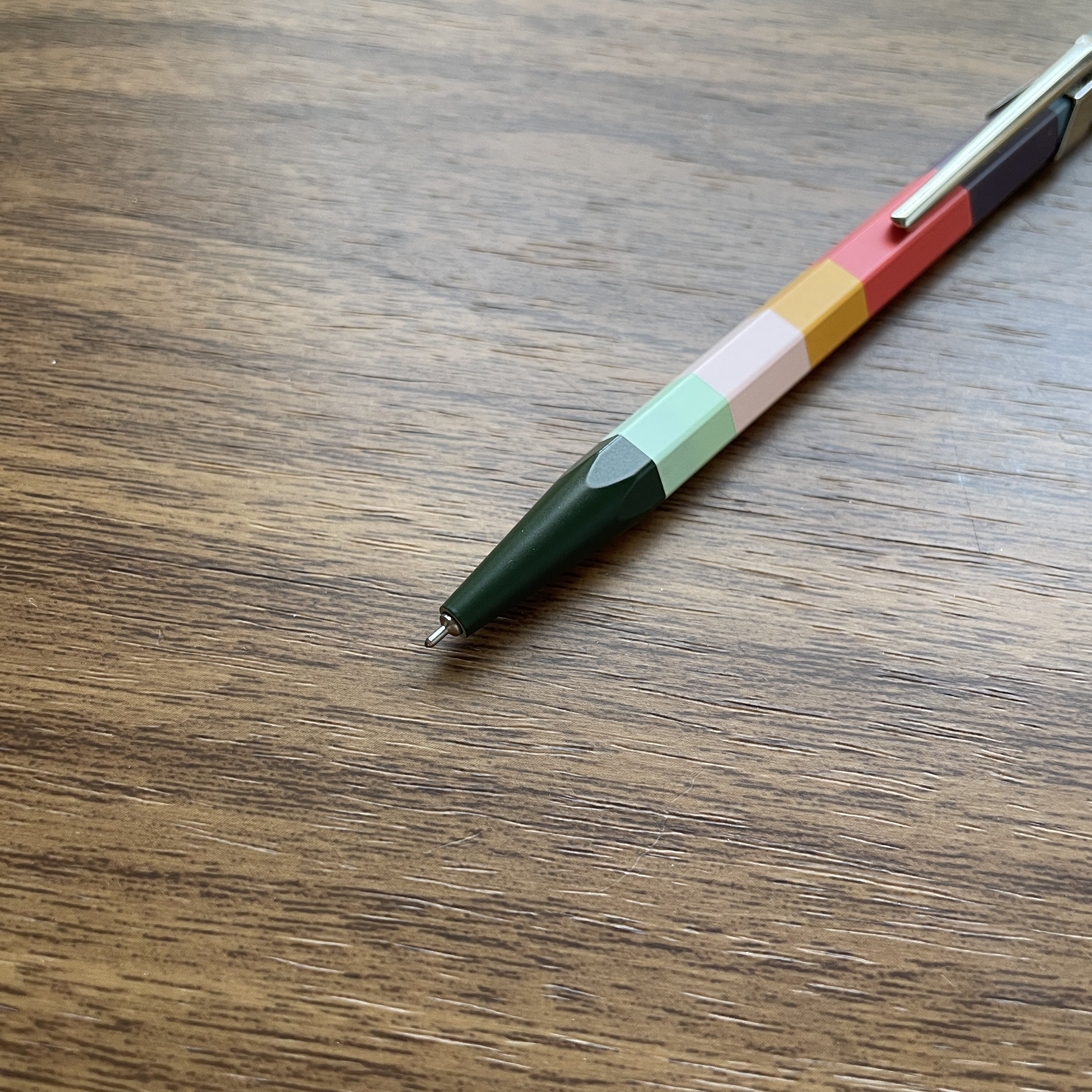
Parker-Style refills such as the Jetstream SXR (in the yellow pen) and the Schmidt P900 (pictured here) can be made to work with a simple trick.

Option 2: The Jetstream SXR (and Most Other Parker-Style Ballpoint Refills)

One of my favorite ballpoint refills of all-time is the Uniball Jetstream SXR - a Parker-style low viscosity ballpoint refill that serves as one of my go-to Parker-style refills when I’m looking for an ultra-fine tip ballpoint that dries quickly. While it took a bit of work to get this particular cartridge to work in the standard Caran d’Ache 849 ballpoint pen, here’s what I did:

  • Step One: Unscrew the knock at the back of the Caran d’Ache 849 and remove the Goliath refill.

  • Step Two: Insert the Jetstream SXR (or Schmidt P900 or Easyflow 9000 or other Parker-style ballpoint refill of your choice).

  • Step Three: Replace the knock and screw it all the way down until you reach the end of the threads. You will likely have one of two issues: (1) when you retract the refill, the tip still extends past the end of the barrel, since the refill is too long; and/or (2) when you try to depress the knock, the refill won’t “catch” and stay in writing mode. To fix both of these problems, I typically unscrew the knock one or two turns, which pulls the tip of the refill back into the barrel without affecting the stability of the knock or causing rattling. (You may have to experiment a bit, depending on the refill you’re working with.)

Note that the tip of this Jetstream SXR refill is slightly too long when the pen is retracted. You can fix this problem by unscrewing the knock one, maybe two, turns to reach your preferred length. I have not found that unscrewing the knock in this way affects the usability of the pen.

Option 3: Ohto “Flash Dry” .5mm Needle-Tip Gel Refill

The third option I plan to discuss requires the most work, though it’s still a pretty easy hack. The Ohto “Flash Dry” refill has garnered a well-deserved reputation as an excellent, relatively fast-drying needle-tip gel option that is compatible with Parker-style ballpoint pens. The problem? It’s too long to fit the standard 849 ballpoint without modification. While you might be able to adjust the refill length using the trick described above (unscrewing the knock), you can also modify the refill by shaving off a bit of the clear plastic tubing using a craft knife or sharp scissors. GO SLOWLY. You only need to shave off .5-1mm, but if you take off too much you can add back length by wrapping a small piece of washi tape around the end of the cartridge. (This one will likely take some experimentation).

The unmodified Ohto Flash-Dry refill (left)

To reduce the length of the refill, pull off the black plastic cap and cut a small sliver off the clear refill tubing. Replace the black plastic cap and the refill should work. If you find that you cut too much (i.e., the tip doesn’t extend all the way through the opening when the knock is depressed), simply wrap a small piece of washi tape around the end of the refill to add back length.

Note that if you don’t want to mess around with hacking the Ohto Flash Dry refill to fit in the Caran d’Ache 849 ballpoint, this refill fits the 849 Rollerball without modification, and also has it’s own Ohto Fast-Dry click-pen, which is inexpensive and which we stock in the shop.

Again, I have to emphasize that although The Gentleman Stationer is an authorized Caran d’Ache retailer, hacks like these are NOT authorized and we obviously can’t guarantee that any modifications will work in all pens, due to slight variations in refill size (and even the various editions of the 849). Proceed at your own (admittedly low) risk, and have fun making your pens work for you!

In Refills, Pens Tags Caran d'Ache 849, Caran d'Ache, Refill Guide, Refill, Refill Hack
11 Comments

Workhorse Pens: The Pilot Custom 823 Fountain Pen

April 29, 2023

The Pilot Vanishing Point might be the most popular, and the Custom Urushi and Custom 845 the media darlings that receive a lot of attention, but the pen that I would identify as the true “workhorse” of Pilot’s lineup, and which - if I were in charge - I would personally consider the flagship, is the Pilot Custom 823. Frankly, I’m somewhat embarrassed to have not given the Custom 823 the formal “Workhorse Pen” review treatment at this point in my career, so here we go!

A flashy pen it is not: The Pilot 823 in Amber (left) and Smoke (right). These two transparent demonstrators are different colors, but when inked it can be somewhat difficult to tell the difference.

The Custom 823 Follows The Workhorse Pen Blueprint

When designing the Custom 823, Pilot seems to have followed my “workhorse pen” blueprint to the letter: (1) an excellent nib; (2) a well-build, balanced pen body that can be used either posted or unposted; (3) an understated design that, while of course lets anyone know you are using a fountain pen, can’t be described as flashy; and (4) a reliable, high-capacity filling system. Over the years, Pilot has taken some flack for not “updating” the design on the Custom 823, and it remains available in the U.S. in exactly two colors: transparent “Smoke” and transparent “Amber,” both with gold trim. There have been no limited or special editions that I’m aware of other than one or two Japan-only exclusives, both of which sold out quickly and now command steep premiums on the secondary market.

Pilot Custom 823 Nibs

The Pilot Custom 823 features a 14k No. 15 nib, which is roughly the same size as a JoWo No. 6.

Why Do I Still Like This Pen So Much, Nearly 7 Years Later?

I first reviewed the Pilot Custom 823 nearly 7 years ago, in August of 2016, after purchasing the Amber pen at the Atlanta Pen Show that same year. While the design of this pen has grown on me over time, the real reason this pen is a regular in my rotation is the overall writing experience. Specifically, the combination of the nib and the weight/balance of this pen is nearly perfect for me, and while I haven’t yet tried the Custom 743 (the newly released cartridge-converter version of the 823), I have a hard time imagining that any pen will supplant the Custom 823 as a go-to recommendation for a high-ink-capacity everyday writer.

The Custom 823 posts deeply, allowing you to write with the cap posted without sacrificing balance.

  • Nib. As I discussed in my initial review, the Pilot Custom 823 features a larger No. 15 14kt yellow gold nib, with the prototypical Pilot engraving and feed. Between the multiple Custom 823s and Custom 74s that I’ve owned over the years, I can honestly say that I’ve never had a bad Pilot gold nib (outside of one finicky Vanishing Point that I bought secondhand…). I don’t like to throw the term “guarantee” around when you’re talking about pens, because so much about the writing experience is subjective, but with Pilot, you’re probably as close as you can get to a “guaranteed” out-of-the-box good writing experience from a major pen company. Quality control is top notch, and in the event there is an issue, they stand behind the product. Currently, I have two Custom 823s in my collection: a stock fine nib that is an excellent pen for annotation, and a medium that I had ground into a blade-style nib by Mark Bacas that might be my favorite.

  • Size and Balance. Each one of us has a “Goldilocks” size when it comes to writing instruments - neither too big nor too small - and for me the Pilot Custom 823 falls squarely into that role, along with the Lamy 2000 and the Montblanc 146. I may even have to give the Custom 823 the slight nod here because I do find the Lamy 2000 slightly too short to use unposted and for whatever reason the 146 less comfortable. Here, the Custom 823 posts deeply and securely, even with the blind cap slightly open to release the safety valve. (More on that below).

  • Filling System. What originally drew me to the Custom 823 years ago was the then-unique vacuum filling system, which has since become far more common and widely available at multiple price points. (See the TWSBI Vac700R and the Nahvalur (Narwhal) Original Plus.) Even if vacuum fillers can be more difficult to clean, I still appreciate the MASSIVE ink capacity, and tend to deal with any cleaning issues by picking a specific ink (or ink color) for each pen and sticking to it. Note that if you’re a serial ink changer, vacuum fillers may not be the best choice, because flushing and cleaning these pens too regularly over time can stress the gaskets and lead to leakage/sticking. (This is really hard to do, and I’ve had my pens for 3-7 years without incident, but I’ve heard isolated reports of it happening with people who overwork the filling system by changing inks frequently - i.e., every other day.)

For longer writing sessions with a vacuum-filler like the Pilot Custom 823, you’ll want to slightly open the blind cap to release the safety valve and allow ink to flow continuously.

Reflections on the Pilot Custom 823 as an Everyday Writer

You can go for a long time without refilling a Custom 823, especially with a fine nib, making it the perfect companion for long trips and extremely long writing sessions where you don’t want to worry about running out of ink. A key benefit of a vacuum filler fountain pen is the shut-off valve, which when closed seals the ink into the barrel of the pen to help prevent leakage. If you plan on writing more than a page or two, all you need to do is unscrew the blind cap to slightly open the valve and allow the ink to flow freely. What this does is offers you the ability to carry this fountain pen on an airplane, in a car, in your bag without having to be overly terrified of a serious ink spill. But at the end of the day, beyond these pragmatic considerations, the reason I love the Pilot Custom 823 so much is that it’s one of those pens that easily “disappears” while you’re writing. The nib isn’t finicky. It’s not distracting. You don’t have to refill it often. It just works.

Takeaways and Where to Buy

When I decided to make a fairly significant investment by bringing Pilot into my shop earlier this year, I could have chosen to start with less expensive lines, or trendier models available in “catch-’em all” colors. But given how I make my selections, the decision to start with the Custom 823 and the Custom 74 was really a no-brainer. While I might add more models in the future, these are the two that I’m comfortable recommending across the board and standing behind.

To be clear, the Pilot Custom 823 is not an impulse buy pen. At $336, it’s a long-term investment in an everyday writer and should be approached as such. However, this is a fountain pen that can last you a long time with proper care, as my own experience attests. We currently stock the Custom 823 in both colors and all nib sizes, and if you want something slightly smaller, with cartridge/converter capabilities and, yes, different color/trim options, consider the Custom 74. I expect that I’ll add the Custom 743 in the near future, but I’d like to get my hands on one first.

A “family portrait” of all the Pilot pens currently in my personal collection, from left: Pilot Custom 74 in “Blue Stone”; Pilot Custom 823 in Smoke; Pilot Custom 823 in Amber, Pilot Custom Urushi, Pilot Custom Heritage 912; Pilot Decimo in Harvest Gold; Pilot Vanishing Point in Blue Carbonesque.

Further Reading

The “Workhorse Pens” series is a collection of articles that I’ve written over the years, focusing on my preferred pens for everyday writing. As I’ve built out my own shop, this series has proven invaluable as a guide to expansion, and if you take a look at the back catalog you’ll be able to get an idea of where things are likely headed! You can read the rest of the articles here.

The Gentleman Stationer is supported entirely by purchases from the T.G.S. Curated Shop, and pledges via the T.G.S. Patreon Program. The T.G.S. Curated Shop is an authorized retailer of Pilot Pens.

In Workhorse Pens Series, Pens Tags Pilot Custom 823, Workhorse Pens
5 Comments

Bespoke Nibs vs. Stock Nibs: One Week With the Lamy Cursive Nib

April 26, 2023

I tend to buy things in multiples, especially those things that I use regularly. This goes for pens, notebooks, and even nibs. Over the years I’ve done a fair bit of experimentation with nib grinds, and the specific nibs that I’ve settled on as best for my particular style of handwriting are: (1) a .4mm cursive italic with soft edges; and (2) a kodachi-style nib. Lately, nearly all of the nibs that I’ve had ground fall into the second category.

For purposes of this review, I’m going to use the terms “Kodachi-style” or “Naginata-style” because there are so many different variations on this grind, from different companies and nib grinders, that there’s a fair bit of disagreement as to what constitutes a “true” Kodachi or a “true” Naginata nib. Personally, the version that works best for me is the “Perspective” nib grind by Gena Salorino at Custom Nib Studio, which I reviewed last year. I enjoy this nib because it gives your handwriting two different types of line variation: a wider cross stroke similar to an architect nib (without the sharp edges of an architect), and the ability to vary vertical line width by angling the nib up or down. I now have three different Perspective nibs, and while each of them writes slightly differently due to things like nib design, the feed, etc., they’re all excellent.

Lamy Cursive Calligraphy Perspective Comparison

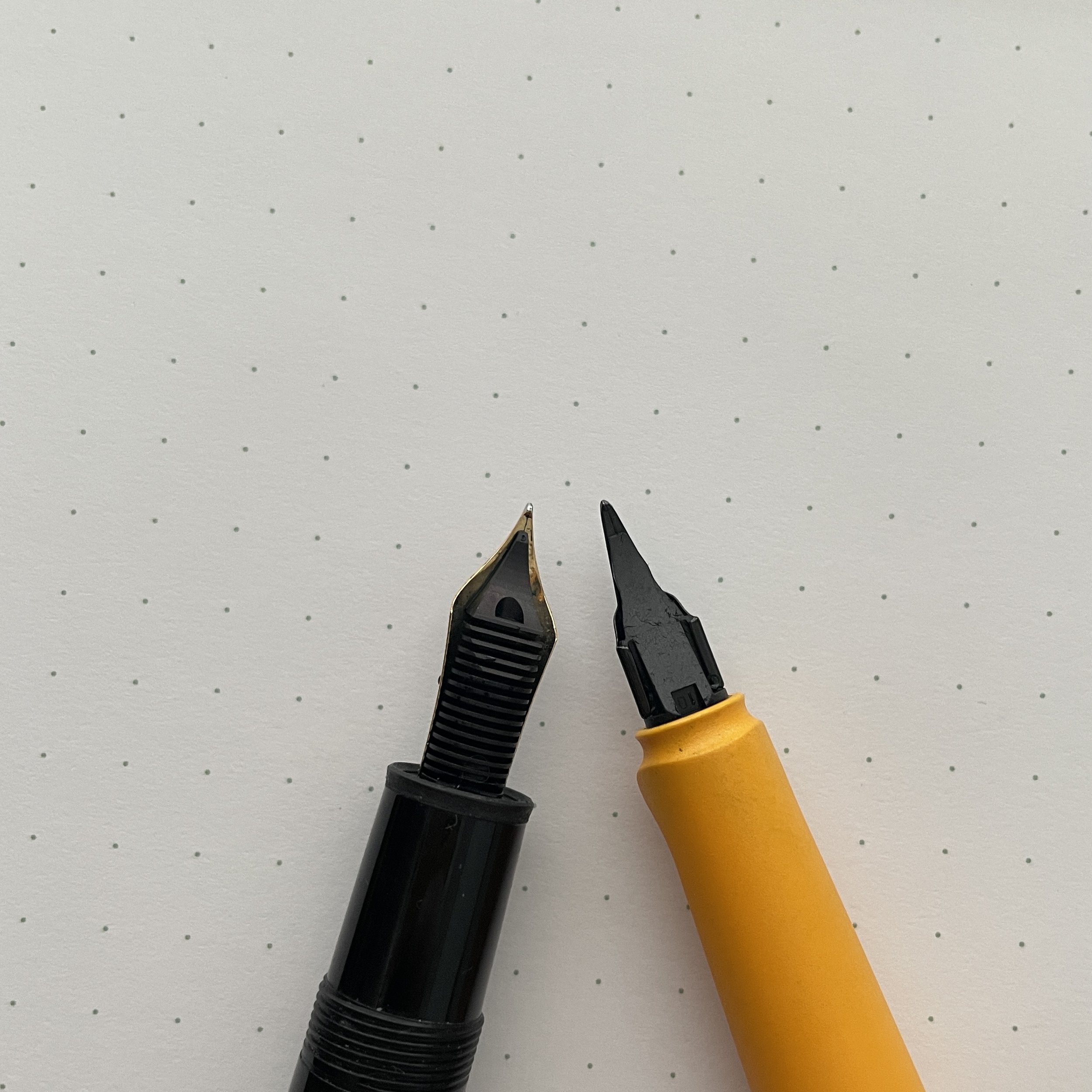
You can see the similarities between the Perspective Nib (left) and the Lamy Cursive Nib (right). Both have a wedge shape, though the Perspective is slightly more defined (and also a narrower nib to begin with). I would best describe the width of the Lamy Cursive as a standard western fine.

Because this nib grind works so well for my handwriting and the type of writing that I do, which involves a lot of moving between longhand notetaking and annotation, I was immediately intrigued when I heard that Lamy had released their “Cursive” nib. While Lamy doesn’t describe this particular nib as a Kodachi, in reality that’s how it’s being marketed, as suitable for Chinese, Japanese, or other “cursive scripts” where the ability to alter line width using a brush-like stroke can be considered important. I tried one of these nibs at our local pen club and loved it, but put off picking up a couple for my own pens until my initial shipment of Lamy products arrived for the shop.

The line variation is more subtle than with an architect, but it’s there.

I now have the Lamy Cursive nib installed in two different pens - a Safari and a Studio - and I have to say that I’m enjoying it a lot. It’s an excellent pre-ground specialty nib that I would personally describe as a hybrid between an architect and a Kodachi-style nib that leans more to the latter. While you don’t have the sharp edges of the architect grind, you also don’t get quite as much line variation by angling the pen as you would with a true Kodachi. That said, I would consider the Lamy Cursive nib to be an excellent introduction to both styles. For $23, you can get a sense of whether this type of nib would work for your personal style of handwriting without permanently modifying a more expensive pen or nib in your collection. If you decide you’d like sharper edges with a thinner vertical line and more definition on the cross-stroke, then you may want to try a true architect. If you find you enjoy the ability to vary the line width by adjusting your writing angle, then perhaps you try a Kodachi or a Perspective. And you may even find that the Lamy Cursive nib suits you just fine, and you can move it between your various Lamy pens!

Writing samples from four different pens. There is some slight variation even between my two Lamy Cursive nibs, with the top one showing slightly less line variation than the bottom (though this could also be due to the Yama-Budo being a wetter ink.)

Takeaways and Where to Buy

I’m glad to see Lamy offering additional options for their swappable nibs, and honestly was surprised that they went this route with such a specialized grind. We’re now able to offer the Cursive nibs directly in the T.G.S. Curated Shop, and have them available for purchase at $23. If you’re interested in learning how to swap them, check out this short YouTube demonstration I did last week. I’m also happy to install one of these nibs for you, and will do so with the purchase of any Cursive Nib + any Lamy Safari or AL-Star fountain pen if you message me after placing your order. Just use the “Contact” link on the navigation bar.

The Gentleman Stationer is supported entirely by purchases from the T.G.S. Curated Shop and pledges via the T.G.S. Patreon Program. This post does not contain paid advertising or third-party affiliate links.

In Pens Tags Lamy Nibs, Lamy Cursive Nib, Lamy, Fountain Pens, Custom Nibs
1 Comment
← Newer Posts Older Posts →
Store Hours and Location
Visit the T.G.S. Curated SHOP
Updated "Best Pens" Guide
On the Paper Trail Podcast
TGS_25 Roterfaden New Stock Available
Hierarchies of Fountain Pen Friendly Paper

Join Our Patreon!
Subscribe to the TGS E-mail List

Featured Posts

Featured
Pentel-Sign-Pen-Cover.JPG
Feb 28, 2026
Pen Review: The Pentel Sign Pen (Craft Design Technology Version)
Feb 28, 2026
Feb 28, 2026
Cover On the Paper Trail Intro Clip.jpeg
Dec 3, 2025
Introducing "On the Paper Trail," a New Podcast/Video Collaboration with Lisa Vanness of Vanness Pens!
Dec 3, 2025
Dec 3, 2025
Iro-Utsushi-Fine-Dip-Pens.jpeg
Oct 1, 2025
The Pilot Iro-Utsushi Dip Pen (and in General, Simple vs. Fancy Dip Pens)
Oct 1, 2025
Oct 1, 2025
The Gentleman Stationer RSS

© Digital Divide Media, LLC, 2014-present.

All content is the exclusive property of Digital Divide Media, LLC, d/b/a The Gentleman Stationer, including “The Gentleman Stationer” website and trademark, and should not be reproduced without express written permission.  All rights reserved.

All content containing paid advertising, affiliate links, or sponsored content will be plainly disclosed by a disclaimer when/if featured.

Contact Information

Store Shipping Policy and Return Policy

Privacy Policy

Cookie Policy

Terms and Conditions

Powered by Squarespace