• Blog
  • Shop
  • Podcast
  • Resources
  • About
  • Archive
  • Contact
  • Cart
  • Sign In My Account
Menu

The Gentleman Stationer

Vintage Living in the Modern World.
  • Blog
  • Shop
  • Podcast
  • Resources
  • About
  • Archive
  • Contact
  • Cart
  • Sign In My Account

PENXO: "Impressive."

October 10, 2015

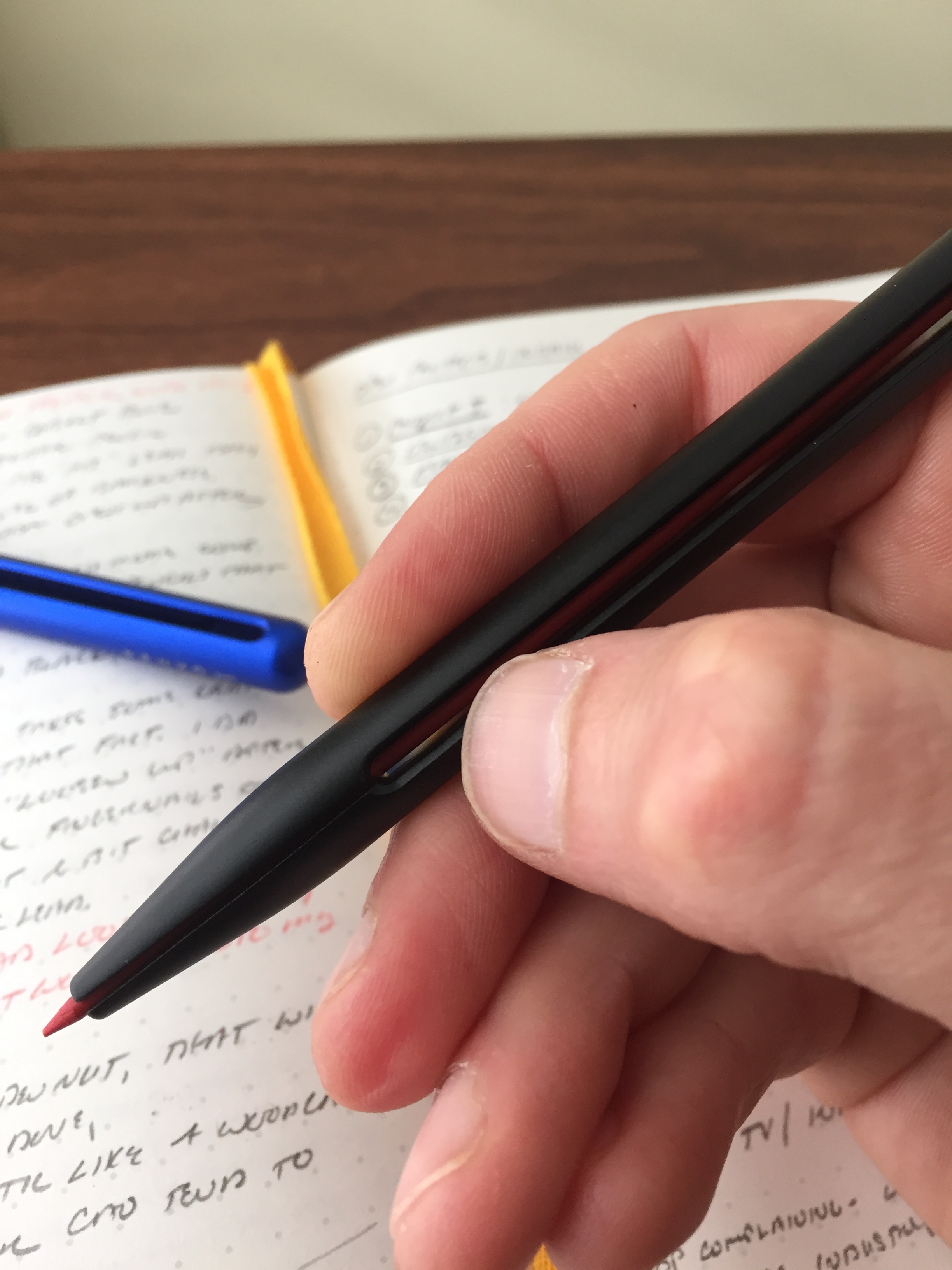
So yesterday, this rolled in.  I'm not sure what the final verdict will be, but my initial impressions of the PENXO, billed as "the most minimalistic leadholder pencil," are positive.  I've never used a leadholder or clutch pencil before, and its interesting.  The one thing I really like is that the PENXO, for me, is the same length as a woodcase pencil that has been used and sharpened down to that "perfect length" for my hand.  While leadholders typically are used for drawing/drafting, the PENXO works well for daily writing (though I am still trying to figure out what I'm going to do with Darth Vader's lightsaber.  For those of you who missed out, PENXO is taking preorders on its website. 

For my Kickstarter reward, I chose the Cobalt Blue and "Darth Black" versions.   

My Kickstarter add-ons:  24 HB Leads, 12 Read Leads, and 12 Blue Leads; two sharpeners; and an eraser. The packaging in the background is a Retro 51-esque tube.  

One comment I do have is that the "clutch" lead-release mechanism takes some getting used to. Machined from aircraft-grade aluminum, the fit is pretty tight, and my thumb is a bit sore from opening the pencil and figuring out how to adjust the lead for sharpening.  My sense is that things will loosen up a touch as I use the PENXO more, or I figure out the perfect spot to apply pressure.  The embedded video below was released by PENXO, and shows how things work.  I will probably update this as I use the pencil more, but I wanted to get my initial thoughts out there.  If you're a PENXO backer, and have received your reward, what are your impressions?   

View fullsize IMG_0773.JPG
View fullsize IMG_0776.JPG
View fullsize IMG_0777.JPG
View fullsize IMG_0778.JPG
View fullsize IMG_0779.JPG

DISCLAIMER:  I purchased the product featured in this post with my own funds, for my own collection.  I was not compensated in any way for this review. 

In Pencil Review Tags Leadholder, Pencil, PENXO, Kickstarter
5 Comments

The Lamy 2000 Fountain Pen and Ballpoint side-by-side.

Lamy 2000 Ballpoint: My Go-To EDC Option

October 3, 2015

Back at the Atlanta Pen Show, I purchased a ... gasp ... ballpoint pen.  First things first, I'm not one of those pen snobs who never uses ballpoints.  They have their place, but my primary beef with ballpoints is that I have small handwriting, and most ballpoints come in 1.0mm widths or broader. Plus the ink in the cheaper models tends to blob.  That aside, a good ballpoint pen is one of the more useful tools that you can have with you at any given time.  They write on more or less any surface, the ink tends to dry quickly and be permanent, and they don't dry out immediately if you leave the cap off the pen.  

Other than my Tactile Turn Mover with a Uniball Jetstream refill, the Lamy 2000 is the only ballpoint pen that I use on a regular basis.  (The Jetstream I really don't even consider to be a true ballpoint pen--it has more in common with a gel pen, and the .38mm refill is a personal fave.) The Lamy looks great, has perfect proportions for shirt pocket or pants pocket carry, and is reliably built.  The ballpoint features the same Macrolon (polycarbonate) material as the fountain pen, and the two look particularly sharp when carried together.  My favorite feature of my ballpoint, however, is this: 

You read that right:  West Germany.  I have no idea how old this pen is, but at a minimum I would think it predates German reunification in 1990 (or was manufactured shortly thereafter, before Lamy had a chance to change their mark).  A cool piece of history and one of many reasons why you should attend pen shows! 

As others have pointed out, the one weakness of the Lamy ballpoint is the refill (or at lease the older Lamy refills that are still out there on the market).  I picked up the blue "Fine", which writes an adequately narrow line, but the refill itself tends to fall on the light side for me.  I suspect that the refill I purchased at the pen show is simply old, because others who have recently purchased a Lamy ballpoint refill have been pleasantly surprised.

A touch light for me, but it works better on smoother paper, such as the Nock Co. Dot-Dash. The line also tends to get lighter and skip more if I write with this pen for extended periods.

2023 Update: Over the years, I became frustrated that not many retailers were carrying the Lamy 2000 ballpoints and focusing on the non-fountain pen portion of Lamy’s excellent lineup, so I became a retailer! You can now purchase the Lamy 2000 line of pens, including the ballpoint, directly from T.G.S. in the Curated Shop.

While I'm at it, I also have to brag a bit about this, which I just received in the mail from Renee at Scriptorium Pens.  I'm inking it up today and can't wait to use it and get my thoughts up on the blog!    

A photo posted by Joe C. (@gentlemanstationer) on Oct 3, 2015 at 5:17am PDT

DISCLAIMER:  I purchased the pens featured i this review with my own funds, for my own collection.  This post also contains affiliate links.      

In Pens Tags Pen Review, Lamy 2000, Ballpoint
5 Comments

What really makes this pencil so great: The red end cap.

Pencil Revisited: The Caran d'Ache Swiss Wood

September 30, 2015

Update to Review as of August 10, 2020. See bolded text throughout for details.

I've intended to write a more in-depth review of the Caran d'Ache Swiss Wood pencil for a while now.  It's recently exploded in popularity, so much that they're difficult to get a hold of, and many retailers have raised the price. [UPDATE: Not anymore! As of 2020, Caran d’Ache sells multiple versions of the Swiss Wood, which I now stock in the T.G.S. Curated Shop.] What makes this pencil so great?  So great, in fact, that it really has been the only pencil that I've used regularly for the past few months? 

What I like: 

The weight.  This is a hefty piece of wood.  The marketing copy describes it as dark brown Swiss Beech wood from the Jura forest, but I wonder whether the wood has been dyed that dark brown color.  Other products made from beech wood don't have that extremely dark-chocolatey hue, and the soy-sauce/chocolate/earthy smell doesn't exactly smell like wood.  But anyway, this pencil is solid, and has near-perfect balance, even without an eraser. 

The end cap.  Speaking of no eraser, the end cap on this pencil is painted red with the white Swiss Cross.  Enough said. 

Point Retention.  Point retention on this pencil is exceptional.  If I had to point to one particular selling point, this would be it.  People may ask, "why on early would you spend upwards of $5 on a single pencil," but the Swiss Wood seemingly writes forever.  Caran d'Ache has marked the core as an HB, but to me it's a shade lighter and harder (probably more like an "H").  For textured paper (like that found in the Baron Fig notebooks), it's perfect, because it leaves a legible line without forcing you to sharpen your pencil every two pages.  Yesterday I wrote three single-spaced pages in a dot-grid Baron Fig Confidant and still had a nearly intact long point on the pencil.  The lighter graphite also doesn't ghost or smear.

The point on a Swiss Wood Pencil lasts forever. You can also see the size difference between the Swiss Wood (on the right), and the Black Wood (on the left). For it's size and hardness, the Black Wood doesn't do a bad job with point retention, either.

What I don't like. 

"Don't like" is a bit strong for what has become one of my favorite pencils.  The lack of general availability can make this pencil hard to use at times, though I'm trying to master my fear of not using my favorite products just because the manufacturer might discontinue them.  I have four or five of these pencils, which should last me a good long while.  A few more "cons" (though they're pretty nitpicky):  

Darkness.  Compared to a pencil like the Caran d'Ache Black Wood, the graphite in the Swiss Wood can be too light for some everyday uses.  When marking up or annotating documents at work, the Swiss Wood can be borderline illegible for some people.  I typically use a pen (with red ink) to mark stuff up, so this isn't a huge deal for me.  At the end of the day, every pencil has tradeoffs in this regard:  you sacrifice darkness for point retention, and sacrifice point retention for darkness.  The point retention on this pencil is so good, and it works so well in my Baron Fig (my preferred pencil paper), that I'm willing to give up some darkness, even though I generally favor 2B pencils.

[Update: As of 2020, Caran d’Ache apparently has changed the graphite in the Swiss Wood to make it write darker, akin to the Black Wood, which has now been discontinued.]   

Compare the darkness of the Swiss Wood vs. the Black Wood pencil, which is a "mini-jumbo" pencil with a softer, darker core. The paper is laid cream-colored paper from Papier Plus in Paris.

Price.  I feel like I have to mention price again.  This is an expensive pencil.  One of the most expensive that I own.  If the "burn rate" on this pencil was higher, and it didn't last as long as it does, it wouldn't be worth the price to me.                 

In Pencil Review Tags Caran d'Ache, Pencils
3 Comments

Franklin-Christoph prominently displayed their new line of inks at the 2015 D.C. Pen Show. 

New Franklin-Christoph Inks: Round One

September 26, 2015

Last month at the Washington, D.C. Pen Show, Lori at Franklin-Christoph kindly provided me with a handful of samples of Franklin-Christoph's new line of inks.  Franklin-Christoph has carried its own brand of inks for a while now--readers who have been with me since the beginning may recall that I reviewed colors such as Syrah Syrah (a dark, wine-colored red) and Olde Emerald (what I'd characterize as a "money-colored" green).  Both were decent inks, but after long-term use had some traits that kept them from making it into my regular rotation, namely their tendencies to dry up in the nib after about a week or so of use and leave residual "gunk" (scientific term there) on the nib and feed.  I can happily announce that, from what I've seen so far, Franklin-Christoph fixed those issues.  

My D.C. Pen Show haul, which I'm slowly working my way through. 

Lori set me up with some healthy samples of the following inks:  Loden, Black Cherry, Dark Chocolate, Midnight Emerald, Noir et Bleu, and Tenebris Purpuratum. (They must have a multilinguist in house:  respectively, Dark Green, Red Black, Dark Brown, Dark Teal Green, Blue-Black, and "Purple Shadow" (my Latin's rusty).) So far, I've had the opportunity to use the Dark Chocolate (used for the writing sample in my TWSBI 580 review), Loden, and the Black Cherry.  The first two are great inks that I've enjoyed a lot. The third, the Dark Cherry, is a good ink but just doesn't do anything for me personally. I'd reach for other dark reds/burgundies before this one. Once I finally drain all of the pens I inked up to take to D.C., I'll load the rest of these samples for review.    

View fullsize IMG_0459.jpg
View fullsize IMG_0460.jpg
View fullsize TWSBI Writing Sample.jpg

I've had no issues with any of these inks. The colors that I've tested are fairly earthy and muted, but behave well on all sorts of paper. I've witnessed no clogging, gunking-of-nibs, or staining-of-pens, and these inks have been loaded and writing for well over a month now. If I had one criticism, it would be that the inks (or at least the three that I've tested extensively) tend to write a bit on the dry side, but I personally don't consider that a bad thing as long as the ink doesn't skip or hard-start, which these do not.  These inks wouldn't be my first choice for writing on super slick paper like Clairefontaine, however, given their slight dryness.    

Paul over at Gorgeous.Ink has posted an excellent overview of the new Franklin-Christoph line, as well as some in-depth reviews of specific inks (including ones I don't have samples of).  His site in general is well worth a read.    

DISCLAIMER:  I was provided the ink samples used in this review free of charge, for review purposes.  All of the inks reviewed here are available for purchase directly from Franklin-Christoph on their website for $12.50.  This is not an affiliate link, and I have not otherwise been compensated for this review. 

In Ink Reviews Tags Franklin-Christoph, Ink Review
Comment
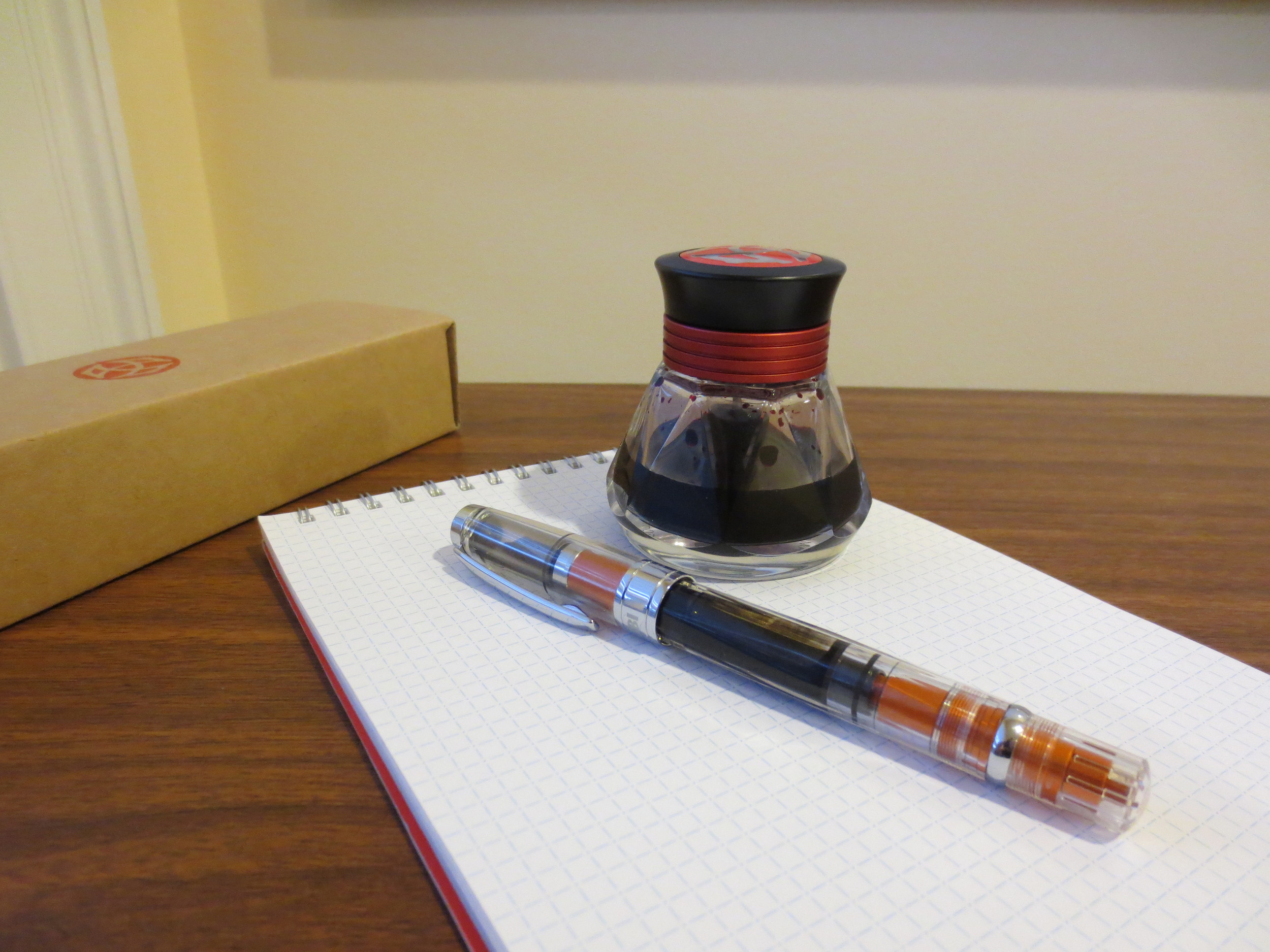
The TWSBI 580AL in orange with its proprietary ink bottle. 

The TWSBI 580AL in orange with its proprietary ink bottle. 

Pen Review: The TWSBI 580

September 23, 2015

As a brand, the TWSBI 580 and its predecessors, the 540 and the 530, personify the modern resurgence of fountain pens.  The pens themselves appear relatively simple; however, they are anything but, and to me, it’s nothing short of amazing that TWSBI can develop a product this good and sell it at this reasonable of a price point. For this reason, TWSBI pens are prominently featured on my list of Top 5 Fountain Pens under $75 as the first piston-filling pen that I recommend to new enthusiasts.   

My TWSBI in its apple-esque white plastic packaging.  I save my TWSBI boxes for pen storage. 

TWSBI pens are manufactured by a subsidiary of Ta Shin Precision, a Taiwanese company with operations in both the United States and China.  Per the TWSBI website, after years of manufacturing products--including fine writing instruments--on a contract basis, the company decided to create its own line of fountain pens.  The design of the TWSBI 530—the first TWSBI pen was heavily influenced by consultation with members of the pen community via the Fountain Pen Network:  the first “crowdsourced” fountain pen, you could say. 

TWSBI's "iconic" logo. 

From my perspective, TWSBI has accomplished its goal of creating an affordable piston-filling fountain pen with a large ink capacity and classic looks.  Additionally, I would go so far as to say that the reasonable price, the relatively widespread availability of the pens, and the fact that the nibs are interchangeable make them the spiritual successor to Esterbrook, though, as I’ll discuss further below, an argument can be made that TWSBIs won’t weather the test of time as well as Esties have.

Looks

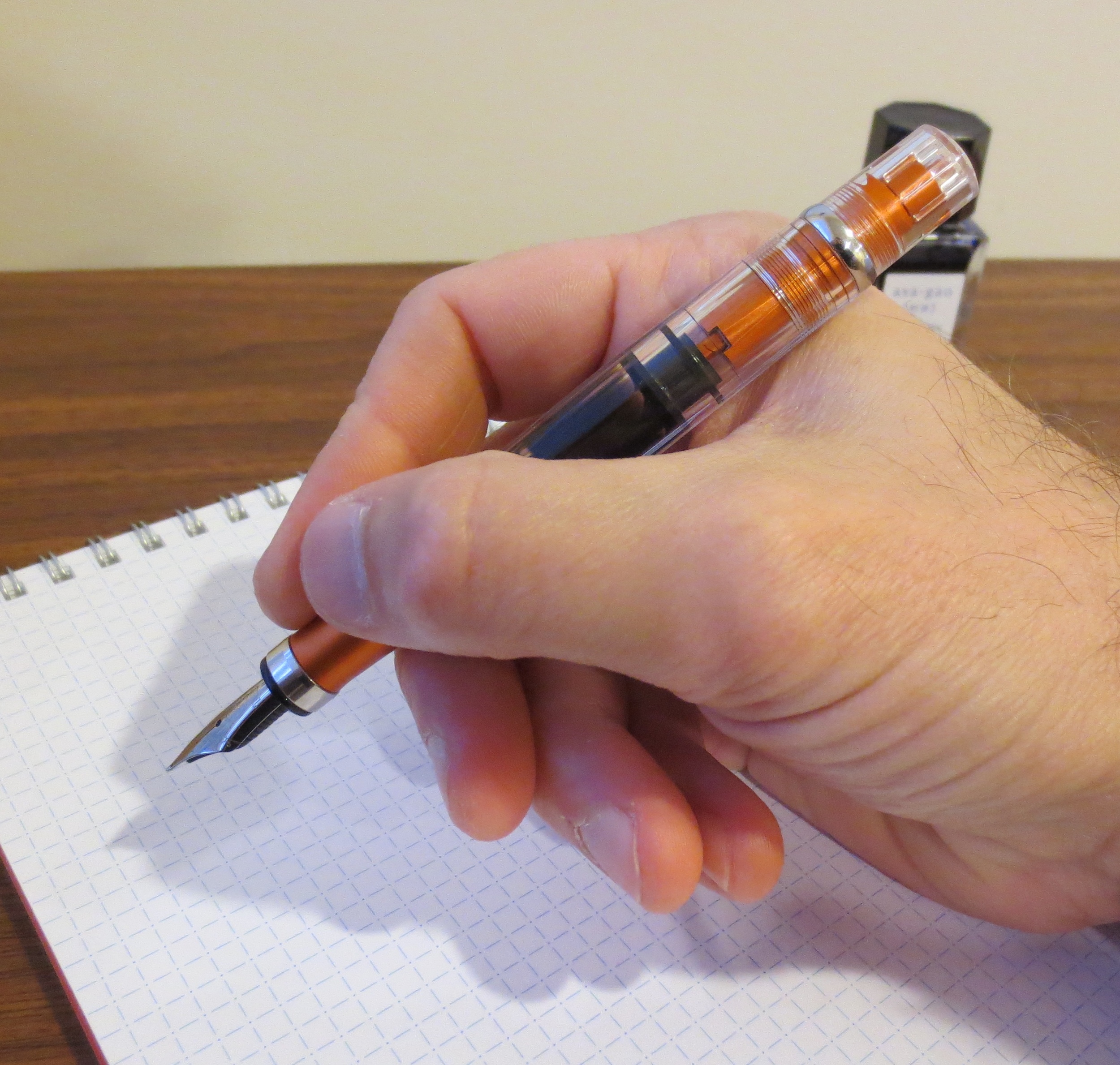
For this review, I’ve used a TWSBI Diamond 580AL in orange, currently the only TWSBI in my collection.  At one time or another, I have owned a Vac 700, a Mini, and a couple colored 540s, but the 580 with the orange aluminum trim (now discontinued) is the pen that has stuck with me. Orange aside, the 580 sports a classic look.  It’s a fairly large fountain pen that fits comfortably in the hand without posting.  Many users have knocked TWSBI for designing pens with caps that don’t post (guilty!), but TWSBI’s recent designs (the Classic and the Eco) have offered an option for posting the cap, and in all honesty, the 580’s size would makes it uncomfortable to use posted.     

The TWSBI 580 is pretty big.  While I like to post caps, the 580 is so long and relatively heavy that posting the cap would likely make it unbalanced/unwieldy. 

The TWSBI 580 is pretty big.  While I like to post caps, the 580 is so long and relatively heavy that posting the cap would likely make it unbalanced/unwieldy. 

A comparison of the TWSBI 580 agains some similarly sized pens in my collection:  from bottom, the Delta Fusion 82, the TWSBI 580 AL, the Montblanc 146, and the Edison Herald. 

Build

TWSBI loses a few points in any discussion of build and manufacturing, simply because rumors of poor quality control have dogged the company from the beginning.  Like any reports that come via the internet, they started as valid criticism but, at least in my opinion, have “gone viral” to some degree, resulting in exaggerated claims of poor quality.  To its credit, TWSBI has responded well, and I haven’t heard of an example where TWSBI has failed to replace broken pen parts (or the entire pen) where a customer has reported a defect.    

The plastic used to manufacture the 530, 540, and the Mini is prone to cracking, particularly at the section, though caps have cracked as well.  TWSBI apparently has addressed the issue with the 580 to a degree—reports of cracking aren’t nearly as widespread.  With the Eco, however, TWSBI adopted a new round barrel (as opposed to the faceted barrel of the Diamond series), which may indicate that the early manufacturing issues had more to do with the faceted design of the "Diamond" pens than the materials used to make them.  Personally, I think a round barrel 580-style pen would be interesting, though the faceted “Diamond” motif has become something of a TWSBI hallmark.  The 580AL that I'm reviewing here has a section and certain other parts made of aluminum as opposed to plastic, presumably making that model more durable.   

For all the talk of cracking, however, and for all the TWSBI pens I have owned (and used heavily), I’ve only had the plastic crack on me once.  My TWSBI mini developed one small hairline in the section threads (probably caused by me over tightening the cap), which didn’t cause me any functional issues.  So from personal experience (with Minis, 540s, and 580s), TWSBI’s quality has been good.  You also can't lose perspective on what TWSBI has been trying to do:  manufacture a reasonably priced, accessible piston-filling fountain pen.  This is no easy task, and at the $55 price point you have to expect some sacrifices in the quality department.  Is this a tank-like Pelikan M800?  No, but it also doesn't cost $400.      

Pricing

TWSBI’s current pricing structure ranges from $30 to $75.  The ECO is TWSBI’s new entry-level model. Next up is the standard model Diamond 580, the Mini, the TWSBI Classic, the 580AL (featured in this review); and the Vac 700 (a vacuum filling pen).  TWSBI’s now-discontinued Micarta pen was priced at $100, making it the most expensive pen TWSBI offered.

Note:  the 580AL in orange is no longer offered.  The 580AL is, however, available in standard aluminum.  I wonder what color they will issue next?  The long-rumored "Vac Mini" should also arrive this year. Note: As of April 2021, you can purchase select TWSBI Products, including the TWSBI 580, directly from the T.G.S. Curated Shop.   

Nibs

TWSBI nibs are generally of high quality, especially since they switched to custom JoWo nibs a few years back.  Apart from a Vac 700 I owned a few years back, none of my pens have required adjustment to the nibs, though I have had some custom-ground to cursive italic and architect's points.  Actually, one of my favorite things about TWSBI pens is the ability to swap nibs.  You can save a lot of money by purchasing one TWSBI pen with some spare nib units and having those nib units customized--depending on how many spare nibs you carry, it's like four pens in one! 

Note that the 580 nibs are interchangeable among all models in the 580 series, and sold separately as spare screw-in “nib units.”  You can purchase additional Mini nib units and Vac nib units for those pens as well, though they aren’t interchangeable with other models.  While I’ve never done this, I understand that you can swap the nibs on the Classic and the Eco by pulling the friction-fit nib—there’s no “nib unit” that’s sold separately and easily switches out.  (Rumor has it you can also "hack" the entire TWSBI line to make them accept all sorts of nibs.  Proceed at your own risk here!) 

A writing sample using my TWSBI 580AL with a Masuyama-ground Architect's Nib (Medium). The brown ink I'm using for this review is Franklin-Christoph's Dark Chocolate (thanks to Lori at FC for the sample!), which I'm really enjoying. 

Accessories
      
In addition to spare nibs, TWSBI also makes products such as ink bottles and notebooks, both of which I own, but which are beyond the scope of this review because I haven’t used them that much.  I will add, however, that the ink bottle has a proprietary nozzle that lets you fill the 580 completely (though you can remove the lid to fill other pens by dipping as you typically would). The notebooks contain fountain-pen friendly paper (probably sugarcane), which appears similar to the paper used in Franklin-Christoph notebooks.  

DISCLAIMER:  I purchased the items featured in this review with my own funds (except for the FC ink sample).   


In Pens Tags Pen Review, TWSBI, TWSBI 580, TWSBI Ink Bottle
Comment
← Newer Posts Older Posts →
Store Hours and Location
Visit the T.G.S. Curated SHOP
Updated "Best Pens" Guide
On the Paper Trail Podcast
TGS_25 Roterfaden New Stock Available
Hierarchies of Fountain Pen Friendly Paper

Join Our Patreon!
Subscribe to the TGS E-mail List

Featured Posts

Featured
Pilot-Custom-Series-Pens-overview.jpg
Mar 14, 2026
The Pilot "Custom" Series: An Overview of Some of My Favorite Fountain Pens
Mar 14, 2026
Mar 14, 2026
Pentel-Sign-Pen-Cover.JPG
Feb 28, 2026
Pen Review: The Pentel Sign Pen (Craft Design Technology Version)
Feb 28, 2026
Feb 28, 2026
Cover On the Paper Trail Intro Clip.jpeg
Dec 3, 2025
Introducing "On the Paper Trail," a New Podcast/Video Collaboration with Lisa Vanness of Vanness Pens!
Dec 3, 2025
Dec 3, 2025
The Gentleman Stationer RSS

View Cart

© Digital Divide Media, LLC, 2014-present.

All content is the exclusive property of Digital Divide Media, LLC, d/b/a The Gentleman Stationer, including “The Gentleman Stationer” website and trademark, and should not be reproduced without express written permission.  All rights reserved.

All content containing paid advertising, affiliate links, or sponsored content will be plainly disclosed by a disclaimer when/if featured.

Contact Information

Store Shipping Policy and Return Policy

Privacy Policy

Cookie Policy

Terms and Conditions

Powered by Squarespace