• Blog
  • Shop
  • Resources
  • FAQ (Ask TGS)
  • About
  • Archive
  • Contact
  • Sign In My Account
Menu

The Gentleman Stationer

Vintage Living in the Modern World.
  • Blog
  • Shop
  • Resources
  • FAQ (Ask TGS)
  • About
  • Archive
  • Contact
  • Sign In My Account

It's pen cleaning time this weekend! Conid's Bulkfiller Minimalistica has been a pleasant surprise for me, in terms of how easy it is to clean. 

Cleaning Pens: Meditative, or Just Annoying?

February 20, 2016

Which camp do you fall into?  Of course, this refers to fountain pens.  If you have to clean ink out of your rollerball, ballpoint, or gel pen, it's probably because something very, very bad happened. But pen maintenance is an essential part of fountain pen ownership.  You have to do it, and to the extent you can, you should learn to love it.  Do I?  Sort of. 

Pen cleaning is one of those things people do either (1) all the time, such as, after they finish every fill of ink; (2) semi-regularly, such as whenever they change colors or every 1-2 months; or (3) whenever the pen clogs up and stops writing.  I'm squarely in the second category.  I don't find cleaning pens to be torture, per se (unless it's one of the rare occasions I've been using some sort of Noodler's permanent ink), but it's not something I necessarily look forward to.  

I'll walk through the various categories of pens that I clean on a regular basis, from what I consider to be the least difficult to the extremely aggravating, and provide my perspective on which of the various filling systems are easiest to maintain.  While the basic principle is the same for all--flush the pen with water--each system has its own peculiarities and quirks that need to be taken into account.

Syringe Fillers.  Say what you will about Conid's Bulkfiller system being hard to get the hang of. Once you do, these pens are a snap to clean.  It's like using a built-in bulb syringe (see below).  Because the pen has such a large ink capacity, it's capable of pushing a large amount of water through the nib, reducing the number of times you have to flush it.  If the pen's clogged, or if you've used an ink that's extremely difficult to clean out, you may have to disassemble the pen, but most syringe fillers have a small number of moving parts, and Conid even provides you with tools and instructions.  

Cartridge/Converter.  I have a growing appreciation for cartridge/converter pens because of how simple it is to clean and maintain them.  While you technically don't need any special equipment, and can just use the converter to flush water through the feed and section several times, a bulb syringe and an ultrasonic cleaner allow you to thoroughly clean your pen quickly. For me, one of the best features of the cartridge/converter system is that you don't actually have to worry about cleaning the entire pen.  Typically, the only part of the pen that touches any ink is the nib section and the converter (though I would recommend occasionally cleaning out the interior of the cap).

Eyedropper.  Some people are going to be puzzled at this one.  How, they might ask, is an eyedropper filling system--where the entire barrel holds ink--more convenient than the piston filler?  Because there are no moving parts, and all you have to do is drop the entire pen into the ultrasonic cleaner.  (In the "after" photo below, there is still some blue-black residue in the barrel, which I will clean out with a q-tip if I decide to change colors.)  While disassembling a pen takes time, you don't have to do it that often! Eyedroppers hold a ton of ink, and if you use a low-maintenance ink and don't feel compelled to change colors, well, you can go a long time without cleaning that pen!   
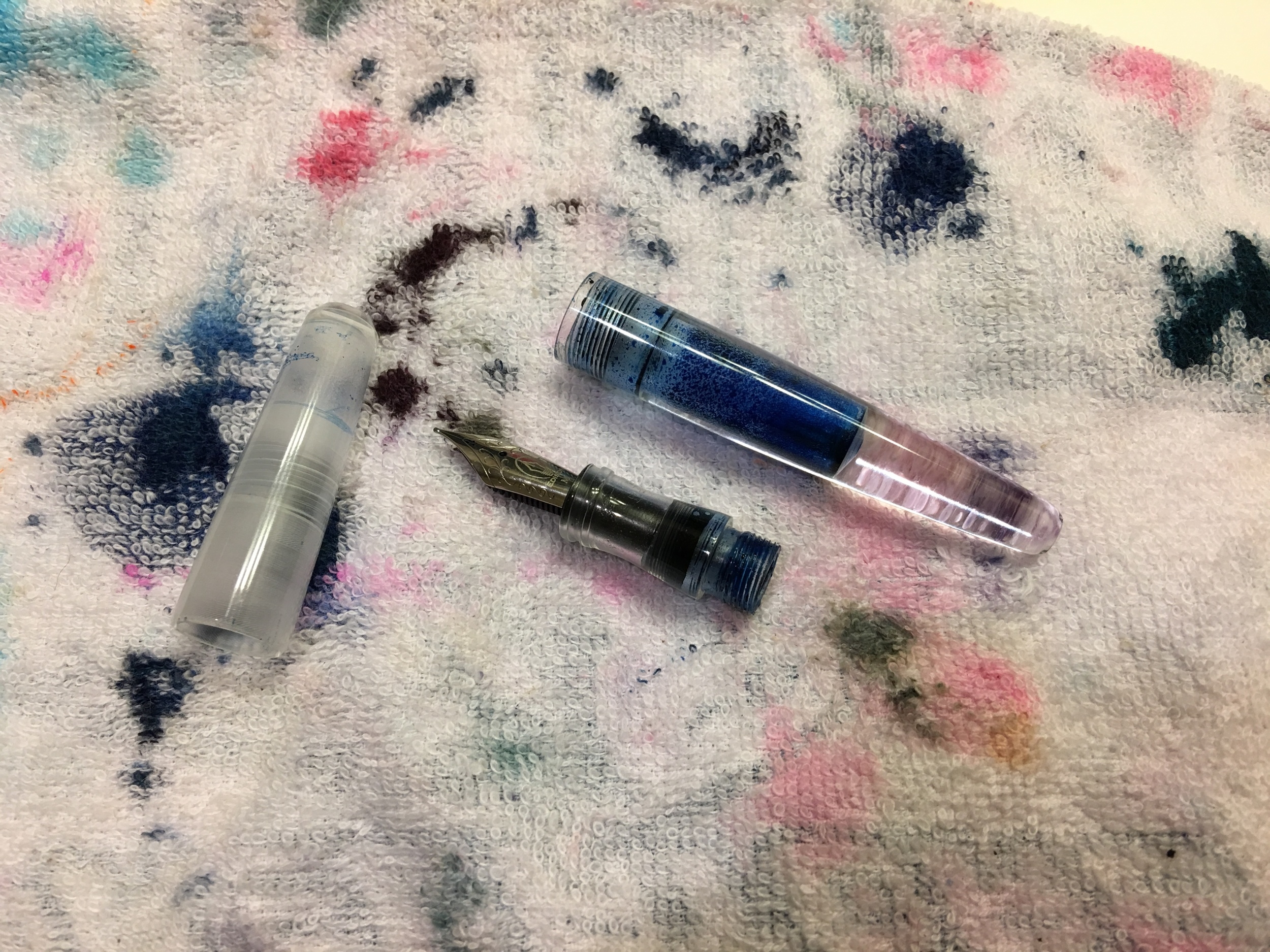
View fullsize Before Flush + Ultrasonic
View fullsize After Flush + Ultrasonic

Piston Filler.  Some piston-filling pens are easier than others to clean.  Pilot's Custom Heritage 92 is a snap (because the piston is highly efficient and works well), and the clear TWSBI demonstrators are also somewhat convenient because they are transparent and relatively easy to disassemble if necessary.  At the end of the day, however most piston-filling pens simply take a long time to flush out all the ink, and I often worry whether that repeated flushing is good for the piston mechanism.  I've had particular difficulty cleaning my Montblanc 146 and my Pelikan M600, though the otherwise excellent Lamy 2000 can be a pain as well.  On all three, I've noticed that the piston mechanisms have loosened up over time, after many many cleanings.    

Pilot's excellent Custom Heritage 92 is extremely easy to clean.  The piston is highly efficient, and as you can sort of see from this terrible photo, the piston fills the ink chamber to capacity, making it easier to flush out the pen.

Sac-Filling Pens (Lever and button Fillers).  Flush these pens with water until it runs clear.  I have these pens listed pretty far down on the convenience list because sacs tend to accumulate ink residue inside them, and it's generally impossible to have any visibility into what's going on inside the pen because they aren't made to be disassembled on a regular basis.  I very rarely use anything other than a "safe" blue or black ink in a pen that fills using a sac. 

Vac-Fillers.  And then, we come to the end.  I love the mechanics of a good vac-filling system, whether it be the classic Parker Vacumatic and the Edison Menlo.  I absolutely hate cleaning them.  After much experimentation, I have scientifically determined that it is physically impossible to get all of the ink residue out of a Parker Vacumatic. No, not really, but it takes so long, and involves so much repeated filling/emptying the pen with water, that I've given up on regularly changing the inks that I use in these pens and stick to "safe blue" or "safe black".  To illustrate how much effort (and ingenuity) it takes to clean these things thoroughly, check out this article by Ron Zorn, who built a centrifuge out of a salad spinner.  (Yes, really.)   In all fairness, the Vacumatic filling system is the product of a time period when most people used three colors of ink (blue, black, and blue/black), so this probably wasn't an issue back then.  (See note below:  a "vac-fill" pen is a pump filler, distinct from the "vacuum-fillers" made by TWSBI and Pilot.  For a demonstration on how a "vac-fill" pen works, see Brian Gray's video.) 

As you can probably tell, this post isn't intended to be a comprehensive, "how-to" guide on cleaning pens (though that may not be a bad idea in the future).  I mainly wanted to provide my thoughts on how easy/difficult I've found certain filling systems to maintain, since it's such an important part of pen ownership.  Opinions may differ.  But if I could provide you with one "semi-pro tip", it would be:  

Buy An Ultrasonic Cleaner.  I was once a skeptic, but about a year ago I purchased one at Bed, Bath & Beyond on a lark and I've since become a convert.  You can get these things really cheap (even cheaper if you have one of those ubiquitous BBB 20% off coupons).  The ultrasonic cleaner is great for cleaning ink out of the nooks and crannies of feeds and nib sections, and saves your fingers a lot of repeated flushing.   If you use a lot of red ink, like I do, the ultrasonic is a lifesaver, because reds can be notoriously difficult to flush.  

Note:  I don't have a ton of experience with vacuum-fillers such as the Pilot Custom 823, TWSBI Vac 700, or the TWSBI Vac Mini, at least not yet. I've recently picked up a Vac Mini, and plan on having my thoughts on the pen up on the blog soon.  I expect that in terms of ease-of-cleaning, these pens will probably fall somewhere between a piston filler and a vac-fill.     
In How To Tags Pen Cleaning, Maintenance
6 Comments

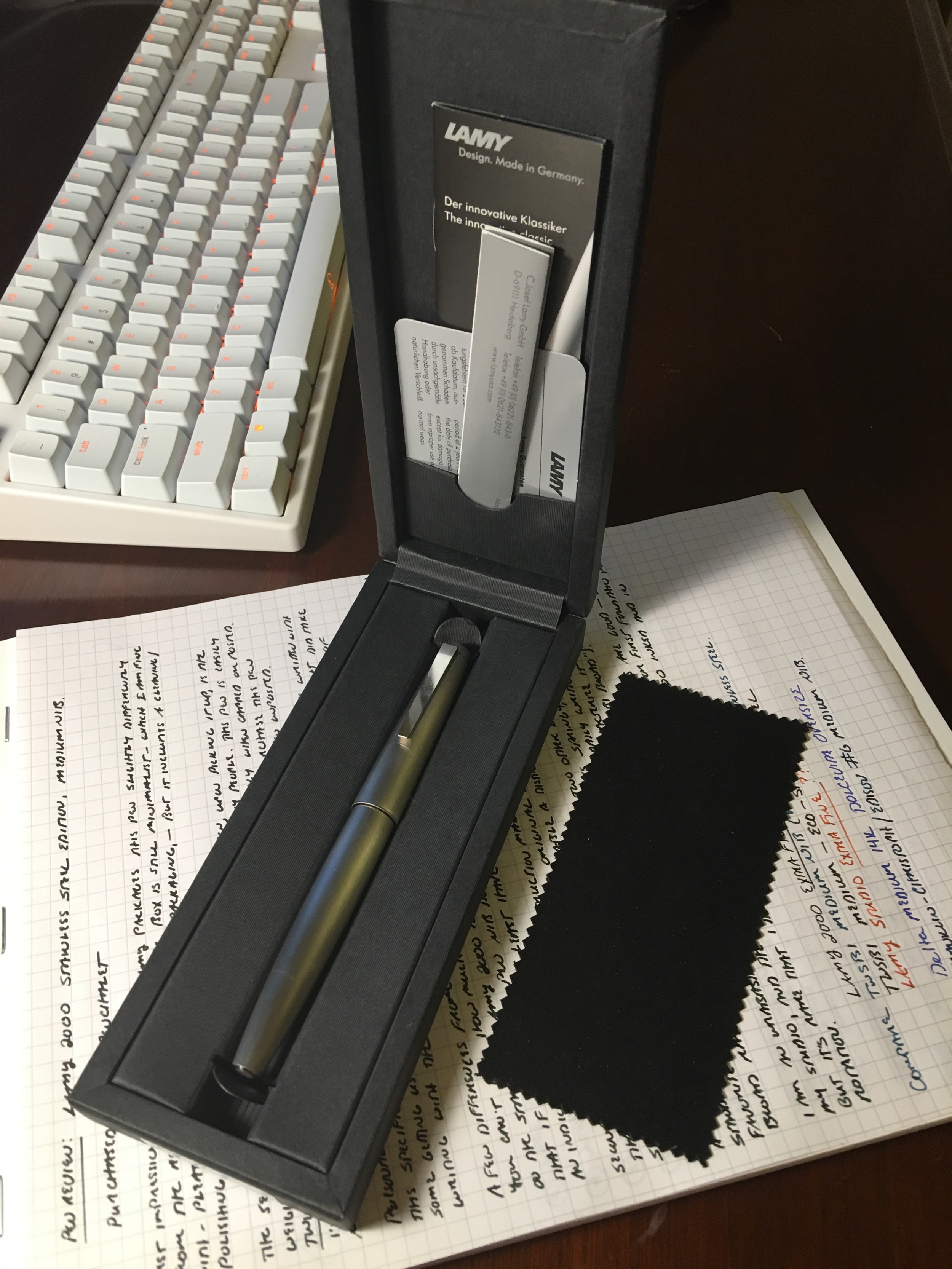
The Lamy 2000 Stainless Steel:  the most recent evolution of a classic design. 

Pen Review: Lamy 2000 Stainless Steel

February 17, 2016

I'll be straight with you up front:  I am an unabashed Lamy 2000 fan and consider it to be one of the greatest pens ever designed.  I have two of the black Makrolon models:  one in an extra-fine nib, and one with a custom .6mm stub.  You could say it was inevitable that I'd eventually get around to adding the Stainless Steel model to my collection.  While I wouldn't grant this pen the same "legendary" status as its cousin, it's close, and this pen has earned a spot in my regular rotation.

First Impressions / Design

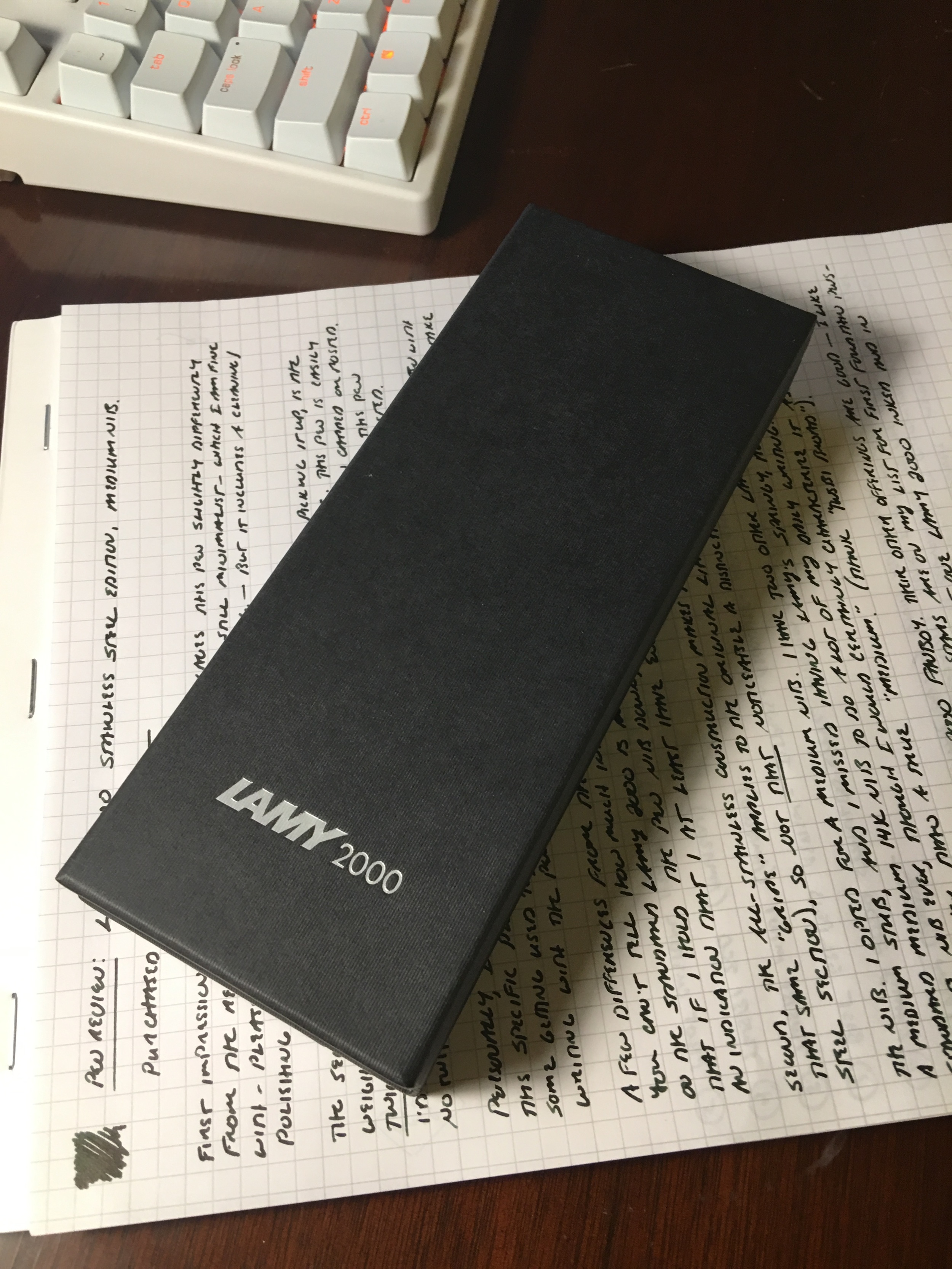
Packaging. The packaging on this pen is slightly nicer than the packaging on the original Lamy 2000, but it's still just a cardboard box. A well-crafted and somewhat eye-catching cardboard box, but still.  None of this matters to me because packaging isn't something I take great interest in unless I can repurpose it as a pen or pencil chest, like some of the more ornate wooden boxes that Delta sells with its more expensive limited edition pens.  One thing I do like, however, is that Lamy has included a polishing cloth.  It's a nice touch.  

View fullsize Lamy 2000 Stainless Packaging
View fullsize Lamy 2000 Stainless Clamshell box

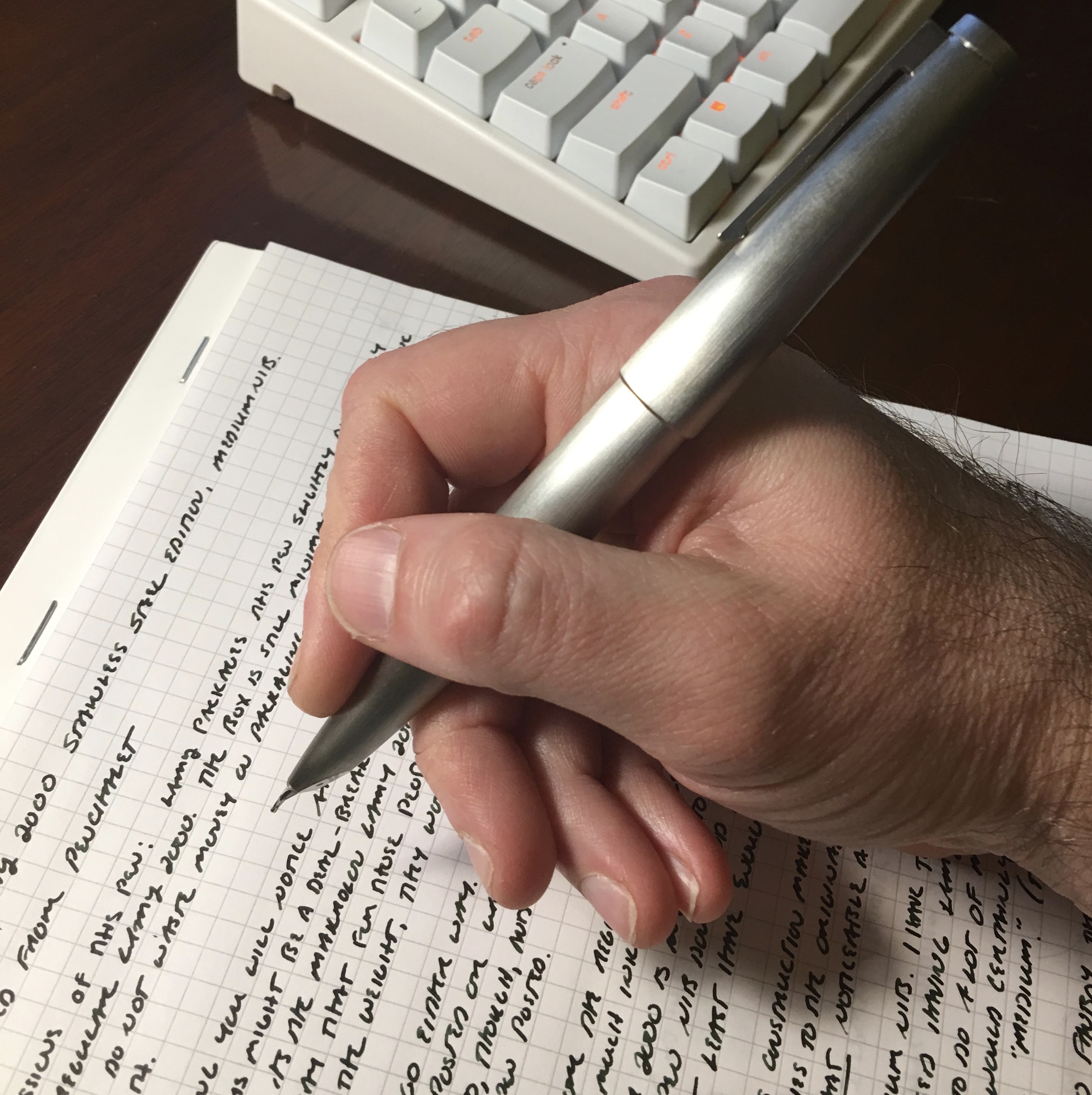
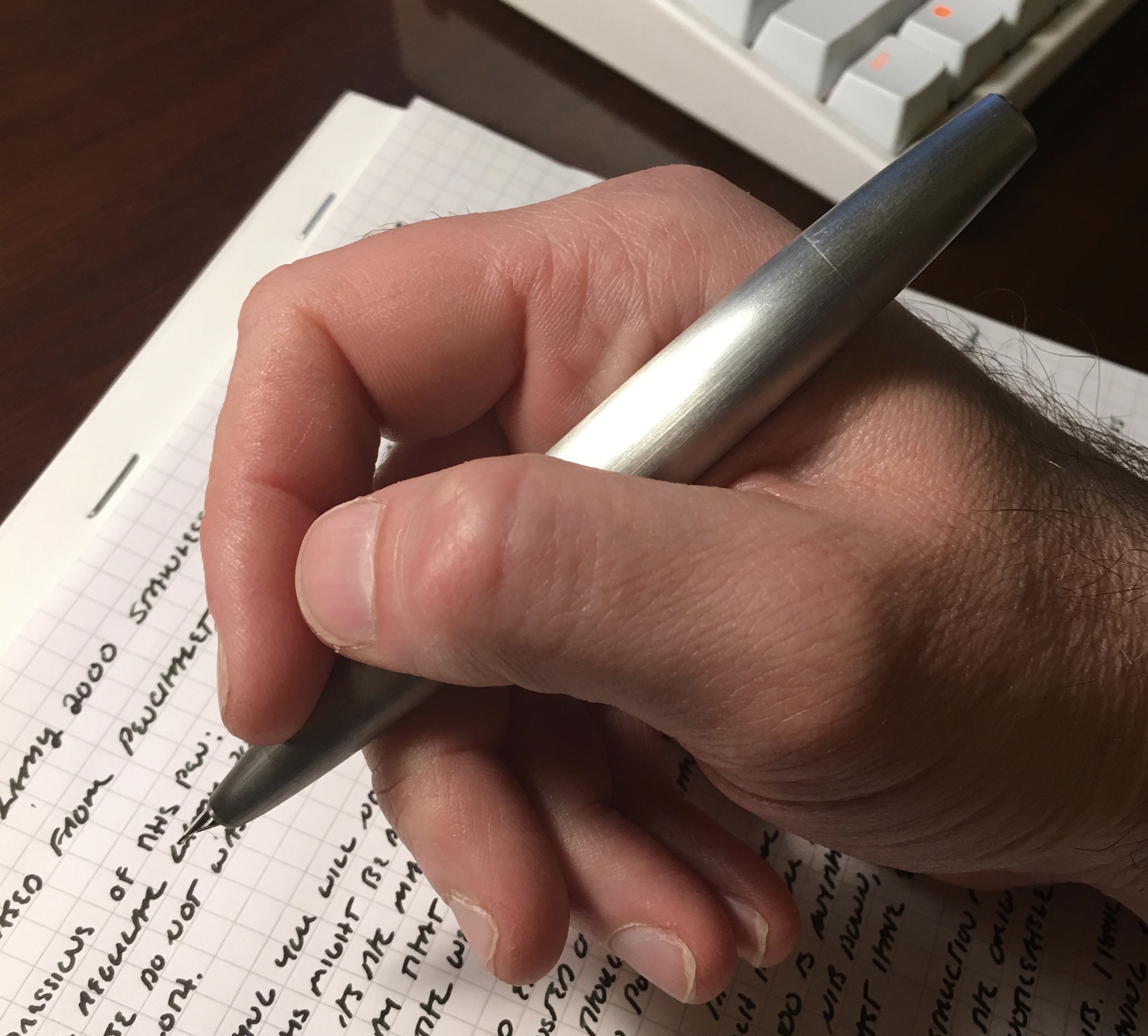
Weight.  The first thing that will strike you about this pen is that it is heavy.  Everyone who reviews it comments on the weight, and how it's probably twice as heavy as the standard Lamy 2000 (maybe more).  The weight might be a deal-breaker for many people, especially if you don't like to use a pen unposted.  

View fullsize Lamy 2000 Stainless Steel Posted
View fullsize Lamy 2000 Stainless Steel Unposted

Personally, the weight doesn't bother me.  I find this pen well balanced for how heavy it is, and I've written with it both posted and unposted for significant periods of time.  Sure, the first extended writing session will make your hand a bit tired, but you will get used to it after a couple outings.  (If you have serious RSI issues, you probably won't, but then again, you're probably not scoping out the market for heavy metal pens anyway.)  On the whole, I prefer to use the pen unposted.  

Design.  The Lamy 2000 Stainless Steel is, for all intents and purposes, the same pen as the standard Lamy 2000.  Both are piston-fillers, and can only be filled from an ink bottle.  The key differences are the material (the entire pen is made from brushed stainless steel, whereas the original only has a stainless steel section); the clip, which is polished and not matte; and the lack of an ink window.  The only change here that bothers me somewhat is the lack of an ink window on the Stainless Steel version, though I'm not sure how they could've incorporated it into the design.  (It's not as though the Lamy 2000 ink window is incredibly useful anyway:  it's opaque and narrow, but when you can see some daylight in there you at least know that you have less than a day's worth of ink left and should refill.)  I haven't figured out how to tell when the Stainless Steel model is almost empty--I'll probably have to go by the weight of the pen--but to be safe, if I'm carrying that pen and need to be sure that I have enough ink to get through a long day of writing, I generally refill before I leave the house.  

I'm a fan of the clip on the Lamy 2000 Stainless Steel.  A brushed or matte clip would be too much here, and the clip wouldn't stand out in any way.

Curiously, I don't find this pen slippery, which was a concern of mine.  Metal pens often pose grip issues, but the brushed stainless steel texture on this pen creates a nice surface that feels good in the hand.  Note:  the original Lamy 2000 has a brushed stainless steel section, so if you have grip issues with that pen, this one isn't going to work for you either.  (Actually, it will probably be worse.)  

The Nib

The medium nib on a Lamy 2000 is closer to a broad in other brands, especially if you are used to writing with steel nibs. 

I opted for a medium nib.  My two other Lamy 2000s sport an extra fine and a .6mm custom stub.  The latter began life as a medium but later had to be retipped after some failed nibwork.  I missed Lamy's big, wet 14K medium nib on the 2000, and I'm glad to have it back in the arsenal once again.  For those of you who haven't yet experienced this pen, the Lamy 2000 nibs are springy, and for the most part great writers out of the box.  (I've heard reports of quality control issues, but have never experienced any myself.)  As I've said before on this blog, Lamy nibs tend to run wide, so this medium is more of a "medium-broad", probably close to the width of a TWSBI broad nib. 

View fullsize Lamy 2000 Medium Comparison
View fullsize Lamy 2000 Medium Writing Sample

Takeaways

I absolutely love this pen, but will be the first to admit that it isn't for everyone.  The weight will turn a lot of people off, and many people just don't like metal pens, period.  It's also expensive, and you have to be a true Lamy fan to invest $300 when--let's face it--you might already own the same pen in the (much) cheaper Makrolon version.  But if you're like me, and love your Lamy 2000s, you won't care.    

As of 2022, we are direct retailers of Lamy Pens through our own Curated Shop, including the Lamy 2000 and Lamy 2000 Stainless Steel models. If you enjoy our content, please consider supporting us directly!   

Further Reading

Mike Dudek at the Clicky Post reviewed this pen (also in a medium nib), and Ed Jelley opted for a broad nib.  Something about the heft of this pen lends itself to a wider point, and a lot of ink!

If you're interested in the black Makrolon version of the Lamy 2000, you can check out my review of that pen here.  It also made my list of "Tier One" pens and best pens for your first purchase over $100. 

In Pens Tags Lamy 2000, Lamy 2000 Stainless Steel, Pen Review, Lamy
1 Comment

The Tactile Turn Mover, in Anodized Red Aluminum

Pen Review: Tactile Turn Mover

February 13, 2016

I’ve gone through multiple machined metal pens over the past three years, including most of the major “Kickstarter” projects. Very few of them have stuck with me. The two that I’ve ended up using the most are the Karas Kustoms Render K, which houses my Hi-Tec-C refill, and the Tactile Turn Mover, which is my “click pen” of choice. 

Tactile Turn: The Company 

Tactile Turn is the brainchild of Will Hodges, a designer and machinist based in Richardson, Texas.  In approximately three years, Will has created and brought to market two excellent machined pens (the Mover and its companion, the Shaker), as well as a series of gorgeous razor handles (the “Parer” and the “Pruner).  He recently concluded another Kickstarter for his “Gist” fountain pen, which fully funded and should ship this month or next.  Starting with the Mover, every Tactile Turn product I have tested has been of exceptional quality.

The Mover

Tactile Turn Mover machined pen in hand

The Mover strikes a perfect balance with respect to weight.  Many machined pens that I’ve tried are simply too heavy for longer writing sessions.  The Mover, which is made out of anodized aluminum, has good heft but won’t wear your hand out when you’re drafting multiple pages of notes.  (For comparison purposes, it’s probably closest to the Karas Kustoms Retrakt, another favorite which some jack*&ss stole off my desk at work.)  This pen might be too long for some people.  Those who want a shorter pen should go for the Mover’s sibling, the Shaker.

The Tactile Turn Nock Mechanism is sturdy, but it probably won't withstand abuse (i.e. clicking the pen repeatedly as a desk toy).

The nock mechanism (i.e., “the clicker”) on the pen is well-made and reliable.  It’s the same one that Karas Kustoms uses on the Retrakt. The stainless steel clip holds well to a shirt pocket, though some may find it a bit tight.  All of the other aspects of fit and finish on my pen are pretty much flawless.  This is a great machined pen, and to me sets the standard by which I typically judge all other entries into this market segment.   

Tactile Turn Mover ribbed grip section

My favorite aspect of the Mover is the textured (ribbed) grip section.  I don’t know whether or not it’s properly referred to as “knurling,” because it’s not the same as the grip on something like the Rotring 600 mechanical pencil—it’s more comfortable to hold and doesn’t dig into your fingers, even if you write with a heavy hand.    

The Color

I’m a sucker for red pens, and my mover is a beautiful deep burgundy-red color.  Tactile Turn offers some of the best anodized colors around, and it’s concerning that most of the anodized pens appear to be out of stock on their website.  I hope it’s just a production backlog since all of Will’s attention is now (understandably) focused on the Gist Kickstarter fulfillment.   

Compatible Refills

The Tactile Turn Mover disassembled:  There's no real art to "hacking" the Jetstream refill.  You'll need to cut it down, and apply some tape to the end to give the Nock mechanism something to latch onto.

The Mover accepts a broad range of refills (some of which require "hacking").  Tactile Turn ships the pen with a .38mm Pilot G2 refill, a personal favorite and, IMHO, one of the best ultra fine gel pen refills that is relatively easy to find at your local office supply store.  With slight modification, the Mover also accepts the hybrid ballpoint Uniball Jetstream refill.  The .38mm blue/blue-black Jetstream refill is superb, and is what I have been using in the pen recently.  Unfortunately, it's not sold separately, so you'll have to buy some disposable .38mm Jetstreams and scavenge the refills.  If you’re a fan of Parker-style refills, then you’ll need to go with the Shaker. 

Uniball Jetstream .38mm Writing Sample.  The refill is labelled blue, but the color ends up being more of a blue-black.  I'm increasingly becoming a fan of hybrid ballpoint inks.  You get the "write anywhere" qualities of a ballpoint …

Uniball Jetstream .38mm Writing Sample.  The refill is labelled blue, but the color ends up being more of a blue-black.  I'm increasingly becoming a fan of hybrid ballpoint inks.  You get the "write anywhere" qualities of a ballpoint with the smooth, dark line of a gel pen.

A complete guide to Mover-compatible refills can be found here, and Shaker-compatible refills can be found here.   

Takeaways

I’ve owned this pen for well over a year, and it’s been part of my EDC since it arrived.  I write primarily with fountain pens, but I’m practical (most of the time), so I always carry at least one ballpoint on me, which gets daily use. More often than not, that pen is the Tactile Turn Mover. This one receives a “highly recommended” rating.    

Further Reading

For some other takes on the Tactile Turn Mover, check out the PurlBug's review, which is extremely detailed, as well as Mary's review at From the Pen Cup.  If you're interested in the Titanium/Brass/Bronze/Copper versions of the Mover and the Shaker, Ed Jelley has a good writeup.  

DISCLAIMER:  I purchased the pen featured in this review with my own funds, for my own collection.  I was not compensated for this review by the manufacturer in any way.  This post does contain some affiliate links, through which I may be compensated a small amount if you purchase something from certain sites linked to in this article.  While I'd greatly appreciate it if you use these links to purchase an item you are interested in, you are, of course, under no obligation to do so.  Many thanks!     

In Pens Tags Tactile Turn, Mover, Shaker, Gel Pens, Machined Pens
2 Comments

My homebrew cigar-box pen chest, made from an old H. Upmann cigar box. 

Favorite Pen Cases and Storage Options

February 10, 2016

After you’ve been in this hobby for a while, pen storage becomes an issue, especially if you’ve invested in some valuable writing implements that you care a lot about and want to protect.  A wide variety of storage options exists, ranging from the simple single-pen leather sleeve to leather-covered pen trays to 80-pen albums that are reminiscent of those things we old people used to carry our CDs around in (remember those?).  I’ll take you through what I consider to be the best options on the market right now, though I’m happy to open up the comments to suggestions of things I missed.  (In case you haven’t noticed, I’m also a bit of an organization/storage/productivity nerd.)

One-to-Three Pen Storage

The average person has no need for a pen case that holds more than three pens.  The average pen addict is a different story, but even the most ardent pen hoarders among us should have a simple three-pen holster to protect those “daily carry” pens in your briefcase.  My personal favorite, and the one I carry everyday, is Nock Co.’s “Lookout” model.  I also have one of the leather three-pen cases sold by Anderson Pens, which is a cost-effective and high quality leather option.  Finally, I recently picked up some pen wraps from EXB Pens, and I’ve been very happy with this Japanese-style storage option.  Look for a review of these at some point in the future.    

My two EXB pen wraps, open and closed. 

Certain of the major pen brands such as Visconti and Pelikan also make leather pen cases, but they are more expensive and you will pay a premium.  I personally have not felt the need to spend a lot of money when there are high quality storage options available at lower price points. I would note, however, that a lot of people seem to be very happy with the Visconti cases.  

Nock Co. Lookout with Field Notes Pocket Notebook for scale. 

If you’re into carrying pocket notebooks or notecards alongside your pens, then check out Nock Co.’s Fodderstack, Hightower, and Sinclair models.  

Five-to-Twelve Pen Storage

Still portable, but large enough to  handle the entire collection of most “normal” people.  To get a quality pen case this large, you probably will be looking at spending more money, but if you have a collection that is larger than you can carry at any given time, it’s worth the investment.  On the smaller (and less expensive) side, the Nock Co. Brasstown is a combination pen case/pen roll, that has room for six pens in the “roll” portion and some room for additional pens and accessories on the side.  Anderson Pens again offers some cost-effective leather options, including 6-12 pen envelopes and zippered “portfolio-style” cases.  Finally, for those of you that also like to carry around a lot of gel pens, pencils, sharpeners, and office accessories, people really like the Lihit Labs series of cases.  

On the higher-end, I highly recommend both Franklin-Christoph and Aston Leather products.  I do not own the Franklin-Christoph “Penvelope” or one of their covered pen trays, but I have seen these items in person at pen shows and they are gorgeous.  Both have been added to “the list”. Currently, my vintage and celluloid pens not in use are stored in two Aston Leather 10-Pen cases that I purchased from Goulet Pens years ago.  The leather is exceptionally high quality and these cases age really well.  I also use these cases to transport pens to shows or meet-ups.    

Aston leather 10-pen folio (though I've found you can easily get 14 pens into this case).  

Mass Storage Options

Here is where you may have to get creative.  If you’re a true collector (or you just own a LOT of pens), you really do need a convenient way to organize and archive them.  The default storage option for most people is one of the large “album-style” pen cases that can hold anywhere from 24-80 pens.  These cases are a fixture at pen shows, as they offer an easy way for dealers to protect and transport their inventory.  Multiple options exist.  Check out these offerings from Anderson Pens and Franklin-Christoph.   

I haven’t gone this route (at least not yet).  The 10-pen Aston Leather cases hold the majority of my pens, but for my overflow, I built my own storage solution out of an old cigar humidor and some faux velvet-lined plastic pen trays.  The result is a two-tiered wooden pen chest that I’m extremely pleased with.  While you can purchase cigar box pen cases pre-assembled, like these from Bama Pens, you might find it fun to make your own.  Cigar stores usually sell empty boxes for a nominal price, and you can source the inserts online.  (I purchased mine from Pendora Pens.)              

My cigar box pen chest (personalized with stickers, of course).  

Now, ink storage is another issue entirely.  I’ve pretty much sworn off all non-sample ink purchases until I burn off some of my stock. Ask me how that’s going in about 10 years.

Further Reading

A while back, after the Nock Co. Kickstarter, I did a three-part review of all the cases I received as my reward.  Part I, Part II, and Part III here. 

Brad from the Pen Addict included a shot of his Bama Pens Cigar Box Pen Chest in his 2014 Atlanta Pen Show writeup.  (I've gotta find one with the glass display lid.)

Jeff Abbot has written a full review of the EXB Pen Wraps. 

DISCLAIMER:  This post contains affiliate links, through which I may be compensated a small amount if you purchase something from certain of the sites linked to in this article.  While I'd greatly appreciate it if you use these links to purchase an item you are interested in, you are, of course, under no obligation to do so.  Many thanks! 

In Pen Storage Tags Pen Cases, Pen Wraps, Pen Chest
3 Comments

Three Esterbrook "J" Pens.  A classic "starter" fountain pen, if you want to go vintage.

25 Resources to Jump-Start Your Pen Addiction

February 6, 2016

I get asked a lot:  "I want to get into pens, and fountain pens in particular, but it all seems so overwhelming.  Where do I start?"  This resource is intended to provide a jumping-off point for those who are completely new to fountain pens, and also to give experienced users some new places to enhance their existing knowledge.  

What's This All About, Anyway?

If you really have no idea what the difference is between a nib, a feed, and a converter, then start with the basics.  You have a lot of reading to do.     

  1. Ed Jelly:  8 Reasons Why You Should Write With a Fountain Pen.  If you’re just beginning your fountain pen journey, and are wondering what all the fuss is about, this is as good a place as any to start.  Ed boils it down to the basics, making this one of the most heavily shared fountain-pen related posts of 2015.

  2. The Goulet Pens Blog:  Fountain Pen 101. The “Fountain Pen 101” series contains explanations of terms, instructional videos, and more.  A great resource for figuring out which way is up when it comes to fountain pens.   

  3. Richardspens.com.  This website from nibmeister Richard Binder, though not updated as frequently as it once was, has a lot of valuable information about fountain pen use and collecting.  His “Reference Pages” lean heavy towards vintage pens, but the general information is still relevant and valuable no matter what your interest.

  4. Glenn Marcus’s Pen Page.  Another nice page, periodically updated, by a veteran pen collector whose tastes run heavily in favor of German and Italian pens.  Glenn also writes a lot about the joys of using pens, and has an archive of ink reviews tackling pretty much every brand out there.

  5. The Fountain Pen Network.  By far the largest pen forum on the internet.  You can learn a lot, though the forums are huge, and it’s very easy to get lost.  I wouldn’t recommend that you start here, but once you have a basic understanding of terms, etc., FPN is a valuable resource. 

  6. FPGeeks Forum.  A sad story.  FPGeeks was once an active website that served as a source for reviews, commentary, and pen-industry news.  I spent a lot of time there.  The main sight has been down for some time, but the forums are still online.  Not quite as expansive as FPN, but still a very good resource.

  7. The Art of Manliness Primer on Fountain Pens.  Not a true fountain pen website, but AoM has a pretty good article on the basics of writing with a fountain pen.  They get it. Plus it’s a pretty great site in that has a lot of interesting resources of topics of general interest.

  8. Pen Chalet.  Retailer Pen Chalet has a nice “How To” section on filling and cleaning fountain pens.  Fountain pen maintenance is very important if you want your pen to write well and last a long time, so it’s good to know what you’re getting yourself into before you buy.  

OK, Here's My Wallet, What do I Buy? 

So you've stayed up 'til 3 a.m. reading Fountain Pen Network threads about how it's impossible to find a perfect match to Montblanc's discontinued, Limited Edition "Gandhi" ink, and your eyeballs haven't started to bleed.  This is a hobby/black hole you know you want to get into.  What do you buy?  (TLDR: you could just buy a Pilot Metropolitan—probably the consensus “best first pen”—use it for a while, and skip directly to Ink.)  

  1. The Pen Addict:  Brad Dowdy's website is a treasure trove of information, but his Top 5 Pens Lists are where you need to start.  Brad’s into more than just fountain pens, too.  

  2. The Gentleman Stationer.  Hey, I’m writing this list--and you're already here--so I don’t feel bad plugging my own stuff.  Check out my lists of Top Five Fountain Pens for Beginners, and Top Five Fountain Pens Under $75. 

  3. Goulet Pens Top Five Fountain Pens for Newbies.  Also check out their Nib Nook and Pen Plaza, which provide photos and writing samples from the fountain pens they stock.  If you see something you like, you can buy directly from them.    

  4. JetPens:  Retailer JetPens has curated a page of beginner-friendly fountain pens, and many of the pens on this list have multiple customer reviews.  I’ve always found JetPens’ customer base informed and pretty reliable for purposes of product recommendations, etc.  

Stock Up On Ink and Paper

Ink and paper form the lifeblood of the fountain pen hobby.  Sometimes I think I'm in this for the limitless rainbow of ink as I am for the pens.  

Now that you have a fountain pen, it’s time to load up on ink and paper.  When it comes to choosing the color you are going to write with, the sheer number of colors available can be overwhelming. Here are a few of my favorite resources for narrowing your choices. 

  1. Goulet Pens.  Again, I'm sending you back to Goulet Pens. They may sell pens now, but they started out as ink and paper specialists.  Their Swab Shop allows you to compare color swatches and writing samples from essentially every ink that is readily available on the market.  They also sell most major brands of fountain-pen friendly paper.  If you can’t find something that you like here, then it may just not exist.

  2. FPN Ink Review Forum.  The Fountain Pen Network has numerous highly prolific ink reviewers and, therefore, an extensive archive of ink that has been reviewed.  In my early days I regularly spent hours here. 

  3. Gourmet Pens.  Azizah’s site has excellent, extensively photographed ink reviews that really showcase what each ink will look like wet, as well as when it’s dry on paper.  She'll also tell you what it tastes like. 

  4. A note on choosing inks:  While I’m far from alarmist about the ink I use in my pens, in the interest of full disclose I should warn you that there has been much discussion about whether or not super-saturated (i.e., dye-heavy) inks such as Noodler's and Private Reserve are “safe” to use in all pens.  I don’t pretend to understand the science behind it all, but just remember that fountain pen inks are chemical solutions, and if you have an expensive or irreplaceable pen that you care about preserving, exercise caution. This article from Richard Binder more or less summarizes the various arguments people have made for or against these inks.        

Join the Community (AKA Full-Blown Addiction)

You have you're pens, ink, paper, and have chosen your FPN handle.  What else is there to do other than actually write with your pen(s)?  Lots.  

  1. The Pen Addict Podcast.  You’re listening to a podcast about pens.  I have nothing else to say.  You’re addicted.  It’s like being in a bar at 10:30 am on a Wednesday. 

  2. The Pen Habit.  An excellent website and Youtube Channel.  Matt Armstrong creates both video and written reviews of pens in every price range, from entry-level writers to custom pens costing hundreds of dollars.  Your credit card will be angry at you. 

  3. SBRE Brown.  A massive Youtube channel with dozens upon dozens of video reviews.  I’m fairly certain that SBRE Brown has reviewed every readily-accessible pen out there (and more).  Some people don’t like his review style, but I’ve always found his videos entertaining and informing.

  4. Pen O'Clock News.  A revival of Fountain Pen Radio, formerly associated with FPGeeks, featuring SBRE Brown, Azizah from Gourmetpens, and Eric (from FPGeeks).  It's a podcast? Or a YouTube show?  Who cares, it's fun.     

  5. Fountain Pen Economics.  If you’re still reading, you’ve progressed from listening to a podcast about pens, watching pen videos on YouTube, to reading a blog about the economics of the fountain pen industry.  (Which, by the way, is incredibly well written, well informed, and interesting.  If you subscribe to the Pen Addict website, you will receive access to a mini-podcast featuring Dr. Jonathon Deans, the author of Pen Economics.)  

  6. The Well-Appointed Desk.  Obviously, you will want to progress from your pen obsession to accessorizing, beautifying and optimizing your office space in its entirety.  Ana Reinert reviews plenty of pens and ink, but there’s also a lot more.  

Yes, you too will soon have a drawer like this one. I actually have "drawers."  Plural. 

Go Vintage?

If there aren’t enough modern pens to keep your hands and pocketbook occupied, then you can always dive into the fountain pen “back catalog.”  Vintage pens are their own thing:  they have their own terminology, their own set of specialist dealers, and (mostly) their own subset of collectors and enthusiasts within the overall pen community.  If you're interested in learning more:   

  1. My Vintage Pen Primer Series.  I've tried to cobble together basic knowledge on a few of the major brands and models of vintage pens.  Not intended to be comprehensive, but merely a jumping off point.  Part II, Part III, and Part IV here.

  2. Anderson Pens.  A retailer that specializes in both vintage and modern fountain pens, and carries a broad range of ink.  Brian and Lisa Anderson are Esterbrook specialists, and Esterbrook is a great jumping off point into the vintage pen world.    

  3. GoPens.com.  A drool-worthy site where you can purchase excellent quality vintage pens for very fair prices.  I personally use the site’s back catalogues as a reference when I’m trying to figure out whether something is a good deal, or when I'm trying to price a vintage pen for resale.

Whew!  Thanks for reading.  Hopefully this was helpful, and I'd appreciate it if you'd share with anyone who you think might be on the brink of diving into the pen hobby.  For more similar content, you can subscribe to my site using the link on the right, or follow me on Twitter and Instagram, where I'm slightly more active. 

Disclaimer:  I was not paid or compensated for including any of the links on this list.  These are all resources that I personally use, and have brought me much enjoyment over the years.  I hope you all enjoy them as well! 

In LInks Tags Editorial, Links
1 Comment
← Newer Posts Older Posts →
Store Hours and Location
Visit the T.G.S. Curated SHOP
Updated "Best Pens" Guide
On the Paper Trail Podcast
TGS x Roterfaden TGS_25
Hierarchies of Fountain Pen Friendly Paper

Join Our Patreon!
Subscribe to the TGS E-mail List

Featured Posts

Featured
Cover On the Paper Trail Intro Clip.jpeg
Dec 3, 2025
Introducing "On the Paper Trail," a New Podcast/Video Collaboration with Lisa Vanness of Vanness Pens!
Dec 3, 2025
Dec 3, 2025
Iro-Utsushi-Fine-Dip-Pens.jpeg
Oct 1, 2025
The Pilot Iro-Utsushi Dip Pen (and in General, Simple vs. Fancy Dip Pens)
Oct 1, 2025
Oct 1, 2025
Levenger-Annotation-Pad.jpeg
Sep 20, 2025
Five Boutique Paper Brands I'm Watching Closely and Why
Sep 20, 2025
Sep 20, 2025
The Gentleman Stationer RSS

© Digital Divide Media, LLC, 2014-present.

All content is the exclusive property of Digital Divide Media, LLC, d/b/a The Gentleman Stationer, including “The Gentleman Stationer” website and trademark, and should not be reproduced without express written permission.  All rights reserved.

All content containing paid advertising, affiliate links, or sponsored content will be plainly disclosed by a disclaimer when/if featured.

Contact Information

Store Shipping Policy and Return Policy

Privacy Policy

Cookie Policy

Terms and Conditions

Powered by Squarespace