• Blog
  • Shop
  • Resources
  • FAQ (Ask TGS)
  • About
  • Archive
  • Contact
  • Sign In My Account
Menu

The Gentleman Stationer

Vintage Living in the Modern World.
  • Blog
  • Shop
  • Resources
  • FAQ (Ask TGS)
  • About
  • Archive
  • Contact
  • Sign In My Account

Galen Leather Notebooks:  On the left, navy blue leather with mustard band; on the right, dark brown leather with dark blue band.

Galen Leather: A New Source for Custom Leather Goods

June 15, 2016

A few months ago, I was contacted by Galen Leather and asked whether I wanted to review some of their custom handmade leather goods.  This apparently was part of a marketing blitz, since pictures of their notebook covers have appeared all over Instagram and Twitter as bloggers and stationery enthusiasts receive their Galen Leather packages.  

The Company

Galen Leather is an online storefront run by a brother and sister in Istanbul, Turkey.  According to their "About" page, they've been in operation since 2011 and selling online since 2012.  Galen Leather specializes in making all sorts of leather goods, but what's attracted the most attention are their leather notebook covers, which they make to fit Midori Traveler's notebook refills, Moleskines, Field Notes, and the Hobonichi Techo.  Since I've really enjoyed the Fountain Pen Day-branded notebook cover that I picked up at the Atlanta Pen Show, I decided to go for the Traveler's Notebook-style cover in the "pocket notebook" (i.e., Field Notes-compatible) size.

I left the brass charm on the blue notebook, but swapped out the charm on the brown for the "evil eye" talisman that comes with every Galen Notebook.  Here's some background on the meaning of the "evil eye". 

The Notebook

My Galen Leather notebooks are each made from a thick piece of leather with burnished edges.  The leather is a touch stiff, at least initially, but with use and wear it should soften up.  The company offers at least 13 different color options (in both leather and bands), many of which are not options for the original Traveler's Notebook.  What I really like is that the Galen Leather notebook comes set up to hold four notebook refills, whereas the Midori notebook comes setup for one or two before you have to purchase more bands.    

Galen Leather allowed me to pick two notebooks, complete with bands of my choice and brass "charms" which can be woven onto the belly band.  They even stamped my initials onto the front of the notebook, and the impression is nice and deep.  I chose the dark brown and the navy blue, both of which are attractive. 

Takeaways

Galen Leather products are nice looking, well-made, and reasonably priced.  I really like this product. I've only had this notebook for a bit, but over the course of two weeks it's become part of my daily carry.  I use it as a sort of "carry all" that fits my pocket notebooks and all the loose papers that I tend to accumulate over the course of the day.  I've kitted it out with two Field Notes-brand pocket notebooks, an Expedition and a Shelterwood, and I've even been able to comfortably tuck my Write Notepads pocket ledger in the back.  I found the brass charms a bit much, to be honest, and felt they got in the way of opening and closing the notebook quickly at work, so I swapped the charm on the brown notebook out for the "evil eye" talisman that Galen includes in every shipment. 

Close-up of the "Evil Eye". 

My dark brown Galen Leather notebook with two Field Notes and a Write Notepads pocket ledger. 

Galen Leather prices their products quite reasonably.  One knock many people have had on Midori is that the Traveler's Notebook is fairly expensive for what it is ($49.99 for the large one, before any refills or accessories).  On the other hand, the Galen equivalent is priced at $32 (and ships without any refill).  I see no reason why Traveler's Notebook accessories, such as the paper and cardholders, would not work with the Galen Leather notebook covers.  (I've not checked the compatibility myself, so proceed at your own risk.)

As you can tell from the pictures, I've been carrying the dark brown leather notebook with the navy blue band.  What do I intend to do with the Navy Blue/Gold Band notebook?  Father's Day present for my Dad, since we have the same initials.  (No spoiler risk here, pretty sure he's not a reader of the blog!)  I think my next purchase might be a leather cover for my Hobonichi.  

DISCLAIMER:  This post contains affiliate links, through which I may be compensated a small amount if you purchase something from certain sites linked to in this article.  While I'd greatly appreciate it if you use these links to purchase an item you are interested in, you are, of course, under no obligation to do so.  Many thanks! 
In Notebook Review Tags Galen Leather, Notebook Review, Notebook Cover
2 Comments

My favorite aspect of the virtually indestructible Field Notes Expedition edition is the very subtle map of antarctica printed on the back of the notebook.  

Field Notes Expedition Edition: Great If I Were Going Up Everest Anytime Soon.

June 11, 2016

I love orange and black as a color combination.  Year-round, too, not just during Halloween.  I'm also a huge fan of dot grid paper.  So it's natural that when I saw the Field Notes Expedition edition, I fell in love with the look of these notebooks immediately.  The Expedition edition ended up being one of the first Field Notes Colors editions I purchased, when I really got into this hobby in earnest a couple years back.  Practically speaking, however, I'm not quite sure what I'm going to do with these things.

Ballpoint or hybrid ballpoint ink works best on the Yupo Synthetic Paper.  Even HB pencil has a lot of ghosting and smearing, in my experience. 

The Field Notes Expedition notebooks are made from Yupo Synthetic Paper, which is described as "100% recyclable, waterproof, tree-free Synthetic Paper" that is "extruded from polypropylene pellets."  In other words, it's plastic.  This stuff won't tear, it's completely waterproof, and depending on what kind of ink you use with it, you can wipe it clean and reuse it.  This last part is what makes Yupo Synthetic Paper a difficult choice for an everyday pocket notebook.  Because the paper is completely non-absorbent, any ink that's remotely water-based or too wet doesn't work at all. Fountain pens, rollerballs, and gel pens simply disappear off the page. You're pretty much limited to writing with a ballpoint pen or a relatively hard pencil.  (I've heard fine-tip Sharpies also work, but have not tested this.)  Soft pencil lead has smearing and ghosting issues.  For me, this limits the usefulness of the notebook, but I'm not the target audience for this product.    

Why don't they work for me as a daily user?  There's too little flexibility regarding the kind of pen or pencil you can use.  With pocket notebooks, I like to be able to jot things down on a moment's notice with whatever pen or pencil that I can find lying around. While I've been carrying the Expedition edition, there have been times when I had to search around for more than a minute or two in order to find a pen that would work on the Yupo Synthetic Paper. What's been the winner?  This.    

For me, the good 'ol Bic Crystal has been the winner for writing on the Yupo Synthetic paper. $3.49 for a dozen. 

Regardless of whether or not it fills a need for most people, the Field Notes Expedition edition apparently has staying power.  It's still a part of the Field Notes regular lineup three years later, though I'm not sure whether this is due to its popularity, or because Field Notes had a large minimum order requirement on the Yupo Synthetic Paper and therefore has a TON of these things lying around.  Because I don't work "in the field," I probably won't go out of my way to purchase more of them unless things change and I decide to haul my "lawyerly" physique into the Himalayas or Antarctica.  That said, it's a cool product, and I'm glad I have a three-pack.  

Be sure to write it down.  You don't want to forget Marion's Address in Nepal again. 

Further Reading

A lot of people reviewed the Field Notes Expedition edition when it first came out.  I haven't seen any recent reviews, so I thought it would be fun to write one up.  If you're interested in other people's reactions to this product, check out these reviews.  Most people did far more extensive tests than I did, using different pens on the paper.  

  • Brad from the Pen Addict tests out the Expedition edition, and looks at how various pens work on the Yupo Synthetic Paper.

  • Johnny from Pencil Revolution tests out the Expedition edition with various pencils.  If you're a pencil user, he gives you the run down on what graphite works best. 

  • The Unroyal Warrant does a thorough review, and also links to a bunch of other write-ups. 

You can still purchase the Field Notes Expedition edition from Field Notes directly, as they are part of the standard lineup.  

So what's my favorite Field Notes edition?  For now, it's still the original Kraft paper notebook, and I expect it to remain that way for the foreseeable future.

In Notebook Review Tags Field Notes
Comment

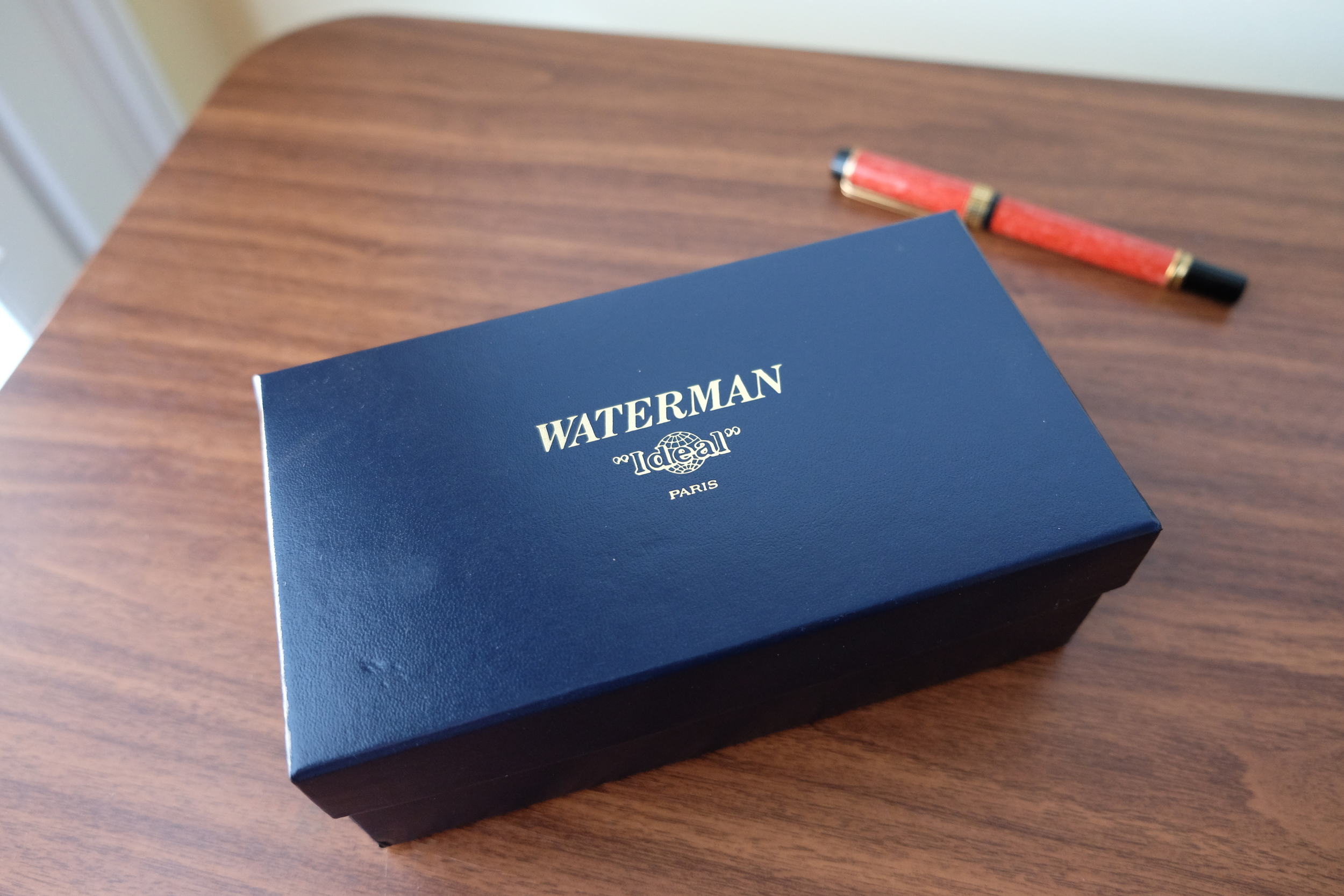
Waterman Man 100 Patrician in its original box. 

Pen Review: Waterman Man 100 Patrician, a Neglected Workhorse

June 8, 2016

I have a soft spot in my heart for modern Waterman fountain pens, even though their line has become a bit stale since they were acquired by Newell-Rubbermaid in 2001, with fewer models introduced into the lineup.  To me, the pens that Waterman manufactured during the 1980s and the 1990s are excellent--I think of them as "vintage" in the sense that they aren't available anymore, but "modern" in that they use contemporary Waterman cartridges and converters. The term I use to describe pens like these is "near modern," and they are a fixture in my collection.  

History of Waterman Pens

The name "Waterman" has a storied history in the fountain pen world, with the lore (repeated on the Company website) being that Lewis Edson Waterman invented the modern fountain pen.  Others have recently cast doubt on this version of history, but the story still sticks. However, what many people don't know that the modern Waterman Pen Company is not the same company that made many of the classic Waterman pens from the 1930s and 1940s, but rather is a descendant of Jif-Waterman, the French subsidiary, which is now owned by Newell-Rubbermaid.  Waterman has an interesting timeline on their website that shows various events from the history of the French and American companies, including all the major pen models introduced over the years.  Of all these designs, the classic "Le Man 100" (known simply as the "Man 100" stateside), first introduced in 1982 for the company's 100th anniversary, is my favorite.  

Design and Build

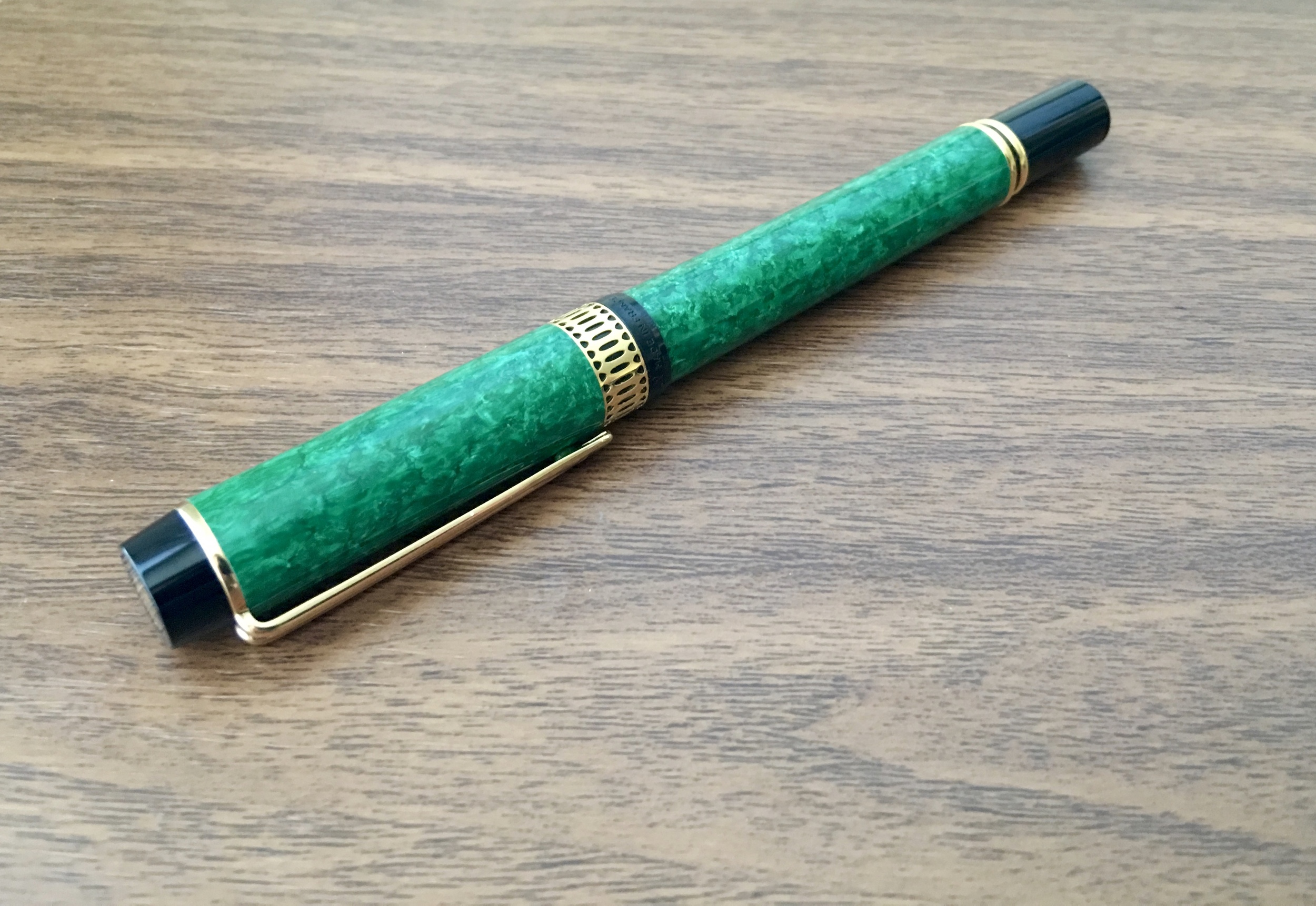
The Waterman Man 100 is a large pen with a lot of heft, since the construction is lacquer over brass.  The lacquer is very thick--despite the years and heavy use (from me), the finish is still flawless. 

The Waterman Man 100, at first glance, resembles a larger version of the Laureate and other more modern Waterman pens.  It is solidly built using the typical Waterman lacquer-over-brass construction that gives the pen some weight.  The style is classic Waterman, with the traditional "Waterman clip" the French company has used since the 1960s and the large 18k "Ideal" nib (borrowed, of course, from the early days of the Waterman "Ideal" fountain pen). The Man 100 was introduced in 1982 and intended to serve as Waterman's flagship luxury pen, competing with Montblanc and Pelikan.  What makes this particular version unique, however, is the cap band. 

Note the stylized Waterman "W" logo on the finial and the cap band.  Also, the cap is friction fit, with the back of the pen tapered to allow the pen to post firmly and securely.  

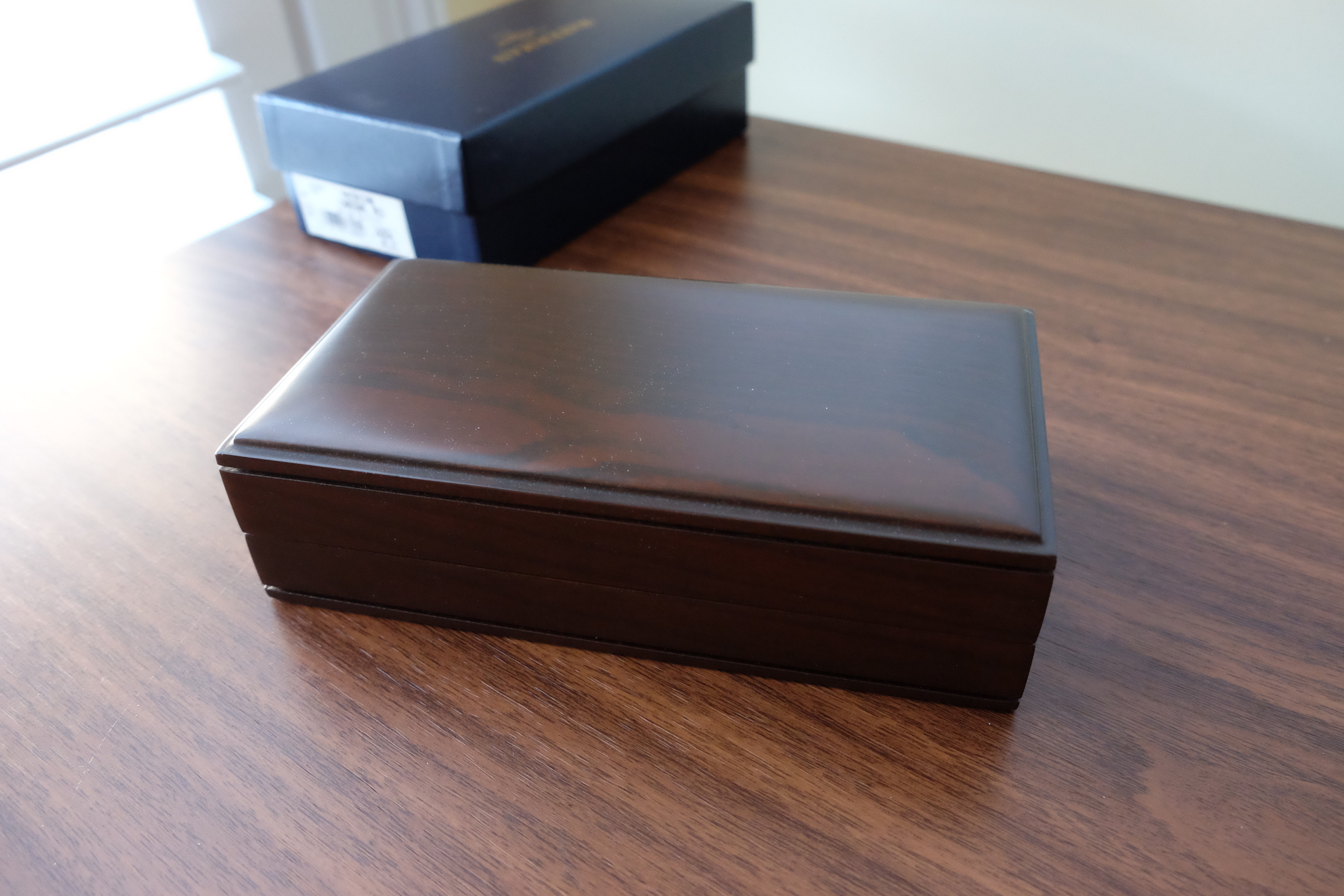
The band on this version of the Man 100 is modeled after the Waterman Patrician fountain pen from the 1920s and 1930s.  Waterman manufactured these "Patrician" Man 100s as special editions from 1992 to 1994.  If you shop around, they are starting to command what I consider to be extremely high prices.  I'm glad I bought when I did:  I love my two Man 100 Patricians, but I'm not sure that I'd be willing to pay what people are asking these days.   One thing I will say--if you can find these new-old-stock, the packaging on these older pens is gorgeous.  It comes with a nice wooden box.  The faux-leather on the inside is a bit worn, but hey, it's almost 25 years old. 

View fullsize Waterman Man 100 Box
View fullsize Man 100 Inner Wooden Box

The Nib

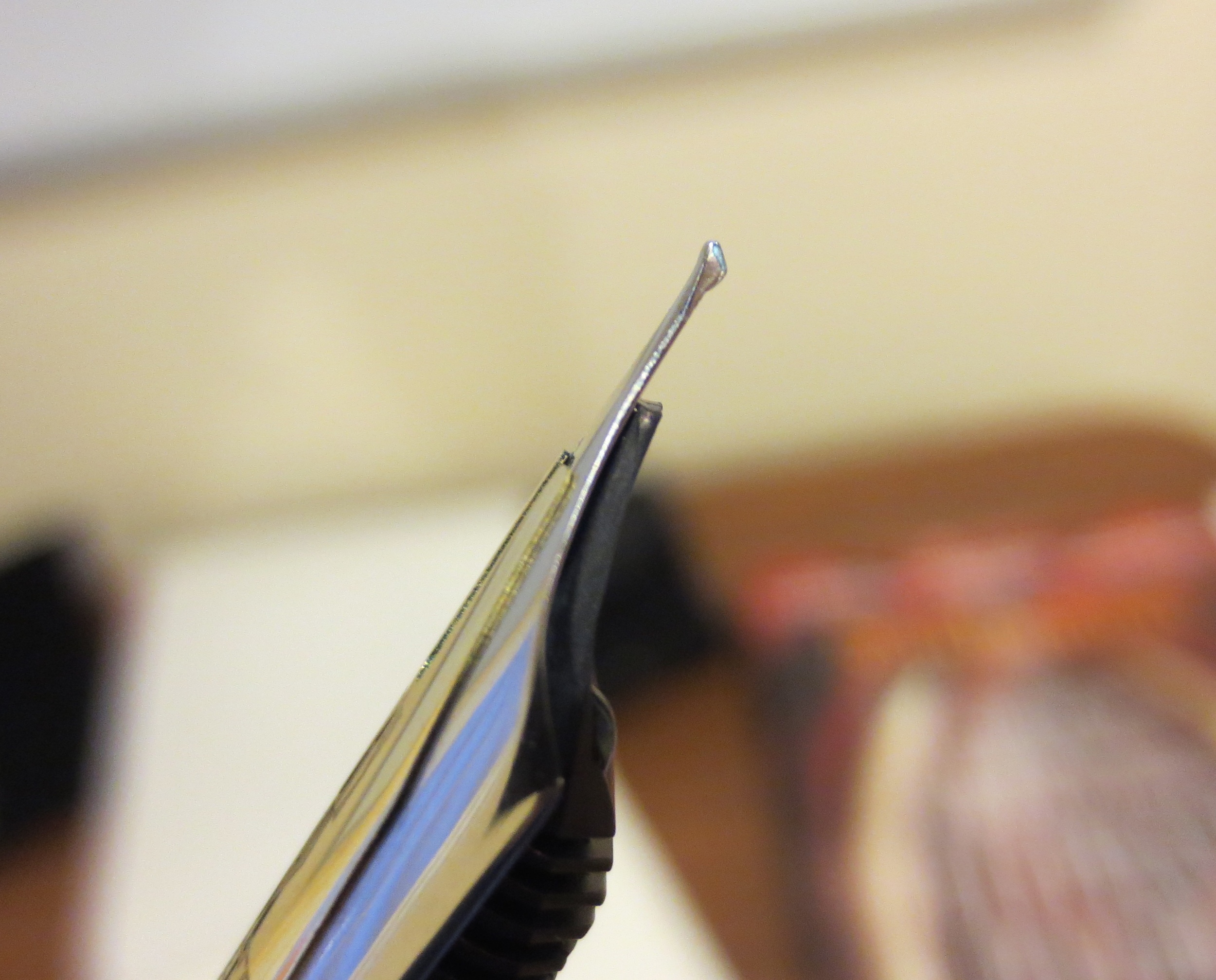
The Waterman Man 100 Ideal Nib.  

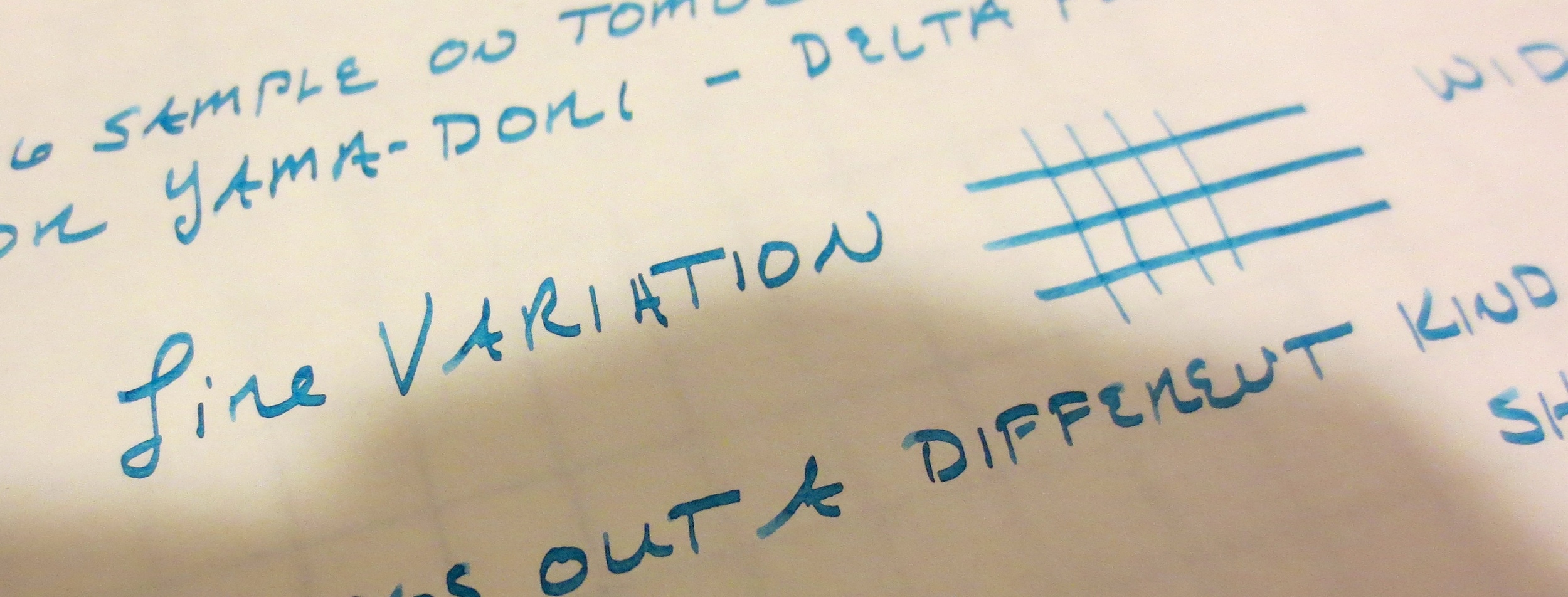
Now for the writing experience:  Waterman nibs are on the stiff side.  The stainless and gold-plated nibs are definitely nails, but the 18k gold nibs have the tiniest bit of spring to them--just enough to keep the writing interesting.  I have two of these pens:  a coral ("Cardinal Red") and a green.  Both of my pens have fine nibs and wrote adequately out of the box.  My coral pen was N.O.S., so the fine nib wrote like a dream.  My green pen was used, and the nib was slightly worn in (to someone else's writing style), so I had Mike Masuyama tweak it.  No big deal.  Both are now very nice daily workhorses.        

View fullsize Waterman Man 100 Writing Sample
View fullsize Waterman Man 100 in Green

Further Reading (and Shopping): 

I use my Waterman pens a fair bit, but I haven't written much about them, probably because I'm just as liable as the next person to get caught up in the latest "craze" to the detriment of my workhorse pens.  A while back I did write a piece for Maybelline over at her blog On Fountain Pens discussing my first "nice" pen, the Waterman Laureate.   

As I mentioned, the Patrician models of the Man 100 pens are becoming difficult to find. Occasionally, they come up on Gary Lehrer's GoPens newsletter, which is where I purchased mine.  I'm still looking to acquire the blue version to complete my collection.  If anyone has one they are looking to unload, please reach out!   

Waterman pens from the Company's current lineup can be purchased from our sponsors Pen Boutique and Pen Chalet.  Waterman also sells a lot through larger retail channels like Staples and Amazon.  You can occasionally find Waterman pens in big-box office supply stores, if they still have a "fine writing" section.

The pens featured in this review were purchased with my own funds for my own collection.  I was not compensated for this review.  

DISCLAIMER:  This post contains affiliate links, through which I may be compensated a small amount if you purchase a pen from certain sites linked to in this article.  While I'd greatly appreciate it if you use these links to purchase something you are interested in, you are, of course, under no obligation to do so.  Many thanks! 
In Pens, Vintage Pens Tags Waterman, Vintage, Near Modern
3 Comments
The year is half full, not half empty.  Plenty of time left for more stationery purchases!   

The year is half full, not half empty.  Plenty of time left for more stationery purchases!   

An Almost Mid-Year Review (and a Sneak Peak at the Rest of 2016)

June 1, 2016

I've been really happy with how things have gone on the blog this year.  For the most part, my readership and traffic have grown slowly but steadily, which suits me just fine.  Being on vacation for a week has given me a chance to--what else--go back through my posts and pick out a handful of favorites. Even though it's not quite mid-year, I've got a quiet morning and lots of coffee, so why not get an early start recapping the first part of 2016?  

  1. My Top Three Favorite Pen Brands.  Without a doubt, my favorite post that I've done this year, and probably one of my top five of all time.  Narrowing the pens that I like down to three major brands has also cut down on the number of impulse purchases I've been making (at least with regards to more expensive pens) and my pens are starting to resemble an actual collection rather than just a random accumulation of shiny things that I've snatched up.
  2. Controversial Changes in the Pen Community.  Another post I enjoyed writing, that generated much discussion in the form of tweets, comments, and Facebook posts.  Many people agreed with me, and some (strongly) disagreed with me, but the point was to provoke a conversation that I felt needed to be had.
  3. 2016 Atlanta Pen Show Recap.  Probably my best pen show experience to date.  If you missed it, you can check out my two-part recap here:  Thursday/Friday, Saturday. 
  4. Pen Show Primer Series.  I've made an effort to create more searchable resources that are helpful to people just entering this hobby (or people who are looking to "go deeper").  Volume I: Why Visit a Pen Show, Volume II: Getting Ready for a Pen Show, and Volume III: Tips for Surviving the Pen Show.  
  5. Delta Dolcevita Soirée Review.  It wasn't until I wrote this review, and started thinking about why I liked it so much, that Delta really solidified its place among my top three favorite pen brands.  Look for more Delta reviews this year.  

Favorite Stationery Purchases of 2016

Some of these products I've reviewed on the blog, and some of these are still works in progress since I haven't had this stuff for long, but these are things that have stuck with me for more than a few weeks, which typically is a good indicator of whether or not I'll use the product long-term. 

  1. The Hobonichi Techo.  Not quite a notebook, not quite a journal.  Whatever you choose to use it for, it makes me want to write in it daily.  I recently wrote up my first impressions here. 
  2. The TWSBI Eco.  Ever since I picked up TWSBI's low-price-point offering, the ECO, it's been a fixture in my rotation.  This pen posts fairly well (unlike most of their other large pens), and is a comfortable, reliable writer.  
  3. The Pilot Custom 823.  I won't spoil my thoughts on this one too much, since my review is still in progress, but this pen is going to be in my EDC rotation for a long, long time.   It's also a favorite of Neil Gaiman, so I'm in good company here. 
  4. The Pilot Custom Heritage 92 Demonstrator.  As I said in my review, this pen's crazy overpriced in the States, and the color demonstrators are Japan-only, but it's a relatively inexpensive, high-quality import. 
  5. Pelikan M800 in Burnt Orange.  Some people have tagged this pen as Pelikan's effort to "knock-off" the Montblanc Hemingway, but this pen has its own charm.  For one thing, the color is slightly different, and these pens with the "burnt orange" color schemes were all designed as homages to the reddish-orange hard rubber pens from the 1920s, like the classic Parker "Big Red" Duofold. I love writing with this pen, and the .4mm Masuyama cursive italic nib is sweet.  These are getting scarce, I believe, so if you see one, act now.    

Looking Forward to the Rest of 2016: Vacation Semi-Impulse Purchases

As I alluded to yesterday on Twitter, I went a little nuts.  Not that any of this was crazy expensive (at least standing alone), but there's a backlog of products I've been itching to try. Among other things, I picked up: 

  1. Some more KWZ inks from Vanness Pens.  KWZ has all sorts of offbeat colors, including Honey and Brown Pink.  I also ordered two additional colors of Callifolio, Olivastre and Adrinople. 
  2. Pocket notebooks and accessories from Write Notepads.  I'm ashamed that I've waited this long to try these out. 
  3. A Seven Seas Writer, Life, and Midori notebooks from Nanami Paper. 
  4. A Dark Lilac Safari and a bottle of the Dark Lilac ink from Goldspot.  (Currently sold out at Goldspot, but as of the time of writing it looks like Goulet Pens still has some in stock.) 

In other words, I'm restocked for the second half of the year, and looking forward to the rest of 2016! 

In Editorial Tags 2016 Recap, Retrospective
Comment

Mike Masuyama and his nib customization setup at the 2016 Atlanta Pen Show. 

An Introduction to Nib Customization

May 29, 2016

I've wanted to write a piece about custom nibs for a while.  As the "pen world" explodes in popularity (well, at least relatively speaking), more and more people are discovering the world of nib customization.  And at the same time, more people who have been tuning and grinding their own nibs at home have begun to transition their hobby into a small business.  Only a few years ago, There were but a handful of reliable people who performed nib modifications.  (Mike Masuyama, Richard Binder, and John Mottishaw, to name a few.) Today, there are even more, including Mark Bacas, Tim Girdler, Linda Kennedy, Dan Smith, and Shawn Newton.  There's enough demand to support multiple people plying their trade, and I know of several individuals experimenting at home who may "go public" in the future. 

What exactly is a custom nib? 

The majority of fountain pen manufacturers offer nibs in four standard sizes: extra-fine, fine, medium, and broad. These "factory" nibs have round tipping material and produce a uniform line of writing that has little variation, meaning that the pen writes with a consistent line width in all directions. While it's become increasingly common for manufacturers to offer stub nibs (discussed further below) in 1.1mm and 1.5mm widths as part of their standard line, and certain manufacturers offer double or triple-broads, ultra-extra fines, obliques, crisp italics, and other specialty nibs.  But even these are not truly "custom".  

As I consider it, true nib "customization" involves sitting down at a table with the nib technician (or "nibmeister", as some might call them, though I prefer "nib technician" and will use that term here for simplicity's sake), having him or her watch you write, and adjusting the nib specifically to your writing style, accounting for various factors.  Of course, this process often involves a nib "grind," (i.e., changing the shape of the tipping material using a grinding stone, wheel, or a rotary tool) but it can also involve smoothing the nib on sandpaper and/or mylar sheets, increasing or decreasing ink flow to the writer's preference, resetting the nib and feed, or aligning the tines. When you walk away from an appointment with a nib technician, you should have a pen that writes perfectly for you and your writing style.  

That said, part of what I love about nib customization is the ability to get unique nib grinds. I'll briefly walk you through a few of my favorites: 

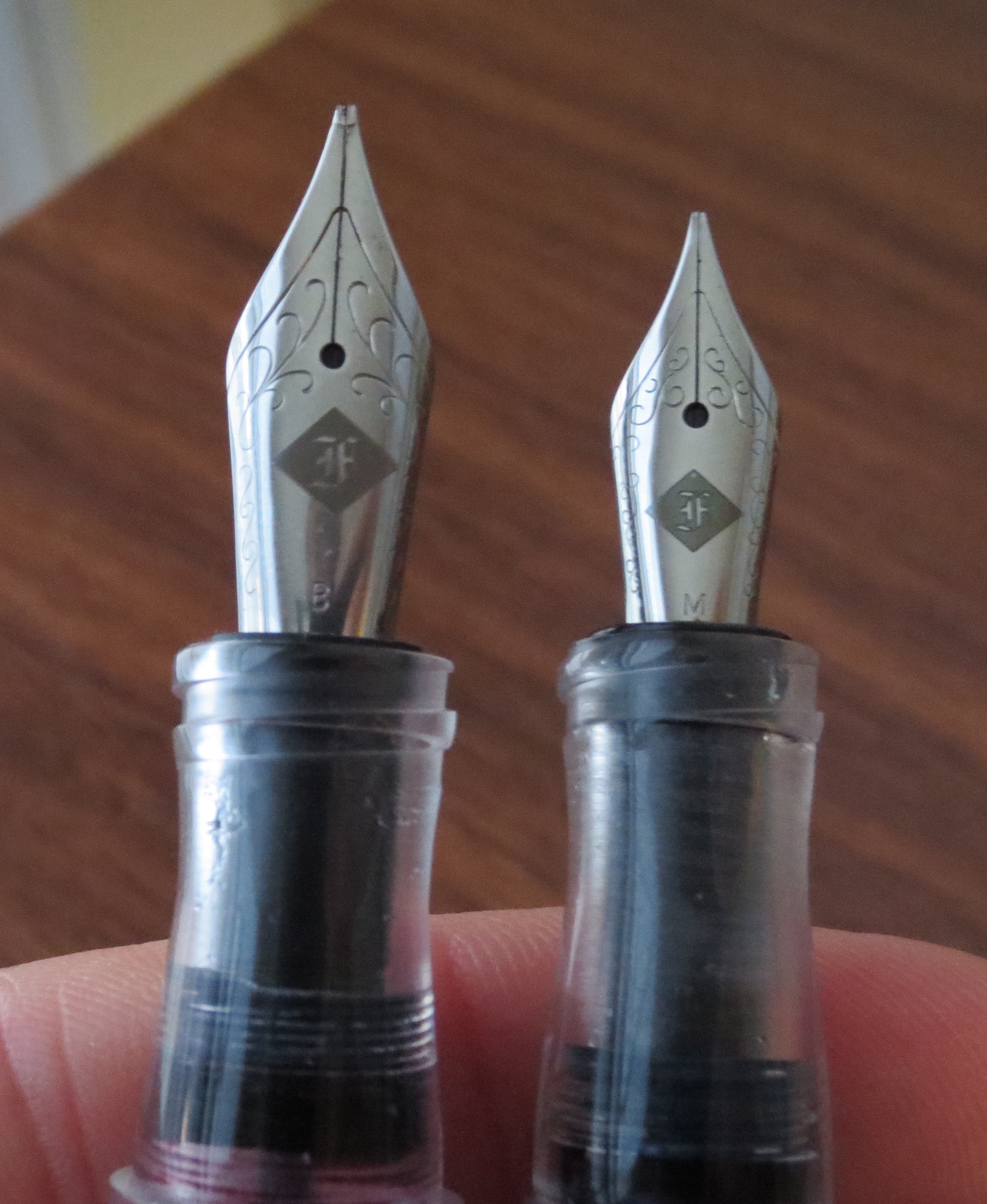
Cursive Italic.  A traditional "true italic" nib has little-to-no tipping material, is cut square across the tip, and has very sharp edges.  I've found sharp italic nibs very difficult to use for daily writing (as opposed to calligraphy) because the sharp edges snag the paper, and the lack of tipping material makes the nib prone to skipping unless the nib is held at exactly the proper writing angle.  A cursive italic nib captures most of the excellent line variation of an italic nib, but slightly rounded edges and a bit more tipping material makes it a better choice for daily writing.  The cursive italic has become one of my favorite nibs for use at work, in part because it's not as wet as a stub and therefore works better on cheaper grades of paper.  I have cursive italic nibs in various widths, ranging from .4mm (a fine) to 1.0mm (a broad).     

View fullsize Two Franklin-Christoph Nibs
View fullsize Franklin-Christoph Writing Sample

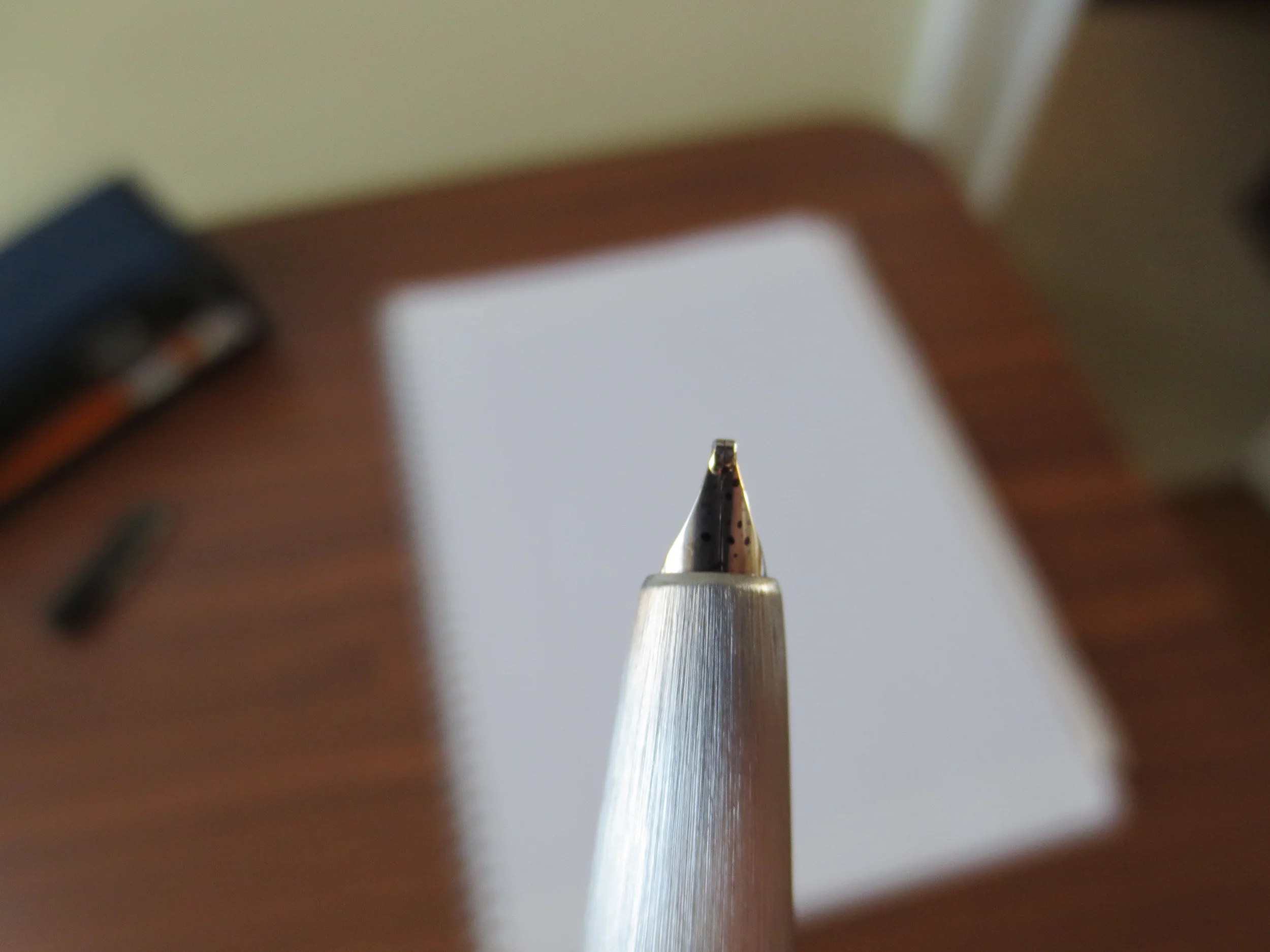
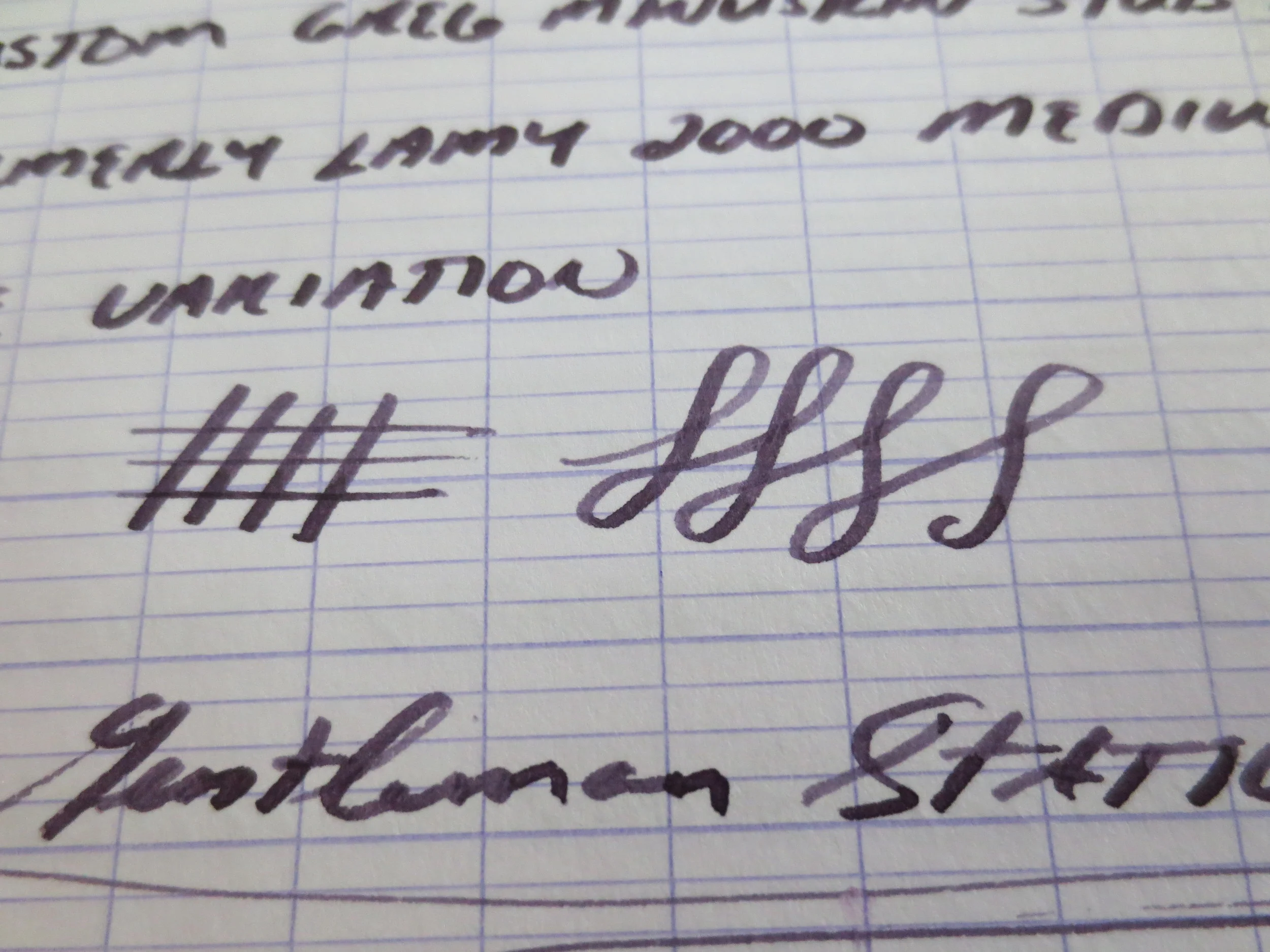
Stub. The stub nib is the most common "gateway" nib grind that people start with, in part because the difference between a stub nib and a standard round nib can be subtle. A stub nib is squared, like an italic, but generally has much more tipping material and the edges are even more rounded off than a cursive italic. The result is a nib that's very smooth to write with, but can be wet. For this reason, I find stubs hard to use on a daily basis at work because they bleed through the paper. 

View fullsize Lamy 2000 Stub Nib
View fullsize Lamy 2000 Stub Writing Sample

It may be helpful to think of Italics, Cursive Italics, and Stubs as steps in a progression, from "sharpest" to "smoothest" nibs, or from most to least line variation.  Italic nibs will have the most line variation, meaning that your horizontal cross-strokes will be much thinner than your down-strokes.  Cursive Italics will create almost as much line variation in your writing, but will be much easier to write with for most people due to the edges not catching the paper.  Stubs won't show as much line variation, but will also be noticeably smoother writers than both italics and cursive italics.   

Architect's Point/Hebrew Italic. Some traditionalists think the Architect's nib is "trendy" or a "fad" that will go the way of the dodo soon. I hope not. It's quickly becoming one of my favorite grinds.  An architect's nib is a stub or cursive italic "in reverse", meaning that it's ground to a wedge-shaped point.  As a result, your handwriting will have broad cross-strokes and narrow downstrokes.  The point is to mimic the script and writing style of architects and draftsmen.  I like this grind because it allows me to write fairly small while still giving my writing some personality.      

View fullsize Richard Binder Architect's Grind
View fullsize Architect's Grind Writing Sample

Needlepoint. A "needlepoint" is a nib that's been ground to a super-fine point. It's sometimes called a "Japanese extra fine" or "ultra extra fine".  I don't currently have any custom-ground needlepoint nibs in my collection, though I do have a Platinum Ultra-Extra fine stock nib that's been tuned by Mike Masuyama, and it's a favorite writer for note-taking and annotation. Needlepoint nibs are becoming increasingly popular.      

Gratuitous shot of me writing smaller than a penny with the Platinum Ultra-Extra Fine Nib.  I've not reviewed this pen, but I've done a "first impressions" Youtube review (linked below).

Where To Start with Nib Customization

My own adventures with custom nibs started at a pen show (the 2013 Ohio Pen Show, to be exact).  What I did - and what I recommend most people do - is start with a simple nib tuning.  You'd be shocked at how much difference these simple adjustments can make.  While most nib technicians accept work by mail, I've had the best results with in-person adjustments at pen shows.  Once you know what you like, and you've worked with a nib specialist a few times, then it's very easy to send work to them via mail.  If you can't get to a pen show, and have to send your pens off, nearly all nib technicians will work with you to get the pen writing exactly how you like it, though you may have to send it back and forth a time or two before it's "perfect".   

In terms of custom grinds, I started with stubs and then progressed to cursive italics.  As I mentioned above, the stub provides a gentle introduction to line variation, and once you get used to writing with a squared-off nib the cursive italic can really make your handwriting pop. But go slowly! Once you enter the world of custom nibs, it's tempting to get carried away and convert all of your old, "boring" nibs into stubs, needlepoints, etc., before you know what you like.   

I'll close by noting one option that's become increasingly popular:  Franklin-Christoph's Masuyama-ground JoWo nibs.  Franklin-Christoph has partnered with Mike Masuyama to offer a line of pre-ground stubs, cursive italics, and needlepoint nibs that can be fitted to pretty much any of the pens in their lineup for a slight upcharge, which is much less than the cost of having Mike grind a custom nib for you.  Granted, these nibs won't be ground or tuned specifically for you (unless you visit them at a pen show), but I've had very good results. Bonus:  Franklin-Christoph uses No. 5 and No. 6 JoWo nibs, which are interchangeable with other JoWo-compatible pens like Edison and Bexley.     

For further reading, you can visit the websites of any of the nib technicians linked above.  Most of their web pages contain excellent descriptions of the various services and grinds they offer. I don't claim to have discussed all of the available customizations out there: there are many, and learning and trying all of them is the fun part of the journey!  Enjoy!

Disclaimer:  The pens pictured in this article are pens from my own collection.  

In Editorial Tags Custom Nibs, Nib grinding, Stub Nibs
2 Comments
← Newer Posts Older Posts →
Store Hours and Location
Visit the T.G.S. Curated SHOP
*New* Updated "Best Pens" Guide (2025)
T.G.S. 2025 Holiday Gift Guide
TGS x Roterfaden TGS_25
Hierarchies of Fountain Pen Friendly Paper

Join Our Patreon!
Subscribe to the TGS E-mail List

Featured Posts

Featured
Cover On the Paper Trail Intro Clip.jpeg
Dec 3, 2025
Introducing "On the Paper Trail," a New Podcast/Video Collaboration with Lisa Vanness of Vanness Pens!
Dec 3, 2025
Dec 3, 2025
Iro-Utsushi-Fine-Dip-Pens.jpeg
Oct 1, 2025
The Pilot Iro-Utsushi Dip Pen (and in General, Simple vs. Fancy Dip Pens)
Oct 1, 2025
Oct 1, 2025
Levenger-Annotation-Pad.jpeg
Sep 20, 2025
Five Boutique Paper Brands I'm Watching Closely and Why
Sep 20, 2025
Sep 20, 2025
The Gentleman Stationer RSS

© Digital Divide Media, LLC, 2014-present.

All content is the exclusive property of Digital Divide Media, LLC, d/b/a The Gentleman Stationer, including “The Gentleman Stationer” website and trademark, and should not be reproduced without express written permission.  All rights reserved.

All content containing paid advertising, affiliate links, or sponsored content will be plainly disclosed by a disclaimer when/if featured.

Contact Information

Store Shipping Policy and Return Policy

Privacy Policy

Cookie Policy

Terms and Conditions

Powered by Squarespace