• Blog
  • Shop
  • Podcast
  • Resources
  • About
  • Archive
  • Contact
  • Cart
  • Sign In My Account
Menu

The Gentleman Stationer

Vintage Living in the Modern World.
  • Blog
  • Shop
  • Podcast
  • Resources
  • About
  • Archive
  • Contact
  • Cart
  • Sign In My Account

Water and White Lightning: Fixing High Maintenance Inks

September 18, 2019

For years I avoided certain ink brands, namely Noodlers and Private Reserve, not because I actually believed those inks would destroy or “melt” pens, but because of batch inconsistency and the fact that many of the inks bled and feathered on all but the thickest coated paper. Others never dried, remaining tacky and subject to smearing for up to a week or more. I would get frustrated and give up, selling or giving away the bottles I had accumulated.

With nearly a decade in this hobby under my belt, I’m slightly more patient than I used to be, and writing this blog has provided me with the opportunity for experimentation. Noodlers makes a wide range of vibrant and unique colors, and most of the inks are so saturated with dye that you can add a couple drops of water or ink additive to improve the ink’s behavior without changing the color significantly or sacrificing vibrancy. The only caveat is that by diluting the ink, you run the risk of compromising special properties such as “bulletproofing” (permanence/water resistance) or quick-drying. I generally don’t purchase inks for these reasons, however, other than a couple water-resistant inks I keep in my collection, and I’ve found that most aren’t significantly affected by a drop of dilution.

Noodler’s Walnut has always been a favorite of mine, but I’ve had trouble with feathering and slow dry times if I use the ink undiluted. How did I fix it? Read on below.

So How Do I “Fix” Problematic Noodlers Inks?

I’ve found that certain Noodlers Inks that are prone to feathering, bleeding, and extremely slow dry times work better with 1-5 drops of water added to a 5ml sample vial. Inks such as Air Corps Blue Black and Walnut are great colors, but sometimes bleed, feather, and smear on cheaper paper, or take a long time to dry on fountain-pen friendly paper like Clairefontaine, Rhodia, or Tomoe River.

Writing Samples of Noodlers Walnut, Air Corps Blue Black, and Shah’s Rose, three colors that behave extremely well with a touch of water (Walnut, Air Corps) or a tiny drop of White Lightning (Shah’s Rose).

On the other hand, for inks that are too dry, I take the same amount of ink (5ml in a sample vial) and add a tiny drop of Vanness Pens “White Lightning” ink additive. You might remember a version of this product when it was sold by Organics Studio, under the moniker “Cuddles Flo Plus”, but Vanness acquired the formula after Organics Studio discontinued it and are now bottling the product directly. White Lightning is intended “for use in poor flowing or dry inks to increase flow consistency,” and the product really does work. I can’t emphasize enough, though, that you should use this product sparingly, and do not add directly to the bottle unless you are extremely sure of the amount. Use too much and you can turn a dry ink into the inverse: an ink that feathers, bleeds, and never dries. I’ve had success using White Lightning to improve the flow of drier Noodlers Inks such as basic Noodler’s Black, 54th Massachusetts, and Shah’s Rose. I’ve also spoken with other people who swear that White Lightning improves extremely dry inks such as certain Kyoto TAG inks, as well as Platinum’s “Classic” series of Iron Gall inks.

One of the great things about Noodlers is that the bottles come filled to the brim. (Just be careful opening them for the first time.) I’ve actually heard some people describe the full bottle, the super-saturation, and the need to dilute certain colors as a “bonus,” because it makes the bottle last a very long time.

Takeaways and Where to Buy

Noodlers Ink is widely available from most pen retailers, and the bottles pictured here were supplied by site sponsor Pen Chalet. What I’ve discovered over the years is that Noodlers makes “tinkerer’s inks.” If you don’t mind playing around with the formulation, you can better enjoy the wide range of colors and properties that the brand has to offer. White Lightning Ink Additive can be purchased from our sponsor Vanness Pens, and is a product exclusive to them. This unique product really does work, and if you have a large ink collection that includes colors you love but can’t use due to how the inks themselves behave, consider experimenting with water dilution or additives to tailor the inks to your preference.

Disclaimer: The inks and ink additive were provided to me free of charge by my sponsors, for review purposes. Many thanks to Pen Chalet and Vanness Pens for making this review possible!
In Ink Reviews, How To Tags Ink, Ink Review, White Lightning, Noodlers Ink, Vanness, Modifying Inks
2 Comments

A Vintage Gateway? Wing Sung 601 "Vacumatic" Filler

September 15, 2019

Longtime readers of this blog know that despite my primary focus on the “high-end” segment of the fine-writing industry, I have a soft-spot for bargains, especially if I find a sub-$20 pen that outperforms pens costing 3-5 times as much. Over the past year, brands such as Moonman and PenBBS have moved to the top of my list quality-wise, but it’s hard to dismiss Wing Sung. But before you write the Wing Sung 601 off as yet another cheap Chinese Parker 51 clone like those that used to sell on eBay at $5 for a pack of 6, let me assure you that all of the recent Wing Sung Pens I have tested, including not just the 601 but also the 618 piston filler, have performed exceptionally well.

The last Wing Sung pens I reviewed were the Wing Sung 618 and the 698, both piston fillers that have proven to be quite durable, despite their all-plastic construction and low price point. I still use them regularly, and my two 618 pens in particular are regularly inked. Enter the Wing Sung 601, which is a bit of a throwback to the late 2000s when Chinese pen companies flooded eBay with extremely inexpensive Parker 51 clones (more on that below), only this pen is of much better quality and uses a pump-filling “vacumatic” filling system.

Yes, you heard that right! You can now purchase a vintage-style “vacumatic” fountain pen for less than $20. And it’s far from a terrible pen. The Wing Sung 601 uses the same stainless steel hooded nib that you find on the 618. Because vacumatic/pump-filler fountain pens use the pen’s barrel as an ink reservoir (like an eyedropper), I actually find that the 601 writes a smoother, wetter line than the 618, even if the nib is still technically a fine/extra fine in width.

The downsides to vacumatic-style fountain pens are (1) they’re a pain to clean, and (2) the rubber sac/diaphragm attached to the pump will eventually wear out, probably every 2 years or so depending on how frequently you use the pen and your choice of inks. With my vacumatics (either true vintage pens or vintage-inspired modern pens), I choose one or two inks - typically a black, blue, or blue-black - to use in the pen, and stick with those colors so that I don’t have to worry about cleaning the pen to a pristine state. With respect to repairs, many people will likely choose to use a $20 pen until it breaks and then toss it in the garbage. However, I think that the Wing Sung 601 presents a low-risk opportunity to learn vacumatic repair/sac-replacement, and some eBay sellers are even offering replacement filling mechanisms.

A note on Chinese companies’ fixation with the Parker 51: Hero and Wing Sung have been producing pens “inspired by” the Parker 51 since at least the 1960s, with varying degrees of quality. It doesn’t take a vintage expert to recognize that these are NOT real Parker 51 pens, in that they don’t say “Parker” anywhere on them, though they do sport an “arrow clip.” I won’t engage in an extended discussion of the history between Parker and Hero/Wing Sung, because that’s been done elsewhere, but the conventionally accepted story is that the Chinese government nationalized a Parker factory in Shanghai at some point in the mid-20th century, and Hero (which I believe owned/owns Wing Sung) has been churning out Parker 51 clones ever since. You can read more about the current status of the Wing Sung brand, and a bit more history, at Frank’s comprehensive Chinese Fountain Pen blog, Frank Underwater.

View fullsize Wing Sung 601 Unposted
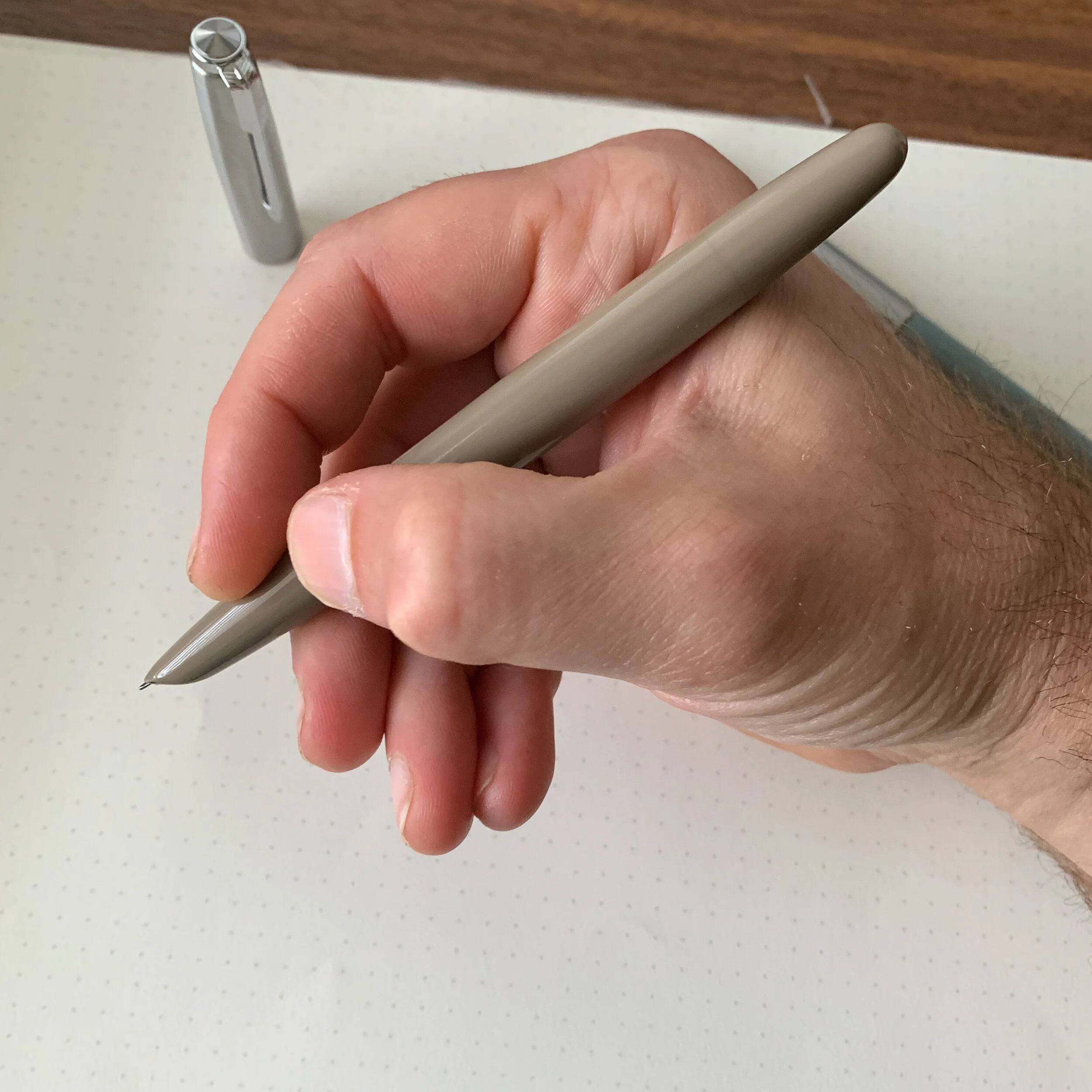
View fullsize Wing Sung 601 Posted
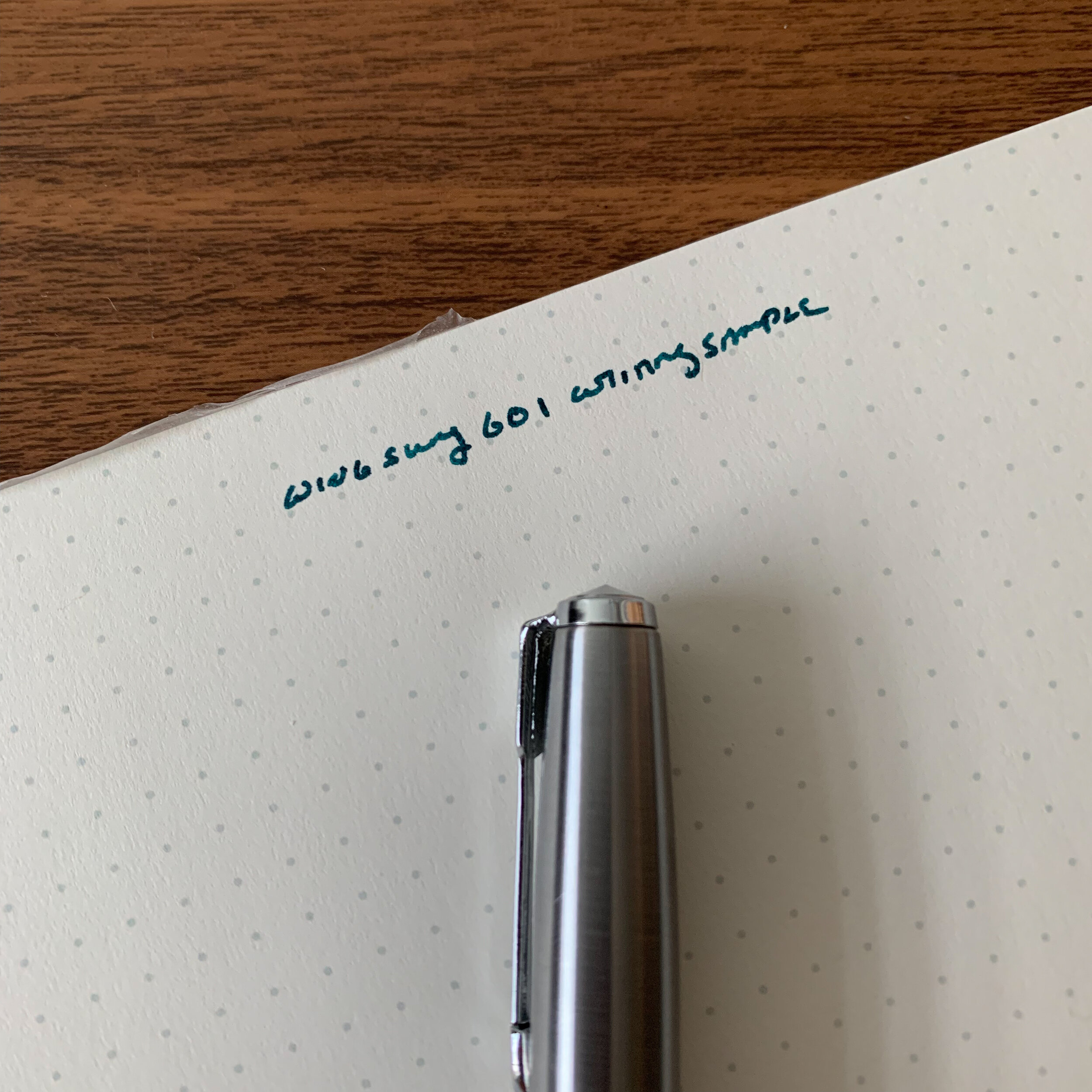
View fullsize Wing Sung 601 Writing Sample

Takeaways and Where to Buy

While a $15-20 Wing Sung pen is never going to replace an authentic vintage Parker 51 in either beauty or quality, the 601 is an inexpensive, low-risk introduction to this style of pen, particularly the vacumatic-style filling system. If you are on the fence as to whether or not you want to spend $100+ on a properly restored Parker 51, give one of these Wing Sung pens a try to see if you enjoy the shape and style. It’s a close-enough approximation, and even if you decide you don’t want to take the plunge, you have a competent everyday writer that didn’t cost a lot of money.

Wing Sung pens, including the Wing Sung 601 pens pictured here, are widely available on either eBay or Amazon. On eBay, I’ve purchased pens from Seller art-pen-book-dy, and also from Amazon, where pens are generally come with free Prime Shipping. One other thing to note is that some eBay sellers are offering replacement filling systems for as little as $2.99. This is doubly interesting to me because not only is it a cheap and easy fix for a broken Wing Sung 601, but it raises the question of whether this mechanism could be used to fix a broken Parker 51 Vacumatic, since original mechanisms are no longer in production.

Disclaimer: This post contains affiliate links. I purchased the pens featured in this review with my own funds, for my own use.

In Pens Tags Wing Sung 601, Wing Sung, Vacumatic Filler, Pump Filler, Chinese Pens
6 Comments

New Notebook Alert: Yoseka Stationery

September 11, 2019

My friend Cary Yeager - of both Fountain Pen Day and Kenro fame - introduced me to this notebook at a pen show earlier this year. I can’t remember exactly which one, but I believe it was the Arkansas Pen Show in Little Rock. A few weeks later, this sample notebook showed up in the mail from Yoseka Stationery, and I have to apologize for how long it’s taken me to do a review, especially since this is such an interesting product. Cary explained to me that the owners of Yoseka Stationery had just opened a brick-and-mortar shop in Sunnyside, Queens, and had designed this notebook from scratch after sourcing the paper from Taiwan.

You can read the full description here on the Yoseka website, but in short this notebook contains 85gsm “KBU2” paper from Conifer, a Taiwanese company that has been around since 1955 and apparently experiments quite a bit with different paper properties. Yoseka chose this particular paper because “it encourages a quick dry and it perfectly reflects the sheen of the pen ink with minimal bleeding.” Since the paper is fairly absorbent, it does dry quickly, with no smearing once the ink is dry - something those who love “sheeny” inks will appreciate since many of those tend to smear even days later.

I had minor issues with bleed-through in the Yoseka notebook, but I’m beginning to suspect that the primary culprit is one particular ink (Lamy Crystal Peridot), which has been temperamental on several different papers. I experienced serious bleed-through with that ink on a Rhodia pad.

The design of the notebook itself merits some discussion. Yoseka uses a plain “cement grey cardboard hardcover”, which reminds me of the thick chipboard covers used on the Doane Paper notebooks, as well as a “naked binding” that shows off the stitching and gluing. Yoseka describes the cover and binding as “durable,” but that characterization will, of course, depend on how hard you use your notebooks. Fans of minimal design will like the look, and the binding allows the notebook to lay completely flat.

A true lay-flat binding!

Takeaways and Where to Buy

Yoseka Stationery makes a nice notebook featuring a simple design and durable construction. This notebook also contains a lot of paper, which should handle most fountain pen inks relatively well and show off any inks that sheen. I’d offer a note of caution for those who anticipate writing on both sides of the page with very wet nibs and inks, as you might experience a touch of “pinpoint” bleedthrough (pictured above). Otherwise, this notebook should meet most people’s needs, and generally has been well-received by fountain pen users.

You can purchase the Yoseka Notebook directly from Yoseka Stationery in Queens, New York, either via their online store or in person at their brick-and-mortar location in Sunnyside. It’s reasonably priced at $20, and I definitely plan to make a visit when I’m in New York City next month (along with visits to my other favorite NYC stationery shops)!

Disclaimer: The notebook featured in this review was sent to me free of charge by Yoseka Stationery. Many thanks to them for making this review possible!

In Notebook Review Tags Notebooks, Yoseka Stationery, Yoseka, Taiwanese Paper, Notebook Review
Comment

Pen Review: Karas Kustoms Vertex Fountain Pen

September 7, 2019

While I wasn’t one of the lucky ones able to snag an original Vertex prototype when Karas teased the pens late last year, I admired them from afar and have been waiting for their wider release. Earlier this summer Paul from Karas Kustoms contacted me and asked whether I would be interested in reviewing the finished product. I received for review a Vertex in limited run “Galeocerdo” acrylic, which I would describe as a multi-toned metallic silver material that I hope makes its way into regular production at some point. As for the pen itself, overall I’m impressed with what Karas has done, but the Vertex still has some issues that give me reservations about issuing an unqualified recommendation. Read on to learn more.    

As always, Karas Kustoms gets creative on their packaging. My Vertex shipped in this machined aluminum box, with a foam insert to protect the pen.

Vintage-Inspired Design and Maximum Writing Comfort

Let’s start with what I really enjoy about the Vertex: the look of this pen and how comfortable it is to use for long periods of time. Karas has carried over the vintage design aesthetic from its previous “Signature” release, the Decograph, into a shorter, chunkier pen that I prefer. (While I enjoyed testing the Decograph, over time I found the pen slightly too long posted.) The long, concave section on the Vertex is outstanding, and in addition to comfort you can modify the look of your pen by swapping in a section made from a different color acrylic. Karas sells replacement sections separately, so you can purchase more than one. 

The metallic shimmer on the Galeocerdo acrylic makes me want to see more of this material. Hopefully the initial run was not a one-off.

As an acrylic pen that uses a cartridge-converter/eyedropper filling system (more on that below), the Vertex weighs next to nothing. For me, the pen has the best balance when posted, and I happily used this pen for three full days of work drafting and annotating documents longhand. The cap posts securely, and the lack of threads on the long section makes the Vertex a great choice for those who, like me, tend to adjust their grip higher or lower as I write, and don’t always hold the pen the same way. While the section is smooth, it has enough texture to provide a good grip, and I had no issues with slippage even after long writing sessions. 

Here, you can see (1) the transparent acrylic section, which is slightly concave; (2) the ink window; and (3) the o-ring embedded in the section to prevent leaking through the front of the pen.

One interesting design choice that I ended up enjoying was the decision to make the top of the cap concave.

View fullsize Karas Kustoms Vertex Unposted
View fullsize Karas Kustoms Vertex Posted

Optimized for Eyedroppering

Karas designed the Vertex as an “eyedropper” fountain pen, meaning that the pen’s barrel can be used as an ink reservoir without resorting to a cartridge or converter. That’s both a blessing and a curse. On the plus side, used as an eyedropper, the Vertex holds a massive amount of ink so you can avoid refilling frequently. Aesthetically, filling the barrel with ink also allows the transparent section to function as an ink window, a conscious design choice and my clear preference since a visible cartridge or converter would, in my opinion, destroy the beauty of the pen. The Vertex incorporates custom fit o-rings into the barrel and section so that the pen ships “eyedropper-ready,” with no need to add silicone grease to seal the threads. The cap also features an o-ring, which creates a seal that not only keeps the cap closed or posted securely, but should prevent ink from leaking out in the event there is a spill in the cap. Which brings me to…. 

The downside of this design. The main flaw in the Vertex is that the o-ring on the interior of the cap can create pressure that draws ink out of the nib and feed when you uncap the pen. To avoid any issues, Karas recommends that you uncap the pen with the nib pointed up. I would add that you should try to uncap the pen as slowly as possible, and to avoid using the cap as a fidget toy, which I confess to sometimes doing with my slip-cap pens. But even exercising as much care as I possibly could, I still ended up with ink on the section, in the cap, and on my hands on multiple occasions, with the problem getting worse after I had transported the pen in my bag to and from the office, where changes in air temperature likely increased the tendency to burp ink. I will note this temperature issue is a problem inherent in most eyedropper fountain pens, unless they incorporate a valve or seal like those found in high-end Danitrios or on the Opus 88 line. I would not recommend using the Vertex as a “pocket” eyedropper, or in a desktop pen-holder such as the Good Made Better Penwell where the pen would stored with the nib facing down.    

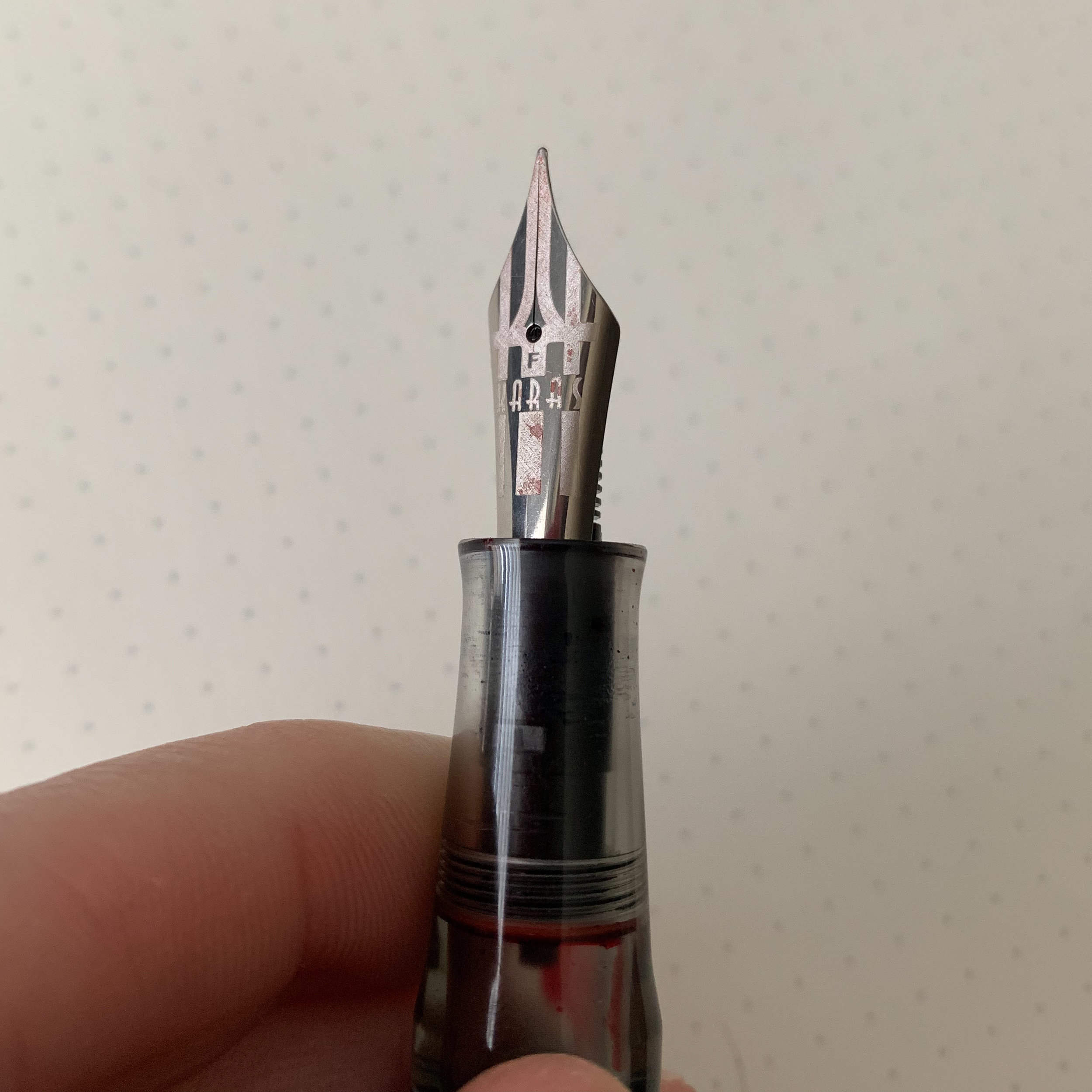
Karas Kustoms went above and beyond on the nib engraving. I love the new logo.

Karas Kustoms went above and beyond on the nib engraving. I love the new logo.

Quality Control on Bock Nibs Remains a Head-Scratcher

Karas Kustoms uses Bock nibs on the Vertex. There’s nothing wrong with Bock nibs per se. If you get a good one, they can be exceptionally nice writers. The nibs on my Conway Stewart Model 100 and both of my Faggionato pens are great examples of how a properly tuned Bock nib can equal most any other writing experience. On the other hand, however, Bock nibs are somewhat notorious for their inconsistency, and I guess I was due to take a hit after I’d had a long run of good draws. The first nib on my Vertex didn’t write at all, whether the pen was eyedroppered or whether I used the included converter. Paul quickly sent me another one - Karas customer service is excellent - and the second nib had a tendency to hard-start with a converter but wrote perfectly well when eyedroppered. The issues with the Bock nibs don’t move me one way or another on this specific pen: While I probably prefer Schmidt or JoWo, many pen brands source their nibs from Bock and unfortunately sometimes you just have to work with your retailer until you find one that’s satisfactory. A good thing about Bock nibs is that they’re easily interchangeable.     

From left, for size/shape comparison purposes: the Lamy 2000 fountain pen, the Karas Kustoms Vertex, and the Franklin-Christoph Model 20.

Takeaways and Where to Buy

I’m all-in on the direction in which Karas is moving with their pen design. I’ve thoroughly enjoyed testing out their last two “Signature” releases, the Vertex and the Decograph, and I would probably give the edge to the Vertex in terms of aesthetic design due to how comfortable this pen is in the hand and how well it posts. In their Signature line, Karas seeks to evoke the shape of classic Parker and Sheaffer pens, and the Vertex definitely has the feel of a Sheaffer Legacy or PFM. 

That said, the tendency for the Vertex to burp ink gives me pause as to whether I could use the pen as a true daily writer, which I really want to do because it’s such a comfortable pen for long sessions. I’m not sure whether anything can actually be done to mitigate the issue - it’s an eyedropper fountain pen after all, and the design of the Vertex doesn’t lend itself to easily incorporating a seal or valve. For the time being, I’m going to continue to use the Vertex and see whether the issue resolves itself as I get a better feel for how to cap/uncap the pen without causing an “inksplosion.”  

The Vertex featured in this review is the limited run “Galeocerdo” acrylic version, which is not currently available for sale on the Karas website. Production line versions of the Vertex are available in black and dark green acrylic, as well as black and white Delrin. As noted above, you can purchase different color clear acrylic sections to customize your pen, and choose from steel, titanium, and 14k gold Bock nibs. The Vertex starts at a more than reasonable $130 for a pen with a steel nib, with the price increasing if you opt for titanium or gold. (The $80 upcharge for a gold nib still allows the Vertex to remain a reasonably priced pen.)

Disclaimer: I received the pen featured in this review from Karas Kustoms, free of charge for review purposes. Many thanks to Paul and the team at Karas Kustoms for making this review possible.

In Pens Tags Karas Kustoms, Pen Review, Karas Kustoms Vertex
1 Comment

Pen Review: Aurora Vintage Duo-cart Fountain Pen

September 4, 2019

In 2017, Aurora teased a reissue of their vintage Duo-cart fountain pen, only to withdraw it from the market in order to fix some minor design flaws. While I owned one of the 2017 Duo-carts, and enjoy the pen, I held off on publishing a formal review until Aurora could perfect the design, namely the friction-fit cap which had a tendency to come loose on the original iteration of the pen. After what turned out to be a bit of a wait, Aurora re-released the Duo-cart this year as part of their “Archivi Storici” lineup, which is the name the company gives to modern versions of vintage pens reissued from the Aurora archives. The result? This one’s a hit and merits the attention of those who desire vintage style without the fuss of writing with an actual vintage pen.  

I tend to ignore packaging, but the delivery on Aurora’s “Archivi Storici” line is top notch. As shown in the “open-box” view below, you get a bottle of ink, converter, and cartridges along with your pen - everything you need to get writing straight away.

Aurora’s hooded nibs are slightly different than those on the Lamy 2000 or the Parker 51. They’re less streamlined and a bit “chunkier,” for lack of a better term. I don’t dislike the look - the Duo-cart is, and was intended to be, a workhorse pen and it looks the part.

Pros: A hooded nib and a highly usable vintage-inspired design.

What do I like about the Duo-cart? It’s a well-built modern workhorse with vintage looks. This combination of style and comfort nearly always lands a positive review here at TGS.

  • A Hooded Nib. Anytime a pen company releases a pen with a hooded nib, it catches my attention immediately. The Duo-cart’s stainless steel nib is stiff and has a touch of Aurora’s signature tooth, which makes for a tactile writing experience, without being scratchy. (It’s hard to describe, but those who have written with an Aurora pen know what I’m talking about - almost like writing with a pencil.) I would characterize the nib as a moderately wet “Western medium,” though that will vary somewhat depending on what ink you use.  

  • True Vintage Styling. In addition to the hooded nib, the Duo-cart features several other vintage-inspired design touches, drawn directly from the Aurora archives. My personal favorites include the “linear guilloche” cap, and the classic “Aurora Made in Italy” script around the base. 

  • Good Balance and All-Day Writing Comfort. What I enjoy most about the Duo-cart (as well as other vintage and vintage-inspired pens) is the fact that the pen was designed in an era when fountain pens were intended to be used as a daily writing tool akin to your keyboard. Therefore, comfort is key. The section is long and provides ample room to grip the pen, and since the Duo-cart uses a friction fit cap there are no sharp threads to interfere with your grip or dig into your hand. The pen is similar in size to the Lamy 2000 or the Parker 51.

The engraved streamline cap looks great - almost like pinstripes. With this release, Aurora introduced navy, light green, and light blue versions of the Duo-cart alongside the black and burgundy versions from the initial release. The light green (shown here) has the most “vintage” feel of any of them, in my opinion.

Cons: You can have your nib in any size you want, as long as it’s medium.

There isn’t much that I dislike about the Duo-cart, but those considering a purchase should note a couple of things: 

  • Posting. The main issue that I still have with this pen, even after the reissue, is that the cap sometimes fails to post securely. On a couple of occasions, I’ve had the posted cap go flying across my desk at work when I turned around or moved my arm suddenly. Not an issue for those who don’t post their pens, but it can be a bit of a problem for me unless I remember to jam the cap down pretty hard on the back of the barrel.

  • Nib Size. What’s the cliche? You can have it in any size you want, as long as you like medium? I imagine this choice had to do with the scale and cost of production on the hooded nib, which is specific to this pen, so Aurora went with its most popular nib option. My two Duo-carts are somewhat wet writers, so those looking for a fine or extra-fine line will probably need to invest in a nib grind.   

In keeping with its name, the Aurora Duo-cart uses a cartridge-converter filling system.

View fullsize Aurora Duo-cart Unposted
View fullsize Aurora Duo-cart posted

Takeaways and Where to Buy

The Duo-cart is my first foray into Aurora’s “Archivi Storici” editions, and given how much I’ve enjoyed this pen I look forward to more of these releases in the future. (I also plan to dig around on eBay and see if I can unearth some of the previous Archivi Storici editions, which include a re-release of the vintage-style Aurora 88.) I support pen companies reissuing modern versions of their vintage pen designs, since it caters to those of us who appreciate the classic fountain pen styles, yet don’t necessarily want to deal with using a higher-maintenance vintage pen on a daily basis.

You can purchase the Aurora Duo-cart at most Aurora retailers, including our site sponsor Pen Chalet. Aurora has set MSRP at $195 for this pen, with most retailers pricing it around $156. I don’t have any issues with this price point. The Duo-cart looks high-end, the pen is well-made, and you have to account for the time and expense of resurrecting a vintage pen from the archives that’s been out of production for years. The $150-200 price bracket is competitive, however, and Aurora is going nose-to-nose with other excellent steel-nib pens such as the Esterbrook Estie, the Leonardo Momento Zero, and the Pelikan M205. The Duo-cart’s hooded nib distinguishes it from these pens, but for around $20 more you can purchase the Lamy 2000, which also features a hooded nib, but in 14k gold with a piston filler. The design aesthetic is distinct enough, however, that the Duo-cart will likely carve out its own niche.

Editor’s Note: The dark teal ink shown in this writing sample is a limited edition collaboration between Pen Chalet and Colorverse, “Monsoon Storm.” This particular Colorverse ink includes two different colors, a 65ml bottle of Monsoon Storm and a 15ml bottle of an orange-gold color called “Monument Valley.” I may do a stand-alone review of both inks but since these are limited edition inks that may sell out I figured I would post the details here. Currently, this ink is listed at 30% off and on sale for $25. 

Disclaimer: This post contains links to paid sponsors and affiliates. I acquired this pen using store credit generated through my participation in Pen Chalet’s affiliate program.

In Pens Tags Aurora Archivi Storici, Aurora Duo-cart, Vintage, Pen Review
Comment
← Newer Posts Older Posts →
Store Hours and Events
Shop T.G.S. Online
Updated 2026 "Best Pens" Guide
No results found
On The Paper Trail: Live In Nashville Event Tickets Now Available!
TGS_25 Roterfaden Restock Notification
Hierarchies of Fountain Pen Friendly Paper

Join Our Patreon!
Subscribe to the TGS E-mail List

Featured Posts

Featured
Pilot-Custom-Heritage-92.jpg
June 6, 2026
Workhorse Pens: Pilot Custom Heritage 92 Fountain Pen
June 6, 2026
June 6, 2026
Kakimori-Inkstand-Before.jpeg
May 30, 2026
Japan Trip Journal: A Visit to Kakimori, Including Custom Notebooks and the InkStand!
May 30, 2026
May 30, 2026
Five-Foundational-Fountain-Pens.jpeg
April 22, 2026
T.G.S. 12th Anniversary: 5 Fountain Pens Everyone Should Experience
April 22, 2026
April 22, 2026
The Gentleman Stationer RSS

View Cart

© Digital Divide Media, LLC, 2014-present.

All content is the exclusive property of Digital Divide Media, LLC, d/b/a The Gentleman Stationer, including “The Gentleman Stationer” website and trademark, and should not be reproduced without express written permission.  All rights reserved.

All content containing paid advertising, affiliate links, or sponsored content will be plainly disclosed by a disclaimer when/if featured.

Contact Information

Website Terms and Conditions

Store Shipping Policy and Return Policy

Privacy Policy and Cookie Policy

Accessibility Statement

Powered by Squarespace