• Blog
  • Shop
  • Podcast
  • Resources
  • About
  • Archive
  • Contact
  • Cart
  • Sign In My Account
Menu

The Gentleman Stationer

Vintage Living in the Modern World.
  • Blog
  • Shop
  • Podcast
  • Resources
  • About
  • Archive
  • Contact
  • Cart
  • Sign In My Account

Notebook Review: Oxford USA Hardcover Journal

December 18, 2019

Those of you who spent your youth (and let’s be honest, still spend their adulthood) stalking the aisles of stationery stores will probably be familiar with Oxford, a brand with a reputation for making high-quality stationery that’s attractively priced and widely available. A representative for Oxford’s parent company reached out several weeks ago to ask whether I’d be interested in reviewing their new hardcover notebook/journal. Oxford has partnered with Monadnock, one of the oldest family owned and operated paper mills in the U.S. According to the contact who sent me the journal, this book is entirely sourced, printed, and bound in the U.S.A.

Since this journal is bound like a regular hardcover book, it won’t lay flat, but it’s sturdy and will last for quite some time.

The Oxford USA Journal contains 192 pages of the aforementioned Monadnock paper, in a Smyth-sewn binding with a charcoal grey, hardback linen cover embossed with an American flag logo. It has a sturdy, well-made feel to it, and the super-picky among us will be glad to know that the end of the ribbon bookmark appears to be heat-fused to reduce fraying. It’s a tastefully designed notebook/journal that I would have no problem carrying anywhere, including at work.

A bit more background information is included inside the back cover.

But of course, as with any higher-end notebook, what everyone wants to know about is how the paper performs with various inks and fountain pen nibs. The answer: Surprisingly well, and better than expected. I tested the paper with a Retro 51 rollerball (.7mm Schmidt refill), a Lamy 2000 EF nib, and a Sailor fine nib, and while there was some show-through with very minor bleed-through, I could still use both sides of a page. A wet Graf von Faber-Castell medium nib pushed the paper a bit too far, and feathering/bleed-through became an issue. If I had to make a comparison, I would equate the performance to the heavier-grade paper used in certain Field Notes editions like “Lunacy” or “America the Beautiful.”
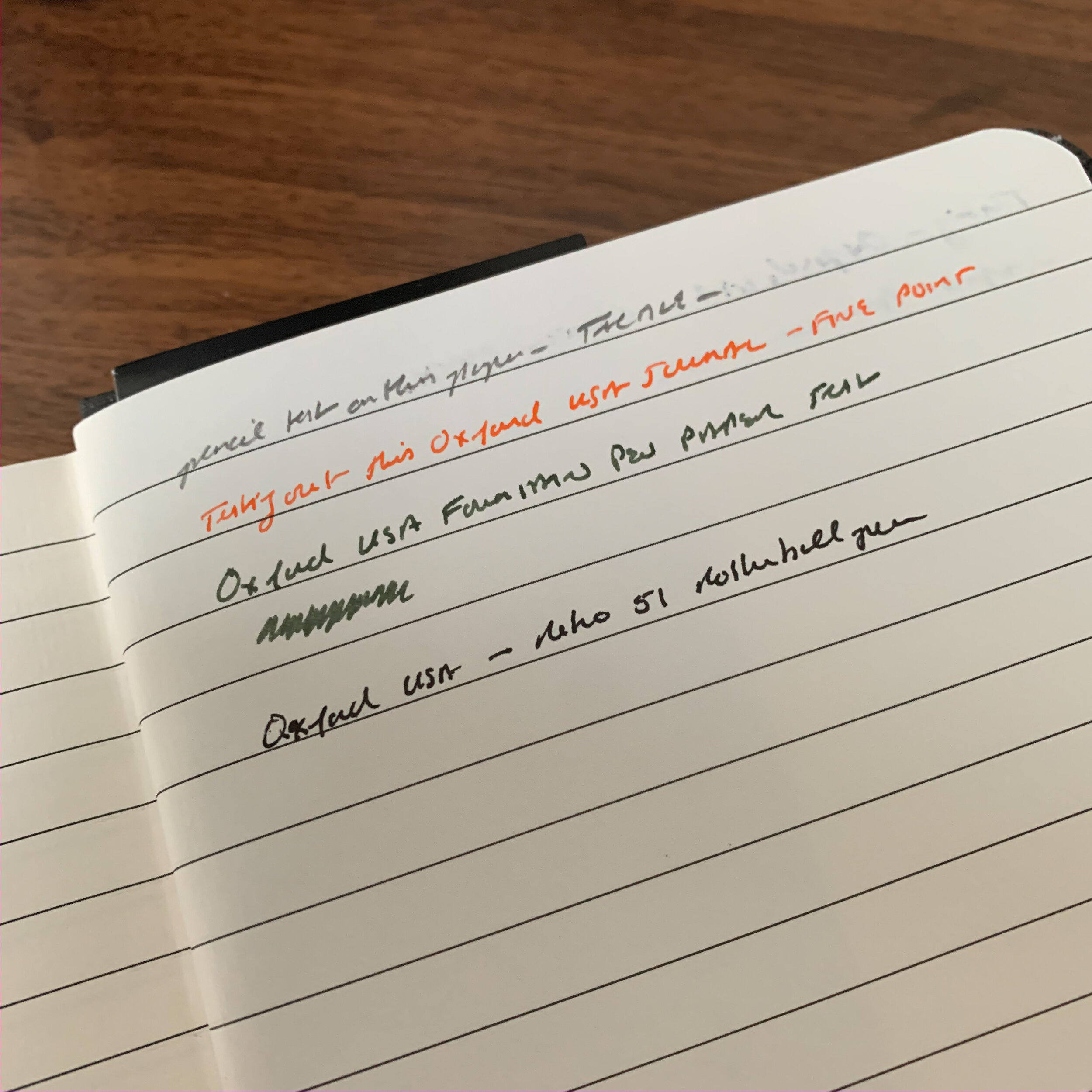
View fullsize Writing Sample
View fullsize Writing Sample: Reverse Side

Takeaways and Where to Buy

Oxford apparently shares common ownership with TOPS stationery (maker of the famed “Double Docket” legal pad), which makes me hopeful that this notebook will receive a wide release. If this journal were to appear at Staples, Target, etc., I’d venture that it would do really well. The cover feels solid and the paper will meet the needs of the overwhelming majority of people. I do wish the ruling were slightly narrower and not quite as dark, but that’s a personal preference.

Currently the only place I’ve been able to locate these notebooks for sale is Amazon, and even there they appear to be sold through third-party office supply wholesalers. Priced at just under $20 (shipping included), this seems reasonable for a quality hardbound notebook. I plan to keep my eye out for this notebook in stores in the coming year. Curiously, these books are not yet featured on the TOPS website, which leads me to believe that they have not yet officially launched. Many thanks to Oxford for sending me this product and making this review possible!

Disclaimer: Oxford USA sent me this journal for review purposes, free of charge. This post contains affiliate links.

In Notebook Review Tags Notebooks, Oxford USA
1 Comment

Last Chance to Grab One: Aurora 88 Sigaro Blu

December 14, 2019

I’m in a strange place with my fountain pen hobby and with this blog. Though I’ve certainly not reviewed everything thoroughly, I’ve had the opportunity to at least write with most of the major pen brands’ flagship models. If I’m honest with myself, this realization take a little bit of the fun out of the whole experience. Things don’t feel as new, and I have to work harder to get interested in new releases, and rarely get excited about yet another Sailor Pro Gear or Aurora 88 special edition. It takes something pretty special.

These days, many so-called limited editions are basically “skins” - the exact same pen with a different barrel color or material. Sure, changing up the acrylic and trim can drastically alter the look of the pen, but it rarely changes my overall opinion on the usability or functionality of the pen. That’s why it’s uncommon for me to re-review pens based solely on changes in appearance, unless I really didn’t like the look of the pen the first time around or the company makes a particularly drastic change. For example, I recently re-reviewed the Pelikan M101N because this year’s edition spoke to me while none of the prior releases did.

In addition to a couple of modern Aurora 88s, I have one vintage pen in the black/”Nikargenta” (nickel alloy) combination.

The Aurora 88 “Sigaro Blu” represents a similar situation. I’ve reviewed the Aurora 88 in two different formats: the limited edition “Minerali” demonstrator and the blacked out “Unica Nera.” The 88 is a great pen with a classic streamlined shape that’s comfortable to use. In its current form, the Aurora 88 has been around since the 1990s, but the pen’s heritage stretches all the way back to 1947 when Aurora introduced a hooded-nib pen to compete with the Parker 51. Today the Aurora 88 is available not only in standard black and silver/gold configurations, but in a wide array of limited editions and special releases. Currently, Dan Smith has at least a dozen different versions of the Aurora 88 available for purchase.

Prior to purchasing this pen, I already knew that I liked Aurora nibs and the overall form factor of the pen, but I hadn’t found a version of the Aurora 88 that was compelling enough to boost the pen into the “daily user” category. So what drove this purchase? The lacquer finish. With the Sigaro Blu, Aurora has layered light blue streaks in a webbed pattern over black lacquer, giving the pen a blue-black or navy appearance. It’s truly distinctive, and understated in a way that’s similar to Japanese Urushi lacquerwork while still maintaining its own identity. I first had the chance to see this release in person at the 2018 Atlanta Pen Show, and since this one was an expensive purchase, I had some saving to do. Fortunately I was able to snag one at a slight discount during a year-end clearance sale at The Nibsmith.

View fullsize Aurora 88 Sigaro Blu Unposted
View fullsize Aurora 88 Sigaro Blu Posted

The “Sigaro” series of lacquer pens offers a different writing experience from the standard Aurora 88. The combination of lacquer and a metal section makes for a heavier, more front-weighted pen, and the balance feels somewhat akin to the Sailor 1911 Black Luster. It’s not a perfect comparison - the 88 is a is a piston filler, making this a more substantial, heavier pen overall, but I still have no issues using this pen all day. It will post, and since the cap has a plastic insert, I’ve not had any issues with the cap threads scratching the lacquer. (Lacquer in general is pretty durable, and I don’t worry about these things anyway. I use my pens how I want to use them, and if they start showing signs of wear that’s just part of the deal.)

The fine 18k gold nib wrote perfectly out of the box, and is paired with an ebonite feed that provides generous ink flow. Aurora nibs are made in-house, and the vast majority of my experience with the brand has been positive. These nibs aren’t glassy smooth, but they’re not scratchy either (at least to me). I enjoy the tactile feel, and by not over-smoothing Aurora tends to avoid the problems other brands have with skipping and hard-starting.

I would call this a true “Western Fine.” Ink shown here is Lamy Blue-Black, a favorite workhorse.

Takeaways and Where to Buy

I love this pen, to the point where I can say that the Aurora 88 Sigaro Blu is a “Top 5” pen for me. The pen has the perfect weight and balance for my hand, and I can comfortably use this pen posted or unposted for hours. This Aurora fine nib writes the perfect line for my daily needs in terms of width and wetness.

As I mentioned earlier, I acquired this pen from Dan Smith over at The Nibsmith, who still has Sigaro Blu pens in stock. Pricing on the Aurora 88 ranges from $495 to $905, and the Sigaro Blu sits at the highest price point. You’re paying an extra $200-300 for the lacquer work, so if the look does not appeal to you and your interest in the Aurora 88 lies elsewhere, there are plenty of lower-cost options to choose from.

Disclaimer: I purchased this pen with my own funds, for my own collection. The Nibsmith is a paid sponsor of this blog.

In Pens Tags Pen Review, Aurora, Aurora 88
Comment

Notebook Review: Filofax Notebook and Clipbook

December 11, 2019

Last week I reviewed some new products from Letts of London, and in that same shipment I received a couple of samples from Filofax, Letts’ sibling brand. I’ve been a regular Filofax user over the years - their A5 organizer was my go-to organization system through college, law school, and for the first few years of work after graduation. I fell away from the Filofax as most of my professional calendaring went digital, and my binder-style paper planner was replaced by books like the Hobonichi Techo, which I would use more as a journal.

Filofax Notebook in “Architexture” cover, A5 size.

Presumably sending shifting trends, Filofax has evolved as a company over the past decade. In addition to their classic organizers, they have launched a series of notebooks that not only feature extremely high-quality paper but are flexible in how you can use them. Taking a cue from disc-bound notebook systems such as Levenger Circa or Staples Arc, the Filofax notebooks feature “movable” pages that can be rearranged within a sturdy wire binding. The 100gsm paper feels and performs similar to Rhodia, and is available in blank, dot grid, lined, and graph rulings. The key selling point of this notebook system is its flexibility over the traditional Filofax organizer: you can certainly use it as a dated planner if you want (Filofax sells “Diary” refills), but I would envision using the included dividers as a way to organize research notes for a work project or a longer piece of writing. Since the notebook is a standard A5 size, you can use Filofax’s proprietary punch to clip in notes from your own A5 notepad. (Other sizes are available, though you’ll have to purchase A4 from Europe as it appears the U.S. store doesn’t carry it.)

For those who prefer the traditional Filofax six-ring binding, Filofax also sells the “Clipbook,” a similar product with a flexible structure but only 80gsm paper, which won’t work as well for my own personal use. While liquid ink pens such as fountain pens and rollerballs work ok, you will see some minor bleedthrough and feathering. That said, if you already have a Filofax Organizer and the “punch” accessory, you know that you can create your own paper refills using whatever paper you prefer.

Filofax Clipbook in A5. While some people might be sold on the ringed-binder system, I definitely prefer the more streamlined look of the Notebook.

The Clipbook binding will look familiar to devoted Filofax users.

While I found the 100gsm Filofax Notebook paper superb, the standard 80gsm paper in the Clipbook does not hold up as well to fountain pens.

Takeaways and Where to Buy

Of these two products, the Notebook is the clear winner for me. The 100gsm paper handles fountain pen ink quite well, and Filofax’s “movable” page system is more convenient than disc-bound notebooks, since the Filofax binding covers the back of the binding and you don’t have the discs sticking out and at risk of coming loose in your bag. Though the Filofax Notebook does not allow you to upgrade the size of the notebook by substituting in a higher-capacity binding, in my experience these sort of moveable-page notebooks become unwieldy to the point of being unusable once you pass a certain point. (It becomes nearly impossible to flip through the notebook without pages falling out.) Thus, I don’t feel that I would be losing anything by moving to the Filofax Notebooks over a Circa or an Arc, which do let you substitute in bigger discs if you need them to hold more paper.

Filofax Notebooks are available in A4, A5, Executive, Letter, and Pocket sizes, ranging from roughly $14-26, depending on size and design. The “Architexture” A5 Notebook pictured here is priced at $23.95 and comes with 56 sheets of ruled paper, four dividers and a ruler included. The Clipbook is more expensive, with the A5 version shown here priced at $29.99 and larger sizes priced at $49.99 or more. All products can be purchased directly from Filofax. For whatever reason, the 100gsm Notebook paper is less expensive than the 80gsm paper sold for the Clipbook: A5 notebook refills cost $4.99 for 32 sheets, whereas the A5 Clipbook refill costs $5.39 for 30 sheets. If you’re planning to invest in this system for the long run, however, by far the most economical choice would be to purchase a Filofax notebook punch and make your own refills.

Disclaimer: Filofax sent me the two notebooks featured in this review free of charge, for review purposes. I was not otherwise compensated for this review. Many thanks to Filofax for making this review possible.

In Notebook Review Tags Notebooks, Discbound Notebooks, Filofax, Notebook Review
Comment

Pen Review Revisited: Pelikan M101N Grey-Blue Fountain Pen

December 7, 2019

I don’t revisit reviews of specific pens very often. There are so many new releases that it’s tempting to keep plowing forward and chasing the next hot thing, even though its often equally valuable to reconsider previous opinions and see whether additional experience and changing preferences lead me to different conclusions. I need to do the latter more often, and the Pelikan M101N is a case in point.

You may recall reading my review of the Pelikan M101N “Bright Red” from June 2017. At the time, the pen didn’t speak to me, and I passed on acquiring one despite the fact that it had a lot to offer: design inspired by vintage Pelikan pens from the 1930s, Pelikan’s famed workhorse piston filling system, a gorgeous (and practical) ink window, and a 14k gold nib. I thought that the size was what held me back, but after a lot of reflection, and having the opportunity to handle other editions of the Pelikan M101N, I think it was simply because the “Bright Red” version wasn’t to my taste.

The Pelikan M101N ships with a 60ml bottle of Pelikan Royal Blue ink, complete with vintage-style label. Pelikan Royal Blue is an excellent ink for everyday writing.

I can’t say the same, however, about this year’s Pelikan M101N “Grey-Blue.” As I’ve said before, the promotional photos of this pen don’t do it justice, and it’s one that you have to see in person before making a decision on it. Not to harp on the benefits of attending pen shows, but if I hadn’t had the chance to pick up this pen at a show, I never would have considered it. The stock pics make the grey-blue material look flat, almost like the generic acrylics found in kit pens, but in person it has the same vintage-style depth as other Pelikan materials. I much prefer the palladium trim to gold.

Pelikan Nibs and the Overall Writing Experience

For the most part, the Pelikan M101N offers an excellent writing experience. It’s an extremely lightweight pen for a piston filler, and after having the chance to use the pen for a more extended period of time, I’ve come to appreciate its size. Unposted, the M101N is still a bit short for anything other than quick notes, but the posted length works perfectly well for me. Fans of the Pelikan M400 Souveran should give this pen a try, though those that find the M400 too slim will probably feel the same way about the M101N.

The nib on the M101N features “Pelikan” engraved in vintage-style script, with no logo.

If there’s one thing that’s kept me from going all-in on Pelikan over the years, it’s the nibs. I don’t dislike Pelikan nibs, but I’ve always considered them a bit “blobbish,” for lack of a better term. When I say that, I mean that Pelikan nibs contain a lot of tipping material - especially the gold nibs - which not only makes them run wider than their stated nib designation but also creates a rounded line with little line variation unless you go with a stock italic or have the nib ground. (The upside to Pelikan using a lot of tipping material is that it gives nib grinders a lot to work with, making them easier to modify, or so I’ve been told.) In my experience, Pelikan nibs write very wet and can pour a lot of ink onto the page, which amplifies the effects of the tipping. I assume Pelikan does this to achieve maximum “smoothness,” which is what luxury penmakers seem to be going for these days, and to Pelikan’s credit, they manage to do this without their nibs being plagued by skipping and babies’ bottoms from overpolishing (unlike another high-end German pen company).

Still not exactly a true “extra fine” nib, but this one writes closer to its true designation out of the box than some Pelikan nibs in my collection.

I’ve generally had better luck with Pelikan stainless steel nibs, such as those on the M120 and the M20X series, and the 14k nib on the M101N, out of the box, feels closer to that writing experience than the nib on my larger Souveran pens, such as the M400, M600, and M800, most of which I’ve had modified. I still wish that the nib on this M101N wrote a finer line for an EF, but it’s still usable for my Jibun Techo planner when paired with an appropriate ink (here, the Pelikan Royal Blue included with the M101N, complete with historical bottle).

After much consideration, the M101N posted isn’t too long. It’s actually a good length for me.

Unposted, however, the Pelikan M101N is too short for anything other than the quickest of notes.

The Pelikan sizing scale, from left: M101N, M120 Iconic Blue, M400, M600, and M800. I don’t yet have a m1000. (But maybe soon?)

Takeaways and Where to Buy

The Pelikan M101N Grey-Blue will stay in my collection for the foreseeable future. It’s compact size when capped and light weight make it an excellent choice for a shirt pocket pen, and this one has seen a lot of use at the office over the past month.

Currently, site sponsor Appelboom has a couple Grey-Blue pens in stock in the extra fine and fine nib sizes. I purchased the pen pictured here from sponsor Pen Chalet during their Fountain Pen Day clearance sale, but their prices were so good that the pen sold out quickly. Barring a clearance sale, you can find the Pelikan M101N in Grey-Blue for between $480-550, though some retailers have offered flash sales with the pen priced below the $400 mark (which is crazy and absolutely makes the pen worth it). The M101N is an expensive pen, but sits towards the lower-end of Pelikan’s special and limited edition pricing scale for gold-nib pens.

If you think the M101N Grey-Blue might interest you, I wouldn’t wait to pick one up, as the pen is already getting harder to find. Since Pelikan releases the M101N only in special edition colors, there is no “standard” version available for purchase at any given time. Pelikan typically announces the annual M101N release during the first part of the year, and stock usually lingers through Christmas, with some editions remaining available for purchase for a year or so afterward. It doesn’t look like that will be the case with the Grey-Blue, however.

Disclaimer: I purchased this pen from site sponsor Pen Chalet using affiliate credit generated through the Pen Chalet affiliate program, which is one way I support the blog and acquire products for review. This post contains affiliate links.

In Pens Tags Pelikan M101N, Pelikan, Fountain Pen, Pen Review
1 Comment

Notebook Review: Updated Notebooks from Letts of London

December 4, 2019

I have a penchant for classic stationery design. On the notebook front, any sort of leather or hard-bound notebook with gilded pages immediately gets my attention, and if the notebook is fountain pen friendly it’s a no-brainer. Letts of London - a UK stationery brand that is now under the same ownership as Filofax - has always appealed to me from a design standpoint but the lack of US availability and a reputation for simply being “ok” for fountain pens kept them off my radar.

Recently, that has changed. Letts was kind enough to reach out and send me two of their larger A5 notebooks featuring excellent 90gsm paper. This upgraded paper, available in Letts’ “Legacy” and “Icon” notebook lines, performed flawlessly, with zero bleedthrough or feathering (even with a stub nib) and good dry time. The only drawback, for some, will be that the notebooks are lined, though the ruling is narrow enough for my tendency to write small.

Letts also sent me a handful of other notebooks: a travel journal that uses the same 90gsm paper as the Legacy, and two pocket notebooks (standard and travel) which use a 3x6-ish “long and slim” format similar to the Kunisawa Find notebook that I’ve been using as my preferred pocket notebooks for the past year or so. The Letts pocket notebooks (both Legacy and Travel) only use 45gsm and 70gsm paper, respectively, so I have no expectations that fountain pens will perform perfectly, but that’s not something I necessarily look for in a pocket notebook, and in any event each comes with a slim ballpoint pen concealed in the spine of the notebook. Not only is this a clever touch from a design standpoint, but the ballpoint refill writes extremely well, and you can purchase refills directly from Letts.

I love the cream-colored paper in the Letts Legacy notebooks. You get 230+ pages, even in the pocket notebooks.

Not a hint of feathering or bleed!

Takeaways and Where to Buy

I’ve always admired the classic (and classy!) design of Letts notebooks, though I’d previously heard that their paper didn’t always play well with fountain pens. Now that Letts has introduced versions of their larger notebooks containing the heavier 90gsm paper, that’s no longer the case. The good thing about Letts, and to a lesser extent their sibling brand Filofax, is their notebooks’ relatively widespread availability at brick-and-mortar retail. I hope to see that expand in the future, especially here in the U.S.

You can purchase all of the notebooks featured in this review directly from the Letts website. The pricing is reasonable given how much paper you get, with both the larger and pocket “Legacy” notebooks running $24.99. The travel journals are priced at $16.99 for the larger notebook and $22.99 for the pocket. The price on both pocket notebooks could be a bit lower, in my opinion, given the lesser paper weight, but I assume the price also accounts for the included pen. I will reiterate that currently only the “Legacy” and “Icon” A5 notebooks feature the 90gsm fountain-pen friendly paper, while the other products contain paper ranging from 45gsm to 80gsm. Be sure to check the specifications before submitting your order, if the heaviest-grade paper is important to you.

Disclaimer: Letts sent me the notebooks featured in this review free of charge, for review purposes. I was not otherwise compensated for this review.

In Notebook Review Tags Notebooks, Letts of London, Travel Journals
1 Comment
← Newer Posts Older Posts →
Store Hours and Events
Shop T.G.S. Online
Updated 2026 "Best Pens" Guide
No results found
On The Paper Trail: Live In Nashville Event Tickets Now Available!
TGS_25 Roterfaden Restock Notification
Hierarchies of Fountain Pen Friendly Paper

Join Our Patreon!
Subscribe to the TGS E-mail List

Featured Posts

Featured
Pilot-Custom-Heritage-92.jpg
June 6, 2026
Workhorse Pens: Pilot Custom Heritage 92 Fountain Pen
June 6, 2026
June 6, 2026
Kakimori-Inkstand-Before.jpeg
May 30, 2026
Japan Trip Journal: A Visit to Kakimori, Including Custom Notebooks and the InkStand!
May 30, 2026
May 30, 2026
Five-Foundational-Fountain-Pens.jpeg
April 22, 2026
T.G.S. 12th Anniversary: 5 Fountain Pens Everyone Should Experience
April 22, 2026
April 22, 2026
The Gentleman Stationer RSS

View Cart

© Digital Divide Media, LLC, 2014-present.

All content is the exclusive property of Digital Divide Media, LLC, d/b/a The Gentleman Stationer, including “The Gentleman Stationer” website and trademark, and should not be reproduced without express written permission.  All rights reserved.

All content containing paid advertising, affiliate links, or sponsored content will be plainly disclosed by a disclaimer when/if featured.

Contact Information

Website Terms and Conditions

Store Shipping Policy and Return Policy

Privacy Policy and Cookie Policy

Accessibility Statement

Powered by Squarespace