• Blog
  • Shop
  • Podcast
  • Resources
  • About
  • Archive
  • Contact
  • Cart
  • Sign In My Account
Menu

The Gentleman Stationer

Vintage Living in the Modern World.
  • Blog
  • Shop
  • Podcast
  • Resources
  • About
  • Archive
  • Contact
  • Cart
  • Sign In My Account
IMG_2214.jpg

Back to Basics: Blue Ink for Everday Writing

November 27, 2019

Ten years ago, I never would have imagined the size and scope of today’s stationery marketplace, much less the depth of the community surrounding it. Indeed, there were times when I was convinced I had picked a hobby that wouldn’t even exist in ten years, much less have expanded so much. While this is mostly a good thing - and a topic I plan to explore in depth in future posts - I sometimes find myself experiencing a sense of overwhelm and paralysis-by-choice. There are simply so many different brands and models of pens, inks, pencils, and paper out there that I can only imagine how confusing it must be to someone diving in for the first time, especially when it comes to fountain pens and fountain pen ink.

In all of our enthusiasm for chasing the next hot thing, I don’t want people to lose sight of the fact that you can always go back to the basics and still have a great experience. When you just want to enjoy a long writing session with a new pen or an old favorite, sometimes the best thing you can do is stop worrying about which ink would make the “perfect pairing,” ditch chasing “shimmer” and “sheen,” and ink up a basic blue or black ink. A few weeks ago I wrote about how I’ve grown to appreciate Lamy’s standard Black and Blue-Black offerings. Not only have I continued to use those two warhorses, but I’ve reached back into my ink cabinet and pulled out a few more favorites, namely some basic blue inks.

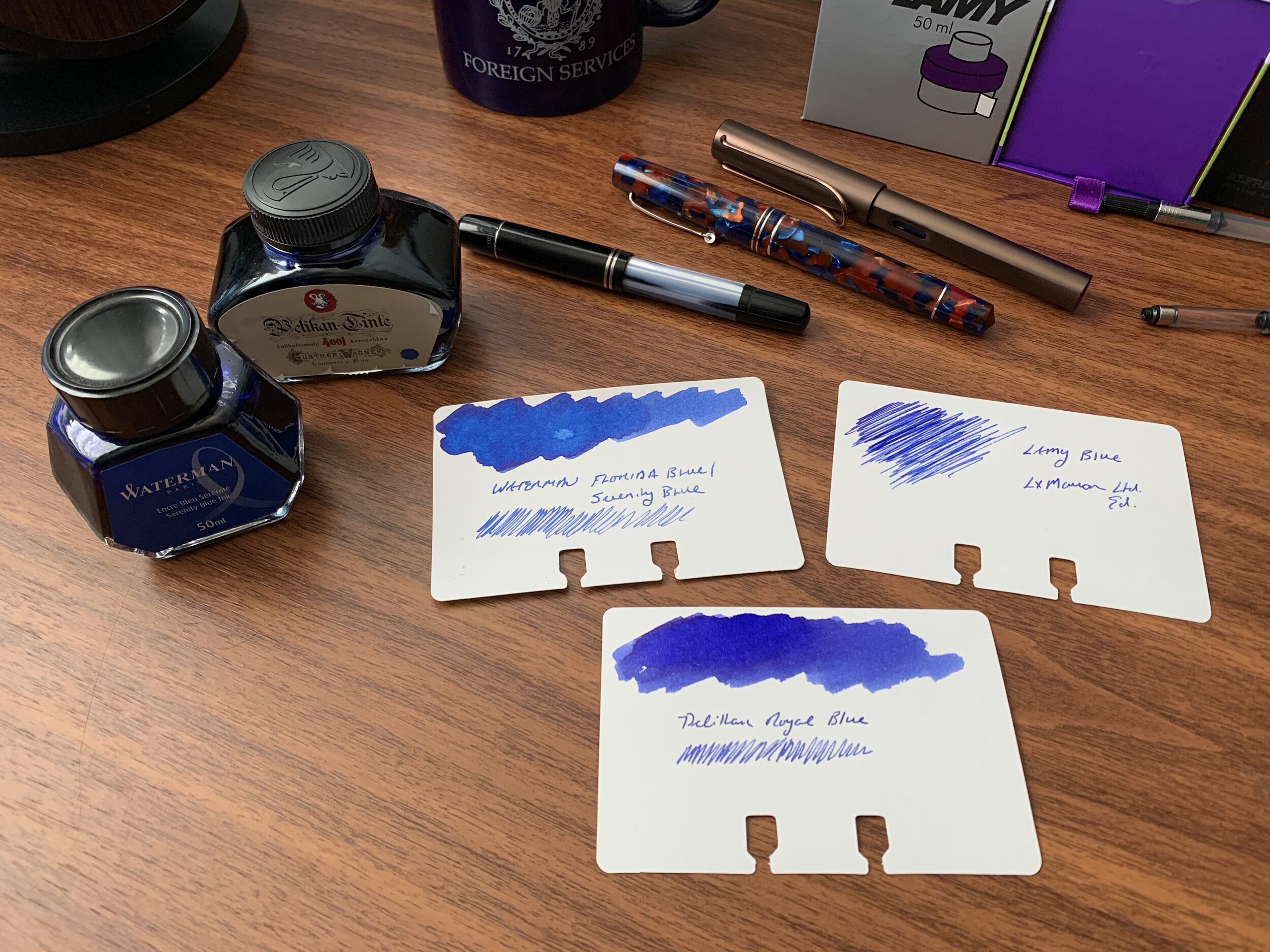
Waterman Serenity Blue

My number one work-friendly ink of all time, Waterman “Serenity Blue” (formerly “Florida Blue”) might be the best all-around fountain pen ink ever made. That’s a pretty big claim, but it’s not hard to support. Waterman ink (1) can be found at $12 or less per bottle at retail; (2) is widely regarded as one of the safest fountain pen inks available for use in vintage pens and materials prone to staining, like celluloid; and (3) works well on nearly all types of paper, making it a versatile ink suitable for pretty much any use case. Waterman ink bottles are also extremely functional: the faceted design lets you tilt the bottle for easier filling once the ink level gets low.

Pelikan 4001 Royal Blue

Slightly darker than Waterman Serenity Blue, Pelikan 4001 Royal Blue has its own group of devotees, some of whom love this ink so much that Pelikan sells it in massive 1 liter bottles (though recently I’ve currently only been able to find this size available in Pelikan Brilliant Black in the U.S.). While I personally prefer Waterman’s brighter tone, Pelikan Royal Blue likewise performs well on most papers and is a “safe” ink to use in nearly all pens. Pelikan inks come in a wider variety of bottle sizes than Waterman, with a few more reasonable options than the liter jug: around $11 for a 30ml bottle, or $14 for a 62.5ml bottle. The “historic” bottle of Royal Blue (same ink, different packaging) is priced at $12 for 60ml.

Lamy Blue

Finally, the last of the three basic blue inks that I use on a regular basis is standard Lamy Blue. If you’ve purchased a Lamy cartridge-converter pen, you have a sample of this ink on hand, since Lamy includes a blue cartridge with every pen sold. Though I still use it fairly regularly - mainly for the convenience of cartridge form - Lamy Blue is my least favorite of the three inks discussed here. It’s less vibrant than both Waterman Serenity Blue and Pelikan Royal Blue, with a tendency to take on a washed-out tone and fade after the ink dries. What this ink does have going for it is Lamy’s excellent ink bottle (complete with blotting paper) as well as the fact that it’s erasable using one of Lamy’s Ink Eraser Pens.

Takeaways and Where to Buy

You can’t go wrong with any of these three blue inks, all of which are inexpensive, reliable, and widely available. While nothing is certain, you probably don’t have to worry about getting attached to any of these three inks, only to have the formulation change or the ink disappear from the market. Waterman, Pelikan, and Lamy inks have all been around forever and I haven’t seen any signs that is about to change.

The one drawback is impermanence: none of these inks are waterproof, so if you’re looking for that you should go elsewhere (Pilot Blue-Black is an exceptional ink with decent water resistance, also available in large quantities).

You can purchase these three inks from nearly all major pen retailers, including site sponsors Pen Chalet and Vanness Pens.

Disclaimer: This post contains links to paid sponsors and affiliates. I believe that I purchased the inks featured in this review with my own funds, for my own use, though it’s possible I used store credit generated through affiliate programs in which I participate. I’ve gone through multiple bottles of Waterman Blue over the years so I can’t be sure.
In Ink Reviews Tags Basic Inks, Blue Ink, Waterman, Pelikan, Lamy, Ink Review
5 Comments

The A5 Slim Jibun Techo fits into the Galen Leather A5 Zippered Portfolio.

My Jibun Techo: The Planner Geek's Planner

November 23, 2019

I’ve used a lot of planners, ranging from the more structured (Filofax A5, Traveler’s Notebook Week-per-Page) to the completely unstructured (Hobonichi Techo, Bullet Journal). Since my planning needs are pretty flexible, I can usually make any system work, but that doesn’t stop me from obsessively searching for the perfect planner, does it? Well, I think I found it this past year, and it’s a planner that receives surprisingly little attention for all its versatility.

The Jibun Techo is made by Japanese stationery conglomerate Kokuyo, which makes a wide range of products including excellent notebooks that are extremely ink-friendly. The Jibun Techo is no exception. I’m not 100% sure the planner contains Tomoe River paper, but it feels and performs like Tomoe River, and I can’t discern much of a difference if it’s something different. The Hobonichi series of planners gets recommended because they’re the default “fountain pen friendly” planner, but now that I’ve used both the Hobonichi and the Jibun Techo, I can shill for both in good conscience.

Note: Before I get into the “nuts and bolts” portion of this review, you’ll have to excuse me for showing you mostly blank pages, especially on the weekly layout. Given the nature of my day job (attorney), I obviously can’t publish detailed entries. Wherever possible, I’ve tried to provide an example of how I use this planner, but sometimes I can’t use a detailed photo of a completed page. Thanks for understanding!

Basic Planner Functions

The core of the Jibun Techo is what I would call a “classic planner,” broken down into two sections: a monthly layout section and a weekly layout section, each of which takes up two pages. While the primary language is Japanese, most of the headers are also show in English, so this becomes a non-issue for me. After the first couple of days I barely noticed anymore.

As you can see, I use the monthly layout for my blog’s editorial calendar and other TGS-related planning, such as pen show travel. On the left, there’s a column for monthly lists, tracking, to-dos, or however else you want to use it.

The weekly planner section is a bit more complex, though the great thing about the Jibun Techo is that you can make things as simple or as complicated as you want. Each week takes up two facing pages, with a seven-day vertical layout. I absolutely love how Saturday and Sunday don’t get short shrift - regardless of whether I’m “working” or not, I have plenty going on over the weekends to the point where I need to be able to track a full day of time and/or appointments. For each day, 3/4 of the column can be used for scheduling, with most space provided for 7am to midnight. The remaining 1/4 can be used to make notes, track your mood (or note good/bad/blah things that happened that day), and even record the weather. Someone who consistently takes advantage of all the Jibun Techo’s tracking functions will have a very thorough record of their year.

Dedicated Logging or Tracking Pages

The Jibun Techo shines with tracking, logging, and various forms of list-making. In addition to the monthly and weekly “classic planner” pages, which provide space for tracking various things, the Jibun Techo contains a more open-ended, versatile section that I use for tracking progress on work projects, exercise, reading, etc. I’ve been extremely inconsistent using this throughout the year, but at times it’s been absolutely critical to my efforts to maintain my sanity.

Want to track something? Exercise? Food? Time? Reading? The Jibun Techo provides dedicated space. Also, notice that the logging and monthly layouts go all the way into March of the following year, if you need to plan ahead.

“Extra” Pages

For lack of a better term, I’ll refer to the rest of the Jibun Techo as “extras,” because they’re not essential for me but still offer a nice convenient space to keep track of running lists and other thoughts. The two sections I’ve used the most are the “Book List” to track my reading (though I will probably barely manage to fill up one side, if that), and the “Movie List” (where I did even worse, though I don’t necessarily consider that a bad thing). I haven’t used the other templates, which include sections to track “Gifts Received,” “Gifts Given,” a “Recommendation List” and “Favorite Phrases.” Come to think of it, the gift lists could end up being quite useful over the next month, and I may re-title and re-purpose some of the others once I start my 2020 planner.

The “Promises” list is one of the stranger aspects of the Jibun Techo’s layout, and I assume something got lost in translation. IMHO, if you have to track 108 promises that you’ve made throughout the course of the year, make sure you’re not over-committed!

Takeaways and Where to Buy

After a few years of experimentation, I’m settling into the Jibun Techo for the foreseeable future. I’m somewhat of an obsessive list-maker and logger of various things, and having a set structure to do this in planner reduces not only the number of notebooks I have to cart around on a daily basis but also helps me manage the psychic load of organization by keeping all of these things in one place. The tracking/logging/listing function of the Jibun Techo is really its selling point - if you’re just looking for a planner with both a monthly and weekly layout in the same package, there are other options, but the true organization nerd will want to give Kokuyo’s planner a closer look.

The Idea notebook is a standard slim Tomoe River notebook of good quality, which mainly serves as scratch paper in the back of my planner.

I purchased the Jibun Techo 3-in-1 Planner/Notebook set from Amazon, which still has 2020 versions in stock. (If you don’t like white, or think it will get too dirty over the course of the year, Blue and Pink versions are also available, along with a smaller B6 edition. The 3-in-1 set includes a graph-ruled “Idea” notebook and a “Life” journal, the latter of which looks like a tool for planning your memoirs or autobiography. I haven’t delved into that one yet, and won’t review it until I do, but maybe next year?

Finally, if you’re just looking for a stand-alone planner refill, and not a 3-in-1 set with a cover, Vanness Pens currently has some in stock.

Disclaimer: I purchased the planner featured in this review with my own money, for my own use.

In Planner Tags Jibun Techo, Planner, Notebooks, Kokuyo
4 Comments

From left, the Moonman C1, the Moonman C3, and the Moonman M2 eyedroppers.

Brand Profile: Taking a Look at Moonman's Emergence and Current Direction

November 21, 2019

Despite Chinese pens having been widely available for a decade or more - since I’ve been in this hobby - none of the brands have ever caught my interest the way Moonman has. The Moonman M2 is the first Chinese pen that legitimately impressed me, to the point where I think it’s a better writing instrument that many pens that cost five times as much. Why? The nib. Any pen company, anywhere in the world, can churn out mass-produced plastic tubes that look decent. Budget pens that write exceptionally well are true gems, and I’ve yet to experience a bad Moonman nib.

Look familiar?

What do we know about the company itself? Not much. From what I can gather by way of Chinese pen experts such as Frank Dong of FrankUnderwater, Moonman is one of several brands manufactured by a large Shanghai-based pen company, Shanghai Jingdian. What differentiates Moonman from other “budget” pen companies is that they have chosen to focus their attention on factory-tuning nibs to a level that most pen companies never reach, while still maintaining a sub-$20 price point.

The nib quality has remained consistent even as Moonman’s product line has expanded. On the M2, Moonman uses a gold-plated No. 5 nib with a basic “Iridium Point German” engraving. So-called “IPG” nibs have garnered - deservedly - an atrocious reputation for quality, but mine arrived tuned to perfection. On newer models such as the C1 and the C2, Moonman has opted for a larger No. 6 nib that still writes well, but quite obviously “borrows” design elements from Conklin and Monteverde. Not only is this tactic unnecessary to sell these pens, but the mishmash of design elements doesn’t work and cheapens the overall look.

Sure, it’s technically a different pattern, but how hard is it to come up with a basic logo that distinguishes your brand?

As much as I enjoy Moonman pens for the fact that they are true bargain-basement workhorses, recent developments have me questioning how much I should support them going forward. Need another example? Well, I probably should have noticed it before now from the promotional photos, but the recently released Moonman C1 is an obvious attempt to replicate Shawn Newton’s Shinobi, particularly the clear models with different color sections. I’m not sure whether this would qualify as technical infringement - the Shinobi design is rather basic and minimalist, after all, and I believe it originates from a custom design proposal submitted to Shawn by a customer - but this goes a step beyond “inspiration.” Is this where Moonman is headed now?

Does the “C” in the “C series” pens stand for “copycat”? The Moonman C2 moves ever closer to Franklin-Christoph territory.

Once you have it in hand, you’re not going to mistake the feel of a C1 for a Newton Shinobi. Shawn’s pens have a much more substantial feel in hand.

Design issues notwithstanding, there’s nothing wrong with the nibs on these pens. Both are excellent writers.

You can see the facet on one side of the pen. The one thing Moonman has perfected here over the Shinobi is that the cap is double-threaded so that the facet on the cap and barrel line up perfectly every time you cap the pen. On the Shinobis you have to guess.

Takeaways and Where to Buy

As much as I enjoy bargain-hunting, recent developments with Moonman as a brand have bothered me a bit, and I’m not sure I like the direction in which this company is moving. Sure, we can debate the extent to which transparent plastic cylinders can/should be protected as proprietary designs, but PenBBS has shown that it’s possible to be successful at this price point without blatant copycatting, which just makes your brand look cheap. Moreover, if I’m going to spend money supporting a company, I want to see them putting effort into bringing something unique to the market, not just inexpensive versions of other peoples’ pens. The irony in this, of course, is that Moonman’s design decisions create a completely unnecessary distraction for the brand. Moonman nibs are more than capable of standing on their own, and the company doesn’t need to churn out knock-offs to be successful.

I’ve acquired all of my Moonman pens via eBay. Currently, Moonman’s “eyedropper” lineup includes the Moonman M2, the Moonman C2, and the Moonman C1, all of which cost less than $20. The only one I can in good faith recommend is the M2, for the reasons I’ve discussed, and the M2 remains an exceptionally nice pen for the money. That said, unless I see the brand moving in a drastically different direction I will certainly lose interest if they continue to release more of the same.

Disclaimer: This post contains affiliate links.

In Pencil Review Tags Moonman, Moonman M2, Moonman C1, Moonman C2, Chinese Pens, Pen Review
4 Comments

The Lamy Studio LX “All Black” (bottom) is shown here with the Lamy Studio “Piano Black” (top).

Workhorse Pens: The Lamy Studio LX All Black

November 16, 2019

If there’s a single series of articles that epitomize what I’m about here at The Gentleman Stationer, it’s the “Workhorse Pens” series, which focuses on those pens most suitable for everyday writing. I always end up talking about the Lamy 2000 in this context, but what about Lamy’s other popular “higher end” pen, the Studio? I consider the Studio to be one of Lamy’s best designed writing instruments, despite it receiving far less attention than the 2000 or the Safari.

The design of the Lamy Studio is streamlined and minimal, with just enough unique touches like the “propeller” clip to keep the pen interesting.

The Lamy Studio tends to fly under everyone’s radar, even my own. I often forget how great these understated pens are, and when I break them out after a long rest I end up pleasantly surprised. Recently, Lamy has shown more love to the Studio line, releasing 1-2 special editions per year. The Racing Green Studio was a favorite, and I just acquired this year’s Lamy Studio LX “All Black” release. The latter may solve a key concern that many have with the Studio - the metal section that can be slippery. The “Studio LX All Black” features a coated black section with a grippy texture, nudging this pen into potential “workhorse” territory for a wider audience. The coating also feels more durable than that found on earlier editions of the Studio, which tended to chip and flake off with heavy use, especially under the clip where it rubs against the cap.

The grip section on the Lamy Studio LX All Black is coated, which will reduce slippage for those concerned about the standard Studio metal section. To complete the “All Black” look on my Lamy Studio LX, I separately purchased a black 14k nib intended for the Lamy Imporium.

So what do I personally enjoy about the Lamy Studio? First of all, it’s an incredibly well-balanced pen, even posted, despite having full metal (aluminum) construction. Second, the streamlined design and “propeller” clip have the potential to become as iconic as that on the Lamy 2000, though the Studio hasn’t been around as long. Third, I continue to swear by the 14k Studio nibs as one of the best values out there. Typically, Lamy only sells one or two versions of the Studio with the 14k nib included - in year’s past it has been the “Palladium” and “Piano Black” pens (the latter of which is shown here in this review). Otherwise, you’ll have to order a gold nib separately, which will run anywhere from $90-110, depending on the retailer. I used to think this was a steep markup, but now I think it’s worth it - Lamy’s 14k nibs have a touch of bounce, and on some of them I’ve even noticed some slight line variation reminiscent of an architect’s nib. Plus, any time you can have a gold nib pen for less than $200 in today’s market, you’re doing well.

A pair of propeller clips!

The Lamy Studio LX All Black posted. Though I love this pen, I’m now even less sure what “LX” is supposed to denote. So Lamy is releasing a separate model of pen called the “Lamy LX,” but now LX is also being used as a modifier for special editions?

Takeaways and Where to Buy

I have a hard time coming up with a reason why every Lamy fan should not have at least one Studio in their collection. In addition to being an exceptional daily writer, the pen is widely available and relatively inexpensive: The standard Lamy Studio with a stainless steel nib is priced at around $80 at most retailers, with the 14k pens priced around $180. With a 10% off coupon code - easy to come by at most retailers - that gets the price to just above $160 for a gold-nib fountain pen, which represents real value.

The pens featured in this review were purchased from Pen Chalet in the U.S. and Appelboom in the Netherlands. Both retailers carry the full Lamy Studio lineup, though if you want to opt for a 14k nib, you’ll either have to purchase the “Piano Black” model or pick up a spare 14k nib from Appelboom. (If you want to build the ultimate Lamy Studio LX “All Black” model, opt for the black PVD coated 14k nib, which I believe is intended for the Lamy Imporium but fits the Studio just fine.)

Disclaimer: I purchased the two pens pictured in this review using store credit provided by Pen Chalet and Appelboom.

Two Lamy Studios (LX All Black and Piano Black) compared against the Lamy 2000 (in 100th Anniversary Bauhaus Blue). The Studio is a slightly slimmer pen than the 2000, but just as well balanced and comfortable to use.

In Pens Tags Pen Review, Lamy Studio, Lamy Studio LX All Black, Lamy Special Editions
1 Comment

Pen Review: Visconti Mirage Fountain Pen

November 13, 2019

Last year, Visconti introduced several lower-priced products into their lineup, in an attempt to diversify away from the ultra-high end pens for which the brand has become known. Until now, even Visconti pens with steel nibs approached $200, but the new Visconti Breeze and Visconti Mirage are both consistently priced at a much lower, and, dare I say it, almost entry level price point? The Breeze can be found at sub-$100, depending on your retailer, and Visconti has emerged as a player in a segment of the pen market that is becoming increasingly competitive.

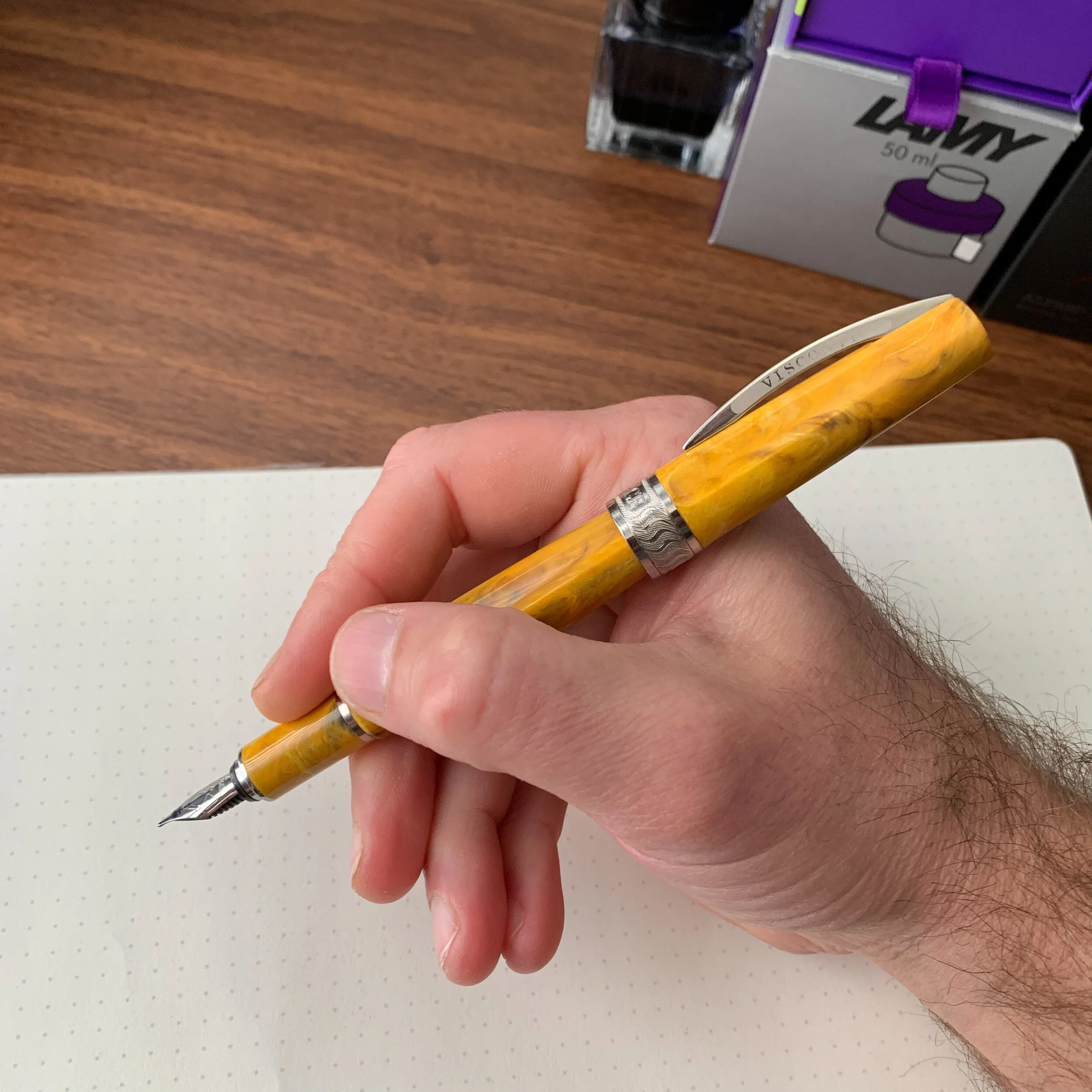
I love the resin on this pen. Previously, to get pens in similar patterns you would have to shell out for a Visconti Van Gogh or a Visconti Rembrandt.

The pen featured in this review is the Mirage - priced slightly higher than the Breeze - and it presents quite a bit of value. Here, Visconti has managed to offer a quality writer at a reasonable price, while still incorporating the luxury spirit of the brand and retaining the brand’s hallmarks, such as the iconic Visconti clip. My favorite aspects of this pen include:

  • Material. Appelboom sent me the “Amber” Mirage to review, and it’s made from a beautiful vegetal resin reminiscent of some of the Visconti Van Gogh pens, specifically my “Vincent’s Chair” edition, though this material has a touch more orange/brown to it. The body of the pen features a soft hexagonal design that is comfortable to hold, and the rounded facets, combined with the clip, make this a great pen for work because it’s not going to roll off a desk.

  • Cap Design. I love how Visconti still includes its signature “Arc” clip on these lower-priced pens. Though some people react strongly to the shape, I’m a fan, and I think the clip adds a lot of sophistication to what would otherwise be a relatively ordinary pen design. The cap also features a magnetic twist closure, which feels quite secure with no wiggle when capped. The one feature of the Mirage I could do without is the oversized cap band, which I found a bit much, especially the word “MIRAGE” written across the front.

  • Nib. In terms of an out-of-the-box writing experience, I’ve found that Visconti’s steel nibs write better than their much more expensive palladium offerings. Though the steel nibs sometimes need a bit of smoothing, they aren’t so wet as to be unusable on anything but the most fountain-pen friendly paper, which is the issue I’ve had with more expensive Visconti pens. The steel nib on this Mirage is an excellent writer, but I do wish Visconti had opted for a larger No. 6 nib instead of this No. 5. It always strikes me as a bit awkward to have a smaller nib on a full-size pen.

If Visconti is going to go with this oversized cap band, why not continue the etching all the way around and omit the “Mirage” engraving? I don’t mind subtle branding, and “Visconti” etched on the clip doesn’t set me off, but there’s no need to go further than that.

View fullsize Visconti Mirage Posted
View fullsize Visconti Mirage Unposted
View fullsize Visconti Mirage Nib
View fullsize Visconti Mirage Writing Sample

Takeaways and Where to Buy

I only had a brief time with the Mirage, since it was sent to me on loan from Appelboom and needs to go home to the Netherlands, but I came away impressed. I’m glad to see Visconti expand their lineup to include a wider variety of pens at different price points, and I hope this trend continues, especially if they can maintain consistent quality control. Visconti’s signature “Arc” clip immediately makes the Mirage look like a much more expensive pen, and if you’re a fan of Visconti’s designs, this pen would be a great introduction to the brand. Personally, the biggest thing holding me back from acquiring a Mirage for my own personal collection is the nib, which writes quite well but in my opinion looks disproportionately small on the pen.

You can purchase the Visconti Mirage from our sponsor Appelboom, currently priced at around $130, depending on the exchange rate. The Mirage comes in six different colors: Amber, Azure Blue, Coral, Emerald Green, Horn Grey, and Night Blue. Appelboom also carries the full range of Visconti pens, including the Breeze, the flagship Homo Sapiens, and a wide array of limited and special editions.

Disclaimer: Our sponsor Appelboom loaned me this pen for review purposes, free of charge. This post may contain affiliate links. Many thanks to Appelboom for making this review possible.

In Pens Tags Pen Review, Visconti, Visconti Mirage, Appelboom
Comment
← Newer Posts Older Posts →
Store Hours and Events
Shop T.G.S. Online
Updated 2026 "Best Pens" Guide
No results found
On The Paper Trail: Live In Nashville Event Tickets Now Available!
TGS_25 Roterfaden Restock Notification
Hierarchies of Fountain Pen Friendly Paper

Join Our Patreon!
Subscribe to the TGS E-mail List

Featured Posts

Featured
Pilot-Custom-Heritage-92.jpg
June 6, 2026
Workhorse Pens: Pilot Custom Heritage 92 Fountain Pen
June 6, 2026
June 6, 2026
Kakimori-Inkstand-Before.jpeg
May 30, 2026
Japan Trip Journal: A Visit to Kakimori, Including Custom Notebooks and the InkStand!
May 30, 2026
May 30, 2026
Five-Foundational-Fountain-Pens.jpeg
April 22, 2026
T.G.S. 12th Anniversary: 5 Fountain Pens Everyone Should Experience
April 22, 2026
April 22, 2026
The Gentleman Stationer RSS

View Cart

© Digital Divide Media, LLC, 2014-present.

All content is the exclusive property of Digital Divide Media, LLC, d/b/a The Gentleman Stationer, including “The Gentleman Stationer” website and trademark, and should not be reproduced without express written permission.  All rights reserved.

All content containing paid advertising, affiliate links, or sponsored content will be plainly disclosed by a disclaimer when/if featured.

Contact Information

Website Terms and Conditions

Store Shipping Policy and Return Policy

Privacy Policy and Cookie Policy

Accessibility Statement

Powered by Squarespace