• Blog
  • Shop
  • Podcast
  • Resources
  • About
  • Archive
  • Contact
  • Cart
  • Sign In My Account
Menu

The Gentleman Stationer

Vintage Living in the Modern World.
  • Blog
  • Shop
  • Podcast
  • Resources
  • About
  • Archive
  • Contact
  • Cart
  • Sign In My Account

Pen Review: CW&T Pen Type-B

July 11, 2020

Described by its creators as a "minimal everyday pen, over-engineered to last generations," CW&T’s Pen Type-B is one of those products that I resisted for years. Despite the pen receiving rave reviews, I didn’t feel the need to invest in a high-end housing for Pilot’s Hi-Tec-C gel refill, even though I’ve long been a fan of needle tip gel pens and rollerballs. At times, Pen Type-B even seemed a bit “too popular,” with Kickstarter hype driving a lot of the sales. Was this a pen for me? And would I end up using it enough to justify the relatively high price point?

If there’s a matte-black option, I’m in. Shown here is the black Cerakote-finished titanium model, with an Esterbrook single-pen sleeve (which fits perfectly).

Brooklyn-based design group CW&T (short for Chei-Wei Wang and Taylor Levy, the team behind their ever-expanding range of products) bills Pen Type-B as the “ultimate pen for illustrators, designers, and architects." I'm none of those things, and the marketing initially kept me away. It shouldn’t have. The lore surrounding the Hi-Tec-C has long focused on Pilot’s needle-tip gel pen as the perfect pen for visual-art creatives, but many writers enjoy this refill as well, myself included. Pen Type-B is no different, and for those of us who use the Hi-Tec-C for writing, an upgraded pen body with some heft can make for a much more comfortable writing experience than the standard plastic barrels or some of the less refined machined pen options.

A Truly Minimalist Industrial Aesthetic

Pen Type-B consists of a cylindrical metal pen component inside a machined pneumatic sleeve with zero visible branding anywhere. It’s a very clean look, and the facet on the sleeve allows you to rest the pen on your desk without fear of it rolling away. I rarely use clipless pens these days unless they have some roll-stop function - it may seem like a little thing, but when you work at a desk for a living, the little things are often what differentiate the nice pens that sit in a case and never get used from those that become core workhorses.

To replace the refill, you unscrew the back of Pen Type-B. In addition to the Pilot Hi-Tec-C, Pen Type-B will accept a range of other refills, though you will have to use a spacer. CW&T has posted details on their website.

In terms of writing, whether you find Pen Type-B enjoyable will likely depend on your feelings about the Pilot Hi-Tec-C refill. As we Hi-Tec-C enthusiasts know quite well, it’s one of the more finicky gel pen refills on the market. When it works, it’s absolutely amazing, but you will inevitably get a few duds. If you’re already a Hi-Tec-C devotee, however, there’s nothing to dislike here. In addition to the bulletproof build quality, Pen Type-B offers a genuinely enjoyable writing experience. You can use this pen in two ways: (1) unposted, in which case the cylindrical "pen" component is exceptionally light; or (2) posted, with the sleeve reversed, which adds a fair bit of weight and creates a writing experience I would compare to the Lamy Dialog 3 in terms of weight and balance. I use Pen Type-B both ways, but when at my desk I prefer to use the lightweight titanium insert for longer writing sessions. (Note: On the version with the brass sleeve, the insert is made from stainless steel, which will be heavier than titanium.)

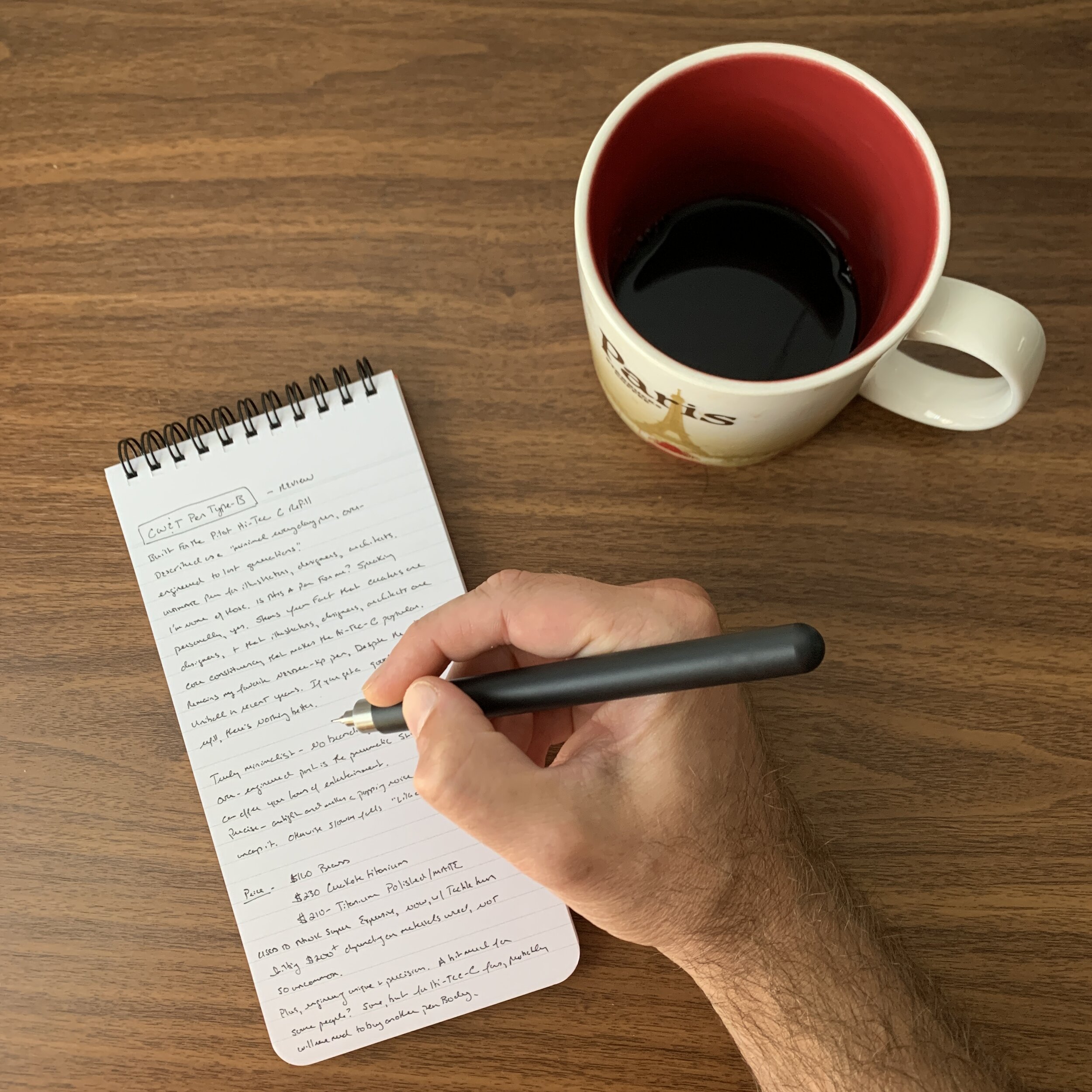
View fullsize Pen Type-B "Unposted"
View fullsize Pen Type-B "Posted"
View this post on Instagram

A post shared by Joe C. (@gentlemanstationer) on Jun 9, 2020 at 8:00am PDT

The "over-engineered" tagline refers to the pneumatic sleeve, which alone will offer you hours of entertainment if you find yourself bored at work (or, more likely these days, at home). The machining is so precise that the sleeve is basically airtight. It makes a popping noise if you pull the pen out quickly, and when you recap, you can watch it slowly slide back into the sleeve like a piston. This also serves a functional purpose: It keeps the refill from drying out.

Posted, the facet on the Pen Type-B creates a comfortable place to rest your grip while writing. (At least for me. YMMV in terms of comfort, depending on how you grip the pen.)

Takeaways and Where to Buy

Is Pen Type-B unnecessary for some (or maybe most) people? Sure. Ever since it launched on Kickstarter, Pen Type-B and it's predecessor, Pen Type-A, have courted controversy on whether these admittedly over-the-top pens are just "too much,” even going so far as to turn it into a bit of a marketing pitch. But if you're a Hi-Tec-C aficionado - clearly the target audience - it doesn't get much better than this. And while I used to balk at the price, which starts at $160 for a brass/stainless steel version and can cost as much as $230 for the black Cerakote titanium pen, other makers in this market segment have started to creep upward to the Pen Type-B's price point, not the other way around. (For example, the most recent line of Tactile Turn pens, for some combinations of materials, break the $300 ceiling and appear to be selling quite well). Given the level of craftsmanship and durability, I'm comfortable recommending, and now selling, these pens at CW&T’s standard pricing, provided that people understand on the front end that this is a pen aimed at a very specific audience.

As I noted above, Pen Type-B and Pen Type-A are the first pens I'm carrying in the TGS Curated Shop as part of my regular retail lineup, with all four finishes in stock and available to ship immediately. The pen featured in this review is the titanium model finished in black Cerakote.

To give you a sense of scale, Pen Type-B is shown here alongside a Write Notepads Reporter Notebook. I wouldn’t call Pen Type-B a pocket pen, but it is relatively portable.
In Pens Tags Pen Type-B, CW&T, Hi-Tec-C, Pilot Hi-Tec-C, Gel Pens, Pen Review
5 Comments

Pen Review: Esterbrook Camden "Composition" Edition

July 8, 2020

In less than two years since acquiring the relaunched brand, Kenro has grown Esterbrook into a fixture of the modern fountain pen scene. Their original release, the “Estie,” is wildly popular, as evidenced by the success of the recently released oversized “Sparkle” edition, made with Diamondcast acrylic, which many retailers already have sold through. Beyond the Estie, the company has begun to get some traction with what I will describe as their secondary model, the Camden, an anodized aluminum pen that originally came in three brushed “satin” finishes: Rose, Silver, and Graphite. Today, I look at a limited edition version: the Camden “Composition” in “Spring Break Fluorescent Green.”

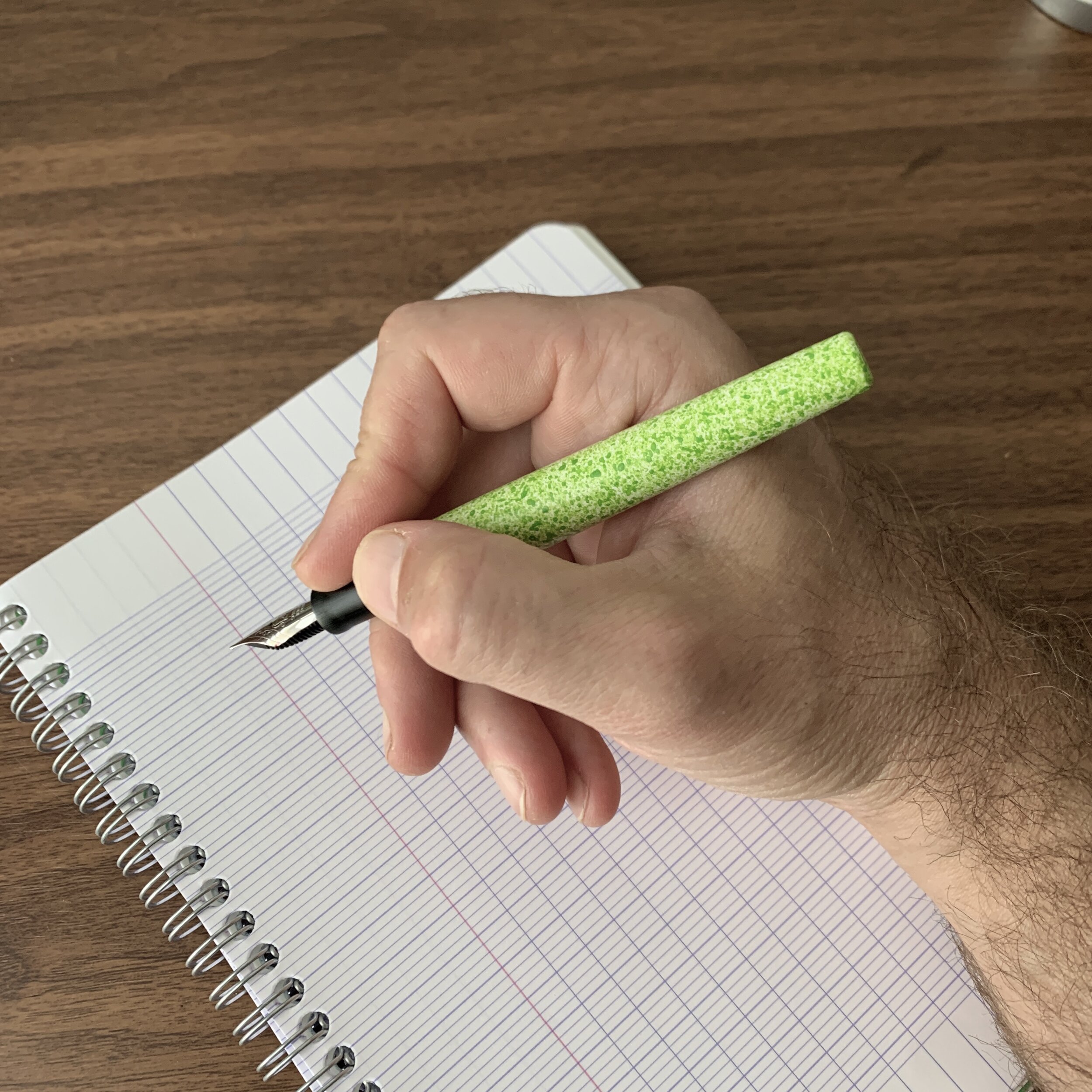
The finish is my favorite aspect of the Camden Composition. The marbling has a nice texture that eliminates any slipperiness inherent in most metal pens.

The inspiration behind this limited edition will be obvious to those of you who have ever attended school in the U.S.: the classic composition book. Esterbrook has taken the Camden and applied a textured marbled finish akin to the traditional covers on these notebooks. Currently, two colors have hit the market: “Back to School Black” and “Spring Break Fluorescent Green,” with “Fall Leaves Burgundy” apparently coming in Fall 2020, per the Esterbrook website.

The Esterbrook Camden features a standard Schmidt nib without the Esterbrook branding found on the Estie. The “Composition” edition uses the same contoured brushed metal section as on the standard version.

As much as I love the finish and the aesthetics on this particular model, the Camden itself is a bit of a mixed bag for me personally. While it’s a well-made pen, and the stainless steel Schmidt nib makes for an excellent daily writer, the proportions of this particular pen feel a bit off. The Camden is already a relatively long pen, and Esterbrook’s cushion-cap system (discussed further below) makes it even longer when posted because the cap doesn’t rest deeply on the barrel. As a committed “poster” - especially for daily writer-type pens intended to be used in class or at the office - I’ve found the Camden too back-heavy to use for long writing sessions. Unposted, the balance is much better, but the tapered barrel has has me really wanting to post this pen, and I can’t help but wonder how much I would love the Camden if the cap sat just a bit deeper on the back.

View fullsize Esterbrook Camden Unposted In Hand
View fullsize Esterbrook Camden Posted

As I mentioned, like the Estie, the Camden features Esterbrook’s spring-loaded “cushion cap” that uncaps with only 3/4 of a turn, allowing for quick deployment. As with the Estie, there may be a bit of a learning curve for those unfamiliar with this sort of closure. In order to engage the cap you will need to gently push the cap down and turn to engage the threads. After you’ve done it once or twice, it’s not a big deal, and the purpose behind the design is similar to Platinum’s “Slip & Seal” system: the inner cap acts as a seal that prevents the nib from drying out even if you leave the pen sitting unused for long periods of time. While systems like these are nice to have, they’re not a huge draw for me personally, since I rarely leave pens sitting inked for weeks at a time (much less months).

Takeaways and Where to Buy

Like the Estie, the Camden is another well-made fountain pen from Esterbrook that will serve you well as a daily writer, but if you post your pens the Estie might be a better choice. Posting the cap on that pen just feels a bit more secure, and the slightly shorter posted length and lighter-weight acrylic makes the Estie more comfortable for me to write with for longer sessions. Price-wise, the Camden and Estie both sit at the $156 retail price point - the current standard for higher-end steel nib pens - so I can’t really argue with Esterbrook’s decision here, even though I might like to see the Camden closer to $130 simply because the Estie feels more “premium.”

The Esterbrook Camden compared against the Estie.

I acquired the pen featured in this review from site sponsor Pen Chalet, which currently has the Camden Composition in stock in both the “Back to School Black” and “Spring Break Fluorescent Green” finishes. Though I’ve not yet seen the pen start to sell out, Esterbrook apparently has limited the run to 250 pens in each color, so eventually this one will go away.

Disclaimer: This post contains affiliate links. The Gentleman Stationer is a participant in the Pen Chalet affiliate program, which allows me to earn store credit for orders placed with Pen Chalet through links on this site. It’s one of many ways I’m able to support the blog and continue to acquire new products for review.

In Pens Tags Esterbrook, Camden, Pen Chalet
Comment

Unsung Heroes: The Waterman Expert Fountain Pen

July 4, 2020

The popularity of some pen brands has ebbed and flowed over the years, as tastes, ownership, and management change. In my mind, no company exemplifies this more than Waterman. Those of us who came of age in the 1980s and the 1990s may fondly recall Waterman as a popular brand that you would regularly see available for sale in brick-and-mortar office supply stores (remember those?), with a quality build and classy design at a lower cost than brands like Montblanc. For a brief history of Waterman pens and the modern company (which is actually a corporate descendant of the original U.S. company’s French subsidiary), check out my review of the Waterman Man 100 Patrician.

This navy blue Waterman Expert ballpoint with gold trim is the oldest pen in my collection. I think I received it when I was twelve.

Though Waterman may be a shadow of its former self, I still have a soft spot for their pens, and over the years have accumulated a micro-collection of sorts. All of my Watermans are either modern or what I would consider “near modern,” pens like the Man 100 that aren’t made anymore but are still modern enough in construction and build that I wouldn’t call them vintage. One of my favorites - and probably the first “nice” pen I’ve ever owned - is an early 1990s Waterman Expert ballpoint that a relative gifted to me for a birthday. I recently had the opportunity to add a sort-of-matching Expert fountain pen, a model I’ve never owned despite the fact that it’s still readily available at retail.

Small details such as the imprint has changed, but most of the design language remains the same over the thirty years that separate these two pens.

Since Waterman has discontinued its true entry-level options such as the Phileas and Kultur - wonderful pens that never should have been allowed to go out of production - the Expert has stood a the lower end of Waterman’s reduced lineup, at least in terms of price. While it appears that the company is introducing a few new entry-level pens that haven’t yet made it to widespread distribution in the United States, for most the Expert is their introduction to the Waterman brand.

The slanted finial is the Expert’s “signature.” I appreciate how it lends a touch of flair to an otherwise standard basic pen design.

The design of this pen has not changed over the years. I would describe the Expert as a moderately sized, streamlined pen with flat ends (though the cap finial is angled in a signature design touch). The pen features a stainless steel nib, a friction fit cap that also “clicks” to post securely, and a cartridge-converter filling system. (The pen does NOT ship with converter - a pet peeve of mine at the $100+ price point). Waterman has clearly designed the Expert to appeal to the maximum range of tastes, not only in terms of design but also size preference. It fits my moderately sized hands perfectly, and I tend to see more Experts in the workplace than any other fountain pen or rollerball, in the hands of both men and women. It’s a great “universal” size for a writing instrument - relatively lightweight and exceptionally well-balanced. The medium nib offers exactly what I expect from Waterman: reliable, moderately wet ink flow and what I consider to be a classic “Western medium” line width. Again - middle of the road, and designed to appeal to as many people as possible. And there is absolutely nothing wrong with that given the market for this pen.

The perfect size for me. I could write with this pen for hours.

Notwithstanding the fact that I still love Waterman, the quality of the modern Expert doesn’t feel quite as good as on my now 30+ year-old ballpoint. That’s not necessarily surprising, since “mainstream” companies like Parker, Waterman, and even Montblanc all seem to have cut some corners in recent years, giving their modern pens a less substantial feel than those you might have picked up as recently as 10 years ago. On the Expert, it’s most noticeable on the finials. The black plastic feels harder and more brittle, whereas on my vintage version they feel more like softer resin, almost rubbery. Only time will tell whether this change in materials affects long-term durability.

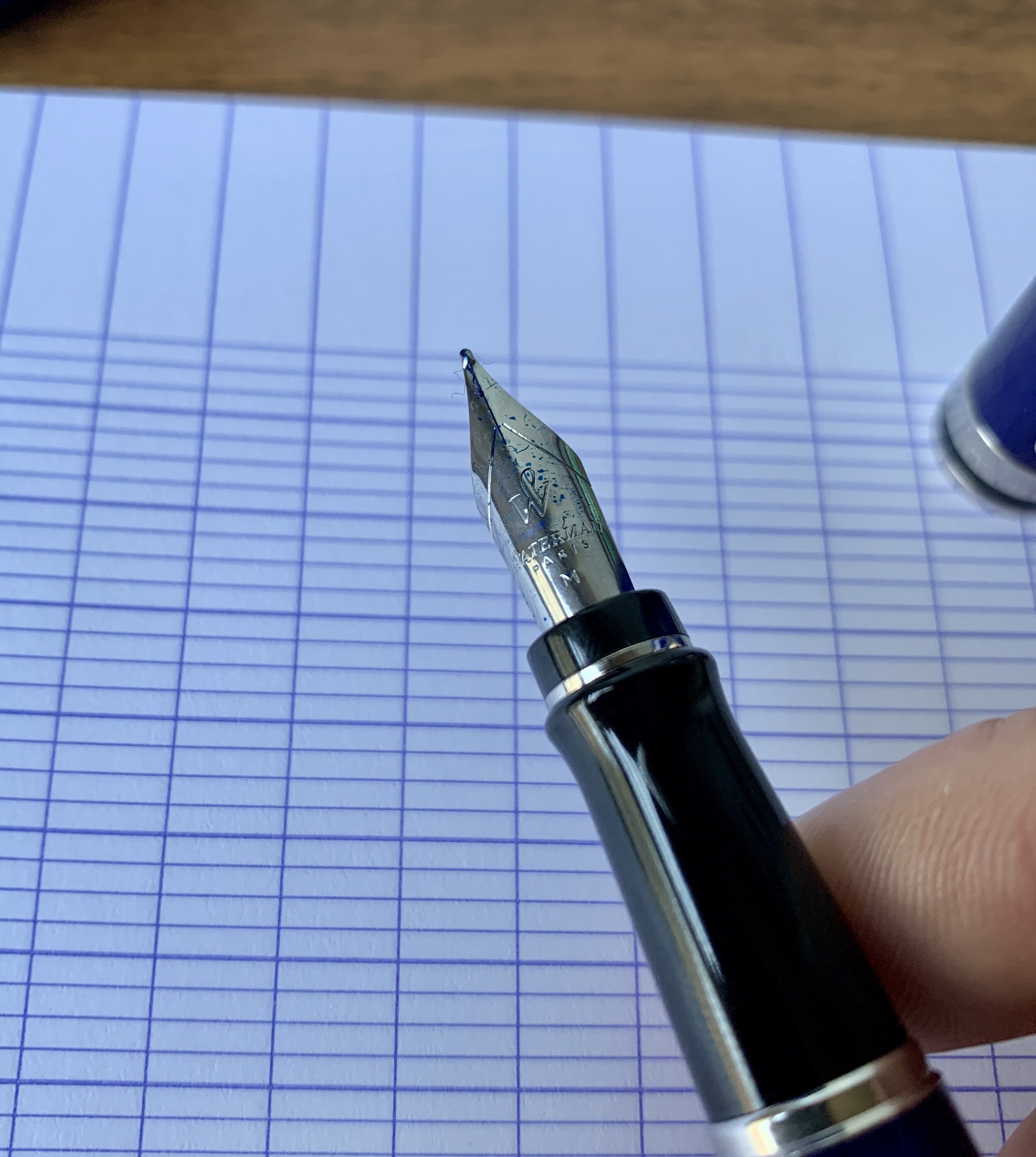
View fullsize Waterman Stainless Steel Nib
View fullsize Waterman Feed
View fullsize Waterman Expert Writing Sample

Takeaways and Where to Buy

While not as ubiquitous as it used to be, you can still find Waterman fountain pens at most pen retailers. I honestly believe that this storied brand should be getting more attention than it does, especially among those of us who rely on our pens as everyday tools for the office or study and don’t necessarily need something flashy, but rather just want a predictably reliable pen that gets the job done at a reasonable cost. The Expert fountain pen retails for $185 MSRP (which is too high), but you mostly see it priced at less than $150. If you can use a discount code to get the pen down into the $125-130 range, I’d recommend this pen any day of the week.

I acquired the blue Waterman Expert featured here from site sponsor Pen Chalet, which currently has the pen priced at $147.35. There’s always a 10% discount code floating around (such as the current “FREEDOM” Fourth of July promotion), which gets the pen to a very attractive price point. For an extra $15 or so, you can opt for the “Deluxe” version with an engraved metal cap.

Disclaimer: This post contains affiliate links, which allows me to receive a small commission, payable in store credit, that I use to acquire additional pens to review on the site. It’s one of many ways I support the blog.

In Pens Tags Waterman Expert, Waterman, Pen Review
3 Comments

What's the Best Long-Point Pencil Sharpener? I Look At Handheld Options

July 2, 2020

I’ve been writing a lot with pencils lately, probably because I’ve been reading more than usual over the past three to four months (for obvious reasons), and I rarely read nonfiction without a pencil to make notes and annotations along the way. I also tend to write small, so when I do use pencils it’s important to me to have a good sharpener that can put a sharp, durable point on the pencil. When I’m at my desk, my go-to is the Carl Angel-5, but when working on the patio, reading in the library, or traveling, it’s not exactly convenient.

A telltale sign of a great sharpener is whether it carves the wood into a single unbroken shaving. In terms of point length, the Masterpiece is pretty much unrivaled for a handheld sharpener.

Until recently, my go-to handheld sharpener has been the KUM Masterpiece, a two-stage sharpener that creates an exceptionally long point but has a couple of drawbacks when you’re at work or traveling. First, there’s no receptacle to hold the shavings, so you need to either be outside in a place where you can dispose of biodegradable pencil shavings, or have ready access to something that can hold shavings, like a garbage can or a plastic bag. Second, the sharpening process is a bit involved in that you need to use the first stage to strip the wood from around the core, and use the second stage to sharpen the point itself, which can be a bit harrowing with softer graphite prone to breakage.

The NJK Long Point does its job efficiently, quickly sharpening to a serviceable long point. It’s size and low cost make it a great choice to keep in your pocket or the car.

Lately I’ve been relying more on single-stage sharpeners, and I’ve come across two that give the Masterpiece a run for its money. The first I discovered as part of the Pencil Box Subscription Program from C.W. Pencil Enterprise: the NJK Long Point Sharpener. CW Pencils recently started selling these sharpeners separately, and at $6.50 each they’re a bargain over something like the Masterpiece, which retails for $22. (Note 2024: Since CW Pencils is no longer operating, we are now selling these pencil sharpeners directly. They are excellent, so please consider giving them a try!)

The Blackwing One-Step: A point so long it curves.

The second sharpener I’ve enjoyed using is Blackwing’s new One-Step Long Point Sharpener. From both a looks and functionality standpoint, the Blackwing sharpener might be the best-looking and best-designed handheld sharpener I’ve ever used. The body of this sharpener is a machined aluminum matte-black jar that holds a relatively large volume of shavings, and the blade sharpens pencils to a concave (i.e., slightly curved) point that holds up much better than similar “needle points” I’ve been able to put on pencils using other concave sharpeners. As with most “concave” sharpeners (and pretty much anything from Blackwing), it doesn’t come cheap. The Blackwing One-Step Long Point sharpener costs $20, and given how well this sharpener works it may have a leg up on the M&R Pollux at $30, unless you prefer the “brass bullet” format, which some people do because it’s far more portable.

A comparison of all three points by handheld sharpeners, from left: Kum Masterpiece, Blackwing One-Step, and NJK.

If you’re looking for a convenient handheld sharpening solution that won’t ask you to sacrifice a long point for the sake of portability, both the NJK Long Point and the Blackwing One-Step Long Point are excellent choices. Personally, I use the NJK the most because of its pocketability, but the Blackwing will definitely find a home in my bag once/if things ever get back to normal and I’m moving around more.

The downside to buying Blackwing’s One-Step Long Point Sharpener at the moment is that you can’t buy a replacement blade. I understand that may change in the future. As you can see, the sharpener is easily disassembled.

Disclaimer: I purchased the sharpeners featured in this review with my own funds, for my own use. This post does not contain affiliate links.

In Pencil Sharpener Tags Pencil Sharpener, Long Point Pencil Sharpener, Handheld Pencil Sharpener, NJK Sharpeners, Blackwing, KUM
9 Comments

What Is a Book Dart? An Explanation.

June 30, 2020

I’ve received a few questions via social media and e-mail over the past couple of weeks about a product that I’m now selling in the T.G.S. Curated Shop: Book Darts. Since Tuesdays are generally pretty quiet around here, I thought I’d take a few minutes to do a quick post explaining Book Darts and why they might be one of my favorite pieces of non-pen/paper stationery that I keep on my desk.

Book Darts are pretty simple products, really. Each “Dart” is a paper thin, precision-cut folded metal clip that slides onto a page from your book or notebook. Since Book Darts are pointed, you can use them to mark entire pages or specific passages or lines. Because they’re so thin, you can stick dozens of Darts into a book without noticeably increasing bulk. Importantly, Book Darts are “archivally safe,” meaning that they don’t damage paper. The company states on their website that they “have tested our Darts on varieties of paper under accelerated heat and humidity conditions, and they have never imparted any stain to any page.”

This Nanami Paper Cafe Note currently has at least six Book Darts marking various sections. Closed, you can barely tell, even on super-thin Tomoe River paper.

While a Book Dart is not the same thing as a standard bookmark, you can certainly use them that way. Most people, however, view them as replacements for dog-eared pages, paperclips, sticky notes, or whatever else you might use to flag pages in a book you’re reading, a journal, or a notebook. Book Darts are reusable, and you can remove them or move them about as you like.

On the left, a standard Book Darts tin, and on the right, my custom tins sold in the store!

I currently sell Book Darts in tins of 50, in either stainless steel, brass, or bronze, as well as in sleeves of 12 or 18 Darts that feature a mix of all three metals. They’re a fairly inexpensive tool to add to your workflow, and one that I find incredibly helpful as I do a lot of reading and research that requires me to come back to revisit passages I’ve read or notes I’ve taken, even years later.

The sleeves ship with a folded “bookmark sheet” of 18 mixed darts - you can use it as a bookmark while you read, holding your Darts until you want to mark a page. These are great for travel!

If you like the look of a Book Dart, but perhaps want something more durable for use as a more traditional bookmark, consider these sterling silver Page Points by WMS & Co. (sold as a set of three). They have the streamlined profile of a Book Dart, but will likely hold up better to repeated use over time as the metal is quite a bit thicker and they’re actually intended for long-term bookmark use. They’ll also take on a nice patina, or you can polish them to maintain the shine.

Disclaimer: I am an authorized retailer of Book Darts, and all links are to my own shop. This post does not contain affiliate links.

In TGS Curated Shop Tags Book Darts, Reading Accessories, TGS Curated Shop
2 Comments
← Newer Posts Older Posts →
Store Hours and Events
Shop T.G.S. Online
Updated 2026 "Best Pens" Guide
No results found
On The Paper Trail: Live In Nashville Event Tickets Now Available!
TGS_25 Roterfaden Restock Notification
Hierarchies of Fountain Pen Friendly Paper

Join Our Patreon!
Subscribe to the TGS E-mail List

Featured Posts

Featured
Pilot-Custom-Heritage-92.jpg
June 6, 2026
Workhorse Pens: Pilot Custom Heritage 92 Fountain Pen
June 6, 2026
June 6, 2026
Kakimori-Inkstand-Before.jpeg
May 30, 2026
Japan Trip Journal: A Visit to Kakimori, Including Custom Notebooks and the InkStand!
May 30, 2026
May 30, 2026
Five-Foundational-Fountain-Pens.jpeg
April 22, 2026
T.G.S. 12th Anniversary: 5 Fountain Pens Everyone Should Experience
April 22, 2026
April 22, 2026
The Gentleman Stationer RSS

View Cart

© Digital Divide Media, LLC, 2014-present.

All content is the exclusive property of Digital Divide Media, LLC, d/b/a The Gentleman Stationer, including “The Gentleman Stationer” website and trademark, and should not be reproduced without express written permission.  All rights reserved.

All content containing paid advertising, affiliate links, or sponsored content will be plainly disclosed by a disclaimer when/if featured.

Contact Information

Website Terms and Conditions

Store Shipping Policy and Return Policy

Privacy Policy and Cookie Policy

Accessibility Statement

Powered by Squarespace