• Blog
  • Shop
  • Resources
  • FAQ (Ask TGS)
  • About
  • Archive
  • Contact
  • Sign In My Account
Menu

The Gentleman Stationer

Vintage Living in the Modern World.
  • Blog
  • Shop
  • Resources
  • FAQ (Ask TGS)
  • About
  • Archive
  • Contact
  • Sign In My Account

If you come see us in person, you can pick up one of these Fountain Pens 101 pamphlets, which offer some guidance on fountain pen ownership and care, including basic maintenance.

Ask T.G.S.: How Often Should I Clean My Fountain Pens?

February 14, 2026

I often get questions from new users about cleaning fountain pens, namely how to do it and how often. I’ve previously published some resources on techniques for cleaning and maintaining fountain pens, but the most basic question involves frequency. There’s no clear answer: my general guidance is every two months or so as a rule of thumb, with more frequent cleaning recommended if you are using specialty inks that contain shimmer particles, are highly saturated, or feature pigment or other additives to make the inks permanent. Usually all you need to do is flush the pen with water using the integrated filling mechanism, a converter, or bulb syringe.

While you may need to add a drop of dish detergent to tougher jobs (purples, reds, and oranges can sometimes be harder to clean), you don’t usually need more than a glass of water to thoroughly clean a fountain pen. The bulb syringe can help flush water through a cartridge/converter pen.

What Happens If You Don’t Clean Your Pens Regularly?

99% of the time, the worst thing that will happen is the pen will hard-start (not write immediately when you touch nib to paper), skip when writing, or not write at all because it’s clogged. Fountain pen ink is water-based, so over time the water in the ink will evaporate, causing the ink to thicken or dry up entirely and clog the pen. Most dyes used by ink manufacturers are water-soluble, so flushing the pen with water should resolve these issues, and if you clean the pen every couple of months as part of your routine you can usually avoid them altogether.

I will have to say that the need to clean pens religiously on some sort of set schedule is often overstated. I know many long-time fountain pen enthusiasts who never clean their pens at all, or at least not until the pen actually clogs, which they take as a sign that the pen “needs cleaning”. However, the best course of action is to use your pens regularly and rotate ink colors because it forces you to clean.

The Major “Don’t-Ever-Do-This” of Fountain Pens

Unfortunately, I’ve run into many new users who have been told by unknowledgeable sellers and “people online” that they can use artists inks such as India ink, Higgins ink, Calligraphy ink, and other paint-like inks in fountain pens. You cannot. Certain of these products contain shellac, which is a glue-like substance that will bind up the inside of your fountain pen and render it unusable if it is allowed to dry. You should only use ink labeled as safe for fountain pens, and preferably inks made by pen manufacturers or boutique ink manufacturers who specifically make ink for fountain pens.

The “Ask TGS” series of blog posts features questions from readers and customers that frequently appear in my inbox, social media DMs, and customer questions. Some of the most frequent posts are summarized on our FAQ page. We also answer reader questions on a podcast that we co-host with Vanness Pens, “On the Paper Trail”. If you have a question you want answered, please do write in using the contact form and we will try to answer the question in one of these forums.
In How To, Ask TGS Tags Ask TGS, Cleaning Fountain Pens, Fountain Pens 101

Don’t drink the ink.

Fountain Pen Maintenance: How I Clean My Fountain Pens

May 25, 2022

Every once in a while I like to take things back to basics and talk a bit about how to care for, maintain, and store fountain pens. While not as “high-maintenance” and messy as some would have you believe, fountain pens definitely require more attention than your typical ballpoint or rollerball in order to maintain an enjoyable writing experience. So what brought this particular topic to mind today? Well, I finally have a sink in my dedicated work area, so I can actually flush out some pens that I’ve been waiting to clean since the Baltimore Pen Show back in March.

For 90% of cleaning jobs, you need little more than a glass of water, a towel, and (maybe) a bulb syringe.

My cleaning process is pretty simple, and I follow three steps:

  • Start (and Finish) With Water. Most of the time, since I use fairly unexciting inks without permanence, shimmer, sparkles, extreme iron gall content, etc., I can make do with a glass of water. I can flush the pen by running plain water through the filling mechanism 5 or 6 times, and that’s typically more than sufficient to clean the pen to a point where you won’t have old ink drying up in the feed and clogging the pen, nor will you see traces of the previous ink when you go to refill it. To dry the pen out I will usually (GENTLY) place the pen nib down in a glass with a folded paper towel or tissue at the bottom for padding, which will wick out any remaining inky water. Note: Some people will probably flip out when they hear that I place the flushed pens nib-down to dry. I’ve never damaged a pen this way but as with everything here, proceed at your own risk and do what you are comfortable with.

  • Proceed to Water + Dish Detergent for Stubborn Messes. If I have a fountain pen where the ink has dried out, or a pen that was inked with a super-saturated color or shimmer ink, I will add a drop of dish detergent (i.e., Dawn) to a large glass of water and repeat step one. 9/10 times, this fixes any problem I have cleaning stubborn pens. In my experience, “pen flush” or dedicated cleaning fluids are almost always unnecessary, though they can sometimes speed up the cleaning process. Buy them from a pen store (preferably a pen manufacturer) and don’t try to make your own with ammonia, diluted Windex, etc. Certainly don’t use them with expensive pens or rare materials like celluloid or other vintage plastics because you never truly know what’s in them or how the material will react.

    • Buy a Bulb Syringe. For either of these first two steps, you might want to pick up a bulb syringe. For cartridge-converter pens, it’s easier to flush water through the section using the bulb syringe than it is the converter, which doesn’t move much water at all. Just be sure to grip the section firmly because a bulb syringe can form a seal and cause the section to go shooting across the room if you’re not careful.

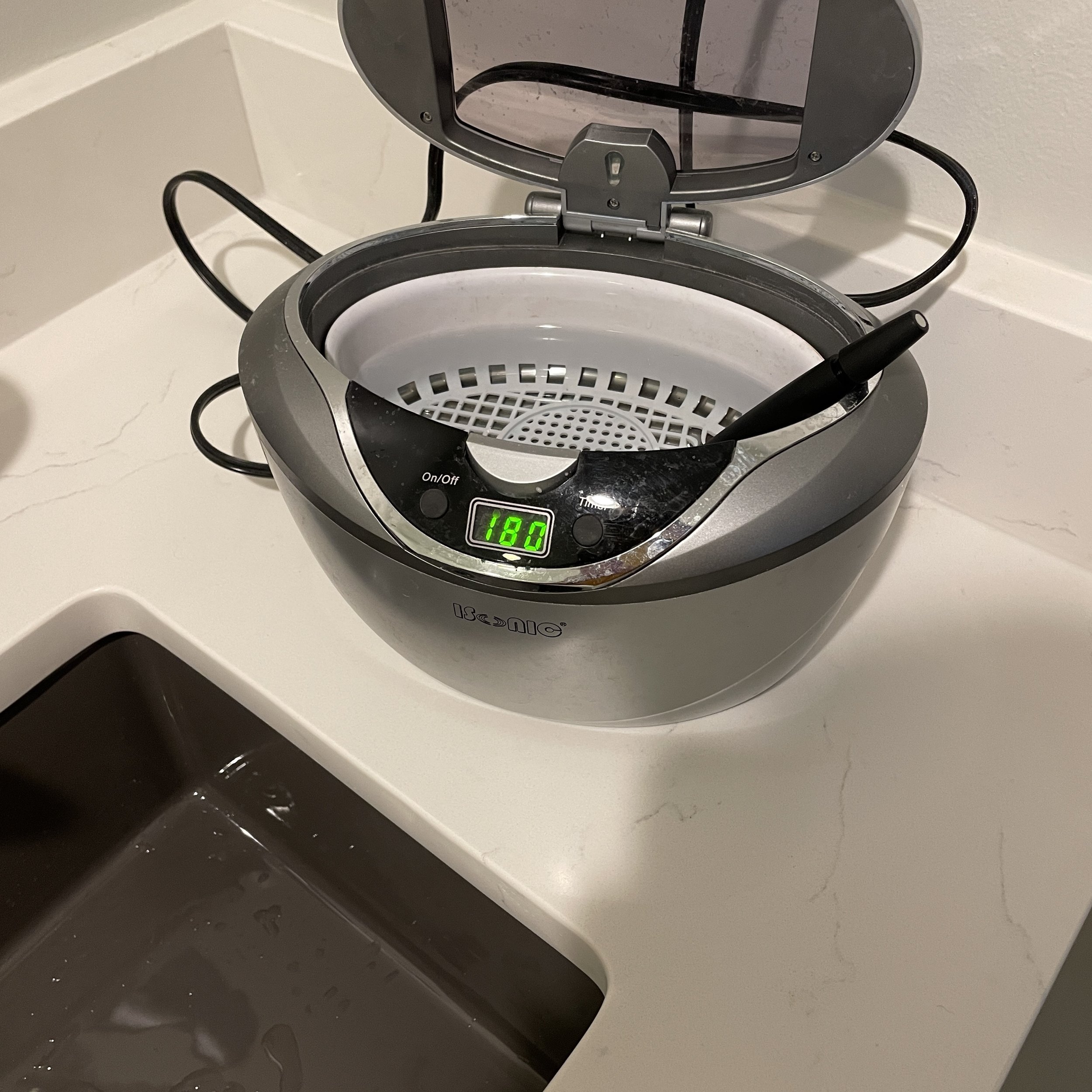
  • Buy an Ultrasonic Cleaner. IF you think you need one. That’s a big “IF” for me, because I hardly ever break mine out, and when I do it’s for pens like the Parker 51, Lamy 2000, or other hooded-nibs where flushing the pen is inadequate because it doesn’t necessarily get water to all parts of the feed. Vacumatic fountain pens are also easier to clean with an Ultrasonic, since the filling mechanism doesn’t push water through the feed with much force.

Cartridge-Converter section with a bulb syringe attached. It takes no time at all to clean a nib/section using the bulb syringe to flush water through the feed.

For tough jobs, a $40 ultrasonic jewelry cleaner (purchased at Bed, Bath & Beyond or Amazon on sale) is all the “heavy equipment” you’ll need. I typically use plain water, though you can add a drop of dish detergent if you like. Just be sure to flush the pen clean afterwards. (And if you’re considering remodeling, a grey or black sink is a nice upgrade to your “pen room” to hide the ink stains!)

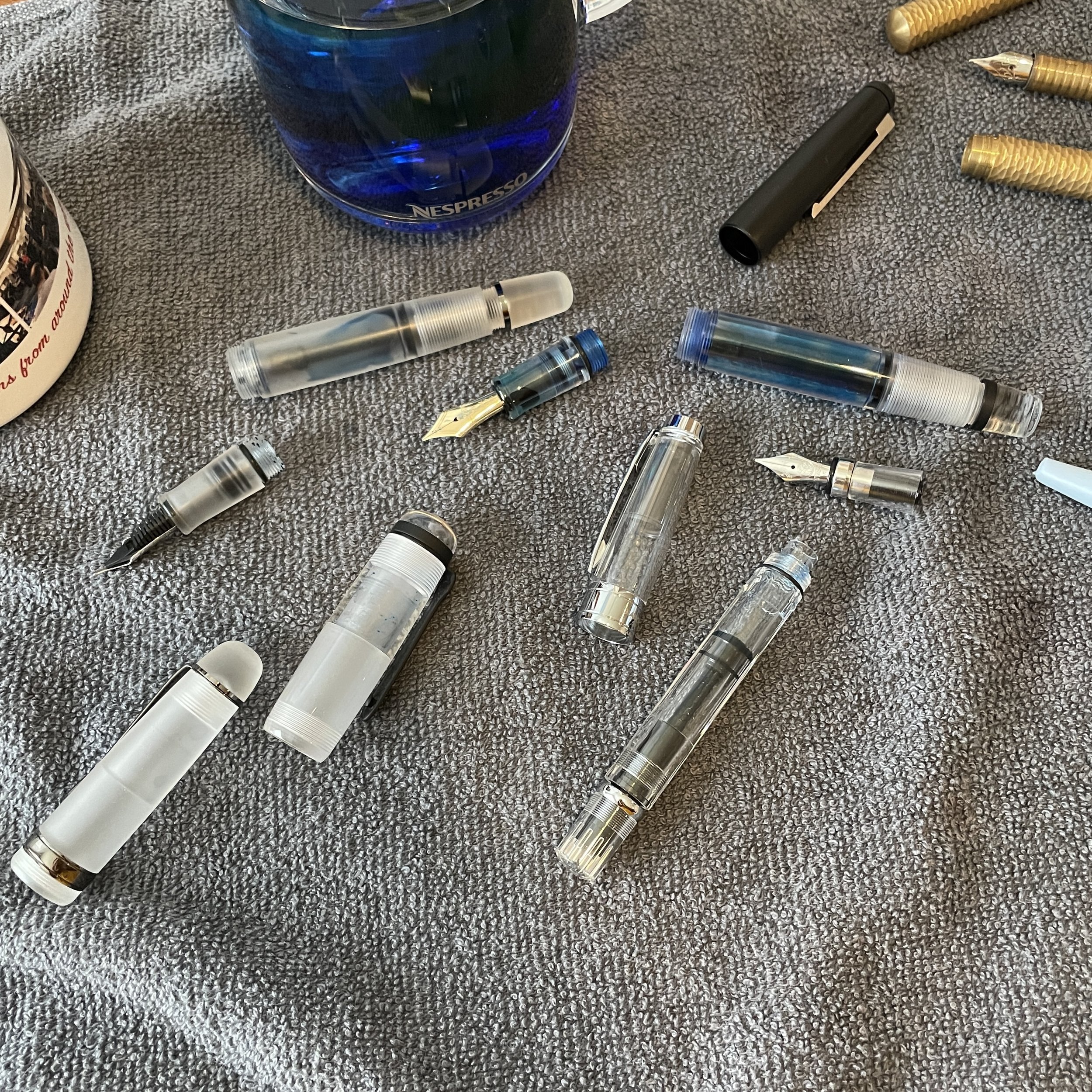
Drying cleaned fountain pens nibs-down, which allows any remaining inky water to leach out. Just be sure to rest the nibs on a folded paper towel. As you can see, I don’t baby my pens.

Final Thoughts and Further Reading

To summarize my philosophy on cleaning fountain pens: Clean relatively frequently and go slowly, only adding substances other than water to the cleaning process if absolutely necessary. I think you’ll find that for most inks and most pens, it’s not. For some additional information and further reading on techniques for cleaning specific types of filling systems, check out this previous post.

I will likely do a further post on this topic at a later date, but favorite high-ink-capacity pens that are easy to clean include the TWSBI 580 piston filler, and the Opus 88 Japanese-style eyedroppers. I was able to flush all of these demonstrator pens perfectly clean in less than a minute since the sections separate and allow you to access the interior. Run them under the sink and/or flush them with a syringe.

This post does not contain third-party affiliate links. The Gentleman Stationer is supported entirely by purchases from the T.G.S. Curated Shop, and memberships via the T.G.S. Patreon Program.

In Editorial, How To Tags Pen Cleaning, Cleaning Fountain Pens, Fountain Pen Maintenance, Editorial
4 Comments
Store Hours and Location
Visit the T.G.S. Curated SHOP
Updated "Best Pens" Guide
On the Paper Trail Podcast
TGS_25 Roterfaden New Stock Available
Hierarchies of Fountain Pen Friendly Paper

Join Our Patreon!
Subscribe to the TGS E-mail List

Featured Posts

Featured
Pentel-Sign-Pen-Cover.JPG
Feb 28, 2026
Pen Review: The Pentel Sign Pen (Craft Design Technology Version)
Feb 28, 2026
Feb 28, 2026
Cover On the Paper Trail Intro Clip.jpeg
Dec 3, 2025
Introducing "On the Paper Trail," a New Podcast/Video Collaboration with Lisa Vanness of Vanness Pens!
Dec 3, 2025
Dec 3, 2025
Iro-Utsushi-Fine-Dip-Pens.jpeg
Oct 1, 2025
The Pilot Iro-Utsushi Dip Pen (and in General, Simple vs. Fancy Dip Pens)
Oct 1, 2025
Oct 1, 2025
The Gentleman Stationer RSS

© Digital Divide Media, LLC, 2014-present.

All content is the exclusive property of Digital Divide Media, LLC, d/b/a The Gentleman Stationer, including “The Gentleman Stationer” website and trademark, and should not be reproduced without express written permission.  All rights reserved.

All content containing paid advertising, affiliate links, or sponsored content will be plainly disclosed by a disclaimer when/if featured.

Contact Information

Store Shipping Policy and Return Policy

Privacy Policy

Cookie Policy

Terms and Conditions

Powered by Squarespace