• Blog
  • Shop
  • Resources
  • FAQ (Ask TGS)
  • About
  • Archive
  • Contact
  • Sign In My Account
Menu

The Gentleman Stationer

Vintage Living in the Modern World.
  • Blog
  • Shop
  • Resources
  • FAQ (Ask TGS)
  • About
  • Archive
  • Contact
  • Sign In My Account

Pen Review: The Pentel Sign Pen (Craft Design Technology Version)

February 28, 2026

I have a soft spot for pens that have remained essentially unchanged for 60+ years, including the Lamy 2000, the Pilot Capless Series, and even less expensive pens like the one I plan to review here: the Pentel Sign Pen. Introduced in 1963, the Sign Pen is famous for its moderately flexible tip that allows for expressive line variation while remaining just firm enough to use for everyday writing. Long a favorite of calligraphers, I had written this one off as an “art marker” that wouldn’t be suitable for my more everyday needs. Let’s say I’ve had to reconsider.

An example of how I’ve been using these pens for my personal planner layouts.

Expanding My Japanese Fineliner Repertoire

Back in December we brought an assortment of Craft Design Technology products into the shop, which included CDT’s versions of a wide range of Japanese stationery items that I had never tried before. This shipment included not only the Sign Pens, but other unique finds including the Pentel Tradio, the Pilot Frixion 3 multi pen, and paper items such as the CDT Memo Rolls and Desk Note Bagasse notebooks. Of all the new additions, however, the Sign Pens and the Tradios were my favorites.

The brush/marker tip is adequately firm for writing, and the colors are quite vibrant. Writing sample here is shown on the CDT Desk Note (Large), which contains ink-friendly, sugarcane-derived Bagasse paper.

I’ve long been a proponent of fountain pen users trying out fineliners as an “everyday” alternative. Fineliners add a degree of expressiveness (meaning line variation) to your handwriting, and have a soft feel that, like a fountain pen, requires very little writing pressure. The Pentel Tradio is actually modeled after a fountain pen, but with a stiffer tip that will feel familiar to U.S. users accustomed to standard felt-tip pens and markers. The Pentel Sign Pen invokes a traditional Japanese brush pen, with a softer tip capable of more significant line variation. As a result, the Sign Pen has become a favorite for calligraphers and artists, though the tip remains firm enough that you can use it for standard handwriting and journaling.

The T.G.S. back-office work table.

So how do I use my own set of Pentel Sign Pens? I’m no calligrapher, and I long ago allowed my art skills to lapse, but I’ve thoroughly enjoyed these pens as journaling and planning tools. The tip is flexible enough to go from a relatively fine line to a bolder marker-esque line, making them useful for drawing layouts. I’ve also been trying to improve my cursive and reduce the amount of pressure that I use while writing by hand, so these are great given that the ink flows similarly to a fountain pen. Unlike many markers, the Sign Pens show relatively little bleedthrough and feathering on decent papers, with the ink behaving similarly to fountain pen ink in that regard.

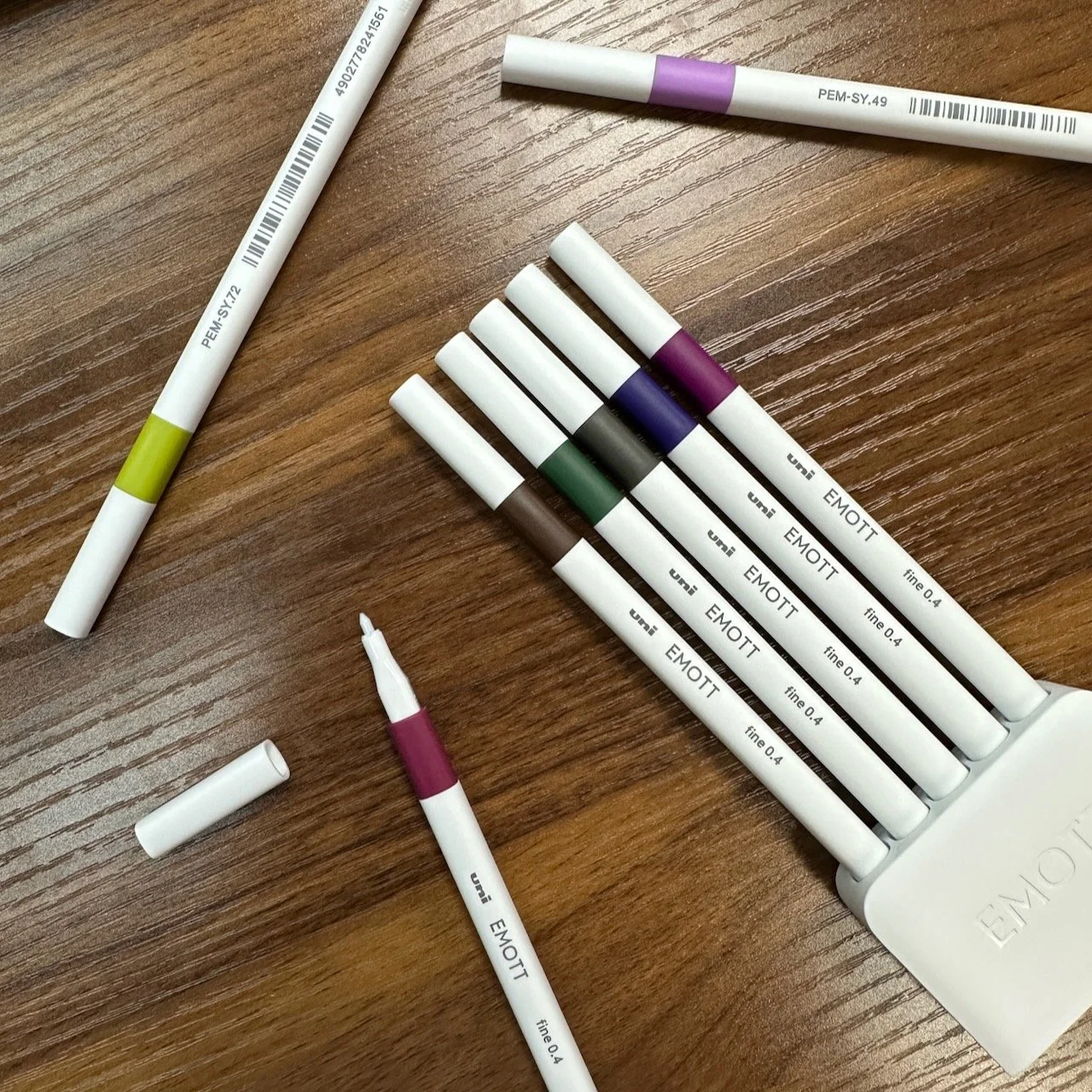
The Pentel Sign Pen features color-coded end caps so that you can conveniently locate the pen you’re looking for.

Takeaways and Where to Buy

I keep a jar of the Craft Design Technology Pentel Sign Pens on the main worktable in the T.G.S. back office - that’s how much I’ve grown to love these things. I’ve always been a fan of fineliners and other fine-tipped markers, but the Sign Pen is different enough that I sometimes feel as though I’ve discovered an entirely different product category! I have one of the 10-pen sets, and I even kept the zippered pouch so that I can take these with me when I travel. They make an excellent addition to a journaling kit if you like to write in different colors but don’t feel comfortable bringing multiple fountain pens and inks.

If you opt for one of the multi-packs, be sure to save the pouch, as it’s quite nice for travel. (Or you can upgrade to one of the CDT Custom Leather zipper pouches.) :)

As noted above, we stock the Sign Pen in the exclusive Craft Design Technology mint green finish. For those unfamiliar with CDT, it’s a Japanese design house that collaborates with various stationery manufacturers on their own unique versions of classic items, including Pentel items such as the Tradio, Sign Pen, Energel, Sharp Kerry, and even more paper products and desk accessories. Most of their releases incorporate some version of their signature green colorway.

The Gentleman Stationer is supported by purchases from the T.G.S. Curated Shop and pledges via the T.G.S. Patreon Program. You can also come visit us at our physical stationery store in Nashville, Tennessee.

In Pens Tags Craft Design Technology, Pentel, Pentel Sign Pen, Fineliner Pens, Brush Pens
Comment

Ask TGS: Five Tips for Success with Refillable Fineliners

October 30, 2024

I’ve read a few posts and reviews recently discussing refillable fineliners and fibre-tipped pens such as those made by Tom’s Studio, Kuretake, and Kakimori, which have raised a number of questions about how to use these pens correctly, and what you can expect with respect to the performance of fountain pen inks in non-fountain pens. Personally, I’ve had success using these pens to the point where they might currently be near the top of my everyday user/workhorse pen rotation. Here are a few tips and tricks to get the most out of your refillable fineliners. The suggestions are mostly brand-agnostic and apply across the product category.

  1. Choose a Saturated Ink for Maximum Legibility. Most refillable fineliners use a cotton or fabric “wick”-style cartridge to hold the ink. You fill the pen by placing the end of the wick into your ink bottle or sample vial, and part of the fun is watching the ink work its way up the refill. After inserting the wick into the section, the “feed” part of the fibre tip should extend into the saturated cotton, and once you see the tip change color, the pen is ready to write. While this is a very straightforward way to fill a pen, the mechanics of writing work differently than with a fountain pen. A fountain pen nib and feed operate essentially as a controlled leak, with a relatively large amount of ink applied to the page compared to something like a fineliner, which works more like a brush. As a result, inks that are lighter in tone and/or designed to shade may appear extremely light in a fineliner, compared to more saturated inks, due to less ink being applied to the page. Use darker, more saturated colors to maximize legibility for writing with a fineliner, unless you are expressly looking for the lighter tone.

  2. Don’t Expect Shimmer Inks or Inks with Special Properties to Behave the Same as in a Fountain Pen. This one should be self-explanatory, but the large particles that give “shimmer ink” the shimmering effect cannot be absorbed by a wick reservoir and can’t flow through the fineliner tip. While a shimmer ink might technically “work” in the fineliner, the color you see will almost certainly be the base color in the ink, minus the shimmer particles. Similarly, I’ve found that some pigmented inks don’t work as well in fineliners, while others (presumably with smaller particles of solid pigment) work better. I would still say that the best performers have been regular water-based fountain pen inks.

  3. Don’t Leave the Cap Off Your Fineliner for an Extended Period of Time. If the ink dries out in a fineliner nib, it will need to be flushed with water to get the pen writing again. Sometimes you can fix the issue by simply wiping the tip with a wet paper towel to remove dried ink, but the easiest fix is to not let the pen dry out in the first place.

  4. When Changing Colors, Let the Wick and Tip Dry Completely Before Refilling. Where a refillable reservoir is included (as with the Tom’s Studio Lumos or Wren), it is absolutely intended to be rinsed and reused several times before being replaced. I’ve had the best luck completely submerging the refill in a bowl of water and squeezing the ink out multiple times until the refill is white again. The tips can typically be rinsed under a faucet, though you may need to soak them with certain inks. Place the tips and reservoir on a paper towel and allow to fully dry (24+ hours, preferably) before attempting to refill.

  5. Think Carefully About How You Plan to Use the Pen Before Filling It. Given that it can be a bit of a chore to change ink colors, you should give a bit of extra thought to ink choice and tip size on the front end. (It’s especially important for single-use pens like the Kakimori Colour Liners.) As I mentioned above, if you’re going to use fineliners for writing or sketching, and it’s important for you to write a dark line, you should choose a very dark, saturated ink.

So what inks have I had the most success using in my refillable fineliners? More saturated solid colors by Tom’s Studio and Diamine have worked extremely well. The darker purples, blues, and greens have given me no trouble, and I’ve recently enjoyed the new Midnight Blue Fibre Tip ink, specifically designed by Tom’s Studio for saturation and flow in the fibre-tipped pens. I mentioned in my recent rollerball writeup that I’ve struggled to find a blue-black rollerball or fineliner refill, and low-and-behold, this new ink appeared literally the next week.
I’ve also run some of the Laban Greek Mythology Inks through my Kakimori Colour Liners, and the more saturated colors such as Ares Red and Artemis Navy Blue work exceptionally well. More nuanced colors like Aphrodite Pink are legible, yet appear lighter than they would in a fountain pen and you therefore lose some of the brown/grey/pink nuance to the color. While there’s no substitute for your own experimentation, I’m playing around with as many inks as possible so you don’t have to!

We carry a fairly wide selection of refillable fineliners and fibre-tipped pens in our shop, from the Tom’s Studio Lumos and Wren pens to the Kakimori Colour Liners, with Kuretake pens on the way. If you have additional questions regarding these pens and how they work, feel free to reach out using our contact link.

In Ask TGS Tags Fineliner Pens, Refillable FIneliners, Tom's Studio Lumos Fineliner, Tom's Studio Wren, Kakimori Colour LIners, Ask TGS
Comment
Store Hours and Location
Visit the T.G.S. Curated SHOP
Updated "Best Pens" Guide
On the Paper Trail Podcast
TGS_25 Roterfaden New Stock Available
Hierarchies of Fountain Pen Friendly Paper

Join Our Patreon!
Subscribe to the TGS E-mail List

Featured Posts

Featured
Pentel-Sign-Pen-Cover.JPG
Feb 28, 2026
Pen Review: The Pentel Sign Pen (Craft Design Technology Version)
Feb 28, 2026
Feb 28, 2026
Cover On the Paper Trail Intro Clip.jpeg
Dec 3, 2025
Introducing "On the Paper Trail," a New Podcast/Video Collaboration with Lisa Vanness of Vanness Pens!
Dec 3, 2025
Dec 3, 2025
Iro-Utsushi-Fine-Dip-Pens.jpeg
Oct 1, 2025
The Pilot Iro-Utsushi Dip Pen (and in General, Simple vs. Fancy Dip Pens)
Oct 1, 2025
Oct 1, 2025
The Gentleman Stationer RSS

© Digital Divide Media, LLC, 2014-present.

All content is the exclusive property of Digital Divide Media, LLC, d/b/a The Gentleman Stationer, including “The Gentleman Stationer” website and trademark, and should not be reproduced without express written permission.  All rights reserved.

All content containing paid advertising, affiliate links, or sponsored content will be plainly disclosed by a disclaimer when/if featured.

Contact Information

Store Shipping Policy and Return Policy

Privacy Policy

Cookie Policy

Terms and Conditions

Powered by Squarespace