• Blog
  • Shop
  • Podcast
  • Resources
  • About
  • Archive
  • Contact
  • Cart
  • Sign In My Account
Menu

The Gentleman Stationer

Vintage Living in the Modern World.
  • Blog
  • Shop
  • Podcast
  • Resources
  • About
  • Archive
  • Contact
  • Cart
  • Sign In My Account

TGS 12th Anniversary: What's in Your Pen Case These Days?

May 2, 2026

“How has your everyday carry evolved over time?” Someone asked me this the other day, and it’s a good question to reflect on as I celebrate TGS’s 12th Anniversary. I’ve never really put that much thought into a specific “kit” outside of planning for trips - I typically ink up a combination of fountain pens based on what I feel like using for the next several weeks along with a handful of workhorse pens chosen based on my current projects and work schedule. However, I do think you can tell a lot about preferences with a simple “bag dump,” or here, a “pen case dump.” Today I plan to look through my “currently inked” lineup, with some added commentary on how my preferences have changed over time.

From left: Pilot Custom 912 fountain pen, Laurett’s Ebonite Ballpoint, Ohto CR02, Pilot Custom 912, Lamy 2000, and Lamy Swift Rollerball. At bottom: Zebra Mildliners and Pilot Juice Up.

Pen Case No. 1: Rickshaw Fillmore 3+3

The first thing you’ll notice is that this six-slot pen case can actually hold a lot more than six pens. Like many people new to the hobby, when I started out I was strictly in the “one pen, one slot” category, but about five years in I stopped caring if the pens touched and/or developed minor scratches and dings. Nearly all of the pens I write with regularly are permanent companions that will not be sold or kept as investment pieces/collectibles. I let them develop their own scars. Sometimes this means I have more than one pen in a single slot, or I’ll carry multiple pens in the front pocket.

As an aside, I love the Rickshaw Fillmore for its ability to unzip all the way around and serve as a pen tray as well as a traditional pen case. In addition to the pen slots, one side contains a forward pocket that can hold a notebook, sticky notes, index cards, or more pens. Here’s what I’ve got in there right now:

  1. Lamy Swift Capless Rollerball. One of the most underappreciated workorse pens, the Lamy Swift rollerball has a genuinely good capless refill, plus a retractable clip that recedes into the barrel when the tip is extended to prevent you from accidentally ruining your shirt pocket, bag, or pen case. The Lamy Swift is one of those subtly good pens that you will use without thinking about it - I find it in my hand all the time.

  2. Laurett’s Waka Ebonite Ballpoint. Sometimes you can’t use a fountain pen, but you want to use a visually interesting pen that features a material like ebonite. As a regular ballpoint user, I was thrilled to discover these ebonite ballpoints from Japanese maker Laurett’s, which specializes in ultra fine knurling in applications from pens to automotive parts. Here, the knurling (i.e. ridges) on the ebonite barrel adds texture that gives the pen a nice grip.

  3. Ohto CR02 Rollerball. For an everyday classic capped rollerball, it’s hard to do better than the Ohto CR02, and if the pen’s not your thing, the fine-tip refill is excellent. I always keep one of these pens with me for when I need a dark black ink, and it’s also a great pen to lend to someone to use in a meeting.

  4. Pilot Custom 912 with PO (Posting) Nib. The most significant change that I’ve made in my fountain pen use over the years is to focus on nibs more than the pens themselves. I’ve accordingly found myself drawn to pens like Pilot’s Custom 912, which features multiple 14k nib options that include many specialty grinds. The PO (Posting) nib is an ultra-extra fine nib that I love for planning and annotation. Currently inked with Bungubox Dandyism.

  5. Pilot Custom 912 with WA (Waverly) Nib. My latest discovery is Pilot’s WA (Waverly) nib, which features a slightly upturned tip designed to write smoothly from multiple angles. Reminiscent of those vintage Sheaffer “Touchdown” nibs from the 1960s and 1970s, the Waverly nib make an excellent everyday writer and I’ve had this one inked up through multiple fill cycles. I currently have it inked up with an orange multi-shading Sailor Ink Studio ink, though I don’t have the exact number since it came from a sample I pulled from a friend.

  6. Lamy 2000 (Standard Black Makrolon - Fine Nib). Yes, there will always be at least one inked-up Lamy 2000 in my pen case. I’ve made no secret over the years that I love everything about the design of this pen, and the nib style fits my handwriting well. Inked up with a special ink that you all will hear about very soon. :)

  7. In The Pocket: 2 Zebra Mildliners and a Pilot Juice Up (Examples). I generally have a handful of highlighters and colorful gel pens in the Fillmore’s center pocket, again for planning and annotation. The specific brand/color/model rotates out fairly regularly, and honestly depends mostly on what’s sitting at my desk when I pack my pen case in the morning. This week it’s been two Zebra Mildliner dual-tip highlighters and a Pilot Juice Up with the excellent .4mm Synergy Tip.

Pen Case No. 2: Nagasawa Kip Leather Five-Pen Zippered Case

I take my Fillmore nearly everywhere I go, but I keep another five-pen case packed with pens that I use mainly for journaling and more introspective writing sessions. Sometimes this case will go with me in my bag, other times it lives at my desk at home, depending on where I’m doing my writing. These pens are a mix of practical workhorses for longer writing sessions and “fun nib and ink combinations”. If you think this case is heavy on Pilot, you would be correct.

  1. Pilot Custom Heritage 92. My clear demonstrator of choice at the moment. A cross between the Pilot Custom 74 and the Custom 912, the Custom Heritage 92 is one of Pilot’s only piston-filler offerings, and in my opinion it’s one of the smoothest pistons out there. When I re-ink this one, I may choose a brighter ink to showcase the transparency and excellent finish, but for now it’s inked up with Taccia Kuniyoshi Uguisu-Cha, a dark tea-green. For those who will ask, yes, I wish I had kept my transparent orange Custom Heritage 92 with a Fine Medium.

  2. Pilot Custom 74 Lavender Fog with SFM (Soft Fine Medium) Nib. Pilot’s fine medium nibs are usually available only in Japan, so when they brought the soft version to the U.S. market with this year’s North American exclusive release, I was all-in. This one is inked with KWZ Brown-Pink, and if you’re interested in a soft nib, please read the review above before buying one and trying to “flex” it.

  3. Pilot Custom 743 with FA (Falcon) Nib. I wanted to grab one of the North American Exclusive Verdigris Custom 743s before they went out of stock, and I opted for a fun FA nib that sort-of-flexes-but-not-really. If you’re looking for vintage-style flex, you will find the FA too stiff, but if you’re instead looking for a nib that adds line variation to your cursive and is capable of showcasing shimmer, shading, and sheen, the FA Nib on the 743 can be a lot of fun for more creative journaling and handwriting practice. This one is inked with yet another Sailor Ink Studio ink that I received as a friend sample and lost the number. It’s a nice legible yellow green.

  4. Pilot Custom 823 with Medium Mark Bacas Blade Nib. My journaling workhorse, the Custom 823 is a candidate for my upcoming international trip due to the vacuum filling system that utilizes a shutoff valve to prevent ink leaks on an airplane. This pen started life as a medium nib but was modified by Mark Bacas to a blade grind (an early variation on a Kodachi/Naginata). Inked with standard Pilot Namiki Black, a reliable standard ink for when you want to write without distraction.

  5. Bonecrusher 7 Studios Fountain Pen with Matthew Chen Fine Stub. This pen may be my favorite purchase from this year’s initial round of pen shows. I usually post my pens, but the shape and length of this one gives it almost perfect balance. Matthew ground the nib for me to a slightly oblique stub nib, which is also inked with Bungubox Dandyism and is almost empty since I’ve used this pen for several extended journaling sessions.
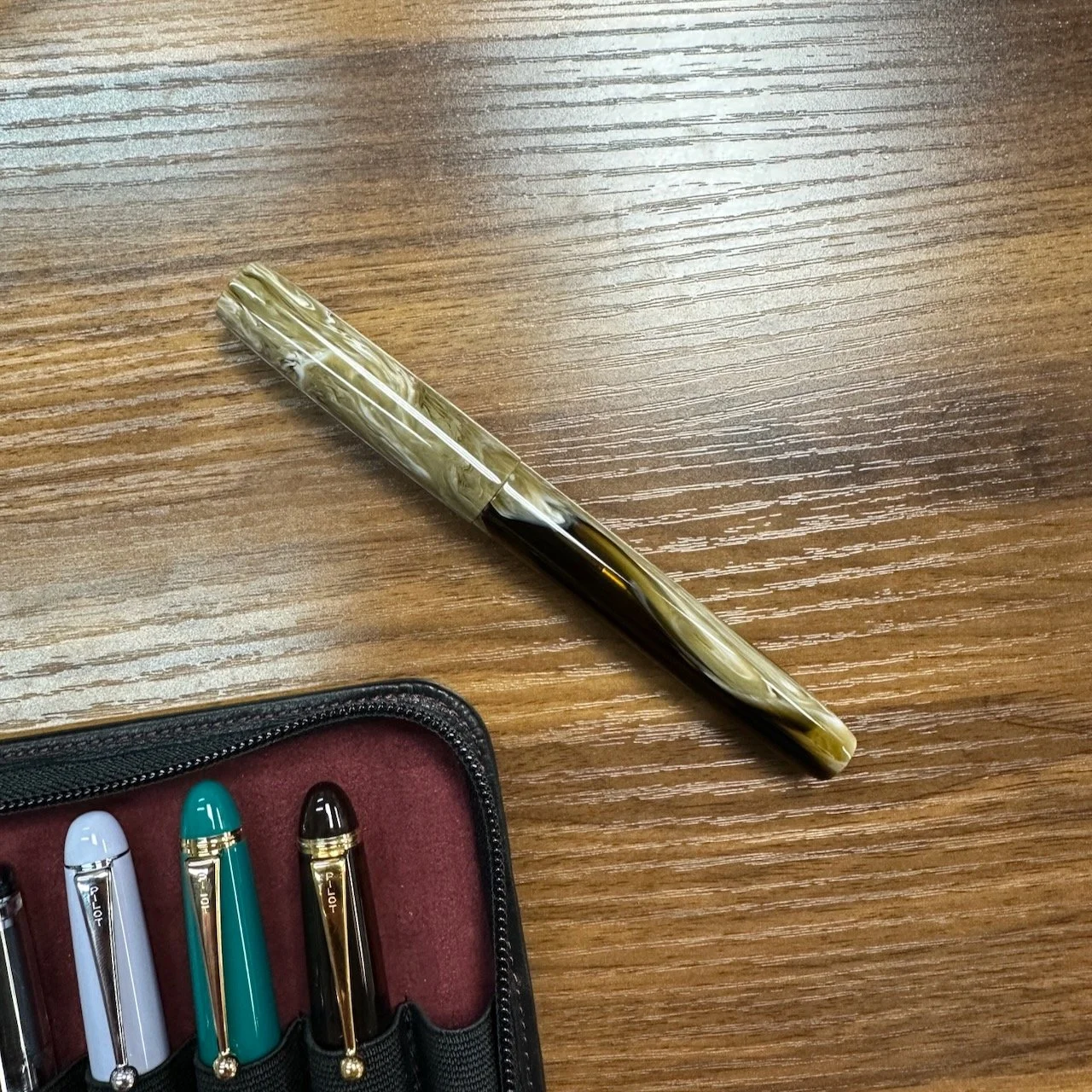
Bonecrusher 7 Studios fountain pen in mocha acrylic

The pen case shown here is a simple five-pen zippered case acquired from Nagasawa at the 2026 California Pen Show. Nagasaw Kip Leather features a rare combination of softness and durability - despite how supple this leather case is, it’s survived multiple trips in my bag without scuffs or scratches.

I may only travel with two pens going (as opposed to coming home). These two are prime candidates.

Guess What? I’m Going to Japan Later This Month!

Lisa and I talked about this upcoming trip a little bit in the latest On The Paper Trail Episode (and it will be a bigger topic of discussion next week), but I am actively thinking about my stationery carry for a two-week international trip where the sole purpose of the trip is…well, stationery. As I mentioned in Episode 8, I plan on “splurging” on some pens while I’m over there, so my outbound carry will be light: maybe one or two pens to use on the plane and a LOT of extra case capacity to bring stuff home. Stay tuned!

The Gentleman Stationer is supported by purchases from the T.G.S. Curated Shop and pledges via the T.G.S. Patreon Program. You can also come visit us at our physical stationery store in Nashville, Tennessee.

In Editorial, EDC Tags Workhorse Pens, Bag Dump, TGS 12th Anniversary
1 Comment

From left: Pilot Custom 74, Pilot Decimo, Lamy 2000, Lamy Safari, TWSBI ECO.

T.G.S. 12th Anniversary: 5 Fountain Pens Everyone Should Experience

April 22, 2026

This month TGS turns 12! Yes, I’ve been at this for over a decade, and while the site has evolved a lot over the years, the core of the business - and what I love about running The Gentleman Stationer - still revolves around pen recommendations and helping those interested in writing by hand find the best pen to fit their specific needs. A common request I get is for an “experience list” or a “what’s next” list - if someone has tested out an inexpensive pen like a Pilot Kakuno or Platinum Preppy and decided that they enjoy writing with fountain pens, what pens should they try next to give them a sense of what else is out there? I consider the five pens discussed here to be to be “foundational,” in the sense that they were all important to me in my own fountain pen journey and still serve as benchmarks for how I consider and evaluate a lot of other pens on the market.

I need to preface this article by saying that this is not intended to be a “pens you need to buy” list, but rather more of a pens to TRY list. Most of these are relatively common fountain pens that you can see in person at most brick and mortar pen shops or pen shows, or in someone else’s collection at a pen club or pen meetup.

TWSBI ECO (left) next to a Lamy Safari.

Lamy Safari

Originally released in 1980 (46 years old - ask me how I know that), the Safari features a modern design with its signature oversized clip and somewhat polarizing triangular grip. A flexible cartridge-converter filling system and interchangeable nibs make it a versatile pen that you can usually find priced under $30. Importantly, if you try out a Safari or its larger sibling, the AL-Star, and discover that molded-grip fountain pens aren’t for you, this will help you rule out a lot of potential purchases.

TWSBI ECO

“I’m curious about using bottled ink and want to try a piston-fill fountain pen but don’t want to spend $100.” I get some version of this question every weekend, and usually my answer is going to be to try the base model TWSBI ECO. At $36.99, you can test out a quality piston fill mechanism that holds a lot of ink, and discover whether it’s for you or whether you prefer the convenience of an ink cartridge or the flexibility of a converter. If you visit our shop in person we almost always have at least one ECO inked as a tester.

Pilot Custom 74

If you’ve never tried a gold nib fountain pen before, start by trying out one of the best possible no-fuss writing experiences. Pilot nibs are known for their consistency and reliability, and even after all these years the Pilot Custom 74 with a 14k medium nib might be my favorite all-around writer. Both steel and gold nibs can offer an excellent writing experience, but gold nibs have their own unique feel. The Custom 74 is one of the best at a very good price point. (Custom 74 Full Review)

Pilot Vanishing Point or Decimo

“A retractable fountain pen?” A lot of new users are shocked that such a thing even exists, much less that it’s been around since the early 1960s. If the clip doesn’t interfere with how you grip the pen, the Vanishing Point/Decimo’s capless design can be a game changer for those of us who have worked in office environments where writing on the go is a necessity. Personally, the slimmer Decimo works better for how I hold my pen, but that’s something you can only discover by trying both pens out in person. (Vanishing Point/Decimo Workhorse Pen Review)

Lamy 2000

The Lamy 2000 draws strong opinions, and that’s exactly why it’s on this list. The Bauhaus-inspired design dates to 1966, and while some may find the minimalist brushed Makrolon construction “boring”, it remains my favorite fountain pen design of all time. Is it for everyone? No. But for every person looking for a brightly colored acrylic demonstrator, there’s someone looking for an everyday workhorse they can use at the office that disappears in their hand. For me, the Lamy 2000 is that pen. Moreover, like the Pilot Vanishing Point, when something has been around for almost 50 years, and is still manufactured today using basically the same design as when it was originally released, its worth a try simply to be able to add it to your “pen vocabulary”. (Lamy 2000 Workhorse Pen Review)

Pilot pens are easy to recommend as reliable workhorses. Shown here are the Pilot Custom 74 (front) with a Pilot Decimo (sorry, the finish was an exclusive for Nagasawa Stationery in Kobe, Japan).

What Factors Drive Inclusion on This List?

Obviously this list isn’t exhaustive - it contains five pens I recommend people try when they’re looking to broaden their horizons and explore different fountain pen options on the market. While some of this is intangible and driven by by my own likes/dislikes and personal experience, here are a few general factors I considered:

  • Range. This set of five pens I’ve chosen presents a diverse variety of styles, from classic (the Custom 74) to more modernist (Safari and the Lamy 2000). Do you prefer an “edgier” look, or more traditional vintage-inspired design?

  • Age and Popularity. For new users, I generally recommend they try as many “classics” as they can, meaning pens that have been around for a while (i.e., usually decades, with the one exception here being the ECO). A baseline familiarity with popular fountain pens broadens your frame of reference and can help you have more informed discussions with other enthusiasts or retailers, making your experience more enjoyable by allowing you to better understand what other people are talking about.

  • Value. The most expensive pen on this list is the Lamy 2000, which retails for $223 and includes a 14k gold nib and an integrated piston filling system. The Pilot Custom 74 is another pen with a 14k gold nib that retails at most places for $216. While I tend to be a “buy what you like and use it forever” person who doesn’t overanalyze price if it’s an item I intend to use long-term, I feel that the rapid emergence of licensed/branded collaborations and marked-up special editions has made it more important to have a perspective on value. I’ve found myself considering - and rejecting - certain pens because at $350+ they simply don’t offer anything beyond core pens I already own, that I enjoy using, and which cost much less. Again, price isn’t always everything, but know what you can get for your money.

We have all of the pens models shown here available in our Nashville shop, and often have at least one example of each model inked up and available to try in person. We also regularly bring pens on the road to shows. We hope to see you sometime!

In Editorial Tags TGS 12th Anniversary, Top Pens, Foundational Fountain Pens, Workhorse Pens

Yes, I have two Lamy 2000s inked up at once.

My Favorite Fountain Pens for Longer Writing Sessions

October 25, 2025

I frequently get this question, and it’s one that I feel is important because it touches on one of the key reasons that so many of us get into fountain pens in the first place: They offer a much more comfortable writing experience over longer sessions, whether that means an extended journaling session, drafting a novel, or pulling together a longer professional document like a report or a legal brief. Personally, I think better when I’m working by hand offline, and over the years I’ve explored pretty much all the analog writing techniques out there. A fountain pen and a good writing pad remains my favorite.

Both of these grips are extremely comfortable for me to use.

What Factors Are Important for Comfortable Long-Form Writing?

If I’m preparing for a longer working session, I’ll consider three main factors when choosing a fountain pen: comfort, ink capacity, and the nib. In terms of comfort, I’m mainly talking about grip and balance. I have to be able to hold the pen easily for a long period of time, which means a comfortably grippy section and a pen barrel that doesn’t feel too weighted towards the front or the back of my hand. In terms of ink capacity, the pen doesn’t necessarily need to hold a ton of ink, but if I’m going away on a writing retreat or work trip I often will choose a piston filler just so I don’t have to worry about refilling (though a Pilot cartridge will last me a VERY long time). Finally, I’ll typically opt for a smooth medium nib, which gives me the least fussy writing experience and lets me “get lost” in whatever project I’m working on.

The Lamy 2000 (top) next to the Pilot Custom 74.

My Top Three Fountain Pens for Long Writing Sessions in My Personal Collection

  • Lamy 2000. Long-time readers of the blog won’t be surprised by my top choice. I tell anyone who will listen that if I had to get rid of all my fountain pens and keep just one, I would probably keep a Lamy 2000 (though depending on the rules I might try to keep multiple Lamy 2000s in different nib sizes). For whatever reason, this pen fits my hand perfectly. I love the lightweight Makrolon (brushed fiberglass composite) construction, which when posted has near perfect balance. And Lamy’s 14k medium nibs are among the best out there, in my opinion.

  • Pilot Custom 74. A close second to the Lamy 2000, Pilot’s Custom 74 is my cartridge-converter fountain pen of choice. I actually use refilled Pilot cartridges more often than Pilot converters, given how much ink they hold. The Custom 74 is another one of those pens that seems to mold itself to my grip, to where I can write with this pen for hours with very little hand fatigue.

  • Leonardo Momento Zero. The Momento Zero has a similar shape to the Lamy 2000, perhaps slightly larger, and if you prefer an even larger pen you can always opt for the Momento Zero Grande. Personally, the standard size fits my hand better than the Grande. Leonardo mainly uses JoWo nibs, which are reliable, if unspectacular, writers. As I mentioned above, sometimes when you want to get lost in a project, choosing a somewhat boring nib over a temperamental needlepoint or an exotic grind lets you focus more on the project itself than the tool you’re using.

What About Budget-Friendly Choices?

The three pens I’ve chosen above are big purchases, and those looking to experiment with fountain pens for the first time probably don’t want to splurge on a $200+ gold-nib fountain pen that they don’t necessarily know if they’ll like. Two pens that I’ve used in the past for travel writing (in places I didn’t necessarily want to take an expensive pen) are the ubiquitous TWSBI ECO and the even more inexpensive Pilot Kakuno (complete with smiley-face nib). Despite garnering reputations as “beginner” fountain pens, these are excellent low-cost writing instruments. I consider both well-balanced with reliable nibs.

Conclusions and Further Reading

There’s no real one-size-fits all analysis here. I can offer my recommendations, as I frequently do at shows and in the shop, but choosing a fountain pen that you can write with for long periods of time takes a lot of research and personal experimentation to determine what meets your needs and preferences. One resource you may find helpful is the “Workhorse Pens” series of articles that I’ve written over the years. Do you have a favorite pen for longer writing sessions? Tell us about it in the comments below!

I try to periodically answer questions from readers and customers that frequently appear in my inbox, social media DMs, and customer questions. You’re always welcome to stop by our store and talk to me in person, and I maintain a FAQ (Ask TGS) section on the site. If you enjoy our content, we are supported entirely by purchases from the T.G.S. Curated Shop and pledges via the T.G.S. Patreon Program.

In Editorial Tags Workhorse Pens, Ask TGS, Fountain Pens, Editorial
2 Comments

Workhorse Pens: Vanishing Point or Decimo for a Capless Fountain Pen?

June 7, 2025

A handful of iconic fountain pens appear on everyone’s “you-need-to-try-it-at-least-once” list. The Pilot Vanishing Point is one of those pens. Not only has it been around since the 1960s, making the original design approximately the same vintage as the Lamy 2000, but after all these years it remains the default option for a retractable nib fountain pen.

I did a review of the Pilot Decimo several years ago, so I won’t go into the nuts-and-bolts details again. I will, however, spend today’s post talking about 5 specific things to understand about the Vanishing Point and Decimo, including what I consider to be key differences between the classic VP and the slimmer Decimo, and how those differences have impacted the pens’ functionality for me over the years. The purpose here isn’t to say that one is better than the other - it’s purely a matter of preference and what will work for you based on how you hold and intend to use the pen. Both pens are the same price, after all, so it’s not a question of saving money by going for one as opposed to the other.

No, this “Harvest Green/Yellow” color isn’t available anymore. And no, my pen is not for sale. :)

Vanishing Point vs. Decimo: 5 Considerations

  • Both Pens Use the Same Nib, Cartridge, and Converter. Since the Pilot Vanishing Point and the Pilot Decimo use the same nib units, ink cartridge, and converter system, you can experiment with both pens without worrying that your parts and accessories will only fit one or the other. This also means that you can easily move nib units between pens, and purchase additional nib units for more versatility without accumulating additional pens that you won’t use. As an aside, you can check out this short video showing how to install a cartridge in both pens. (They work the same way.)

  • The Decimo is Slimmer. The Decimo is lighter weight and slimmer than the Vanishing Point, which means that it will fit many people’s hands better. This is purely a matter of personal preference, since the pens otherwise function in the same manner and use identical components, as noted above.

  • Both Pens Feature the Same Clip (But Consider…). One “controversial” aspect of both the Pilot Vanishing Point and Decimo is the clip placement. The clip necessarily has to sit on the nib end, since the pen must be carried nib-up, but some find that it interferes with their grip due to finger placement. This is yet another matter of personal preference, but I tend to find the Decimo more comfortable because the slimmer barrel alters how the clip fits in my grip. (And, yes, you can remove the clip entirely, but understand that it will void your warranty.)

  • The Decimo Fits More “Pen Loops,” Including on Plotters. One reason I absolutely love the Decimo is that it fits my Plotter pen loop and in most other planners. The extra-fine nib writes well on most papers, regardless of quality. This makes it a perfect “planner pen” for me.

  • The Vanishing Point Comes in a Wider Range of Colors. If you’re looking for matte black trim or the iridescent “carbonesque” finishes, you’ll be limited to the Vanishing Point model. That said, Pilot periodically releases Japan-only Decimos in gradients and other unique finishes, though you may have to pay a premium.

A comparison between Vanishing Point/Decimo nibs (top) and the E95s nib (bottom).

TLDR Version: Pilot’s retractable nib Vanishing Point and Decimo Capless fountain pens are the best version of the “Retractable Nib Fountain Pens” product segment. Over the years, I’ve gravitated towards the Decimo, since a slimmer pen better fits how I use retractable fountain pens, but I do own and use both. As you can see from the photos, I’m also experimenting with the E95s, which is not retractable but highly portable, and which also features an excellent inlaid nib that’s the spiritual successor to the Pilot Myu.

We currently carry select models of the Pilot Vanishing Point (Matte-Black Trim and Carbonesque) and Decimo, with most nib sizes available in pens and as separate nib units. If you enjoy our content, we are entirely self-supported through our online shop and physical store, as well as the T.G.S. Patreon Program.

In Pens, Workhorse Pens Series Tags Workhorse Pens, Pilot Vanishing Point, Pilot Decimo, Fountain Pens, Pen Review
Comment
Inexpensive Pens Pocket Pens

More Thoughts on (Relatively) Inexpensive Stationery

February 15, 2025

Building on Wednesday’s post and accompanying YouTube video about why many of us love inexpensive pens, I’ve been thinking more broadly about the role that the less expensive stationery products play in my everyday rotation. While I firmly believe that all stationery - even the very nice pricey stuff - needs to get used at some point, because that’s what it’s made for - even I balk at using more expensive paper for things as routine as grocery lists, meeting notes that won’t be retained, draft markups, and other “junk paper” that I never intend to keep. Similarly, when I’m forced to write on cheap recycled copy paper at work, I don’t necessarily want to use my nicer inks in a context where they’ll just feather and bleed, and where I won’t get much enjoyment from the writing experience. So although I do tend to use the more “upscale” stuff for most of my personal journaling and longhand professional writing, here are five categories of relatively inexpensive stationery that I tend to keep on hand for the more mundane tasks:

  1. Rhodia, Clairefontaine, Levenger, and Maruman Mnemosyne Paper. These paper brands handle most ink types relatively well, and the paper is fairly priced so that I don’t feel self-conscious about using it as scrap paper. Sure, I do sometimes still get comments from co-workers such as “You spent $8 on a legal pad?!?”, but honestly, if you care about a baseline level of quality in the tools you use, you learn to tolerate the attitude. (Sometimes I like to gently remind people that the legal pad I’m using still costs less than the coffee/beer they’re consuming during the course of our conversation, and will last 30x as long.)

  2. .5mm Mechanical Pencils. For everyday office work, I’ve been relying more and more on mechanical pencils because I can use them for pretty much anything, without thinking about how they’ll perform on the paper. As you saw in Wednesday’s video, I’m a fan of the Pentel Sharp Kerry since it has a cap and slips easily into my pocket. The Kuru Toga Alpha Gel Switch is an underrated writer, which also comes in a .3mm for those who write very small.

  3. Platinum Plaisir Fountain Pen with EF Desk Pen Nib. This particular pen requires a bit of a hack, but if you take the EF steel nib from the Platinum Desk Pen and swap it into a Platinum Plaisir fountain pen, you get an excellent everyday writer that works quite well on less expensive paper, especially when you pair it with Platinum Carbon Black or Blue-Black cartridges (both great “cheap paper” inks).

  4. Standard Blue, Black, or Blue-Black Ink. Speaking of ink, I always have one or two workhorse fountain pens inked up with very basic water-based “pen company” inks that I know will behave moderately well no matter how they are used. All of the Waterman Inks, basic Pilot Blue, Black, and Blue-Black, and the Platinum cartridges linked above are all rock-solid options.

  5. Low-Viscosity Ballpoint Multi Pen. Alongside my mechanical pencils, a versatile three or four-color multi pen is always in my rotation. While not the most inexpensive, the Lamy 2000 4-color is my main workhorse, supplemented by various Jetstream Multi Pens and the Pilot Hi-Tec-C Coleto gel pen. The ballpoints come in handy for when I need to sign documents in permanent ink (not an infrequent occurrence), and the Coleto Multi Pen when I need a pop of color.

My Platinum Plaisir Frankenpen (Top) and a green Pentel Sharp Kerry I’ve had for years.

As someone who makes a chunk of their living writing about and selling stationery, people often expect that I use the most expensive stuff available, and that’s far from the truth. Most of what I use day-to-day falls well under the $30 price point (and sometimes sub-$20). It’s one reason I’m not overly pessimistic about the future of our hobby in the face of inflation and rising costs. Even if we end up having to scale down, there’s plenty of great options to be had for not a lot of money!

Thank you for reading! The Gentleman Stationer is supported by the T.G.S. Curated Shop and the T.G.S. Patreon Program. If you’d like to visit our in-person location, you can view directions and up-to-date hours here.

In Editorial Tags Editorial, Inexpensive Pens, Inexpensive Paper, Workhorse Inks, Workhorse Pens
2 Comments
Older Posts →
Store Hours and Location
Visit the T.G.S. Curated SHOP
Updated 2026 "Best Pens" Guide
No results found
On the Paper Trail Podcast
TGS_25 Roterfaden New Stock Available
Hierarchies of Fountain Pen Friendly Paper

Join Our Patreon!
Subscribe to the TGS E-mail List

Featured Posts

Featured
Five-Foundational-Fountain-Pens.jpeg
April 22, 2026
T.G.S. 12th Anniversary: 5 Fountain Pens Everyone Should Experience
April 22, 2026
April 22, 2026
Pilot-Custom-Series-Pens-overview.jpg
March 14, 2026
The Pilot "Custom" Series: An Overview of Some of My Favorite Fountain Pens
March 14, 2026
March 14, 2026
Pentel-Sign-Pen-Cover.JPG
February 28, 2026
Pen Review: The Pentel Sign Pen (Craft Design Technology Version)
February 28, 2026
February 28, 2026
The Gentleman Stationer RSS

View Cart

© Digital Divide Media, LLC, 2014-present.

All content is the exclusive property of Digital Divide Media, LLC, d/b/a The Gentleman Stationer, including “The Gentleman Stationer” website and trademark, and should not be reproduced without express written permission.  All rights reserved.

All content containing paid advertising, affiliate links, or sponsored content will be plainly disclosed by a disclaimer when/if featured.

Contact Information

Store Shipping Policy and Return Policy

Privacy Policy

Cookie Policy

Terms and Conditions

Powered by Squarespace