• Blog
  • Shop
  • Podcast
  • Resources
  • About
  • Archive
  • Contact
  • Cart
  • Sign In My Account
Menu

The Gentleman Stationer

Vintage Living in the Modern World.
  • Blog
  • Shop
  • Podcast
  • Resources
  • About
  • Archive
  • Contact
  • Cart
  • Sign In My Account

Old Reliables: The Platinum Preppy and Plaisir?

October 17, 2018

Of the “Big Three” Japanese pen companies: Pilot, Sailor, and Platinum, the latter traditionally gets the least amount of attention outside of Japan. Thing have changed somewhat in recent years, as Platinum has started to explore the limited edition market with its excellent line of 3776 Century pens, and its sister brand, Nakaya, has developed a stellar reputation among high-end collectors of pens featuring urushi, makie, and other forms of traditional Japanese artistry.

What tends to get lost in the shuffle is that of the “Big Three,” Platinum probably makes the widest array of low-cost pens. Two models, the Preppy and the Plaisir, regularly find their way onto various “Best First Fountain Pen” lists, and for good reason. Starting at $3.95, the Preppy can be as cheap as some disposable fountain pens, yet can be refilled with (proprietary) Platinum cartridges OR it can be eyedroppered, provided you first add some silicon grease and/or an o-ring to the barrel threads. Eyedroppering a Platinum Preppy is an excellent way to use “high-maintenance” inks that might damage or stain nicer pens, and the highlighter version of the Preppy can be used with Noodler’s Highlighter Inks.

A .3mm stainless steel nib on the Plaisir (left) and a .5mm stainless steel nib on the Preppy (right). Both nibs wrote an extremely smooth line out of the box, using the stock Platinum ink cartridge that came with the pen.

The Platinum Plaisir adds an upgraded body to the same nib, feed and section featured on the Preppy, made from anodized aluminum and available in a wide array of colors. The primary reasons to opt for the Plaisir over the Preppy would be aesthetics and durability - some of the color options on the Plaisir are quite nice, like the “Ice White” featured here, and the caps on Preppies tend to crack over time.

The Platinum Preppy posts a bit longer than the Plaisir, but it’s also extremely light due to its plastic construction.

On the whole, however, both pens offer an exceptional writing experience at the price point. One quirk is that nib sizes on these pens are not labeled with the usual EF, F, M, B designations. Rather, they are numbered .2, .3, and .5.  For example, the Preppy featured here is labeled “.5”, as in .5mm, which equates to a medium, while the .3mm on the Plaisir is a fine. Platinum also makes a .2mm extra fine, which is a bit more difficult to source.

I prefer the weight and balance of the Plaisir, but you can’t argue with the writing experience the Preppy offers for $3.95.

The .3mm (fine) nib is my favorite. I’m not a fan of stock Platinum black ink, as it can have a washed-out appearance.

Takeaways and Where to Buy

I’ve neglected both the Preppy and the Plaisir in my own use, and that’s unfortunate, especially since I’ve grown to appreciate Platinum as a brand. These relatively inexpensive models offer an excellent writing experience at a bargain price. The Preppy in particular gives you a reliable refillable fountain pen at a price point similar to “disposable” pens like the Pilot Varsity. For just a bit more money, you can get the more professional looking Plaisir in a growing array of colors.

You can purchase either of these models from most major pen retailers in the U.S., including our friends at Vanness Pens (in the United States). [Update: As of August, 2022, you can purchase the limited edition Platinum Plaisir Aura, as well as other select Platinum products, directly from us via the T.G.S. Curated Shop. Thanks in advance for your support!]

Disclaimer: This post does not contain links to paid sponsors or affiliates. The Gentleman Stationer is supported entirely by purchases from the T.G.S. Curated Shop and pledges through the T.G.S. Patreon Program.
In Pens Tags Pen Review, Platinum, Platinum Preppy, Platinum Plaisir
1 Comment

First Impressions: Syahi Monarch Fountain Pen

October 3, 2018

The Syahi Monarch was one of a handful of pens that came home with me from the 2018 D.C. Pen Show. Prior to the D.C. Pen Show, Sanay, one of the owners of Syahi India, reached out and requested that I stop by their table and pick up a pen to review. I finally managed to make it over there on Sunday afternoon during a lull in the insanity, and selected the Syahi Monarch in Striped Ebony with a fine steel “semi-flex” nib.

The brushed brass trim and the wood grain on the ebony are both gorgeous.

The Monarch is quite large - the length of a Pelikan M800 or a Montblanc 146, but heftier. The girth comes close to a Montblanc 149. The pen does not post. The body features a black acrylic section that’s comfortable to write with - the threads are larger, not sharp, and sit higher up on the section so they don’t get in the way of your fingers. In terms of designing a larger wooden pen that’s a comfortable writer with high quality fit and finish, the company has succeeded. According to Sanay, all components are made in-house, and Syahi’s goal is to manufacture a high-quality Indian fountain pen made of wood that doesn’t feel like a “kit pen.”

Nib and Writing Experience

At the DC Pen Show, the Syahi “flex” and “semi-flex” nibs were the subject of much discussion. I chose to review what the company calls a “Fine Semiflex Steel” nib, which appears to be a Bock nib modified by extending the nib slit all the way to the base. This is a common technique used to add “flex” to steel-nib pens while keeping the price relatively low, and if done correctly, the technique is highly effective in adding line variation to your writing. The nib on my Syahi Monarch works quite well, and the nib remains smooth enough to use as a daily writer even when you’re not flexing. (Sometimes these modified steel flex nibs can feel scratchy.)

Because the steel “semi-flex” nib remains relatively stiff, you can continue to use it for standard writing.

Even though it flexes well, this nib has its drawbacks. Extending the nib slit also exposes the feed to more air, leading to issues with ink evaporation and hard starts. If you’re going to use one of these steel flex nibs, you shouldn’t leave the pen sitting for more than a day or so. I’d also recommend using a low-maintenance, free flowing ink such as Waterman Blue (or, as shown here, a 50/50 mix of Waterman Blue and Violet (“Blurple”)).

Syahi Monarch (center), compared against a Montblanc 146 (left) and a Platinum Plaisir (right).

Takeaways and Where to Buy

Wooden pens are difficult to do correctly, in the sense that they can easily turn out looking like inexpensive “kit pens” that you’d purchase from a hobby store. Syahi has plainly avoided this pitfall - nobody would confuse this with a $30 pen. From the choice of wood, to the brushed trim, to the experimentation with the nibs, the company is striving to deliver a high quality product.

Currently the easiest way to purchase a Syahi fountain pen is to order directly from the Company’s website, though based on what I learned at the D.C. Pen Show, you may start seeing these pens at retailers soon. The pen featured here - a Monarch in Striped Ebony with Brass Trim - looks like it’s unavailable at the moment, but there does appear to be a Monarch in Mexican Rose Wood with brushed brass, and if you don’t mind polished gold trim you can still purchase a striped ebony Monarch. Other models are available as well, with pricing starting at $159. If I hadn’t been able to find an ebony Monarch, I likely would have gone with the flat-top Imperator.

Many thanks to Syahi for making this review possible!

Disclaimer: I was provided with this pen free of charge, for review purposes.

In Pens Tags Syahi India, Indian Fountain Pen, Pen Review, Wooden Pen
2 Comments

A Modern Classic? Montblanc Heritage Collection 1912

September 29, 2018

The Montblanc Heritage 1912 falls squarely within the “niche pen” category that certainly won’t appeal to everyone, but offers a glimpse of what storied, experienced brands like Montblanc are capable of when they reach into their back catalog for inspiration. I’ve had mine for a couple years now, and while it was an expensive purchase that required me to liquidate a significant chunk of my pen collection to be able to buy it, I’ve enjoyed every minute of owning and using this pen.

The Heritage 1912 is compact, which makes it a fun pen to carry for work, though you do have to mind where you set the cap because the pen doesn’t post.

This pen’s full name is the “Heritage Collection 1912 Fountain Pen,” which for simplicity’s sake I’ll refer to as the “Heritage 1912.” If you’re familiar with fountain pen history, and especially vintage Montblancs, you’ll notice the resemblance to the Simplo “Safety Filler” from the early 20th century. The key innovations of safety fillers like the Simplo included retractable nib mechanisms and a screw-on cap, both of which made early hard-rubber eyedropper pens less likely to leak. This pen, of course, is resin, not hard rubber, and it’s not a true “safety filler” eyedropper pen but rather a piston-filler that features a retractable nib.

The Heritage 1912 with the nib extended, and…

With the nib retracted.

The filling system on this pen is one of the more unique in my collection - it’s a piston filler where the piston knob has been modified to control both the filling system itself and the retractable nib mechanism. (Pictures and descriptions are included below.) Concerned that you might accidentally cap the pen with the nib extended? Worry not, because Montblanc designed a failsafe in the cap that keeps you from screwing the cap on in a manner that damages the nib. There’s a thin metal rod mounted in the end of the cap that blocks the cap from closing and bending the nib tines.

In its standard position, the piston knob rotates to extend/retract the nib.

Once the nib is extended, you pull out on the piston knob to engage the filling mechanism, which works like a regular piston filler. Once you fill the pen, you push the knob back in.

Don’t get me wrong, I own far more functional fountain pens than the Heritage 1912, which has its drawbacks as an everyday writer. For starters, the pen doesn’t post. Also, a smaller ink capacity limits your ability to use the Heritage 1912 with broader nibs: the pen holds less than 1 ml of ink, which I worked around by having Mike Masuyama grind my fine nib to a .4mm cursive italic. If you can overlook these two issues, however, the Heritage 1912 is a superb writer. The resin body has exceptional balance, with the filling system/mechanism lending this smaller pen some weight. The 14k, rhodium-plated nib has quite a bit of spring/bounce (NOT flex) to it, and I’d consider it one of the best Montblanc nibs I’ve ever used.

The design element that drew me to this pen was how Montblanc treated the Snowcap. Montblanc describes its emblem as “encased in transparent resin and coated in mother-of-pearl lacquer.”

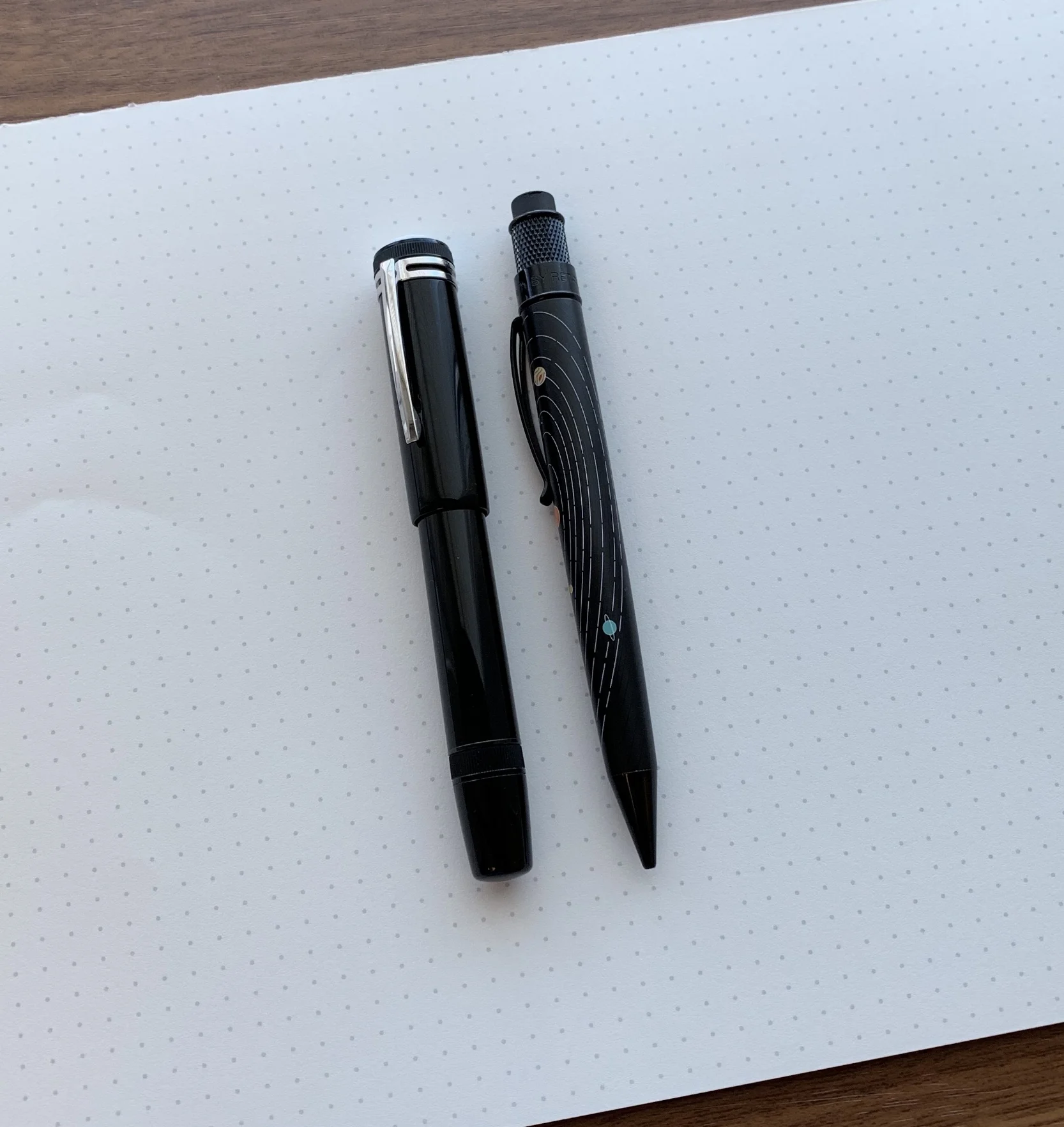
A size comparison shot of the Montblanc Heritage 1912 against my recently acquired - and sharp looking - Retro 51 “The System” pencil from Mike Dudek of the Clicky Post!

A size comparison shot of the Montblanc Heritage 1912 against my recently acquired - and sharp looking - Retro 51 “The System” pencil from Mike Dudek of the Clicky Post!

Takeaways and Where to Buy

I count myself an unabashed fan of Montblanc, especially when they branch out of their standard comfort zone of pens based on the Classique/146/149 templates and do something unique like the Heritage 1912. There’s nothing else like this pen in my collection, and if I ever had to narrow my pens to a handful, this one would easily make the cut. I would wholeheartedly recommend this pen to any Montblanc enthusiast or those who’d like to experience the feel of a vintage safety filler but want a pen that they can use everyday without worrying about damaging a valuable antique.  

The Heritage 1912 can be somewhat challenging to find, but it is part of Montblanc’s standard lineup and not a special or limited edition. Site sponsor Appelboom currently has the pen available for around $850 USD (depending on the exchange rate), which certainly isn’t inexpensive but also doesn’t approach Montblanc’s premium pricing on its Writer’s Editions and other limited offerings. (If you really want to blow it out, you could spring for the much larger Heritage 1914, which retails in the many thousands of dollars/euros. I’ve never seen one in person, and presume they were made in much smaller quantities.) Other Montblanc retailers who stock the Heritage 1912 include La Couronne du Compte and Fountain Pen Hospital.

Disclaimer: I purchased the pen featured in this review with my own funds, for my own collection. This post does contain affiliate links.

In Pens Tags Montblanc Heritage Collection 1912, Montblanc, Fountain Pen
4 Comments

Pen Review: Montblanc M Ultra Black Fountain Pen

September 19, 2018

Once again, I’m a bit late to the party here in reviewing a pen that’s been out for a while - the Montblanc M by Marc Newson, a collaboration between the venerable (and somewhat staid) German brand and the industrial designer, most recently known for his status as a senior member of Apple’s design team. The version featured here is from Montblanc’s “Ultra Black” series, which means matte black resin and ruthenium trim - a combination that’s a personal favorite of mine. (This isn’t the first “Ultra Black” pen I’ve reviewed. You can check out some shots of my 146 Ultra Black here.)

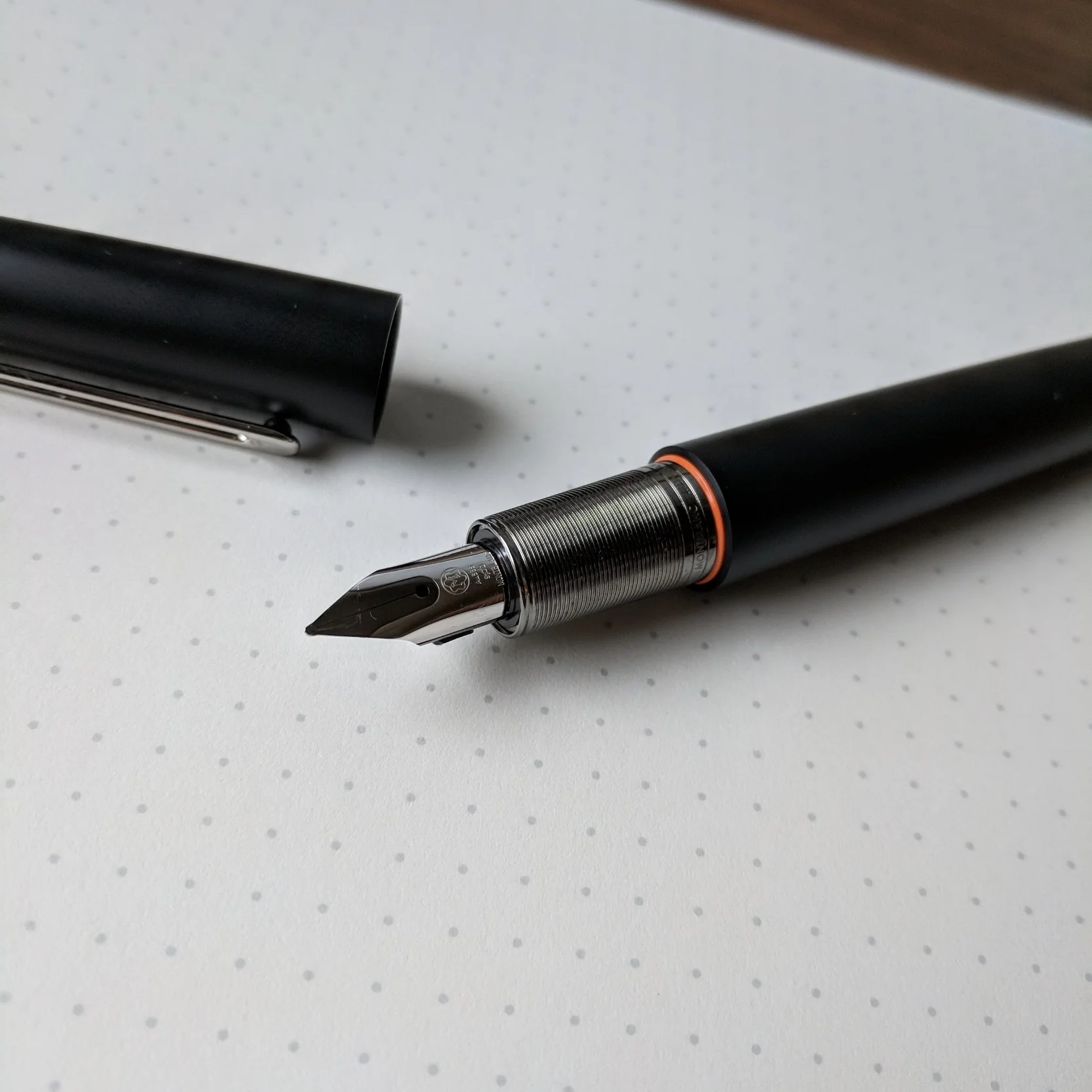
Montblanc-M-Ultra-Black-Nib

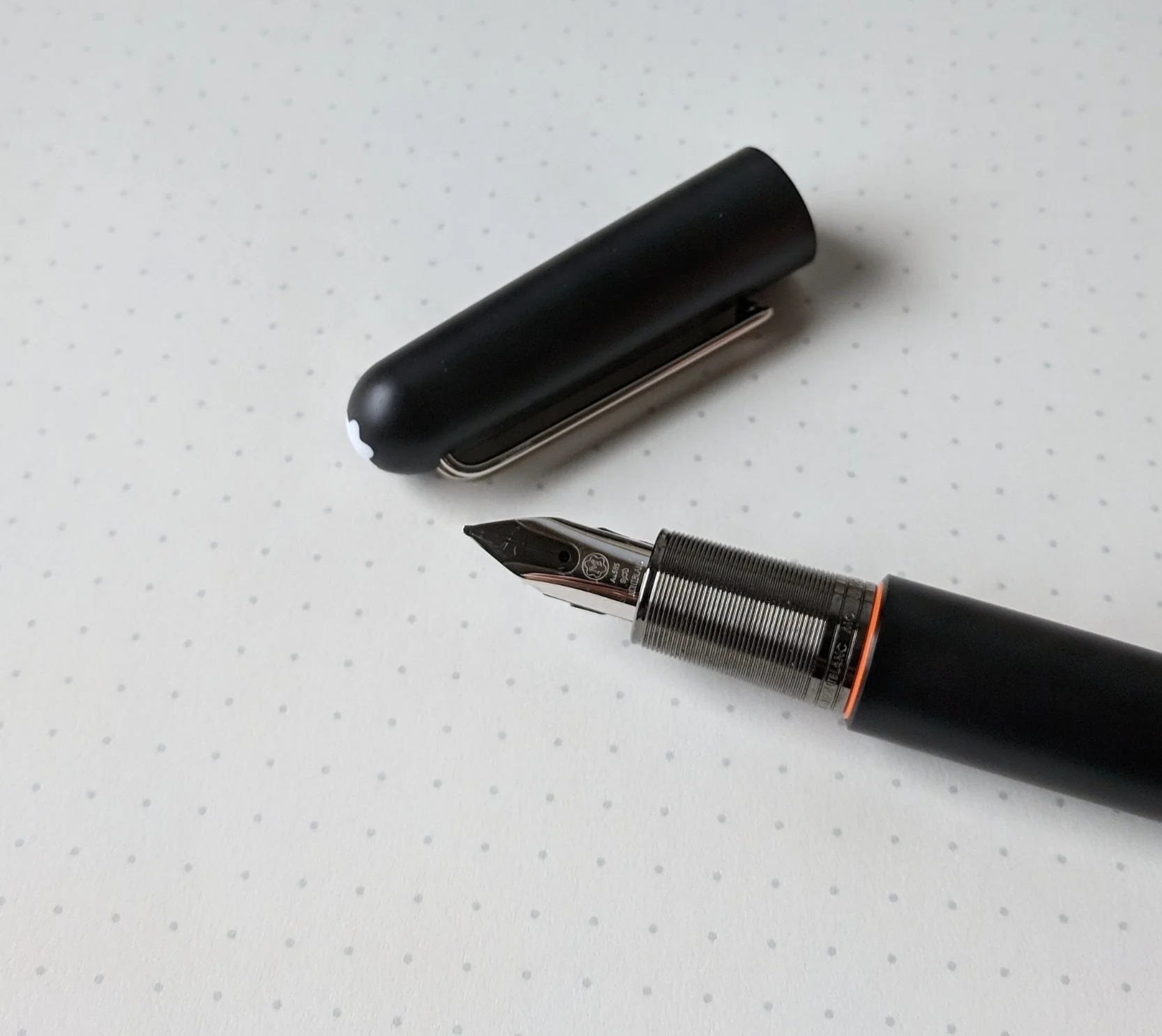
As one would expect from the “Ultra Black” designation, this pen features a ruthenium/rhodium plated, two-toned 14k gold nib, available in fine or medium. The particular pen I’m reviewing here has a fine nib, which writes a relatively wet line with just a touch of tooth. I wouldn’t call it scratchy, just tactile. The textured ruthenium-plated section is comfortable to hold, and the metal ridges offer a nice gripping surface. The balance and overall ergonomics are also nice, though as I’ll discuss further below, you can’t post the cap.  

There is a fairly significant step-down from the barrel of the pen to the grip section, which isn’t sharp, but I can still feel it when writing. Note the orange highlight, which adds a pop of color and stands out nicely on the otherwise dark design.

There is a fairly significant step-down from the barrel of the pen to the grip section, which isn’t sharp, but I can still feel it when writing. Note the orange highlight, which adds a pop of color and stands out nicely on the otherwise dark design.

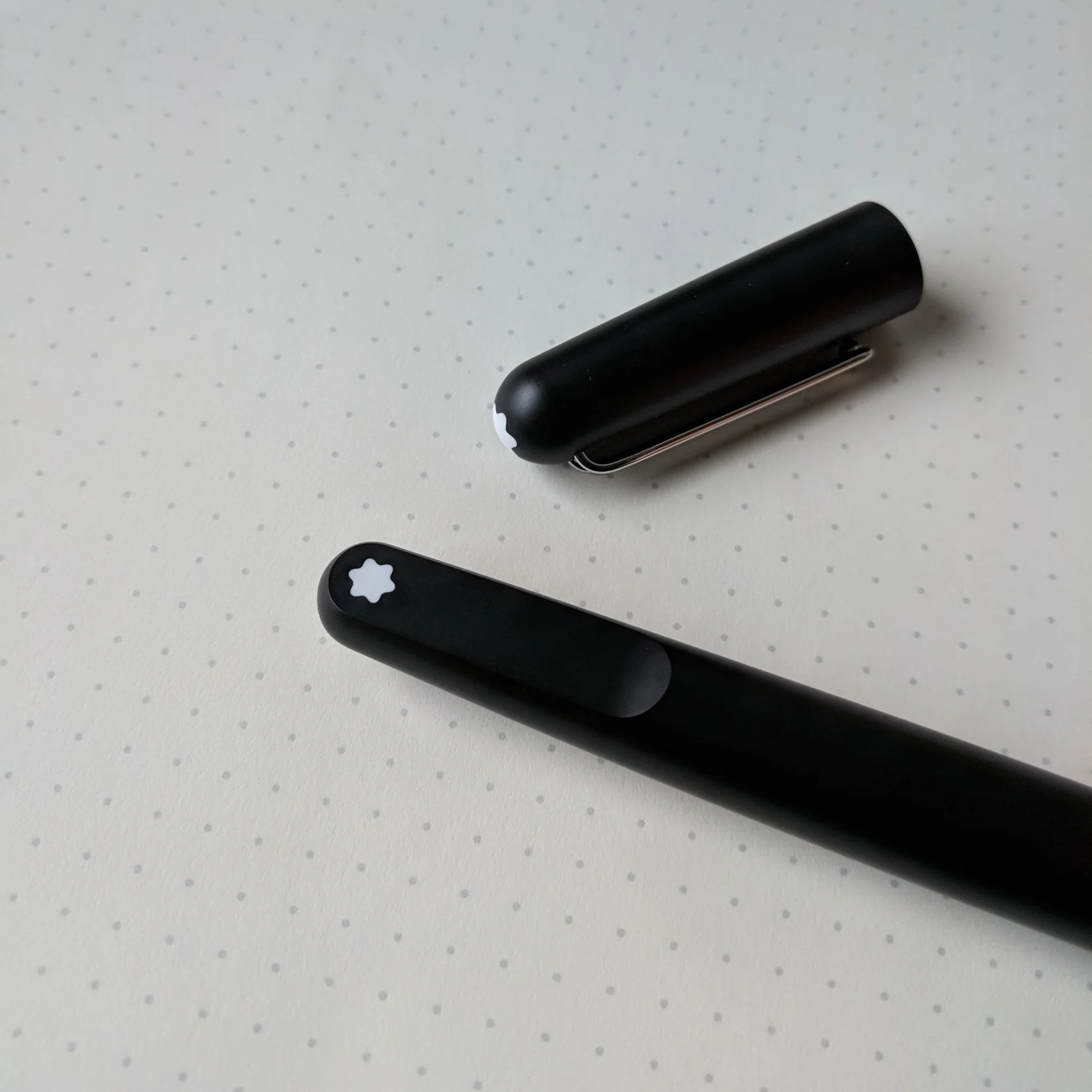
Two aspects of the pen’s design might make this one a no-go for many people.  First, the Montblanc “M” Series is a cartridge-only fountain pen. While you may be able to find a shorter converter that fits the barrel, no converter ships with this pen and Montblanc markets this pen as cartridge-only. Second, there is absolutely no ability to post this pen due to the placement of the signature feature, the “plateau” on the back of the barrel emblazoned with the snowflake.

Montblanc-M-Ultra-Black-Plateau

Where Montblanc has excelled, however, is the magnetic cap, which automatically aligns the clip with the “snowflake” logo on the “plateau.” It’s quite accurate, and fun to play with. The platinum-plated clip is different from what Montblanc normally uses on their pens, adds a modern, clean look, and has great tension so that it clips easily to a shirt pocket.   

A shot of the split-pronged clip and the two snowflakes. Design-wise, this is certainly a pen that’s grown on me.

Takeaways and Where to Buy

The Montblanc “M” series draws strong opinions - people tend to love this pen or actively dislike it. I think part of that is the fact that it’s such a departure from Montblanc’s standard line that the pen doesn’t appeal to the “purists” - those drawn to the more traditional Meisterstuck pens and the special and limited editions based off the Classique, 146, and 149 models.  On the whole, I like this pen, but it’s probably not one that will end up in my collection in fountain pen form. The step from the body to the section bothers me a little bit, and something about the form factor seems to lend itself more to a ballpoint/rollerball than a fountain pen. For longer writing sessions, I’m not sure that this pen would be my choice, but for short jottings at work with Montblanc’s excellent ballpoint and rollerball refills, I’m still considering picking one up.

Many thanks to site sponsor Appelboom for loaning me the pen featured in this review. The Montblanc “M” series currently retails at $540 for the fountain pen version, or $400 for the ballpoint and rollerball version.  Prices listed here are approximations and subject to change due to the EUR/USD exchange rate.  

Disclaimer: This post contains affiliate links, as TGS is a member of Appelboom’s Affiliate Network. For more information, please see our privacy and cookie policies.

A size comparison shot, from left: Franklin-Christoph Model 20, Montblanc M Ultra Black Fountain Pen, Montblanc 146 Ultra Black, and Platinum 3776 Oshino Demonstrator.

In Pens Tags Montblanc, Montblanc M, Montblanc M Ultra Black, Marc Newson
Comment

Testing Out "Tester Pens": What's the Role of the "Cheap" Fountain Pen?

September 15, 2018

You may have noticed that I’ve been trying to reintroduce ink reviews on the site by - well, reviewing more inks. A couple things make this a challenge for me. First, I do use my pens regularly outside of the work I do here on this blog. I have a writing-intensive job with an output that regularly exceeds 20 (typed) pages per day, and the way I work/think involves a lot of longhand note-taking and sketching out ideas before I even start on the computer. These notes are frequently shared among colleagues, and handwritten markups of documents scanned and e-mailed to clients. That’s a long way of saying that whatever ink I use in my daily writers needs to be something that I know is reliable and works well on cheap recycled copy paper, which limits my opportunities to experiment with new inks that I don’t know much about, not to mention properties like sheen and shimmer.

Wing Sung 3001 Demonstrators

At the same time, I don’t like to write ink reviews based on a swab and a couple lines of writing with a dip pen. That doesn’t give me any sense of how the ink truly “performs,” and whether it’s something I could legitimately recommend for daily use - which is what I try to keep the focus on here. But I also don’t want to ink one of my favorite writers up with an “unknown” ink and just have it sit indefinitely (or stain, clog, melt, etc. if the ink turns out to be not-so-nice). So what to do? Enter the low-cost tester pen.

Wing Sung 3010 Demonstrators

Earlier this year I discovered Wing Sung demonstrators. These inexpensive Chinese piston fillers were some of the best cheap pens that I’d used to date, and that impression has not changed. Even better, Wing Sung continues to release a steady stream of new models, often sold in packs of four or five pens that gets the price down to a few dollars per unit. This eliminates any risk of testing out “higher maintenance” inks in my nice pens.

Wing Sung 3008 Demonstrators, which I first learned about at this year’s DC Pen Show.

So right now I have a dozen or so Wing Sung demonstrators inked up with an equal number of inks I’m testing, sitting in a cup on my desk at home. Four of them are loaded up with various Colorverse “glistening” inks (Ham, Hayabusa, Brane, and Gluon).  The rest contain various Noodler’s permanent and quick-drying inks and some highly saturated Private Reserve Colors. Surprisingly, the extra fine nibs on all of these pens are good writers, and I’ve found myself reaching for them at home quite a bit when I’m working at my desk there. If the inks turn out to be serviceable, I’ll slip one of the tester pens into my pen case and take it to work for the day, giving it a more extended “audition.” If I don’t like it, and it sits so long that it clogs or stains, so what? I’m liking my new system.

So Which Pens Am I Talking About, Exactly?

I’ve purchased all of my Wing Sung pens via Amazon, and the Sellers don’t always make the model number clear, so it can be difficult to know exactly which pen you’re buying.  The piston fillers that hold the glistening inks are the Wing Sung 3008, which are sold in packs of four and feature different colored aluminum caps and trim. (I first learned about these because Ana had them at the 2018 DC Pen Show.) The rest of the pens are Wing Sung 3010 and Wing Sung 3001 demonstrators, which are cartridge-converter pens that feature a surprisingly good converter. (So good, in fact, that I’m going to see if this converter fits other pens. It seals really well, and includes a small spring in the barrel which breaks surface tension, ensuring good ink flow.)

So far, I’ve been pleased with all of these pens. Of course, at this price point I don’t expect them to last forever. In particular, the pistons and converters will eventually wear out, or the plastic will crack after repeated capping/uncapping. But in the meantime, enjoy them for what they are: fun demonstrator fountain pens that you can fill up with the craziest of inks, safe in the knowledge that if things don’t work out, at most, you’re out a couple bucks.  

Disclaimer: This post contains links to paid sponsors and affiliates.

In Pens Tags Wing Sung, Chinese Pens, Pens, Wing Sung 3008, Wing Sung 3010, Wing Sung 3001
Comment
← Newer Posts Older Posts →
Store Hours and Location
Visit the T.G.S. Curated SHOP
Updated "Best Pens" Guide
On the Paper Trail Podcast
TGS_25 Roterfaden New Stock Available
Hierarchies of Fountain Pen Friendly Paper

Join Our Patreon!
Subscribe to the TGS E-mail List

Featured Posts

Featured
Pilot-Custom-Series-Pens-overview.jpg
Mar 14, 2026
The Pilot "Custom" Series: An Overview of Some of My Favorite Fountain Pens
Mar 14, 2026
Mar 14, 2026
Pentel-Sign-Pen-Cover.JPG
Feb 28, 2026
Pen Review: The Pentel Sign Pen (Craft Design Technology Version)
Feb 28, 2026
Feb 28, 2026
Cover On the Paper Trail Intro Clip.jpeg
Dec 3, 2025
Introducing "On the Paper Trail," a New Podcast/Video Collaboration with Lisa Vanness of Vanness Pens!
Dec 3, 2025
Dec 3, 2025
The Gentleman Stationer RSS

View Cart

© Digital Divide Media, LLC, 2014-present.

All content is the exclusive property of Digital Divide Media, LLC, d/b/a The Gentleman Stationer, including “The Gentleman Stationer” website and trademark, and should not be reproduced without express written permission.  All rights reserved.

All content containing paid advertising, affiliate links, or sponsored content will be plainly disclosed by a disclaimer when/if featured.

Contact Information

Store Shipping Policy and Return Policy

Privacy Policy

Cookie Policy

Terms and Conditions

Powered by Squarespace