• Blog
  • Shop
  • Podcast
  • Resources
  • About
  • Archive
  • Contact
  • Cart
  • Sign In My Account
Menu

The Gentleman Stationer

Vintage Living in the Modern World.
  • Blog
  • Shop
  • Podcast
  • Resources
  • About
  • Archive
  • Contact
  • Cart
  • Sign In My Account

Tactile Turn Gist Revisited: Titanium Gist 2.0

April 13, 2019

I initially reviewed the Tactile Turn Gist fountain pen back in 2016, following the close of the Kickstarter project. The Gist Kickstarter can only be considered an unqualified success for Tactile Turn, raising $129,000 in pledges and cementing their status as one of the premier manufacturers of machined “EDC-style” pens. The “Gist 1.0”, as I’ll call it, garnered generally positive reviews. Most attention focused on the Gist’s pairing of a lightweight Makrolon (polycarbonate) pen body with a textured metal section made from either common or rare metals, including copper, brass, bronze, Damascus Steel, zirconium, and titanium. All-metal versions were also available, though they could be quite expensive due to the difficulty of machining pens from certain materials (i.e. zirconium, which has a tendency to combust and do inconvenient things like destroy machinery).

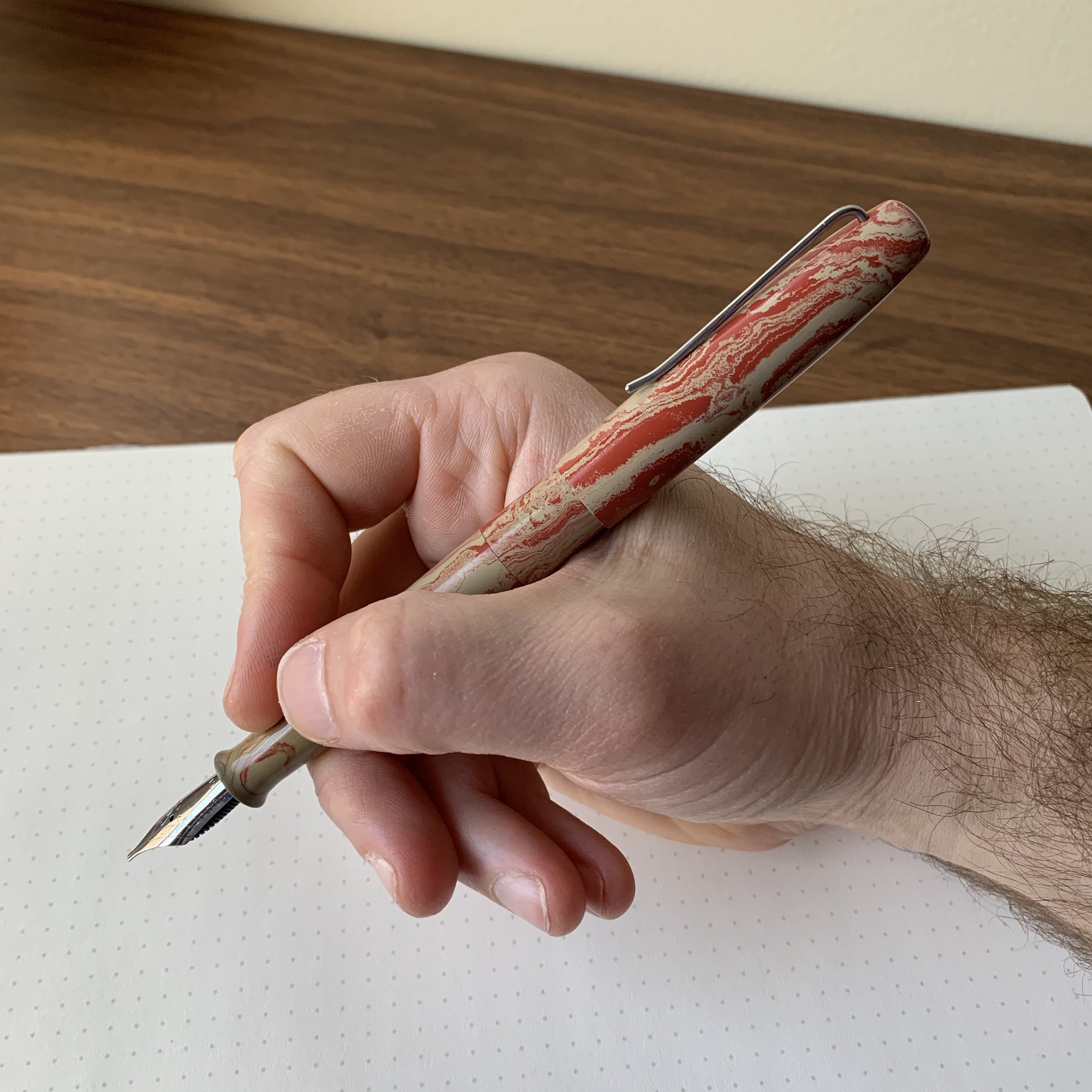
Will changed quite a few things with the Gist 2.0, but the signature Tactile Turn texture remains intact!

As I noted in my initial review, the Gist 1.0 was not without a “few hiccups,” most notably the Makrolon’s propensity to crack around the cap lip, and for the nib to dry out due to some caps not sealing properly. The pen body was also too short to accept a standard Schmidt international converter, so you had to use a different one supplied by Tactile Turn which, in my opinion, wasn’t as good since it had lower ink capacity and ink flow issues. None of these issues made the Gist 1.0 a “bad pen” - to the contrary, I enjoyed the weight, balance, and overall look. I know several people who still use their Kickstarter Gist as a daily writer more than two years later, and issues are to be expected with any “version 1.0” product release. How a company progresses from version 1.0 to version 2.0, incorporating feedback from customers, is more telling about the Company’s future prospects. From my experience with the Gist v. 2.0, the future looks bright for Tactile Turn.

New Materials, Different Specs

For the next iteration of the Gist, Tactile Turn made several notable design changes:

  • No More Makrolon! Tactile Turn stopped using Makrolon in favor of Delrin, a plastic used by high-end penmakers such as Conid. According to Will Hodges of Tactile Turn, the Makrolon he was able to source was not up to his standards in terms of durability, so he made the decision to switch materials on the non-metal pens. I think the Delrin pens look great, and they’re now available in white as well as black. As of now, metal sections are not available - you either go all-metal or all-Delrin.

  • A Longer Body. The Gist now accepts a full-size Schmidt international converter, and the added body length provides better balance, whether you write with the pen posted or unposted.

  • Shorter Threads. It now takes only 1.5 turns to cap/uncap the pen, as opposed to the 3+ on version 1.0. The threads also aren’t nearly as tight, reducing the risk of cracking the cap lip.

  • Plastic Cap Inserts on Metal Pens. You can now post the cap on the metal versions of the Gist without any unwanted metal-on-metal contact. I can’t speak to the other metal options, but the titanium pen posts nicely without too much added weight.

The Gist v.2.0 features Higbee thread starts, and the pen caps/uncaps in 1.5 turns.

This particular Gist sports one of the best Bock nibs I’ve ever used. I’ve had much better luck with Bock recently. I do think they’ve upped their quality control.

You can read more about the various design choices on Tactile Turn’s website, including specific details on the machining and engineering. Fans of the first Gist will be happy to know that the Gist continues to feature Tactile Turn’s signature texture, which serves a dual purpose of making a metal pen easier to grip (no slippage!) and hiding the small scuffs and scratches that polished metal tends to accumulate through everyday use.

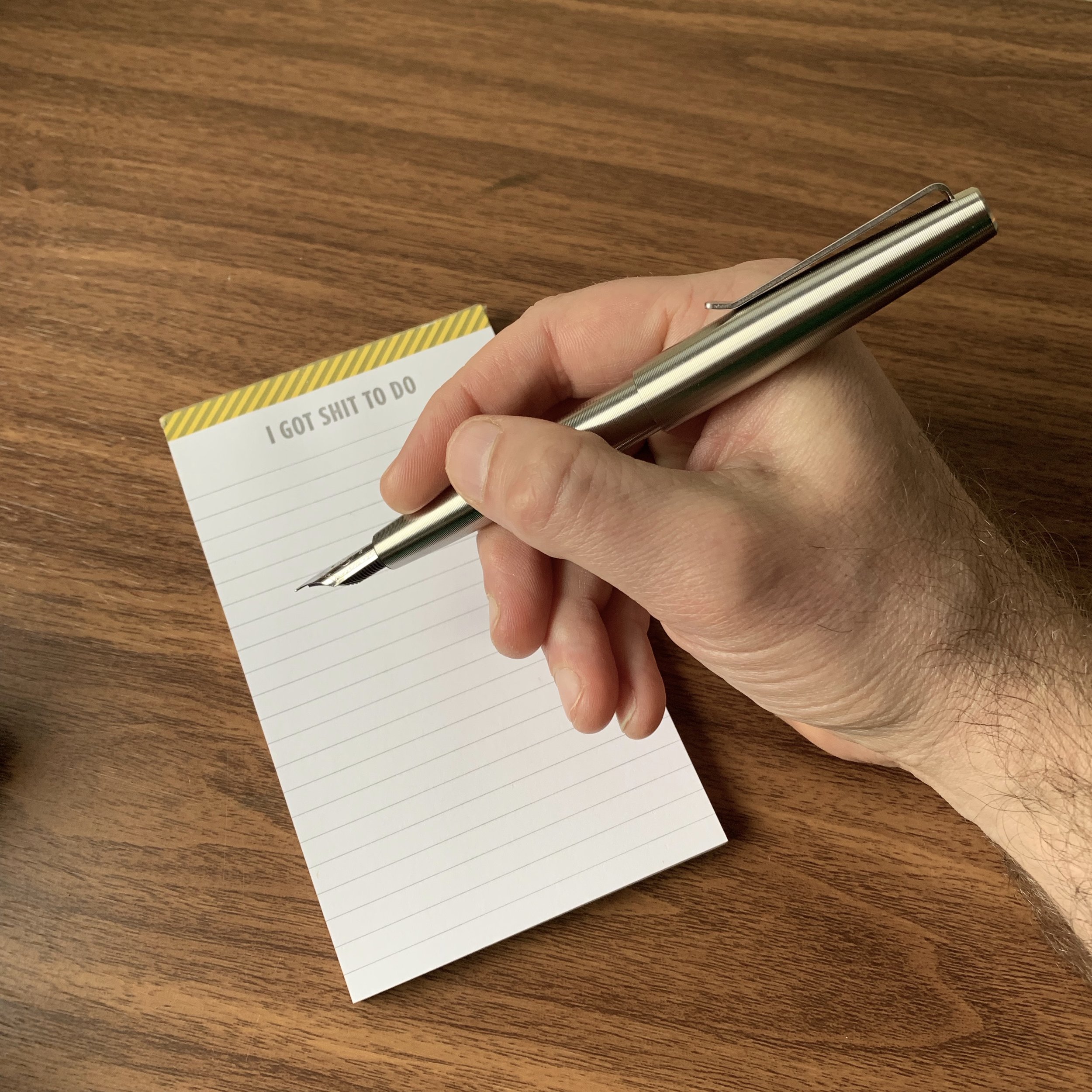
View fullsize fullsizeoutput_220f.jpeg
View fullsize fullsizeoutput_220e.jpeg

Takeaways and Where to Buy

My Gist is a joy to write with, and I’m happy to report that I’ve written through three straight fills of ink since acquiring this pen at last month’s Arkansas Pen Show. The Gist presents a durable, well-priced option for a daily writer, and “Version 2.0” is everything I hoped it would be. The Gist comes in both fountain pen and rollerball configurations, with prices starting as low as $99 for a Delrin pen. The titanium version reviewed here runs $219 for the fountain pen, with copper and brass versions priced at $139 and $119 respectively.

The Titanium Gist was one of my purchases from this year’s Arkansas Pen Show.

Disclaimer: Will Hodges at Tactile Turn was kind enough to provide me with a discount on my purchase of the titanium Gist featured in this review, which I purchased with my own funds. Many thanks to Will for making this review possible! This post contains links to paid sponsors and affiliates (ink notes below).

So What About this Purple Ink?

Waterman-Tender-Purple-Swatch

The eye-popping purple ink that appears below, and that I’ve been using in this pen, is standard Waterman Violet (or, as it’s known now, “Tender Purple”). Surprising, I know! I recently broke out my Waterman inks after a long hiatus, and love them as much as I did when I first got into fountain pens years ago. They’re currently available for the bargain-basement price of $11 per bottle at Vanness Pens, making Waterman ink one of the best buys out there. The paper pictured in this review is, of course, the “Shit to Do” notepad from Skylab Letterpress. Ink swabs are done on Col-o-dex cards, courtesy of Ana Reinert and Skylab.

One note of caution: while Waterman inks are generally regarded as “safe” inks, the purple, in my experience, will stain celluloid and light-colored acrylics, as well as demonstrators and converters if you let the pens remain inked long enough. This isn’t uncommon among purple inks, but since Waterman ink has a reputation as being "safe for anything,” it’s worth mentioning.

In Pens Tags Tactile Turn, Tactile Turn Gist, Fountain Pen, Pen Review, Revisited
Comment

Kickstarter Alert: 22Pen by Mario Shimodaira

March 29, 2019

I wanted to do a special short post this Friday to let everyone know that there’s just a little more than 24 hours left in the Kickstarter for the 22pen, a unique pocket pen that readers should be sure to check out. The pen holds two D1 refills in a flat format, allowing you to easily switch between two colors without clicking, and also allowing you to easily clip the pen inside a notebook. I have a review unit (in a prototype material) that I just now received, so I don’t have a full review ready to go, but my initial impressions are very favorable and I’m really looking forward to seeing how I can work the 22pen into my daily workflow, especially with pocket notebooks! I backed for the blue version. You can check out the full details of the 22pen here on the Kickstarter page. Many thanks to Mario for sending this pen over for review.

The 22pen may look a bit awkward, but it’s surprisingly easy to use.

The reverse of the 22pen features a clip to attach the pen to the inside of a notebook.

The reverse of the 22pen features a clip to attach the pen to the inside of a notebook.

Disclaimer: I received the pen featured in this post free of charge, for review purposes. I was not otherwise compensated for this review and I’ve backed this project with my own money.

In Pens Tags 22pen, Mario Shimodaira, Kickstarter
1 Comment
Pineider-Arco-Collection-Fountain-Pen

First Impressions: Pineider Arco Collection Limited Edition with 14k "Quill" Nib

March 27, 2019

Few materials have captivated the pen community in the same way as Arco celluloid, especially in pens made by the Italian pen manufacturers, and Omas in particular. After Omas folded, legacy company Armando Simoni Club/ASC Pens purchased the remaining Omas celluloid rod stock, and has released a series of pens in both the green and brown Arco celluloid under its own name and in partnership with Leonardo. (I own a Leonardo pen in green Arco Verde celluloid, and it’s gorgeous.)

But the rumor is that once ASC Pens’ current stock of Arco celluloid is gone, it’s gone. Celluloid is extremely time consuming and difficult to make, requiring a large (and expensive) investment of time and materials up front, followed by a years-long period of waiting for the celluloid to cure. As it turns out, however, companies don’t want the Arco “look” to go away (especially given the price Arco celluloid is commanding on the secondary market). This year, Pineider announced and released a limited edition “Arco Collection” pen in which Pineider attempted to duplicate the look of Arco celluloid using a layered acrylic.

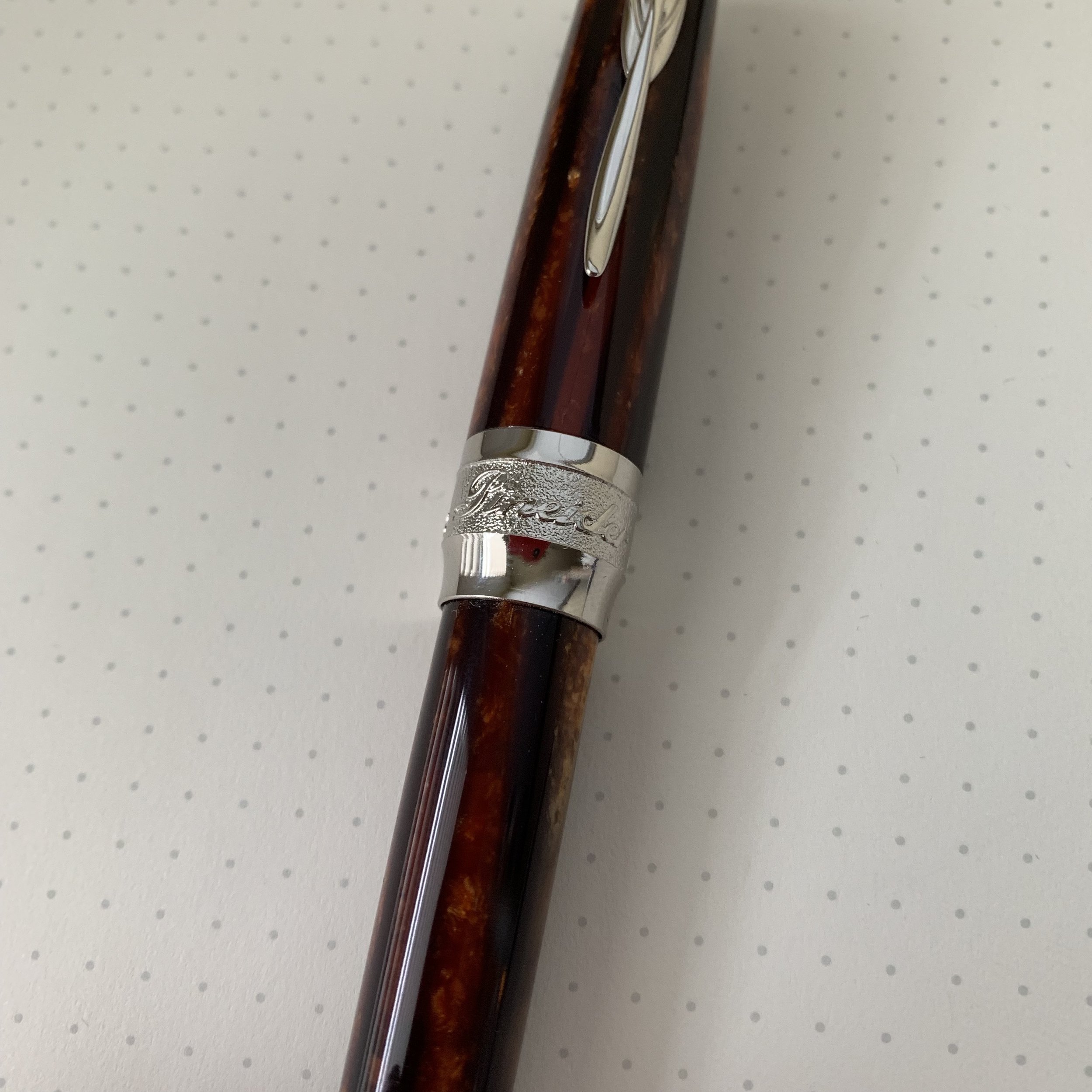
Here you can see the striations in the acrylic. Lovers of vintage Arco celluloid will say it's not the same - and it’s not - but the material is beautiful in its own right. The cap features a twist magnetic closure, with a metal piston knob that all…

Here you can see the striations in the acrylic. Lovers of vintage Arco celluloid will say it's not the same - and it’s not - but the material is beautiful in its own right. The cap features a twist magnetic closure, with a metal piston knob that allows you to post the pen using the magnet in the cap.

Pineider pens present a mixed bag for me. Functionally, the company makes a high-quality product. I previously reviewed the Pineider Avatar, which I enjoyed reviewing but the pen didn’t do it for me in terms of aesthetics, mainly because I found it a bit boring. Last year, Pineider released a new series of pens that I liked better, the La Grand Bellezza “Gemstone” collection, which featured new materials and came equipped with a new 14k “hyperflex” nib that Pineider dubbed the “Quill.” The new Arco Collection pens generally take the shape of the Grand Bellezza models, adding a piston filler and limited edition numbering.

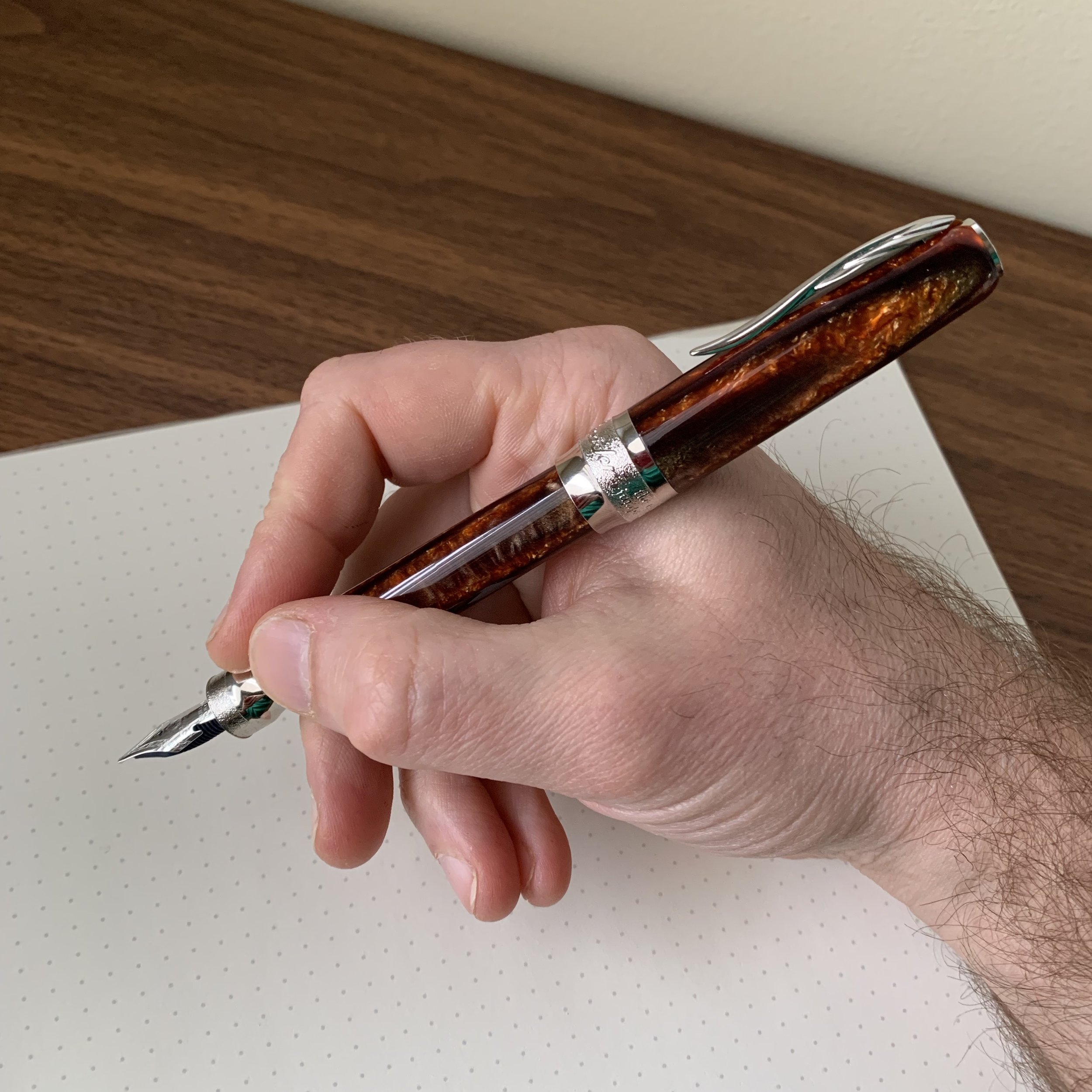
There are 888 Arco collection pens, with each one numbered on the piston knob.

What everyone wants to know, of course, is how the new “Arco” acrylic compares to Arco celluloid. Short answer: it’s beautiful in its own right but not the same. Classic celluloid has a depth to it that’s practically impossible to duplicate, which is why it remains such a coveted material among pen collectors despite its many downsides. (i.e., it stains, it’s fragile, it’s flammable, and it’s expensive… I could go on, but you get the point.) Pineider’s Arco acrylic definitely captures some of the look of classic Arco, but is much darker and doesn’t quite get all of the gold and copper highlights found in the celluloid. There definitely will be a trade-off for the durability and lower price point of an acrylic pen.

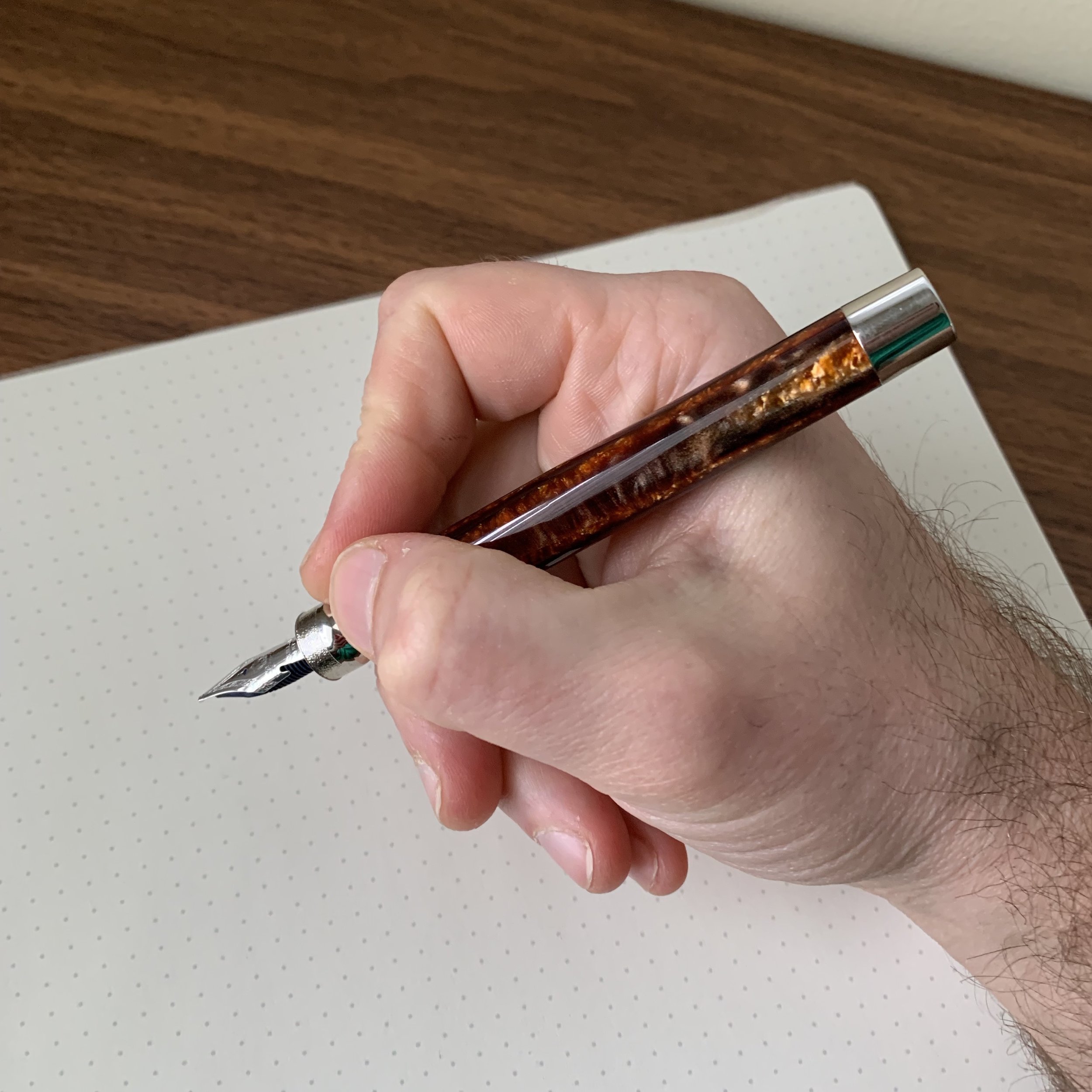
The broad “Quill” nib on this Arco pen is more than a little stubbish.

For me, the Quill nib is what makes this pen (and the other Gemstone/Grand Bellezza pens) really shine. Pineider describes the nib as “hyperflex,” but as is often the case with so-called “flex” pens, there’s more than a bit of hyperbole involved. I’d describe the Quill nib as “true semi-flex,” in that you will get some significant line variation, especially in the narrower nib widths (EF-F). The stubbish broad nib I tested had a nice bounce to it, and really put a lot of ink on the page. To me, the Pineider nib is certainly “flexier” than Aurora’s flex nib, but you still shouldn’t expect a vintage-style flex pen.

Takeaways and Where to Buy

Pineider has my attention more than than they did when they first appeared on the scene. After spending two weeks with the Arco pen, I could see myself picking up one of the Grand Bellezza “Gemstone” pens just to have a Quill nib in my collection, probably opting either for a broad or an extra fine. The standard “Gemstone” pens have an MSRP of just under $500, with an actual retail price that typically sits just under $400. Vanness, however, is currently running a 40% off promotion in which the cost of the Pineider La Bellezza fountain pen with the Quill nib is just $298. That’s a very good price on an excellent pen, especially for a semi-flex nib of this quality.

As a limited edition with a piston filler, the Arco collection pens are more expensive, with MSRP at around $700 and retail price between $500-600. They’re also selling quickly, so you’re probably going to have to hunt around to find one. Vanness Pens is currently sold out, and they may or may not get more, depending on availability.

Many thanks to my sponsors at Vanness Pens for loaning me this Arco Collection pen to review. It made for an enjoyable two weeks between the Baltimore and Arkansas pen shows!

Disclaimer: This post contains links to paid sponsors and affiliates. Vanness Pens loaned me pen featured in this review at no charge.

View fullsize Pineider Arco Unposted
View fullsize Pineider Arco Posted
In Pens Tags Pens, Pineider, Pineider Arco, Vanness, Flex Nib
Comment

Pen Review: Desiderata Soubriquet in Briar Ebonite

March 23, 2019

One of the things I’ve enjoyed about following the pen community and writing this blog over the past five years is watching smaller makers evolve and fine-tune their craft, especially where the products they offer are entirely unique from anything else out there. Pierre Miller, the man behind the Desiderata Pen Company, is one such penmaker. Pierre’s pens first came on my radar four or five years ago at the D.C. Pen Show, back when it was at the old (read: better) location in Tyson’s Corner and he showed up with early versions of his Daedalus pen fitted with Zebra G dip nibs, which was one of the first modern pens I had seen that allowed a user to combine the true vintage-style flex of a dip nib with the portability and larger ink reservoir of an eyedropper fountain pen.

Flex, of course, isn’t really my thing, as readers here are aware. I’m not a calligrapher, and most of my pen usage is daily user, office-style stuff. Flex nibs are fun to dabble with, but I always hesitate to shell out hundreds of dollars for a pen that I can’t use on a daily basis. Desiderata Pens didn’t really reappear on my radar until Pierre started offering the JoWo No. 6 nib option and different filling mechanisms in the “Soubriquet” model. After talking with Pierre at several different pen shows over the last couple of years, I finally picked up a Soubriquet in Los Angeles, and it’s seen steady use in the month since that show.

Sure, I could swap in a Zebra G, but when I can use this pen as an everyday writer with one of my favorite stock stub nibs, it may take me a while to get around to it…

What I Like About the Desiderata Soubriquet

Pierre has extensive notes on his website in which he discusses the story behind the pen and explains the various design choices, which makes for an interesting read and provides a lot of insight into how he designs and makes pens. Here are a few of the highlights, which are also the features that I appreciate the most.

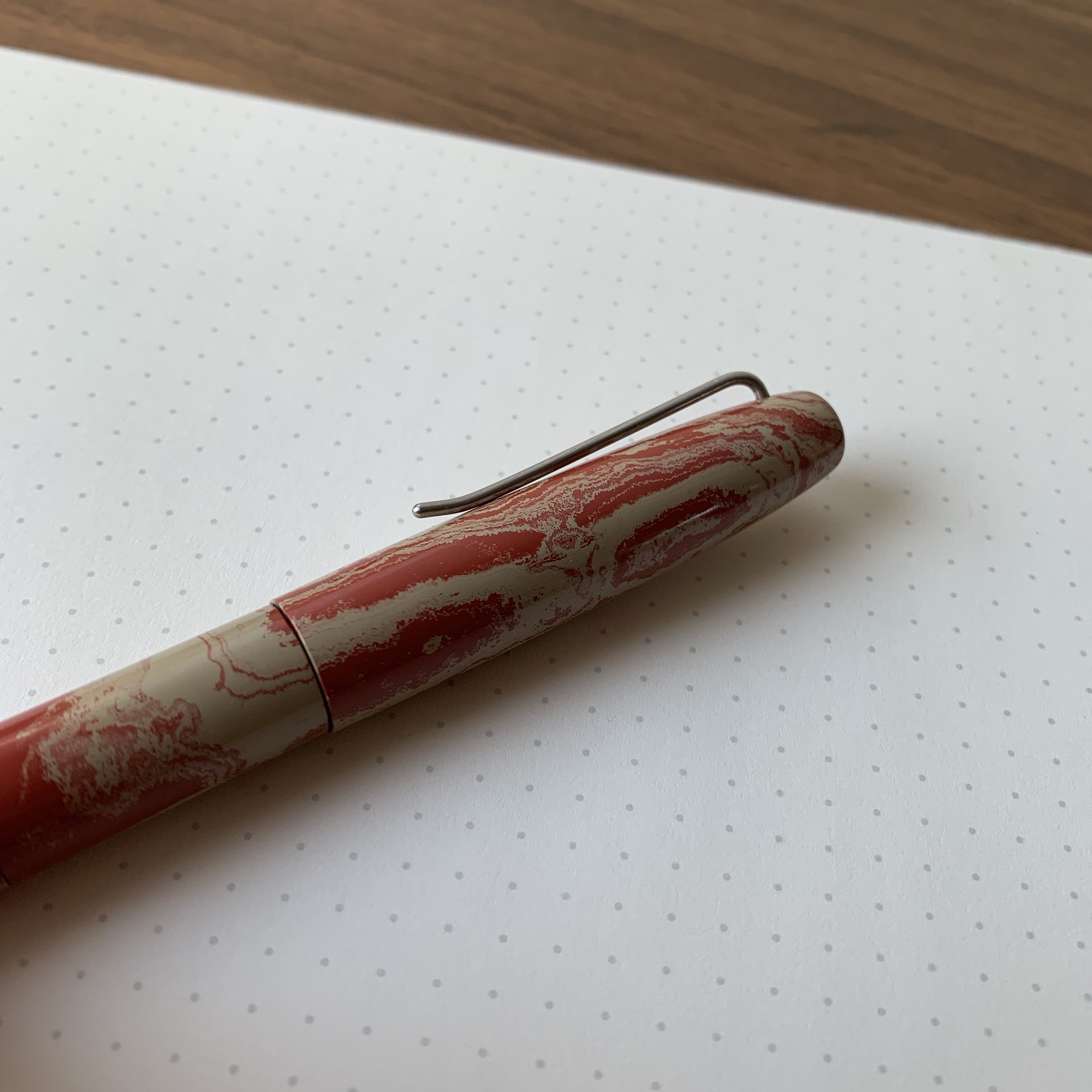
The Soubriquet is the first Desiderata pen to feature a clip, and I like the “wire” design.

The Soubriquet is the first Desiderata pen to feature a clip, and I like the “wire” design.

  • Size and Shape. The knock on a lot of modern custom pens is that they tend to be very large, especially when compared to vintage or vintage-inspired designs. The Soubriquet is the product of Pierre’s attempt to design a larger pen without “going overboard,” and he threads that needle quite well. The Soubriquet is about the same size as a Montblanc 146 (though much lighter), which is a great size for me in terms of ergonomics. I can comfortably use this pen posted and unposted, with the cap posting deeply on the tapered barrel. The section also tapers towards the nib, with the threads placed higher up on the barrel just below the ink window. I can’t emphasize enough how comfortable this pen is to write with for long periods of time.

  • Filling System and Ink Capacity. Since I opted for a JoWo 1.1mm stub nib, ink capacity and ink flow can become an issue. The Soubriquet features a “piston vacumatic” filling system, which uses an o-ring instead of a sac and operates like the filling mechanism on the TWSBI Go. Pierre designed the pen to allow one-handed filling, and it works as intended. You simply submerge the pen in ink and depress the plunger until the pen is full. This type of filler is also much easier to flush clean than a sac-based vacumatic pen. I was able to clean ink out of the pen and refill it with a different color in just a couple of minutes. The pen holds approximately 1.5ml, which will keep me writing for quite a while, even with a stub.

  • Clip. Earlier models of Desiderata pens were clipless, but the Soubriquet introduced a thin, wire-style clip made from 304 stainless steel. Despite the slim profile, this clip is VERY sturdy, and I’ve come to appreciate the distinct design element that the clip lends to the pen.

  • Ebonite Material. Pierre works extensively with ebonite, which many readers will recognize as a form of vulcanized rubber that’s been used to make pens (and bowling balls) for well over a hundred years. I’ve been looking to add a mottled/swirled ebonite pen to my collection for a while now, and when I spied the last briar ebonite pen on Pierre’s table, I knew this one was coming home with me. Ebonite has an unparalleled feel in the hand - it emits a warmth and has a softer feel to it than acrylic or other plastics, even though it’s still extremely durable.

The Soubriquet disassembled to show the filling system.

View fullsize Desiderata Soubriquet Unposted
View fullsize Desiderata Soubriquet Posted

Pierre urged me to make sure that everyone knows up front that Desiderata Pens are “small batch” manufacture, meaning that the pens are made in very small numbers in a one man shop. I guess that’s his way of saying that it’s not unusual to find small variances or imperfections on the pens, but other than a few barely perceptible tooling marks, the fit and finish on my Soubriquet is excellent. No issues or complaints whatsoever from me.

A comparison photo, from left: Aurora Optima, Desiderata Soubriquet, Montblanc 146, and Leonardo Momento Zero.

Takeaways and Where to Buy

I’m extremely happy with my Desiderata Soubriquet. I originally approached the purchase as a “tinkering pen” that I might use occasionally to practice handwriting and flex calligraphy, but the JoWo nib unit has worked so well that the pen has not left my daily carry for the past month. I do feel that I need to offer a note of caution: I have used the Zebra G nib in an earlier version of the Desiderata Daedalus that I borrowed, and while it does work well and can be quite enjoyable to use, fountain pens fitted with calligraphy dip nibs require much more frequent maintenance, as the nibs will deteriorate and need to be replaced on a monthly basis, if not sooner depending on how frequently you use the pen. If you are purchasing a Desiderata Pen specifically to take advantage of the Zebra G’s flex capabilities, I’d encourage you to read the resources available on the Desiderata website, and also watch some of Pierre’s YouTube videos in which he shows you how to set up the pen for this sort of writing. Be prepared to tinker with it!

As I mentioned above, I purchased this particular pen directly from Pierre at this year’s L.A. Pen Show, where he had just one of the Briar Ebonite models. The Soubriquet in this particular material is currently sold out, but on the website Pierre has indicated that he will consider requests to make more, so if you’re interested let him know! The Soubriquet runs anywhere from $225-250, which I find reasonable for a custom/small-batch pen with a non-cartridge/converter filling system. Pens ship with the Zebra G calligraphy nib, but JoWo No. 6 nibs are also available upon request, and it’s what I’ve been using since L.A. I likely will swap in the Zebra G in the near future to play around, but I’ve been enjoying this JoWo No. 6 stub so much I’ve not been motivated to change it out.

At the moment, Pierre has several other Soubriquet models available in his Etsy store, with additional Desiderata models for sale on his website. Pierre regularly attends pen shows, and during the last couple of shows he had a variety of Soubriquets in some unique acrylics not yet listed online. (Also, you definitely won’t want to miss the pre-order for the BAMF pen, which should ship within the next few months.)

Disclaimer: I paid for the pen featured in this review with my own money, though Pierre did give me a slight discount on the purchase of a second nib unit.

In Pens Tags Pen Review, Desiderata Pens, Desiderata Soubriquet
Comment

First Impressions: Spoke Pen with Uni Signo UM-151 (DX) Refill

March 13, 2019

One of my pickups from this month’s Baltimore Pen Show was a Spoke Pen prototype that Brad was kind enough to give me for review. I opted for red (of course), and all of the prototypes Brad brought to the show had titanium grips, which was just fine with me because it makes this pen a perfect match for my red/titanium Spoke Pencil Model 4. While my personal interests focus on fountain pens, I regularly use a handful of others, including two Montblanc rollerballs, my Lamy 2000 multi pen, a Ti Arto Universal Refill Pen, and a few Baux Pens loaded with Bic Cristal refills. The Spoke Pen is a unique addition because it’s the first machined pen designed specifically for the Uni UM-151 (DX) refill, an excellent fine-tip gel pen that until now has been restricted to my Ti Arto. Since this pen is a prototype, and since I’ve only had it in my hands for a couple weeks, this post will take the form of a shorter “first impressions” piece.

On the left, the Spoke Pen. On the right, the Spoke Pencil Model 4.

By far my favorite feature of any Spoke Design product is the grip section.

Things I Like

  • Design. I’ve owned a Spoke Pencil Model 4 for the past year or so, and also backed the Baux Pen 2 (which comes from the same “family”), so I’m a fan of Spoke Design. The Spoke Pen definitely shares the same DNA in terms of durable feel, great balance, and a modern, industrial look that appeals to me. I like the look of what I refer to as the “mixed metal” pens, combining an aluminum barrel with a titanium grip section. It makes for a durable, yet lightweight writing instrument.

  • Magnetic Closure. Brian also runs the “Strong Like Bull” magnet company, so of course the Spoke Pen was going to feature a magnetic cap closure. The cap closes firmly with very little play. Due to its strength, the magnet will attract little metal items on your desk like paper clips, etc., just be warned!

  • Grip. Though it’s part of the overall design of the pen, the grip on the Spoke Pen warrants separate mention. In my opinion, Spoke Design has perfected the grip of a machined metal pen. Rather than traditional knurling, the Spoke Pen, Spoke Pencil, and Baux Pen all use tightly spaced rings around the section. This sort of grip is quite comfortable to use over long periods of time, and doesn’t leave pressure marks on your fingers. The Ti Arto features a similar grip, but Spoke spaces the rings closer together, which I prefer.

  • Refill. The Signo UM-151 (“DX”) refill is one of the more popular fine-tip gel refills on the market, mainly because of the wide range of available colors and tip sizes. While my prototype came loaded with a black .5mm refill, I swapped that out for a .38mm red-black refill that I picked up at Kinokuniya in New York. I can’t say that the Signo DX is my all-time favorite gel refill, but it’s up there and does an excellent job. As I mentioned, the selection of colors is unparalleled.

The magnetic cap snaps shut firmly, and the clip is tight. Apart from the finish, which will wear on any metal pen, the Spoke Pen should be a highly durable writing instrument that will give you years of long-term use.

Potential Issues

I only spotted a couple of issues with the Spoke Pen, and it’s too early to say whether these are points that actually will end up bothering me over the long run, since this particular pen (1) is a prototype and (2) has only been in my hands for less than two weeks.

  • Posting. The Spoke Pen doesn’t post. Two years ago this would have been a deal-breaker for me, and I wouldn’t have backed the project, but I’ve recently expanded my horizons into some larger, non-posting fountain pens so it may end up not being an issue. Since this is a gel pen, I’ve been able to leave the pen uncapped on my desk while I’m using it without experiencing any skipping or drying out.

  • Anodized Finish. I’m withholding final comment on the finish, since this is a prototype, but I’ll note that there are a few spots of wear on the black clip, and places on the edges of the cap and around the “jewels” where the anodizing is already starting to wear away. With respect to the cap edges, that’s entirely predictable because you have a metal cap sliding onto a knurled metal section and there’s no real way to prevent it. Plus, it’s not noticeable when the cap is closed. Wear to the finish will eventually give the pen a “stonewashed” look, which you may or may not like depending on your personal preferences.

From left, the Ti Arto Universal Refill pen, which is the only other pen in my arsenal to accept the Signo DX; the Spoke Pen, and the Spoke Pencil 4.

Takeaways and Where to Buy

Like all Spoke Design products, the Spoke Pen is well designed and well made. If you’re looking for a machined pen specifically designed to house your Signo DX refill, you may not have many choices out there, but you’ll be hard-pressed to do better than this one. I’ve personally gravitated to Spoke products over the past couple of years (Spoke Pencil/Baux Pens) due to the grip, which I find much more comfortable than other options on the market. I ended up backing the Kickstarter project for the “two pens” reward level, and will likely end up using these similar to how I use my Baux Pens: to house various colors and tip sizes of specific refills that I like to use for certain purposes.

Unfortunately, the Spoke Pen Kickstarter has now closed, so if you didn’t back you’ll have to wait until Brad and Brian finish project fulfillment and officially launch the project before getting your hands on one of these. In the meantime, if the design appeals to you and you’re a fan of mechanical pencils, you can purchase an excellent Spoke Pencil, which now comes available in Model 4 and Model 5.

Disclaimer: Spoke Design and Brad Dowdy provided me with this prototype pen for review purposes, free of charge. I was not otherwise compensated for this review, and have separately backed the Kickstarter project.

In Pens Tags Spoke, Spoke Design, Spoke Pen, Kickstarter, FIrst Impressions
3 Comments
← Newer Posts Older Posts →
Store Hours and Location
Visit the T.G.S. Curated SHOP
Updated "Best Pens" Guide
On the Paper Trail Podcast
TGS_25 Roterfaden New Stock Available
Hierarchies of Fountain Pen Friendly Paper

Join Our Patreon!
Subscribe to the TGS E-mail List

Featured Posts

Featured
Pilot-Custom-Series-Pens-overview.jpg
Mar 14, 2026
The Pilot "Custom" Series: An Overview of Some of My Favorite Fountain Pens
Mar 14, 2026
Mar 14, 2026
Pentel-Sign-Pen-Cover.JPG
Feb 28, 2026
Pen Review: The Pentel Sign Pen (Craft Design Technology Version)
Feb 28, 2026
Feb 28, 2026
Cover On the Paper Trail Intro Clip.jpeg
Dec 3, 2025
Introducing "On the Paper Trail," a New Podcast/Video Collaboration with Lisa Vanness of Vanness Pens!
Dec 3, 2025
Dec 3, 2025
The Gentleman Stationer RSS

View Cart

© Digital Divide Media, LLC, 2014-present.

All content is the exclusive property of Digital Divide Media, LLC, d/b/a The Gentleman Stationer, including “The Gentleman Stationer” website and trademark, and should not be reproduced without express written permission.  All rights reserved.

All content containing paid advertising, affiliate links, or sponsored content will be plainly disclosed by a disclaimer when/if featured.

Contact Information

Store Shipping Policy and Return Policy

Privacy Policy

Cookie Policy

Terms and Conditions

Powered by Squarespace