• Blog
  • Shop
  • Resources
  • FAQ (Ask TGS)
  • About
  • Archive
  • Contact
  • Sign In My Account
Menu

The Gentleman Stationer

Vintage Living in the Modern World.
  • Blog
  • Shop
  • Resources
  • FAQ (Ask TGS)
  • About
  • Archive
  • Contact
  • Sign In My Account

Pen Review: Aurora Vintage Duo-cart Fountain Pen

September 4, 2019

In 2017, Aurora teased a reissue of their vintage Duo-cart fountain pen, only to withdraw it from the market in order to fix some minor design flaws. While I owned one of the 2017 Duo-carts, and enjoy the pen, I held off on publishing a formal review until Aurora could perfect the design, namely the friction-fit cap which had a tendency to come loose on the original iteration of the pen. After what turned out to be a bit of a wait, Aurora re-released the Duo-cart this year as part of their “Archivi Storici” lineup, which is the name the company gives to modern versions of vintage pens reissued from the Aurora archives. The result? This one’s a hit and merits the attention of those who desire vintage style without the fuss of writing with an actual vintage pen.  

I tend to ignore packaging, but the delivery on Aurora’s “Archivi Storici” line is top notch. As shown in the “open-box” view below, you get a bottle of ink, converter, and cartridges along with your pen - everything you need to get writing straight away.

Aurora’s hooded nibs are slightly different than those on the Lamy 2000 or the Parker 51. They’re less streamlined and a bit “chunkier,” for lack of a better term. I don’t dislike the look - the Duo-cart is, and was intended to be, a workhorse pen and it looks the part.

Pros: A hooded nib and a highly usable vintage-inspired design.

What do I like about the Duo-cart? It’s a well-built modern workhorse with vintage looks. This combination of style and comfort nearly always lands a positive review here at TGS.

  • A Hooded Nib. Anytime a pen company releases a pen with a hooded nib, it catches my attention immediately. The Duo-cart’s stainless steel nib is stiff and has a touch of Aurora’s signature tooth, which makes for a tactile writing experience, without being scratchy. (It’s hard to describe, but those who have written with an Aurora pen know what I’m talking about - almost like writing with a pencil.) I would characterize the nib as a moderately wet “Western medium,” though that will vary somewhat depending on what ink you use.  

  • True Vintage Styling. In addition to the hooded nib, the Duo-cart features several other vintage-inspired design touches, drawn directly from the Aurora archives. My personal favorites include the “linear guilloche” cap, and the classic “Aurora Made in Italy” script around the base. 

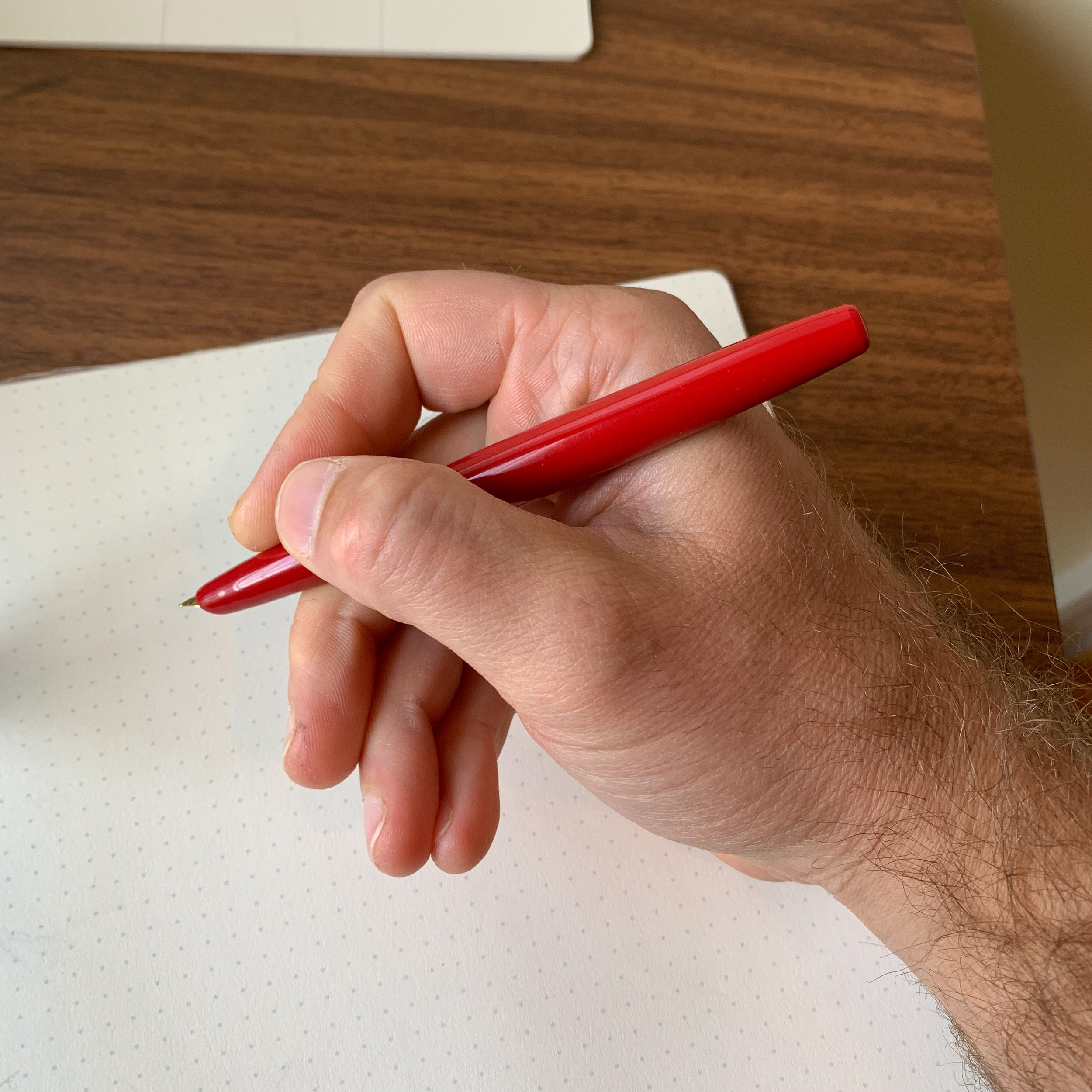
  • Good Balance and All-Day Writing Comfort. What I enjoy most about the Duo-cart (as well as other vintage and vintage-inspired pens) is the fact that the pen was designed in an era when fountain pens were intended to be used as a daily writing tool akin to your keyboard. Therefore, comfort is key. The section is long and provides ample room to grip the pen, and since the Duo-cart uses a friction fit cap there are no sharp threads to interfere with your grip or dig into your hand. The pen is similar in size to the Lamy 2000 or the Parker 51.

The engraved streamline cap looks great - almost like pinstripes. With this release, Aurora introduced navy, light green, and light blue versions of the Duo-cart alongside the black and burgundy versions from the initial release. The light green (shown here) has the most “vintage” feel of any of them, in my opinion.

Cons: You can have your nib in any size you want, as long as it’s medium.

There isn’t much that I dislike about the Duo-cart, but those considering a purchase should note a couple of things: 

  • Posting. The main issue that I still have with this pen, even after the reissue, is that the cap sometimes fails to post securely. On a couple of occasions, I’ve had the posted cap go flying across my desk at work when I turned around or moved my arm suddenly. Not an issue for those who don’t post their pens, but it can be a bit of a problem for me unless I remember to jam the cap down pretty hard on the back of the barrel.

  • Nib Size. What’s the cliche? You can have it in any size you want, as long as you like medium? I imagine this choice had to do with the scale and cost of production on the hooded nib, which is specific to this pen, so Aurora went with its most popular nib option. My two Duo-carts are somewhat wet writers, so those looking for a fine or extra-fine line will probably need to invest in a nib grind.   

In keeping with its name, the Aurora Duo-cart uses a cartridge-converter filling system.

View fullsize Aurora Duo-cart Unposted
View fullsize Aurora Duo-cart posted

Takeaways and Where to Buy

The Duo-cart is my first foray into Aurora’s “Archivi Storici” editions, and given how much I’ve enjoyed this pen I look forward to more of these releases in the future. (I also plan to dig around on eBay and see if I can unearth some of the previous Archivi Storici editions, which include a re-release of the vintage-style Aurora 88.) I support pen companies reissuing modern versions of their vintage pen designs, since it caters to those of us who appreciate the classic fountain pen styles, yet don’t necessarily want to deal with using a higher-maintenance vintage pen on a daily basis.

You can purchase the Aurora Duo-cart at most Aurora retailers, including our site sponsor Pen Chalet. Aurora has set MSRP at $195 for this pen, with most retailers pricing it around $156. I don’t have any issues with this price point. The Duo-cart looks high-end, the pen is well-made, and you have to account for the time and expense of resurrecting a vintage pen from the archives that’s been out of production for years. The $150-200 price bracket is competitive, however, and Aurora is going nose-to-nose with other excellent steel-nib pens such as the Esterbrook Estie, the Leonardo Momento Zero, and the Pelikan M205. The Duo-cart’s hooded nib distinguishes it from these pens, but for around $20 more you can purchase the Lamy 2000, which also features a hooded nib, but in 14k gold with a piston filler. The design aesthetic is distinct enough, however, that the Duo-cart will likely carve out its own niche.

Editor’s Note: The dark teal ink shown in this writing sample is a limited edition collaboration between Pen Chalet and Colorverse, “Monsoon Storm.” This particular Colorverse ink includes two different colors, a 65ml bottle of Monsoon Storm and a 15ml bottle of an orange-gold color called “Monument Valley.” I may do a stand-alone review of both inks but since these are limited edition inks that may sell out I figured I would post the details here. Currently, this ink is listed at 30% off and on sale for $25. 

Disclaimer: This post contains links to paid sponsors and affiliates. I acquired this pen using store credit generated through my participation in Pen Chalet’s affiliate program.

In Pens Tags Aurora Archivi Storici, Aurora Duo-cart, Vintage, Pen Review
Comment

Pen Review: Leonardo Officina Italiana Momento Zero x Pen Chalet Special Edition

August 21, 2019

For years, I went back and forth on whether to acquire the Delta Dolcevita, the flagship of now-defunct Italian pen company Delta. While I appreciated the depth of the orange material Delta used - a bright orange acrylic/cellulose acetate? - the pen was always just slightly too large for my taste, and the trim levels and scrollwork a little too ostentatious. I never ended up buying the classic Dolcevita, though I did briefly own the Dolcevita Soiree.

Leonardo uses Bock nibs, customized with an understated imprint. All of my Leonardo nibs have been well-tuned writers out of the box. The “roller clip” is another nice Delta legacy. Most of the standard Momento Zero pens feature stainless steel nibs, with gold nibs available on premium models.

Leonardo Officina Italiana is a new pen company run by former Delta craftsmen, and while you definitely notice the Delta heritage, Leonardo pens appeal to me because they are more understated, taking the best elements of Delta’s design and material choices and omitting the superfluous flourishes. The pens are “minimalist” in the best sense: they rely on a design that’s simple and straightforward without being boring, and focuses the attention Leonardo’s diverse array of materials that range from acrylics to celluloid to ebonite.

While I’ve previously reviewed Leonardo’s “flagship” pen, the Momento Zero, I wanted to separately review a recently released limited edition made available through Pen Chalet, which transposes the Delta Dolcevita’s orange and black color scheme onto the much more functional size and shape of the Momento Zero. Even better, the pen was made available in both a gloss and matte finish, with ruthenium trim. The pen pictured here sports the matte finish.

Like the other Momento Zero pens in my collection (I now have seven total), everything about this special edition is well-executed and makes for a quality, highly functional pen. The medium size and slightly tapered shape of the Momento Zero lends itself to longer writing sessions or all-day use, whether you post the pen or not. The matte finish on the section feels nice, similar to the matte finish on the Sailor Imperial Black, and provides good grip. The nib writes a smooth, relatively wet, western fine line. Like the other Momento Zeroes that are priced below $200, this pen features a steel nib and a “captured converter” filling system, meaning that you can either unscrew the section and remove the converter as you would with a traditional cartridge-converter pen, or you can remove the blind cap and work the converter like a piston-filler. As pictured below, even the converter sports ruthenium trim!

Did I mention Leonardo’s attention to detail? Most companies would not have bothered to plate the “non visible” components, such as the end of the converter under the blind cap. Things like this make me smile.

Takeaways and Where to Buy

I appreciate how Leonardo has chosen to focus its offerings on two classically styled pen models, the Momento Zero and the Furore, and expand the lineup by releasing these pens in new colors and new materials that include exclusive store collaborations. As I mentioned above, the pen featured here was an exclusive collaboration with our site sponsor Pen Chalet, and limited to a run of 25 pens. It sold out quickly. Fortunately, however, Pen Chalet and Leonardo have just launched a new, expanded collaboration that slightly tweaks the design of the pens. Check out the newest release, now available in orange and matte or gloss black acrylic with gold trim or in “Hawaii” acrylic with matte or gloss black acrylic and ruthenium trim. The orange/black/gold combination offers the classic “Delta Dolcevita” look, while the “dark Hawaii” is something truly unique to Leonardo. These pens are priced at the $199 price point - which I consider a bargain given the quality - and I’m looking forward to adding one of the “dark Hawaii” pens to my collection soon.

A few of the other Leonardo Momento Zero pens in my collection, including three from the high-end “Maestro” set made available last year.

Also stay tuned for the upcoming Momento Zero Grande, which will be a larger version of the standard pen featuring an integrated piston filling system and new materials. Follow @leonardo_pens on Instagram for details.

Disclaimer: This post contains affiliate links. I purchased the pen featured in this review using store credit generated through my participation in the Pen Chalet affiliate program, which is one method I use to acquire pens to review for the blog. Many thanks to Ron and Pen Chalet for making this review possible!

In Pens Tags Leonardo Momento Zero, Leonardo, Leonardo Officina Italiana
1 Comment

Pen Review: Schon DSGN Classic Machined Pen in PVD DLC Stainless Steel

August 14, 2019

If I had to pick one “small-batch” maker who has seriously impressed me with his ability to consistently produce high-quality pens at a relatively small scale while still maintaining an accessible price point, it’s Ian Schon and his company, Schon DSGN. You’ll recall that I reviewed the Schon DSGN Classic Machined Pen last year, but this particular pen - my Classic Model in PVD DLC Stainless Steel - was not featured in that review. Why? Unfortunately I had “misplaced” it at the time, and I was despondent. As it turns out (and as frequently happens when you have hundreds of pens lying around your house), I found it in the pocket of some shorts that I had stored away last winter and didn’t pick up again until the June. This beauty is now firmly back in the rotation.

Compact, durable, and equipped with the reliable Fisher Space Pen refill, a Schon DSGN pen - especially in a nearly indestructible material like DLC-coated stainless steel, could easily be your go-to everyday carry pen.

What is “PVD DLC”?

Let’s get that out of the way first. “PVD DLC” refers to a process by which items such as pens and watches are coated to make them darker and more durable. The “PVD” part of the process ("Physical Vapor Deposition”) actually refers to the process, and I’m not about to delve into the technicalities because it’s way above my head. You can read more about it here. “DLC” (“Diamond Like Carbon”) refers to the coating itself, which darkens the look by bonding to the steel and hardening the pen even further. Needless to say, it will be very difficult to damage a PVD DLC stainless steel pen, especially one that’s already as durably built as a Schon DSGN Classic.

I picked up the PVD DLC Classic at the 2017 D.C. Pen Show, which I believe was the first time that Schon DSGN attended. Why did I pick this particular pen to take home? Because during my conversation with Ian, he was showing it off as the pen he designed for himself, and at the time, the PVD DLC model wasn’t a regular part of the lineup. If I’m at a pen show, talking directly to a maker, and they tell me, out of all their pens, which one they built for their own use, 9/10 that’s the one I’m buying.

The Schon DSGN Classic is a short pen to use unposted, but the stainless steel model actually feels pretty good due to the added weight.

Despite the heft of this pen, I still find it comfortable to use for it’s intended purpose: short notes and marking things up in the course of day-to-day activities. While it may not be the best choice for novel writing, I had no issues posting the pen and using it to write out a full page of notes for this review. Like the other Schon DSGN Classic pens, this one accepts the Fisher Space Pen refill, and I swapped in the burgundy version.

The Schon DSGN Classic posted. Since the pen is well balanced and the cap threads on the back, I have no issues posting this one. Those with smaller hands may find it too back-weighted to use comfortably posted.

Side Note: Did I mention that the DLC coating is super hard and durable? To the point where it. will. scratch. anything. Don’t carry a DLC-coated pen in a bag or pocket with something like a phone unless you want a big scratch down the center of your screen. Personal experience here.

Takeaways and Where to Buy

When I purchased this pen in 2017, Ian wasn’t sure that he was going to make PVD-DLC a standard option, since it’s (1) a fairly “hardcore” EDC choice, and (2) expensive to make. I’m glad to see that the PVD DLC version of the Schon DSGN Classic is now available for purchase at a relatively accessible price point of $150. If you don’t want/need the added “boost” of DLC durability, Schon DSGN also makes a polished stainless steel version of the Classic priced at $108. While the default refill on this pen is the Fisher Space Pen refill, Schon DSGN also sells a D1 refill adapter.

Unfortunately I was unable to break away from the table long enough to pick up one of the new Schon DSGN fountain pens that were released at the 2019 D.C. Pen Show. These will be released to the general public on the Schon DSGN website August 20th. I would expect the first run to sell out quickly so keep your eyes peeled and act quickly if you want one!

Disclaimer: I purchased the pen featured in this review with my own funds, for my own collection. This post contains affiliate links.

In Pens Tags Schon DSGN, Schon DSGN Classic, PVD DLC, Pen Review, EDC
Comment

First Impressions: Kanilea Pen Company Aolani Fountain Pen

July 27, 2019

I’ve eagerly awaited this year’s release from Kanilea Pen Company, the Aolani, because the rumors turned out to be true and this pen is a departure from previous Kanilea releases: a darker-colored pen, and purple to boot! “Aolani” means “heavenly clouds,” and it’s a fitting name. Swirls of purple, silver, dark blue, black, and gray are all visible throughout the acrylic. As my interest in pens and stationery has matured, I’ve become increasingly drawn to unique materials, as opposed to new shapes or design profiles. While occasionally a new design will move me, I feel that most innovation these days comes on the materials front, which is where Kanilea really grabs me. They nailed the acrylic on the Aolani, and the pattern and color combination evokes the transition between night and day that’s only visible at dawn.

The Kanilea Aolani in the “Classic” profile. The Aolani will also be made available in each of the other four Kanilea design profiles.

The material for each Kanilea model is based on a photograph taken by Hugh and Karol of a favorite location in Hawaii. The pen comes with a wooden keepsake box, complete with a copy of the photograph on which your pens is based and information about the company, pen care, etc.

The Kanilea wooden boxes are one of my favorite aspects of a Kanilea purchase. They make excellent pencil cases!

“Ascending Haleakala volcano (on the island of Maui) is a spectacular experience, especially at sunrise. The sun appears over the horizon, and the blanket of clouds within the crater’s interior takes on a luminous glow. Colors change from black to midnight blue to violet to rose. We sat watching with a cup of hot Kona coffee, drinking in the moment as the stars twinkled and gradually faded away.”
— Kanilea Pen Company

Because there are unique variations in the acrylic on each pen, I love choosing my Kanilea pens in person. If you look closely here, you will see that the swirls in the material are continuous. Kanilea uses a feature-matching process that transitions the color and design from cap to barrel.

The flip side of the Aolani. Note how the swirls on one side of the pen are quite dark, but on the other side, shown here, you get more of the gray, purple, and iridescent silver.

Takeaways and Where to Buy

I haven’t yet seen a pen from Kanilea that I don’t like, and Aolani is certainly no exception. Purple pens sell extremely well, and I expect that Aolani is going to sell out quickly at next week’s upcoming D.C. Pen Show, much like the Hanauma Bay and Haleakala Silhouette pens have in the past. If Aolani has piqued your interest, I’d make plans to jump on it quickly!

Kanilea Pens can be purchased directly from Kanilea Pen Company, either through their website or in person at a pen show. Though it may not be an option for everybody, if at all possible I strongly recommend attending a show and picking out your pen in person. Not to ensure you “get a good one” - they’re all good - but to pick the material that speaks to you the most and to have the opportunity to work with Hugh to tune your nib and ensure that it writes exactly the way you want it to write. All of my Kanileas have been purchased in person and write to perfection. Check out my prior reviews of the Kanilea Mauna Kea, as well as my Nui Nalu and Hanauma Bay Fountain Pens.

The Aolani is available now, starting at $395.00 for a pen with a steel nib, $520 with a gold. Since all pens are handmade, online orders typically take 14-16 weeks for fulfillment, but Kanilea always comes to shows with a healthy stock of pens, and you’ll get one as long as you make them one of your first stops in D.C.!

Disclaimer: Kanilea Pen Company loaned me the pen featured in this post for review purposes, free of charge. Many thanks to Hugh, Karol, and the rest of the team at Kanilea for making this review possible.

In Pens Tags Kanilea Pen Co., Kanilea Aolani, Aolani, Pens, First Impressions
1 Comment

Pen Review: Esterbrook Phaeton 300R Fountain Pen

July 13, 2019

Since Esterbrook’s “reboot", most of the attention has focused on the Estie, the Company’s first release following its acquisition by Kenro. Currently, Esterbrook only has two pens on the market: the Estie (which comes in standard and oversize versions) and the Phaeton, which I’ll look at today. In my opinion, this somewhat singular focus has served Esterbrook well, and the Estie, which I consider a well-designed, appropriately priced “daily workhorse”-type pen, has received largely positive reviews. Kudos to Esterbrook for pacing themselves and letting their reputation build around the Estie and expanding their offerings by gradually releasing new versions of that pen, as opposed to flooding the market with multiple designs and seeing what sticks. It shows confidence in their strategy.

The Esterbrook Phaeton comes in four colors: Signal Red, Mineral Blue, Spruce Green, and Midnight Black. Gold-plated trim only.

Which brings me to the Phaeton (also listed as the “Phaeton 300R”), marketed as a re-release of a vintage hooded-nib Esterbrook, the Phaeton 300, a pen you don’t hear much about save in vintage collector circles. Though I understand Esterbrook’s desire to expand the line across a wider range of price points - particularly the need to offer something in the sub-$100 price bracket - I question whether this current version of the Phaeton was the right move, mainly because this pen faces steep competition from lower-priced alternatives.

I love the practicality of this type of converter - it works better than any Indian-style converter I have used, but man does this thing stink!

For starters, many people have pointed out that the Phaeton bears a striking resemblance to much less expensive offerings sold by Indian fountain pen companies such as Kanwrite. Assuming there is some relationship there, however, I do think that it’s unfair to write the Phaeton off as a pure “rebadge” of a stock pen purchased abroad. There clearly have been some design modifications to the cap and clip, and the nibs and feeds on the Phaetons have plainly undergone more rigorous quality control than you would find on a typical $15 Indian fountain pen. Moreover, it’s no secret that Esterbrook pens are made by contract manufacturers, presumably incorporating stock parts that go into other pens sold by different companies. Esterbrook doesn’t own their own factory, and many other companies do the same thing. The end result for the Phaeton is a good daily writer with a cool vintage vibe, especially if you like hooded-nib fountain pens, as I do. At the end of the day, however, the question is still whether Esterbrook has done enough to this pen to justify the $85 MSRP/$68 street price. That’s where I have my doubts.

I love hooded nibs! Even on relatively inexpensive pens, they seem to write well, and are very practical for those times when you’d prefer to use a pen that doesn’t scream “Fountain Pen!”, such as in a meeting.

Before I talk further about the price-value proposition, a few comments on the Phaeton’s specs and usability. I had no issues whatsoever inking up the Phaeton and getting it writing out of the box. The syringe-filling converter works well, and makes it easy to flush the pen, though you have to deal with the extremely stinky plastic that Indian pen companies use to manufacture these types of converters. (If you’ve ever used a Noodler’s pen, you’ll know exactly what I’m talking about.) The nib writes a standard medium-fine line, which is the only nib size available, and while the pen has some tooth, I found it pleasant to use. In terms of size, the Phaeton will remind you of classic vintage pens such as the Parker 51, Parker Super 21, Aurora 88, and, yes, the original Esterbrook Phaeton. Like those pens, the metal cap is a friction-fit clutch design, which also posts easily. In short, from a pure usability standpoint, the Phaeton is a nice pen that will serve you well as a daily writer.

View fullsize Esterbrook Phaeton Posted
View fullsize Esterbrook Phaeton Unposted

Overall Takeaways and Where To Buy

The Phaeton offers a retro vibe at a not-objectively-unreasonable price point, especially if you wait for a sale or coupon code. The issue I have with this pen is the increasing level of quality competition at the same or lower price, and I’m not sure that I can recommend the Phaeton at $68 over, say, a TWSBI 580 at the same price, a PenBBS 456 vacuum filler priced around $40, or a PenBBS 308 cartridge converter filler or 309 piston filler at an even lower price point. If you want a hooded nib pen, the KACO Retro costs less than $20.

I am glad to see Esterbrook experimenting with lower priced offerings than the $150+ Estie. That said, I don’t necessarily see the Phaeton gaining as much traction, given the relatively high price point as compared to pens of similar - and some would say better - quality. One reason why you may still want to consider the Phaeton, though, is the widespread availability at retail in the U.S. If you’re uncomfortable purchasing pens from eBay or Amazon sellers - a mainstay at this price point - the Phaeton can be acquired from pen retailers such as Pen Chalet or Vanness Pens, both of whom will certainly stand behind the product if you have a problem (as will Esterbrook).

Disclaimer: I received the Esterbrook Phaeton featured in this review from Esterbrook, free of charge, for review purposes. Many thanks to Esterbrook for making this review possible! This post contains affiliate links.

In Pens Tags Esterbrook, Esterbrook Phaeton, Hooded Nib
Comment
← Newer Posts Older Posts →
Store Hours and Location
Visit the T.G.S. Curated SHOP
*New* Updated "Best Pens" Guide (2025)
T.G.S. 2025 Holiday Gift Guide
TGS x Roterfaden TGS_25
Hierarchies of Fountain Pen Friendly Paper

Join Our Patreon!
Subscribe to the TGS E-mail List

Featured Posts

Featured
Cover On the Paper Trail Intro Clip.jpeg
Dec 3, 2025
Introducing "On the Paper Trail," a New Podcast/Video Collaboration with Lisa Vanness of Vanness Pens!
Dec 3, 2025
Dec 3, 2025
Iro-Utsushi-Fine-Dip-Pens.jpeg
Oct 1, 2025
The Pilot Iro-Utsushi Dip Pen (and in General, Simple vs. Fancy Dip Pens)
Oct 1, 2025
Oct 1, 2025
Levenger-Annotation-Pad.jpeg
Sep 20, 2025
Five Boutique Paper Brands I'm Watching Closely and Why
Sep 20, 2025
Sep 20, 2025
The Gentleman Stationer RSS

© Digital Divide Media, LLC, 2014-present.

All content is the exclusive property of Digital Divide Media, LLC, d/b/a The Gentleman Stationer, including “The Gentleman Stationer” website and trademark, and should not be reproduced without express written permission.  All rights reserved.

All content containing paid advertising, affiliate links, or sponsored content will be plainly disclosed by a disclaimer when/if featured.

Contact Information

Store Shipping Policy and Return Policy

Privacy Policy

Cookie Policy

Terms and Conditions

Powered by Squarespace