• Blog
  • Shop
  • Resources
  • FAQ (Ask TGS)
  • About
  • Archive
  • Contact
  • Sign In My Account
Menu

The Gentleman Stationer

Vintage Living in the Modern World.
  • Blog
  • Shop
  • Resources
  • FAQ (Ask TGS)
  • About
  • Archive
  • Contact
  • Sign In My Account

Pen Review: The Schon DSGN Monoc Nib, Fine Tip

September 13, 2023

I'm gradually working my way through all the different updates on new product releases from the Washington D.C. and San Francisco Pen Shows, and readers have requested my thoughts on the latest Schon DSGN Monoc nibs, which were released in fine and broad tip sizes. My original review of the Monoc nib - with the name derived from the aerospace/racing term "monocoque" that refers to single shell construction - can be read here, and contains additional background on the nib's history and design process. Today, however, I’m going to discuss the fine Monoc that I picked up in San Francisco!

To recap briefly, the Monoc is Schon DSGN's completely in-house fountain pen nib, machined from a single piece of Grade 5 titanium and featuring an ultem feed. The initial batch of Monoc nibs made available for order came in what I would characterize as a standard medium tip size, but Ian Schon and his team always contemplated releasing additional options as the manufacturing process allowed. Well, that time has arrived, and it was worth the wait.

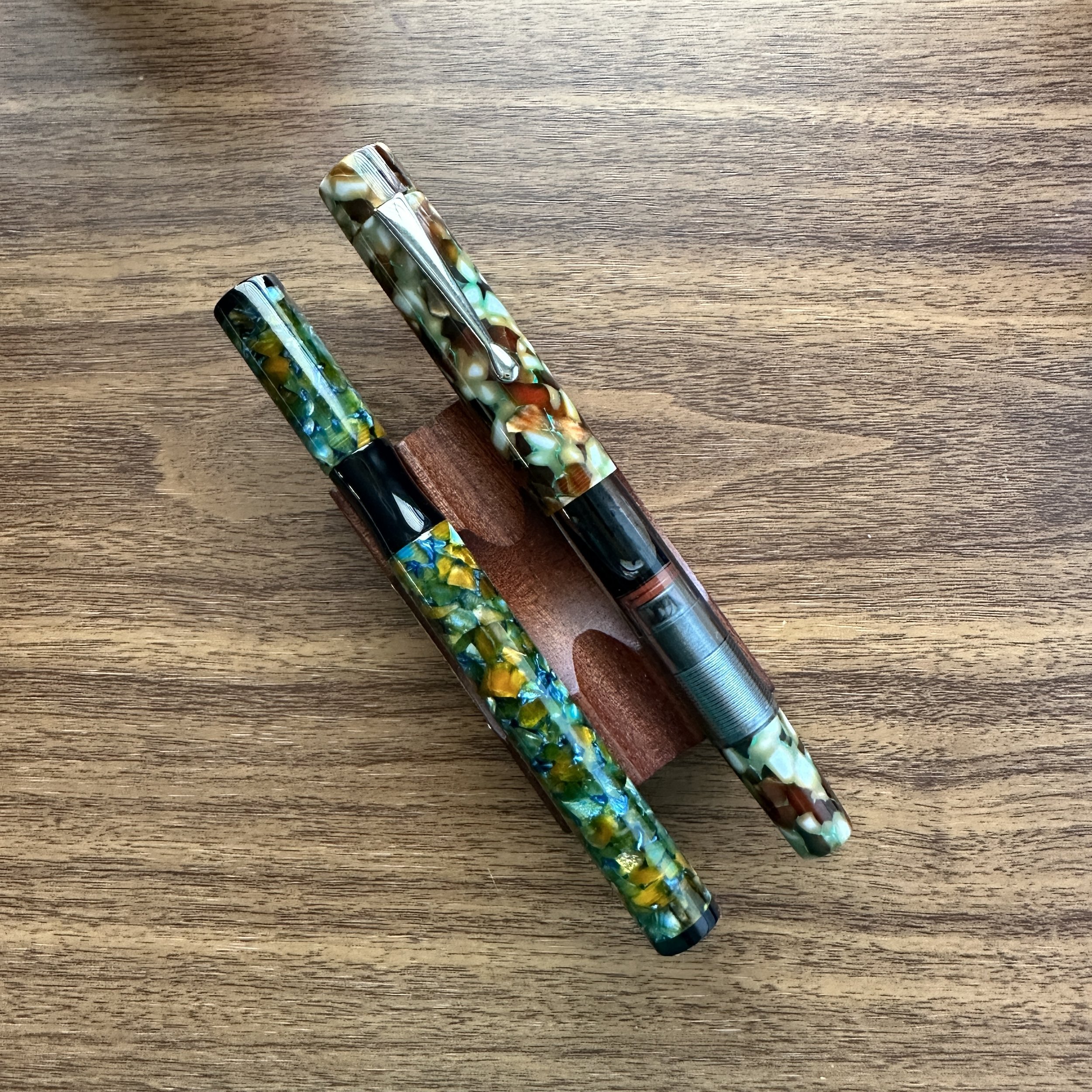
Two Monoc Nibs: the Fine (left) with a rainbow gradient anodization, on the Ultem pen, and the Medium (right) with a standard titanium finish on “Rainbow Sprinkles” full-size metal fountain pen.

My New Schon DSGN Monoc Nib, Fine Tip, Anodized, with Reversible Architect?!?!

I decided that if I was going to purchase one of the fine Monoc nibs, I would go all-in and get one with an interesting anodization. I had with me at the San Francisco Pen Show my first ever Schon Pocket 6 fountain pen in a blue pattern that's no longer made, so I asked Ian to choose an anodized Monoc that complemented the colors. He chose this gorgeous rainbow gradient. While I’ve since swapped the nib into my Full Size Ultem fountain pen for this review (to better compare the feel with my standard medium), I'll likely move it back to one of my Pocket 6 pens and/or my other pens as I use them. This particular Monoc is that good, and I want it inked up at all times!

In "standard" writing position, the fine Monoc writes what I'd consider a western fine, or possibly an extra-fine, line. Since these nibs are made individually and hand-tuned/finished, there could be some variation in the final product. That said, it's noticeable finer than the medium Monoc nib, which is exactly what a lot of potential Monoc buyers have been waiting for. Grade 5 titanium has a tactile feel (almost pencil-like), which you will notice more in the fine than in the medium. Personally, I like this, and to me the nib absolutely does not feel “scratchy” though at the same time it's not glassy-smooth.

A writing sample comparing the Medium Monoc (top, inked with Nagasawa No. 69 ink), against the Fine Monoc (both standard and reverse (bottom, inked with Scribo Grigio ink). On both nibs, in standard position, the slightly curved/upturned tipping results in something akin to a Pilot Waverly nib, where the line is consistent regardless of angle. You can also write with the medium Monoc in reverse, but it’s not tuned for reverse writing in the same way as the fine nib.

The real stunner with respect to the fine nib's performance is reversibility. By that, I mean you can turn the nib over, and the fine Monoc will write a line that's the near- equivalent of an architect grind. I say "equivalent" because this nib hasn't been ground and therefore it’s not particularly crisp - I understand that the architect-like shape is due to the natural contour of the fine tipping, though some extra finishing is required to make the reverse side usable.

A sample of the fine Monoc, standard and reverse, where the architect-like line variation is apparent. It’s slightly more subtle than a true architect grind but that means it’s also very usable for everyday writing.

Takeaways and Where to Buy

The initial batch of Monoc nibs impressed me, but this fine version takes it to a new level. If you value versatility, and aren't afraid to spend a bit more to get it, then you need to keep this Monoc nib on your radar. At the time of publication, the fine Monoc nib is not yet available to order in the Schon DSGN online shop, but I would expect to see them relatively soon. You can order Monoc nibs in various custom anodizations but it appears that only medium tips are available at the moment.

The Fine Monoc was one of my takeaways from the San Francisco Pen Show. You can read more about those here.

I've already noted in my prior review that a Monoc nib is not an inexpensive purchase, primarily due to the materials and labor-intensive manufacturing process. The nib featured in this review cost approximately $425, for the nib alone, and you have the option of adding a compatible Schon DSGN Pen to your purchase at a 15% discount. The standard Monoc nib (without anodization) is priced at $385.

The Gentleman Stationer is supported entirely by purchases from the T.G.S. Curated Shop and pledges via the T.G.S. Patreon Program. I paid full price for the Monoc Nib featured in this review, and this post does not contain paid advertising or third-party affiliate links.
In Pens Tags Schon DSGN Monoc Nib, Schon DSGN Fine Monoc Nib, Schon DSGN
Comment
Jetstream Edge .28mm and .38mm Refill

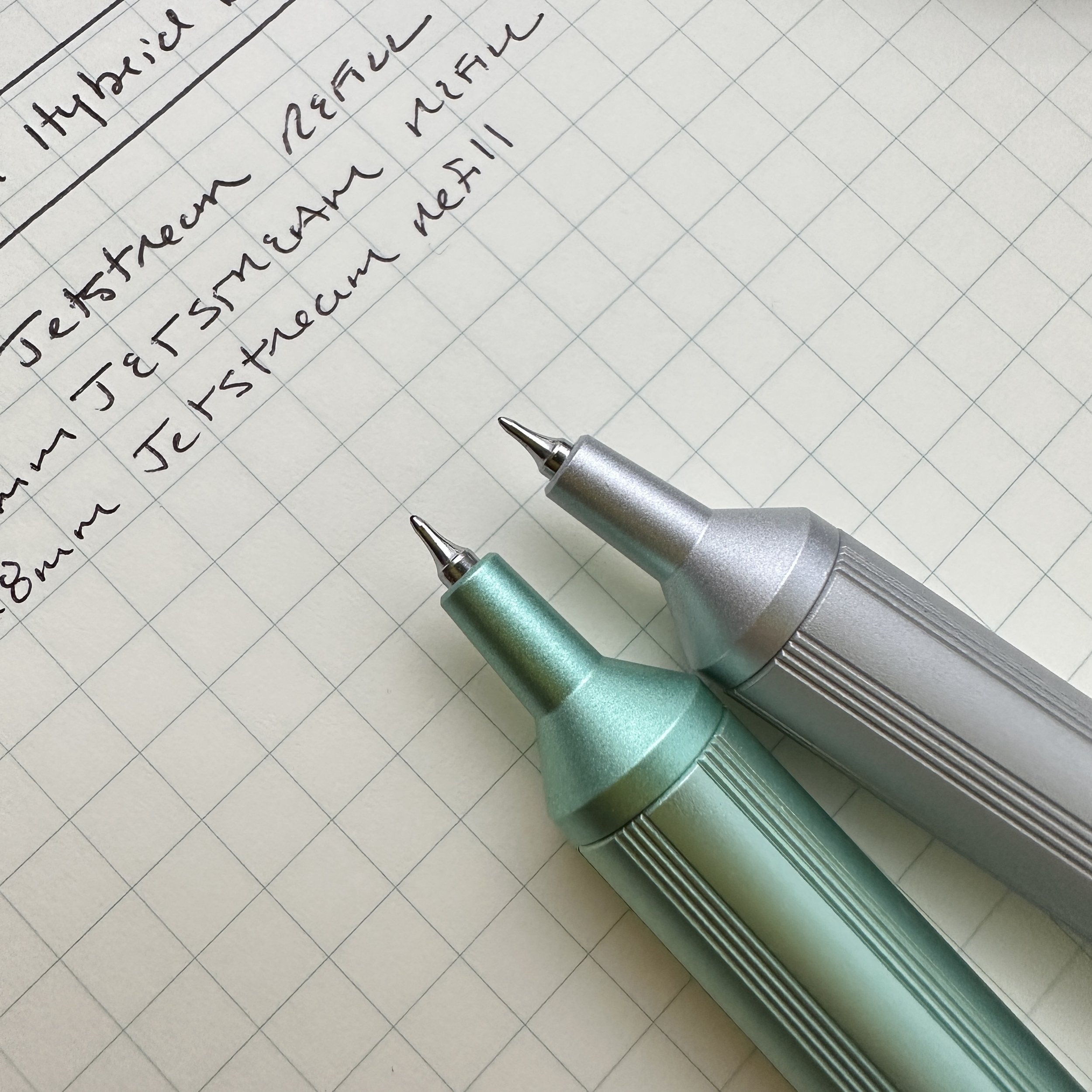
.38mm (left) vs. .28mm (right) Uniball Jetstream Edge

When Does "Fine" Become "Too Fine"? Finding the Sweet Spot for Extra-Fine Pens

August 16, 2023

I have relatively small handwriting, though I’m something of a special case since I tend to change my handwriting depending on what exactly it is that I’m working on. For standard writing and journaling, I’ll adopt a larger hand for which a medium nib is more suitable, but as I’ve mentioned before, a large portion of the writing that I do involves marking up and annotating documents that can contain very fine print. For work like this, I’ll typically need at least an extra-fine nib fountain pen, though this is where I tend to incorporate fine tip gel pens and ballpoints into my workflow.

My fine writing lineup, from left: Uniball Jetstream 4+1 Multi Pen, Anterique Brass .5mm Ballpoint, Uniball Jetstream “Tokyo Bike” 4+1 limited edition, two Jetstream Edge ballpoints in .38mm and .28mm, Uniball Jetstream 3 Multipen in .38mm tip size, Pilot Hi-Tec-C Coleto Multi Pen, and the Pilot Custom Heritage 912 with a PO Nib.

How fine can I go? Pretty Fine, But There Are Practical Limits.

On the fountain pen side of things, it’s difficult to get a nib that writes as fine as most .28mm or .38mm gel or ballpoint pens. Even if you’re using the Pilot PO (“Posting”) nib, Platinum’s UEF (Ultra Extra-fine), or a Saibi Togi-style nib, water-based fountain pen ink tends to spread on paper, so unless the pen writes fairly dry or you select a drier ink, you may have trouble obtaining the desired line width. For this reason, most of my annotation work is done with a finer gel pen or, more recently, low-viscosity ballpoint pens. I get a lot of questions about the best pen for “fine writing,” so I thought it might be interesting to talk a bit about the different options I rotate through on a regular basis and what my preferences are:

The Pilot PO nib leaves a line that’s roughly equivalent to a .38mm gel or ballpoint, provided you use good paper like the Midori MD pad pictured here.

  • Fountain Pens. My all-time preferred option for is the Pilot PO (“Posting”) nib, originally intended for addressing mail. It’s a VERY fine, slightly downturned nib that’s relatively dry and, when paired with an ink like standard Pilot Blue-Black, holds a fine line pretty well as long as you are using decent paper. On cheap office paper, however, even this ink tends to spread, which costs you the benefit of the finer point, which is why at the office I always have a gel or ballpoint pen with me.

  • Gel Pens. I rarely go finer than a .4mm Pilot Hi-Tec-C refill, since below that tip size I tend to run into drying/skipping/clogging issues, plus the writing experience becomes scratchy. My pen of choice is the Pilot Hi-Tec-C Coleto multi pen, which allows me to carry up to four different colors in a single pen body (or three plus a mechanical pencil). Lately, I’ve also added the .4mm Pilot Frixion to the rotation, and have been pleasantly surprised with how well it’s performed. The ink isn’t as dark as other gel pens, but it’s better than it used to be, and I plan to write up a full review of the Frixion once I’ve had more longer-term experience with it.

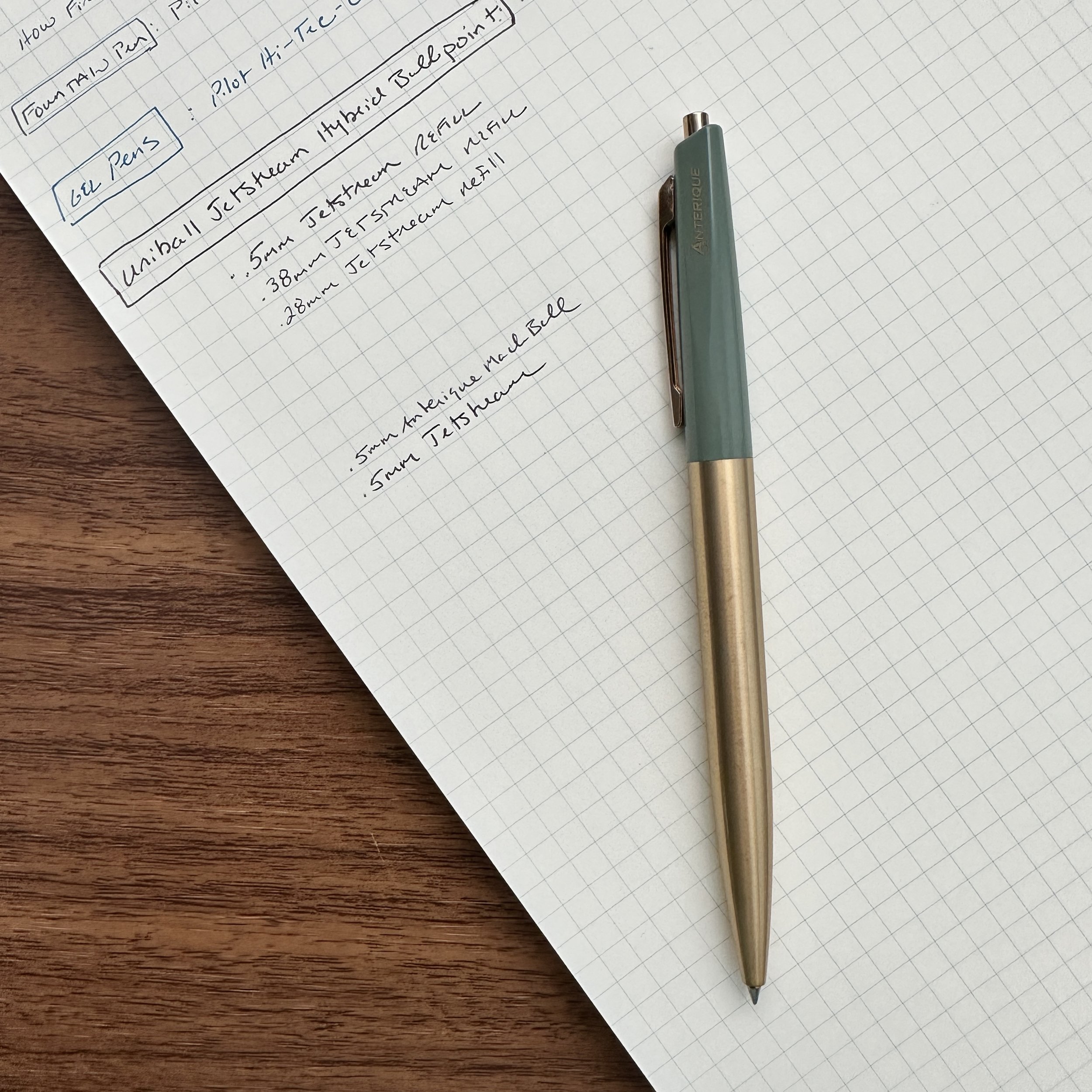
  • Ballpoint Pens. Honestly, where I’ve been spending most of my “fine-writing” time these days is in the hybrid/low-viscosity ballpoint category, since I generally find the writing experience smoother and more reliable, even if you go down to the .38mm tip size. I recently posted about my trip to New York City, where I visited Kinokuniya books and picked up a fistful of Uniball Jetstream multi pens, including a .38mm version that I had never seen before. While some claim to have experienced skipping and scratchy writing with the .38mm Jetstream cartridge, I’ve used this pen for years and never had an issue. That said, there’s no denying that a .5mm low-viscosity ballpoint refill is smoother, and unless I need to write really small, my pen of choice is the .5mm Uniball Jetstream (typically loaded into a multi pen) or the one of the .5mm Anterique “Mach Ball” pens.

The Anterique Mach Ball .5mm writes something more akin to a .4mm line - it’s narrower than the Jetstream .5mm despite having the same nominal tip size.

But What's the Absolute Finest I Can Go?

I used to say .38mm, but last month at Kinokuniya I picked up the .28mm Jetstream “Edge”, which features a Rotring-style hexagonal barrel and rounded grip section that some might find more comfortable than your typical technical pen. Check out the difference in tip size from the writing sample below:

Comparing the range of Jetstream tip sizes.

The shocking thing to me is that even at .28mm, you don’t lose that much smoothness or visibility compared to the .38mm. That said, I’m not sure that the .28mm gives you meaningfully more versatility than a .38mm refill for actual writing, as opposed to technical drawing or art where the subtle differences between line widths actually make a difference. Even if the .28mm is usable (which it is!), I’m not sure that there’s a benefit beyond novelty for most people. .28mm probably sets the floor for me personally!

The Gentleman Stationer is supported entirely by purchases from the T.G.S. Curated Shop and pledges via the T.G.S. Patreon Program. This post does not contain paid advertising or third-party affiliate links.
In Pens, Editorial Tags Uniball Jetstream, Small Writing
4 Comments

Three Ways to Use Uniball Jetstream Refills to Upgrade Pens for Work and School

August 2, 2023

I say this every year, but the end of the Summer vacation and travel season seems to come earlier every year. For our family, school starts Monday, and based on order patterns and inquiries I’ve been receiving through the blog, readers have begun winding down their Summer travel adventures and preparing to head back to the office, more often than not in-person. In the past, I’ve used this time of year to talk about some of my favorite everyday working stationery, which includes the beloved Uniball Jetstream - one of the best all-around pens (and refills!) on the market. Today, the goal is to take the opportunity to discuss how you can use the Jetstream to “upgrade” pens you may already own.

Many popular non-fountain pens on the market today ship with the Schmidt P8126-27 capless rollerball refill. (For those unfamiliar with the technical name, this is the same refill included with the Retro 51 Tornado and Baron Fig Squire. The P8127 is the medium-tip version, whereas the P8126 is a touch finer.) While this refill is probably the best capless rollerball refill available, I personally dislike it. Rollerballs in general are far more finicky for me to use than fountain pens, and with the exception of a few specific cartridges I enjoy, I nearly always swap out the stock refill for a new option. My swap refill of choice for Schmidt capless rollerballs is the Parker-style Jetstream SXR, but you’re not limited to that format for the Jetstream writing experience. I kit out most of my multi pens with Jetstream D1 refills, and am always looking for other Jetstream (or Jetstream-like) low-viscosity cartridges to “upgrade” my non-fountain pens.

The Craighill Kepler pen: a recent discovery. Check out the unique D1 refill mechanism below.

Why I Love the Uniball Jetstream

  • It writes smoothly, dries quickly, and doesn’t bleed through paper. As a low viscosity “hybrid” ballpoint pen, Jetstream ink combines the smoothness of gel ink with the quick drying and permanence of a ballpoint. Uniball was one of the original manufacturers to introduce this type of pen, and the category (which includes other excellent options) has exploded in popularity in recent years.

  • The standard Jetstream pens are easy to find in most stores, and we’ve recently been able to source the Jetstream SXR-600 Parker-style refills from Japan. I’ll talk further below about my favorite ways to use these cartridges in non-Jetstream pens.

  • Across the board, Jetstream pens and cartridges last a long time and are relatively inexpensive. The SXR-600 cartridges can be found for roughly $7-8 per unit, and the D1 refill for even less than that. While that might seem high, due to the nature of ballpoint ink, these last for a very long time without drying out (as in, years), especially if you like your tip sizes in .5mm or narrower

The Craighill Kepler pen kitted out with a Uniball Jetstream D1 refill.

My Favorite Iterations of the Uniball Jetstream and HoW I use them

  1. Uniball Jetstream D1 Refill. The Jetstream D1 refill shot the Lamy 2000 4 Color Ballpoint (Multi Pen) to the top of my non-fountain pen everyday carry. But lately, I’ve also discovered that this refill fits the Craighill Kepler Pen, which I previously had assumed was another retractable rollerball pen but actually uses a unique D1 mechanism. Available colors include black, blue, and red.

  2. Jetstream SXR-600 Parker-Style Cartridge. I have this refill loaded into pens including the Retro 51 Tornado, the Baron Fig Squire, the Schon DSGN Classic Machine Pen v.2, and the Caran d’Ache 849 “Rollerball”. This cartridge features an absolutely massive ink capacity, and I have yet to experience one running dry, especially in the finer tip sizes. The drawback is that they apparently only come in black ink. Blue, red, and green, please!

  3. The Uniball Jetstream 3&1 or 4&1 Multi Pen. While you can’t swap the refills into a different pen body - at least not to my knowledge - Uniball makes its own multi pens, and they’re excellent. I personally prefer the “&1” series, which indicates that a mechanical pencil is included as one of the functions. On my recent trip to Kinokuniya in NYC, I went a bit crazy and picked up a handful of these in some less common collaboration colors. I love that the Uniball multi pens often contain red and green Jetstream refill options.

If there’s one piece of “advice” that I would want readers to take away from this post, it’s not to give up on a pen just because you don’t like the stock refill. Unless a brand (like Lamy) heavily invests in proprietary refill designs, you can often find other compatible cartridges that will fit your pen and might better match your writing style. For a refill compatibility resource, I generally refer people to this comprehensive post by my friend Ana over at The Well-Appointed Desk.

Note: I will be attending the D.C. Pen Show from Thursday, August 3 through Sunday, August 6. While orders will still ship within our typical 2-3 business day processing time, if you’d like something to arrive early next week, please get your orders in by 5:00pm U.S. Central Time today.

In Pens Tags Back to School, Back to Work, Uniball Jetstream
3 Comments

Pen Review: Newton Pens Hale Fountain Pen

July 12, 2023

When it comes to custom penmakers - especially those who display at pen shows - Shawn Newton is one of the originals. We've both been involved in the pen hobby/business for around the same amount of time (going on 13+ years?!?) and I've enjoyed watching Newton Pens grow and Shawn's lineup of pen models expand! To read more on the story behind Newton Pens, you can check out their website, as well as my earlier review of the custom Newton Shinobi I commissioned many years ago.

What makes the Hale unique is that the cap threads on to the very tip of the section and sits flush, compared to a typical fountain pen where the section sits inside the cap. See the comparison photos with the Newton Orville, below.

The pen I'm reviewing today is the Newton "Hale", a cylindrical-bodied pen with a short cap that first caught my eye at the 2021 Chicago Pen Show. This year, Shawn kindly let me take one home from Arkansas for review. It may not go back. I discovered that I actually enjoy this style of pen ("Short-cap pens"?) and it's possibly opened up a new category of products for me to try.

This “short-cap” style is a recent trend in penmaking, with many penmakers introducing variations on pens where, as here, the cap attaches to the end of the grip section, and, sometimes, where the pen features no traditional grip section at all and you hold the pen by the barrel. (Check out these pens from Tesori/HelloTello Studio, Mayfair, and Franklin-Christoph as additional examples.) The Hale does have separate grip area, though it's nontraditional in that it features a slightly tapered hourglass section that ends up flush with the rest of the pen and cap.

View fullsize Newton Pens Hale Capped
View fullsize Newton Pens Hale Uncapped

The Hale isn't just visually interesting - I find it insanely comfortable to write with. Initially, I had my doubts about this particular shape, but it didn't take long for those concerns to disappear, at least with the Hale. This slightly contoured grip area works for me, and the pen is well-balanced. For purposes of this review, I chose a "Concord"-style nib unit ground by Mark Bacas, which has a VERY fine tip akin to a Pilot PO ("Posting") nib. This style of pen, with a wider grip, offers a lot of control over your handwriting - or at least it feels that way to me - particularly important when you are writing with such a fine point.

Takeaways and Where to Buy

Count me a fan of the Newton Hale! Shawn's designs are well thought-out and well-executed, and this pen is no exception. The particular material used in the pen shown here is the same used in pens like the Leonardo Momento Zero Grande "Girasole/Sunflower", and one of my personal favorites. While I didn't use a Newton Pens nib for this review, it's worth mentioning that Shawn tunes all of his nibs before the pens ship, and they generally write very well.

From Left: Newton Pens Hale, Newton Pens Orville, and Newton Pens Shinobi.

The Hale starts at $170, featuring a stainless steel JoWo No. 6 nib unit. Shawn typically has inventory available for purchase on his website and at shows. While you can also commission fully custom pens, Shawn's a busy man and has quite the wait list, last time I checked! Personally, I enjoy shopping his show stock. Between shows he keeps busy making pens, and part of the fun for me is selecting from the various options he's chosen to make for himself. Come visit Shaw Newton and Newton Pens to see the Hale for yourself at the upcoming D.C. Pen Show, which will be held from August 3-6, 2023!

The pen featured in this review was loaned to me by Newton Pens for review purposes, and I was not compensated for this post. The Gentleman Stationer is supported entirely by purchases from the T.G.S. Curated Shop and pledges via the T.G.S. Patreon Program. To support the site, please consider visiting our store and checking out our offerings, including our recent product collaborations!

In Pens Tags Newton Pens, Custom Pens, Pen Review, Fountain Pens, Newton Hale
4 Comments

Pen Review: The Good Blue R615 "Titanium Blue" Vanness Exclusive Edition Fountain Pen

June 10, 2023

The pen I'm reviewing today is part of my ongoing effort to break out my fountain pen comfort zone and try things that I wouldn't typically purchase to use at work, but rather pick up just for fun. The Good Blue is a London-based company that specializes in flexible-nib fountain pens paired with a unique feed system designed to ensure and adequate supply of ink to the nib, which is where most "modern flex" pens have underwhelmed. So how does The Good Blue R615 perform? Honestly, very well.

I absolutely love the color of the Cerakote on this pen. Read more on the history of the pen design and materials used directly on The Good Blue website.

Pen Design and Aesthetics

This particular model, the R615 "Titanium Blue" is a special edition collaboration between our friends at Vanness Pens and The Good Blue. The pen features a streamlined, 6082 Aluminum body with "Titanium Blue" Cerakote coating, paired with a section machined from untreated CZ121 brass. The body of the pen is deceptively comfortable - I expected the step down from the pen body to the section to be too steep and severe for my taste, but as it turns out the grip area is long enough that this is not an issue.

The brass section will patina due to both your grip and exposure to ink. Note the porous feed and compare to the photo of the un-inked pen below.

While the R615 has no clip, the streamlined body features a facet on one side, which acts as a roll-stop. It's a simple, practical design. The brass components, per the company's website, are untreated and "precision textured with a surface roughness for ergonomic grip." Note that the untreated brass will absolutely patina, and may also change color due to exposure to ink. This doesn't bother me at all, and I find it to be part of the charm of the pen.

The pen doesn’t post, given the design, but is very well balanced in the hand.

Nib and Writing Experience

As I mentioned above, the main issue that people run into with so-called "modern flex pens" is ink starvation. Namely, modern plastic feeds have a difficult time maintaining ink flow sufficient to write broader lines as you flex the nib from extra-fine to double-broad. The Good Blue appears to have solved this issue by using in-house polymer feeds made from an absorbent material that not only absorbs the ink to keep the feed saturated but changes color to match the ink (helpful if you, like me, often forget what ink you have in a pen.)

The engraving on the nib says “For the love of flex.” These nib units are in JoWo-threaded housings and therefore interchangeable with pens from other brands.

The Good Blue offers several different nib options. There are, of course, standard stainless steel nibs available, but with a company known for flex, I had to try the titanium flex nib. Once broken in, the titanium nib lays down a ton of ink, and line width ranges from a bouncy fine/medium, writing with little pressure, to around a double broad if I really try to push things. (By “broken in,” I mean that the nib will soften with use. Mine was fairly stiff when I first received it, but has gradually opened up to where I can get significantly more line variation.) I have experienced zero "railroading" as long as I use moderately wet inks, and have only had issues with a couple of drier or extremely saturated shimmer inks.

Writing sample on Write Notepads paper with Iroshizuku Asa-Gao fountain pen ink.

Takeaways and Where to Buy

I didn't intend to purchase this pen, but after playing around with the demo model at the Vanness Table at the Arkansas Pen Show (dangerous table neighbors there), I couldn't pass it up. My R615 has remained inked ever since March, and while I don't write with it every day, it sees regular use in my journal and written correspondence, as well as when I'm doodling around with ink - something I've tried to do more of for the simple joy of it. The Good Blue makes one of the best modern "stock" flex nibs I've used, and I'd like to try their calligraphy and 14k nibs in the future.

Because this particular pen is exclusive to Vanness Pens, you can only purchase it through them (though it is currently out of stock as of the time of writing). Vanness does carry other versions of the R615, including the acetate and Ultem versions, as well as a selection of the standard and flex nibs. Prices start at $140 and increase depending on your choice of materials and nib, with the pen shown here coming in at $220 for the special finish plus the titanium flex. The pens and various specialty nibs (including 14k flex and untipped "Calligraphy Flex") can also be ordered directly from The Good Blue, though they will ship from the U.K.

I purchased this pen from Vanness Pens with my own funds for my own collection, though I received a discount for review purposes. This post does not contain affiliate links or paid advertising. The Gentleman Stationer is supported entirely by purchases from the T.G.S. Curated Shop and pledges via the T.G.S. Patreon Program.

In Pens Tags The Good Blue, Vanness Pens, Flex Nib, Titanium Nib
1 Comment
← Newer Posts Older Posts →
Store Hours and Location
Visit the T.G.S. Curated SHOP
*New* Updated "Best Pens" Guide (2025)
T.G.S. 2025 Holiday Gift Guide
TGS x Roterfaden TGS_25
Hierarchies of Fountain Pen Friendly Paper

Join Our Patreon!
Subscribe to the TGS E-mail List

Featured Posts

Featured
Cover On the Paper Trail Intro Clip.jpeg
Dec 3, 2025
Introducing "On the Paper Trail," a New Podcast/Video Collaboration with Lisa Vanness of Vanness Pens!
Dec 3, 2025
Dec 3, 2025
Iro-Utsushi-Fine-Dip-Pens.jpeg
Oct 1, 2025
The Pilot Iro-Utsushi Dip Pen (and in General, Simple vs. Fancy Dip Pens)
Oct 1, 2025
Oct 1, 2025
Levenger-Annotation-Pad.jpeg
Sep 20, 2025
Five Boutique Paper Brands I'm Watching Closely and Why
Sep 20, 2025
Sep 20, 2025
The Gentleman Stationer RSS

© Digital Divide Media, LLC, 2014-present.

All content is the exclusive property of Digital Divide Media, LLC, d/b/a The Gentleman Stationer, including “The Gentleman Stationer” website and trademark, and should not be reproduced without express written permission.  All rights reserved.

All content containing paid advertising, affiliate links, or sponsored content will be plainly disclosed by a disclaimer when/if featured.

Contact Information

Store Shipping Policy and Return Policy

Privacy Policy

Cookie Policy

Terms and Conditions

Powered by Squarespace