Pencils! Pick Five.

First of all, thank you to everyone who has participated so far in my giveaway here.  I'd like to remind all readers that a winner will not be chosen until Tuesday, so you have until 11:59 p.m. on Monday to enter. 

Second, for some reason pencils have been calling my name this past week or so.  I've still been using my fountain pens for certain things, but the giant cup of pencils that sits crammed-full on my desk has been bothering me for a while, urging me to sharpen them up and use them.  So I have.  I'm not a pencil purist, meaning that I don't use them exclusively by any means, but I do love me some graphite. 

My pen and pencil cup runneth over.

Here are five of my current favorites:

  1. Palomino "Classic" Eraser-tipped HB.  If I was stranded on a desert island and could have one writing implement, I would choose this pencil.  To me, it has the perfect combination of smoothness, darkness, and point retention.  If I had one criticism, it's that the ferrule and eraser tend to loosen up, and eventually fall off, as the pencil is used, but that could just be a bad batch.  Oh, and the cedar smells great when you sharpen this pencil.  Theoretically, I know there's not much difference between this and Palomino's Blackwing 602, but I just like this pencil.  A lot.  (As of October 1, 2016, It looks like the Palomino HB is out of stock. I've been unable to find a source of them anywhere. Hopefully they aren't being discontinued.)

  2. Palomino Blackwing 602.  A close second.  The point retention in this pencil is second to none, but I sometimes wish it was just a hair darker (but not as dark/soft as the original Palomino Blackwing or the Blackwing Pearl).  The gunmetal finish on this pencil is gorgeous. 

  3. Dixon Ticonderoga #2 HB (Chinese Version).  (Formerly) an American classic.  This is still a decent quality pencil, the lead is smooth and very dark, and you can't beat the price.  I docked this pencil some points because the QC is not what it used to be.  Several of the pencils in the 30 pack I purchased were warped.  Not to the point of being unusable, but still...when I spend $4.00 on a pack of 30, I want my money's worth.  Oh, wait.  In terms of smoothness and darkness, you can't really beat the combination of price and easy availability. (Don't order these online - Go to your nearest big-box store and pick up a pack that says "Made in China." The "Made in Mexico" versions aren't as good.)

  4. Faber Castell American.  There are better pencils, but I love these because they were, to me, the classic yellow #2 that I used growing up.  I bought a half gross on Ebay for next to nothing, so I can use them freely.  These pencils aren't as dark as any of those listed above, which doesn't put them at the top of my list, but they are dark enough and the point retention is excellent.  They write more like a modern German HB pencil.  They are also made of real cedar and the lacquer and ferrule have a quality you don't see much anymore in a budget pencil, other than Musgrave.

  5. Field Notes Pencil.  A great pencil in concept, but I've had some performance issues with the graphite core breaking as the pencil get's shorter.  If you don't use a long-point sharpener, the problem isn't as pronounced, but what's the fun in that?  Otherwise, the unfinished raw cedar smells amazing, the graphite is acceptably smooth and dark, and the green eraser is offbeat enough to be interesting and works well.  I really want to like this pencil, but I'm going to use a few more before I make a bigger purchase.

From left:  Field Notes Pencil, Palomino Blackwing 602 (with replacement pink eraser), Classic Palomino HB, Dixon Ticonderoga, vintage Faber Castell American.

This is a pretty accurate depiction of the darkness of the lead.  In terms of darkness alone, I would rank them:  (1) Chinese Ticonderoga; (2) Palomino Blackwing 602; (3) Palomino HB; (4) Field Notes; (5) Faber Castell American.  In terms of smoothness, the rankings would be similar, thought the Palomino pencils would both trump the Chinese Ticonderoga, with the Blackwing 602 taking the prize.

By far, these are not the only pencils I use, simply those that I have been using recently.  I'll be trying to get more woodcase pencil reviews up, since I know there's demand out there for more pencil-related content.
Uni Signo DX Gel Pen Review

When I started this blog, I didn't intend for it to cover fountain pens exclusively, though I've gone in that direction.  I do use other kinds of writing implements, primarily woodcase pencils and gel pens.  This past week, for some reason, I just felt like using these more, probably because I had not broken them out in a while.  So this week I'll take a break from my fountain pens and explore a different aspect of analogue writing.  First up:  the Uni Signo DX. 

From left:  Blue-Black; Orange; Red-Black; Green-Black; and Brown-Black.

I would say that the Uni Signo DX is one of the two most popular Japanese "micro" gel ink pens that are available in ultra-fine tip sizes, the other being Pilot's Hi-Tec-C.  I'm a huge fan of both.  The two pens have similar performance, but are built differently.  The Signo DX has a conical tip, and the Pilot Hi-Tec-C has a needle-point.  The ink in both pens is similar in terms of behavior, but I do find that the Hi-Tec-C writes a sharper line.  

Here's a shot of the Signo DX conical tip.  Compare with the Hi-Tec-C's needle point, below. 

I'm just a fan of needle-point pens in general.  The Hi-Tec-C does it as well as any.

Personally, I favor the Hi-Tec-C, but ultimately it's a matter of personal preference and I use both.  I do find that the Signo DX is more sensitive to the pen's position vis-a-vis the paper, and it tends to skip unless you are holding the pen close to vertical.  With few exceptions, I have not had that issue with the Hi-Tec-C.  Some people have had the exact opposite experience, but part of this may be that I favor the .4mm Hi-Tec-C, which is somewhat less temperamental than the .3mm (or narrower) tip sizes.  What the Signo DX does have going for it is the wide selection of colors.  Here, I've provided a sample with the five that I have:  Green-Black; Blue-Black; Orange; Red-Black; and Brown-Black.  I can't say whether or not the Signo DX "Black" colors are the same that you find in the Uniball "BLX" series you see in U.S. office supply stores, but that may be an interesting experiment for a different time....

Writing Samples from the five Uni Signo DX Gel pens that I have, all in .38mm tip size.  For comparison purposes, I've also included a writing sample from a blue-black Pilot Hi-Tec-C gel pen, which I find writes a slightly cleaner line than the conical-tip DX. 

The Signo DX is technically Japan-only, but it's relatively easy to find.  I purchased these at Kinokuniya Bookstore in New York City, but you can also find them at Jetpens.com. 

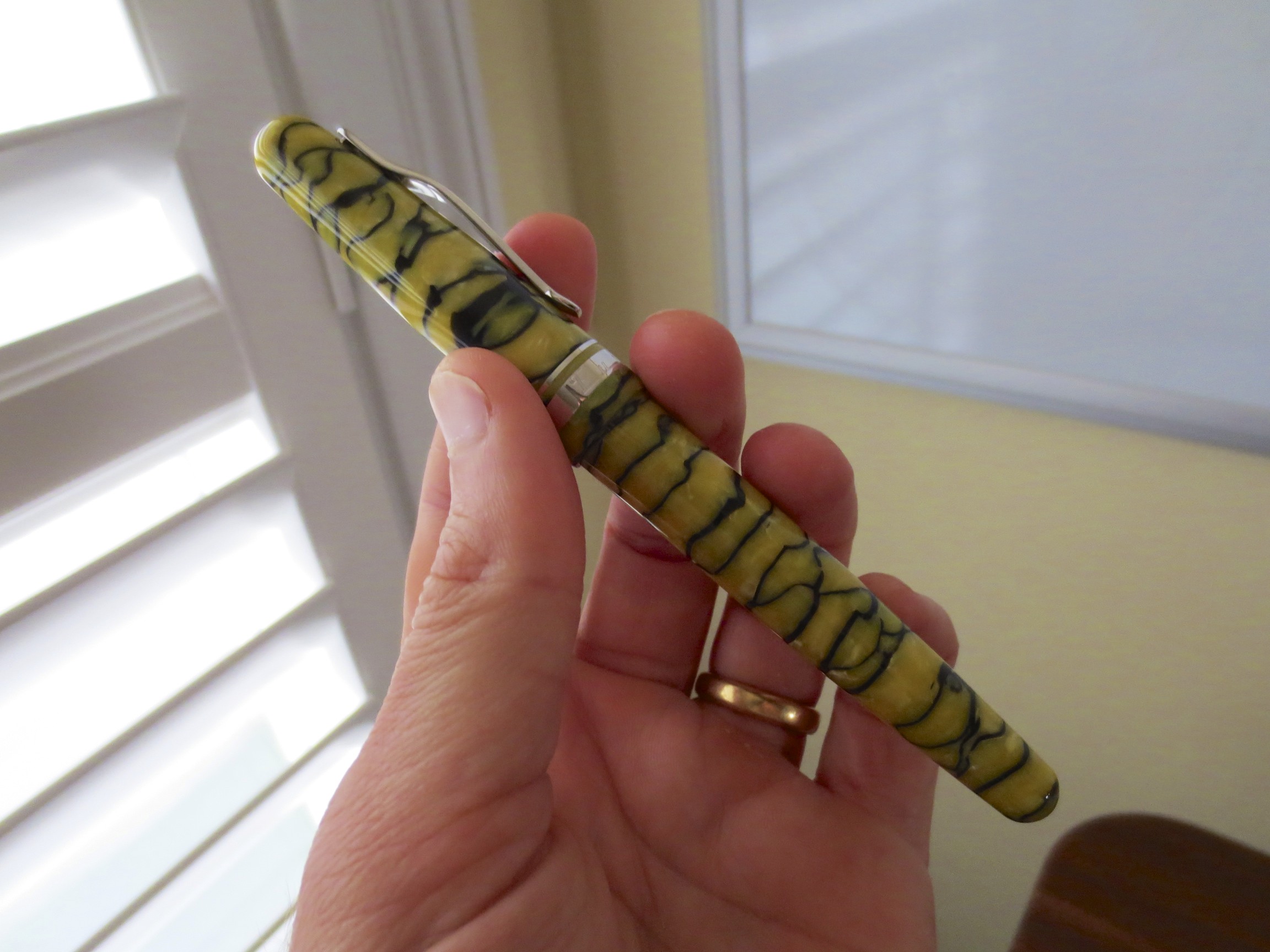
Delta Fusion 82, Part II, the Nibs

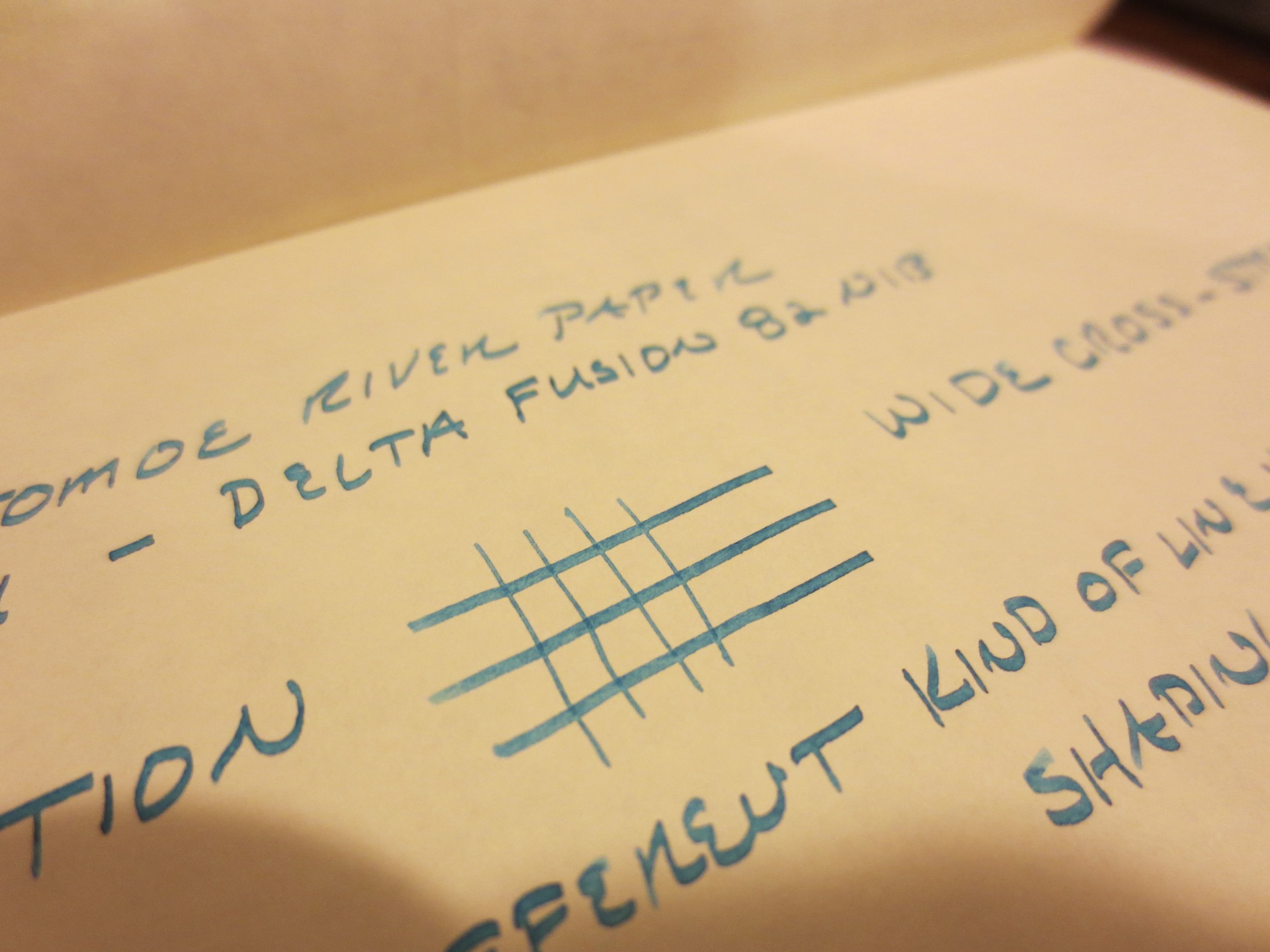
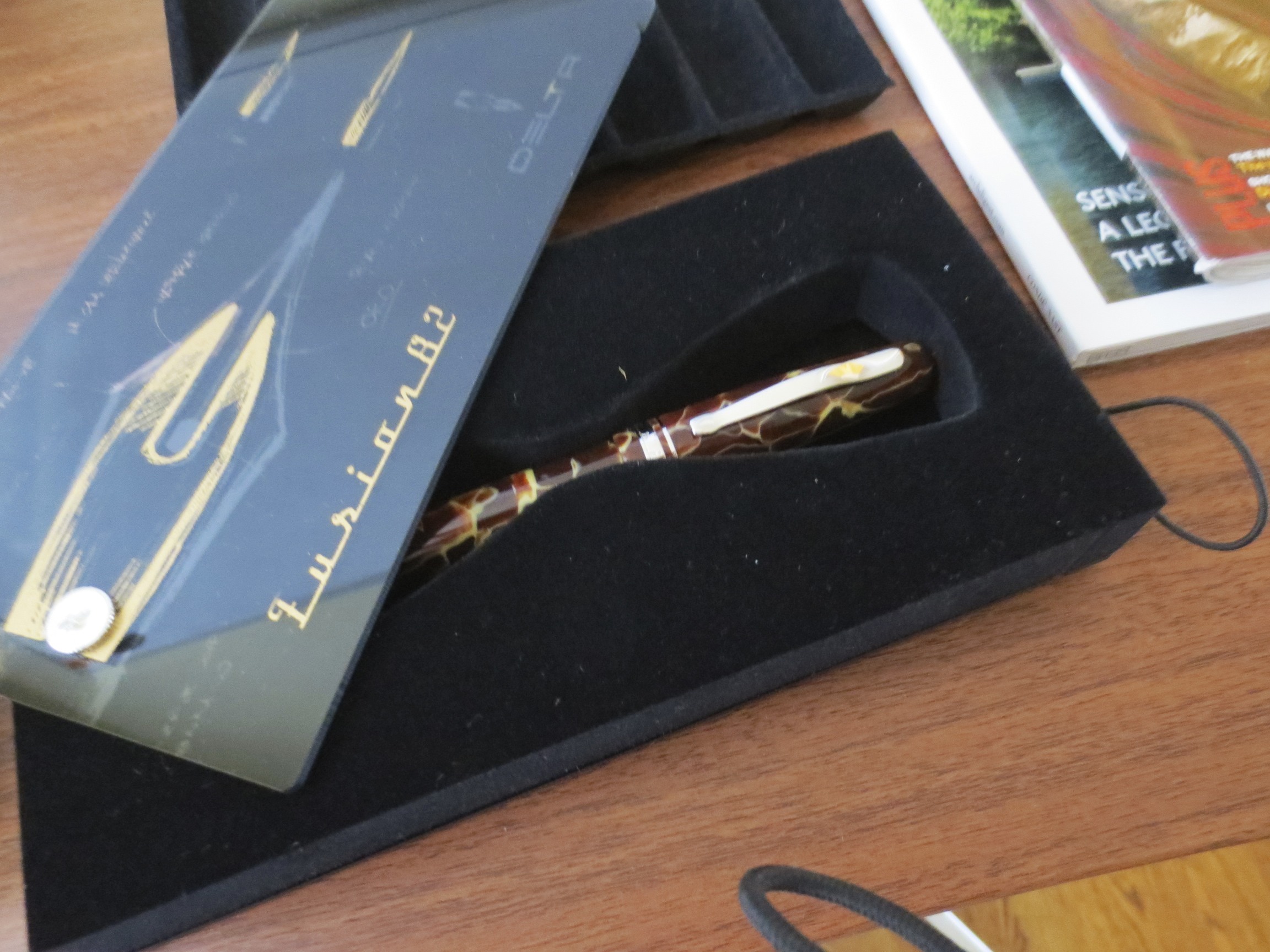
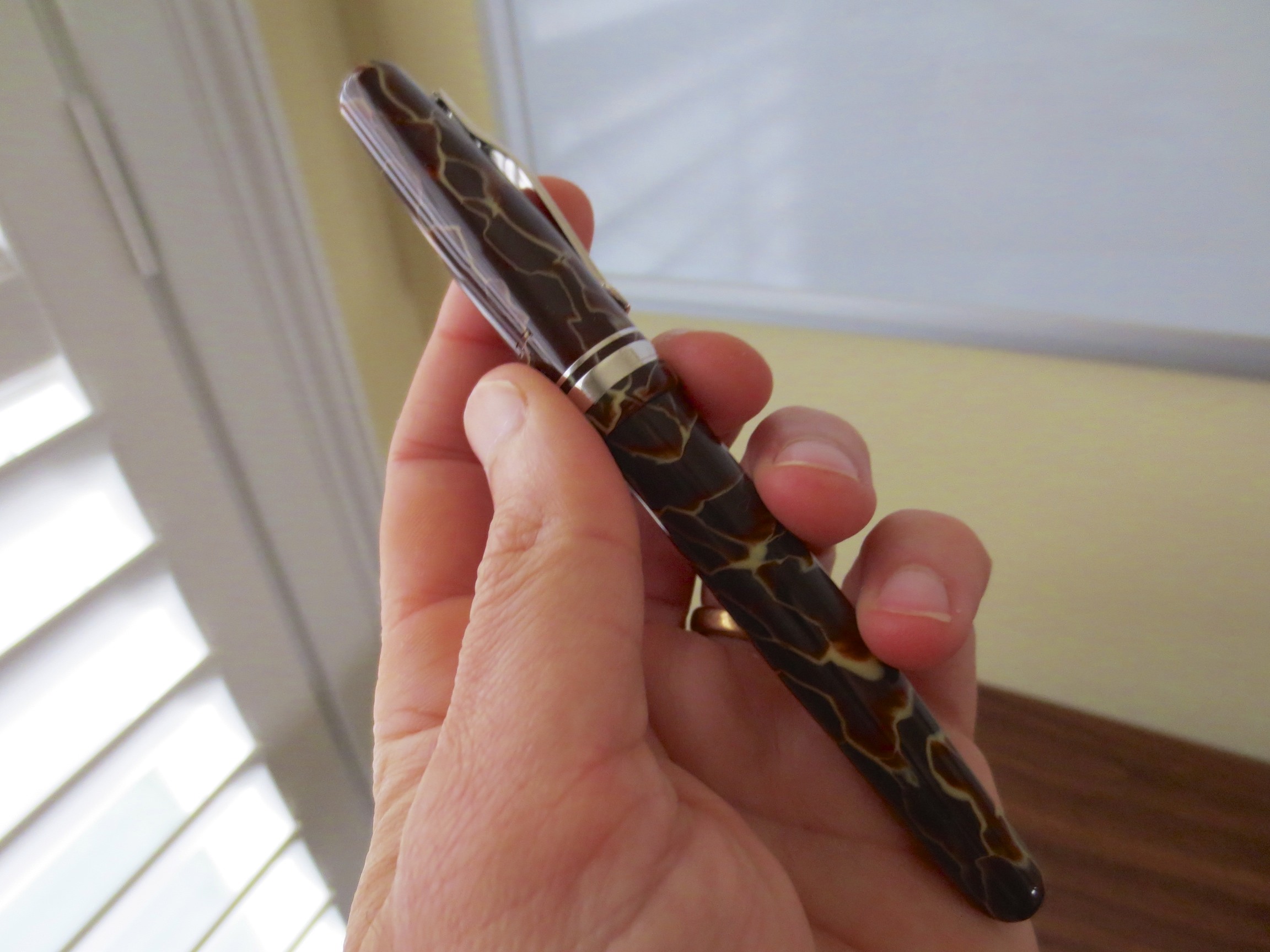
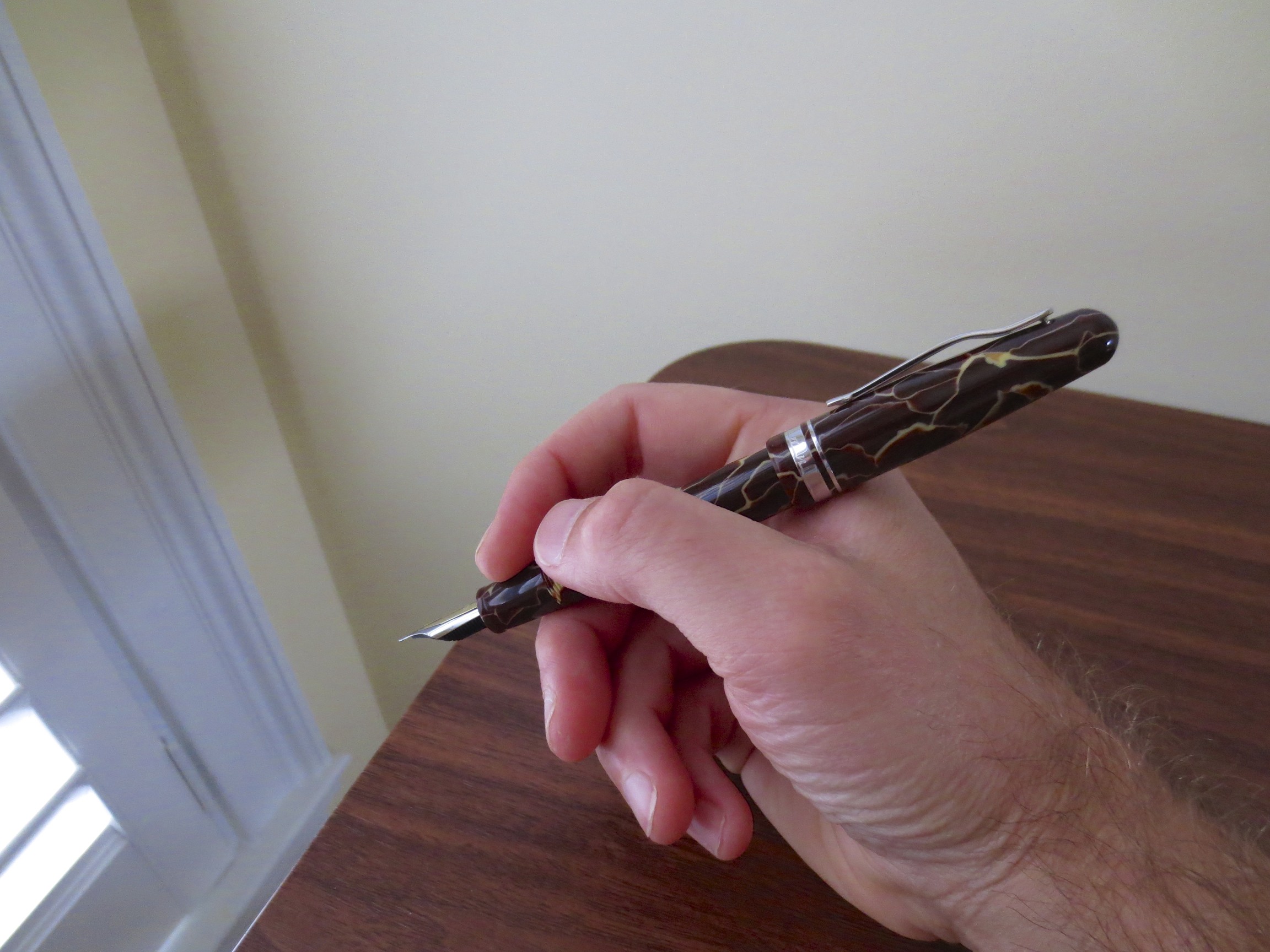
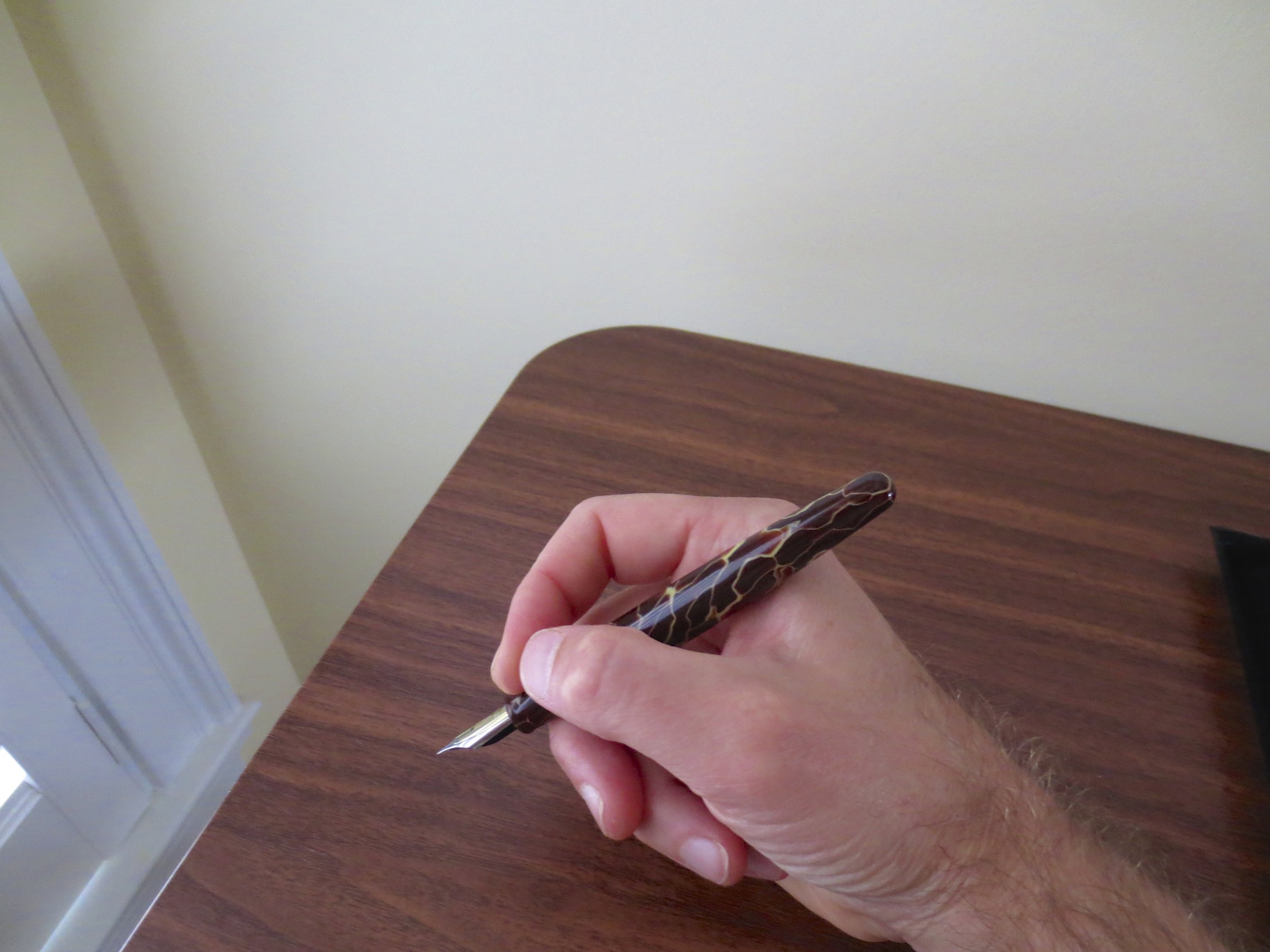
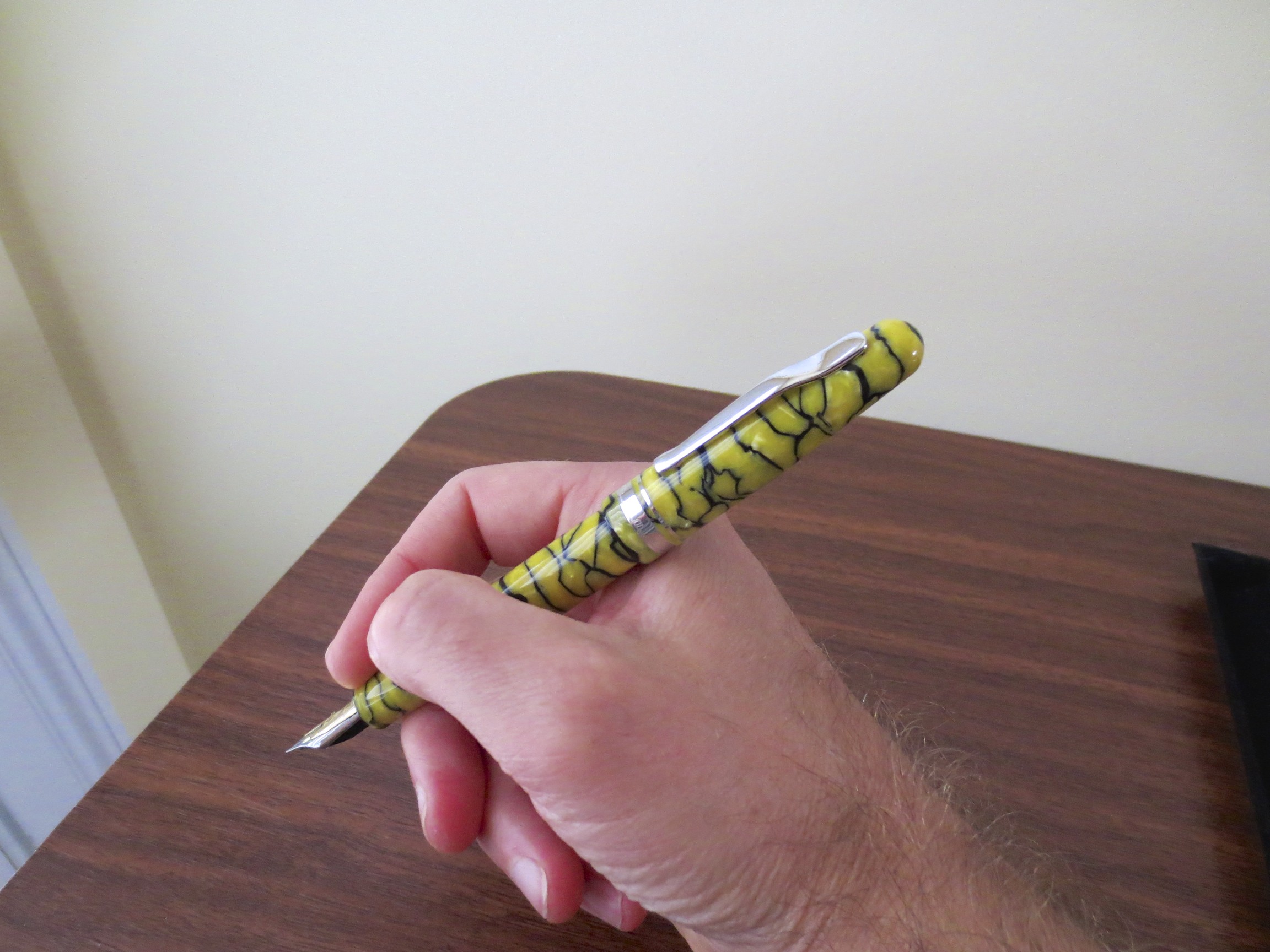
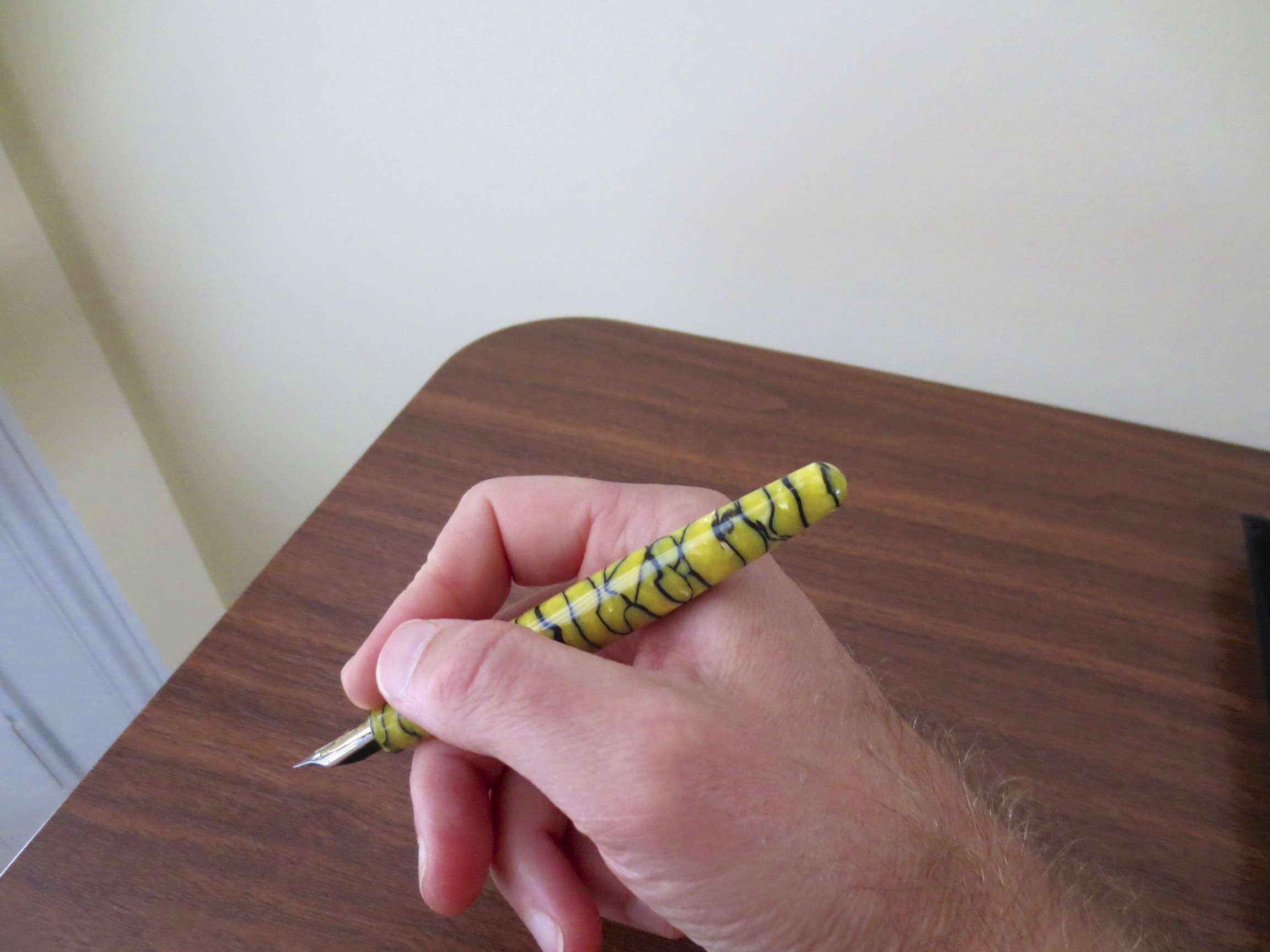
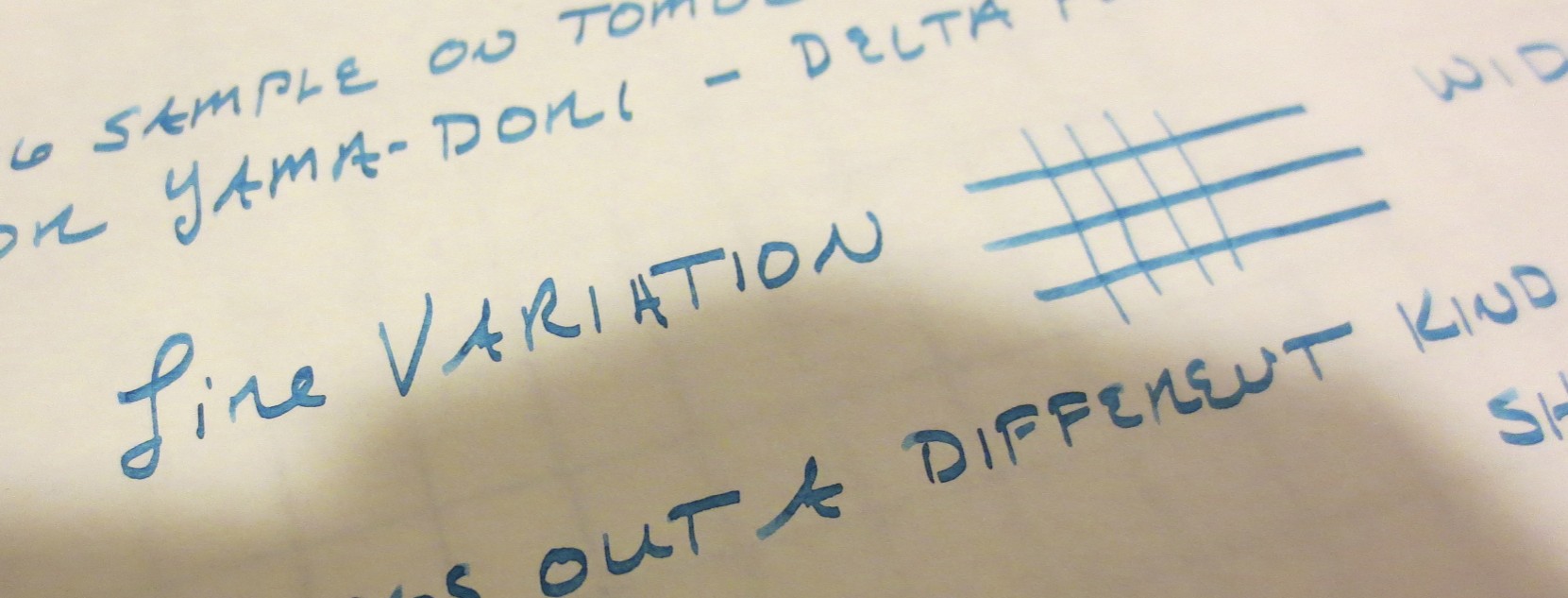
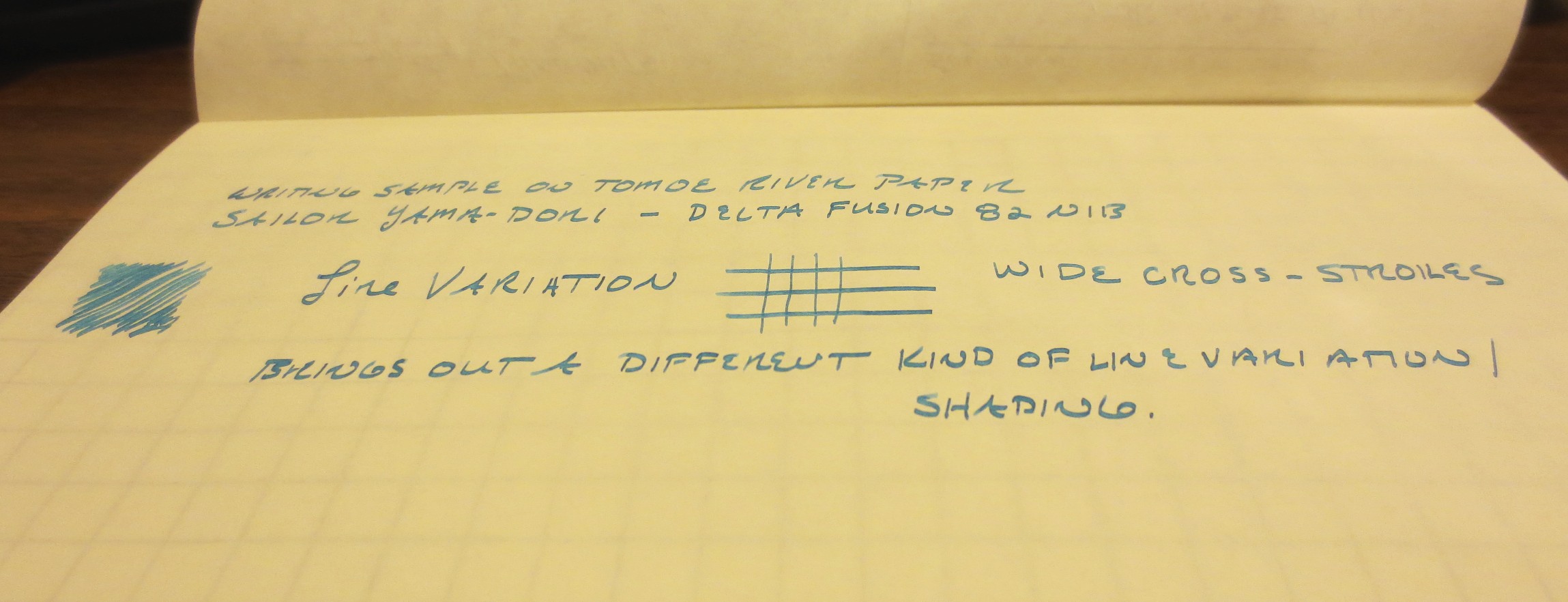
Part II of this review will focus mainly on one nib in particular:  the Pompeii celluloid Fusion 82 that I had Richard Binder grind from a broad nib to a Hebrew Italic nib.  This grind is quite unique, and is the opposite of the typical italic grind, which has wide vertical strokes and narrow cross-strokes.  The Hebrew Italic nib has wide cross-strokes and narrow vertical ones, which gives your handwriting what some have described as an "architectural" look, because it resembles the handwriting of Frank Lloyd Wright.  As always, Richard has done an excellent job on this grind.  The pen is a lot of fun to write with, and despite the unusual nature of the nib it's very easy to use as a daily writer--much easier than some crisp italics I have used.  I've included several photographs of my handwriting with the nib, from a variety of angles.  In the longer handwriting sample below, you will see that you can flip the nib, as you can with Richard's Italifine, to write an ultra-fine line.   

This is the best picture I've managed to take that shows the nature of the grind, which gives narrow vertical strokes and wide cross-strokes.  Because this nib started as a broad Fusion nib, which is narrower than most broads, I get less dramatic line variation than a grind which started with more tipping material. 

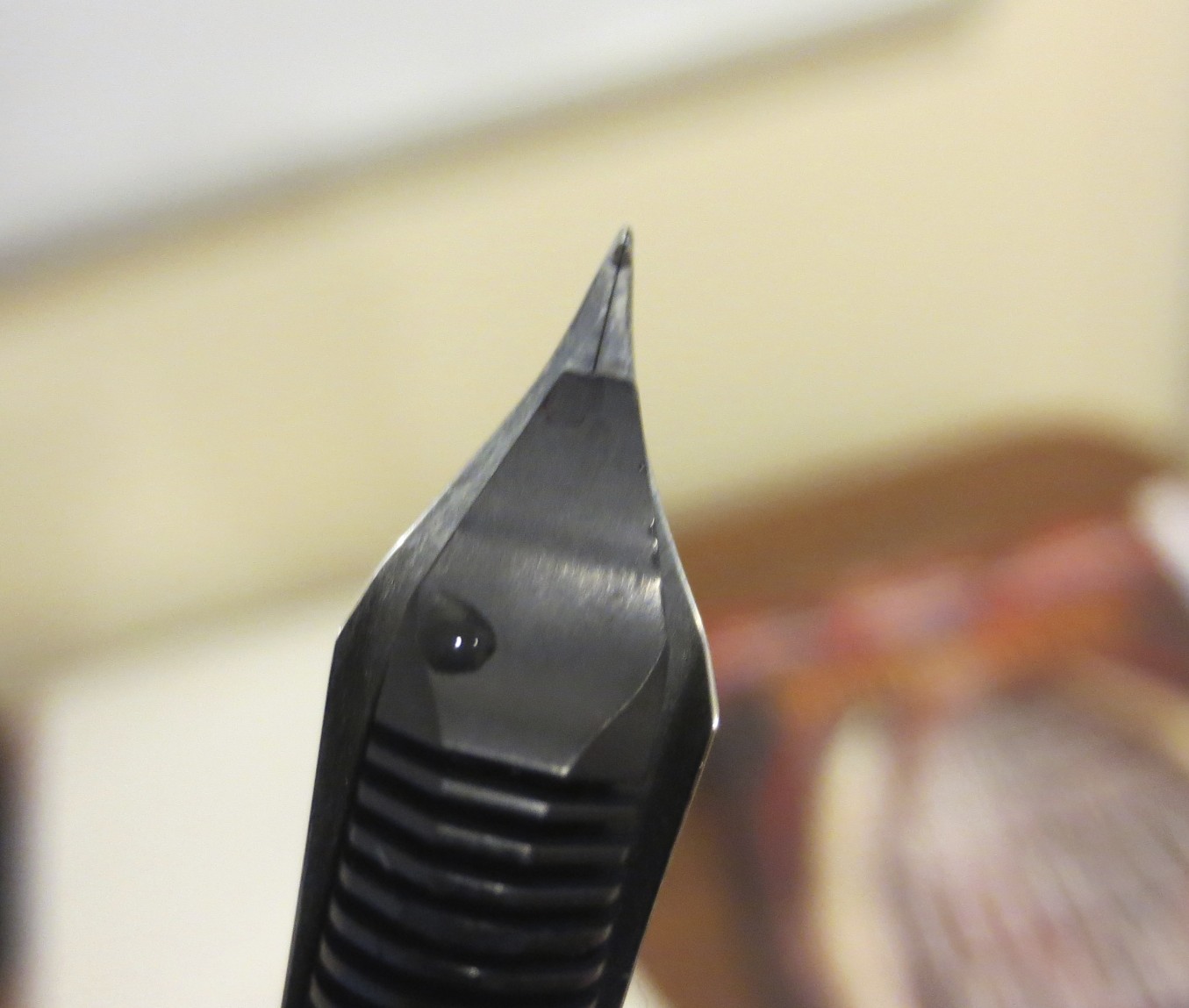
Second, my thoughts on the Delta's "Fusion" nib generally:  Overall, it's an excellent steel nib.  The nibs are exceptionally smooth, and are paired with a good feed that supply adequate ink flow.  I probably would not, however, pay a premium for this nib alone.  The approximately $236 for the standard acrylic Fusion 82 is a very steep price for what is, essentially, a steel nib pen, absent any compelling explanation (which I have yet to see) as to how the Fusion "technology" works.  As I mentioned in my previous review, however, I justified the purchase price of these pens on the basis of the celluloid material, not the nibs, although I'm happy that the nibs are more than functional functional and don't detract from the pens at all. 

Handwritten review on Exacompta card stock.  The top writing sample is the Hebrew Italic in Sailor Yama-Dori (a little light because I had just cleaned the pen and there was some water in the feed); the bottom sample is Sailor Souten in the sta…

Handwritten review on Exacompta card stock.  The top writing sample is the Hebrew Italic in Sailor Yama-Dori (a little light because I had just cleaned the pen and there was some water in the feed); the bottom sample is Sailor Souten in the standard Delta Fusion medium nib.  Note the ability to flip the Hebrew Italic and write with an ultra fine point.

Ink Review: Diamine Red Dragon

I've never really gotten into Diamine inks, for whatever reason.  I think I find the vast array of colors so intimidating that I don't know where to start, combined with the fact that they typically come in a massive 80ml bottle.  Back when I was a Goulet Pens Ink Drop member, however, I received a sample of Red Dragon, and I instantly took to this ink.  At this year's Atlanta pen show, I picked up this 30ml "mini-Diamine" from the Vanness Pens table, which to me is a great size since I wasn't sure how I would like the ink in heavy rotation.

I think I'll definitely pick up a larger 80ml bottle of Red Dragon once I use up the 30ml. 

Red Dragon is fairly saturated, but not saturated enough to smear or bleed a lot.  Performance may very depending on paper quality (with very, very cheap paper seeing some bleedthrough), but I have been satisfied.  The color is great for a "red ink person" like me:  it's not quite "blood red" like some swabs of Diamine Oxblood I have seen, but it's still got a lot of depth and doesn't have the generic "fire engine red" color that you see in other inks, like Skrip (though that particular ink does have its place).  Overall, this one has seen regular use since I acquired it, and it will continue to find its way into the rotation.