Fresh from random.org, the giveaway winner is everyone's favorite (new) podcaster.... Will Fanguy! Will, you have exactly 3 days to claim your prize before I pick a new winner. Don't think I won't do it. Please contact me through Twitter or the website and I will figure out how to get your ink to you.
Why do I go to flea markets whenever I can? Because you never know what you will find. Today, an early 1920s Sheaffer flat-top and two bullet pencils. The one on the left received a new eraser from me.
Vintage Pen Primer, Part I
One common question I get from readers is “how do I go about purchasing a vintage fountain pen, if I'm just getting into collecting?” It’s a difficult question: there’s no per se right or wrong way to do it, and the reality is that it’s a trial-and-error process that I’m still learning myself. But here are a few thoughts to make your vintage pen buying experience as enjoyable as possible.
Do your research. From the time they hit the mainstream in the early 1900s until the 1970s, fountain pens were a commodity item. There are dozens of brands of vintage pens out there floating around. The pen forums (FPN, FPGeeks, FPBoard) are invaluable sources of information on vintage pen brands and all aspects of repair, use, collectibility, etc. Books, such as Andreas Lambrou's "Fountain Pens of the World", are also helpful, especially when they have good pictures. Once you know what interests you, check out the trading forums and their online classifieds sections to get a sense of the appropriate price range for the pen you have in mind. Prices will vary, but doing a survey of pens for sale online will give you a rough idea so that you don’t overpay too much. See my “Reference Links” page on this blog for some additional sources of free information.
Don’t spend a lot of money starting out. I understand this concept is completely subjective, and varies from person to person, but the point is to not spend more than you can afford to lose until you figure out what you are doing. For a lot of people, vintage Esterbrooks are a good place to start. Esties can run anywhere from $15 or less on eBay (unrestored) to $50-60 from a reputable pen restorer. The good thing about Esties is that they are fairly easy to restore to writing condition, so your odds of getting a bum pen are fairly low. Given how durable Esties are, you also shouldn’t have any qualms about using them as a daily writer.
Three Esterbrooks, from top: Blue "J", Red "J", and Dollar Pen. I bought all of these pens as parts of lots on eBay, and restored them myself. Lever filler pens, which fill using a pressure bar and an ink sac, are inexpensive repairs and can be done at home once you make a small investment in supplies. If you are interested in starting a larger collection, it's worth learning this skill.
If you absolutely must have that Parker Duofold, Vacumatic, or 51 as your first foray into vintage pens, purchase from a reputable vintage pen retailer or go to a pen show where you can inspect the pen in person. Many pens sold on eBay are unrestored and/or damaged in some way, and are therefore not in working order. I would advise you not to purchase an expensive vintage pen off of eBay unless you are relatively certain the pen is not a fake and you (1) are willing to pay extra money to have the pen professionally restored ($20-$75 on average, depending on what needs to be done); or (2) know for sure that the seller is a reputable vintage pen dealer and/or restorer. While the pens mentioned above are generally very durable and can be used as daily writers (especially the Parker Vac and the Parker 51), they require a certain level of experience/competence to restore correctly, and a botched restoration job could mean you end up with a massive ink leak in the middle of that important work meeting. This has happened to me. Also, vintage pens typically hold a LOT of ink—much more than the modern cartridge/converter filler—so spills can be “spectacular”.
The Parker 51 (at bottom) and the Parker Vacumatic (top) are among the most collected vintage pens. Both make excellent daily writers, if restored correctly, but buyer beware if you go to eBay.
Buy “user grade” pens, at least to start. To me, “user grade” means a pen that is in respectable condition, but isn’t an immaculate, mint-condition “collector’s piece” where you will destroy the value of the pen by inking it up and using it. To this day, I don’t buy pens that I wouldn’t feel comfortable using. Even though I have some pens that I wouldn't carry around in my pocket, everything in my collection can be used to work at my desk. Writing with a vintage pen is part of the fun; it’s difficult to get a sense of which pens “speak to you” without being able to write with them. Buying "user grade" also keeps the price down.
Accept that you will get burned at least once, but probably a few times. I don’t view this as being cynical so much as realistic. As with the market for any antique or collectible, there are unscrupulous people out there looking to rip off newbies and capitalize on rising prices as good vintage pens become more scarce. There are also a lot of honest people out there who simply don’t know what the hell they are doing. You can purchase a pen that appears competently restored, only to discover later (typically, the hard way) that you were wrong. I’ve also come across people at flea markets trying to sell off-brand pens like “Majestic” or “Wearever” for $100 or more, when the value of such pens rarely, if ever, exceeds $20 restored. Despite your best efforts, if you trade or buy enough, you eventually will spend money on a pen that wasn’t worth it. It happens to us all. Accept it and move on.
Temper your expectations. Vintage pens are antiques, often 75-100 years old. They can seem as usable as they were the day they were made (and often, they are), but people still tend to expect too much. Even the best-restored vintage pen may have the occasional hiccup. For example, the most common issues I run into involve temperature and air pressure fluctuation. If the temperature changes rapidly (such as when going from a cold car to a warm office), the pen may burp ink. Likewise, don’t carry filled vintage pens on an airplane unless you want a mess when you uncap the pen. Learn to accept that this is part of the fun, and doesn’t necessarily mean your pen is defective. As much as we all love fountain pens, they were never perfect technology. There was a reason the pen companies started developing ballpoints.
Consider collecting what I refer to as “new vintage.” One personal area of interest is Waterman pens from the 1980s and 1990s. These pens are sturdy cartridge/converter fillers, and therefore have the same “advantages” as modern pens. Because they are still relatively common, you often can find new old stock or mint condition pens for very reasonable prices. And, because these pens often don’t need restoration beyond a good polishing and cleaning, there’s less risk incurred in the purchase. Waterman, Sheaffer, Parker, and others all produced very high quality writing instruments during this time frame.
I hope this has been helpful. Some of these may seem like “common sense” points, but they’re still worth keeping in mind if you're considering entering the vintage pen world. Take it from someone who's been there: in the heat of a pen show, or when presented with a spur-of-the-moment, can’t-pass-it-up “great deal,” common sense can go out the window. But at the end of the day, I love using my vintage pens, keep them inked up regularly, and am always looking to add to the collection. Over the next few weeks, I’ll be posting some reviews on specific vintage models, and will discuss different topics on collecting, use, and restoration.
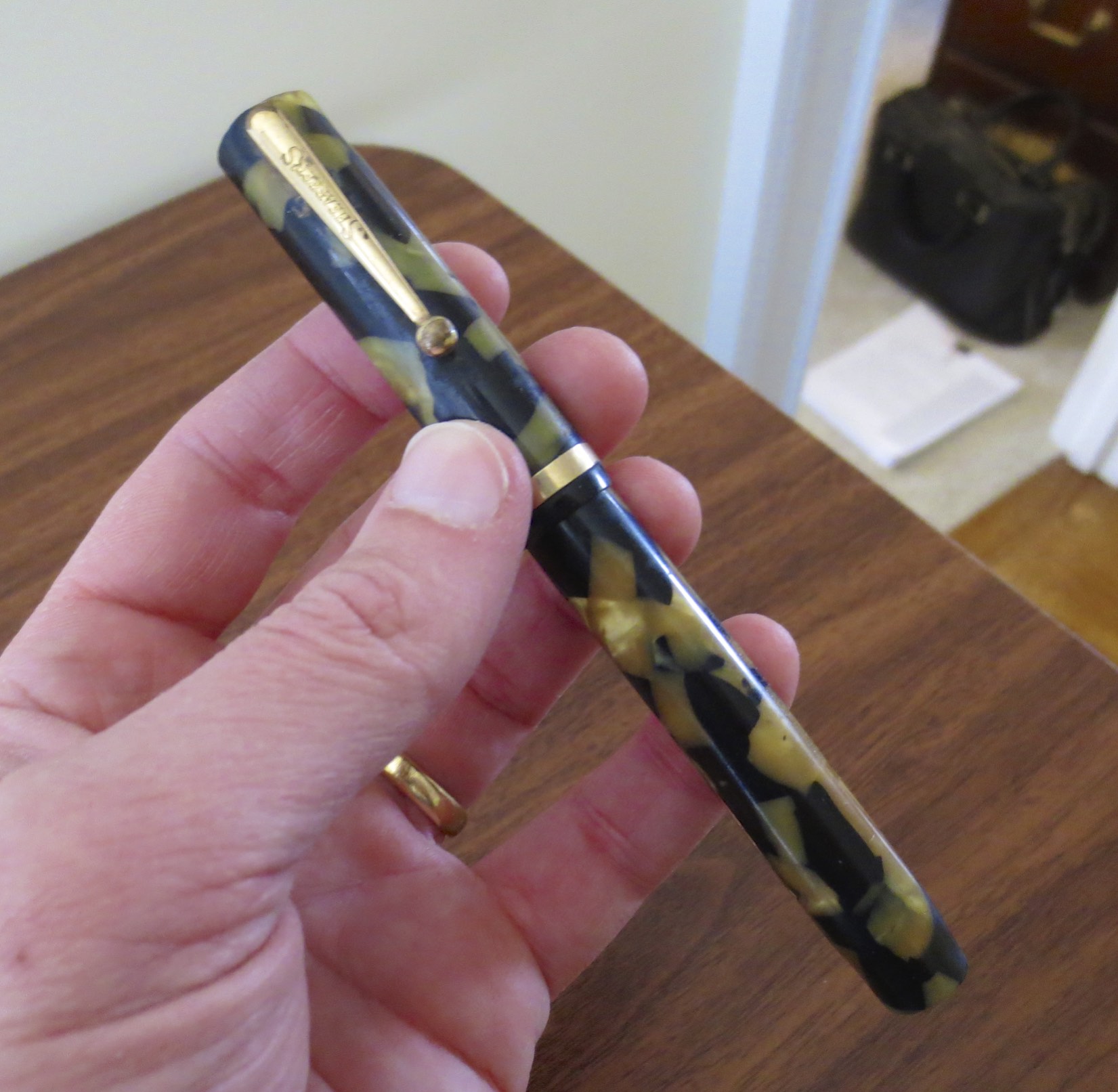
Another shot at today's find in the Nashville Flea Market: An early-1920s Shearer Flat-top. This pen is definitely user-grade, but I'm still looking forward to restoring it to writing condition and using it at home.
I may not like this ink much, but I love the older Montblanc "rounded shoe" ink bottles, as opposed to the more recent square versions.
I Review a Vintage Montblanc Ink I Don't Like--And Give It Away!
One criticism I often see lobbed at product bloggers--and stationery bloggers in particular--is that we review the products we like and largely ignore products we don't (presumably to curry favor with manufacturers and retailers who send out complimentary products for review). I don't see it that way--I think most people just don't like the negativity associated with slamming someone's product, especially where there has been a good-faith attempt to introduce something new into the market. But, reviewing is a public service of sorts, and I do what I must. I've come across an ink that I don't like at all.
I picked up this bottle of vintage (late 1990s, early 2000s) Montblanc Ruby Red ink at Joe Rodgers office supply in Cleveland, Tennessee, when I was in the area over the summer. Remarkably, this bottle also bore the original price tag ($8.50). This ink's name, however, simply does not match the actual color. It turns out that Ruby Red is more of a pinkish coral/peach color, that is so bright at times it almost looks neon. This color just doesn't work for me, and there's not much more to say about it.
I had to adjust the photo some to duplicate the pinkish hue of this ink, which doesn't photograph very accurately. I wouldn't use this color, so there's no reason to keep it. I do wonder, though, how it compares against Montblanc's new "pink" ink.
If you'd like this bottle of ink, leave a comment here on the blog, and in exactly one week I will number the comments in the order they are received and use a random number generator to pick the lucky reader. Unfortunately, since this is ink, and it's a relatively heavy bottle, I'm going to have to economize and make this giveaway open to U.S. residents only. There is nothing wrong with the ink itself. It behaves like a Montblanc ink should, even though it's red. I had no trouble washing this out of the pen (immediately) after reviewing it. Best of luck, everybody!
I will send you this bottle in its original box (with $8.50 price tag). :)
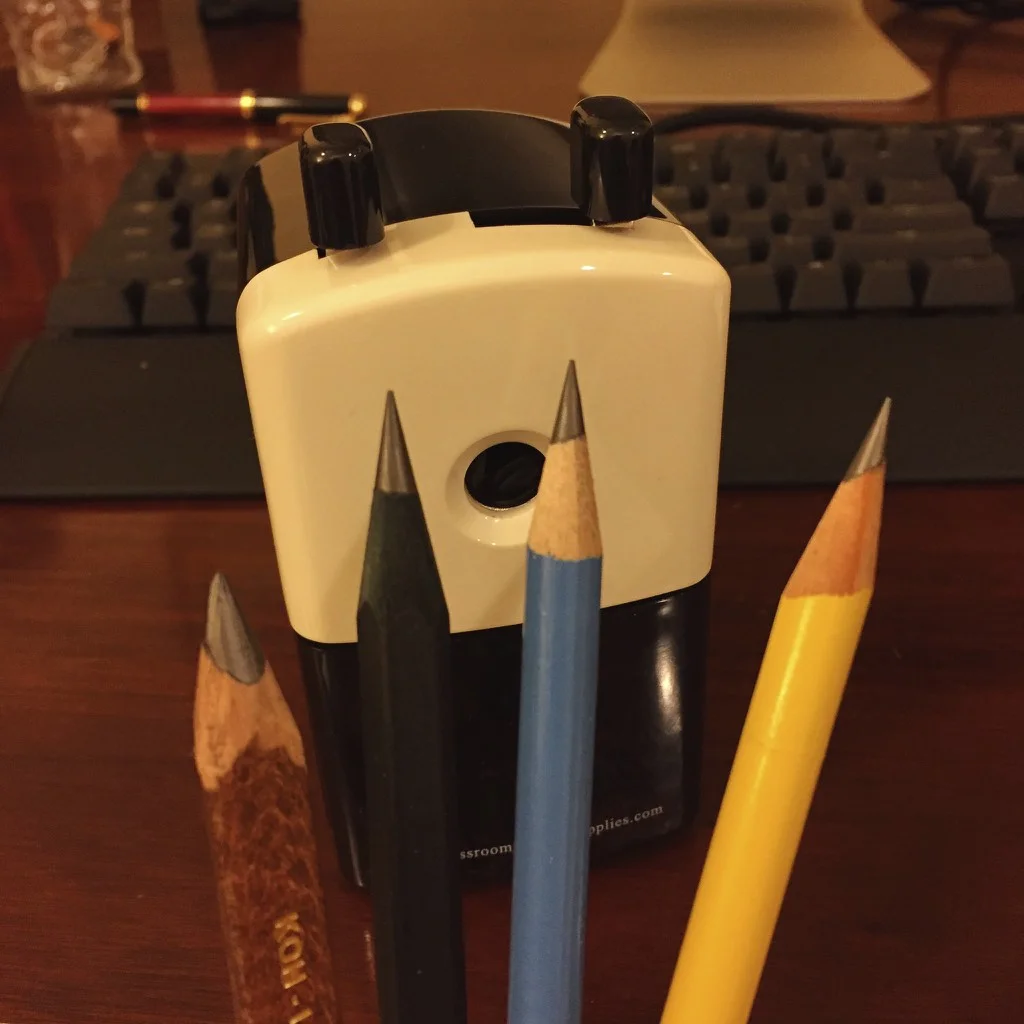
From left to right: Koh-I-Noor Triograph (this super-jumbo triangular pencil is the only one I've found that won't fit); Caran d'Ache Blackwood; Musgrave Cub; and Ticonderoga Laddie.
Classroom Friendly Supplies: Jumbo Sharpener Review
Not much needs to be said about this beauty. I'm an unabashed fan of jumbo and mini-jumbo pencils, especially round ones, because I find that they can be much more comfortable to hold for long stretches of time than the standard No. 2. The drawback is that it's extremely difficult to find a sharpener that fits a larger pencil, and the ones that do put a short, stubby point on the pencil that lasts for about 10 minutes. I'm here to tell you that Classroom-Friendly Supplies has solved that problem.

Classroom Friendly Supplies is a company operated by teachers, formed with the purpose of selling high quality, relatively quiet pencil sharpeners at a reasonable price. Sick of those wall-mounted and/or electric sharpeners that don't sharpen properly and eat your pencils? I hated those things when I was in school. (And, apparently, teachers hate them because they are extremely loud.) Classroom Friendly Supplies offers two models: a sharpener for standard-girth pencils (reviewed here at Pencil Revolution), and the version that I'm reviewing here, which is the jumbo sharpener (technically called the "Large Hole Sharpener"). The standard version is made out of metal, the jumbo out of plastic, and both operate via the same slide-out-the-faceplate, insert-pencil-into-grip, and crank method that does a great job of not only forming very sharp points but preserves your pencils by doing only as much sharpening as is necessary.
While you can use the Classroom Friendly Jumbo Sharpener to sharpen regular pencils, it does not produce the satisfyingly long point that the regular Classroom Friendly Sharpener does. Here you can see the Jumbo Sharpener loaded with a pencil, ready to go. Just crank!
Takeaways
Classroom Friendly sharpeners are great products. I have two of them, and love them. The standard model that I have was purchased with my own funds, and I've been using it for a couple years. In the interest of full disclosure, this jumbo model was provided to me free of charge for review purposes by Classroom Friendly Supplies. All of their sharpeners can be purchased directly through their website for the very reasonable price of $24.99 each, and I believe there are also educator and volume discounts available. If you wear out your sharpener (which I imagine would take quite a while), you can also purchase replacement parts. Classroom Friendly Supplies has generously allowed me to use an affiliate link here, so if you want to purchase a high-quality sharpener, and do so through this blog, I will receive a small commission.
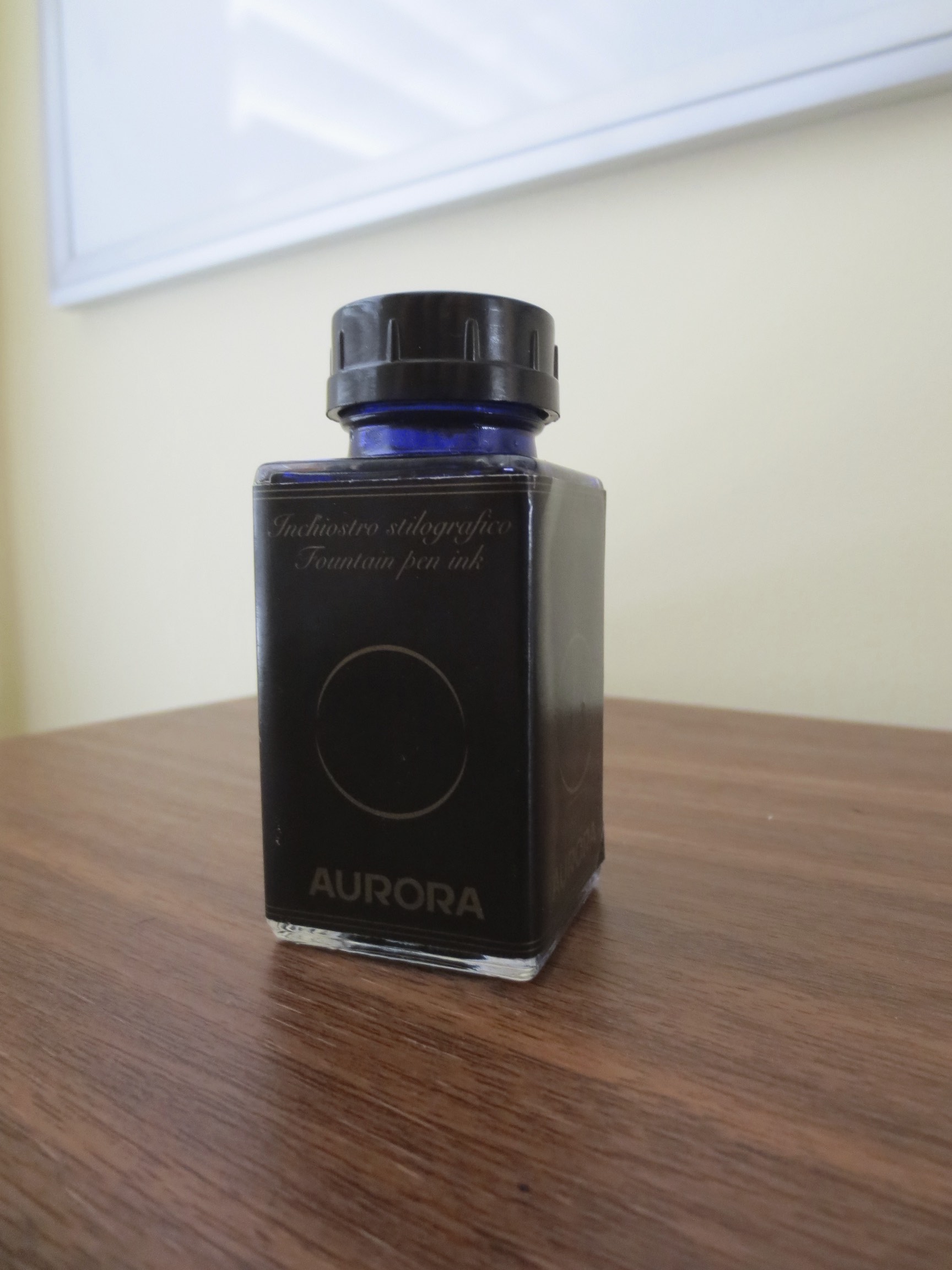
Deep, rich, purply blue Aurora Ink!
Ink Review: Aurora Blue
If I have a pen loaded up with "basic" blue ink for work, there's a good chance it's Aurora Blue. I prefer the Aurora ink to Waterman's Serenity (formerly "Florida") Blue; the Aurora has a depth and richness of color that the Waterman does not, without sacrificing any of the properties that make Waterman ink the “go-to” ink for vintage pen users and restorers.
By the way, if you’re a fountain pen user and have not heard others sing the virtues of Waterman “Florida Blue” (as it was formerly known), it’s generally considered one of, if not the, safest inks out there, in that it does not stain pens or clothes, behaves well on the vast majority of papers, and won’t melt your fountain pen. While I’m no chemist, and make no representation as to whether or not Aurora Blue has a similar chemical composition, in my experience Aurora ink (black or blue) is low-maintenance and safe. I’ve never had a problem with it in any pen.


Takeaways If You Are Considering This Ink
- If you need a solid, well performing blue ink for professional use, you can’t go wrong here.
- Aurora Blue does not feather, bleed, smear, or ghost on most papers. It dries quickly, even on the slick Clairefontain paper and Exacompta index card stock that I use to write my reviews.
- The one “con” I can come up with is price, and I know I’m being nitpicky here. Aurora ink is generally priced at $15–18 for a 45ml bottle. That’s more expensive than Waterman ink (approximately $11 for a 50ml bottle). I do like the Aurora bottle very much, in that it is tall and makes it easy to fill a pen with a large nib.
- NOTE: Aurora Blue is a very deep violet blue, with noticeable purple undertones, especially when the ink is wet. If you don't like purple inks, you may not like Aurora Blue. (In the interest of full disclosure, I would write with purple ink on a regular basis if I could get away with it, but many of the documents that I have to sign daily must be signed in blue ink, so this is my best option.)
While this bottle of Aurora Blue is from my personal collection and was purchased with my own funds long ago, our sponsor PenChalet has a good price ($15) on this ink.