• Blog
  • Shop
  • Resources
  • FAQ (Ask TGS)
  • About
  • Archive
  • Contact
  • Sign In My Account
Menu

The Gentleman Stationer

Vintage Living in the Modern World.
  • Blog
  • Shop
  • Resources
  • FAQ (Ask TGS)
  • About
  • Archive
  • Contact
  • Sign In My Account

My Parker Vacumatics, all of which have been inked and are written with regularly. 

Controversial Changes in the Pen Community

February 27, 2016

I love pens and writing implements.  That shouldn't come as a surprise to many people who read this blog, but I've been giving a lot of thought recently to why I like these things so much.  Not just why I get up early to take the time to post three times a week or more, but why I care enough to regularly deal with aligning nib tines, cleaning up ink burps, or sharpening pencils, when it would just be so much easier to fire up Word and have at it.  Why I care enough to take at least two annual trips to mingle with other like-minded enthusiasts at pen shows around the country.  And why I think our reasons for liking pens offer some insight into some recent controversy that's generated a lot of discussion.     

I Buy My Pens to Write with Them

To me, my pens aren't just a frivolous interest; they're a core part of my workflow.  Members of this community (and my comments here are applicable to the entire "analog writing" community, not just the fountain pen community, though fountain pens is where I have most of my experience) often hear their interest derided as "impractical" and a "waste of time and money," since everything is "going digital" and handwriting will be "obsolete."  As you might expect, I disagree.  I write a minimum of 30 pages a day for my job, and every single thing I write, whether it be a brief, oral argument, etc., starts with pen and pencil on paper.  As far back as I can remember, I've used pen and paper to collect my thoughts, outline, and even write entire first drafts by hand.  Since high school, I've had to deal with people (teachers/bosses/colleagues) urging me to improve my "efficiency" by moving everything to a computer, only to have them back off when they see the end result.    

I'm not one of these people who wants to preserve handwriting for handwriting's sake.  I'm ambivalent at best on whether cursive is essential, and think schools traditionally have placed too much emphasis on what handwriting looks like as opposed to what it accomplishes.  I'd bet money on the fact that many people who want to "kill handwriting" still resent the fact that they were marked down in school because their teachers didn't consider their handwriting "pretty" enough.  My own childhood handwriting was uniformly criticized as atrocious (and it kept me off the elementary school honor roll for six years, hah!).  Abolishing handwriting altogether, however, is insane, and the equivalent of not teaching kids how to do math because we have calculators.  Handwriting is a powerful tool for thought and analysis.  My parents were always great about assuring me that the "process" of writing things out by hand was what mattered, that it helped develop your thinking, and that sooner or later nobody would care whether your handwriting was "too small" or "too cramped."  I kept at it, and sure enough, they were right.  Today, having moved into a supervisory role at my job, I'm seeing firsthand the consequences of people abandoning handwriting altogether.  Writing is disorganized, research is shallow, and, overall, the quality of work is poor and getting worse every year.  If there ever was an argument against abolishing handwriting, it's what passes for professional writing in the modern workplace.   On the other hand, whenever I'm blown away by the quality of something someone has written for me, more often than not I'll find their desk littered with pen cups, notebooks, and legal pads. 

Given how much I use my pens on a daily basis, and the value I place on handwriting, I won't dignify the "pens-are-a-waste-of-money" argument with a response.  (Though I will say that I'll gladly put the total cost of my pen and ink collection up against what some of my friends spend going out to dinner/drinking on an annual basis, and happily have an objective discussion about what qualifies as flushing money down the toilet.)     

We Are Largely Users, Not Collectors.  

I will often refer to my "collection" of pens, but I don't consider my self to be a pen collector. "Collector" conjures up an image of someone sitting in a room with boxes upon boxes of items, some displayed, some not, perhaps categorized by rare variant, but hardly ever used.  I buy my pens to write with them.  If a pen sits for more than a few months without finding its way into the rotation, then I find a new home for it.  I didn't pay good money (sometimes in the hundreds of dollars) for what is essentially a tool to sit around unused. 

I've been a "hardcore" fountain pen user for 5 years now, and I've been blogging for just under two.  By my count (and take this with a grain of salt, I'm writing this at 5:45 a.m.), I've been to seven pen shows.  While there have been some awkward experiences mingling with other members of this community at those shows, on the whole it's been a positive experience.  Without exception, the people whom I've met through this somewhat offbeat interest of mine have been interesting, intelligent, and most of all, friendly and eager to meet others who also see the importance of working offline in an increasingly digital world.

Matt Armstrong's write-up of his experience at the 2016 Los Angeles Pen Show sparked a flurry of blog posts, tweets, and spirited discussions over e-mail and Slack.  In short, a great many people have the feeling that they are "unwelcome" at pen shows, and that many of the vendors and exhibitors at these shows don't want to give them the time of day.  From several things I've witnessed first-hand over the years at shows, these feelings are justified, and a lot of them are indeed attributable to blatant agism, sexism, and a lack of appreciation for the overall more diverse crowd that makes up the new community of people interested in this stuff. 

But I think there's something else going on here as well, that hasn't received much play.  The new group of fountain pen enthusiasts that's started to attend shows are, on the whole, users, not collectors.  They are coming to shows because, today, unless you live in a major city or near one of the few specialized shops devoted to fountain pens and fountain pen accessories, it's nearly impossible to go to a retail store and try out a fountain pen--it's simply not economical for most brick and mortar retailers of writing implements to stock them, where such retailers still exist at all.  This generally younger crowd doesn't have the disposable income to purchase a pen that's going to sit in the case, or on display, and never be used.  If they come to a show, and a vintage pen catches their eye, they're going to want to use it. 

Scenes from the 2015 Atlanta Pen Show, which featured, on the whole, a much younger crowd and lots of new companies like Nock Co. and Franklin-Christoph.  To many of the attendees, it was as if aliens landed on the hotel lawn.  

This mentality is completely foreign to a subset of the old-line pen collectors and traders who also attend these shows.  When the show circuit launched in the 1980s/1990s, it was to trade vintage pens and attend auctions of vintage pens.  There really wasn't a reason for modern pens to be the focus of shows, because you could still find them "in the wild," and the custom pen makers such as Edison, Ryan Krusac, Scriptorium, and Newton Pens didn't exist.  Many of these same people have what I refer to as a "pure collector" mentality, in that they see their pens primarily as investments or commodities that they've put away for years, hoping they will increase in value, and now they are trying to cash in on that investment.  There's nothing wrong with that, but it's an entirely different approach to the pen hobby that sets the stage for a massive culture clash with the next generation, who are, on the whole, not interested in collecting for the sake of collecting. 

One brief anecdote to illustrate what I think is going on.  A friend of mine here in town was browsing through a local wine and liquor store that most people view as a bit "on the snooty side."  A younger man--probably in his late 30s, but still decades younger than most other patrons of the store--was also in the store talking to the owner and another employee about selecting a very nice bottle of wine.  As he was paying, the owner was questioning him about how he planned to "store" the bottle of wine, because it would reach the "optimal price for resale" in five years or so.  His response:  "Oh no, I'm drinking it tonight, with dinner."  My friend swears he nearly dropped his handle of Wild Turkey 101 (yes, that's how we roll here, y'all) when the guy responded that his wife had asked him to pick up a bottle of wine and Wendy's on the way home.  End of story:  he bought the wine, and I'm sure it was great with his Baconator, but after he left the shop owner said some pretty rough things about whether or not they should have sold it to him at all. 

To a high-end pen "collector," this guy would be the equivalent of the fountain pen "newbie" who comes to the D.C. Show, buys a mint Parker Vacumatic, and proceeds to ink it from the 12-year old bottle of Baystate Blue at the ink testing table.  The new fountain pen enthusiast thinks, "why spend four hundred dollars on a beautiful writing implement that I'm never going to use?"  At the same time, the dealer who sold him the pen is likely thinking:  "This 'kid' just destroyed that pen's 'value.'"  But perceived value is entirely subjective, and the new group of fountain pen users seems to value the experience of using the pen over owning the pen as an investment piece.  Like the wine-shop owner, many vintage pen collectors/dealers are not going to understand this mentality, and we shouldn't expect them to. We should, however, all be able to be civil to each other and coexist peacefully in this little niche we've carved out for ourselves.   

The Pen Community Has Already Changed

I don't want to be too black and white here, because there's also a lot of gray.  It's a sliding scale. There are "collectors" attending the shows who are also enthusiastic users of fountain pens.  There are people who have been attending shows for years, such as Susan Wirth and her team, who are devoted entirely to helping people find a good fountain pen to actually write with.  And on the whole, it's these people who are welcoming the new crowd in with open arms, because they understand that if these pen shows--not to mention their individual businesses--want to survive into the future, they have to adapt and change their target audience.

I don't think that we can expect the "pure collector" contingent to all of a sudden change in how they approach the hobby, and they're probably not going to understand the new crowd anytime soon.  (I want to avoid saying the "younger contingent" because what I refer to as the "new crowd" is incredibly age diverse, and there are some younger collectors as well.)  We are unwilling (or unable) to pay the often astronomic prices some of them think their pens warrant, and many collectors resent that fact and characterize it as a failure to "appreciate" their offerings, leading to what Brad Dowdy has characterized as the "get off my lawn" mentality.  But the community has changed significantly in the past five years, and regardless, I'd venture to say that most of the "old guard" at least wants to try to embrace it.  I've spoken with more than one dealer at shows who has expressed delight that "new blood" is showing up, as well as their own disappointment that they've been trying unsuccessfully to "drag" their own children and grandchildren to shows for years.  In short, people shouldn't be afraid to attend shows or stop attending shows because they worry that they won't feel welcome.  A pen show is what the attendees make of it:  There may be a few crabby apples, but there will also be people to welcome you, and if you just decide not to go, then nothing will ever change, and the shows themselves may die.  The different groups in this community can and should learn to live and let live, and for the holdouts, they're going to have to get used to the idea the community is changing and figure out how to adapt and go along with it.  The worst possible outcome for everyone is that pen culture itself disappears, and I have a hard time believing that anyone in this community wants that to happen.  

DISCLAIMER:  It goes without saying that the views expressed in this post are my own, and I'm sure many people may have different thoughts and may disagree.  That's what the comments section is for.  I don't censor my comments, unless something goes completely out of bounds, so let fly! 
In Editorial Tags Editorial, Pen show
45 Comments

The First Tumblr Review is Sailor Bung Box Tears of a Clown

Introducing the TGS Ink Review Tumblr!

February 26, 2016

I've been struggling to get ink reviews up regularly on the main site, and have been looking for a way to make it easier to write up quick posts in a form that's longer than TwInstagram and shorter than a full-on blog post.  I also wanted to use a format that makes it easy for you all to share your own ink reviews if you so desire.  That's right!  The TGS Ink Review Tumblr is open to submissions.  Check it out here.  For now, the name will be "gentlemanstationer.tumblr.com", but if anyone has any creative ideas, please feel free to share them.  I will pay you in ink samples.  

Hopefully I'll be better about getting my inks posted and reviewed regularly if I'm not chained to having to do it on an actual computer. Sorry Squarespace, but your mobile editor isn't the greatest.  Plus, Tumblr is easy to post to remotely, and submissions are easier to manage.  Hope you enjoy! 

In Ink Reviews Tags Ink Review, Tumblr
Comment

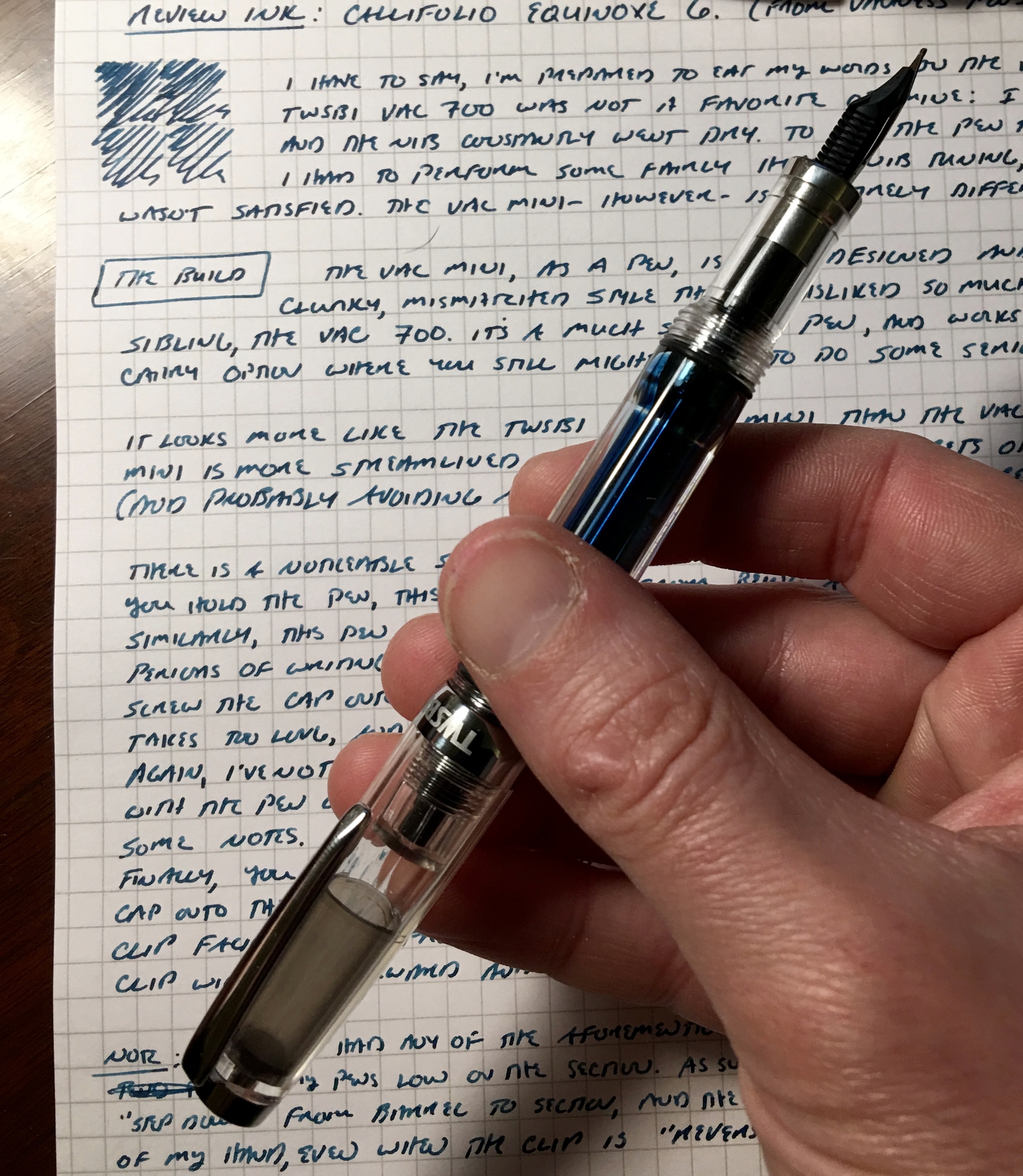
The TWSBI Vac Mini, with a medium nib.  The ink used in this review is Callifolio Equinoxe 6, from Vanness Pens. 

Pen Review: The TWSBI Vac Mini

February 24, 2016

I'm prepared to eat my words on the Vac Mini.  After a less-than-stellar experience with the Vac 700, the idea of a miniature version of TWSBI's vacuum filler didn't excite me in the least, and I dropped one in my Amazon shopping cart as an afterthought when I was stocking up on something else.  I fully expected this to be a "review purchase," after which I'd resell the pen.  I was wrong, and I'm pleasantly surprised by TWSBI's latest "mini" model.  

A Recap of the Vac 700 and "Vacuum Fillers"

In 2012, TWSBI introduced the Vac 700, which at $70 was the most reasonably priced "Vacuum Filler" fountain pen available on the market.  The vacuum filling system is cool. The technical niceties are better explained elsewhere, but in short you stick the nib into an ink bottle, depress a plunger rod, and at the end of the downstroke the negative pressure causes the barrel of the pen to fill with ink. The Vac 700 was admired for bringing a unique filling system to the masses at a favorable price point, but has been criticized over the years for its somewhat clunky aesthetics and early quality control problems with the nibs.  I eventually sold mine after a couple of months, and haven't been tempted by another vacuum filler other than Pilot's higher-end Custom 823 (which is still on "The List"). [2021 Update: TWSBI has released a new version of the Vac 700, dubbed the Vac700R, which adjusted the filling system and valve to increase ink flow and solves many of the early problems I and others had with the pen. It’s definitely worth checking out, though the Vac Mini probably remains my favorite due to the pocketable format.]  

Note:  A "vacuum filling" fountain pen is not the same thing as a "vacumatic" fountain pen. Despite the similar sounding names, a "vacumatic" filling fountain pen uses a pump.  I am working on my own video demonstrating these filling systems, and will supplement this review at some point in the future.  For now, please check out Brian Goulet's video here on how to fill a vacuum-fill fountain pen.

The Build of the Vac Mini

The Vac Mini is not just a slimmed down version of the Vac 700: it's an entirely new design, and a good one at that.  The Vac Mini has none of the clunky, mismatched styling that I disliked so much with its larger sibling (err, cousin?).  It's much smaller, and works well as a pocket carry option for those days when you plan to be on the move and don't want to carry a full bag or pen case, but still have some serious writing to do and need a pen with a large ink capacity.  

A shot of the Vac Mini's streamlined aesthetics.  Note the slight, yet noticeable, "step" from the barrel to the nib section.  

The design reminds me more of the Diamond Mini than the Vac 700, though the Vac Mini is more streamlined and foregoes the sharp facets of the Diamond 580 line (which probably lowers the risk of the plastic cracking).  There is a noticeable "step" from the barrel to the nib section (see picture above), and depending on how/where on the section you grip your pen, this could range from being a non-issue to a deal-breaker. Similarly, this pen is not one that you can use unposted for long periods of time, though for short jottings I've found that it works fine.  

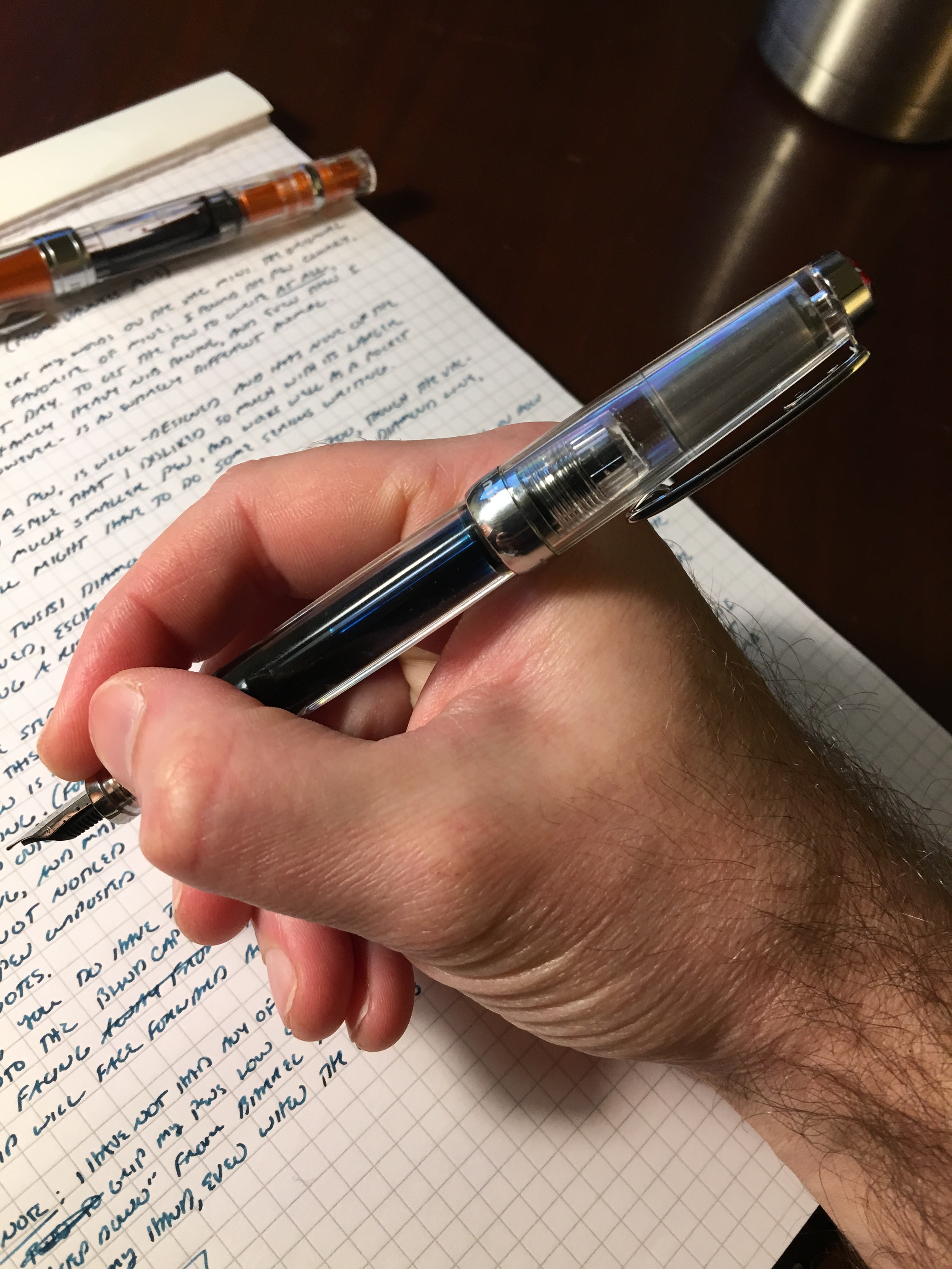
The TWSBI Vac Mini unposted.  I've found that it works fine for short notes.

Which brings me to a second commonly heard criticism of the Vac Mini:  to post the pen, you have to screw the cap onto the threaded end of the pen (the "end cap").  Some users have complained that this process takes too long, and makes this "pocket pen" too inconvenient to carry if you're someone who constantly caps/uncaps/posts/unposts the pen to take notes in short bursts. As I noted above, I've not had too much trouble in this regard, since I find the Vac Mini fine to write with unposted for brief periods of note-taking.  

Many people will also have to pay attention to the orientation of the clip when you post the cap.  The end cap is double-threaded, meaning that there's more than one way to screw on the cap, and as a result the clip can end up facing up or down. To some people, this means that the clip will end up "digging into your hand" or "not digging into your hand."  My hands aren't large enough to make this an issue, but I can see how it could be extremely uncomfortable for some people.  I've taken two pictures (below), attempting to demonstrate what people are complaining about:  

View fullsize Vac Mini Cap Posted "Incorrectly"
View fullsize Vac Mini Posted "Correctly"

At least on my pen, I've found that if you start threading the cap with the clip facing "down" (away from the top of the nib), you'll end up posting the pen with the clip facing away from your hand, and shouldn't have an issue with the clip bothering you as you write. 

To ensure the cap posts "correctly", with the clip facing away from your hand, start threading the cap with the clip facing the feed, not the top of the nib.  Annoying at first but pretty soon it becomes second nature.  

To ensure the cap posts "correctly", with the clip facing away from your hand, start threading the cap with the clip facing the feed, not the top of the nib.  Annoying at first but pretty soon it becomes second nature.  

The Nib

I purchased my pen with a medium nib.   TWSBI's medium nibs are what I would call a "true medium"--not too fine, but also not too broad.  This one is particularly smooth and wet, and one of the better TWSBI nibs that I've owned.  

I've always liked TWSBI's nibs (now made by JoWo), and their logo engraved on the front. Unfortunately, I don't believe the Vac Mini nib units are interchangeable.  

One thing to be sure to remember on a vacuum filler fountain pen:  If you are writing for a long-ish period of time (as in, more than half a page), unscrew the end cap slightly.  The metal rod that makes up the filler mechanism has a small O-ring at the end, which seals the nib and feed and prevents leaks when the end cap is closed all the way.  It's a handy feature to have on a pen that holds this much ink, and makes this a good option for airplane travel, but you'll need to open the seal before writing to allow the ink to flow freely. 

On the Vac Mini (and any vacuum-filling pen, for that matter) you should open the end-cap for longer writing sessions, to allow the ink to flow.  

Takeaways

I purchased this pen a few weeks ago, and I love having it as a part of my carry.  It's everything that I want in a pocket pen: it has a large ink capacity and writes reliably. I also prefer the more streamlined look of the Vac Mini to the sharp facets of the TWSBI Diamond 580 and the Diamond Mini. At its price point ($60), this pen will get a lot of use from me. In my opinion, TWSBI generally represents excellent value regardless of your level of experience with fountain pens. As of 2021, you can now purchase the TWSBI Vac Mini directly from T.G.S. via The Curated Shop.  

I am not, however, going to add the Vac Mini to my list of Top Fountain Pens under $75.  Why not?  Risk of new user confusion. I think the filling system and the mechanism for posting the cap are too complex for most users to want to bother with. I'm a pen geek, and things like screw-on caps and vacuum filling systems are fun for me to play with. The average user, or someone looking to buy their first fountain pen, probably should not buy this pen over a cartridge/converter pen or a piston filler. The filling mechanism is more complex, and between having to unscrew the end cap for longer writing sessions, threading the cap to post, and paying attention to how the clip is oriented to prevent discomfort, that's a lot for a new user to have to deal with. If you are just getting into fountain pens, the TWSBI Eco is probably the better buy for a fountain pen newbie, at half the price.     

AND....it wouldn't be a TWSBI without the famous red logo on the top of the cap!  

Further Reading

On the whole, the reaction to the Vac Mini has been positive.  As I mentioned above, however, some people have found the Vac Mini too difficult to post/unpost quickly, making it less unusable for them as a pocket carry.  Check out Matthew's review over at Nib & Ink for this perspective.  Azizah over at Gourmet Pens liked the pen, on the whole, but wasn't crazy about the aesthetics of the pen and thought her broad nib was on the dry side.     

DISCLAIMER:  I purchased this pen with my own money, for my own collection.  In the years since this post was originally published I have opened the T.G.S. Curated Shop (which is an authorized retailer of TWSBI and certain other select brands) and the T.G.S. Patreon Program, both of which allow me to support the site directly. All levels of support are greatly appreciated (but far from obligatory - my content here is free)! 

In Pens Tags Pen Review, TWSBI, TWSBI Vac Mini
4 Comments

It's pen cleaning time this weekend! Conid's Bulkfiller Minimalistica has been a pleasant surprise for me, in terms of how easy it is to clean. 

Cleaning Pens: Meditative, or Just Annoying?

February 20, 2016

Which camp do you fall into?  Of course, this refers to fountain pens.  If you have to clean ink out of your rollerball, ballpoint, or gel pen, it's probably because something very, very bad happened. But pen maintenance is an essential part of fountain pen ownership.  You have to do it, and to the extent you can, you should learn to love it.  Do I?  Sort of. 

Pen cleaning is one of those things people do either (1) all the time, such as, after they finish every fill of ink; (2) semi-regularly, such as whenever they change colors or every 1-2 months; or (3) whenever the pen clogs up and stops writing.  I'm squarely in the second category.  I don't find cleaning pens to be torture, per se (unless it's one of the rare occasions I've been using some sort of Noodler's permanent ink), but it's not something I necessarily look forward to.  

I'll walk through the various categories of pens that I clean on a regular basis, from what I consider to be the least difficult to the extremely aggravating, and provide my perspective on which of the various filling systems are easiest to maintain.  While the basic principle is the same for all--flush the pen with water--each system has its own peculiarities and quirks that need to be taken into account.

Syringe Fillers.  Say what you will about Conid's Bulkfiller system being hard to get the hang of. Once you do, these pens are a snap to clean.  It's like using a built-in bulb syringe (see below).  Because the pen has such a large ink capacity, it's capable of pushing a large amount of water through the nib, reducing the number of times you have to flush it.  If the pen's clogged, or if you've used an ink that's extremely difficult to clean out, you may have to disassemble the pen, but most syringe fillers have a small number of moving parts, and Conid even provides you with tools and instructions.  

Cartridge/Converter.  I have a growing appreciation for cartridge/converter pens because of how simple it is to clean and maintain them.  While you technically don't need any special equipment, and can just use the converter to flush water through the feed and section several times, a bulb syringe and an ultrasonic cleaner allow you to thoroughly clean your pen quickly. For me, one of the best features of the cartridge/converter system is that you don't actually have to worry about cleaning the entire pen.  Typically, the only part of the pen that touches any ink is the nib section and the converter (though I would recommend occasionally cleaning out the interior of the cap).

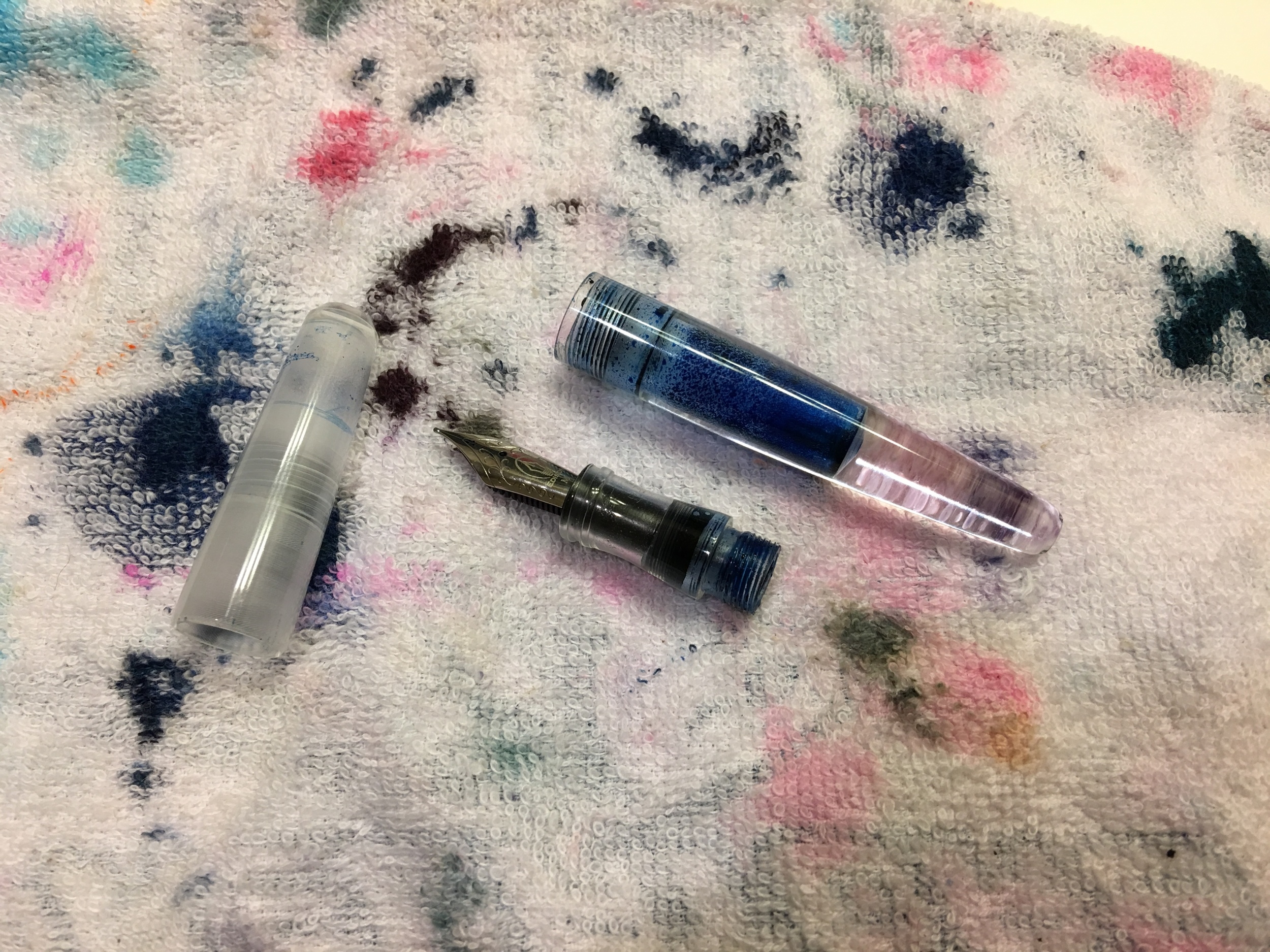
Eyedropper.  Some people are going to be puzzled at this one.  How, they might ask, is an eyedropper filling system--where the entire barrel holds ink--more convenient than the piston filler?  Because there are no moving parts, and all you have to do is drop the entire pen into the ultrasonic cleaner.  (In the "after" photo below, there is still some blue-black residue in the barrel, which I will clean out with a q-tip if I decide to change colors.)  While disassembling a pen takes time, you don't have to do it that often! Eyedroppers hold a ton of ink, and if you use a low-maintenance ink and don't feel compelled to change colors, well, you can go a long time without cleaning that pen!   

View fullsize Before Flush + Ultrasonic
View fullsize After Flush + Ultrasonic

Piston Filler.  Some piston-filling pens are easier than others to clean.  Pilot's Custom Heritage 92 is a snap (because the piston is highly efficient and works well), and the clear TWSBI demonstrators are also somewhat convenient because they are transparent and relatively easy to disassemble if necessary.  At the end of the day, however most piston-filling pens simply take a long time to flush out all the ink, and I often worry whether that repeated flushing is good for the piston mechanism.  I've had particular difficulty cleaning my Montblanc 146 and my Pelikan M600, though the otherwise excellent Lamy 2000 can be a pain as well.  On all three, I've noticed that the piston mechanisms have loosened up over time, after many many cleanings.    

Pilot's excellent Custom Heritage 92 is extremely easy to clean.  The piston is highly efficient, and as you can sort of see from this terrible photo, the piston fills the ink chamber to capacity, making it easier to flush out the pen.

Sac-Filling Pens (Lever and button Fillers).  Flush these pens with water until it runs clear.  I have these pens listed pretty far down on the convenience list because sacs tend to accumulate ink residue inside them, and it's generally impossible to have any visibility into what's going on inside the pen because they aren't made to be disassembled on a regular basis.  I very rarely use anything other than a "safe" blue or black ink in a pen that fills using a sac. 

Vac-Fillers.  And then, we come to the end.  I love the mechanics of a good vac-filling system, whether it be the classic Parker Vacumatic and the Edison Menlo.  I absolutely hate cleaning them.  After much experimentation, I have scientifically determined that it is physically impossible to get all of the ink residue out of a Parker Vacumatic. No, not really, but it takes so long, and involves so much repeated filling/emptying the pen with water, that I've given up on regularly changing the inks that I use in these pens and stick to "safe blue" or "safe black".  To illustrate how much effort (and ingenuity) it takes to clean these things thoroughly, check out this article by Ron Zorn, who built a centrifuge out of a salad spinner.  (Yes, really.)   In all fairness, the Vacumatic filling system is the product of a time period when most people used three colors of ink (blue, black, and blue/black), so this probably wasn't an issue back then.  (See note below:  a "vac-fill" pen is a pump filler, distinct from the "vacuum-fillers" made by TWSBI and Pilot.  For a demonstration on how a "vac-fill" pen works, see Brian Gray's video.) 

As you can probably tell, this post isn't intended to be a comprehensive, "how-to" guide on cleaning pens (though that may not be a bad idea in the future).  I mainly wanted to provide my thoughts on how easy/difficult I've found certain filling systems to maintain, since it's such an important part of pen ownership.  Opinions may differ.  But if I could provide you with one "semi-pro tip", it would be:  

Buy An Ultrasonic Cleaner.  I was once a skeptic, but about a year ago I purchased one at Bed, Bath & Beyond on a lark and I've since become a convert.  You can get these things really cheap (even cheaper if you have one of those ubiquitous BBB 20% off coupons).  The ultrasonic cleaner is great for cleaning ink out of the nooks and crannies of feeds and nib sections, and saves your fingers a lot of repeated flushing.   If you use a lot of red ink, like I do, the ultrasonic is a lifesaver, because reds can be notoriously difficult to flush.  

Note:  I don't have a ton of experience with vacuum-fillers such as the Pilot Custom 823, TWSBI Vac 700, or the TWSBI Vac Mini, at least not yet. I've recently picked up a Vac Mini, and plan on having my thoughts on the pen up on the blog soon.  I expect that in terms of ease-of-cleaning, these pens will probably fall somewhere between a piston filler and a vac-fill.     

In How To Tags Pen Cleaning, Maintenance
6 Comments

The Lamy 2000 Stainless Steel:  the most recent evolution of a classic design. 

Pen Review: Lamy 2000 Stainless Steel

February 17, 2016

I'll be straight with you up front:  I am an unabashed Lamy 2000 fan and consider it to be one of the greatest pens ever designed.  I have two of the black Makrolon models:  one in an extra-fine nib, and one with a custom .6mm stub.  You could say it was inevitable that I'd eventually get around to adding the Stainless Steel model to my collection.  While I wouldn't grant this pen the same "legendary" status as its cousin, it's close, and this pen has earned a spot in my regular rotation.

First Impressions / Design

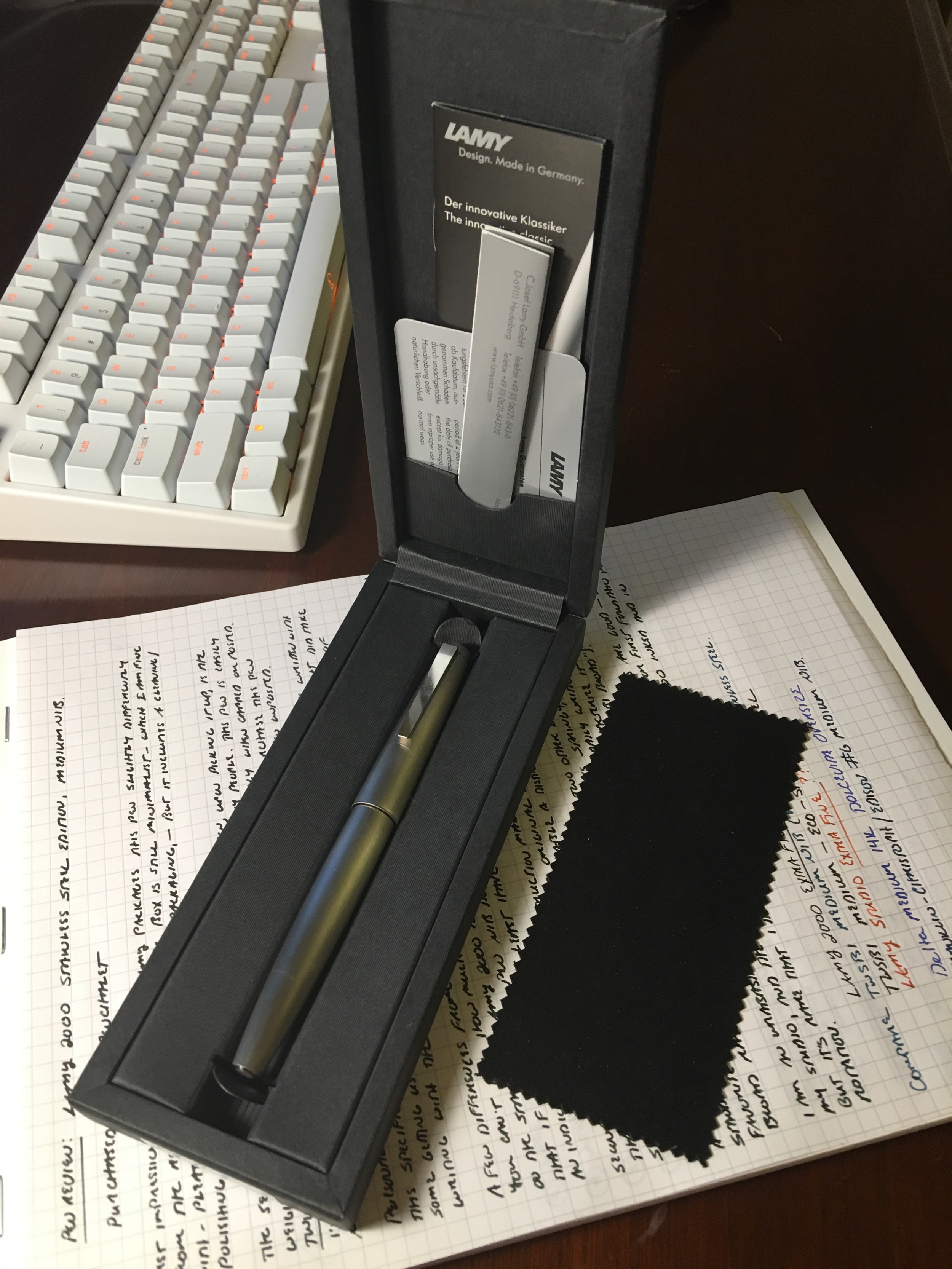
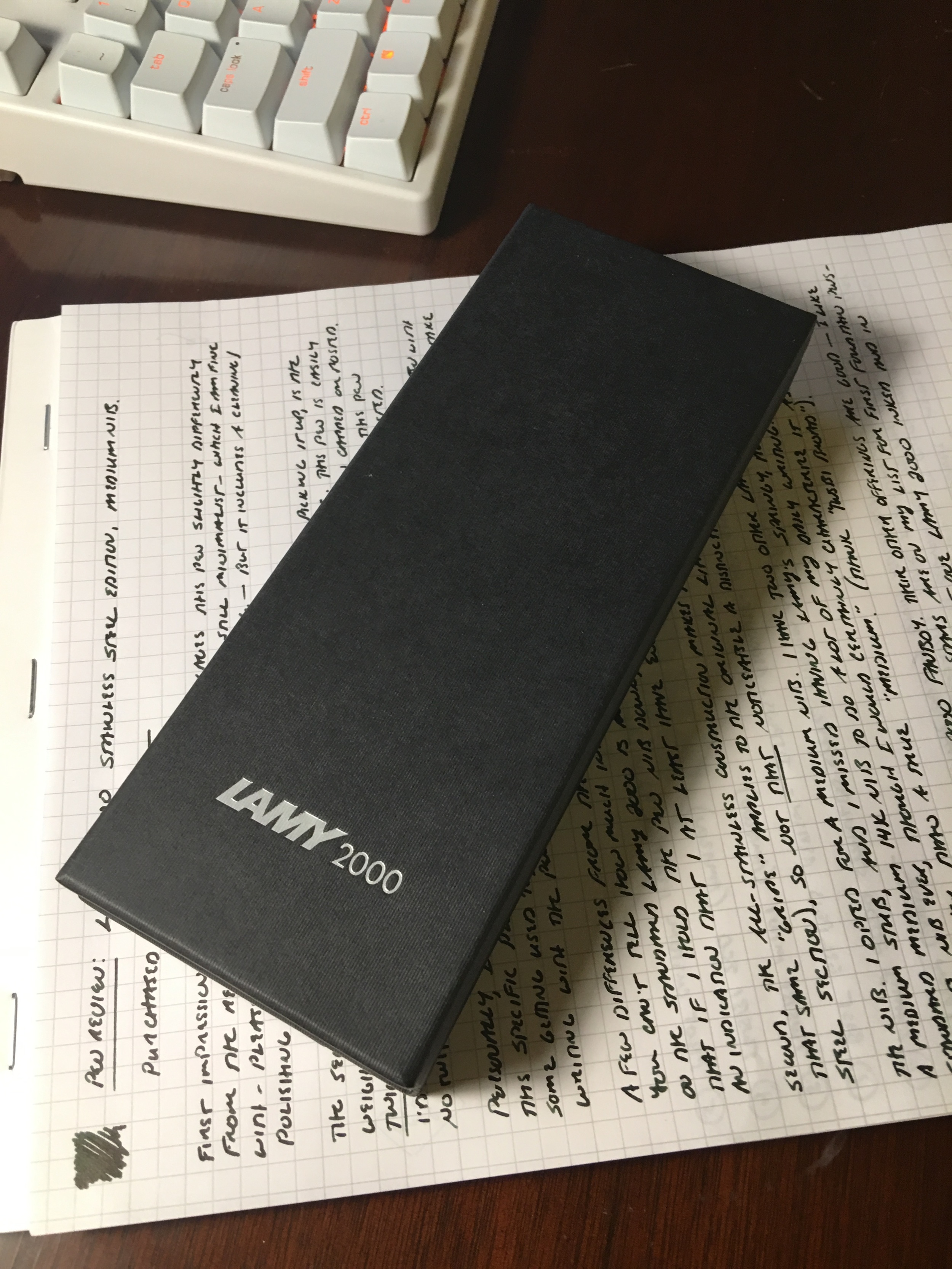
Packaging. The packaging on this pen is slightly nicer than the packaging on the original Lamy 2000, but it's still just a cardboard box. A well-crafted and somewhat eye-catching cardboard box, but still.  None of this matters to me because packaging isn't something I take great interest in unless I can repurpose it as a pen or pencil chest, like some of the more ornate wooden boxes that Delta sells with its more expensive limited edition pens.  One thing I do like, however, is that Lamy has included a polishing cloth.  It's a nice touch.  

View fullsize Lamy 2000 Stainless Packaging
View fullsize Lamy 2000 Stainless Clamshell box

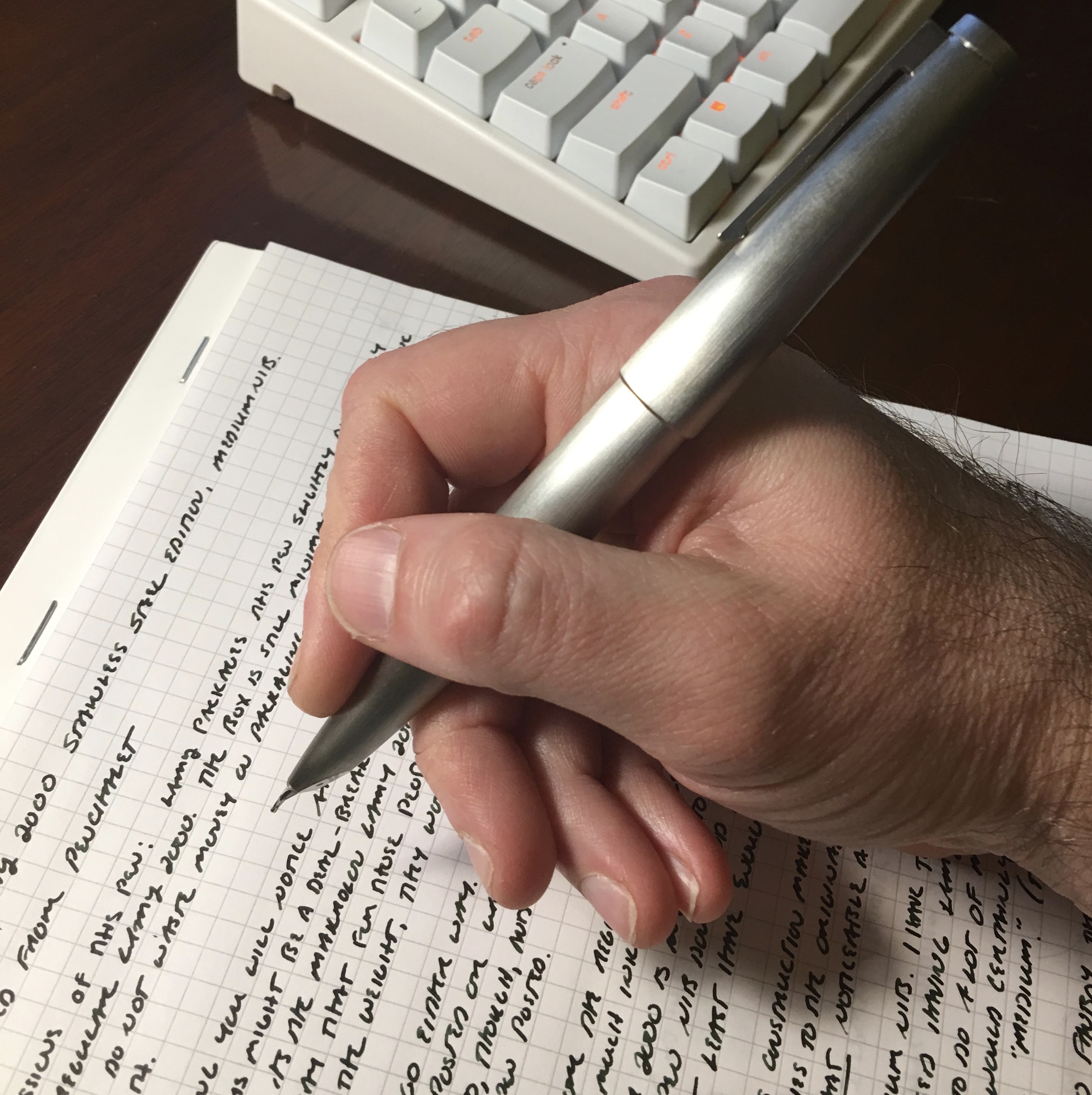
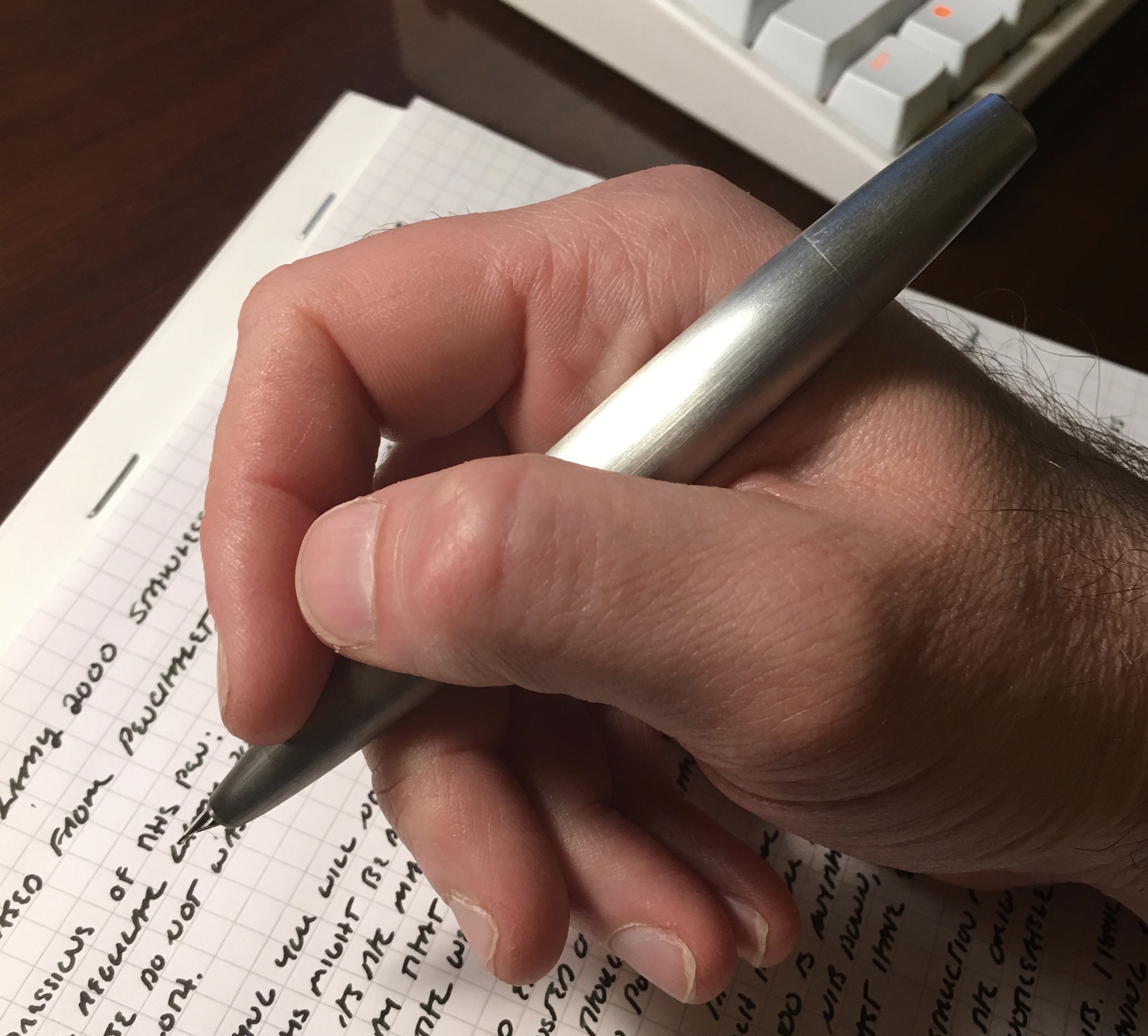
Weight.  The first thing that will strike you about this pen is that it is heavy.  Everyone who reviews it comments on the weight, and how it's probably twice as heavy as the standard Lamy 2000 (maybe more).  The weight might be a deal-breaker for many people, especially if you don't like to use a pen unposted.  

View fullsize Lamy 2000 Stainless Steel Posted
View fullsize Lamy 2000 Stainless Steel Unposted

Personally, the weight doesn't bother me.  I find this pen well balanced for how heavy it is, and I've written with it both posted and unposted for significant periods of time.  Sure, the first extended writing session will make your hand a bit tired, but you will get used to it after a couple outings.  (If you have serious RSI issues, you probably won't, but then again, you're probably not scoping out the market for heavy metal pens anyway.)  On the whole, I prefer to use the pen unposted.  

Design.  The Lamy 2000 Stainless Steel is, for all intents and purposes, the same pen as the standard Lamy 2000.  Both are piston-fillers, and can only be filled from an ink bottle.  The key differences are the material (the entire pen is made from brushed stainless steel, whereas the original only has a stainless steel section); the clip, which is polished and not matte; and the lack of an ink window.  The only change here that bothers me somewhat is the lack of an ink window on the Stainless Steel version, though I'm not sure how they could've incorporated it into the design.  (It's not as though the Lamy 2000 ink window is incredibly useful anyway:  it's opaque and narrow, but when you can see some daylight in there you at least know that you have less than a day's worth of ink left and should refill.)  I haven't figured out how to tell when the Stainless Steel model is almost empty--I'll probably have to go by the weight of the pen--but to be safe, if I'm carrying that pen and need to be sure that I have enough ink to get through a long day of writing, I generally refill before I leave the house.  

I'm a fan of the clip on the Lamy 2000 Stainless Steel.  A brushed or matte clip would be too much here, and the clip wouldn't stand out in any way.

Curiously, I don't find this pen slippery, which was a concern of mine.  Metal pens often pose grip issues, but the brushed stainless steel texture on this pen creates a nice surface that feels good in the hand.  Note:  the original Lamy 2000 has a brushed stainless steel section, so if you have grip issues with that pen, this one isn't going to work for you either.  (Actually, it will probably be worse.)  

The Nib

The medium nib on a Lamy 2000 is closer to a broad in other brands, especially if you are used to writing with steel nibs. 

I opted for a medium nib.  My two other Lamy 2000s sport an extra fine and a .6mm custom stub.  The latter began life as a medium but later had to be retipped after some failed nibwork.  I missed Lamy's big, wet 14K medium nib on the 2000, and I'm glad to have it back in the arsenal once again.  For those of you who haven't yet experienced this pen, the Lamy 2000 nibs are springy, and for the most part great writers out of the box.  (I've heard reports of quality control issues, but have never experienced any myself.)  As I've said before on this blog, Lamy nibs tend to run wide, so this medium is more of a "medium-broad", probably close to the width of a TWSBI broad nib. 

View fullsize Lamy 2000 Medium Comparison
View fullsize Lamy 2000 Medium Writing Sample

Takeaways

I absolutely love this pen, but will be the first to admit that it isn't for everyone.  The weight will turn a lot of people off, and many people just don't like metal pens, period.  It's also expensive, and you have to be a true Lamy fan to invest $300 when--let's face it--you might already own the same pen in the (much) cheaper Makrolon version.  But if you're like me, and love your Lamy 2000s, you won't care.    

As of 2022, we are direct retailers of Lamy Pens through our own Curated Shop, including the Lamy 2000 and Lamy 2000 Stainless Steel models. If you enjoy our content, please consider supporting us directly!   

Further Reading

Mike Dudek at the Clicky Post reviewed this pen (also in a medium nib), and Ed Jelley opted for a broad nib.  Something about the heft of this pen lends itself to a wider point, and a lot of ink!

If you're interested in the black Makrolon version of the Lamy 2000, you can check out my review of that pen here.  It also made my list of "Tier One" pens and best pens for your first purchase over $100. 

In Pens Tags Lamy 2000, Lamy 2000 Stainless Steel, Pen Review, Lamy
1 Comment
← Newer Posts Older Posts →
Store Hours and Location
Visit the T.G.S. Curated SHOP
Updated "Best Pens" Guide
On the Paper Trail Podcast
TGS x Roterfaden TGS_25
Hierarchies of Fountain Pen Friendly Paper

Join Our Patreon!
Subscribe to the TGS E-mail List

Featured Posts

Featured
Cover On the Paper Trail Intro Clip.jpeg
Dec 3, 2025
Introducing "On the Paper Trail," a New Podcast/Video Collaboration with Lisa Vanness of Vanness Pens!
Dec 3, 2025
Dec 3, 2025
Iro-Utsushi-Fine-Dip-Pens.jpeg
Oct 1, 2025
The Pilot Iro-Utsushi Dip Pen (and in General, Simple vs. Fancy Dip Pens)
Oct 1, 2025
Oct 1, 2025
Levenger-Annotation-Pad.jpeg
Sep 20, 2025
Five Boutique Paper Brands I'm Watching Closely and Why
Sep 20, 2025
Sep 20, 2025
The Gentleman Stationer RSS

© Digital Divide Media, LLC, 2014-present.

All content is the exclusive property of Digital Divide Media, LLC, d/b/a The Gentleman Stationer, including “The Gentleman Stationer” website and trademark, and should not be reproduced without express written permission.  All rights reserved.

All content containing paid advertising, affiliate links, or sponsored content will be plainly disclosed by a disclaimer when/if featured.

Contact Information

Store Shipping Policy and Return Policy

Privacy Policy

Cookie Policy

Terms and Conditions

Powered by Squarespace