• Blog
  • Shop
  • Resources
  • FAQ (Ask TGS)
  • About
  • Archive
  • Contact
  • Sign In My Account
Menu

The Gentleman Stationer

Vintage Living in the Modern World.
  • Blog
  • Shop
  • Resources
  • FAQ (Ask TGS)
  • About
  • Archive
  • Contact
  • Sign In My Account

Every bottle of KWZ Ink has a handwritten swatch on the label. More often than not you get a very accurate idea of what the ink looks like dry. 

KWZ Inks: A New Favorite

July 13, 2016

This year I made the decision to move most of my ink reviews over to my Tumblr blog, www.bottledup.ink, and to start writing ink reviews in a much more abbreviated format. I did this for a couple reasons. First, there are a number of people out there who do far more comprehensive ink reviews than I was ever able to put together, so in terms of this blog, it seemed like a better use of my time to produce other kinds of content. Second, I honestly was getting a bit bored with the lineup of available fountain pen inks and wasn't having as much fun writing the reviews. Sure, there were still some unique colors out there, but it was getting increasingly expensive to chase "uniqueness" in the form of limited editions that were starting to run upwards of $35 per bottle.  

Enter KWZ. KWZ is manufactured in Warsaw, Poland by Konrad Zurawski, a PhD student in Chemistry. KWZ inks originally attracted attention for their lineup of modern iron gall inks in a wide range of unique colors, such as Mandarin Orange and Turquoise. I'm not aware of another company that offers ink like this: previously, with iron galls you were limited to blue blacks and the occasional "dusty pink/purple", such as Rohrer and Klingner Scabiosa. While I don't personally own any of the KWZ iron gall inks, I've tested them out at pen shows, and it seems as though KWZ has managed to create an iron gall ink that flows well.  (The one knock on iron gall is that traditionally, it can write very dry.)     

NOTE: If you are unfamiliar with Iron Gall ink and its properties, please read the ENTIRE disclaimer on the Vanness website. TLDR version: iron gall ink, while famous for its ability to change color as it dries, can be corrosive, and while the iron gall content in KWZ ink is probably not high enough to damage modern gold or stainless steel fountain pen nibs and parts, it's not a good idea to leave these inks in a pen for weeks at a time, or to mix these inks with non-iron gall inks. I'm not trying to be alarmist - I use a couple iron gall inks on a regular basis, including Platinum blue black and the old school Pelikan blue black - you just have to practice good fountain pen hygiene.  

KWZ Green Gold, in a Lamy 2000 Stainless Steel medium cursive italic ground by Mark Bacas.

Personally, I'm enamored with KWZ's standard line of inks (i.e., the non-iron gall variety). I purchased my first bottle (Green Gold) at the 2016 Atlanta Pen Show, and soon after placed an order for two other inks that caught my eye: Brown-Pink (yes, that's a real color) and Honey (it looks exactly as you'd expect Honey-colored ink to look). 

A macro shot of KWZ Brown Pink on Leuchtturm dot grid paper.

Behavior-wise, these inks tick all the boxes I look for: they flow well, they don't feather or bleed on relatively cheap paper, and they dry quickly with no smearing. Seriously, all three of these KWZ inks have near-instantaneous dry times, which I love when I'm taking quick notes at work and have to be able to flip the pages without worrying whether or not I'll end up with a smeary, unreadable mess at the end of the day.

A macro shot of KWZ Honey on Leuchtturm dot grid paper.

But as it always is with inks, it really comes down to the color.  For work, I prefer muted, offbeat colors that don't scream off the page.  The Brown Pink could best be characterized as a burgundy with purple tones.  It's a nice color that I've used regularly. Honey resembles J. Herbin's Lie de The, only it's a slightly warmer color with less green. The Green Gold is how I expect my "moss green" or "racing green" ink to look. It's not watery like some other inks I've tried in this color (Stipula Verde Muschiato and Papier Plume Moss Green come to mind). Though I'm someone who rotates inks a lot in his pens, these three have seen a lot of repeat use lately.

Where to Buy 

Vanness Pens is the only U.S.-based retailer I'm aware of that stocks KWZ inks, and they always maintain a wide selection in stock, though Honey and Brown Pink tend to sell out quickly. KWZ ink is also reasonably priced, at $12 for 60ml.   

Further Reading

Check out these links for some additional reviews of KWZ Inks.

Brad Dowdy of the Pen Addict reviews Iron Gall Gummiberry. 

Jeff Abbot, writing for the Pen Addict, reviews Iron Gall Gold. 

Azizah over at Gourmet Pens reviews KWZ Honey.

The Pen Habit reviews Iron Gall Turquoise.

DISCLAIMER:  I purchased the inks featured in this review with my own funds for my own collection.  While Vanness Pens is a sponsor of this site, I was not compensated in any way for this review. 
In Ink Reviews Tags KWZ Ink, Ink Review
3 Comments

My pen cup runneth over. 

Best Non-Fountain Pens for Everyday Use

July 9, 2016

There's been a lot of talk recently about when a certain kind of writing instrument simply isn't the best tool for the task at hand.  Many fountain pen collectors/users actually feel guilty if they're not using their prized writing implements all the time.  But if you're in the shop, the field, or a car, a fountain pen likely isn't the easiest or the most practical writing implement.  I'd venture that for most people, fountain pens work better for longer periods of writing at a desk, in a chair, etc.  I'd characterize my own usage at about 60% fountain pens, 20% pencils, and 20% non-fountain pens, but my day job involves a lot of longhand note-taking and drafting, so for me a fountain pen is often the most comfortable tool to use. 

That said, I still use a LOT of non-fountain pens.  You've seen pictures of the various pen and pencil cups I have sitting around everywhere.  Here are my favorite disposable non-fountain pens that find their way into my bag.  

Many people prefer the conical tip of the Signo DX, but I'm partial to the needlepoint tip of the Hi-Tec-C. 

I prefer needlepoint tips, like the Pilot Hi-Tec-C. 

  1. Pilot G2/Pilot Juice.  The G2 is probaby my favorite all-around retractable gel pen, and for whatever reason I cannot for the life of me convince my workplace to swap in Pilot G2s for my most hated pen ever, the standard Zebra Sarasa (not to be confused with the Sarasa Clip, which is a great option).  The Pilot Juice basically uses the same refill as the G2, but comes in a wider array of colors and smaller point sizes.  Both are easy to find and exceptionally smooth writers. 

  2. Pilot Hi-Tec-C.  My Japanese micro gel pen of choice.  I love the needle-point tips in the .4mm size, which hits a sweet spot for me.  It's small enough for annotations and notetaking, but it's also wide enough that it's not uncomfortable to use for longer pieces of writing.  Sometimes you can find these in US retail stores as the Pilot G-Tec-C.

  3. Uniball Signo 207/307.  After the G2, this is probably my favorite gel-ink click pen.  Uni recently introduced the "307" into stores (and finally introduced a .5mm option), but the 207 continues to be widely available so I don't know whether the 307 is a replacement or simply yet another option.  Anyway, the differences between the two seem to be minimal, and if you're in a pinch in a big-box store, you can't go wrong with these or the G2.

  4. Pilot Razor Point II Extra Fine.  I keep boxes of these in my desk at home and at work. They're relatively easy to find, and they come in a few other colors such as purple and blue. These are good pens for Field Notes.  I did a full review of this pen a while back. 

  5. Uni Signo DX.  Doesn't have the "skippiness" problem that you sometimes find with the Hi-Tec-C, and it comes in a wide range of colors, but for some reason this pen has never spoken to me the same way the Hi-Tec-C has.  If the Hi-Tec-C doesn't work for you, or if you prefer conical tips to needle-points, then this would be my recommended option.  I reviewed these pens in a few of the widely available colors.  

At some point I will do a list of favorite pen bodies to hold non-fountain pen refills.  As you might expect, my favorite is the Tactile Turn Mover, which shipped with a .38mm G2 refill that I find awesome.  Remember:  Ultimately all of these "Top 5" lists come down to personal preference.  What matters is that you find the pens that work for you, and that you enjoy using. 

In Pens Tags Gel Pens
1 Comment

Updated "For Sale" Page

July 7, 2016

The "Great Consolidation" of my collection continues.  I've brought the "For Sale" page live again, and it has some great vintage stuff, as well as a few modern pens that just haven't been getting enough love. Terms of sale are on the Sale page, but feel free to e-mail me if you have questions or would like to make an offer.  Discounts will be seriously considered if you take more than one pen.  Thanks again!

Comment

Franklin-Christoph's Covered Pen Tray in "Boot Black" Leather

Pen Storage Options: Franklin-Christoph Covered Pen Tray

July 6, 2016

Back in February I discussed various pen storage options, and how I store my own personal collection.  All of that still holds true, though since then I've added a Franklin-Christoph Covered Pen Tray in "boot black" leather.  This is a product I can easily recommend, especially if you're looking for a storage option that looks really nice on a desk or display shelf.

Franklin-Christoph

I've reviewed several Franklin-Christoph products in the past, and I've never had a bad experience.  The company, which has a long history, is based in North Carolina, and manufactures pens, inks, and related accessories. I'm generally a fan of their pens, and I especially like the fact that you can purchase a pre-ground nib from Mike Masuyama in various standard customizations such as italic, cursive italic, needlepoint, etc. What doesn't get enough attention, in my opinion, is their line of pen cases, which includes your standard pen sleeves, holsters, and zippered album-style pen cases, as well as more unique products like the "penvelopes" and the Covered Pen Tray. 

The Covered Pen Tray

The Franklin-Christoph Covered Pen Tray in "Slotter Box" Mode

The Covered Pen Tray is based on the traditional "slotter box" that many pen dealers use to transport pens to and from pen shows, and was originally conceived as a means to both carry pens to shows and easily display them upon arrival.  The tray (or "CPT", as it's referred to on the Franklin-Christoph website), is made from leather, lined with durable textured cloth, and comes configured to hold either 12 pens or 7 pens plus accessories (converters, cartridges, spare nibs, etc.).     

The Franklin-Christoph Covered Pen Tray in "Display Stand" Mode

If you want to display your pens, whether at a show or in your home, the double-hinged lid of the Covered Pen Tray folds under to create a display stand that sits at an angle.  When you want to put them away, the lid closes securely using a magnetic front flap. The intention is to allow you to use the box to transport pens, though the Covered Pen Tray shouldn't be used as a daily carry or travel case for inked pens because there's still some room in the slots for the pens to slide around. You might end up with a mess on your hands.   

The red cloth inserts on the Covered Pen Tray look like they are durable and will stand up to heavy use. 

The Covered Pen Tray is available in the same maroon, black, and brown color options as Franklin-Christoph's other leather goods.  Recently, Franklin-Christoph changed their leather, so instead of the matte "boot leather" pictured in this review, the new Covered Pen Trays are made from "FxCel oil tanned leather," which the company says offers a "smoother high quality finish".  I haven't seen the new leather in person, but will definitely be checking it out next month at the Washington, D.C. Pen Show.

I love the matte look of the "boot black" leather.  It's embossed with the Franklin-Christoph logo on two places:  the top of the lid and the foldover hinge.  

Franklin-Christoph has created a unique product.  Other "display boxes" or pen stands aren't portable, like Levenger's Point of View Pen Case or the various model of boxes and stands offered by Lanier Pens. Personally, I'm partial to leather over wood, so I'll gladly pay the extra premium.  The leather has a good feel to it (as in, not plasticky like some leather used to make inexpensive pen cases), the stitching is flawless, and the burgundy cloth used to line the interior is both attractive and durable.  One note about the interior and the slots themselves: the Covered Pen Tray doesn't use "pre-made" slot inserts that you see in a lot of other pen boxes (and that I used to make my cigar box pen case).  I suspect these are handmade, and the result is a much more high-quality piece than other products I've seen on the market around this price point.        

A close up look at the textured burgundy cloth used to line the Covered Pen Tray.  It's durable while still being soft enough not to scratch your pens. 

Where to Buy

The Covered Pen Tray can be purchased directly from Franklin-Christoph for $149.50.  This is not an inexpensive storage option, though once you get into pen cases, trays, and boxes that are meant to be displayed and not simply to store pens out of sight in a drawer or a bag, you're going to be paying more money, especially for quality leather goods. This one occupies prime real estate on my desk in my home office.         

DISCLAIMER:  I purchased the product featured in this review with my own funds, for my own collection. This post also contains affiliate links.  

In Pen Storage Tags Franklin-Christoph, Pen Cases
Comment

The Tactile Turn Gist Fountain Pen in polycarbonate with Damascus grip and finial.  Bock titanium nib. 

Pen Review: Tactile Turn Gist

July 2, 2016

The Tactile Turn Gist fountain pen was one of the most hyped Kickstarter projects of the past year (well, at least in the stationery world).  Due in no small part to the previous successes of its creator, Will Hodges, the Gist blew away its $50,000 fundraising goal, drawing over $129,000 in total pledges. So now that I've had the final result in my hands for about a month, how did the pen turn out? Short answer: the Gist is well worth the money, especially if you like pens made from unique metals, but it's not without a couple hiccups.

Background

For those of you unfamiliar with Tactile Turn, the company is small machine shop and design studio located in Richardson, Texas and run by machinist and designer Will Hodges. Will's prior work has included his Mover and Shaker machined pens, since discontinued except for certain limited models.  I reviewed the Mover a while back, and it's a favorite daily carry-type pen of mine. 

Somewhat unrelated to stationery, Tactile Turn also ran a Kickstarter for the "Parer" and "Pruner" machined razor handles compatible with Gillette Mach 3 and Fusion cartridges. (Now if only they could do one for Harry's blades....)    

Design and Build

My two Tactile Turn Gist fountain pens, in zirconium and Damascus steel.

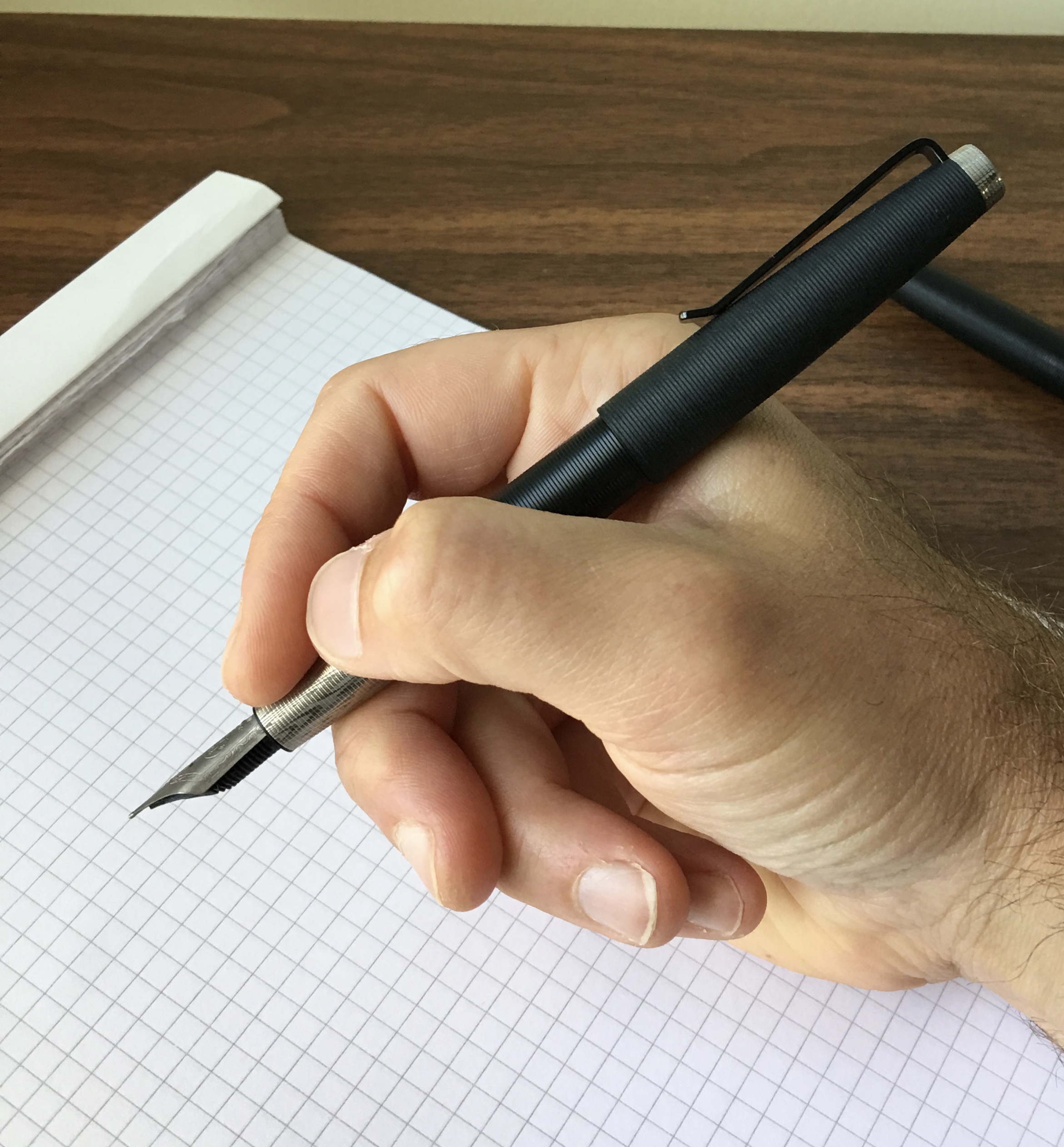
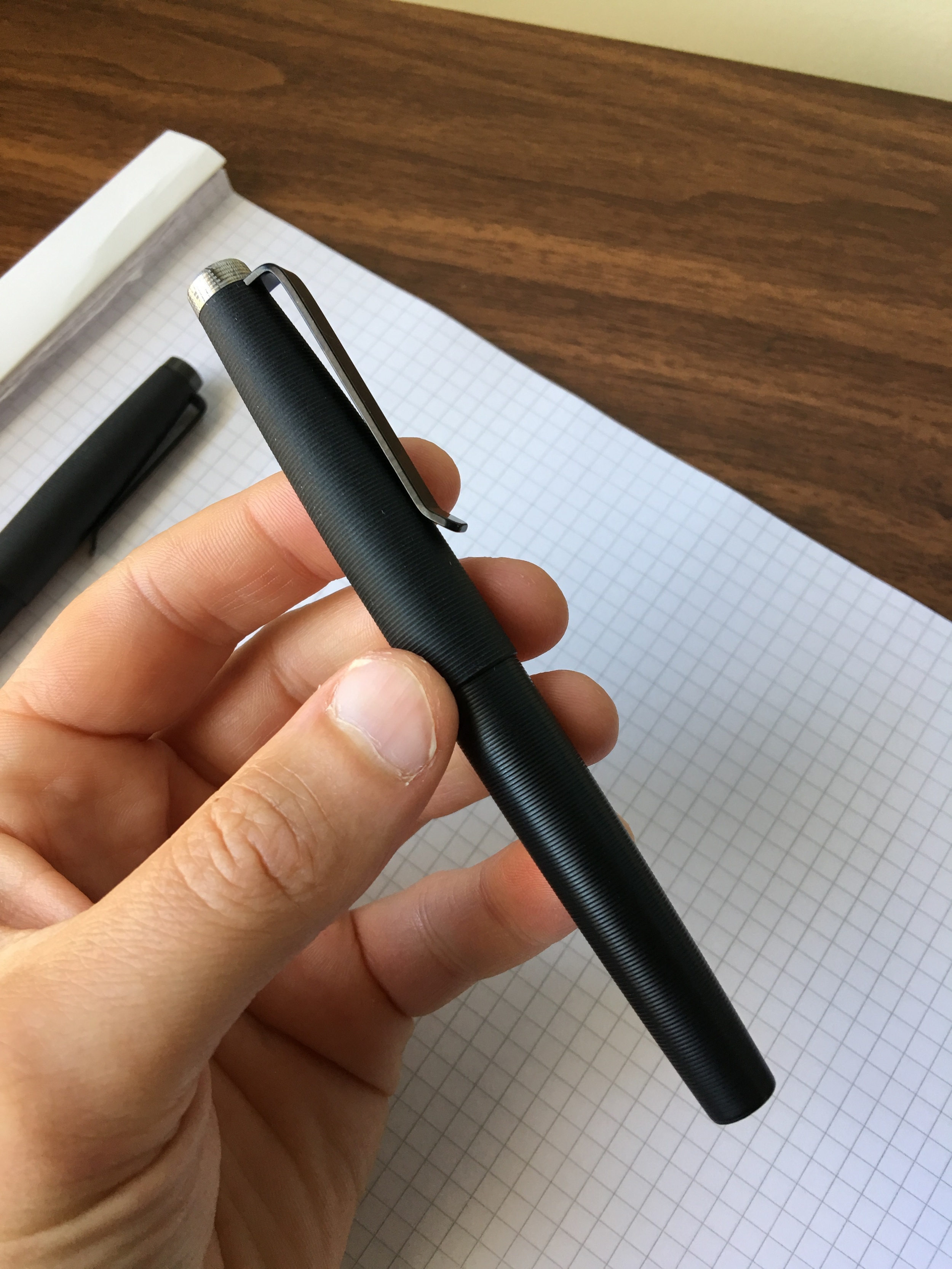
On to the Gist.  Overall, the Tactile Turn Gist is a well-designed, functional fountain pen that should wear well and stand up to whatever you might throw at it.  Whereas most Kickstarter pens are crafted from metal or wood, Will decided to do something different, opting for fiberglass-reinforced plastic called polycarbonate, better known by its trade names Makrolon or Lexan. Those of you familiar with Lamy's flagship "Lamy 2000" fountain pen may recognize the material-it's very similar, if not identical, to what Lamy uses in the 2000.  Because the Gist is a cartridge/converter pen, however, the body is very light and lacks the weight added by Lamy's piston-filling mechanism.  This could be a good or bad thing, depending on your preferences, but you should understand that the all-polycarbonate Gist is VERY light.  If I hadn't opted for the metal section on both pens that I ordered, the pen would probably be too light for me to use comfortably.  

A look at my "blacked out" Tactile Turn Gist with Zirconium section. 

But let's talk about the metal section.  With the exception of the Lamy Studio, I generally dislike all-metal pens because I find them too heavy to use for extended periods of time.  Not so here. The section, like the body of the pen, is textured, which minimizes slippage.   

The Tactile Turn logo engraved onto the zirconium finial.  You can opt for logo or "no logo".  I wish I had gone for the latter. I think it would have given the pen a cleaner look.  

You can customize your polycarbonate Gist fountain pen with a wide array of different metal sections and finials. Materials include the not-so-uncommon stainless steel, titanium, copper, brass, and bronze, as well as rarer materials like zirconium and damascus steel. I couldn't pass up the zirconium or damascus options, so I backed the Kickstarter for both pens. If you're a fan of all-metal pens, you can purchase the Gist in stainless steel, titanium, brass, bronze, and even zirconium (which comes with a pretty price tag).    

The Tactile Turn Gist comes with multiple "trim options."  I opted for Damascus steel (top) and zirconium (bottom).  

As I mentioned, the pen is well-built with an eye towards heavy daily use.  The cap posts well, which I prefer, and I like the length of this pen both capped and posted.  It sits well in a shirt pocket at work, and is well-balanced in the hand (more on that below).  Tactile Turn used an excellent black metal clip, which not only looks great but clips the pen securely to whatever you use to carry it, whether that be a pen case, bag strap, or shirt/jeans pocket.

The clip on the Tactile Turn Gist will ensure the pen doesn't go anywhere. 

Some people have been having issues with the threads being cut too tight.  The threads on the Gist are "acme" threads, meaning they're cut thicker than is typical on a pen.  This allows the cap to screw on securely, but I wish it took maybe one less turn to remove the cap.  The threading on one of my pens is also slightly off:  the cap is too tight, which has caused a small hairline crack in the cap lip.  Nothing that makes the pen unusable as long as I'm careful not to overtighten the cap, but I'll eventually have to send this back to Tactile Turn for repair or a replacement cap.  I've not read anything that suggests these problems are widespread.  The threads on my other pen are flawless. 

Writing Experience

The stainless steel Bock nib that shipped with my zirconium Gist. 

As I mentioned above, the Gist is a well-balanced fountain pen, which makes it comfortable to write with for long periods of time.  I prefer the pen posted, mainly due to the light weight of the polycarbonate.  The pen uses the cartridge-converter filling system, but instead of the standard international converter, the Gist uses a smaller converter that appears to be the one manufactured by Monteverde.  This choice of converter is an aspect of the pen I'm not crazy about:  the Monteverde converter is shorter, so it has a relatively small ink capacity, and doesn't feel very durable.  Also, if you lose the converter, if it breaks, or if the manufacturer ever stops making this part - and you can't find a replacement converter that fits - you might be forced to resort to refilling short international cartridges with a syringe to continue using the pen.  

The converter that ships with the Gist.  

The Gist uses Bock nibs, which on the whole are good quality but can be temperamental.  Lots of people like them, but my experiences with their steel nibs have been a mixed bag.  I've had better luck with Schmidt and JoWo.  The steel Bock nib that shipped with my Gist is no exception: the tines were misaligned and the nib was dry.  Eventually, after some tuning, it will write at an acceptable level, but it needs some work.  

View fullsize Tactile Turn Gist Capped
View fullsize Tactile Turn Gist Unposted
View fullsize Tactile Turn Gist Posted

I enjoy writing with Bock's titanium nibs, though be warned that you'd better have nice paper that can stand up to how wet these nibs tend to write. For a writing sample, check out my review of the Conid Bulkfiller, which uses the same nib.  I had no issues with the titanium nib on my Gist.  

What would I like to see in the future? A rhodium-plated gold nib option, which Conid offers on their pens. I'd consider upgrading my pens to the gold Bock nibs, but I'm not a fan of yellow gold on black pens.  

Takeaways

I've enjoyed using my two Gist fountain pens, and overall I think they're solid additions to my arsenal.  Tactile Turn's textured/ribbed design is unique, and when picking out my pens I really enjoyed being able to customize the design with the various metals available.  If I had to pick a favorite, it would be the polycarbonate/zirconium combination. 

In terms of the price/value proposition, you're paying a bit of a premium for the design and the rare metals, such as zirconium and Damascus steel.  The list price of the all-polycarbonate model starts at $99.00, with a zirconium section starting at $149 and a Damascus section starting at $179 (though you can add metal finials to your all-polycarbonate pen for a little less). Adding a titanium or gold nib will further increase the cost of the pen off the base price.  

For someone making a first purchase of a pen in this price range, my overall recommendation would still be the Lamy 2000, which is a piston-filling fountain pen with a gold nib. Even with Lamy's own nib quality control issues, I've had fewer issues with the 2000 than I've had with the Bock steel nibs.  If, however, you're like me, and a nut for Damascus steel and "blacked-out" metals like ruthenium and zirconium, the Tactile Turn Gist should definitely be on your radar screen because you won't find anything else like this on the market.  

Where to Buy

Tactile Turn sells the Gist fountain pen directly through its online store, though the company has started to sell pens through retailers as well.  Vanness Pens, one of my sponsors, carries the Gist, though as of the time of writing they are sold out of the "All Copper" and "All Polycarbonate" models. 

Further Reading

Ed Jelley took what was perhaps the first look at the Tactile Turn Gist, and also shot the Kickstarter photos.  Brad Dowdy at the Pen Addict also reviewed some pre-release prototypes. For a review that looks at the pen from a somewhat different angle (as part of an everyday carry instead of a pure "pen review"), check out this review from Everyday Commentary. 

DISCLAIMER:  I purchased the pens featured in this review with my own funds, for my own collection, at the full Kickstarter price.  

In Pens Tags Tactile Turn, Pens, Machined Pens
5 Comments
← Newer Posts Older Posts →
Store Hours and Location
Visit the T.G.S. Curated SHOP
Updated "Best Pens" Guide
On the Paper Trail Podcast
TGS x Roterfaden TGS_25
Hierarchies of Fountain Pen Friendly Paper

Join Our Patreon!
Subscribe to the TGS E-mail List

Featured Posts

Featured
Cover On the Paper Trail Intro Clip.jpeg
Dec 3, 2025
Introducing "On the Paper Trail," a New Podcast/Video Collaboration with Lisa Vanness of Vanness Pens!
Dec 3, 2025
Dec 3, 2025
Iro-Utsushi-Fine-Dip-Pens.jpeg
Oct 1, 2025
The Pilot Iro-Utsushi Dip Pen (and in General, Simple vs. Fancy Dip Pens)
Oct 1, 2025
Oct 1, 2025
Levenger-Annotation-Pad.jpeg
Sep 20, 2025
Five Boutique Paper Brands I'm Watching Closely and Why
Sep 20, 2025
Sep 20, 2025
The Gentleman Stationer RSS

© Digital Divide Media, LLC, 2014-present.

All content is the exclusive property of Digital Divide Media, LLC, d/b/a The Gentleman Stationer, including “The Gentleman Stationer” website and trademark, and should not be reproduced without express written permission.  All rights reserved.

All content containing paid advertising, affiliate links, or sponsored content will be plainly disclosed by a disclaimer when/if featured.

Contact Information

Store Shipping Policy and Return Policy

Privacy Policy

Cookie Policy

Terms and Conditions

Powered by Squarespace