• Blog
  • Shop
  • Resources
  • FAQ (Ask TGS)
  • About
  • Archive
  • Contact
  • Sign In My Account
Menu

The Gentleman Stationer

Vintage Living in the Modern World.
  • Blog
  • Shop
  • Resources
  • FAQ (Ask TGS)
  • About
  • Archive
  • Contact
  • Sign In My Account

Leather Goods from Baron Fig: The Guardian and The Sheath

February 15, 2018

Baron Fig has recently supplemented their accessories lineup to include a whole slew of new colors. While I’ve written much about Baron Fig’s pens, notebooks, and paper, I’ve never reviewed any of their leather products. Here, I’ll take a quick look at two that I recently received.

“Guardian” Confidant Cover

The Guardian is a high-quality leather cover for Baron Fig’s flagship product, the Confidant notebook. Available in two sizes, “Flagship” and “Plus”, the cover adds some protection to the Confidant’s cloth cover, which will come in handy if, like me, you tend to use your notebooks over a longer period of time and need the covers to hold up. If you’re a planner person, and you’ve chosen to go with the Baron Fig Confidant Planner for 2018, I’d definitely recommend investing in a leather cover to ensure that your planner survives the full 12 months. A smaller Guardian is also available for the pocket-sized Vanguard softcover notebook, which seems as though it could double as a wallet.

Pictured here is a Baron Fig Confidant (Dot Grid) in the "Plus" size. (Squire and Sheath for scale.) 

Pictured here is a Baron Fig Confidant (Dot Grid) in the "Plus" size. (Squire and Sheath for scale.) 

I appreciate that the Guardian doesn’t add much bulk to your notebook. Initially, the cover is a tight fit, and for the first week or so the front cover of the notebook may not lay completely flat when the notebook is closed. Eventually, the leather stretches out a bit, and it’s no longer an issue. The Confidant still lays flat when the notebook is open.

There is no branding on the front of the Guardian cover. The only Baron Fig branding is an imprint on the back inside flap, which makes for a very clean design.

“Sheath” Pen Sleeve

One of the more practical accessories that Baron Fig offers is the “Sheath” pen sleeve, tailor-made to fit the Squire. I advise against carrying liquid ink rollerball pens in your pocket or loose in a bag - if the tip of the pen accidentally makes contact with fabric, it can ruin your clothes. A close-fitting leather pen sleeve not only protects the pen, but protects you from your pen! (Or from yourself, whichever it may be.)

I do wish Baron Fig had omitted the “sword” motif from the front of the Sheath, and left the Guardian as a more minimal leather sleeve. While I can live with it, and I understand that their brand is based on adding a bit of whimsy to the otherwise staid stationery industry, I can’t help but feel that the imprint cheapens the look of the product a bit.

The Sheath features the Squire's "sword" logo on one side, and a Baron Fig imprint on the other. 
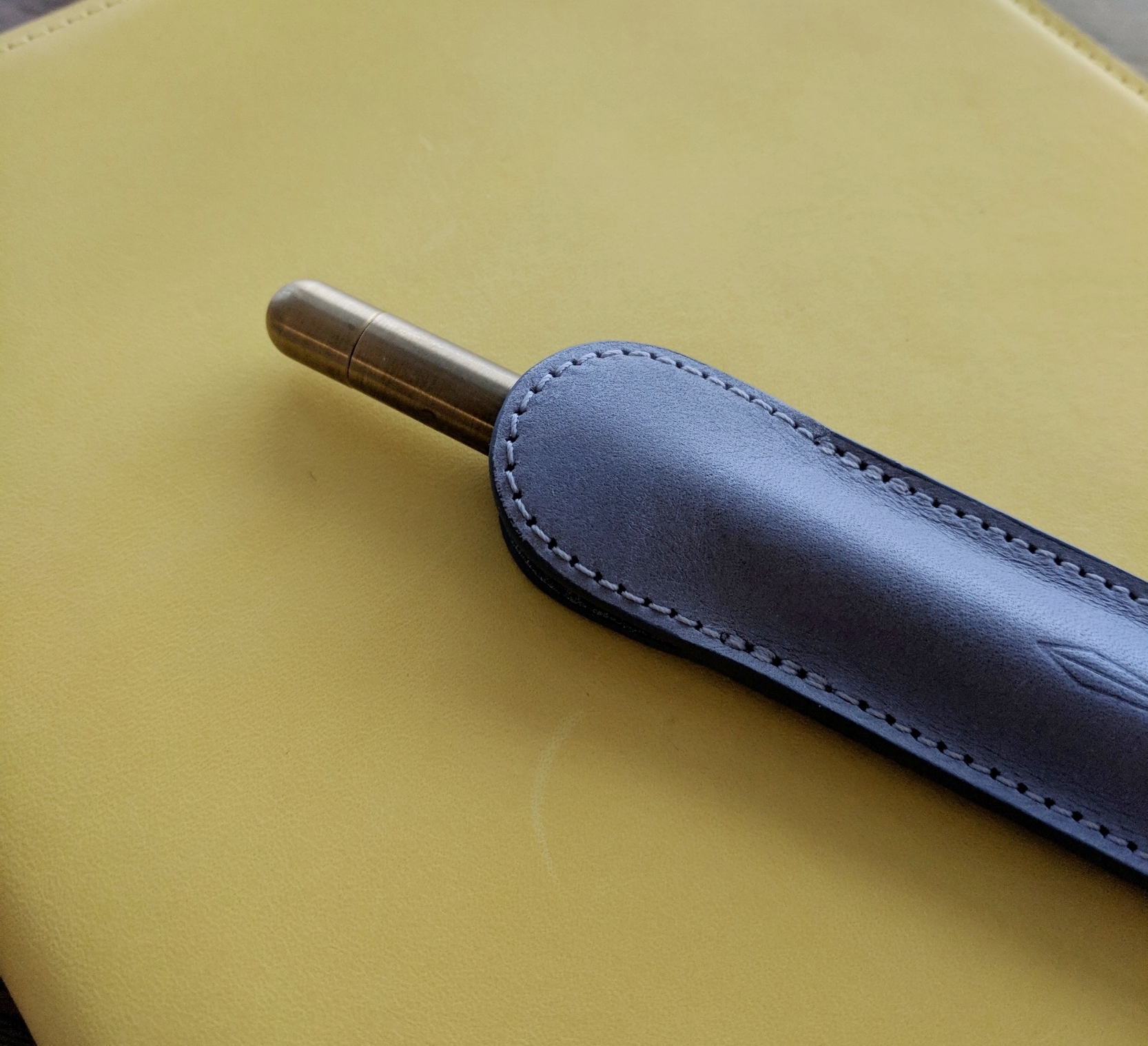
The Sheath is a straightforward product. You slide the Squire (here, the Brass "Key" edition) into one end of the leather sleeve/pouch. It's a tight fit, so no worries about the pen sliding out. 

The Sheath is a straightforward product. You slide the Squire (here, the Brass "Key" edition) into one end of the leather sleeve/pouch. It's a tight fit, so no worries about the pen sliding out. 

Takeaways and Where to Buy

Overall, I’m impressed with the build quality of Baron Fig’s leather goods, all of which are made in the USA. My favorite aspect, however, is the range of available color choices. Rather than your ordinary brown, black, and natural leather options, Baron Fig decided to go with something completely different, offering both the Guardian and the Sheath in Fig Wine (a burgundy-ish red), Charcoal (pictured here on the Sheath), Blue Slate (self-explanatory), Yellowgold (pictured here on the Guardian), Rose Quartz (the recently released pink option), and Light Brown (the conservative “tan” option). I know, for someone who talks so much about “work appropriate” products that won’t turn heads at the office, who would’ve thought that I would opt for the bright yellow leather notebook cover?

You can order the Guardian Confidant cover and the Sheath pen sleeve directly from Baron Fig, via their website. The Guardian starts at $79 for the standard A5-ish “Flagship” version, and $109 for the larger “Plus” version. The Guardian Vanguard is $45. The Sheath pen sleeve costs $24. While these prices aren’t cheap, they’re well within the range of reasonableness for leather goods of this quality.

Disclaimer: Baron Fig sent me the Guardian Confidant cover for review purposes, free of charge. I purchased the Squire Pen Sheath with my own funds, for my own use.
In Accessories Tags Baron Fig, Notebook Cover, Pen Sleeve, Leather, Accessories
Comment

Swabs of the four Kyo-iro Inks from Kyoto TAG

Ink Review: Kyoto TAG Kyo-Iro 02 (Ohara's Morning Snow)

February 10, 2018

During my visit to Vanness Pens in December, Lisa and Mike were kind enough to send me home with samples of essentially the full line of Kyoto TAG inks, save for a couple that were out of stock. If you're unfamiliar with these inks, they're yet another line of specialty Japanese inks developed for specific stores. These inks are made by the TAG stationery store in Kyoto, Japan using traditional Japanese dyeing techniques and named after locations in and around Kyoto.  

Swabs of the Kyo-no-oto inks from Kyoto TAG

The Kyoto TAG inks are divided into two groups: Kyo-iro and Kyo-no-oto inks. So far, I've had the opportunity to use three of these inks extensively: Kyo-no-oto 01 Nureba-iro (a very interesting black ink with undertones of blue and green, as well as some sheen); Kyo-no-oto 02 Imayou-iro (a bright pink ink that's surprisingly usable as an everyday writer); and Kyo-iro 02 Morning Snow of Ohara (a deep blue black/blue-gray). So far, the latter is my favorite of the bunch. 

Morning Snow of Ohara (Kyo-iro 02) which can alternately appear blue-black, blue-gray, or even purplish, depending on the light. 

Kyo-iro 02 / Morning Snow is a softer dark blue that probably falls into the "blue-black" category, though the tone changes depending on the lighting. It's a highly usable, work-friendly ink that shades nicely. Standard blue-black inks can be a bit on the boring side, so it's always fun to find one that has some character.  

All of the Kyoto TAG inks that I've used have been super well-behaved, and I've had no issues using Morning Snow on cheaper copy paper at work, even in a stub nib. This is pretty remarkable to me because I've found the Kyoto TAG inks to be on the wetter side, with above-average ink flow. Morning Snow of Ohara stands a chance of becoming a go-to blue ink for work, since it's interesting, yet at the same time not distracting. Another thing I'll note is how easy these inks are to clean out of pens - I had no trouble quickly flushing the Nureba-iro or the Morning Snow, and even the Imayou-iro cleaned up easily, which is notable for a pink ink. I'd characterize these inks as "safe" to use in most pens (with the proviso that any pink or red carries the possibility of staining). 

View fullsize Kyo-iro No. 02 - Morning Snow of Ohara
View fullsize Kyo-iro Box Label - Morning Snow of Ohara

Takeaways and Where to Buy

For the past month or so I've had this ink loaded into my Montblanc 146 Ultra Black, and I'm on my second fill. I switch inks constantly, and rarely refill a pen with the same ink twice in a row unless I'm at the office or on the road without a new option, so that tells you something about how good this ink is. It's on the list for a full-bottle purchase at the upcoming Baltimore Pen Show. 

You can purchase the full line of Kyoto TAG inks from Vanness Pens. The inks come in 40ml bottles - slightly smaller than the standard 50ml - and are priced at $28 per bottle. Since they're made in small batches and imported from Japan, they're on the pricier side, but there are much more expensive inks out there, and if you're a fan or collector of the Japanese boutique inks you don't want to miss this particular line. 

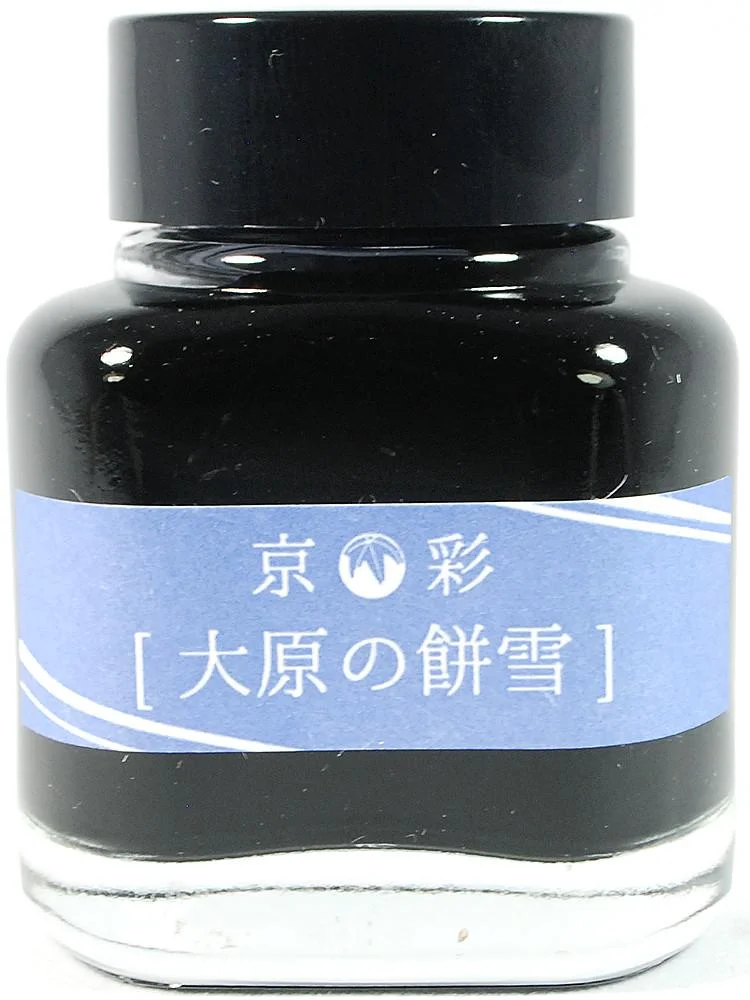
Disclaimer: Site sponsor Vanness Pens provided me with a sample of the ink featured in this review free of charge, for review purposes. The pictures of the ink bottle and label are courtesy of Vanness Pens, since I don't have a full bottle of this ink at home. 

In Ink Reviews Tags Ink Review, Kyo-iro, Kyoto TAG, Vanness
Comment

Initial Impressions: Wing Sung 618 and Wing Sung 698 Piston Fillers

February 7, 2018

If you’ve been following the links in my Deals and Drops posts over the past few months, you might suspect that I've been dabbling in the world of ultra low-cost Chinese pens. You notice I don’t use the word “cheap”, because I don’t necessarily agree with all that term implies, namely low quality. Indeed, the first two pens that I’ve tried recently - two piston filling demonstrators from Wing Sung - are a far cry from the fragile, basically disposable pens that I became familiar with from my early days in this hobby.

Previous Experience

My prior experience with inexpensive Chinese pens was primarily with Jinhao, and as we all know I’m not the biggest fan. I’ve owned some Jinhao pens that were serviceable writers; however, at the same time, I’ve received Jinhao pens with severe flaws in the finish, and the Monteverde Monza / Jinhao 992 has barrel-cracking issues in addition to quality control problems with the nibs. I did purchase a Kaigelu Duofold clone from now-defunct isellpens.com that was an ok writer, but the pen was also extremely heavy due to the brass barrel. Based on my experience so far, the Wing Sung pens are a cut above their competitors: they are relatively well-built, functional pens that I can actually see myself using, provided they hold up over the long term. 

Design and Build

For my initial foray back into the Chinese pen market, I opted to try two Wing Sung demonstrators, the Wing Sung 618 and the Wing Sung 698. Both of these pens are attractive. Wing Sung did a good job of polishing the acrylic for this price point, and the clips feel secure. It remains to be seen how the pens will hold up over the long term (i.e., more than a month), but when you’re operating at this price point durability is one of those things you may have to sacrifice (or just assume that it’s reflected in the lower price).  

I like that the Wing Sung pens (on the right) sport the clean lines and modern aesthetics of the TWSBI 580 and TWSBI Eco (two pens on the left), but in a slimmer, more streamlined package.

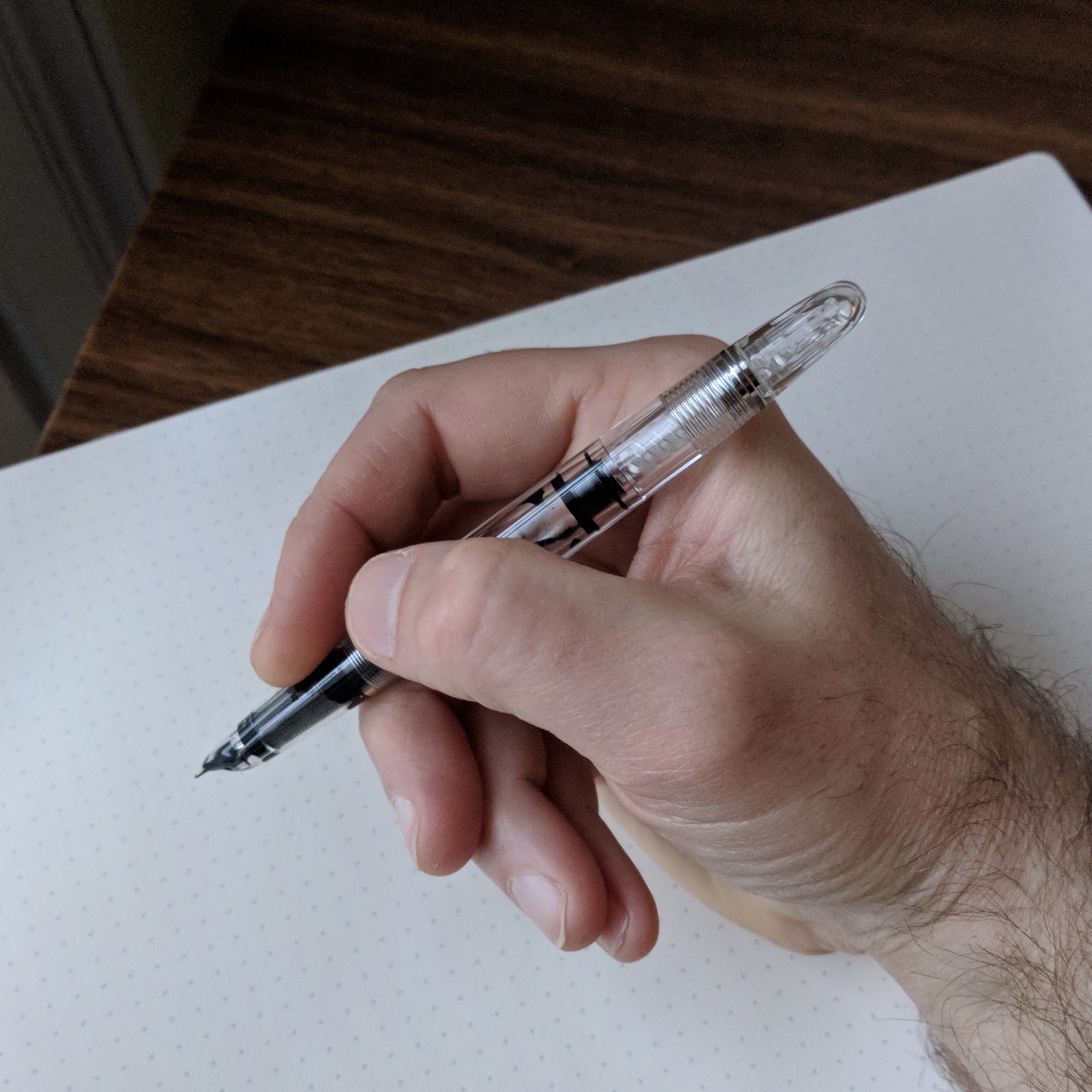
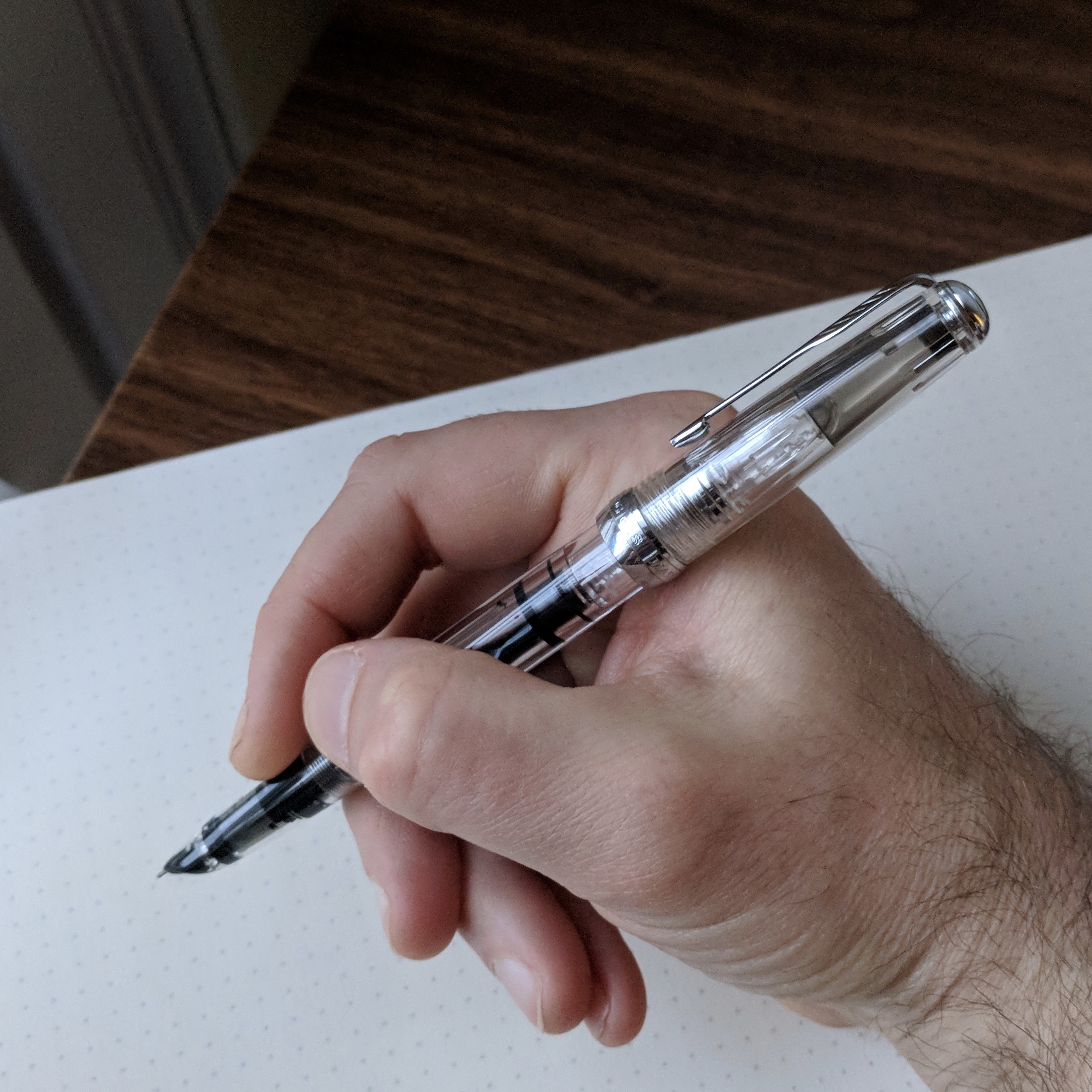
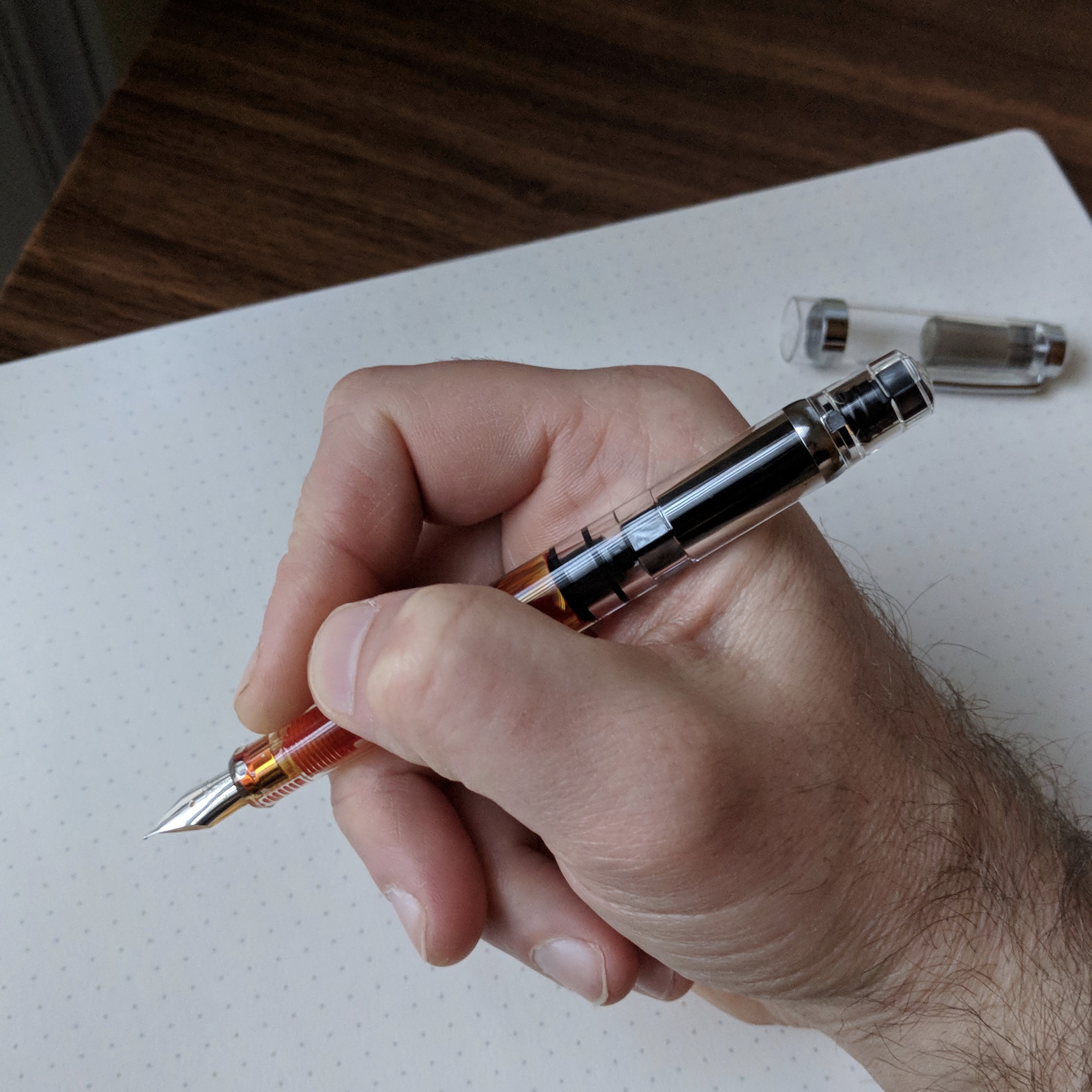
The 618 posts quite well; the 698 doesn't post at all.

View fullsize Wing Sung 618 Unposted
View fullsize Wing Sung 618 Posted
View fullsize Wing Sung 698 Unposted - Pen Doesn't Post

The 618 is approximately the same size and shape as the vintage Parker 51, though the addition of the piston filler, threaded cap, and chrome cap band do change the look of the pen by modernizing it quite a bit. I would compare the 698 to a slimmer mash-up of the TWSBI 580 and the TWSBI Eco. I could use both Wing Sung pens very comfortably, though I wish the 698 posted.

While both pens have "Wing Sung" engraved on the barrel, for some reason the 698 has "Lucky" written on the clip. 

A note on design. Chinese pen companies have been known for their “liberal” approach to intellectual property rights. With the possible exception of the “Arrow Clip” (which I believe is the subject of an ongoing dispute between Parker and Hero, Wing Sung's affiliated company, dating back to the 1940s), these two pens feature more original design elements than I’m accustomed to seeing, placing 618 pens more into the “homage” or “fantasy pen” category. The 698, to my knowledge, is distinct enough from anything else on the market to stand on its own.

Filling System and Writing Experience

This is where these pens almost lost me. While Wing Sung markets these pens as “piston fillers,” the filling system is a touch janky, for lack of a better term. This filling system is more accurately described, in my opinion, as a hybrid syringe filler / piston filler, since in order to get a “full fill” - and a full fill on these pens holds a lot of ink - you need to hold the blind cap steady and pull the piston out a bit as you turn, or else the blind cap will screw down and stop the piston before the pen is full of ink. It takes a few tries to master, and is tricky enough that I wouldn’t recommend this as a first fountain pen, despite the low price.

UPDATE: Based on reader recommendations, I tried again with the piston on these pens. As it turns out, Wing Sung uses a "locking piston" system, where in order to engage the piston you have to first pull out on the blind cap, after which the pen works like any regular piston filler, with no "syringe" action. Once you fill the pen, you push down on the blind cap to lock it back in place. It's slightly more complex than a typical piston filler, but it does work fairly well. I still wouldn't recommend this pen for beginners, since the instructions from Wing Sung don't offer clear instructions on how to fill the pen (unless you read Chinese). Also, the locking blind cap is held in place by small plastic "teeth," and I'm interested in seeing how those hold up over time. 

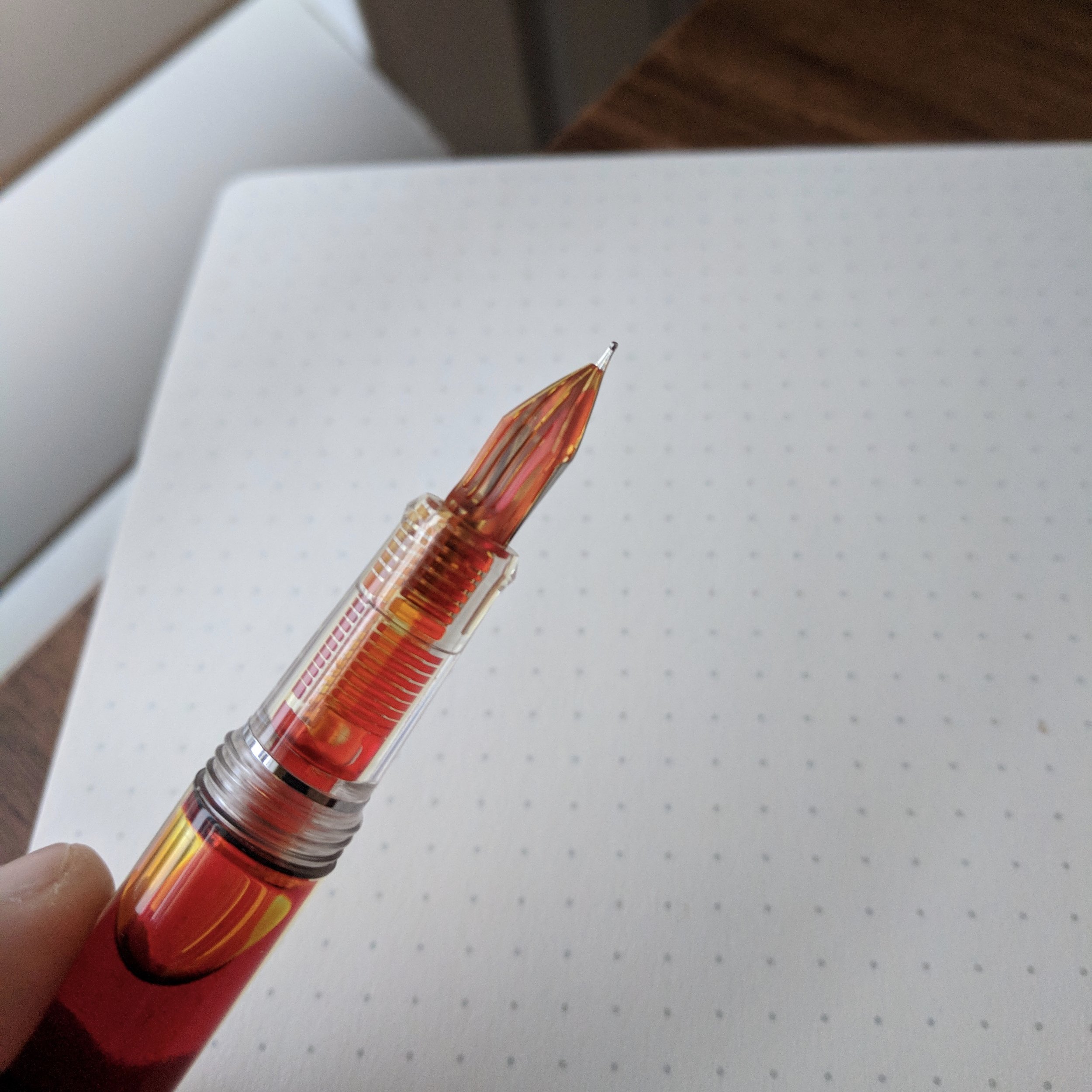
I love vintage-style hooded sections, and other than the Aurora DuoCart and the Lamy 2000, not many pen companies use them today. 

At the end of the day, it took me two or three attempts to get a full fill, and wow, these pens hold a lot of ink. I’ve been writing with the 618 almost non-stop for the past couple of weeks, and it’s still ¼ full. If I’m only refilling these pens once or twice a month, I can live with the temperamental piston.

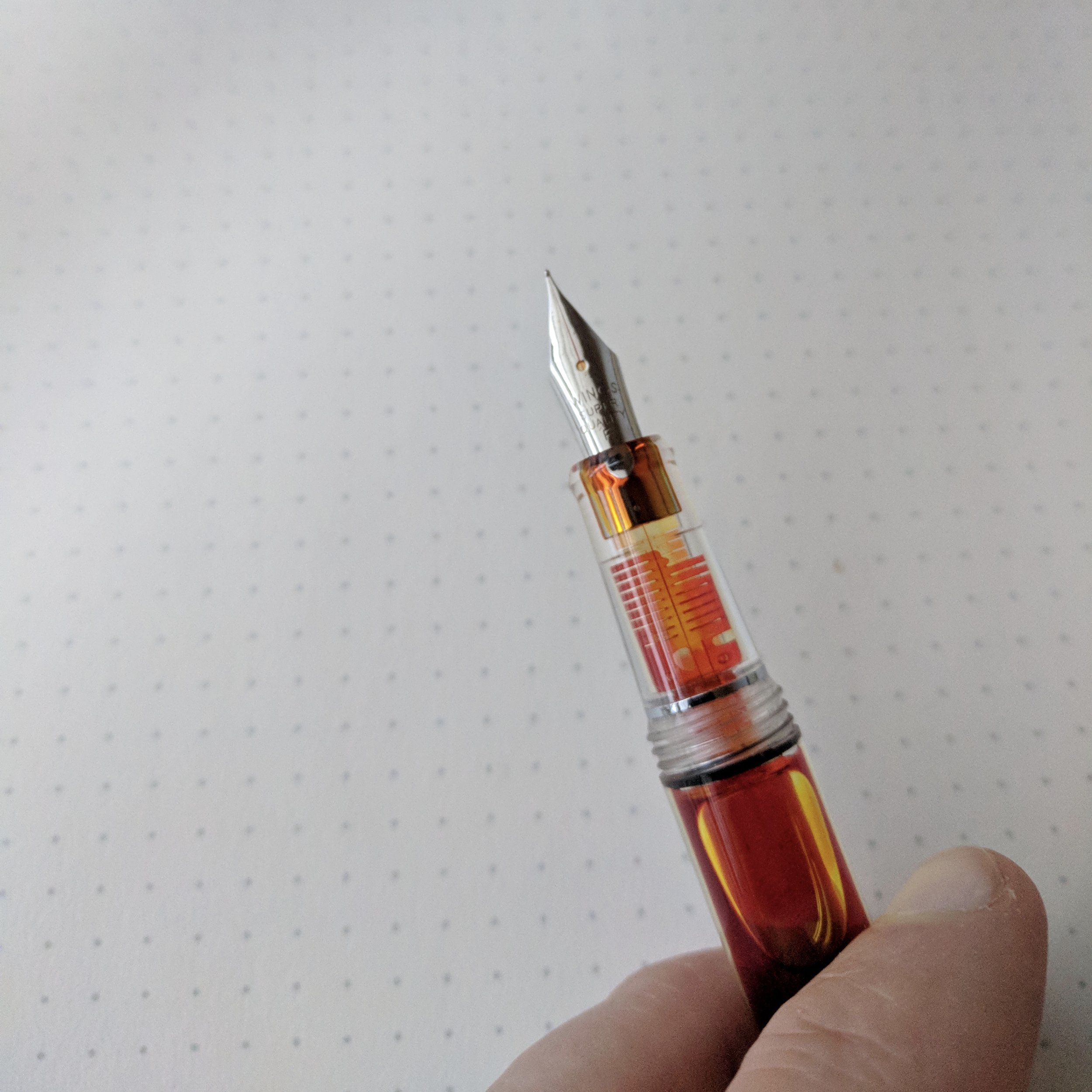
View fullsize Wing Sung 698 Nib (Top)
View fullsize Wing Sung 698 Clear Feed and Section

The nibs are unremarkable, and I’d characterize both as “Western fine”. The nib on my 618 is fairly toothy, and I’ll probably take some micromesh to it to smooth it out. The nib on the 698 writes extremely well unmodified, and looks and feels similar to the nib on a Pilot Kakuno.

Takeaways and Where to Buy

Right now, I’m categorizing this article as my “initial impressions” as opposed to a full review, because I still have some durability concerns about how long these pens will last and I want to revisit them at some point in the future. Given the low price point, I expect that some users will experience cracking in the acrylic, and that others will have problems with the “pistons,” but that’s to be expected with less expensive pens. Even TWSBI took a while to get the QC right at a much higher price point.

That said, my initial impressions are favorable. I’ve enjoyed using these unique pens, both of which have decent nibs that wrote immediately out of the box without any adjustment, which unfortunately is more than you can say for many pens that cost 2-3 times as much. Again, I would not recommend these as anyone’s first piston filling fountain pen - stick with the TWSBI Eco - but if you’re looking to vary your collection with some inexpensive transparent demonstrators, give these a try.  

I purchased these pens from Amazon, where prices will vary. (See a link here for the 618 and a link here for the 698.) Though there are other ways to source these pens, I prefer to rely on Amazon when I can because (1) Prime shipping is generally faster, and (2) I like Amazon’s buyer protection services. The 698 is only available as a clear demonstrator, with chrome or gold plated trim, but the 618 comes in a wide range of colors, and I have a transparent dark blue with silver trim version on its way to me, via the slow boat, apparently. Look for more pics and an updated opinion in the future! 

Disclaimer: I purchased these pens with my own money, for my own use. This post does contain affiliate links.

In Pens Tags Pens, Wing Sung, Demonstrator, Chinese Pens
4 Comments
Bellroy-A5-Work-Folio-Midori-MD

Bellroy Work Folio A5: A Practical Daily Companion

February 3, 2018

Today I'll take a more in-depth look at a product that I've previously mentioned: the Work Folio A5 from Australian leather goods company Bellroy. There's been a lot of discussion about this product recently, and I wanted to add a bit of a different perspective, coming from someone who has used the Work Folio "in the wild" for a period of time in perhaps a different context than what's already been discussed. 

Build and Practicality

I love portfolios. They fit the way I work, which is a combination of being chained to a desk for 4-5 hours a day, with the other 4-5 hours spent moving between out-of-the-office meetings, conferences calls, and court hearings. While I've made a lot of progress in terms of reducing the amount of "junk" paper that I cart around with me, I still need a good notebook to take meeting notes, brainstorm, and record appointments. When I'm traveling, a zippered portfolio provides an easy way to hang onto cards, tickets, receipts and other bits of paper that you tend to accumulate on the road. So when Bellroy reached out and asked whether I'd like to review one of their new Work Folios, I seemed like a natural fit. 

The Work Folio features a heavy duty zipper and Bellroy's trademark owl logo.

I first heard about Bellroy through curated online retailer Huckberry, who I've been buying from for years. Four years ago, my wife bought me the Bellroy Hide & Seek wallet for Christmas. Other than softening a bit, the leather still looks pristine, and it's more or less the only wallet I carry on a daily basis and look forward to doing so for years to come. I've since added a Bellroy leather pocket notebook cover as well. 

The Work Folio A5 without the notebook inserted.

Bellroy uses high-quality leather that stands up well to heavy daily use. I'm very hard on bags, portfolios, pens, you name it, so ruggedness is important and I'm not afraid to pay money for a product if I think it's going to last me a long time.  The Work Folio doesn't disappoint in this regard. Bellroy sent me the tan leather option, which feels thick and substantial, and the zipper seems heavy duty enough to last a very long time. Bellroy goods are backed by a three-year warranty. 

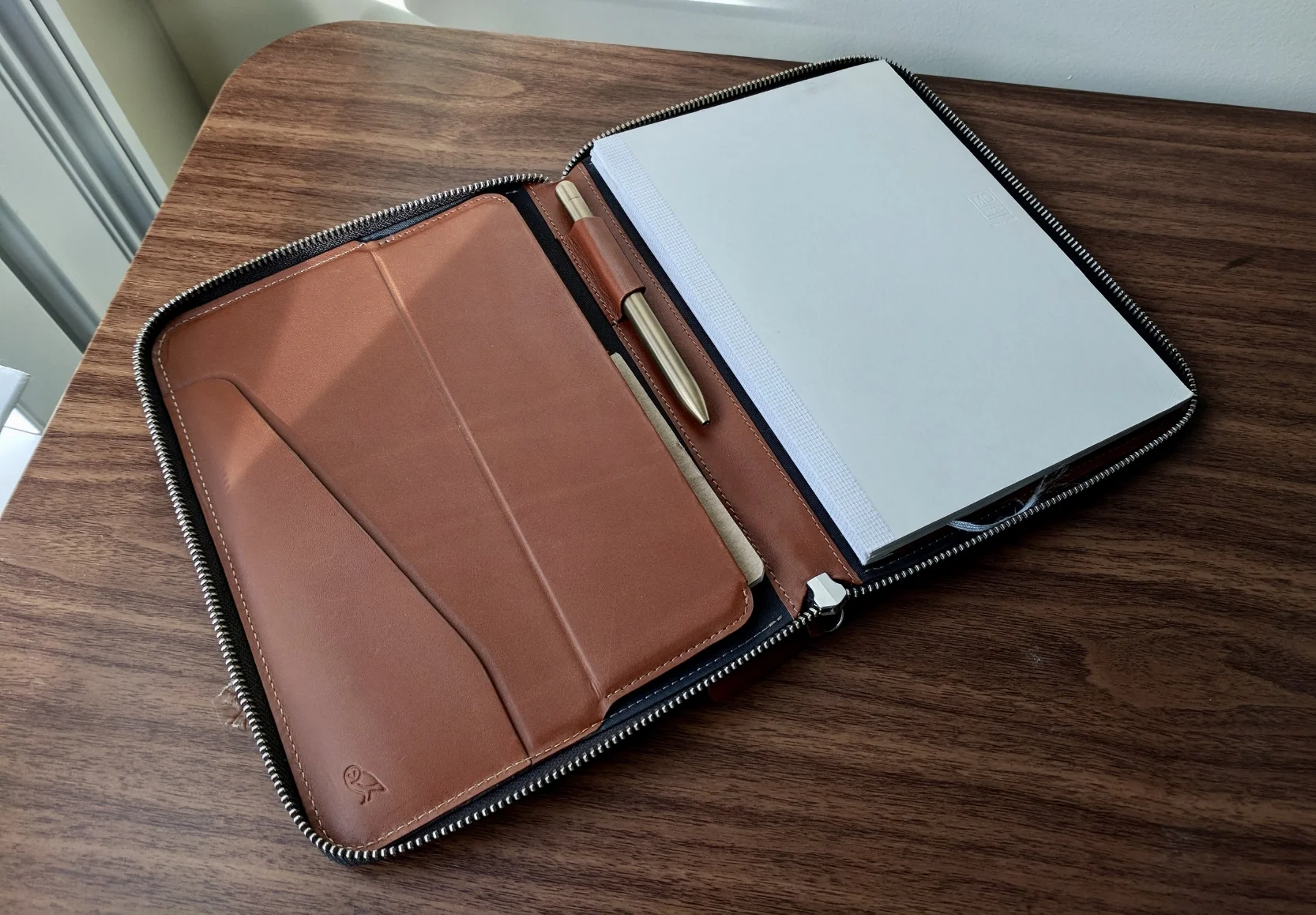
The left inside flap has pockets to hold business cards, notecards, post-its, your phone, a pocket notebook, etc. I'm sure you could also use them to hold a power bank, headphones, charging cables, and other small odds and ends if you use your folio to hold your tech products when traveling.

Inside, the Work Folio has a slot for a softcover A5 notebook on the right, which seems like the main feature of this piece. While there has been some discussion about hardcover A5 notebooks not fitting properly, the Work Folio A5 strikes me as something you would use instead of a hardback notebook like a Leuchtturm 1917, hardcover Moleskine, or a Baron Fig Confidant. While I was able to squeeze in a Confidant, it did leave the folio pretty bulky and the notebook didn't lay completely flat. If you're looking for a leather cover for your hardback notebook, you have other options. 

The Bellroy Work Folio A5, shown here with the Nanami Seven Seas Writer.

Bellroy ships the Work Folio with a slim A5 notebook, and if that's what you use the one I received was serviceable. You can also find plenty of other softcover A5 options. Personally, I prefer a notebook with more paper than what these slim notebooks offer, so I opted for a Midori MD A5 notebook, which works perfectly. The Nanami Paper Seven Seas softcover A5 notebooks also fit well, and I think that when the Midori runs out I will move over to one of the Crossfields that I have in my stash. 

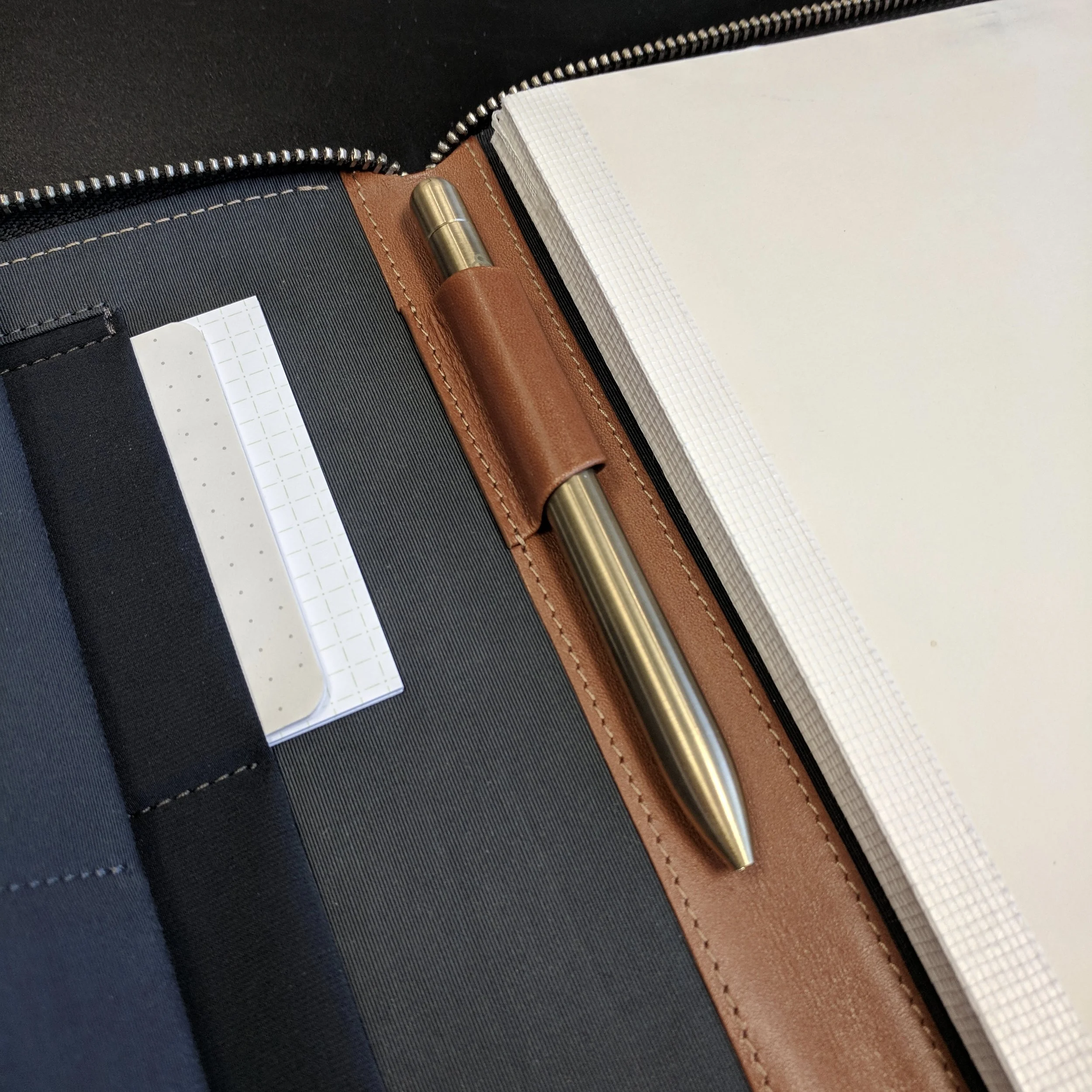
Due to the lack of a clip on the Baron Fig Squire (Brass "Key" version shown here), this may not be the most "practical" pairing I can think of but I like the combination of the patina on the brass and the leather portfolio. The pen loop is pretty s…

Due to the lack of a clip on the Baron Fig Squire (Brass "Key" version shown here), this may not be the most "practical" pairing I can think of but I like the combination of the patina on the brass and the leather portfolio. The pen loop is pretty slim, so don't expect that it will hold your fat fountain pens.

In addition to holding the notebook, the Work Folio has a leather pen loop and several pockets to hold cards, your phone, and even an "e-reader or small tablet." This would have to be limited to something like the Kindle Paperwhite or Kindle Fire (or maybe an iPad Mini), but I personally would never think to cart these around in my work portfolio because, well, I don't think they're very practical for professional use, as opposed to a full-size iPad, which requires it's own case anyway. While I may test it out as a tablet case at some point in the future, possibly when I'm traveling and would want to read a Kindle on the plane, my initial thought is that having a tablet in the Work Folio with a notebook would make it too bulky.

I typically stick a pocket notebook under the left flap. Shown here is an A6 Flip/Flop Notebook from Say Nice Things.

Takeaways and Where to Buy

The Work Folio A5 is an excellent product from a reputable and established leather goods company that serves my particular needs well. That said, I can't emphasize enough the need to do your research and consider your own personal preferences and requirements before making a purchase, especially at the price point high-quality leather portfolios tend to command. For most people, this would be a substantial investment in a key part of your workflow, not an impulse buy. If you're committed to hardback notebooks, this particular portfolio is probably not the best option for you, but if you enjoy softcover notebooks like the Midori MD, Life A5, or the Nanami Seven Seas series, I would definitely consider what Bellroy has to offer. Cared for properly, this piece should provide you with years of service. 

I believe the Work Folio A5 is currently in production, and that what Bellroy sent me is a substantially final prototype. The Folio is available for purchase/pre-order on the Bellroy website for $199 USD, with the site estimating delivery in three weeks. If you are interested in an even larger porfolio that holds an A4 pad, and has even more internal pockets, consider the Work Folio A4, priced at $299 USD. 

Disclaimer: Bellroy send me this product free of charge, for review purposes. Many thanks to Bellroy for making this review possible. 

In Notebook Review, Accessories Tags Bellroy, Folio
1 Comment

Pen Review: The Wancher Dream Pen in Dark Blue Urushi

January 31, 2018

The big news of the past week (at least in the pen community) has been the wild success of Wancher's “Dream Pen,” a Kickstarter project that launched last Thursday. Wancher is a Japanese pen company that has been around for some time, but the Dream Pen is their first high-profile product release. So far, the Kickstarter has been successful by any measure, raising more than $215,000 from 550+ backers in less than a week, with 29 days still to go.

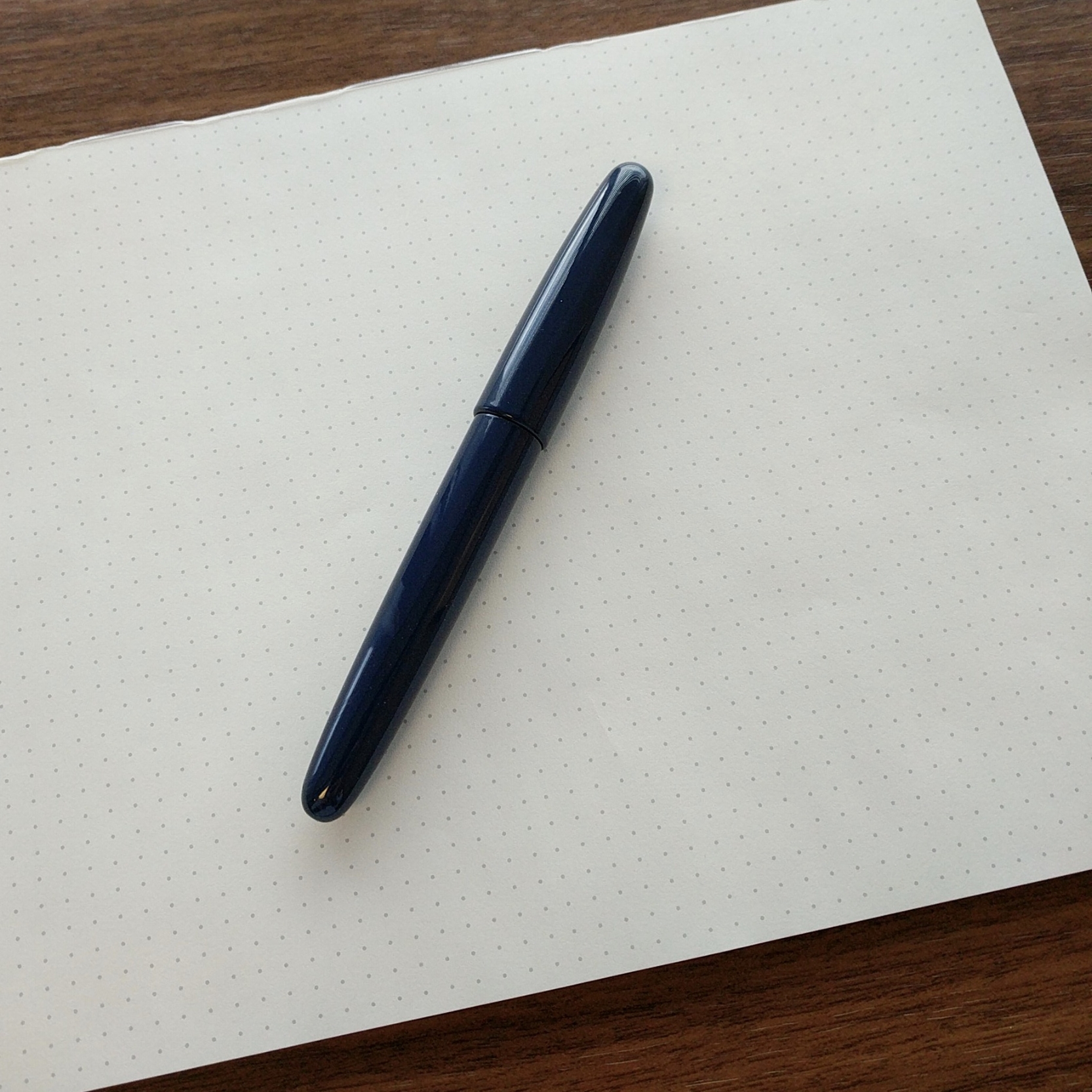
The prototype Dream Pen sent to me is a dark blue urushi. It's a gorgeous color. 

The prototype Dream Pen sent to me is a dark blue urushi. It's a gorgeous color. 

The goal of the Dream Pen is to make the Japanese urushi and maki-e artistry available “without the luxury markups.” In other words, Wancher is taking aim at a lower-cost market segment disregarded by the likes of Platinum and Nakaya, whose urushi pens start around $700 and move very quickly into the thousands for the more intricate and complex designs. While the Dream Pen is certainly not inexpensive, Wancher’s pricing ($350 Kickstarter / $450 retail) is more in line with what you would pay for a custom Edison or Newton pen with similar specs.

Since this was a relatively expensive loaner prototype, I was careful in terms of how hard I used this pen and where I took it, but I did have the opportunity to "test drive" the Dream Pen. So far, I’m impressed. I found the pen extremely comfortable, lightweight and well-balanced, though like almost all urushi pens it can only be used unposted.  

Broad JoWo 18kt nib 

The nib on this particular prototype is one of the better JoWo nibs I’ve used, and I suspect that it’s due to the ebonite feed. Nibs fitted to ebonite feeds tend to be wet writers, so while I loved this broad nib, I’ll likely opt for a fine or medium nib on my final Kickstarter reward.

The Dream Pen features an ebonite feed, which are increasingly uncommon on modern pens. 

So should you back the Wancher Dream Pen? It’s a lot of money, so here are the pros and cons, from my perspective:

Pros:

  • The price point, especially at the Kickstarter price. Well-executed urushi pens with gold nibs and ebonite fees can easily run $700-plus, so if you’ve been considering a similar pen from Platinum or Nakaya, the Wancher should be on your radar.
  • The Dream Pen features a JoWo nib and non-proprietary cartridge/converter compatibility. I’ve seen some comments to the effect that a JoWo nib is a drawback, in that it’s “boring” and there isn’t any detailing like on Nakaya's gorgeous nibs. Fair enough. But the drawback to Nakaya nibs is (1) the price, and (2) that you're locked into the proprietary Platinum converter, which I don’t necessarily like, and the proprietary Platinum cartridges.
  • The construction and the build on the Dream Pen are high-quality. The spring-loaded cap was a surprise, and creates a very secure closure. I could not locate a single flaw in the Urushi finish. The pen feels great in the hand and is very well-balanced.

Cons:

  • Price. Regardless of how this pen compares to other urushi offerings, $350-450 is a LOT of money to spend on a pen - especially a Kickstarter project where you won't have the reward in your hands until late summer, early fall (assuming no delays in production). 
  • Non-lacquered threads. In an effort to keep costs down - which is completely understandable - the Dream pen features non-lacquered ebonite threads. I personally like the contrast, but some may think that they make the pen look unfinished.
  • JoWo nib. See above. Some people don’t like how they look or write, but as I've said before, it's unrealistic to expect smaller companies to offer a house-made nib and still keep pricing reasonable.
  • As of now, the Dream Pen does not give you the option of adding a clip, and, like most urushi pens, the Dream Pen does not post. 

I ended up deciding to back this pen, and I really hope that there is a yellow urushi option at some point. I’ve been going back and forth on a Nakaya Portable Writer in Nanohana-Iro (yellow) for the past couple years, but I’ve had trouble justifying the $700+ price tag for the pen that I want. I owned a standard black Portable Writer a few years ago, and while I enjoyed the pen, I ended up selling it mainly because it hadn’t spoken to me in the way it would have needed to in order to justify keeping that much money invested. I’m more comfortable with the Dream Pen as a price/value proposition.

The size of the dream pen is roughly equivalent to a Montblanc 146, though slightly fatter and longer. Both pens shown here in a Wancher leather two-pen case. 

The fact that this project, to date, has raised over $200,000 in less than a week leaves me somewhat speechless. It definitely speaks to the number and market power of pen enthusiasts around the world, because prior to this, I would have thought “Japanese urushi fountain pens” to be the definition of a hyper-niche market. Wancher has struck a chord, and hopefully this project turns into a massive success and serves as the debut of an exciting new player in the international fountain pen market.

Disclaimer: Wancher loaned me this pen free of charge for review purposes, to be returned upon completion of the review. The pen case pictured in this review was provided free of charge, for review purposes.

In Crowdfunding Projects, Pens Tags Kickstarter, Wancher, Dream Pen
6 Comments
← Newer Posts Older Posts →
Store Hours and Location
Visit the T.G.S. Curated SHOP
Updated "Best Pens" Guide
On the Paper Trail Podcast
TGS x Roterfaden TGS_25
Hierarchies of Fountain Pen Friendly Paper

Join Our Patreon!
Subscribe to the TGS E-mail List

Featured Posts

Featured
Cover On the Paper Trail Intro Clip.jpeg
Dec 3, 2025
Introducing "On the Paper Trail," a New Podcast/Video Collaboration with Lisa Vanness of Vanness Pens!
Dec 3, 2025
Dec 3, 2025
Iro-Utsushi-Fine-Dip-Pens.jpeg
Oct 1, 2025
The Pilot Iro-Utsushi Dip Pen (and in General, Simple vs. Fancy Dip Pens)
Oct 1, 2025
Oct 1, 2025
Levenger-Annotation-Pad.jpeg
Sep 20, 2025
Five Boutique Paper Brands I'm Watching Closely and Why
Sep 20, 2025
Sep 20, 2025
The Gentleman Stationer RSS

© Digital Divide Media, LLC, 2014-present.

All content is the exclusive property of Digital Divide Media, LLC, d/b/a The Gentleman Stationer, including “The Gentleman Stationer” website and trademark, and should not be reproduced without express written permission.  All rights reserved.

All content containing paid advertising, affiliate links, or sponsored content will be plainly disclosed by a disclaimer when/if featured.

Contact Information

Store Shipping Policy and Return Policy

Privacy Policy

Cookie Policy

Terms and Conditions

Powered by Squarespace