• Blog
  • Shop
  • Podcast
  • Resources
  • About
  • Archive
  • Contact
  • Cart
  • Sign In My Account
Menu

The Gentleman Stationer

Vintage Living in the Modern World.
  • Blog
  • Shop
  • Podcast
  • Resources
  • About
  • Archive
  • Contact
  • Cart
  • Sign In My Account

Traveling with Fountain Pens: Do You Need a Traveling Inkwell?

January 24, 2019

Everyone who writes for the pen community gets questions about the ins and outs of traveling with fountain pens. One topic that comes up frequently is the question of filling from a bottle when you’re on the road, especially for an extended period of time. This issue doesn’t arise much for me - my work trips tend to be 2-3 days in most cases, and two fountain pens filled to capacity will easily last me that long. That said, I know there are readers out there who travel for a week or longer at a time, and may need to consider a piece of fountain pen-specific travel gear: a traveling inkwell or ink pot. Also, if you favor piston-fillers with larger nibs, such as the Pelikan M800 or the Montegrappa Extra 1930, or pens like the Visconti power-fillers that are just difficult to fill to capacity, these devices can be quite useful and will make it easier for you to get a full fill of ink.

You’re pretty much limited to two options: the Visconti Traveling Inkwell or the Pineider Pen Filler Inkwell. Visconti created this highly specialized piece of equipment years ago, in 1997, so the idea has been around for quite some time. After Visconti founder Dante Delvecchio left the company to join Pineider, Pineider released their own version, which holds 5ml more ink than the Visconti and costs less than half the price. (The Visconti Traveling Inkwell holds 5ml of ink, and the Pineider Pen Filler holds 10ml.)

Fill ‘er up! It’s hard to see, but both the Visconti Traveling Inkwell and the Pineider Pen Filler feature a rubber gasket on the inside that forms a seal.

Using these inkwells are fairly simple once you grasp the concept, which can seem confusing and a bit counterintuitive (not to mention risky) at first. To start, you remove the cap of the inkwell and fill with your ink of choice to the indicator line, using the supplied eyedropper (or your own syringe or pipette).

When you’re ready to fill, Insert the pen and press gently until you feel the pen come to a stop. The section should form a secure seal against the rubber gasket inside the inkwell, allowing you to invert the inkwell (yes, you heard me correctly) while you turn the piston or converter. You will get a full fill of ink into most pens, which to me is the primary selling point of these contraptions. Note: for vacuum fillers, make sure your seal is TIGHT and hold onto the inkwell securely when you depress the plunger to fill the pen. Otherwise, you may get the “rocket effect” when the inkwell (and all of the ink in it) goes sailing across the room, coating your walls, carpet, etc. It may also be preferable to try outside for the first few times until you get the hang of it.

Check out how much ink I was able to get into a Montblanc 146! The best part? Hardly any ink on the section afterwards. You’ll only have to wipe off the nib and the very end of the pen where the ink meets the feed.
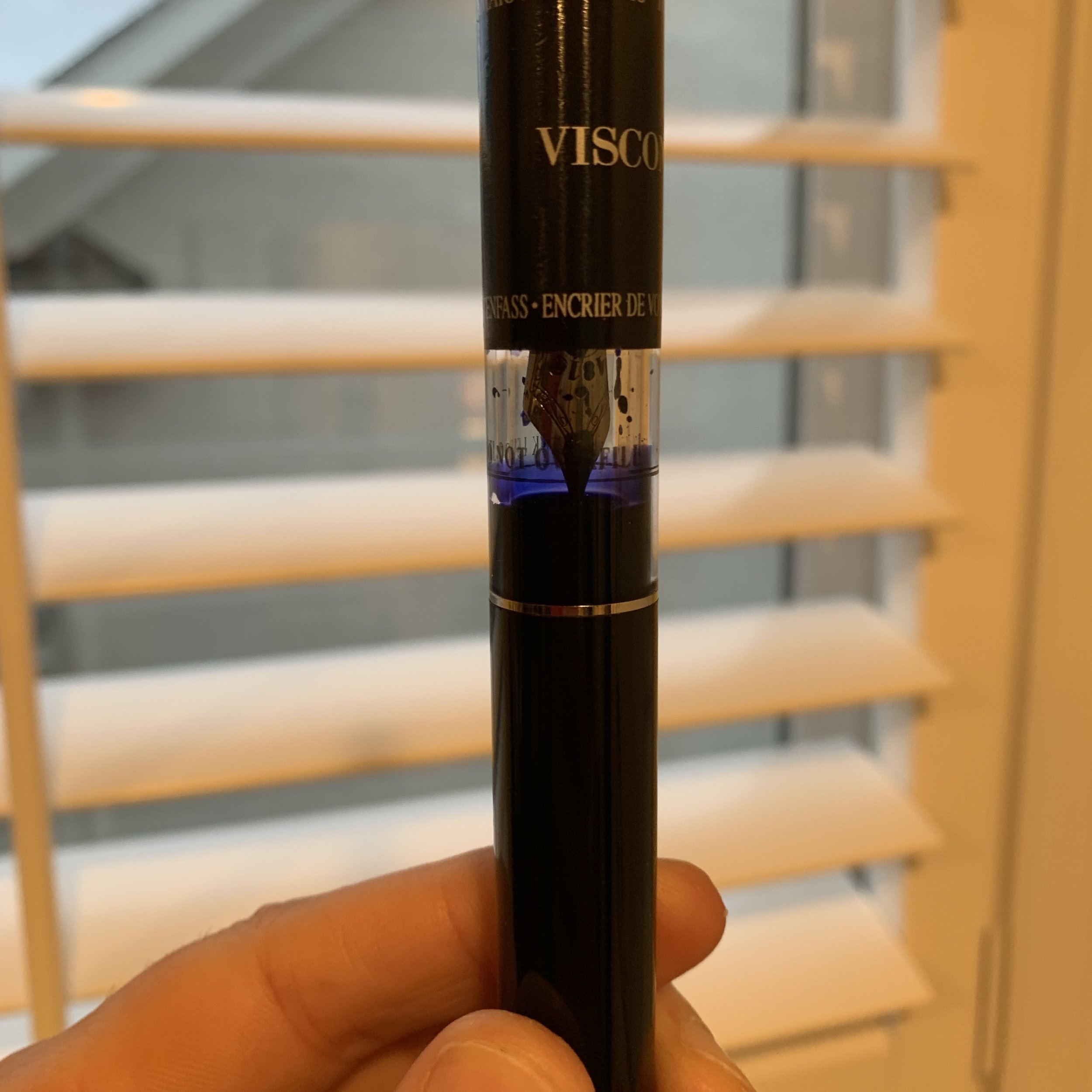
View fullsize Visconti Traveling Inkwell Before Filling
View fullsize Visconti Traveling Inkwell After Filling

In terms of actual traveling, I’m honestly a little nervous about flying with these things, only because you’re technically supposed to put all liquids (including fountain pen inks) into single plastic bag in order to get past security. Both of these inkwells have a “stopper” closure, not a threaded cap, so I have some concern about leakage. For the record, the stopper on the Pineider inkwell feels a lot tighter and more secure than the Visconti. I’ve included pictures of the Pineider in action below, featuring a Sailor Pro Gear. I’ve never been able to get that much ink into a Sailor Converter without syringe filling!

View fullsize Pineider Ink Pot with Sailor Pro Gear
View fullsize Pineider Ink Pot Inverted

Takeaways and Where to Buy

I like both of these products, but perhaps not for their stated purpose of traveling. Rather, for me their true utility lies in the ability to swap favorite inks (mostly Sailors) from the hard-to-fill “flat” bottles into a different format that will let you use piston-fill pens with larger nibs, such as No. 8s. They’re also a great way to make sure your pens are filled to the brim if you’re preparing to leave on a trip or attend a class/meeting where you will have to do a lot of writing.

I acquired both of the inkwells featured in this review from Pen Chalet. The Visconti Traveling Inkwell is currently priced at $70 MSRP, with a street price of $56. While it’s certainly not inexpensive, I recall these being priced well north of $100 when they first came out several years ago. Pineider has priced their version lower at $25 MSRP / $20 street price, and to be honest it’s probably the product I would advise most people to buy. While its overall design lacks some of the elegance of the Visconti and feels a bit insubstantial, it’s the more practical choice for what’s going to be a relatively limited-use purchase for most people. I have, however, read reports that certain Visconti pens don’t fit well into the Pineider inkwell, specifically those with the “hook” closure system, so if you have a large Visconti collection stick with that brand.

Side Note: Though you will eventually run into the same problem as you do with ink bottles once the ink level gets too low, many people forego the traveling inkwell in favor of ink sample vials or the 4oz version of these smaller Nalgene bottles. In addition to being extremely inexpensive, the caps on both are quite secure and have survived many a trip through TSA screening.

Disclaimer: This post contains affiliate links. I purchased both inkwells featured in this review from our sponsor Pen Chalet using store credit generated through Pen Chalet’s affiliate program.
In Accessories Tags Inkwell, Traveling Inkwell, Visconti, Pineider, Pen Travel, Travel
2 Comments
Pelikan-M400-Brown-Tortoise-Material

Debate Reopened? The Pelikan M400 and the Perfect Pelikan Size

January 19, 2019

Back when I first reviewed pens from Pelikan’s flagship Souveran collection, I only had one: the M600, which is the “mid-size” model and what I had expected would be a great size for me. I wasn’t wrong. I love the M600, and have long expressed a desire for Pelikan to do more with that model in terms of special and limited releases. This past year we M600 fans got our wish, with a special edition “Brilliant Orange” M600, though not everyone’s a fan of the color. I’m still on the fence, leaning towards passing on Brilliant Orange and waiting to see what, if anything, Pelikan has in store for 2019. But I digress.

The Pelikan Souveran M400 (left) compared to the M600 (center) and the M800 (right)

As it turns out, I’m no longer sure that the M600 takes first prize among the Pelikan lineup for me. More and more, I find myself turning not to the larger M800 (as many Pelikan fans do), but to the smaller M400. This isn’t about price, though as I’ll discuss below, the M400 sits at a fairly attractive price point once you take into account all the features. No, it’s mainly about portability. For an everyday workhorse, I like a pen that sits comfortably in a shirt pocket. As a lighter-weight pen, the M400 doesn’t pull the pocket forward as much as its bigger cousins, probably due to the use of a lighter piston mechanism.

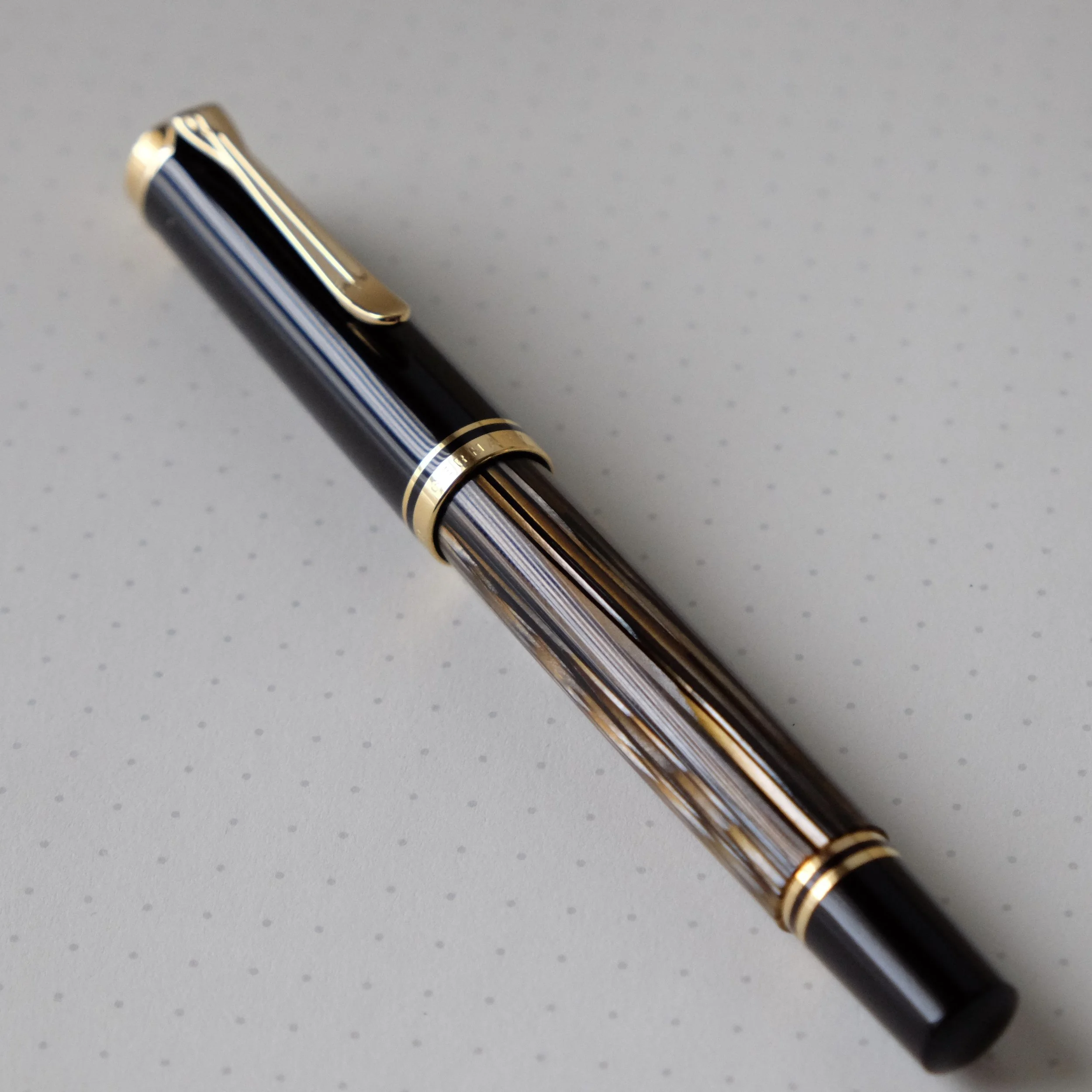
The brown tortoise acetate that Pelikan uses as the binde on its pen barrels is one of my favorite pen making materials ever. If only they would leave it in the lineup! Also, as with the M800 Burnt Orange, the acrylic used for the cap, section, and blind cap is actually a very dark brown, though it appears black in most photos.

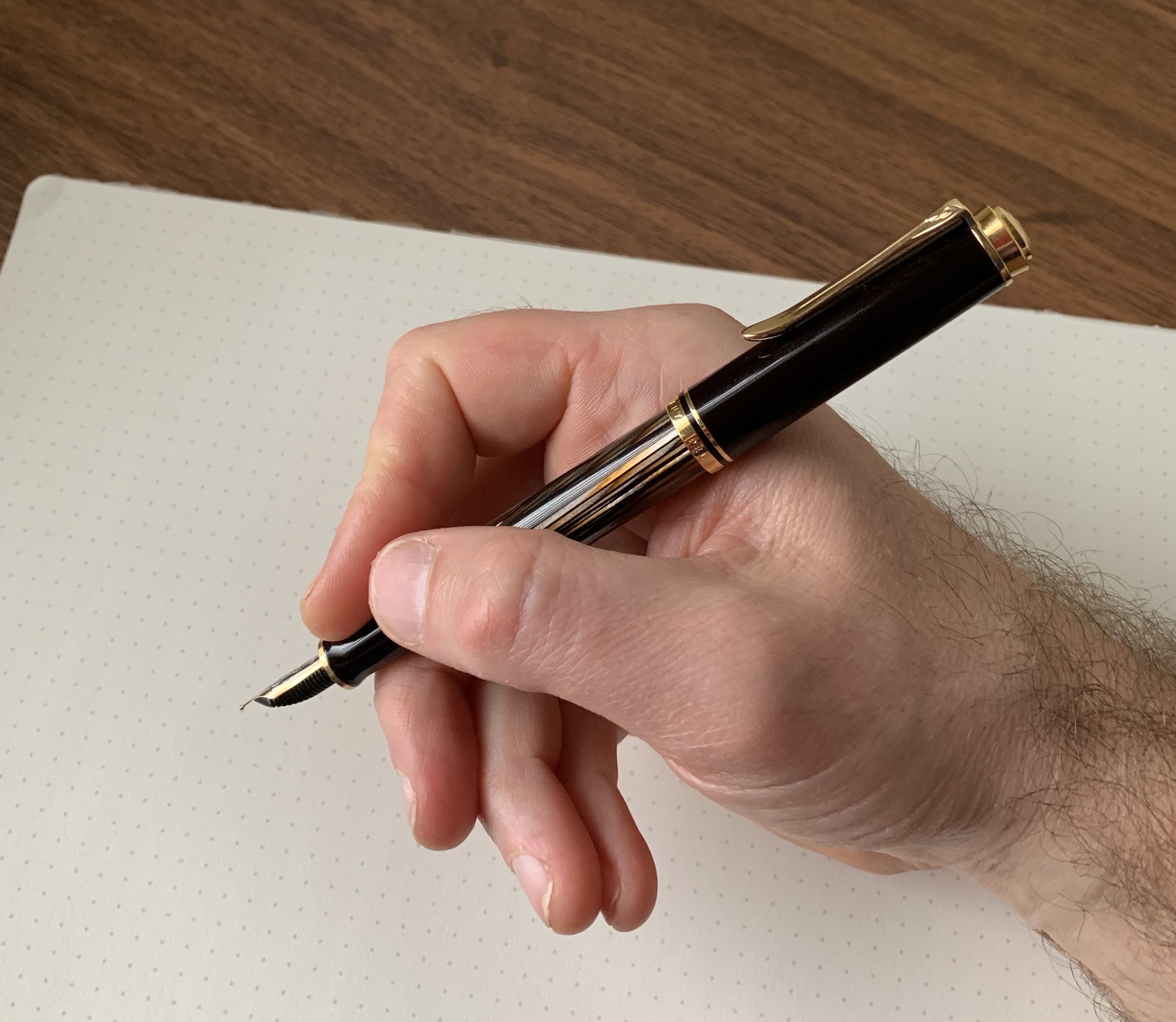
Even though it’s one of the smallest pens in Pelikan’s current lineup, I don’t necessarily consider the M400 to be “small.” Taken in its historical context, the M400 is approximately the same size as many - if not most - vintage Pelikan’s, as well as many other vintage pens of the same era such as the standard Esterbrook J. I can comfortably use the M400 (as well as the M200 and the M120) for very long writing sessions without any discomfort, and the M400 has excellent balance when posted.

View fullsize Pelikan M400 posted
View fullsize Pelikan M400 unposted

Another advantage to the M400 size is that the nibs can be swapped with most similarly sized vintage Pelikan pens. In my review of the Pelikan M120, I discussed how I was able to take an oblique medium nib from a vintage Pelikan and swap it into a modern one. Guess what? That vintage nib fits into both the M120 AND the M400. I plan to spend my pen show time this year hunting more vintage Pelikan nibs in this size.

Pelikan nibs are among my favorite in terms of decorative scrollwork and brand logo.

Takeaways and Where to Buy

As I mentioned above, while the Pelikan M400 certainly doesn’t come at a bargain price, I do consider it good value. For around $300 (and even less with the occasional coupon code), you get a reliable Pelikan piston filler with what is, for the most part, an excellent 14k gold nib right out of the box. Over the years, quality control on Pelikan nibs has ebbed and flowed, but recently I’ve had nothing but good luck. The fine nib on the M400 writes more like a traditional medium, but it’s smooth and the ink flow is perfect with no tendency to skip or hard start. The M800 I purchased recently also had a great out-of-the-box nib, though it was a medium that wrote more like a broad. I generally advise people considering Pelikan pens to purchase one nib size smaller than what they normally write with. If you only like extra fine or needlepoint nibs, you will almost certainly be looking at having someone grind the nib down for you, as gold nib extra-fines from Pelikan write more on the fat side of a traditional “western fine,” in my experience.

Not exactly the narrowest “fine” nib.

I purchased the Pelikan M400 in Brown Tortoise pictured in this review from Pen Chalet, but unfortunately that pen has now been discontinued. Pen Chalet does, however, carry the standard M400 (gold trim) and M405 (Rhodium Trim), both priced between $300-315, and you can get that down even further using one of the coupon codes floating around out there. The M405 Stresemann costs a bit more at $380, and I don’t know whether or not Pelikan considers this pen to be a special edition like the Brown Tortoise. If so, it may also be susceptible to being phased out in the future, though I hope not.

If you have your heart set on the M400 in Brown Tortoise, shop around and act quickly if you locate one. Currently, site sponsor Goldspot has a few in stock, and there are also various Amazon sellers that still have the pen. Again, don’t wait, because whenever Pelikan discontinues one of their pens in brown tortoise (i.e, the M800 and previous M400 versions) they quickly become hot commodities on the secondary market. Of course, Pelikan tends to bring them back every few years, but there’s no guarantee they’ll continue to do that, and no telling when.

Disclaimer: This post contains links to paid sponsors and affiliates.

In Pens Tags Pelikan M400, Pelikan Souveran, Pelikan, Pen Review
5 Comments

Catching up with Baron Fig: New Squires, a Confidant Partnership, and Leather Goods

January 17, 2019

In terms of companies that make some of my favorite products for everyday use, both at home and at work, you need not look much further than Baron Fig. From its origins as a Kickstarter notebook project, the company has evolved from being simply the makers of the Confidant notebook to a full-blown lifestyle brand, though the focus remains on stationery. Today I’ll take a look at a few of the Baron Fig products I’ve added to my daily kit over the past year or so.

Pictured from left: Squire Rollerball in “Sheath” Pen single pen sleeve; “Lock” Brass limited edition Squire (check out that patina!) and my getting-worn-in slim bifold wallet. All of these products are sitting on top of a Mastermind desk pad.

Squire Rollerball Pen. Baron Fig’s Squire is my preferred iteration of the retractable rollerball - I like the teardrop shape, they’ve kept the design clean, and now there’s even a compatible Uniball Jetstream Refill that you can use to turn your rollerball into a fine-tip hybrid gel/ballpoint. Over the past year, Baron Fig also has backed away from a quarterly “limited edition” release schedule in favor of a wider range of standard colors and materials. The most recent release has been a Squire in brass, which is one of my favorites and which I’ve had the pleasure of using as part of the “Lock and Key” limited edition set that was released about a year ago. Today, my brass pen sports a gorgeous patina. I’m glad to see brass join stainless steel and copper as part of the regular Squire lineup.  

Confidant Notebooks. The Confidant lineup also has expanded over the past couple of years, with both new sizes and new colors now available as part of the regular line. The limited or special edition Confidants that were being released on a quarterly basis have apparently been replaced by special-purpose notebooks designed in partnership with various writers and designers. These include the new Clear Habit Journal (designed to accompany the book Atomic Habits by James Clear), the Wander Dream Journal, and the Show & Tell Notebook (designed in conjunction with Dribbble design showcase). Of these three, the Clear Habit Journal is probably the only one that might find its way into my regular rotation - and I have one on the way to review - but I love that Baron Fig has branched out and released these other products. I know several people who have enjoyed using the Wander Dream journal, and the Show & Tell will appeal to those who like to combine lined pages for writing with blank pages for sketching, doodling, or diagramming.

Workspace Accessories. In 2018 the Mastermind Desk Pad remained my most used stationery item. I probably churned through a dozen of these things, far outpacing my use of anything else in my kit. Though the Mastermind is not intended for writing on both sides of the page, the paper quality holds up with fountain pens, especially with respect to feathering and dry time. One of the things I love about Baron Fig paper is that it’s slightly absorbent, so it dries relatively quickly and doesn’t get all over your hands and wrists if, like me, you keep a Mastermind notepad underneath your keyboard. It also comes available in an “Mini” size, and Baron Fig subsequently released a narrow “Weeks” version to help you plan.

Bags and Leather Goods. Last but not least, I’ve found Baron Fig’s leather goods surprisingly impressive in both their looks and durability, especially at the price point. I’ve periodically posted that I’m carrying one of their slim bifold wallets in Charcoal, which is actually a very light gray that ages into an almost khaki color. I’m very hard on wallets, and this one has held up well. Other Baron Fig leather goods in my regular repertoire include the leather “Sheath” pen case for the Squire, as well as the “Guardian” notebook covers.  

You can say I’m a fan of the Squire…

Takeaways and Where to Buy

Baron Fig is one of those brands that I’ve enjoyed getting to watch grow over the past few years. One thing I appreciate is that despite their rapid growth and introduction of new product lines, I’ve not had significant quality control issues, even as they’ve managed to keep their pricing reasonable. The stuff just “works,” and allows you to get down to doing your work, whatever that may be, with a minimum of fuss.

You can purchase any of the products featured in this post through the Baron Fig website, and they’re even starting to expand into retail streams. Our sponsor Vanness Pens currently carries a range of Baron Fig products, including the Confidant and Vanguard notebooks.

Disclaimer: This post contains links to paid sponsors and affiliates. Baron Fig provided me with certain of the products pictured in this review free of charge for review purposes, though others (like the gray squire pen and the Mastermind desk pads) were purchased with my own funds for my own personal use.

In Paper Products, Pens Tags Baron Fig, Baron Fig Confidant, Baron Fig Squire, Baron Fig Mastermind, Paper, Leather, Rollerball
1 Comment

Catching Up with Kanilea: Nui Nalu and Hanauma Bay Fountain Pens

January 12, 2019

It’s been too long since I’ve devoted a full post to the Kanilea Pen Company. I purchased my first Kanilea pen, a Mauna Kea, back in March 2017 at the Baltimore Pen Show. In the meantime, I’ve added two more to my collection: a Nui Nalu and a Hanauma Bay (from their “Elements” and “Locations” collections, respectively). In my earlier post, I went over the history of the brand, and particularly how Hugh and Karol Scher launched Kanilea based on their family’s travels to and love of Hawaii. I’ve regularly remarked on how I consider Kanilea to be one of the most unique well-conceptualized, and well-implemented “small batch” pen brands. (By “small batch,” I mean pens that aren’t made-to-order custom pens in a material/design chosen by the customer, but rather come from a standard product line, made in extremely small quantities and, in the case of Kanilea, entirely by hand.) Regardless of whether or not you find the aesthetic of the pens appealing, you have to appreciate what Hugh and Karol have done with the brand in such a short period of time.

So let’s catch up and talk about what’s special about my two latest Kanilea additions:

  • The Nui Nalu (“Big Waves”) fountain pen was inspired by the waves on the North Shore of O’ahu. I chose this particular pen due to how the white swirls were both evenly distributed through the material AND formed a continuous “wave” pattern. It’s not as obvious in my pen, since the darker swirls and “whitecaps” are more prominent, but sections of the acrylic are slightly translucent, allowing you to see the converter or, alternatively, the ink should you choose to eyedropper the pen. I also selected a different shape from my Mauna Kea, opting for the Classic rather than the Classic Flush, so the cap on this pen is slightly oversized.

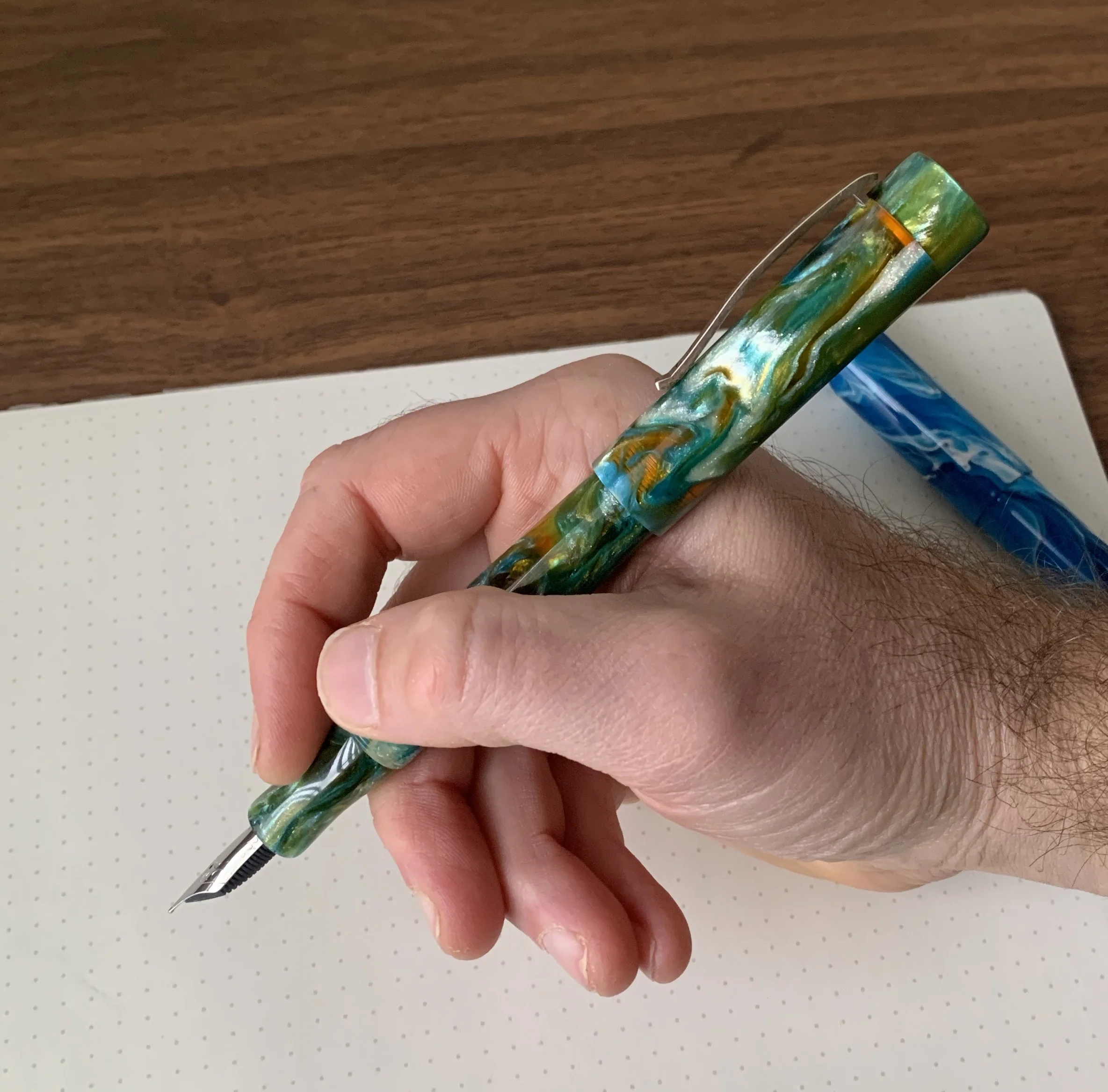
  • The Hanauma Bay fountain pen, from the “Locations” collection, was inspired by a photograph of a sunset over Haunauma Bay, O’ahu. The pen is definitely one of the wilder pieces in my collection, with the acrylic featuring swirls of green, gold, white, turquoise, blue and orange, and the orange and blue showing a good degree of translucency. Most notably, my Hanauma Bay is a “Classic V” shape with a sterling silver clip, and this design posts, which distinguishes it from most of the other Kanilea models. The pen is a bit long posted, but it’s also quite light due to the acrylic construction and cartridge-converter system, so I can easily post it when I don’t have a convenient place to set the cap down.

View fullsize Kanilea Classic V Posted

Premium design and construction warrants a premium price. Kanilea Fountain pens start at $395 for a pen with a steel nib, with gold nibs $125 extra, and rose gold nibs $135. The acrylics are custom made for Kanilea, and the pens are all hand-turned. Trim (clips and medallions) are sterling silver, and nibs are all tuned by Hugh prior to shipping. Finally, most people ignore (or throw out) the packaging from their pens after purchasing, but you’ll want to hang onto your wooden Kanilea box, which makes a great keepsake or pencil box for your desk. I’ve found ways to use all three of them!

Kanilea Clips and Medallions are made with Sterling Silver, lending the pens a very classy, high-quality look.

All Kanilea pens come with a postcard featuring the photograph that inspired your pen’s design.

Takeaways and Where to Buy

In my 2018 recap, I wrote that I would be limiting the number of pens I bring into my collection going forward. One of those slots will almost certainly be held open for a Kanilea Pen, as they always seem to be releasing something new and interesting around the time of the D.C. Pen Show, where I’ve purchased both my Nui Nalu and my Hanauma Bay fountain pens. These are among my favorite fountain pens in my collection, due to both the overall aesthetic as well as the care and craftsmanship that go into the pens themselves, and I look forward to adding more in the future.

Kanilea doesn’t sell through retailers, only directly, so you are limited to purchasing one of their pens through the Kanilea Pen Company website or at a pen show. This year, Kanilea will be attending the Baltimore, Chicago, Washington, D.C., and San Francisco Pen Shows. If you can get to one of these shows, I personally recommend visiting the Kanilea table and seeing the pens in person before you make a decision. Don’t get me wrong, all of their pens are beautiful, but there is so much variation in the materials they use that one pen might speak to you more than others.

Disclaimer: I purchased the pens featured in this review with my own funds, for my own personal collection. I was not compensated in any way for this review, and all opinions expressed are my own.

In Pens Tags Kanilea Pen Co., Hanauma Bay, Nui Nalu, Mauna Kea, Pen Review
Comment

Catching up with Kaweco: Art Sport, AL Sport, and Skyline Sport

January 9, 2019

I believe someone wrote into the Pen Addict Podcast a couple of months ago asking whether there was one brand you couldn’t quit, even though you may have had some issues over the years. For me, that brand is Kaweco, and the Sport models in particular. While Kaweco has frustrated me in the past with their inconsistent quality control on nibs, I love the form factor of the Sport lineup, making it one of the pocket pens I reach for most often. Nib quality has improved recently, though I still have the most luck with mediums and fines. This post will take a look at a few new additions to the Kaweco lineup over the past year that have managed to make their way into my collection.

From left, the Kaweco Art Sport in Dark Blue, the Kaweco Skyline Sport in “Fox,” and the Kaweco AL Sport in Red.

Skyline/Classic Sport: Two New Colors for Late 2018

In late 2018, Kaweco announced two new colors for their basic lineup, the Classic/Skyline Sport: Navy Blue and “Fox”. Since I had recently purchased a Dark Blue Art Sport (see below), I passed on the Navy Blue, plus it had gold trim and I preferred the Art Sport’s chrome. The Fox, however, spoke to me immediately, with its muted, almost terra-cotta tone coupled with the Skyline series’ chrome trim. Other than the new color, there’s not much new to say about this pen. The medium nib is a good enough writer, and the standard Kaweco Sport continues to be one of those pens that is easy to recommend at the lower end of the pricing spectrum, especially for beginners.

AL Sport: Finally, a Red One!

This pen caught me completely by surprise at the 2018 Atlanta Pen Show, where Lisa Vanness had quite a stock at her table. I believe this ruby red color was a North American exclusive for a limited period of time, and for a while Vanness was the only retailer who stocked this particular version. I initially reviewed the AL Sport back in the early days of this blog, and everything I said about that pen still holds true: it’s a pocket-sized workhorse that’s quite durable, and will look even better over time as the anodized finish wears off and takes on that “stonewashed” look.

I first had a chance to take a look at the current Art Sport lineup when I was working the Vanness Pens table at the 2018 D.C. Pen Show.

Art Sport: The Best Version of What The Sport Can Be?

A word of warning: the higher-end Art Sport can spoil you forever on Kaweco pens, and make you never want to touch a Classic/Skyline again. Though Kaweco’s “premier” non-metal Sport model is expensive, the pen kicks the quality up a notch - it’s made from turned acrylic, not injected molded plastic, which gives the pen a warm feel in the hand. Once you’ve written with an Art Sport for an extended period of time, you start to REALLY notice the sharp facets and injection-molding lines of the standard version. Whether this justifies paying the upcharge is a personal decision. (More on that below). Along with the better QC and tighter manufacturing tolerances, the key selling point of the “Art Sport” line is definitely these unique acrylics. While this particular dark blue color, of course, isn’t especially unique, it does have a vintage vibe that I enjoy. The current series also has a lighter blue, as well as “Perlmutt Orange,” and “Metallic Green”. If you’re willing to shop around, you can also find the gorgeous “Tiger Eye.”

When it comes to Kaweco, I accept that I’m going to have to trade reliability for a general lack of nib variety. For the best writing experience, the simple medium works best for me, and it’s what I purchase in all of my Kaweco pens.

Takeaways and Where to Buy

Kaweco Sports are the one pen that I allow myself to pick up on a whim, if I like the color. Because they’re so handy to “grab ‘n go,” I keep a handful inked up at any given time on my desk at home and at work. I don’t anticipate giving up this habit anytime soon. Now if only Kaweco would resurrect the piston-filling Sport that’s sitting in their vintage archives…

As I mentioned, I purchased the red AL Sport from Vanness Pens, who still has it in stock for $90. I acquired the Art Sport in Dark Blue from Pen Chalet, priced at $130. When this series was first released, Kaweco priced the Art Sport models at $175, which I consider way too steep. The turned acrylic and limited edition colors are nice, but this is still a small pen with a steel nib, and a standard $125-135 price point seems appropriate given the “small batch” nature of the production. If Kaweco kept the current pricing standard, they’d gain a lot more traction with the Art Sport, in my opinion. As of 2023, The Gentleman Stationer is an authorized retailer of Kaweco, and stocks the Skyline Sport in colors including the “Fox” pictured here.

Disclaimer: I purchased the AL Sport pictured in this review with my own funds from Vanness Pens, and acquired the Fox Skyline Sport and the Art Sport from Pen Chalet using store credit generated through their affiliate program, of which T.G.S. was a member at the time of original publication. All opinions expressed herein are my own.

A comparison shot with another pocket pen that I recently reviewed: the Sailor Sapporo Mini.

In Pens Tags Kaweco AL Sport, Pen Review, Kaweco, Kaweco Art Sport, Kaweco Skyline Sport, Kaweco Sport
1 Comment
← Newer Posts Older Posts →
Store Hours and Events
Shop T.G.S. Online
Updated 2026 "Best Pens" Guide
No results found
On The Paper Trail: Live In Nashville Event Tickets Now Available!
TGS_25 Roterfaden Restock Notification
Hierarchies of Fountain Pen Friendly Paper

Join Our Patreon!
Subscribe to the TGS E-mail List

Featured Posts

Featured
Graphilo-Kobeha-Paper.jpg
July 11, 2026
Paper Review: Graphilo by Kobeha
July 11, 2026
July 11, 2026
Pilot-Custom-Heritage-92.jpg
June 6, 2026
Workhorse Pens: Pilot Custom Heritage 92 Fountain Pen
June 6, 2026
June 6, 2026
Kakimori-Inkstand-Before.jpeg
May 30, 2026
Japan Trip Journal: A Visit to Kakimori, Including Custom Notebooks and the InkStand!
May 30, 2026
May 30, 2026
The Gentleman Stationer RSS

View Cart

© Digital Divide Media, LLC, 2014-present.

All content is the exclusive property of Digital Divide Media, LLC, d/b/a The Gentleman Stationer, including “The Gentleman Stationer” website and trademark, and should not be reproduced without express written permission.  All rights reserved.

All content containing paid advertising, affiliate links, or sponsored content will be plainly disclosed by a disclaimer when/if featured.

Contact Information

Website Terms and Conditions

Store Shipping Policy and Return Policy

Privacy Policy and Cookie Policy

Accessibility Statement

Powered by Squarespace