• Blog
  • Shop
  • Podcast
  • Resources
  • About
  • Archive
  • Contact
  • Cart
  • Sign In My Account
Menu

The Gentleman Stationer

Vintage Living in the Modern World.
  • Blog
  • Shop
  • Podcast
  • Resources
  • About
  • Archive
  • Contact
  • Cart
  • Sign In My Account

Pen Review: Yookers Refillable Felt-Tip Pens

November 6, 2019

One of the more intriguing products to catch my eye over the past few months is a series of “refillable felt-tip pens” from Yookers, a brand that seemingly came out of nowhere but apparently ran two highly successful Kickstarters. (I don’t follow Kickstarter all that closely, so the fact that I missed out doesn’t mean much.) After fountain pens, felt-tip or fiber-tip pens have a special spot in my pen case, dating all the way back to the red Papermate Flair pens I used in school. Picking up one of the Yookers pens was a no-brainer.

I opted for the “Matte Black Lacquer” version of the Yookers Metis, of course!

Before I get started on the pen: what about the Company? I could locate very little information about Yookers or the individuals behind it, even on the Yookers website. The “About” section describes Yookers as “a union between passionate people from different universes who decided to innovate together,” along with a paragraph of additional marketing-speak. Their Kickstarter page is even more vague, describing Yookers as “the blending studio.” (???) There’s nothing wrong with owners of companies wanting to maintain privacy and discretion - hey, I value my own privacy and take steps to protect it - but I’d like a bit more information here. Both Kickstarters indicate that Yookers is based in Hong Kong, and I would venture that they have some relationship with Yafa, the owner/distributor of Monteverde pens and inks. Personally, I think the design of the Yookers pens bears a strong resemblance to Monteverde pens, as do their ink bottles, so it could be some sort of joint venture.

Yookers already has a fairly extensive lineup of pens, and seems to have ramped up production quickly. The original “Refillable Felt-Tip Pen” first appeared on Kickstarter last year, and Yookers has since launched a second Kickstarter project for a different pen design called the “Eros". The Yookers website features additional pens, priced anywhere from $12-$55.

The Yookers Metis Disassembled.

So what about the pens themselves? Well, they’re mostly as advertised. The refillable felt-tip mechanism works well, and I’ve had no difficulty cleaning out the tip to change colors, no leaks, or anything else of that sort. The Yookers pen writes like your typical felt-tip pen. However, before you run out and drop up to $50 on one, here are a few considerations:

  • Filling the Pen. The Yookers pens use a cartridge/converter filling system, but you cannot fill the pen through the tip - you have to fill the converter directly either by dipping the end of the converter into an ink bottle or using a syringe. If you want to use your collection of bottled ink, the process of filling will be messier than your typical fountain pen. Of course, you can also use cartridges.

  • Writing Experience. The Yookers felt-tip writes very well, and feels like a Pilot Razor Point, Papermate Flair Marker, or one of your other standard office-supply store pens in an upgraded body. That said, fountain pen ink is water based, whereas your standard disposable felt-tip pens use pigmented ink or something more permanent. You’ll probably notice that the Yookers felt-tip doesn’t write a particularly dark line, probably because the smaller tip doesn’t allow for a large volume of ink to pass through onto the paper, unlike a fountain pen. I’m going to experiment with more saturated or permanent inks to see what works best.

  • Replacement Tips. Eventually, all felt-tips wear out and need to be replaced. Yookers sells replacement tips for $6 each. However, you don’t replace just the tip - you replace the entire front section of the pen. While they may have decided to do this for convenience sake, and figured that replacing just the smaller tip would be too difficult for most people to do without increasing the risk of the pen leaking, etc., it strikes me as a lot of wasted metal and plastic to throw out the entire section. Moreover, as other have observed, if you decide to invest in a Yookers pen as a key part of your writing/drawing kit, you are betting that Yookers will be around to manufacture the replacements for the foreseeable future. If you really like this pen, I would go ahead and stock up on replacement tips, which Yookers says will last about a year, depending on use, writing pressure, etc.

The Yookers pen probably works best unposted. As shown in the next picture, the cap doesn’t post deeply and sits awkwardly on the back.

The Yookers Metis posted.

Writing Sample in Noodler’s Walnut.

Takeaways and Where to Buy

I enjoy my Yookers Metis refillable fiber-tip pen, and it’s one of the more unique stationery products to have been released in the past year. The pen functions as intended, seems very well-made, and the price point is more than fair. I do, however, wish that I knew more about the company, especially since you will be investing in a proprietary system should you decide to make the Yookers pen a central part of your writing kit.

You can purchase the Yookers Metis refillable fiber-tip pen from our sponsors at Pen Chalet. The “Metis,” which is the pen with a metal body, currently retails for $42, but if you prefer to test out the refillable fiber-tip technology at a lower price point, the Yookers “Yooth” pen features a plastic barrel and comes in at less than $10. Replacement tips/sections cost around $6.

Disclaimer: I purchased this pen from site Sponsor Pen Chalet using store credit generated through the Pen Chalet affiliate program. This post contains affiliate links. Many thanks to Pen Chalet for making this review possible.
In Pens Tags Yookers, Felt-Tip Pens
6 Comments

Ink Review: Vanness Pens / Joey Feldman "Inktober" and "Good Evening"

November 2, 2019

Most people know Vanness Pens in Little Rock, Arkansas as the go-to resource for rare and unusual inks. They have one of the largest selections of fountain pen inks in the world, and are always the first to import new lines of ink from Japan, Korea, the Netherlands, the Philippines - you name it. As experts in the subject, I guess it was only a matter of time before they started mixing their own inks! Today I’m reviewing two inks developed in collaboration with artist Joey Feldman: a black ink called Inktober 2019, as well as a red/burgundy called “Good Evening,” which you might find reminiscent of a certain highly coveted limited edition ink from around 2013. (It’s intentional.)

Let’s start with Inktober. For those of you unfamiliar with the term, #inktober is an online challenge in which participants post one drawing per day for the month of October. As someone with zero artistic ability who assumes that people will be easily bored by an endless array of stick-figure cartoons, I’ve not participated, but I always enjoy seeing the amazing work that everyone else can do.

As the name implies, the Inktober ink was formulated as a black ink for sketching during the month of, well, Inktober. It’s impermanent by design - many of the #inktober entries have featured brush and ink-wash techniques that take advantage of this ink’s ability to shade when diluted. That said, I absolutely LOVE this ink as a black ink for writing. I’d compare it to Lamy Black or Rohrer & Klingner Leipziger Schwarz, which are both interesting black inks with different tones to them. I do think that the Inktober dries quicker and feathers less on inexpensive paper, and of course, with these two inks you don’t get a bottle featuring Joey Feldman artwork.

I think I like Joey’s caricature better.

“Good Evening” is easily my favorite of these two releases, which should come as a surprise to no one. It’s a rich red ink that I could alternately describe as “burgundy red” or “blood red,” depending on the light. Both the name and the design on the bottle should give you a good idea of the inspiration for this particular ink, and it’s absolutely amazing to see someone come EXTREMELY CLOSE to duplicating what I consider one of the best red inks ever made. Good Evening also makes for an excellent writing ink, and given that it writes relatively wet and flows well, the lack of feathering and bleedthrough surprises me. (The writing sample featured here was done with a firehose broad nib on a Lamy 2000.)

Some of the difference here is the lighting, and the fact that the Montblanc Hitchcock is still wet, but the ink on the left has a bit more red in it than the “Good Evening.” Once the inks are thoroughly dry, the match is closer, but not exact.

Another picture taken after the ink swatches are dry. You’ll notice that the Good Evening still has slightly more purple/blue, while the Hitchcock has more red. Hitchcock can also have a slight gold/brown sheen to it (the “dried blood” effect).

Takeaways and Where to Buy

Inktober and Good Evening both have the potential to become favorites, and I’m looking forward to more special edition runs and, hopefully, a standard lineup from Vanness in the future. Right now, you can purchase the Inktober 2019 Limited Edition Ink and “Good Evening” for $15 per bottle on the Vanness website. If I didn’t already have a gazillion bottles of ink sitting in a cabinet in my home office, I’d be buying multiples. These inks are that good.

Also, don’t miss the Vanness Fountain Pen Day Orange Ink, made to match the Limited Edition FPD Franklin-Christoph 31 pen released yesterday! Vanness still has both pens and ink in stock, though the pens are a limited run of 88 so I’m not sure how long they will last. Also, be sure and check out yesterday’s Deals & Drops post, which highlighted this and several other Fountain Pen Day promotions. At least one sale (Pen Chalet) has been extended through Sunday.

Disclaimer: I received the two bottles of ink featured in this review, free of charge, from Vanness Pens for review purposes. This post contains links to paid sponsors and affiliates.

In Ink Reviews Tags Vanness Ink, Vanness Pens, Joey Feldman, Ink Review
Comment

Pen Review: Lamy LX Marron Special Edition

October 30, 2019

I’ve written much this year about Lamy’s newfound fondness for special and limited editions. In addition to the blue Macrolon Lamy 2000 they released to commemorate the 100th Anniversary of the Bauhaus, Lamy has also issued three different Safaris in various pastel colors, two different Studios, an AL-Star in “Bronze,” and now a Lamy LX in “Marron.”

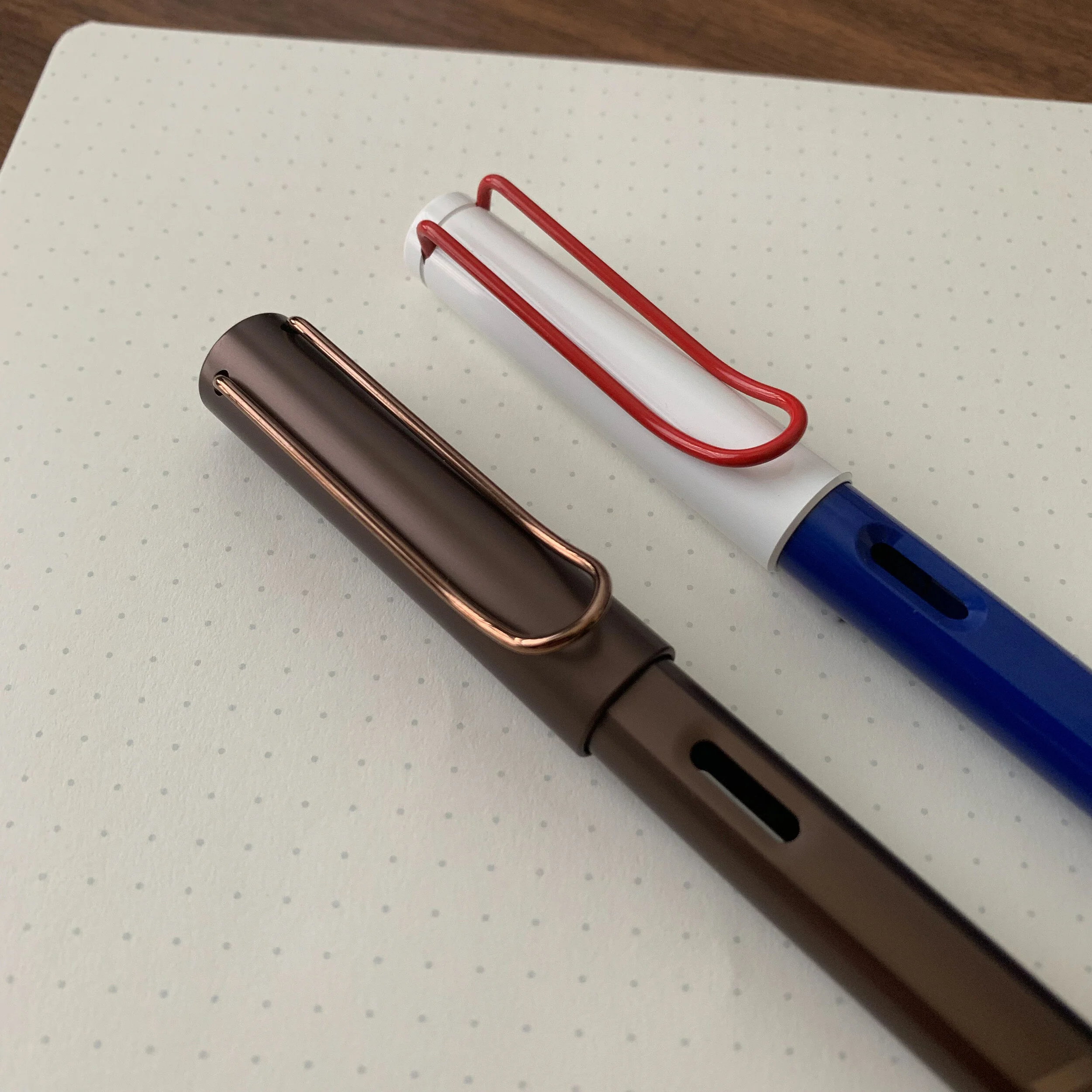
I’ll give Lamy this: their clip game is killing it. I couldn’t choose between the burnished clip on the LX Marron and the red clip on the “Independence Day” Safari, so I picked up both.

I’ll give Lamy this: their clip game is killing it. I couldn’t choose between the burnished clip on the LX Marron and the red clip on the “Independence Day” Safari, so I picked up both.

I reviewed the standard version of the Lamy LX last summer, and my overall reaction was “meh.” Though far from a bad pen, I questioned whether Lamy did enough to justify the markup over a standard AL-Star by adding new “iPhone colors” and a fancier nib. I’m still leaning towards “no” on the regular versions of the LX, but this new “Marron” (French for chestnut) model might be a different story.

I don’t typically go for brown pens, but I have to hand it to Lamy here: the combination of brown anodizing and the burnished copper/bronze clip look better than any special edition AL-Star in recent memory. I think I’ve said it before, but it would serve Lamy well to rein in the volume of special edition releases - especially the more generic ones - in favor of cranking out real beauties like this pen.

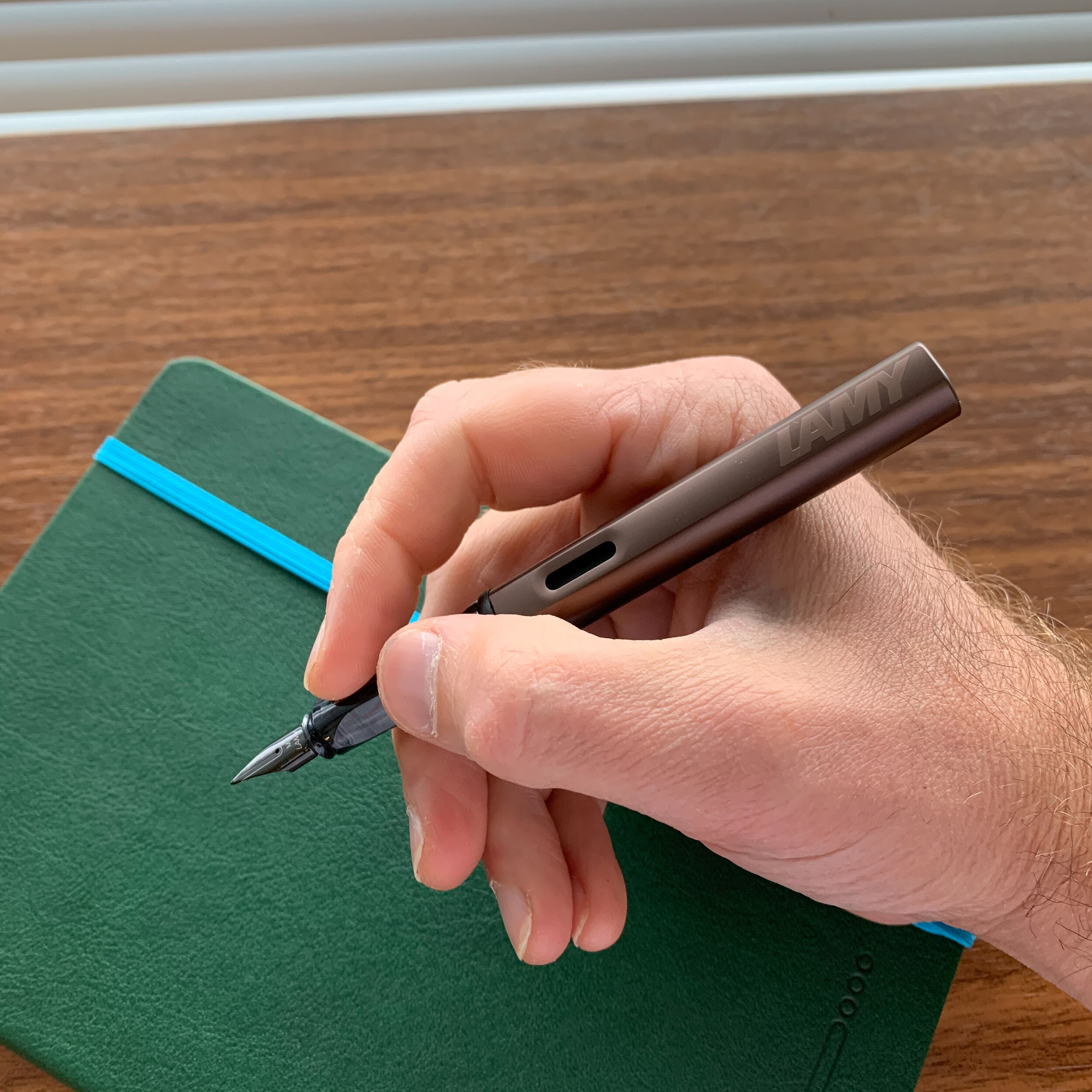
View fullsize Lamy LX Marron Posted
View fullsize Lamy LX Marron Unposted

Takeaways and Where to Buy

Unless you don’t already have another Lamy AL-Star or Lamy LX, the Marron special edition is basically a vanity purchase for the new color scheme. Those who aren’t really drawn to this particular color will - and should - question whether it’s worth it to pay the markup for the LX instead of the perfectly functional AL-Star. Personally, I think the dark chestnut brown looks excellent, and the combination of this particular anodization with the metallic bronze clip makes me wonder if Lamy should have gone all-in on the Marron instead of this year’s somewhat uninspiring special edition AL-Star release in “Bronze”.

Apart from the special colors, the only real difference in terms of hardware between the Lamy AL-Star and the Lamy LX is the nib.

You can purchase the Lamy LX Marron special edition fountain pen from our sponsor Pen Chalet, currently priced at $56. Pen Chalet also carries the full line of standard Lamy AL-Stars, and if the Bronze special edition interests you, it’s currently on sale at a reduced price.

For those of you located outside the U.S., our sponsor Appelboom also carries the Lamy LX fountain pen, in both the standard colors as well as the Marron Special Edition.

Disclaimer: This post contains links to paid sponsors and affiliates. I purchased the Lamy LX featured in this review using affiliate credit generated through Pen Chalet’s affiliate program. Many thanks to Pen Chalet for making this review possible.
In Pens Tags Lamy, Lamy LX, Lamy LX Marron, Lamy Special Editions, Fountain Pen
Comment
Best-Buys-in-Fountain-Pens

The Best Value Buys in Fountain Pens in 2019

October 26, 2019

When I evaluate items purchased or sent to me for review, I focus on a few key points. The first, and to me, the most important, is quality. If something is a poorly made piece of junk barely capable of putting ink on the page, I don’t care what it looks like, how little it costs, or how easily replaceable it is - I won’t recommend that anyone purchase the product. The second point is practicality. I use my pens, so in the context of reviewing I consider the pen’s functionality as a daily writer. Did I need to adjust the nib out of the box? Does the pen balance well in the hand? Does the cap post to my satisfaction? Is the pen so comfortable to use unposted that I don’t care? Is ink capacity an issue for longer writing sessions?  The third factor, which I’ll focus on today, is the pen’s overall value proposition. Though the concept of value is highly subjective, and much depends both on the traits and features that one considers important as well as one’s budget/price sensitivity, I’ll assume for purposes of this particular article that the majority of my readers are willing to spend anywhere from $20-$200 on a fountain pen, and share most of my personal preferences in terms of what they look for in a pen. With this in mind, I’ll discuss several pens that I think give you a lot of bang for your buck. 

Value Considerations In a Fountain Pen Purchase

So what do I look for? To me, whether or not a particular fountain pen represents a good or bad value proposition starts with the price point at retail. In today’s market, I consider the baseline price of a high-quality steel-nib fountain pen that will give you years of consistent service without much fuss to be around $135. If a pen I’m reviewing falls around this price point, has a good nib, is comfortable to use, and doesn’t feel inexpensively made or mass-produced, I generally consider that pen to be reasonably priced and a “fair” value. As you would expect, if a pen ticks all those boxes and falls below this $135 mark, it becomes a better “value proposition” (i.e., you get more for your money). Pens that exceed my baseline price point can still be good value propositions, but they need to offer something more that distinguishes them from run-of-the-mill offerings. 

With respect to those much less expensive pens that I consider great value propositions, I feel that I am getting something in terms of the writing experience that one would typically only find in a more expensive pen. For example, an injection-molded plastic TWSBI may not feel as well-made or appear as attractive as a pen from Franklin-Christoph, but it does offer a reliable, smooth piston mechanism with a large ink capacity for less than $70. For that reason, I think TWSBI generally offers excellent value. Similarly, pens by PenBBS and Moonman have exceptionally smooth nibs, and I understand that Moonman nibs are actually hand-tuned at the factory. This is something you don’t usually find on inexpensive pens that can be purchased for under $20.

On much more expensive pens (say $250-plus), I apply the “Lamy 2000 Test.” I can usually purchase a Lamy 2000 - probably my favorite fountain pen on the market - for $200 tops, and typically less. What is there about a more expensive pen that justifies spending the extra money? Is the pen made from an uncommon or special material, like celluloid or a manufacturer-exclusive acrylic? Is the pen a special or limited edition with a theme that holds particular meaning for me? Is the pen hand-turned by a small maker or a collaboration where a portion of the proceeds goes to a cause I care about? Do I love the aesthetics of the pen so much that I simply don’t care about having to shell out the extra money? 

My 2019 Value Recommendations

With these considerations in mind, what fountain pens do I think represent the “best value” in 2019? 

Lamy 2000. It’s hard to beat the Lamy 2000 as a value proposition, especially when you can grab it for less than $150 on sale or by using a coupon code. I won’t go into what I like about this pen as a daily workhorse for the umpteenth time - you can read my “Workhorse Pens” profile here - but for the money you will get a reliable, lightweight piston filler with a 14k gold nib. The way prices are trending these days, a similarly equipped pen from another major brand like Pelikan would run you at least $300. (Purchase Here)

Anything From Franklin Christoph. The main selling point about Franklin-Christoph pens are their nibs, with the unique resins and acrylics coming in a close second. The Franklin-Christoph Model 20 is one of my personal favorites, and it starts at $165 with a standard nib, but you have the option to add a hand-ground S.I.G. (Stub Italic Gradient) nib for $20, or a Mike Masuyama specialty grind for $25. (Prices are for steel nibs; gold nibs cost extra.) The ability to add a customized stub or italic nib to an already exceptional fountain pen, and still come out under $200, equals huge value in my book. (Purchase Here)

Leonardo Momento Zero. One of my favorite new brands is Leonardo Officina Italiana, and I am a huge fan of their Momento Zero fountain pen. The base model is a hand-turned acrylic pen with a stainless steel nib - on paper, nothing special - but Leonardo offers unique materials that I think have the look and feel of vintage celluloid, with the pens starting at $169 retail and often ending up priced even lower. That represents outstanding value for such a high-quality handmade pen. My one very high-end purchase this year was one of the Momento Zero “Maestro” sets, which gave me very little hesitation since pens made from those specific Italian celluloids are retailing for much more than the Leonardo set when considered on a per-pen basis. (Purchase Here)

TWSBI ECO. For those looking to break into the world of bottled ink without spending a lot of money, it’s hard to do better than the TWSBI ECO. Retailing at around $30 or less, you get a well-made pen with a good steel nib, large ink capacity, and a reliable piston. TWSBI also has started to release the ECO in a range of transparent colors, making it a fun and inexpensive series of pens to collect, if that’s your thing. Honestly, if I had to, I could make do with a TWSBI ECO as my sole daily driver. (Purchase Here)

PenBBS 308. At the sub-$20 level, you have PenBBS, which I’ve found to be one of the more fun and reliable inexpensive brands. While I don’t have enough experience with their more sophisticated filling systems (vacuum, syringe, and piston fillers) to make a long-term judgment on their durability, the cartridge-converter PenBBS 308 can be found for less than $20, and comes in a range of unique, colorful materials that I’ve never seen at this price point. I also really enjoy the slightly upturned nib, which I’ve consistently found to be a smooth writer. (Purchase Here)

Pilot Pens in General: The Pilot Custom 74, the Pilot Custom Heritage, and the Pilot Vanishing Point will all net you a pen with a gold nib for $200 or less. (The Custom Heritage runs around $220 but 10% discount codes are fairly easy to come by.) Though the Vanishing Point and its slightly smaller sibling, the Decimo, have their fans and detractors due to the placement of the clip, which can interfere with grip depending on how you hold the pen, the Custom 74 (cartridge-converter) and Custom Heritage (piston filler) are standard-shaped pens that most can use quite comfortably. In my opinion, they are also both highly underrated and don’t receive nearly the amount of attention they should. (Purchase Here)

This isn’t intended to be a sophisticated economic analysis of the fountain pen market, just a general discussion of what I consider when offering my opinion on whether specific pens represent “good value” or, on the other hand, are overpriced. Different people will have different considerations, but I thought it might be helpful to my readers to lift the veil a bit on what I consider in the course of my reviews. Feel free to reach out or comment if you have any further questions.

Disclaimer: This post contains links to paid sponsors and affiliates.

In Editorial Tags Editorial, Value, Top 5
3 Comments

Pen Review: Jacques Herbin "Sloop" Fountain Pen

October 24, 2019

Last year, Herbin, one of the oldest ink manufacturers in the world, announced that it would launch a set of high-end fountain pens under the new moniker “Jacques Herbin.” When the designs were revealed, it’s safe to say that people were … underwhelmed. I’ve yet to read a review of these pens, and I’ve not seen them sold at retail in the U.S. Our sponsor Appelboom, which is located in the Netherlands, kindly agreed to lend me one of the dark blue “Sloop” fountain pens with brushed steel trim. My conclusions? The Jacques Herbin Sloop would make a nice everyday writer, similar to some of the more basic models by Waterman or Montegrappa. The problem here, as is common with companies trying to break into the fountain pen market at the “luxury” level, is the high price point.

I truly enjoyed several aspects of the Jacques Herbin Sloop. While I didn’t subject this pen to the true rigors of my daily carry, since I received this pen on loan, I spent enough time with it to offer some general observations.

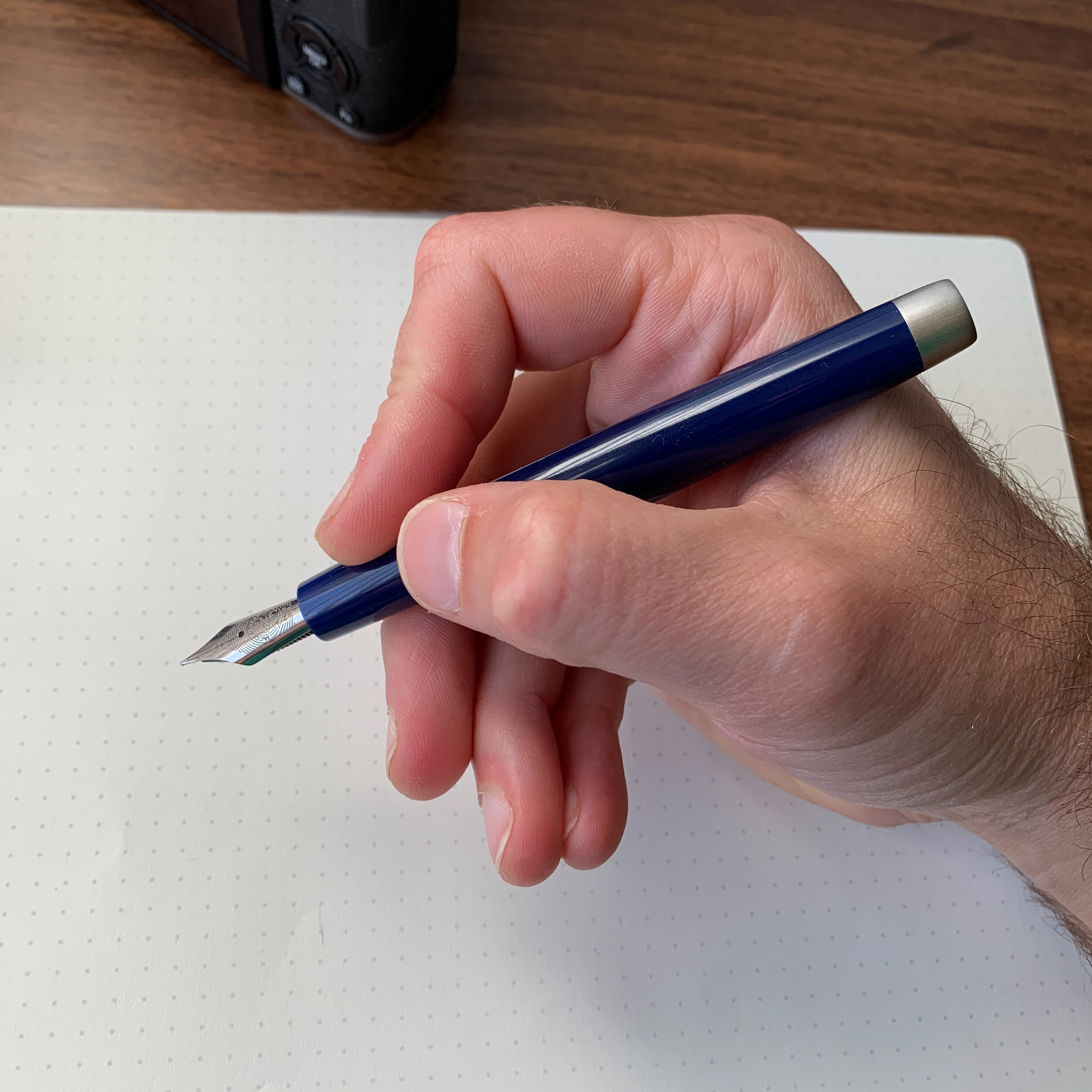
A comfortable section, with the threads placed high so as not to interfere with your grip. Perfect for longer writing sessions!

Pros:

  • Overall Design. The Sloop features a classic, understated, vintage-style design (which you would expect from Herbin). I would characterize this pen as a streamlined flat-top, accented by brushed metal trim on the cap band, clip, and two finials. The acrylic section is on the longer side, and despite the fact that the pen has metal threads, they sit high up and shouldn’t interfere with most people’s grip.

  • Brushed Metal Trim. More companies should offer brushed metal trim. It adds interesting detail to an otherwise basic acrylic design. I could have done without the “Jacques Herbin Paris 1670” engraving around the cap finial, since something about it looks slightly “off” when set against the brushed metal. It may be that Herbin simply tried to include too much text in a small area, and the brushed metal leaves the edges looking fuzzy. 

  • Well-tuned Bock Nib. The stainless steel Bock nib on the Sloop was a good one: well-tuned and moderately wet. I also liked the fact that Herbin went with a custom engraving and didn’t offer just a stock nib. If a company plans to ask for more than $200 for the pen, customized nibs are really the only option.

The Bock nib on this Jacques Herbin Sloop wrote extremely well.

Cons: 

  • Price. The single biggest issue with this pen is the price point Herbin has chosen to pursue. The Sloop is currently priced at around $240, placing this pen at a more expensive price point than brands such as Franklin-Christoph, Leonardo Officina Italiana, and introductory level Montegrappas like the Elmo and Fortuna.  

  • Insubstantial Feel in the Hand. The material feels thin, and different from the resin or acrylic used by Montblanc, Franklin-Christoph, or even PenBBS. That’s not to say the pen is poorly made or fragile - I’m sure it will hold up fine - it just doesn’t feel as you would expect from a pen at this price point. 

  • Postability. Since the Sloop is a relatively slender pen, I found myself wanting to post it, but the cap doesn’t post deeply enough for a comfortable writing experience. The feel of this pen is very much like the Karas Kustoms Decograph: as noted above, I enjoy the vintage-style design, and the section is quite comfortable, but like the Decograph, it’s a bit long and awkward posted. 

While I like the brushed trim on this fountain pen, I’m not sure that this particular engraving design/technique works….

View fullsize Jacques Herbin Sloop Unposted
View fullsize Jacques Herbin Sloop Posted

Takeaways and Where to Buy

It’s always interesting to see companies branch out from their traditional product lines in an effort to expand their brand’s reach. Previously, Herbin has confined it’s pen offerings to lower-cost dip pens, inexpensive fountain pens, and refillable rollerballs. While my overall impression of Herbin’s first foray into the high-end pen market is generally positive, and I certainly like the look they are going for, I think Herbin will have a hard time being successful unless they move these pens into the $150-200 price range. While nice, the overall design isn’t particularly distinctive or inspired enough to warrant charging more than, say, a Montegrappa Fortuna - a pen that is already pushing the upper limits of what consumers would be willing to pay for a cartridge-converter fountain pen with a stainless steel nib. 

The pen featured in this review was generously loaned to me by Appelboom, a sponsor of this blog. The Jacques Herbin Sloop is currently priced at $240 US (subject to change along with the exchange rate), and comes available in Black, Amber, and Taupe, in addition to the Dark Blue model pictured here.   Appelboom carries the full range of Jacques Herbin fountain pens, Herbin inks, and dozens of other brands. 

Disclaimer: This post contains affiliate links. Should you elect to purchase a pen from Appelboom, I will receive a small commission which I use to keep this blog running. Many thanks to Appelboom and all my readers for your support!

In Pens Tags Jacques Herbin, Jacques Herbin Sloop, Pen Review
Comment
← Newer Posts Older Posts →
Store Hours and Events
Shop T.G.S. Online
Updated 2026 "Best Pens" Guide
No results found
On The Paper Trail: Live In Nashville Event Tickets Now Available!
TGS_25 Roterfaden Restock Notification
Hierarchies of Fountain Pen Friendly Paper

Join Our Patreon!
Subscribe to the TGS E-mail List

Featured Posts

Featured
Pilot-Custom-Heritage-92.jpg
June 6, 2026
Workhorse Pens: Pilot Custom Heritage 92 Fountain Pen
June 6, 2026
June 6, 2026
Kakimori-Inkstand-Before.jpeg
May 30, 2026
Japan Trip Journal: A Visit to Kakimori, Including Custom Notebooks and the InkStand!
May 30, 2026
May 30, 2026
Five-Foundational-Fountain-Pens.jpeg
April 22, 2026
T.G.S. 12th Anniversary: 5 Fountain Pens Everyone Should Experience
April 22, 2026
April 22, 2026
The Gentleman Stationer RSS

View Cart

© Digital Divide Media, LLC, 2014-present.

All content is the exclusive property of Digital Divide Media, LLC, d/b/a The Gentleman Stationer, including “The Gentleman Stationer” website and trademark, and should not be reproduced without express written permission.  All rights reserved.

All content containing paid advertising, affiliate links, or sponsored content will be plainly disclosed by a disclaimer when/if featured.

Contact Information

Website Terms and Conditions

Store Shipping Policy and Return Policy

Privacy Policy and Cookie Policy

Accessibility Statement

Powered by Squarespace