• Blog
  • Shop
  • Podcast
  • Resources
  • About
  • Archive
  • Contact
  • Cart
  • Sign In My Account
Menu

The Gentleman Stationer

Vintage Living in the Modern World.
  • Blog
  • Shop
  • Podcast
  • Resources
  • About
  • Archive
  • Contact
  • Cart
  • Sign In My Account

Swapping Fountain Pen Nibs: From Easy to Expert

October 13, 2021

One thing that most enthusiasts love about fountain pens is the ability to customize your pen for your writing style and aesthetic preferences. Whether it’s having a custom pen turned from a favorite material, in a shape that’s the perfect size for your hand, or a nib ground to showcase your own style of handwriting, the options are essentially limitless. At the same time, the idea of physically pulling the nib and feed out of your fountain pen and putting it back together again intimidates many people, even seasoned users who have written with fountain pens for years. There’s no reason to be afraid. While changing nibs on your own does merit a degree of caution (just like disassembling a pen for cleaning or filling from an ink bottle), it’s something that most fountain pen users can do without risk of seriously damaging their pen. Today I plan to walk through a few different options, ranging from easily swappable pre-assembled nib units to more complex modifications.

When changing nibs (or doing any sort of pen-related maintenance), I typically like to work on a towel or other soft/grippy surface to keep pens and loose parts from rolling off the table.

Getting Started: Create Your Workspace

Necessary precautions are minimal. Basically, you need a well-lit workspace with a towel or other no-roll surface to hold your pens and nibs. The number-one danger when performing any sort of work or maintenance on fountain pens is dropping a pen onto the floor and cracking the pen barrel and/or bending the nib, so make sure your pens are secure. I typically unroll a towel onto a sink or standing desk and use that as my work surface.

Swapping out interchangeable nib units (discussed further below) doesn’t require any special tools. Otherwise, you will likely need a square of rubber to help grip the nib and feed, and possibly a loupe or other magnifier to align nib tines.

Franklin-Christoph fountain pens use JoWo nibs, so it’s easy to amass a large collection of custom-ground F-C nib units that you can swap between all of your JoWo-compatible pens.

Easy: JoWo, Bock, and TWSBI Interchangeable Nib Units

These days, the majority of pen makers no longer manufacture their own nibs in-house, and instead purchase nibs from third-party companies JoWo, Bock, and to a lesser degree, Schmidt (though I find Schmidt nibs excellent and don’t know why they’re not more widely used). While some people complain about monotony and the lack of expressiveness in how these modern nibs write, there is one key advantage to this uniformity: interchangeability. Many, if not most, pens that accept standard JoWo or Bock nibs use a default nib unit (i.e., a nib and feed seated in a threaded housing) that can easily be unscrewed and used in another compatible pen. Once you start custom-grinding these nib units or gather the range of nib sizes, it becomes a very versatile platform that can allow you to thoroughly enjoy your pen collection.

The process for swapping out a JoWo or Bock compatible nib unit is mostly the same between brands. Gently grasp the nib and feed and turn counter-clockwise to unscrew the unit.

The process for swapping out a JoWo or Bock compatible nib unit is mostly the same between brands. Gently grasp the nib and feed and turn counter-clockwise to unscrew the unit.

The process itself is simple. First, if the pen you are working on is a cartridge-converter model, remove the converter. Then, gently grasp the nib and feed and turn the nib unit counter-clockwise to remove it. Select your new nib unit, insert it into the section, and rotate clockwise until secure. Do not overtighten, as this can misalign the tines of the nib, at best, and cause stress damage to the nib housing, at worst, in which case you will need a replacement.

Opus 88 pens, which are Japanese-style eyedroppers, add one slight wrinkle to the process. There is a small o-ring attached to the bottom of the nib unit housing. If replacing with a non-Opus nib unit, don’t forget to transfer the o-ring as well. It sits on the plastic “stem” and is easily removable.

TWSBI nib units are slightly different, though still simple. On the TWSBI Diamond 580, you simply unscrew the front section of the pen and slide the nib unit out of the plastic cover (shown here in red but clear on most current 580 models). Insert your new nib unit and reassemble. Because TWSBI sells spare nib units for the express purpose of allowing you to easily switch nibs between pens, you don’t have to worry about voiding your manufacturer’s warranty or otherwise causing unintended damage. I own several spare TWSBI nibs, some of which have been custom ground to specialty nibs such as architects.

View fullsize 35633B67-7AE5-4CB2-AABE-0FD988432538_1_201_a.jpeg
View fullsize FE53EEC6-E337-43D7-9DAC-77A8521F41D3_1_201_a.jpeg

Editor’s Note: There has been a lot of press recently about a manufacturing defect that has caused cracks in JoWo nib housings. While I’ve been lucky and have not yet found the issue in any of my personal pens, JoWo has released a series of announcements discussing how they plan to fix the problem. If you have been inspecting your JoWo nib units and discover cracks, please reach out to Meister Nibs, the U.S. JoWo distributor.

Intermediate: Pulling and Setting Friction-Fit Nibs

But what about pens that don’t use interchangeable nib units? Well, the nibs on those pens are, for the most part, equally “swappable” and the process is no more mechanically complex than taking a small square of rubber or other grippy material, grasping the nib and feed, and pulling both out of the front end of the pen’s section using a steady motion. You replace a nib the same way, though you need to be pay attention when reinserting the nib and feed as some pens have grooves or “guides” that determine exactly how the nib is supposed to fit.

The nibs on some pens, especially those with proprietary in-house nibs like this Platinum 3776, do not come in a housing, meaning that the nib and feed sit directly inside the custom section.

So why do I have this categorized as requiring an “intermediate” skill level? Honestly, it’s more about confidence than skill. Sometimes, things don’t go 100% as expected. Old ink residue may cause the nib and feed to get stuck in the section, and you may find yourself having to pull fairly hard or jiggle the nib a bit (gently!) to dislodge it from the pen. Any time you apply force, you run some risk of misaligning the nib tines or cracking the feed. Changing friction-fit nibs properly requires some patience, a willingness to engage in a bit of trial-and-error, and an “intermediate” understanding of how fountain pens work. Finally, keep in mind that if your pen breaks and you can’t fix it on your own, the manufacturer might consider removing or swapping the nib on a pen without an interchangeable nib unit to be a “modification” that voids your warranty. That’s not to say that you won’t be able to find someone who can fix the pen, but you will likely have to pay for it.

From the top: Platinum 3776 UEF in Schon Black Ultem, via Flexible Nib Factory JoWo housing; Pilot PO Nib in Newton Shinobi, via same housing; Platinum 3776 in an Opus 88 Jazz, via same housing.

Expert: Custom Nib Housings for Maximum Pen Hacking

The last topic I plan to discuss combines the two techniques discussed above in a manner that allows you to create your own custom nib units. Flexible Nib Factory sells custom nib housings designed to pair proprietary nibs and feeds (i.e. Platinum, Pilot, Pelikan, Sailor, etc.) with JoWo and Bock-compatible pens. For example, I pulled a friction-fit medium 14k Platinum nib from a standard Platinum 3776 fountain pen, and inserted both the nib and feed into a JoWo-compatible Flexible Nib Factory housing, which I then seated in an Opus 88 Jazz. The one drawback is that these custom housings won’t accept a converter, so you will need to use a piston filler, eyedropper, or bulkfiller-style (i.e. Conid) pen. Opus 88 pens work great for these types of modifications, though with certain brands like Platinum you may have to trim the plastic end on the back of the feed in order to allow the Japanese-style eyedropper system to close.

A nib unit disassembled. Using Flexible Nib Factory housings, you can pull, for example, a nib and feed from a Platinum 3776 and insert it into the custom housing designed to fit a JoWo or Bock pen. It’s less complex than it looks.

A word of caution: customizing fountain pens in this way is addictive. Since building my FrankenJazz, I’ve also moved another Platinum 14k UEF (Ultra Extra-Fine) nib and a Pilot PO (Posting) nib into JoWo housings, which are now in a Schon Black Ultem and Shawn Newton Shinobi. I’m eyeing several other nibs in my collection that don’t get much use in their current setup…

This post does not contain affiliate links. I purchased the pens, nibs, and nib units featured in this post with my own funds, for my own collection. The Gentleman Stationer is reader-supported. If you would like to support us, please consider purchasing from the T.G.S. Curated Shop or checking out the T.G.S. Patreon Program, which offers access to online meetups, exclusive discounts and pre-orders, and more!
In Editorial, Guide Tags Nib Modification, Nib Grinding, Nib Swapping
16 Comments

Introducing the New and Improved T.G.S. Review Archive

September 25, 2021

One thing that has frustrated me beyond compare is the inability of readers (and myself) to easily search the eight years’ worth of T.G.S. review content. I finally couldn’t take it anymore, and for the past month I’ve been working on building an organized archive of past T.G.S. pen reviews. I’m happy to let you know that the new archive is now available to search, and I plan to do the same with non-fountain pens, inks, and paper in the future.

I have organized this review archive by brand, albeit with most small-batch and artisan makers grouped into their own section, which sits at the top of the page. My recommendation is that you go there first, as that’s where the most exciting stuff is happening these days. Enjoy!

You may notice that some brands are missing from this list. That is either because I have not yet reviewed pens made by the brand in question, or I haven’t yet located the past content. The archive is, and will forever remain, a work in progress as I don’t aim to stop reviewing anytime soon!

In Editorial Tags Editorial, Content Archive
1 Comment

Today’s review pens: a Scriptorium Balladeer and Schon DSGN Ultem Fountain Pen.

Spotlight On: The Nib Tailor, Featuring Architect + Inverted Architect Nib Grinds

September 18, 2021

I’ve known J.C. Ament for years, from way back when he was attending shows as an enthusiast, to when he started dabbling in nib work under his previous brand, Nibs on Point. I wanted to take a moment today to let everyone know about his latest endeavor, in which he’s embarked on nib work full time as “The Nib Tailor.” Before he took a break from pen shows, J.C. sent me two examples of his work for review: a broad “standard” Architect nib that has since lived in my Scriptorium Balladeer, and what J.C. calls an “Inverted Architect,” a nib that I’ve swapped between a bunch of different pens but which now lives in my Schon DSGN Ultem.

Before we get started looking at nib grinds, check out this eyedroppered Schon DSGN Ultem fountain pen, which is shown here holding a full 4ml ink sample!

Before we get started looking at nib grinds, check out this eyedroppered Schon DSGN Ultem fountain pen, which is shown here holding a full 4ml ink sample!

Standard Architect Nib vs. Inverted Architect Nib

For newer readers, or those unfamiliar with specialty nib terminology, an Architect nib (also sometimes referred to as a “Hebrew Italic”) is the reverse of your classic stub or italic-style nib in that an Architect has broad cross-strokes and narrow downstrokes. If the grinder is skilled, you can usually use the reverse side as a needlepoint, or ultra-extra fine, nib.

Architect’s Nib Grind, with the signature blade-like shape. Turn the nib over and write with the tip for an extra-fine line.

Architect’s Nib Grind, with the signature blade-like shape. Turn the nib over and write with the tip for an extra-fine line.

An “Inverted Architect” is, well, the inverse: it’s basically a needlepoint/extra-fine nib with an Architect grind on the top, which you can use if you invert the pen. For my particular writing style and use case, the Inverted Architect serves a unique purpose: annotation and highlighting. I can use the extra-fine tip to take notes in the margins of documents, and the Architect side for highlighting/underlining, provided I select an appropriate ink color such as a bright orange or green.

“Inverted Architect” Nib Grind, with the needlepoint tip and “flat top.”

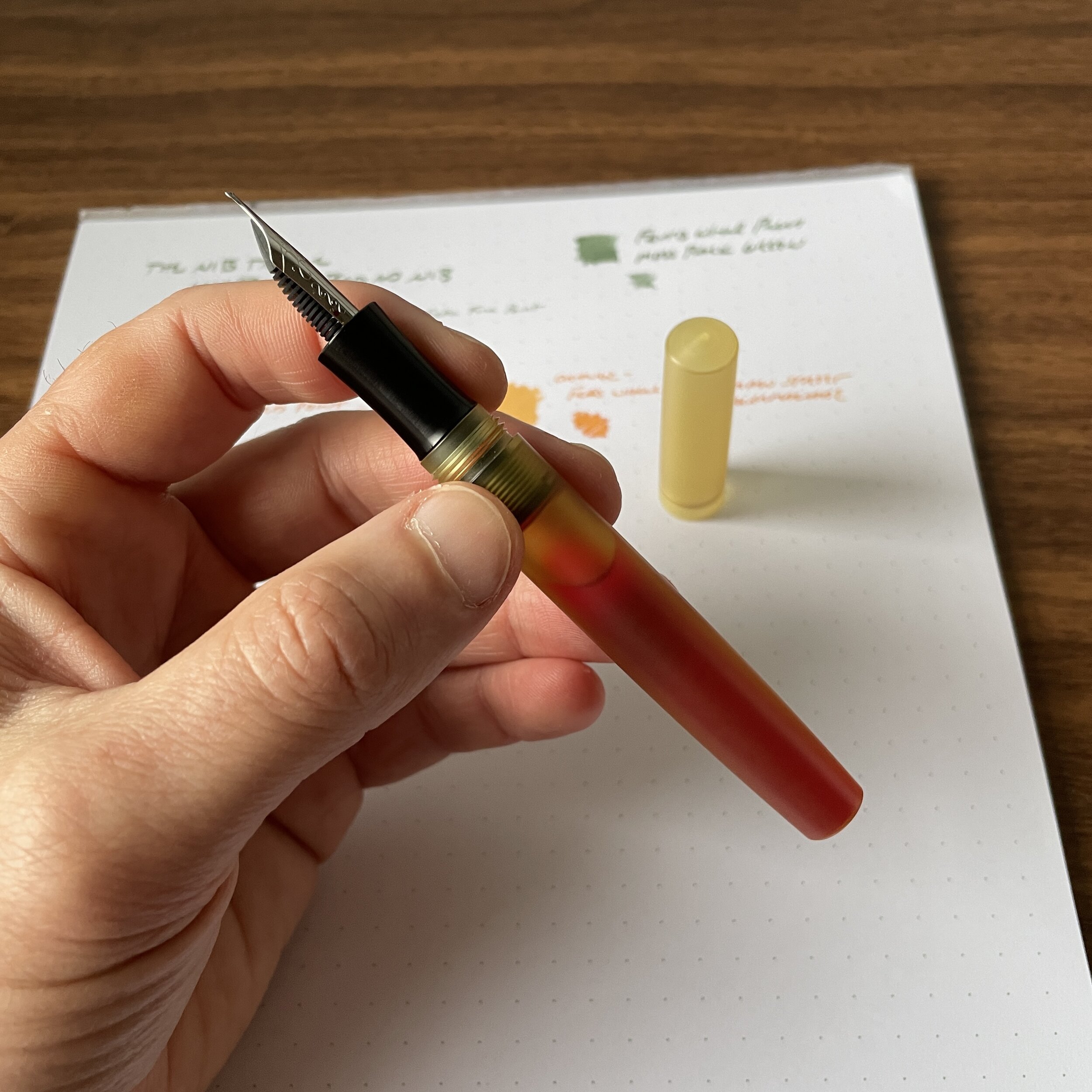
Writing samples for both a standard Architect nib (top, in Ferris Wheel Press Moss Park Green), and an Inverted Architect (bottom, in Ferris Wheel Press Main St. Marmalade), both inks courtesy of Vanness Pens.

A Word of Caution: If you’re new to fountain pens, or have never used an Architect nib, I would strongly advise you to consider borrowing one from a pen friend or visit a pen show prior to ordering this particular grind. Architect grinds can be a bit temperamental, in the sense that they can go from smooth to scratchy very quickly depending on the angle at which you hold your pen (and they’re not “butter smooth” writers to begin with, since you’re essentially making cross-strokes with a blade). It’s extremely important that the nib grinder understands your writing angle, so if you cannot visit in person, I would send multiple photos of how you hold the pen and the angle at which the nib hits the paper. That said, if you do decide that an Architect nib is for you, this grind gives your writing truly unique character. For those interested in reading further, I’ve previously written posts about various options for nib customization.

View fullsize Ferris Wheel Press Main St. Marmalade
View fullsize Ferris Wheel Press Moss Park Green

The Nib Tailor - Available Grinds and Pricing

The two nibs shown here are just a small selection of what The Nib Tailor has to offer. You can choose from pretty much any custom nib grind, and J.C. has a detailed form for you to complete alongside your inquiry. In addition to custom work (i.e., where you send in your pen), you can purchase pre-ground nibs in various styles depending on availability. Visit the Nib Tailor website for additional details. Pricing is standard, running from $25 for a simple tuning to $55-60 for more complex grinds. In addition to mail-in work and pen shows, J.C. occasionally grinds nibs in-store at Bertram’s Inkwell, and I believe he will be there this weekend. Check out his Instagram for details.

Disclaimer: This is NOT a paid advertisement. That said, I can’t recall whether J.C. gave me these nibs for free, or whether I paid for them. Either way, he’s a friend of mine but I still think he does good work. Given the increased demand for nib work, especially at pen shows, it’s great to see new faces entering the market. It keeps nib work accessible, and ensures that future generations will have the same opportunity to enjoy customized writing experiences!

In Editorial, Unusual Stationery, Pens Tags The Nib Tailor, Architect Nibs, Inverted Architect Nib, Nib grinding, Custom Nibs, Custom Grinds
1 Comment

Vintage Pen Primer, Part V: What About Just Opting for a Vintage Nib?

September 8, 2021

Many pen enthusiasts love the styling of vintage pens, enjoy tinkering with their unique (and sometimes temperamental) filling systems, and look forward to the routine maintenance and occasional repair as part of a vintage pen’s charm. Others focus on the nibs, preferring the performance and feel of vintage 14k and 18k nibs that often write (much) better than their modern equivalents, sometimes at a lower price point. If, like me, you fall into the latter group, there’s an option that doesn’t get as much attention as it should: using vintage nibs in a modern pen body, which allows you to avoid certain inconveniences of vintage while enjoying the unique writing experience.

Custom pens from my collection. On the left are the two Peyton Street Pens customs with vintage nibs that I picked up at this year’s San Francisco Pen Show (discussed further shown below). On the far right is a Newton Shinobi; Second from right is a Scriptorium Balladeer with a custom Architect nib from The Nib Tailor.

There are a couple of different ways you can go about using vintage fountain pen nibs in a modern pen. A few years back, my friend Leigh Reyes, who regularly scouts pen shows for loose vintage nibs, wrote an excellent article on fitting vintage nibs into modern pens such as Kaweco Sports and Franklin-Christoph Model 45s. This approach takes some leg work, as you have to pay close attention to things like stress and wear on the nib over time if the modern housing, feed, and/or section aren’t a perfect fit for the nib. (Please read the article and do as much research as you can before you try this - as Leigh points out, it’s possible to damage both your pen and your nib if you’re not careful.)

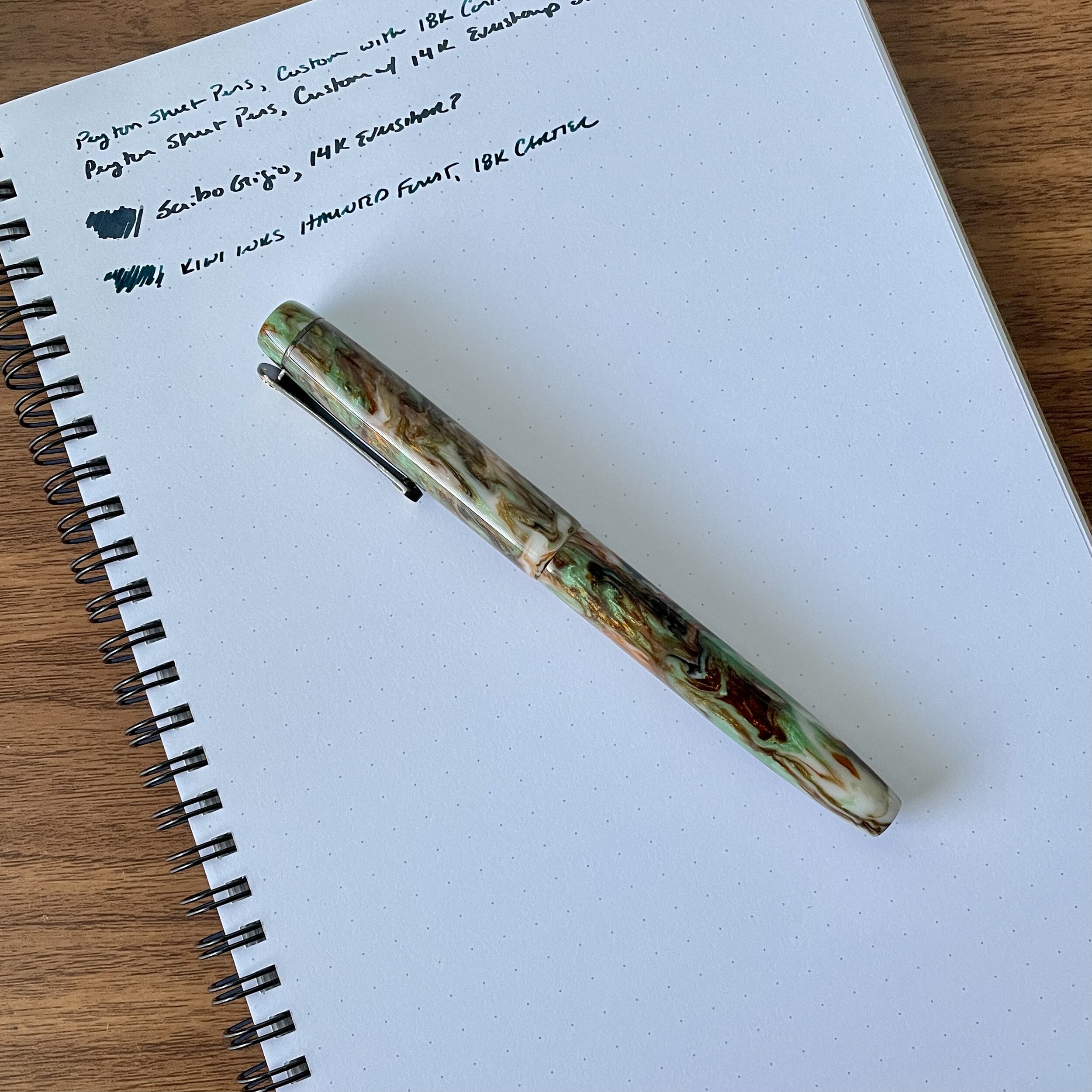
View fullsize Peyton Street Pens Custom
Peyton Street Pens Custom
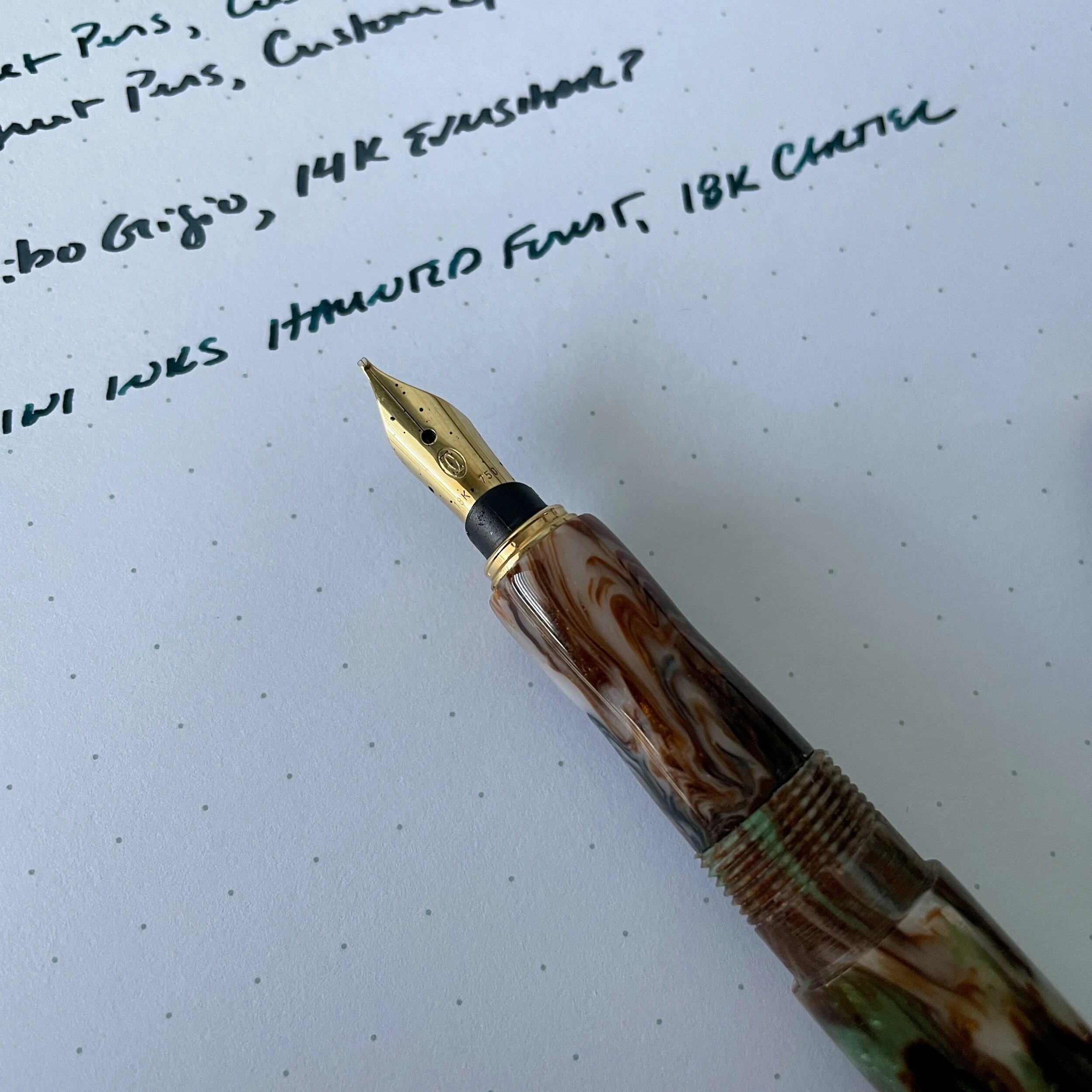
View fullsize PSP Custom with 18k Cartier Nib
PSP Custom with 18k Cartier Nib

The other option is having a brand new pen or section custom made to fit a specific vintage nib (or, like my friend Thomas, having one pen made with multiple different sections sized to fit different nibs). While you will have to discuss with your penmaker of choice whether this is even a possibility, Shawn Newton (Newton Pens) has done this sort of work in the past, as has Jonathon Brooks of Carolina Pen Company. Teri Morris of Peyton Street Pens also regularly makes pen bodies to house vintage nibs from companies such as Sheaffer, Cartier, and Eversharp.

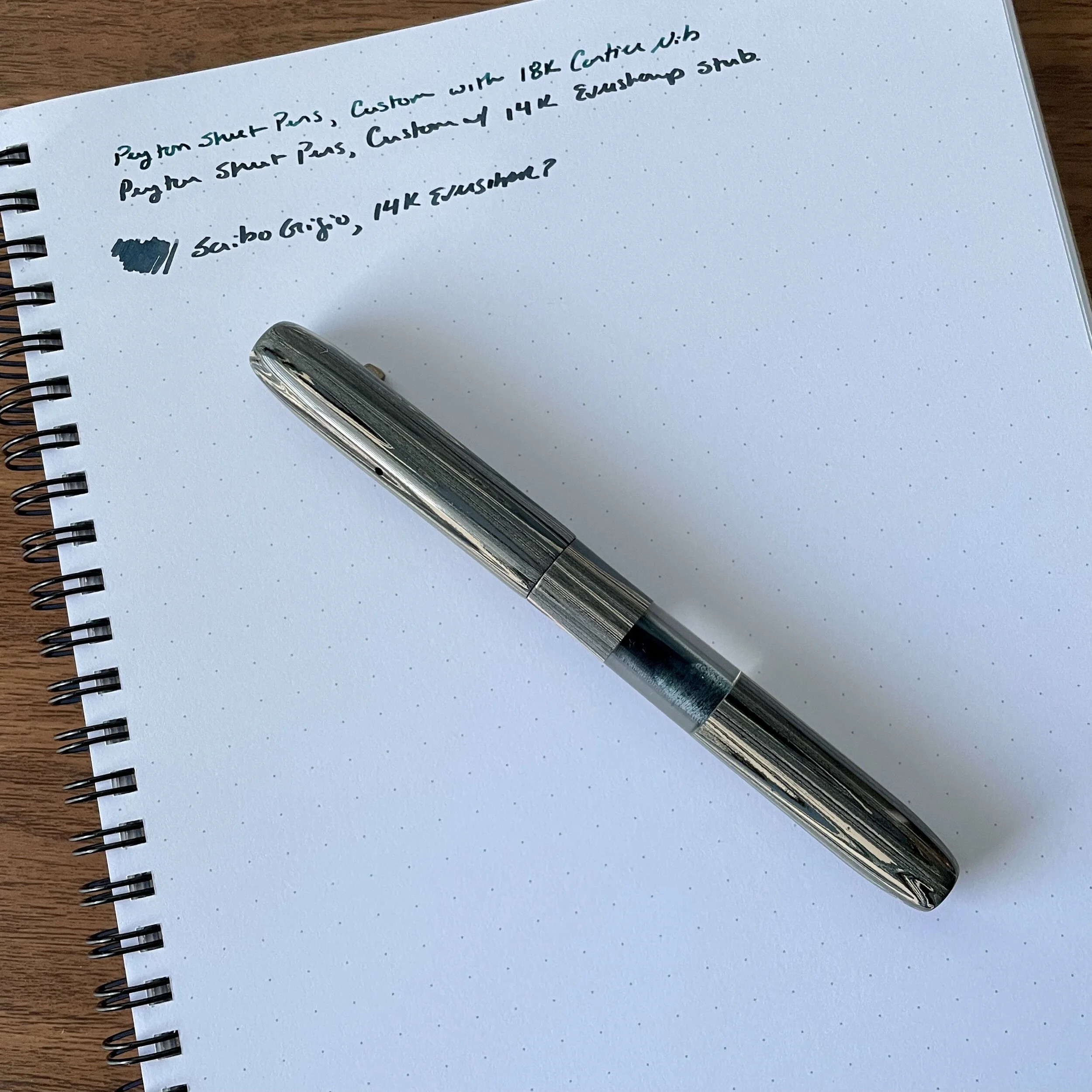
View fullsize Peyton Street Pens Custom Ebonite
Peyton Street Pens Custom Ebonite
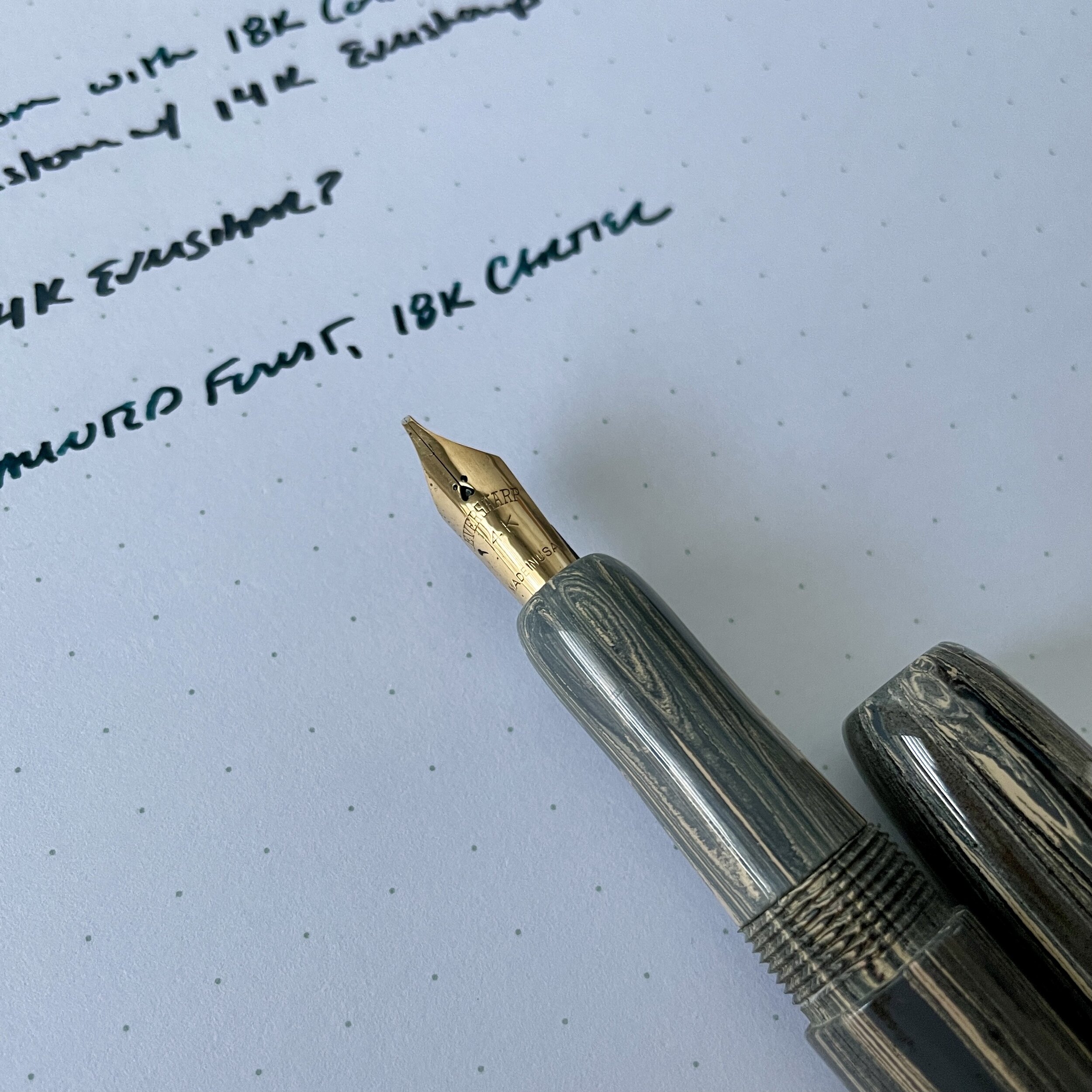
View fullsize PSP Custom with 14k Eversharp
PSP Custom with 14k Eversharp

When I was in San Francisco, I had the opportunity to visit the Peyton Street Pens table and picked up two new additions to my collection that feature excellent vintage gold nibs: an 18k Cartier nib ground to a smooth cursive italic, and a 14k Eversharp stub that’s slightly springy in a way you only really see in vintage nibs. Both are on original feeds, so I’ve experienced zero issues with ink flow. Peyton Street Pens currently has some similar offerings for sale in the “Peyton Street Exclusives” section of their store.

Many vintage nibs are set to write much wetter than what modern pen users are accustomed to, especially if you’ve been using standard stainless steel nibs from JoWo and Bock. For the best experience, be sure to use fountain pen friendly paper. Writing sample shown here is on a Write Notepads Spiral Notebook

As is always the case with vintage anything, your mileage may vary based on the specific pen and/or nib at issue. I highly recommend visiting a pen show, if circumstances allow, so that you can inspect and/or write with the nib you’re considering. Of course, this may be impossible when you’re buying a loose nib that’s not currently installed in a pen, or when you’re asking someone to build a custom pen for you. Often, however, penmakers at shows will have examples of their work at their tables, and will work with you if you have problems with your pen. Sometimes it takes a few tweaks and adjustments to get things writing perfectly.

Further Reading

I’ve previously written several posts on dabbling in the vintage world. I’m far from an expert, but have owned many vintage pens over the years, and I enjoy talking about them from the perspective of someone who doesn’t necessarily “collect,” but rather uses them for everyday writing. Several years ago I started a multi-part “Vintage Pen Primer” series, which lay dormant until today. I you enjoyed this post, you can read the previous articles here: Vintage Pen Primer, Part I; Part II (The Parker 51); Part III (Inks for Vintage Pens); Part IV (The Parker Vacumatic).

Disclaimer: This post does not contain paid affiliate links. Going forward, T.G.S is supported entirely by purchases from the T.G.S. Curated Shop and the T.G.S. Patreon Program, which offers access to online meetups, exclusive discounts and pre-orders, and more!

In Vintage Pens, Editorial Tags Vintage Nibs, Vintage Pens
3 Comments

Back to Work Check-In: What I'm Using (2021 Edition)

August 25, 2021

Despite it becoming clear over the past several weeks that the pandemic is not over, due to work circumstances beyond my control I’ve found myself working outside my house regularly for the first time in over a year. As a result, I’ve had to adjust my stationery “work rotation,” so I thought it would be interesting (for both me and the readership) to do a back-to-work/back-to-school check-in since I assume many of you are in the same boat. I also get a lot of regular questions about what notebooks I carry on a daily basis, so I wanted to be responsive to those who are interested. This post only discusses my notebooks and pen cases, so while my pen and ink usage has changed as well, that’s a topic for a separate post.

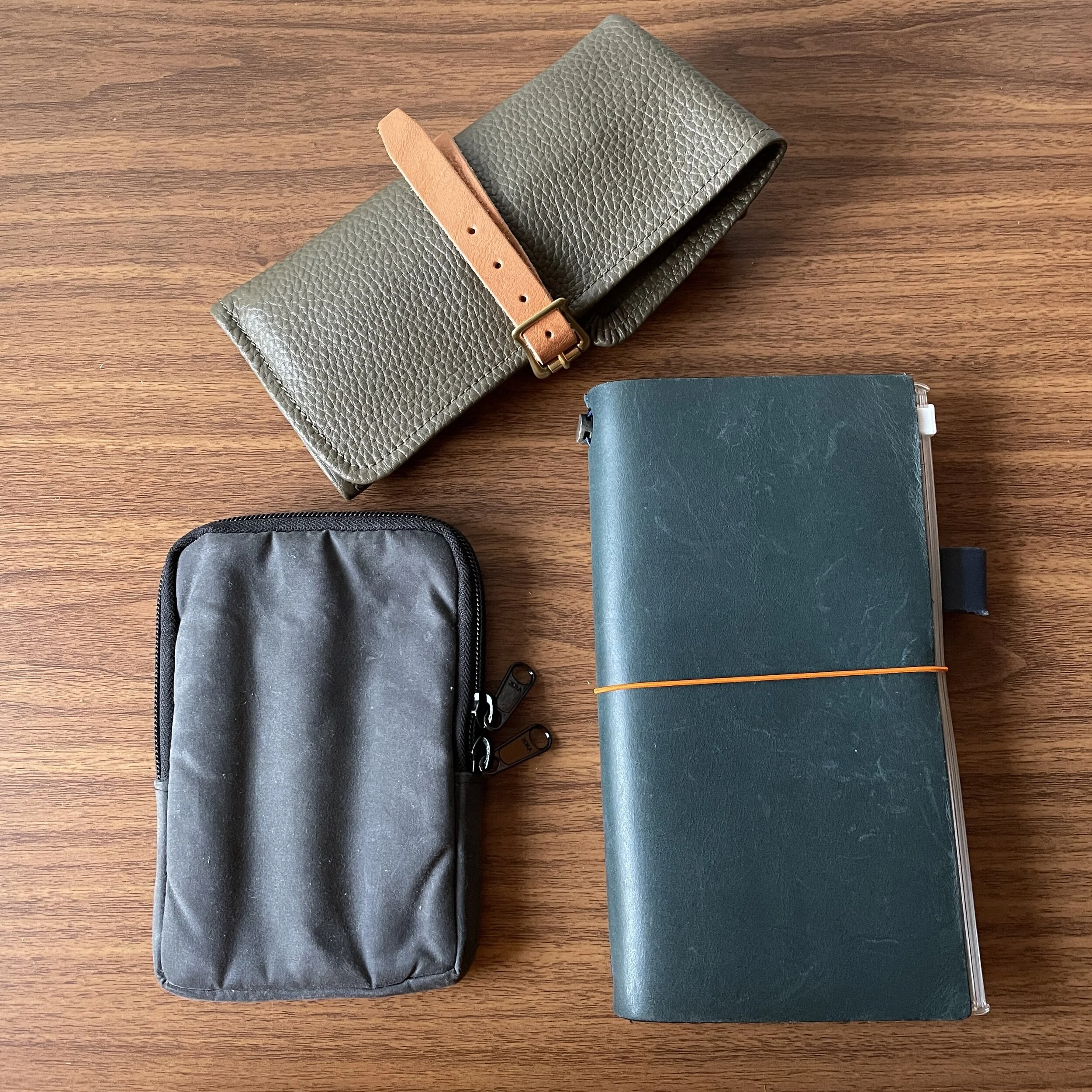
View fullsize 2021 Daily Carry (Spread)
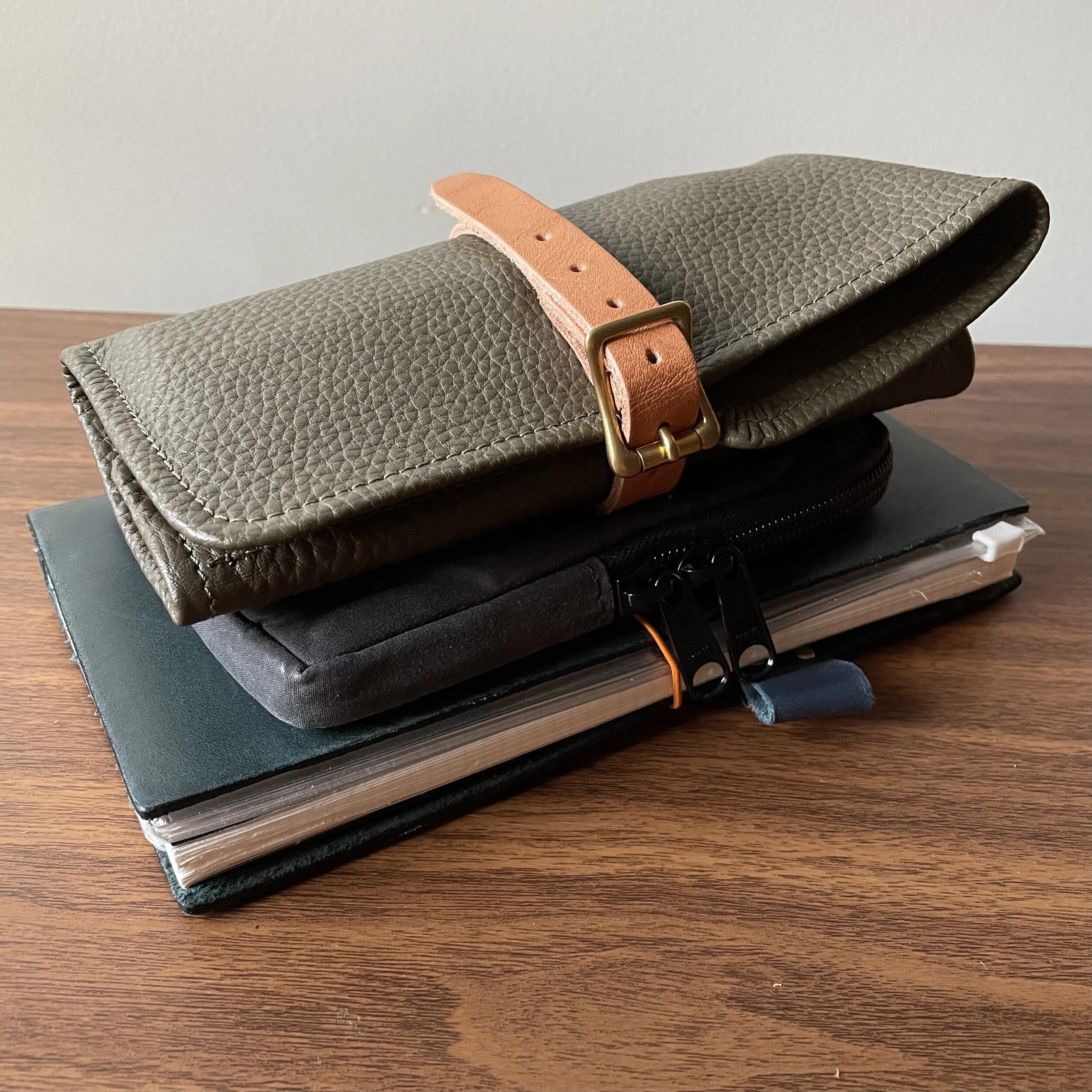
View fullsize 2021 Daily Carry (Stacked)
  1. Main Work Notebook: Standard Traveler’s Notebook in Blue. My primary work notebook remains the Traveler’s Notebook standard-size cover. The various refills and accessories that I use can vary depending on exactly what’s going on at the moment, but the “Slim A5” format of the Traveler’s Notebook system tends to fit my style of planning and notetaking perfectly because I make a lot of lists. I use a heavily modified bullet-journal system to take notes, which is idiosyncratic and probably makes sense only to me. I’d show you here, but a lot of my notes are confidential and can’t be photographed.

  2. Stalogy 1/2 Year Graph Notebook (Cut Down to Traveler’s Size). Before this year, I had not used Stalogy paper, and it took some getting used to, but now I’m a convert. I’ll definitely do a full review at some point, but Stalogy paper manages to be both extremely thin and more absorbent than Tomoe River while still handing fountain pen ink relatively well. Yes, there’s can be some show-through with very wet fountain pens, but the trade-off is a much quicker dry time and, in my opinion, softer texture and a better writing feel. Please note that I have modified this notebook to fit the Traveler’s Notebook cover. You can read more here.

  3. Traveler’s Company Undated Planner Refill. I’m a die-hard fan of undated planners, since I don’t necessarily use a paper planner every month - just when it gets busy - and I hate wasting paper. I filled up a Traveler’s Notebook Weeks + Memo insert during the first half of the year, but when I moved to the Stalogy because I needed more room for notes, I incorporated an undated monthly calendar so that I could do more high-level overviews of my schedule.

  4. Superior Leather Co. Pen Roll. A new addition to my collection that I absolutely love, this olive green leather pen roll from Superior Labor was purchased from Baum-kuchen in Los Angeles. It might be the softest leather pen roll that I’ve ever used, and since it matches my Filson bag perfectly, it has not come out of rotation. I also tuck document flags, post-its, and other miscellaneous stationery items into the larger pocket.

  5. Nock Co. Sinclair Three-Pen Case. Perhaps the most consistently featured piece of stationery in my arsenal, this particular black waxed canvas/burgundy piece (an Atlanta Pen Show pickup from several years ago) has become a true ride-or-die item. I’ve told Brad for years that the waxed canvas Sinclairs are a winner, and now they’re back!

Yes, I’m still using favorites such as the Nanami Paper Cafe Note in B6 slim and the Write Notepads Spiral notebook, but those tend to stay home as I use them more for journaling and personal writing. My personal journals (I keep several) are ANOTHER topic that warrant a separate post, but the “system” I use is kind of complex, so I’m struggling a bit to describe it coherently. Stay tuned….

This post does not contain affiliate links. The Gentleman Stationer is supported by purchases from the T.G.S. Curated Shop and reader donations. If you would like to support us even further, please consider checking out the T.G.S. Patreon Program, which offers access to online meetups, exclusive discounts and pre-orders, and more.

In Editorial Tags Editorial, Back to Work, Back to School, Notebooks
1 Comment
← Newer Posts Older Posts →
Store Hours and Location
Visit the T.G.S. Curated SHOP
Updated "Best Pens" Guide
On the Paper Trail Podcast
TGS_25 Roterfaden New Stock Available
Hierarchies of Fountain Pen Friendly Paper

Join Our Patreon!
Subscribe to the TGS E-mail List

Featured Posts

Featured
Pilot-Custom-Series-Pens-overview.jpg
Mar 14, 2026
The Pilot "Custom" Series: An Overview of Some of My Favorite Fountain Pens
Mar 14, 2026
Mar 14, 2026
Pentel-Sign-Pen-Cover.JPG
Feb 28, 2026
Pen Review: The Pentel Sign Pen (Craft Design Technology Version)
Feb 28, 2026
Feb 28, 2026
Cover On the Paper Trail Intro Clip.jpeg
Dec 3, 2025
Introducing "On the Paper Trail," a New Podcast/Video Collaboration with Lisa Vanness of Vanness Pens!
Dec 3, 2025
Dec 3, 2025
The Gentleman Stationer RSS

View Cart

© Digital Divide Media, LLC, 2014-present.

All content is the exclusive property of Digital Divide Media, LLC, d/b/a The Gentleman Stationer, including “The Gentleman Stationer” website and trademark, and should not be reproduced without express written permission.  All rights reserved.

All content containing paid advertising, affiliate links, or sponsored content will be plainly disclosed by a disclaimer when/if featured.

Contact Information

Store Shipping Policy and Return Policy

Privacy Policy

Cookie Policy

Terms and Conditions

Powered by Squarespace