• Blog
  • Shop
  • Podcast
  • Resources
  • About
  • Archive
  • Contact
  • Cart
  • Sign In My Account
Menu

The Gentleman Stationer

Vintage Living in the Modern World.
  • Blog
  • Shop
  • Podcast
  • Resources
  • About
  • Archive
  • Contact
  • Cart
  • Sign In My Account

Clockwise from top: Leonardo Momento Zero in Burkina Celluloid, Decimo in Harvest Gold, Camel 2B Woodcase Pencil; Lamy Studio in Olive Green, Visconti Van Gogh “Vincent’s Chair”, Nakaya Long Piccolo, Platinum Plaisir in Bali Citrus.

More Mini-Collections: The Most Underappreciated Color in Stationery?

December 1, 2021

It’s funny - over the years I’ve managed to pick up many pens, notebooks, and pencils on clearance, only to have these surplus (and often heavily discounted) items turn into coveted “grails” years later. Over the past couple of weeks, as I’ve been pruning back my collection, I realized two things: (1) I have a ton of pens in an “anise green” shade that people always comment on (if not try to purchase off me), especially when they see them in person; and (2) this same shade of yellow-green tends to sell very slowly at retail, and often makes up the last of a lot whenever I stock it, even though it’s arguably the best-looking color in products like the Quo Vadis Habana Notebook or the Clairefontaine 1951 Classic Series. On the pen side, Nakaya discontinued their “Nanohana-Iro” urushi finish, and Pilot stopped selling the “Harvest Yellow” Decimo that I’ve been clinging to for dear life over the past few years, as people have tried to pry it from my hands. It’s even become difficult to find pens in a solid shade of yellow-green ebonite, unless you order the rods yourself and have a custom pen made.

From left, my Wakakusa-Iro Nakaya Long Piccolo, Pilot Decimo in Harvest Gold, and the Platinum Plaisir in Bali Citrus.

So I’ll pose kind of a silly question: Is yellow-green/anise green/pea green the most underappreciated color in stationery? Or to frame it for broader discussion: Why do people only seem to appreciate some things after they start to disappear from the market? I suspect that part of the issue with this particular color is that it’s very difficult to accurately photograph, and even if you get a good picture, vast discrepancies in calibration across computer monitors can make it look much too pale, robbing it of its depth, or on the flip side, too dark, making it look flat and boring. I’ve also heard it’s a hard color for manufacturers to consistently reproduce, so you will get a lot of batch variations across a single product line. That said, this isn’t the only “cult color” that disappears only to become insanely popular on the secondary market.

I guess this is yet one more example of me subconsciously building a “mini-collection” that in this case extends across different product categories. In addition to my Nakaya Long Piccolo in “Wakakusa-Iro” (which was a store exclusive from Aesthetic Bay in Singapore), the Harvest Gold Decimo, and other pens such as my Visconti Van Gogh “Vincent’s Chair” and a green-gold Platinum Plaisir in “Bali Citrus”, I ended up purchasing a gross of the Camel 2B pencils from the CW Pencil Enterprise closeout sale because I couldn’t bear to be without a stash of the green ones.

What colors do you think remain underappreciated in the stationery industry? For a while, it seems as though everyone was moving towards matte-black everything, then the clear demonstrators became popular, and now the trend is towards sparkling acrylic/DiamondCast. When manufacturers focus on outdoing one another on the latest trend, we seem to miss out on these more offbeat colors that don’t get a lot of attention, and might attract more fans if companies were willing to take a bit more risk and give these products a chance to distinguish themselves. That said, as participants in this community we also have a responsibility: If you like a particular product, and find yourself wishing that “more companies made something like that,” then buy it if you can. Manufacturers and retailers can’t pay their bills on admiration alone, and we shouldn’t wait for these “cult hits” to go out of stock before everyone starts scrambling to find them.

If you’d like to read more on the subject of “Mini-Collections,” and how I’ve focused my own pen and ink collecting, check out these posts on the Parker Sonnet (one of my favorite under-appreciated pens), and my obsession with red inks, among other things.

This post does not contain paid third-party affiliate links, and all likes are to the T.G.S. Curated Shop or other third-parties who have not compensated T.G.S. for links. Shopping with T.G.S. directly supports original content, pen reviews, pen show events, etc. from The Gentleman Stationer. If you would like to support us even further, please consider checking out the T.G.S. Patreon Program, which offers access to online meetups, exclusive discounts and pre-orders, and more!
In Editorial Tags Mini-Collections, Green Pens, Yellow Pens, Pens, Editorial
3 Comments

The five fountain pens discussed in this post, from left: Platinum Preppy; Platinum Plaisir; TWSBI Swipe; Caran d’Ache 849; and Midori MD. Through Monday (11/29), don’t forget to use the coupon code “BLACKFRIDAY” to get 10% off all orders in the T.G.S. Curated Shop (excluding TWSBI), as well as the “Gently Used” Sale!

Five Knockaround Fountain Pens for the Office and Beyond

November 27, 2021

While Black Friday weekend continues, and everyone is doing their shopping with all the different promotions available, I had the idea to do a short post containing some ideas beyond those in this year’s T.G.S. Gift Guide. I’ve become mildly obsessed with the idea of finding the perfect “knockaround” fountain pen for the office: a functional fountain pen that you can leave in your bag, on your desk at work, or stuck in the loop in your planner and not worry excessively about whether it’s going to “walk away” or get damaged. This category isn’t the same for everyone, since we all operate at different price points, but for reliable fountain pens this category typically starts around $20 (excluding the Platinum Preppy, which is much less expensive).

  1. Platinum Preppy. I know several people who keep a fistful of these pens inked up at all times, either to give away to the fountain pen curious or eyedropped with inks they’re “experimenting” with. Preppies are also extremely inexpensive everyday writers, starting at around $4.50 for the standard version, with even the limited edition “Preppy Wa” pens priced at just over $7.

  2. Platinum Plaisir. Though they feature the same nib, the Platinum Plaisir is a slight upgrade over the Preppy in terms of both looks and durability, since the pen sports an aluminum barrel that comes in a wide array of colors and will take more of a beating than the Preppy. Honestly, the Plaisir will often be my choice over the Preppy (unless I’m eyedroppering to test inks), since I appreciate the added splash of color. Available starting at $22.

  3. TWSBI Swipe. Honestly, TWSBI’s latest low-cost fountain pen has blown me away with its value proposition. Not only do you get a reliable nib from a reputable brand, but unlike any other pen on this list, it ships with a converter (actually, two converters) to allow you to fill with bottled ink, in addition to using a cartridge. Available priced at $26.99.

  4. Caran d’Ache 849 Fountain Pen. Looking for a fountain pen to match your classic Caran d’Ache 849 ballpoint pen or rollerball? The Caran d’Ache 849 fountain pen features a springy stainless steel nib that’s pleasant to write with, and is also somewhat slimmer, allowing it to fit in planner pen loops that might otherwise be too small to fit bulkier fountain pens. Available at $52.

  5. Midori MD Fountain Pen. Sure, the plastic barrel isn’t much to write home about (even if it is tastefully color-matched to the Midori MD aesthetic), but the nib on this pen is exceptional. Midori has taken the same nib used in the Traveler’s Company brass bullet pens and tweaked it so the nib turns slightly downward, supposedly to better hold up to the harder writing pressure of modern users (and probably those inexperienced with fountain pens). The firm writing experience reminds me of a wider (M) posting nib. Available priced at $38.

Please note that of the fountain pens on this list, the Caran d’Ache 849 and the Midori MD Fountain pen take standard international cartridges, while the Platinum Pens and the TWSBI Swipe accept proprietary cartridges sold by those specific brands. If you’re looking for refills for these particular pens, either for yourself or to include with a gift for someone else, we carry standard international cartridges by Caran d’Ache and Traveler’s Company, as well as both TWSBI Cartridges and bottled ink. Platinum Preppy pens ship with one Platinum ink cartridge included.

As always, you can check out other pen recommendations here, as well as posts discussing my thoughts on fountain pen inks and fountain pen friendly paper. Links here are to the T.G.S. Curated Shop or our friends at Vanness Pens, which are not paid affiliate links but merely friendly recommendations. Many thanks for your support!

In Editorial, Guide Tags Guide, Office Tools, Pens
1 Comment
TGS Bag Dump 2021

What's Inside My Bag? Daily Carry Breakdown 2021

November 3, 2021

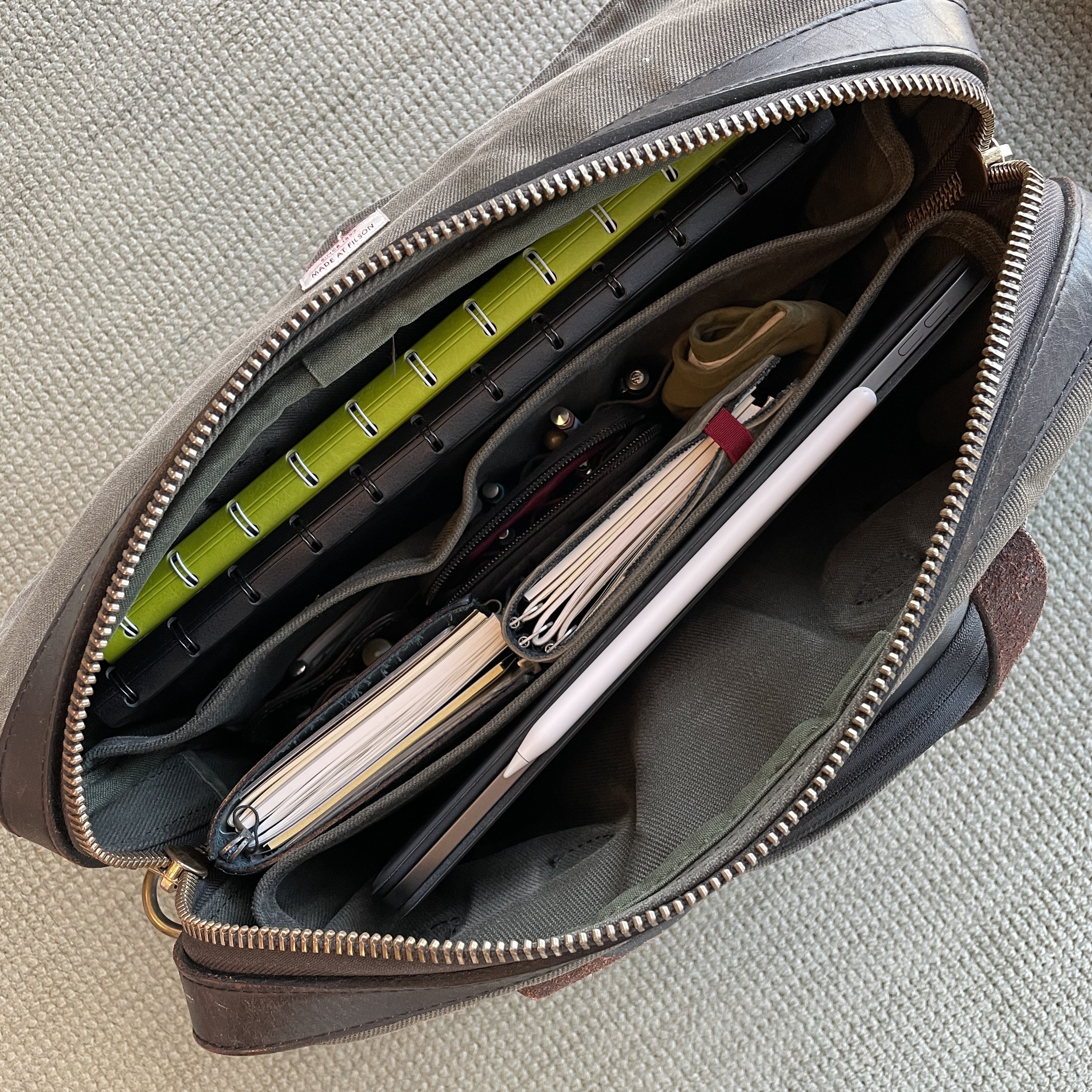
I’ve not done a full “Bag Dump” post in a few years, mainly because what I carry day-to-day doesn’t change all that much and it would be a rather boring exercise to repeat it over and over again. But as I was sorting through my bag yesterday, I realized how much I’m enjoying my current setup. Here it goes:

My briefcase has taken a lot of abuse over the years. And still looks basically new.

The Bag Itself

I’m not a bag person. Far from it. I essentially have two: a Filson Original Twill Briefcase in Otter Green that’s about 8 years old, and a five-year-old North Face Surge backpack that some of you may have seen me carrying at pen shows. Both of these bags do what I need them to do: They have three separate compartments/dividers for separating notebooks, files, and a laptop, while also providing plenty of pockets and loops for pens and other tools. The Filson gets carried daily; the North Face is for travel since it has more padding for a computer. I don’t see myself making any changes to this setup until something falls apart.

Traveler's-Notebook-Roterfaden

Planners and Journals

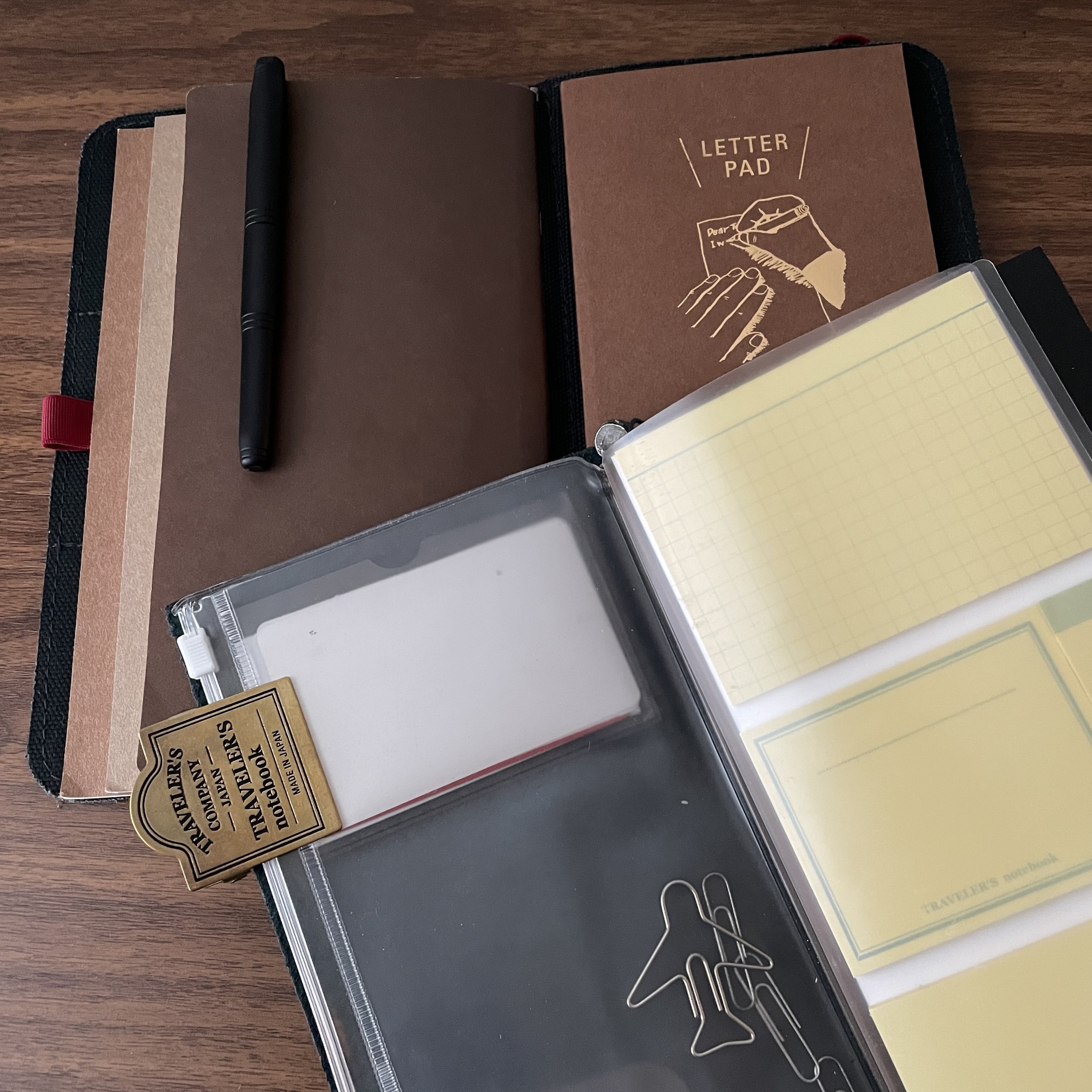
Lately I’ve been carrying two Traveler’s-style notebooks. My Standard Traveler’s Notebook in blue contains a trimmed down Stálogy Half-Year Notebook, an undated monthly calendar (for work), a sticky notes insert, and a zippered pouch. Lately, I’ve also been carrying a Traveler’s-sized Roterfaden from Baum-kuchen (“BK_19”) with four different inserts: a day-to-a-page diary refill, a standard blank MD notebook, a dot grid notebook, and a Letter Pad featuring MD Cotton Paper (in the back slot). This particular notebook serves as my personal journal, and it has absolutely no structure whatsoever. I simply write whatever I feel like writing.

A4 (black) and Letter (green) Filofax Refillable notebooks shown with my Traveler’s Notebook (left) and Roterfaden (right).

Work Notebooks

I go through a LOT of notebooks and pads of paper at my day job, used for a combination of notetaking, brainstorming, and writing. (I do the first draft of pretty much everything by hand - at a bare minimum I’ll hand-write a very detailed outline.) Many of you have written in asking me to do a more detailed post on my specific notetaking and workflow “systems”, and I’m considering it, but honestly nothing is very exciting and doesn’t go much beyond writing everything down and keeping a minimal index of each notebook in the event I need to go back and find things later. If something is important and absolutely needs to be remembered, it gets incorporated into an outline, database, or final work product that is easier for other people to read and navigate.

The wire binding on the Filofax refillable notebook. No more rings that fall out randomly!

Lately I’ve been relying heavily upon Filofax refillable notebooks in both Letter and A4 sizes. The Filofax paper is pretty good for most pens, but if you buy the hole punch you can use whatever paper you want, and also print out documents and articles to stick in these notebooks. I find these bindings more reliable than ring-bound systems, and the pages turn easier. I typically don’t carry pads of paper around with me, since I’ll have a few sheets in these notebooks, but if I do it’s usually a Rhodia Pad or a Write Notepads Dot-Grid Writing Pad.

Pens

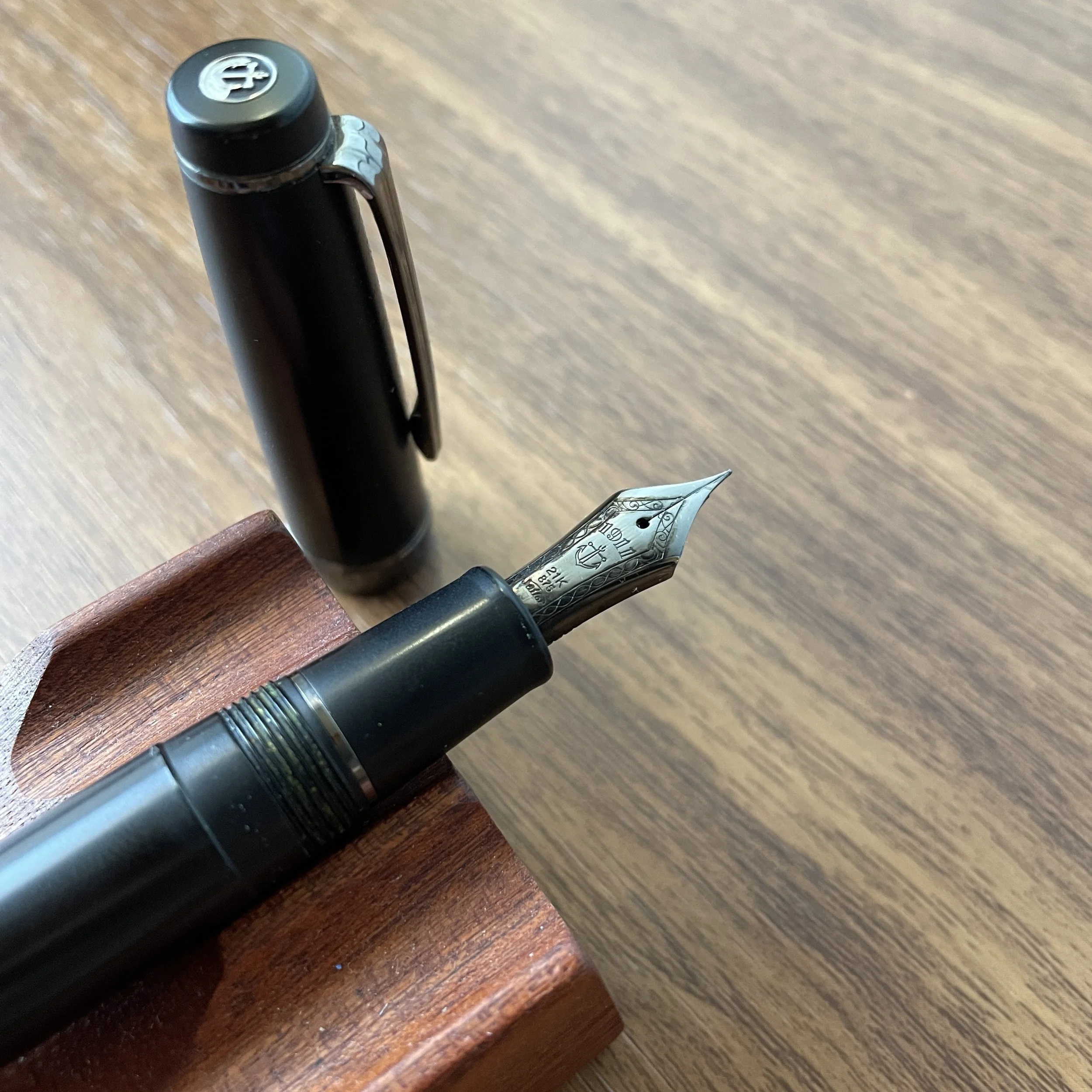
My pen selection sees the most change, as I’ll typically rotate 2-3 new pens in every couple of days depending on what type of work I’m doing and whether I have something new in for review. These pens always travel in my Nock Co. wax canvas Sinclair or another 2-3 pen roll or sleeve. Lately, I’ve been carrying my Schon DSGN Ultem Pens nearly exclusively, since the nibs I have in those pens are perfect for the type of work I’ve been doing lately.

EDC Pens from left: Schon DSGN Ultem fountain pen, Schon DSGN Black Ultem fountain pen, Baron Fig Squire in brass, Montblanc Starwalker rollerball, Montblanc Le Petit Prince Classique Rollerball.

For general all-purpose writing, I carry a handful of ballpoints and rollerballs, including at least one Caran d’Ache 849 (my go-to “click pen”); my Montblanc Starwalker and Montblanc Le Petit Prince Classique rollerball; my Sunderland mk1 (of course), my Baron Fig Brass Squire, and a Traveler’s Company Brass Ballpoint (typically kept clipped to my notebook).

Computer

I don’t always carry a laptop, but I nearly always have an iPad on me (iPad Pro 12.9” with the Magic Keyboard and Pencil 2, to be specific). I mainly use my iPad for document management and annotation where writing on a paper copy would be unwieldy, since many of the documents I deal with can run into the hundreds of pages. As fellow attorneys know, the ability to leave “the binders” at the office is a huge advantage!

Noise Cancelling Headphones

I’ve had a pair of Bose Quietcomfort QC35 headphones for the past few years, and they get the job done. They’re more than serviceable on the sound side, and the noise cancellation (the main reason I use them) is superb. At some point I will likely substitute a set of noise cancelling earbuds so I won’t have to carry the larger headphones every day, and can reserve them for airplane travel.

And that’s it! You may find a couple of other small items tucked in my bag here and there, such as chargers, cables, and these days, spare masks, but all of this stuff discussed above forms the backbone of my day. As I mentioned, I may work up some additional posts regarding workflows, note-taking, and everyday use/carry topics, if this is something that would interest readers. Let me know!

This post does not contain paid third-party affiliate links. The Gentleman Stationer is supported entirely by reader contributions and purchases from the T.G.S. Curated Shop. By shopping with us directly, you are supporting original content, pen reviews, pen show events, etc. from The Gentleman Stationer. If you would like to support us even further, please consider checking out the T.G.S. Patreon Program, which offers access to online meetups, exclusive discounts and pre-orders, and more!
In Editorial, EDC, Bag Reviews Tags Bag Dump, Bag
Comment

I have more black pens, matte black pens, and pens with black trim than I can count. This isn’t even a “mini-collection,” it’s a full-blown archive. (This also isn’t even half of them.)

The Allure of the Stealth Pen: What Makes the All-Black Pen So Popular?

October 23, 2021

For the first several years I participated seriously in this hobby (through the early-to-mid 2010s, it seemed as though pen companies were racing to introduce a “stealth” version of their various models, typically a black or matte black version of a pen featuring black-plated trim. (I’ve actually been around long enough to recall Pilot’s release of the current matte-black Vanishing Point, as well as a series of other VPs with matte-black trim and accents.) I’ve always wondered what makes these particular pens so popular. Black-on-black pens, and especially matte black pens, show no sign of going away anytime soon, so this week I spent some time noodling on it and felt compelled to put together an “all-black” carry for yesterday’s remote work outing.

From left, the Sailor 1911 “Black Luster” edition, my own T.G.S. x Sunderland mk1 rollerball, and the Montblanc “Midnight Black” Starwalker Rollerball. Case is a special edition Nock Co. Sinclair (since discontinued).

Originally, “stealth pen” marketing borrowed heavily from the “tactical pen” crowd, evoking military imagery, extreme durability, and touting the ability to bring your fountain pen along on those top-secret night missions. For example, I recall Monteverde marketing a pen with Goulet called the “Nighthawk” that featured black trim and a carbon fiber motif. Over the years, however, blacked-out pens and black trim in general became mainstream, not just a sub-category targeted to EDC (“everyday carry”) enthusiasts.

Contrary to popular belief, black pens don’t have to be boring. Not only can you add a splash of color to really set off the finish, but manufacturers can vary the design on things like the grip section to add a lot of character. Check out the knurling on the Montblanc Starwalker!

I’m not sure the popularity of black-on-black pens should come as a surprise. Black accessories of any sort are universally appreciated because they match easily, and while some might be hesitant to claim “black” as their favorite color, I’d venture that it has much wider appeal than the stereotypical “stealth pen” customer would suggest. Here are a few key reasons why I enjoy them myself:

  • Sleek, Understated Look. In my “real” life as a working attorney, there are contexts in which I need a pen to blend in to the surroundings and not become a distraction. Court hearings, depositions, and crowded meetings are NOT the time to break out the bright red Pilot Custom Urushi, or the Krusac Scrimshaw Navigator. On the other hand, a black makrolon Lamy 2000, Lamy Studio LX All-Black, or Sailor Pro Gear Imperial Black doesn’t obviously turn heads at first glance (and most people won’t notice the Lamy 2000 isn’t a rollerball). In a culture where, unfortunately, many consider using any sort of decent pen or pencil to be a pretentious affectation, black pens can be a good choice where you feel as though you need to fly under the radar.

  • Better Grip and Texture. My favorite pens are what I call my “workhorses,” or pens that I can write with all day. Matte-finish pens offer a pleasant grip and texture for all-day writing sessions or when you’re in a hot room with sweaty hands. The pen won’t get slick.

  • Black Pens Age Well. As I’ll further discuss below, most black pens, and especially matte black pens, will eventually show some wear and tear. Personally, I find that it adds to the aesthetic and I will never replace a pen for this reason. Look no further than my Sailor Pro Gear Imperial Black, which not only has worn smooth and shiny on the barrel from years of regular use, but now has a partially chrome (as opposed to black-plated) cap finial. I have experienced zero wear, however, on the black ion plating to the nib, clip, or cap band.

Some flaking on the cap finial is actually the only real wear and tear on my eight-year-old Sailor Imperial Black Fountain pen, which I re-reviewed years after I first purchased the pen.

Eight years and one dropped nib repair later, the nib on my Sailor Imperial Black looks just as good as it did when I first purchased this pen! Thanks Mark!

Of course, there are also some considerations that anyone considering a matte black pen - especially one with black trim - should keep in mind. First, if you’re particular about scratches, chipping, and visible wear on your pens, this finish may not be for you. Most matte texture is created using some form of powder-coating or anodization, and no matter how careful you are with your pens, the finish will eventually wear smooth, and you will likely accumulate some dings and scratches. As I noted above, I love how this looks over time, and merely serves as a reminder that my pens are tools meant to be used, but hey, personal preference. Second, if you are considering a pen with a plated or coated nib, talk to an experienced nib grinder before performing any sort of modification on the pen. Different manufacturers use different techniques to plate their nibs, and depending on the quality of the work and materials used, the coating can start to peel or flake off if the nib is ground. That’s not to say you can’t do it, but I’ve experienced it on a few pens across multiple brands and price points. (You can’t blame the manufacturers for this. When you choose to grind a nib, you are, after all, modifying their pen in a way that they did not originally intend. You are responsible for educating yourself on all the different things that might occur as a result.)

You know that you’ve really gone off the deep end when you find yourself purchasing things like these matte black Allex scissors, not necessarily because you have a burning use case for them, but because C.W. Pencil Enterprise is closing and, well, you just need these for your desk. (Great scissors, btw.)

While there have been murmurs in the pen blogosphere about blacked-out pens being “tired” or “played out,” I expect them to continue to sell well, and for manufacturers to continue to make these pens for as long as demand holds up. Personally, I consider this a classic design, and would love to see black trim in particular become a default option alongside the black/gold and black/rhodium that you see everywhere. I can’t help but think it might even outperform the current “standards.” Consider some other possibilities. I mean, Lamy recently released a brown Lamy 2000 with a brown plated clip. If they released a version of the 2000 with a ruthenium-plated clip, section, and nib, can you imagine how well that would sell?

(Maybe terribly, but I don’t care. I still want it.)

You can’t accuse me of inconsistency. I’ve always loved a matte-black pen with a dark red section. Here, the visibility isn’t the best because the alumilite has darkened over the years, but my Newton Shinobi is black ebonite with a dark, blood red alumilite section.

Ending with a Shameless Plug for the T.G.S. x Sunderland Machine Works MK1

Since I love black pens, it’s not a coincidence that I chose to incorporate a matte black finish into the first exclusive pen collaboration that I’ve done: the T.G.S. x Sunderland Machine Works mk1 matte-black and burgundy release. While you can read more on the specs for this pen in the shop listing, this release pairs the comfortable and functional Sunderland mk1 design with a durable bead-blasted matte-black and burgundy finish, along with a DLC (Diamond-Like-Coating) black stainless steel clip. I need to give Sunderland mad props for the durability of the finish on this pen - as I noted above, most matte pens will show wear over time, especially if you toss it into bags, pen cases, and pockets. After more than seven months of hard use, however, my current demo shows no wear, which can only be a testament to the quality of the processes used. (Note: I’ve intentionally NOT been gentle with this pen, since I wanted to see how it would hold up in the real world.)

Yes - the section threads are internal, so they don’t interfere with your grip.

I’d love to do more pen collaborations in the future, and given how well this one has sold, you can expect more from me in the coming year. The T.G.S. x Sunderland pen is not a limited edition, but it is a store exclusive, so you can only get it directly from the T.G.S. Curated Shop. Priced at $110, it’s a slight premium over the standard Sunderland mk1, mainly due to the cost of the bead-blasted finish and DLC coating. All proceeds go to support and grow T.G.S., both the blog and the fledgling shop operation!

This post does not contain paid third-party affiliate links. By shopping with us directly, you are supporting original content, pen reviews, pen show events, etc. from The Gentleman Stationer. If you would like to support us even further, please consider checking out the T.G.S. Patreon Program, which offers access to online meetups, exclusive discounts (including a slight price break on the Sunderland) pre-orders, and more!

In Editorial, Pens Tags Matte Black, Black Pen Society, Black Pens, Editorial
Comment

The Lamy 2000 “Bauhaus” edition (left) is a great example of a limited pen that disappeared immediately online, only to appear on reseller sites at ridiculous markups.

Online Pen Shows: They May Be Easier, But Are They Really The Same?

October 20, 2021

Before we get started, I want to make clear that in this post I’m not criticizing any single brand, company or online pen show, even if they happen to be mentioned by name in this article. Any such discussion is solely for illustrative purposes since I suspect what I talk about here is going to be an emerging industry-wide trend that is here to stay and that everyone is going to have to live with in some way or another.

When literally all of the post-Baltimore pen shows were cancelled in 2020, both sellers and enthusiasts were faced with the prospect of having a primary revenue stream completely shut down, an existential threat for many. As a way to adapt, many retailers and makers turned to “online pen shows” - essentially, windows in which exclusive, limited, or discounted products were made available for purchase online. The way in which an online pen show works varies. For example, Franklin-Christoph announces ahead of time that certain models will be made available in their Stock Room, similar to how C.W. Pencil Enterprise released their Pencil Advent Calendar. Others attempted to duplicate an actual in-person pen show experience. Ian Schon offered time slots for customers to peruse pens via Zoom, and the St. Louis Pen Show went virtual, offering courses and content via YouTube. But while I’m thankful that these options were available to help keep the pen industry and associated community viable throughout the pandemic, I hope they don’t replace traditional shows and opportunities for in-person shopping over the long-haul, as some are suggesting they should. Here are my thoughts on both the advantages and disadvantages of these types of shows.

Benefits of Online Pen Shows

  • Safety. This one goes without saying. Depending on COVID-19 levels at any given time in any given area, it may not be safe to attend in-person events. Online options are a viable alternative should an event or retailer need to cancel.

  • Increased Accessibility. Even setting aside the pandemic, one key benefit to these sorts of online events is increased accessibility to those who can’t make it to an in-person pen show due to health, distance, etc. The beauty of the internet (for the most part) stems from its ability to bring otherwise geographically distant people together.

  • Small-Business Friendly. Extremely small makers, or those just starting out, may not have the resources to travel to shows or to stock any sort of in-person store. The ability to operate online levels the playing field to a certain degree, not only in terms of accessibility but in allowing smaller retailers with higher costs to compete on price.

I likely would never have purchased many of the pens in my current collection (including these Franklin-Christoph Model 20s) without the opportunity to see the material and handle each pen in person.

Drawbacks to the Online-Only Model

  • Amazonification of the Experience. Part of what I love about visiting pen shows (as well as brick-and-mortar pen stores) is the ability to not only view products in person before I make a purchase, but to interact and engage with the makers and retailers themselves. If you take away this aspect of the experience, to me it becomes much less attractive. Buying a pen online, especially a handmade or secondhand pen, sight unseen, doesn’t hold the same cachet, especially since I often want to experience in-person a pen that I plan to use for writing over the long-haul.

  • Loss of Community. The friendships I’ve made through pen shows are priceless. Whether it’s gathering around a table discussing a new release or prototype design, having a friend let me write with a pen from their collection so I can decide whether it works for me, or simply meeting like-minded people who you keep in touch with outside of shows, the ability to socialize with others is a key part of what makes in-person pen shows irreplaceable, IMHO.

  • Consumer Frustration. When dealing with limited run or limited release products, it can be extremely frustrating for fans and enthusiasts to take time out of their workday or schedule to be online at the time of a “drop,” only to have the product sell out in less than 2 minutes (i.e., before most people can add the product to their cart and pay). However unfair it may be to the retailer or maker, who often has no control over the quantities available and/or techniques buyers use to jump to the head of the queue (see third bullet below), it creates resentment at what the shopper perceives as wasted time. Many people, myself included, don’t enjoy a “gamified” experience where part of the thrill is not knowing whether you will “get one” or not, or knowing that I will have to quickly drop $500 (or sometimes more) unless I’m willing to risk never being able to buy one of these products again.

  • Benefiting Profiteers and Resellers. Adding to customer resentment over their inability to have a fair shot at getting a limited run pen or other special release is the fact that many of these products immediately appear on third-party retailer websites, often marked up 2x or 3x. This isn’t a new trend by any means, as it’s plagued other industries for years, but it may become more prevalent in the pen community if people move to an online-only model. Japan has recently seen a proliferation of companies whose business consists entirely of buying up store exclusives and other limited releases solely for the purpose of reselling, primarily to overseas buyers.

Takeaways and Final Thoughts

Look, there’s no avoiding the fact that the past two years have been a giant unknown filled with uncertainty for pretty much everyone involved in our industry and community (most of all the makers and retailers), and everyone has had to get creative just to keep the lights on. That said, I personally am of the opinion that every effort needs to be made to preserve traditional retail and show options, or else we lose not just the social aspect of this community in general but the accessibility of products to all but the most tech-saavy or those willing to pay reseller mark-ups. While I understand that online shows and product drops are beneficial to retailers from a revenue perspective (i.e., you sell a lot of pens without incurring the costs of traveling to shows, working through distributors, etc.), I can also see how this runs the risk of frustrating/alienating a large portion of the market, and encouraging things like hoarding/FOMO buying/profiteering. There is a segment of the pen community with a strong focus on accumulation and “buying all the things,” regardless of intent to actually use the product, and while people are free to spend their money however they want, certain retail and marketing strategies cater more to this group than others.

This post does not contain affiliate links. I purchased the pens, nibs, and nib units featured in this post with my own funds, for my own collection. The Gentleman Stationer is reader-supported. If you would like to support us, please consider purchasing from the T.G.S. Curated Shop or checking out the T.G.S. Patreon Program, which offers access to online meetups, exclusive discounts and pre-orders, and more!

In Editorial Tags Pen Show, Online Pen Show, Editorial
6 Comments
← Newer Posts Older Posts →
Store Hours and Location
Visit the T.G.S. Curated SHOP
Updated "Best Pens" Guide
On the Paper Trail Podcast
TGS_25 Roterfaden New Stock Available
Hierarchies of Fountain Pen Friendly Paper

Join Our Patreon!
Subscribe to the TGS E-mail List

Featured Posts

Featured
Pilot-Custom-Series-Pens-overview.jpg
Mar 14, 2026
The Pilot "Custom" Series: An Overview of Some of My Favorite Fountain Pens
Mar 14, 2026
Mar 14, 2026
Pentel-Sign-Pen-Cover.JPG
Feb 28, 2026
Pen Review: The Pentel Sign Pen (Craft Design Technology Version)
Feb 28, 2026
Feb 28, 2026
Cover On the Paper Trail Intro Clip.jpeg
Dec 3, 2025
Introducing "On the Paper Trail," a New Podcast/Video Collaboration with Lisa Vanness of Vanness Pens!
Dec 3, 2025
Dec 3, 2025
The Gentleman Stationer RSS

View Cart

© Digital Divide Media, LLC, 2014-present.

All content is the exclusive property of Digital Divide Media, LLC, d/b/a The Gentleman Stationer, including “The Gentleman Stationer” website and trademark, and should not be reproduced without express written permission.  All rights reserved.

All content containing paid advertising, affiliate links, or sponsored content will be plainly disclosed by a disclaimer when/if featured.

Contact Information

Store Shipping Policy and Return Policy

Privacy Policy

Cookie Policy

Terms and Conditions

Powered by Squarespace