• Blog
  • Shop
  • Resources
  • FAQ (Ask TGS)
  • About
  • Archive
  • Contact
  • Sign In My Account
Menu

The Gentleman Stationer

Vintage Living in the Modern World.
  • Blog
  • Shop
  • Resources
  • FAQ (Ask TGS)
  • About
  • Archive
  • Contact
  • Sign In My Account

My Experience with the Drillog Metal Dip Pen: Hype vs. Reality

February 12, 2022

For those unfamiliar with Drillog, it’s a Japanese CNC-machined dip pen designed to look like a drill (hence the name) and advertised as being machined with “aircraft grade precision” (hence a hefty price tag). The pen launched last year on Kickstarter, and with as much hype as this product received, I couldn’t NOT back it. I’ve had my Drillog machined dip pen in hand for a few weeks now, and wanted to provide my initial impressions of this niche product that, while certainly interesting, I unfortunately can’t recommend until the manufacturer either works out the quality control issues or provides additional clarity on what ink and/or techniques need to be used to get the advertised performance.

As a preliminary note, I backed this product on Kickstarter and paid full price for it with my own money. I was not asked to review it or promote the Kickstarter in any way. You’re reading this as an unvarnished review from someone whose information comes from personal experience and the Kickstarter page, with no communications with the manufacturer.

My experience with dip pens and calligraphy is rudimentary at best, so I came to the Drillog as a true novice, and mainly saw this as a tool that could help me sample inks and experience writing with more “high-maintenance” formulations without having to worry about cleaning them out of a fountain pen. I was especially intrigued by Drillog’s claim that a single dip can “fill a sheet of A4 paper with writing lines”, even though I could never really see myself actually using it for that long of a session. So does Drillog live up to the hype and promise? In short, no.
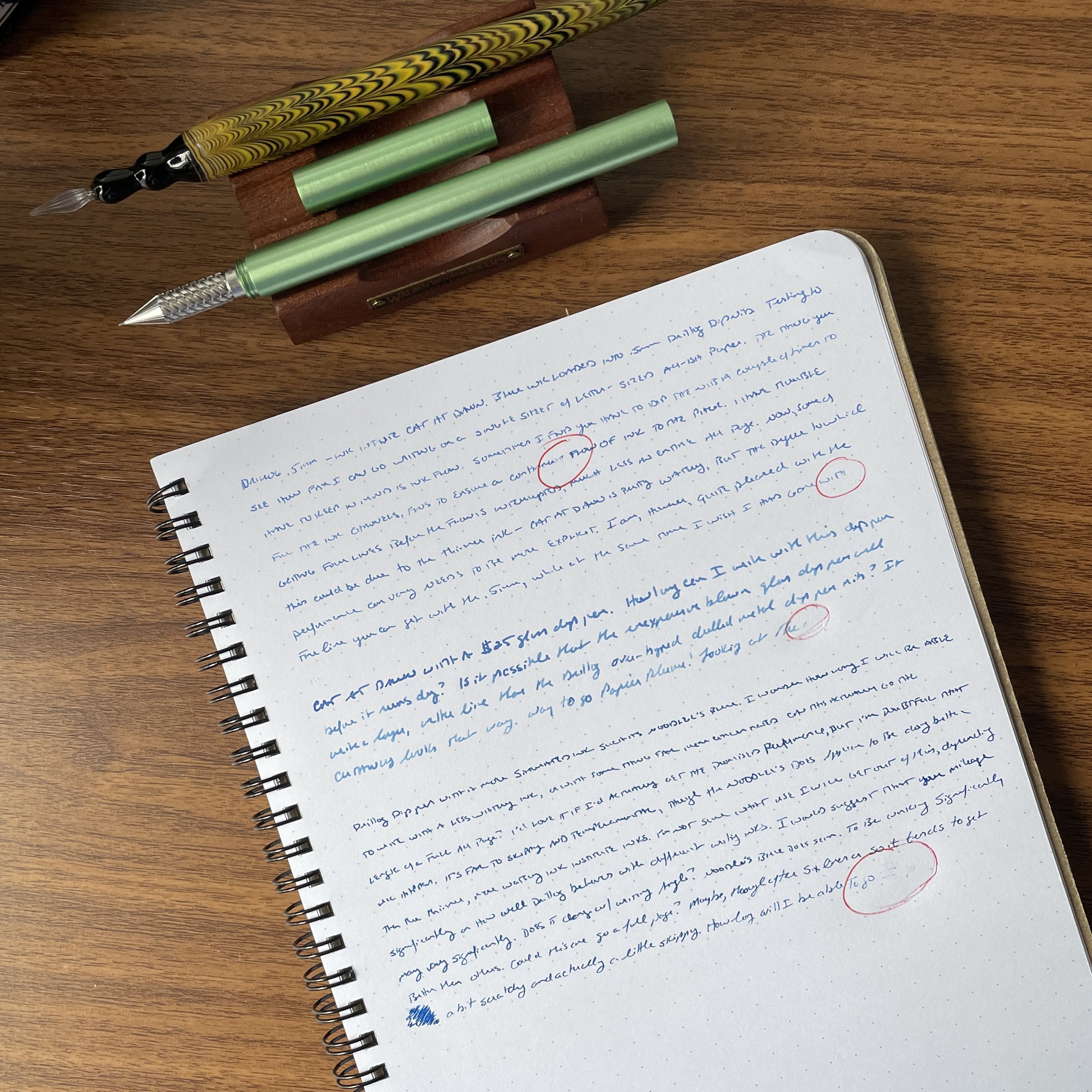
Drillog Dip Pen Writing Sample

The top two writing samples were done with Ink Institute’s “Cat at Dawn,” a shading ink that’s on the watery side. The top paragraph was written with the Drillog, and I circled in red the two points at which the nib ran dry and I had to re-dip the pen. The middle paragraph was written with a glass pen, using the same ink. The last paragraph was written with Noodler’s Blue, a slightly thicker, more saturated in that performed better, but I still didn't get close more than a quarter page.

“Ink Retention Structure for Uninterrupted Writing”: I’ll start here because this is what drew me to the Drillog in the first place. I write very small and like to take notes and make annotations in tiny handwriting, so there was something attractive about the (theoretical) ability to quickly switch inks and play around with different colors in my journals and notebooks without having to flush and refill multiple fountain pens. And to be honest, the Drillog does allow you to do that, to a point. My issue is that despite testing a half-dozen inks with this thing, I’ve never been able to get more than a quarter page of writing out of the .5mm Drillog, much less the full “A4 page” touted by Shion, the manufacturer. That’s similar to what I get out of a $25 glass dip pen, which writes a much wetter line and lays down more ink. I’ve also experienced consistent hard starts and other problems with getting my Drillog to write, often having to dip the pen multiple times to get it started. Upon close inspection, the tip of my pen appears ever-so-slightly bent or curved, and one side of the pen won’t write at all because ink doesn’t flow through the grooves. While I plan to reach out to Shion to request a replacement (or an explanation), I’m disappointed something like this made it through QC at this price point.

The drill-bit-like grooves in the nib are designed to hold a large volume of ink and, theoretically, allow you to write for a full A4 page before having to re-dip the nib. I’ve been unable to duplicate that in real life.

Ability to Use All Sorts of Inks and Easily Change Them. Drillog doesn’t expressly represent that the pen is intended to be used with fountain pen inks, but let’s be honest, that’s why many people ordered this pen and there needs to be more transparency around what users can reasonably expect. Jacob (writing at Fudefan) has done more extensive testing with the Drillog, and remarked that the nib appears to be sensitive to surface tension/ink viscosity, with certain inks performing better than others. Drillog also has a proviso on the Kickstarter page stating that “the area that can be written on may change due to the ink drying up.” I don’t know what they’re specifically referring to here, since there’s no context for the statement, but I suspect that because many fountain pen inks are water-based, with varying degrees of viscosity, surface tension, and saturation, thinner ink formulations may dry out on the nib before you have the chance to write the nib dry. This could be the source of the issues I’ve had with my pen, though I suspect that it has more to do with a manufacturing issue given the hard starts and scratchiness. Given the massive discrepancy between what I’ve experienced and what was advertised, I can’t get past that, especially where I can get similar performance in a less expensive product.
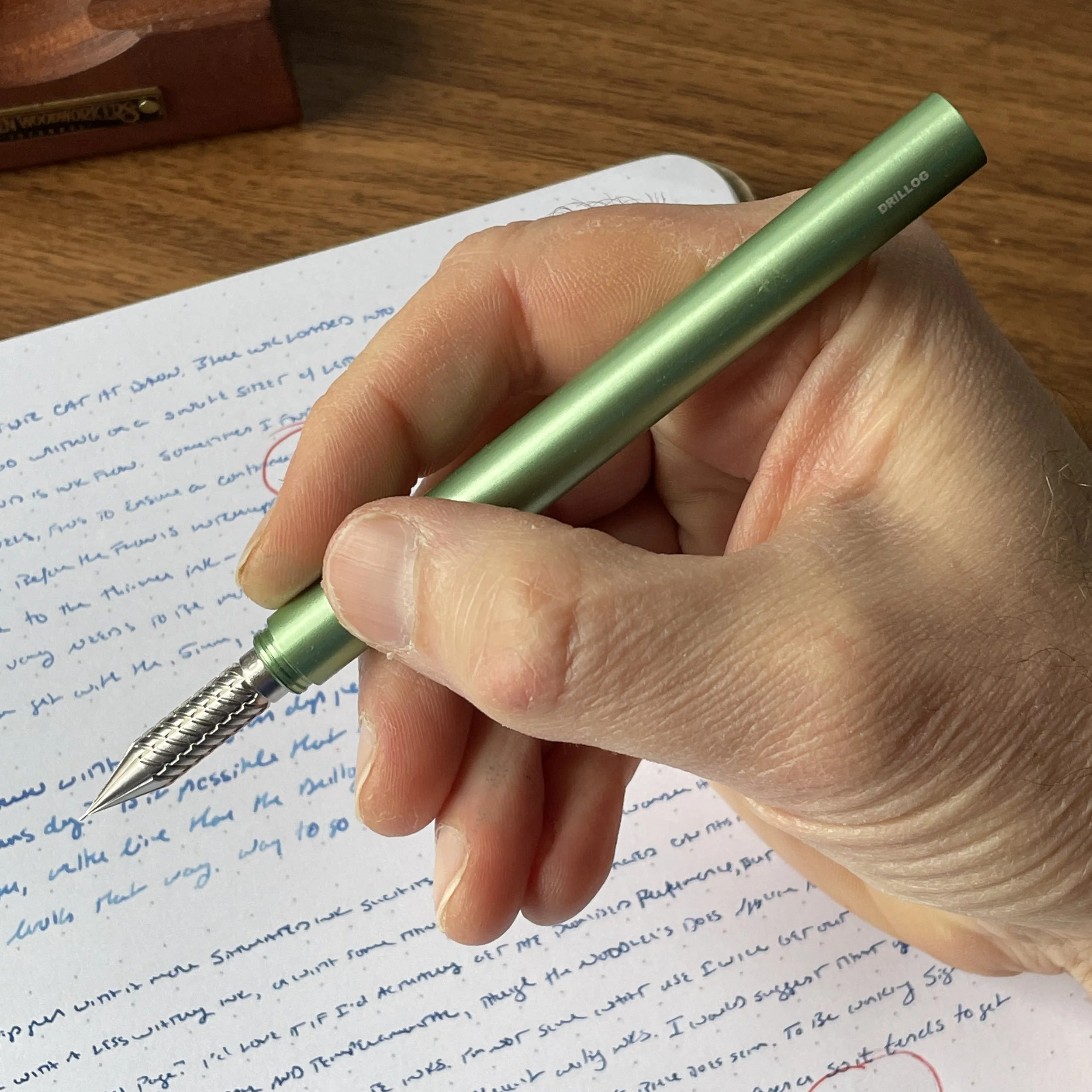
Performance aside, the Drillog is visually stunning, and a gorgeous piece of machining.

Comfortable and Convenient Nib Holder. I give credit where credit is due, and one area where Drillog did a nice job was the design of the nib holder. I opted for the longer round barrel, as opposed to the spiral or grooved designs, and I love the cap, which means that I can transport this dip pen easily to pen shows. Honestly, this is why I’ll probably hang on to the Drillog - so that I can sample different inks after hours in my pen show notebook. That said, you can find inexpensive capped glass dip pens by Moonman and other brands for much less money, and even if you have to buy a few to find one that works reliably, you’ll have spent much less money than on the Drillog.

Takeaway and Final Thoughts

I hate to say it, but I consider the performance of my Drillog dip pen to be unacceptable for the price. At ¥25,692, which equates to roughly $225 at today’s exchange rate, that’s a huge premium for a dip pen that promises performance based on precision engineering - the source of the astronomic price tag - but fails to deliver a writing experience consistently better than much less expensive options. If I paid $50 for this pen, I might say it was “ok” and recommend that people pick it up if they’re interested in using it for testing inks or are looking for a machined dip nib with a very small tip that might be advantageous for certain types of lettering and other artwork requiring a great degree of precision. That said, I’m not sure what this offers the typical writing and ink enthusiast over a glass pen or inexpensive traditional XXF calligraphy nibs, other than the Drillog will last much longer and comes with a capped holder (which is quite cool).

This purchase was intended as an experiment, and I went into it suspecting the Drillog would likely not live up to the lofty promises, having read a handful of online reviews and comments similar to my own. Still, I expected more than this. I’ve also had the opportunity to test a handful of early-release “tester” Drillogs sent to other bloggers and reviewers, all of which worked much better than the one I received. That leads me to suspect that these review units were subjected to a higher level of QC testing than the ones that ultimately went out the door to paying customers, which is disappointing. A quick scan of the comments on the Kickstarter page confirms that I’m not the only one who’s had problems. I’ll be keeping on eye on Shion and Drillog to see if there are manufacturing tweaks made to a “version 2.0”, and whether they offer to take back any malfunctioning pens. So far, I’ve not seen any outreach in the Kickstarter comments.

UPDATE: Following this review, Drillog reached out, confirmed that it looks like something is wrong with my pen from the writing sample, and offered to send a replacement. I plan to take them up on it and will report back on how the new nib functions.

Disclaimer: As noted, I purchased the product featured in this review with my own funds, for my own personal use. All opinions expressed here are my own. This post does not contain affiliate links, and I was not compensated in any way for this review.
In Crowdfunding, Pens Tags Dip Pen, Drillog, Kickstarter, Pen Review
7 Comments

Pen Review: Otto Hutt Design03

January 22, 2022

I remember back in 2016, when I seemingly was the only pen blogger who had reviewed a product from German pen maker Otto Hutt, based in famed jewelry town Pforzheim since the 1920s. Over the past several years, Otto Hutt has made a concerted effort to expand beyond Europe into the U.S. market, and since I first reviewed the Otto Hutt Design06, I’ve had the opportunity to look at their flagship Design07, and today, the Design03. Each pen has been a pleasure to write with, and I remain an unabashed fan of Otto Hutt as a brand.

The Otto Hutt Design03 in blue (right) shown with the Otto Hutt Design06 in matte black (left).

The Design03 has a completely different look and feel from either of the two pens that I’ve previously reviewed. While both the Design06 and Design07 feature a “flat top” look, the Design03 is rounded, with a more modern silhouette and a more visible logo on the barrel. The Design03 is also the slimmest pen of the three I’ve reviewed, and would easily fit within a planner loop or pen sleeve (though I’d be sure to clip it in because the Design03 is on the heavier side).

The Design03 makes for a classy looking workhorse.

And let’s talk about weight. Like most Otto Hutt offerings, the Design03 is a metal pen, which gives it some heft. But also like the Design06 and the Design07, this fountain pen is exceptionally well balanced. Due to the shape and cap design, the pen doesn’t post, but the balance is such that the heaviest part of the barrel rests comfortably between my thumb and forefinger. I had no issues with hand fatigue, but as with most metal pens, those sensitive to the weight of their writing instrument may want to try this one in person before you buy it.

For me, this pen writes a perfect medium line. The balance of this pen makes me feel as though I have a lot of control over my writing, which I appreciate.

Finally, the nib. Otto Hutt uses bicolor stainless steel nibs that I believe are sourced from Bock, though they are customized for Otto Hutt. Every Otto Hutt nib I have used has been expertly tuned for a smooth writing experience that’s never caused me any issues. Indeed, the nibs on my Otto Hutt pens are some of the most reliable in my collection. The Design03 is no exception, writing a smooth, medium-wet line with consistent ink flow. (The ink shown here is Scribo Grigio, a dark grey-blue that’s a current favorite.)

One distinction between the Design03 and the Design06 is the lack of visible branding on the Design06 (other than the cap finial and cap band).

Takeaways and Where to Buy

As always, I thoroughly enjoyed getting to review this Otto Hutt fountain pen. Despite the brand’s somewhat inexplicable lack of traction stateside, I remain a huge fan and try to get my hands on them whenever I can. Otto Hutt’s steel nibs are smooth, reliable writers, and I personally find their pens fit my hand perfectly. The matte texture that they use on both the Design06 and the Design03 (featured here) makes for one of my favorite tactile writing experiences.

if you’re interested in trying Otto Hutt out for yourself, please visit Pen Heaven, a UK-based retailer that carries a wide-variety of fountain pens, ink, and related writing accessories. The Design03 pictured here is currently priced at $162, which hits the sweet spot for a pen of this quality. The pen accepts standard international cartridges, and also ships with an Otto Hutt converter. Many thanks to Pen Heaven for making this review possible!

The pen featured in this post was sent to me free of charge by Pen Heaven, for review purposes. I was not otherwise compensated for this review. This post does NOT contain paid affiliate links and I am not compensated for any purchases made from Pen Heaven.

In Pens Tags Pen Review, Fountain Pens, Otto Hutt Design03
2 Comments

Pen Review: Pininfarina PF Two Fountain Pen

December 11, 2021

One relatively new release that caught my eye at this year’s San Francisco Pen Show was from a brand that had never previously interested me: Pininfarina Segno, a branch of the famed automotive design firm Pininfarina. Over the years, this Italian brand has become known for their quirky modern writing instruments with an industrial or automotive inspiration (which is not surprising given the brand’s origins and association with makers such as Ferrari).

The pen I’m looking at today offers Pininfarina design at a relatively accessible price point. The “PF Two” fountain pen is part of Pininfarina’s “Design Writing” Project, which they describe as a “collection of unique accessories thought to go above and beyond mere utility, where the product’s essential function is just the first step.” In other words, this pen is marketed as a design piece in addition to a solid writing instrument. Of course, whenever you go above the $200 price point, you’re paying for design, but at around $230, you’re not that much higher than the $150-200 price point most manufacturers are targeting these days for their high-end steel nib pens. Those looking for a workhorse pen with a unique look could do much, much worse than considering the PF Two.

Pininfarina PF Two Packaging

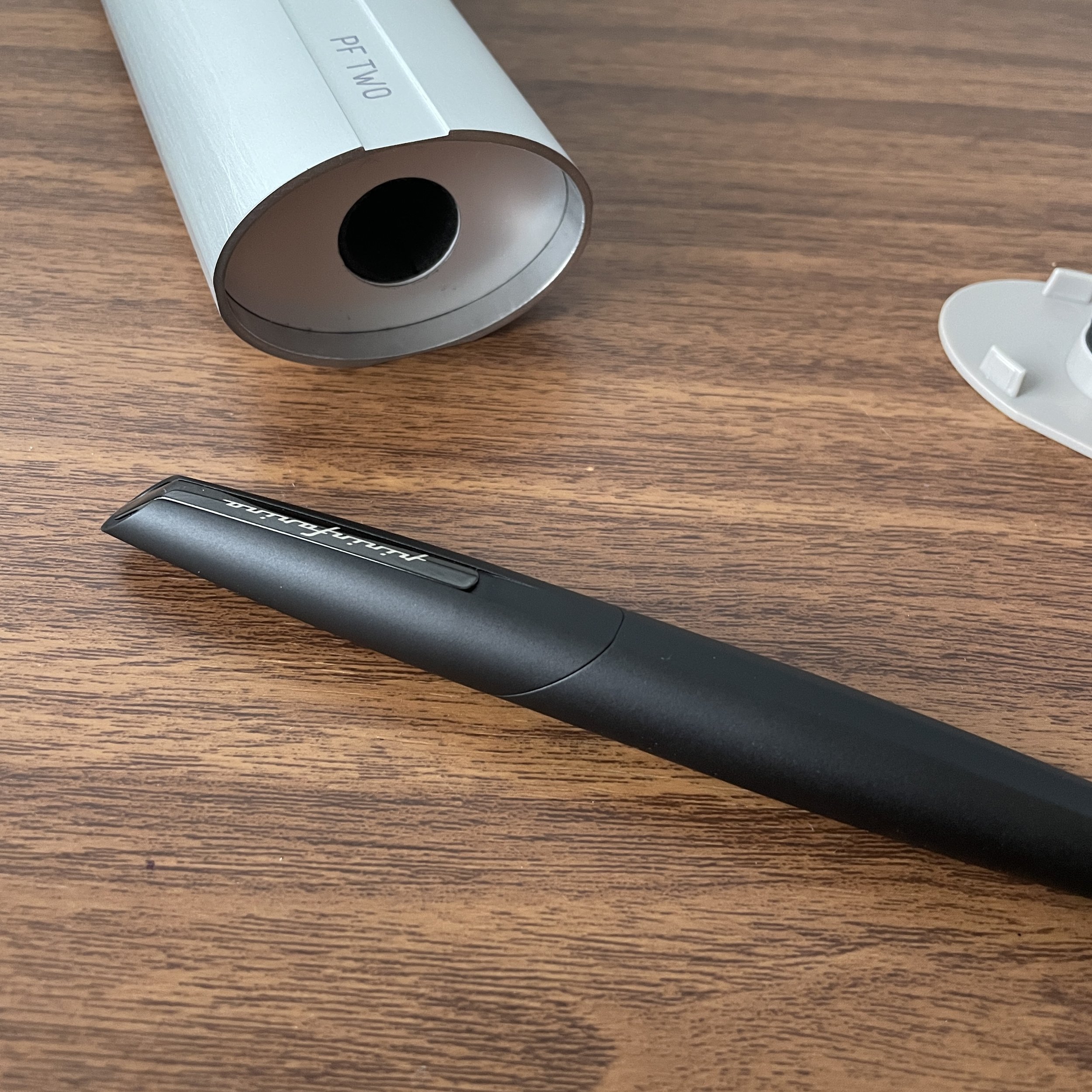
The pen’s unique design extends to the packaging: an aluminum sleeve with a padded insert. I’m not sure that I’d reuse the case for everyday carry, but if you store your pens long term in the original packaging, it will hold up and protect your pen.

Build Quality

The PF Two features an anodized aluminum body, in either black or light blue. It has a streamlined shape with flattened, angled ends, reminding me of a more industrial-looking Waterman Carene. The spring-loaded clip is flat, and lies flush with the body of the pen inside a single facet that functions as a roll-stop. the end result is a sleek, modern design that’s adventurous without losing any functionality. Honestly, it’s exactly what I like to see from makers in an industry where it sometimes seems like everything that can be done design-wise has already been attempted, and the focus has shifted solely to reissuing the same pens in different materials. The build quality also impressed me, from the black anodized finish, to the polished clip, to the well-tuned JoWo No. 6 nib. The magnetic cap closes securely and perfectly flush with the barrel.

The clip on the PF Two sits flush with the pen when not extended.

To extend the clip, press down on the finial. Despite its thinness, the clip actually did a fairly good job of holding this heavy pen to the front of a notebook. Given the relative heft of the PF Two, however, i’m not sure how much I’d rely on this clip to secure the pen to a bag or shirt pocket.

Writing Experience

In terms of a writing experience, I have to mention the nib first. In an era where JoWo stainless steel nibs have become the default option for pens under $250, it’s easy to lump these into a single category and bypass any particularized discussion. I won’t do that here, because the nib on this PF Two is one of the smoothest, well-tuned JoWo stainless steel nibs I’ve ever written with, on par with ones I’ve received from Franklin-Christoph (all of which are tuned by hand prior to shipping). Now, Pininfarina describes this nib as a “calibrated nib, which guarantees a long ink life, protecting it from atmospheric pressure and temperature.” I don’t really even know what this means - it’s likely just marketing speak for “we tuned the nib” - but I do have to agree: they did something to it, and whatever their process is, it works.

The PF Two is also very well-balanced. Since you cannot post the pen, this is important, and the pen has just enough heft to make it comfortable. The grip section offers enough texture to prevent your hand from slipping, though keep in mind that there is a rather sharp step from the barrel to the section. Given how I grip the pen, it didn’t pose any issues for me, and in fact I never even noticed it when writing.

View fullsize Pininfarina PF Two Nib
View fullsize PF Two Writing Sample (Private Reserve DC Supershow Blue)
View fullsize Pininfarina PF Two Converter

Takeaways and Where to Buy

The Pininfarina PF Two is a well-made modern fountain pen that offers famed Pininfarina design at a price point that should be relatively accessible to many pen enthusiasts. I won’t say that this is an “inexpensive” pen at more than $200, but it’s in the same ballpark as the Montegrappa Fortuna, Montegrappa Miya (with the steel nib), and the standard Leonardo Momento Zero and Momento Zero Grande.

The Pininfarina PF Two (second from right) shown here next to, from right, a Waterman Carene, Diplomat Aero, and a Lamy 2000.

You can purchase the Pininfarina PF Two fountain pen from The Pleasure of Writing and other Pininfarina retailers. As I mentioned above, this pen typically retails for a street price of around $230 (with an MSRP of $295). In addition to the fountain pen, ballpoint and rollerball versions are also available. Many thanks to the team at The Pleasure of Writing (formerly Bittner), for loaning me this pen for review purposes. While I need to send this particular pen back following the review, I’m eyeing a light blue version for my own collection at some point in the future.

This post does not contain affiliate links. I was not compensated for this review, and the pen featured here was loaned to me for review purposes. Many thanks to The Pleasure of Writing for making this review possible!

In Pens Tags Pininfarina, Pininfarina PF Two, Pen Review, Fountain Pens
7 Comments

Esterbrook x Accutron: The Collaboration Continues with New Esties, Including an Oversize!

November 24, 2021

When we last looked at the collaboration between American “heritage” brands Esterbrook and Accutron, it was limited to a special edition Esterbrook Camden fountain pen in a gorgeous green shade. Recently, Esterbrook and Accutron have followed up with two new limited edition Estie fountain pens in green and gold DiamondCast material, in both standard and oversized versions. All feature details such as the Accutron “tuning fork” logo on the cap and nib that set these pens apart from the standard Esterbrook lineup.

To recap a bit from my previous post, the “Accutron” brand was first associated with a line of watches manufactured by Bulova, and recently relaunched as a separate company by the Citizen Group. You can read more about both vintage and modern Accutron watches on dedicated watch sites such as Hodinkee, and the story behind the development of the technology is fascinating. Short version: Accutron watches bridged the gap between traditional mechanical watches and modern quartz watches, introducing a unique “tuning fork” movement that was one of the first mass-market electronic watches available. Esterbrook distributor Kenro and Accutron were kind enough to send me the modern Accutron “Spaceview” watch pictured here, so that I could get a sense of the current company’s aesthetic and how it complements the limited edition Esterbrook pens. I won’t do a full watch review, since that steps out side my area of expertise, but I did enjoy wearing the watch for a few days, and if you enjoy the Accutron look, I’d encourage you to read the full Hodinkee write-up of the Spaceview 2020 here.

My First Experience with the Oversized Estie

This particular post will focus on one of the two pens I was sent for review: the Accutron x Esterbrook Oversized Estie, which - believe it or not - I’ve never had the opportunity to test for an extended period of time. I’ve always though I would remain partial to the “standard” size Estie fountain pen, since (1) it’s quite comfortable and nearly the perfect size for me; and (2) it posts, which can be important given how/where I do much of my daily writing. That said, after having a few weeks to test out the oversized version, I’m beginning to reconsider.

Here’s what I enjoy about the Oversized Estie:

  • This pen has fantastic balance. While the standard Estie is extremely comfortable to use, the Oversized pen is perfectly weighted for unposted use, and even though it’s a big pen, you don’t notice the size. I would compare the overall length and proportions to a slightly slimmer Opus 88 Jazz.

  • JoWo 18k nibs are among my favorite stock nib units. I’ve had several JoWo 18k gold nibs in my collection over the years, and they never fail to disappoint. This medium nib arrived perfectly tuned, and I’ve not experienced any issues with skipping or hard-starting.

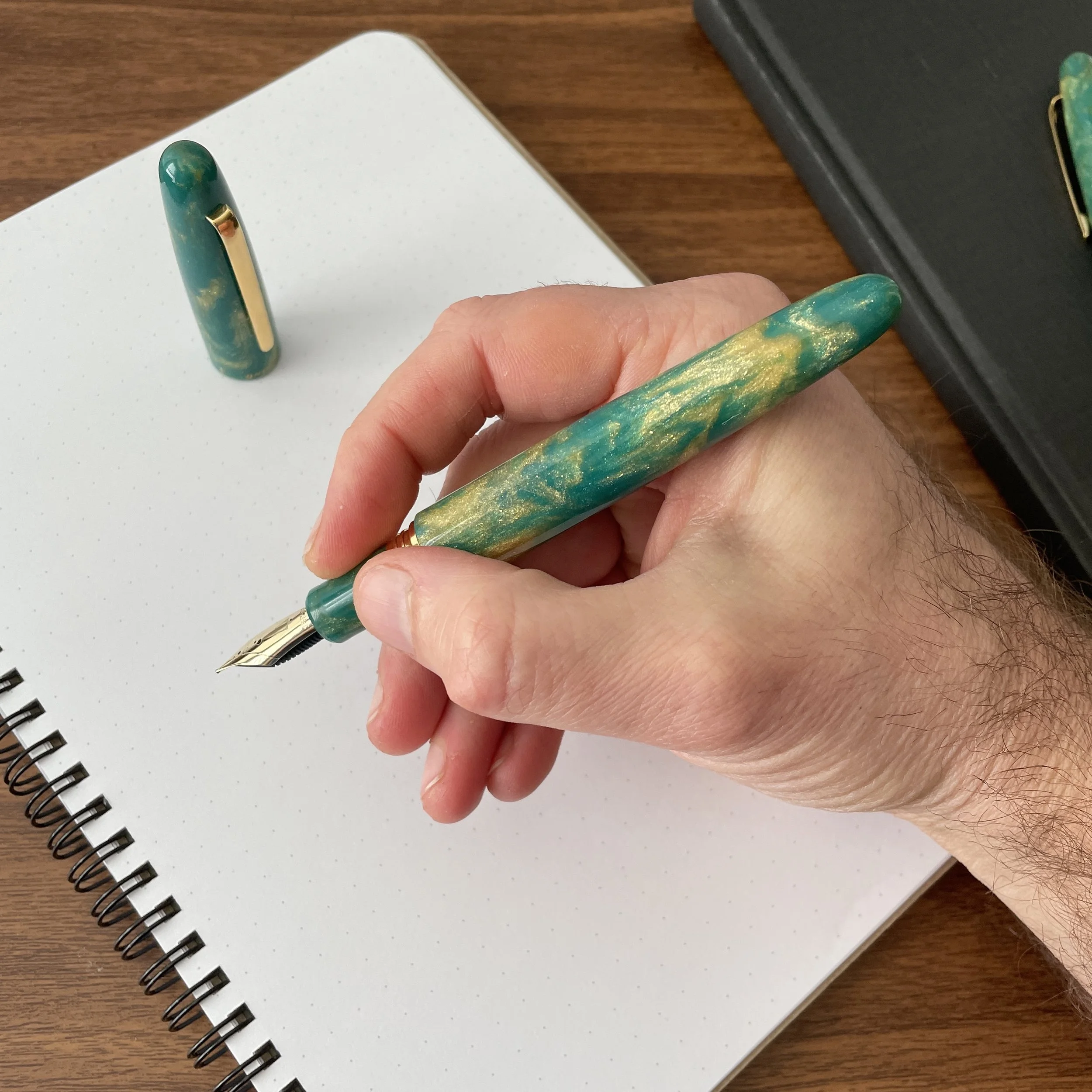
  • The larger pen body is the perfect canvas for showcasing the DiamondCast material. If you’re unfamiliar with “DiamondCast”, it’s a material made by McKenzie Penworks in here in Tennessee, which features a mixture of alumilite, pigment and real diamond dust. You can read more on the McKenzie Penworks website.

View fullsize Estie Oversized Unposted
View fullsize Estie Standard Unposted
View fullsize Estie Standard Posted

If there’s anything that I don’t enjoy about the Estie Oversized, it would be the metal threads on the barrel, which, in my opinion, somewhat disrupts the streamlined design of the pen. At the same time, the threads are not sharp at all, so they don’t interfere with a comfortable grip, and the added bit of metal front-weights the pen which likely contributes to the excellent balance I noted above. Taken as a whole, this is an aesthetic preference for me that at the end of the day, won’t prevent me from adding an Oversized Estie to my collection.

The Accutron “Tuning Fork” logo dates back to the “tuning fork movement” used in vintage Accutron watches.

Takeaways and Where to Buy

Unlike the Camden, which was available only from select Accutron watch retailers, the new Esterbrook x Accutron Diamondcast Esties pictured here are also available through most major Esterbrook pen retailers. Like other Esties made from Diamondcast material, the price point is higher than standard Estie fountain pens, with the standard model bearing an MSRP of $395 / $316 retail, and the oversized priced at $750 MSRP / $675 retail. (The Oversized version comes only with a 18k JoWo Nib.) If you’re a fan of this green and gold Diamondcast material, or looking for an Accutron-branded Estie to match a recent watch purchase, I’d act quickly because these pens are part of a limited edition series and won’t be around forever. In fact, they’re already sold out at some retailers.

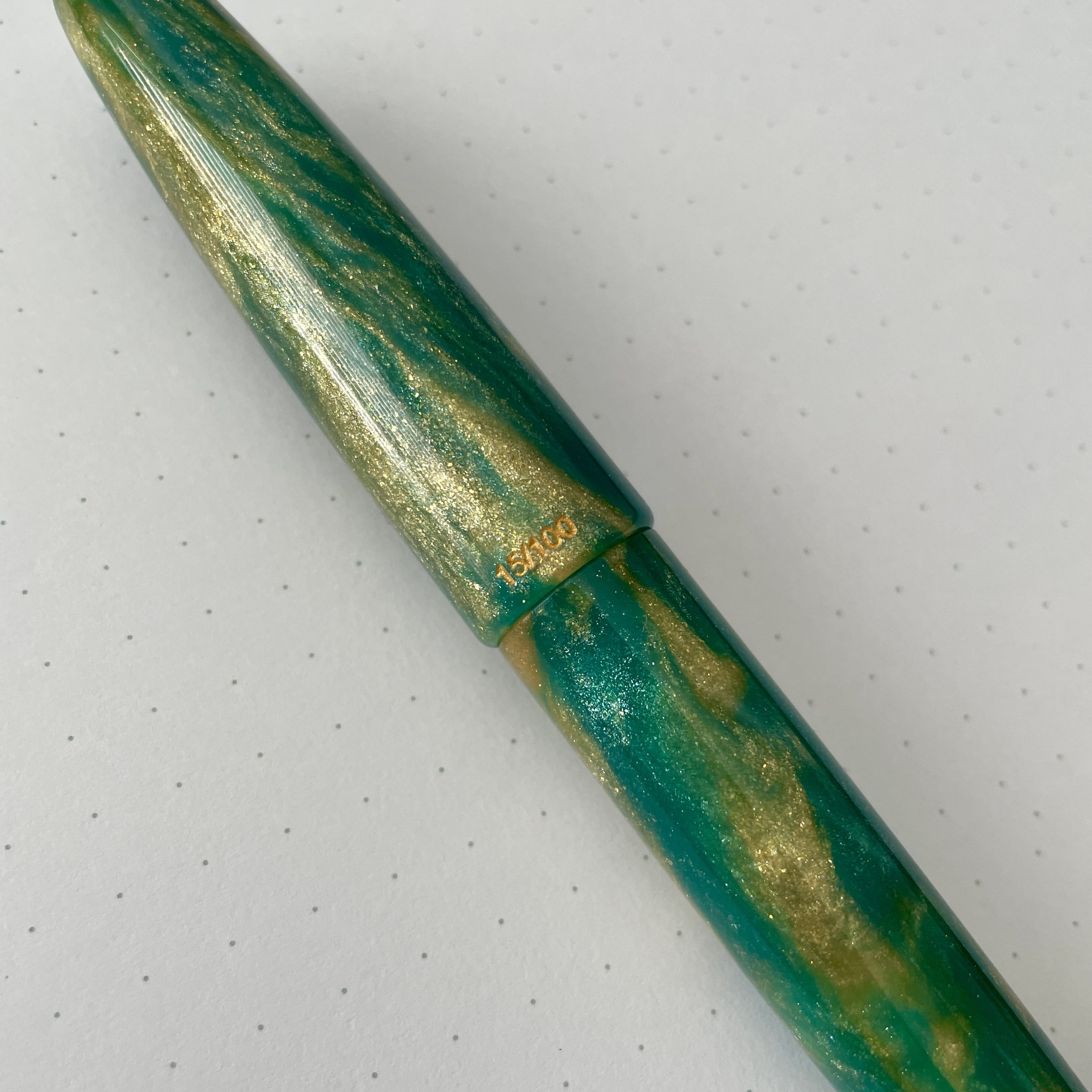
The Esterbrook x Accutron Estie Oversize pens are numbered in an edition of 100.

On a more general note, count me a fan of the Estie Oversized! I’m already looking for the perfect model to add to the permanent rotation, and strongly considering one of the “Nouveau Bleu” models with the gold trim, perhaps adding a “Scribe” specialty nib.

Many thanks to Esterbrook and Kenro Industries for making this review possible. This post does not contain affiliate links, nor was I compensated for this review. All products shown here were lent to The Gentleman Stationer for review purposes and returned afterwards.

In Pens Tags Esterbrook Estie, Esterbrook x Accutron, Kenro, Esterbrook Accutron, Esterbrook, Pen Review
Comment

The Ultem-ate EDC? Reviewing the Schon DSGN Ultem Pens in Black and Amber

October 27, 2021

By far my biggest prizes from this year’s pen show season have been my two newest additions from Schon DSGN: Ian’s first full-size fountain pens made from the engineered plastic Ultem. This material is increasingly popular in penmaking, so you may have seen a bunch of pictures of Ultem pens in recent month, both from Schon DSGN and other makers, and wondered, what the heck is it?

Ultem is a “semi-transparent high-strength plastic” that is capable of being machined thinner than most other plastics or acrylics, so when used in penmaking you get a pen that is not only resistant to cracking and breaks from accidental drops, but chemical and stain resistant as well. (Source: Curbell Plastics). You read that last part right: If you’ve been dreaming of eyedroppering that transparent fountain pen with Noodler’s Baystate Blue, you can fill your Schon DSGN Ultem pen with Baystate or any other high-maintenance ink with a clean conscience, since it will neither stain nor disintegrate! This makes sense once you understand that in “real life”, Ultem is so durable that it is typically used to make medical, industrial, and other scientific equipment.

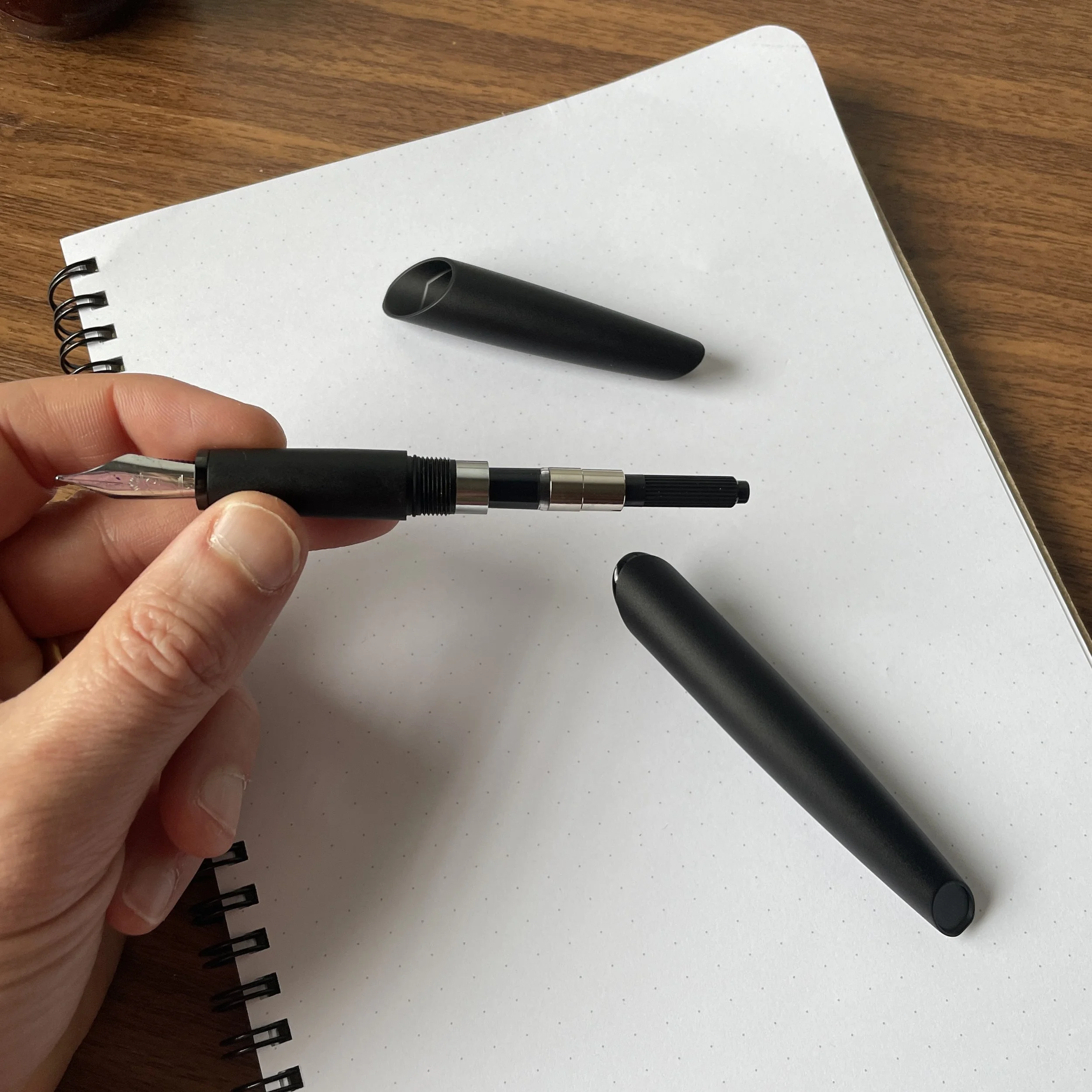
Schon DSGN Ultem Fountain Pen Swapped Parts

I swapped the sections on my two Schon DSGN fountain pens as soon as I got them. It looks great and adds just enough variation to make them interesting without looking overly mismatched.

I admit that I was a touch skeptical when these pens were first released, not because I doubted that Ian Schon would make a great full-size fountain pen, but rather because I didn’t understand how the properties of Ultem justified the somewhat hefty price tag. Ultem as a material isn’t cheap, so a cartridge-converter Ultem fountain pen with a steel nib starts at $250. But as with most things Schon DSGN, once you get the product itself in your hands, you realize that you get what you pay for. Here’s a short list of what I love about the Schon DSGN Ultem fountain pen:

Schon DSGN Ultem Eyedropper
  • Lightweight Design. Ultem’s key selling point - its extremely light weight - translates well to pen design. For example, you can post the cap on the end of the pen with no perceptible change in weight or balance. I’ve never had an experience like this posting a fountain pen before. To me, it’s the epitome of well-considered and creative pen design: using the properties of a specific material in a way that actually enhances the user experience.

  • Eyedropper Capability. I generally don’t eyedropper standard cartridge-converter fountain pens, as they tend to burp ink into the cap (and eventually, onto your hand) due to air pressure and temperature shifts. Unless you use a Japanese-style system that includes a “shutoff valve,” or skillfully apply o-rings and silicone grease to minimize potential leakage, you could end up with a real mess on your hands. Here, Schon DSGN has already included at least five o-rings into the design of the Ultem fountain pen (I count four in the section and one in the cap), making it eyedropper-ready. I’ve flown with these pens twice and have had no serious “ink-cidents.”

  • Comfort. The Ultem fountain pen is designed for comfort. Not only is it lightweight, but the concave section provides a nice grip, and the threads are high enough on the barrel to stay out of the way. Ultem as a material has a nice grippy texture that doesn’t get slick over the course of longer writing sessions.

  • Durability. I’ve carried this pen in a traditional pen case, loose in a bag, and in my pocket, and have had no issues with scratches, cracks, or other damage. Given the industrial uses for Ultem, it’s highly unlikely that the average fountain pen user could stress this pen to the degree necessary to cause damage. While not marketed as a “pocket pen,” I would carry the Schon Ultem in my pocket with confidence.

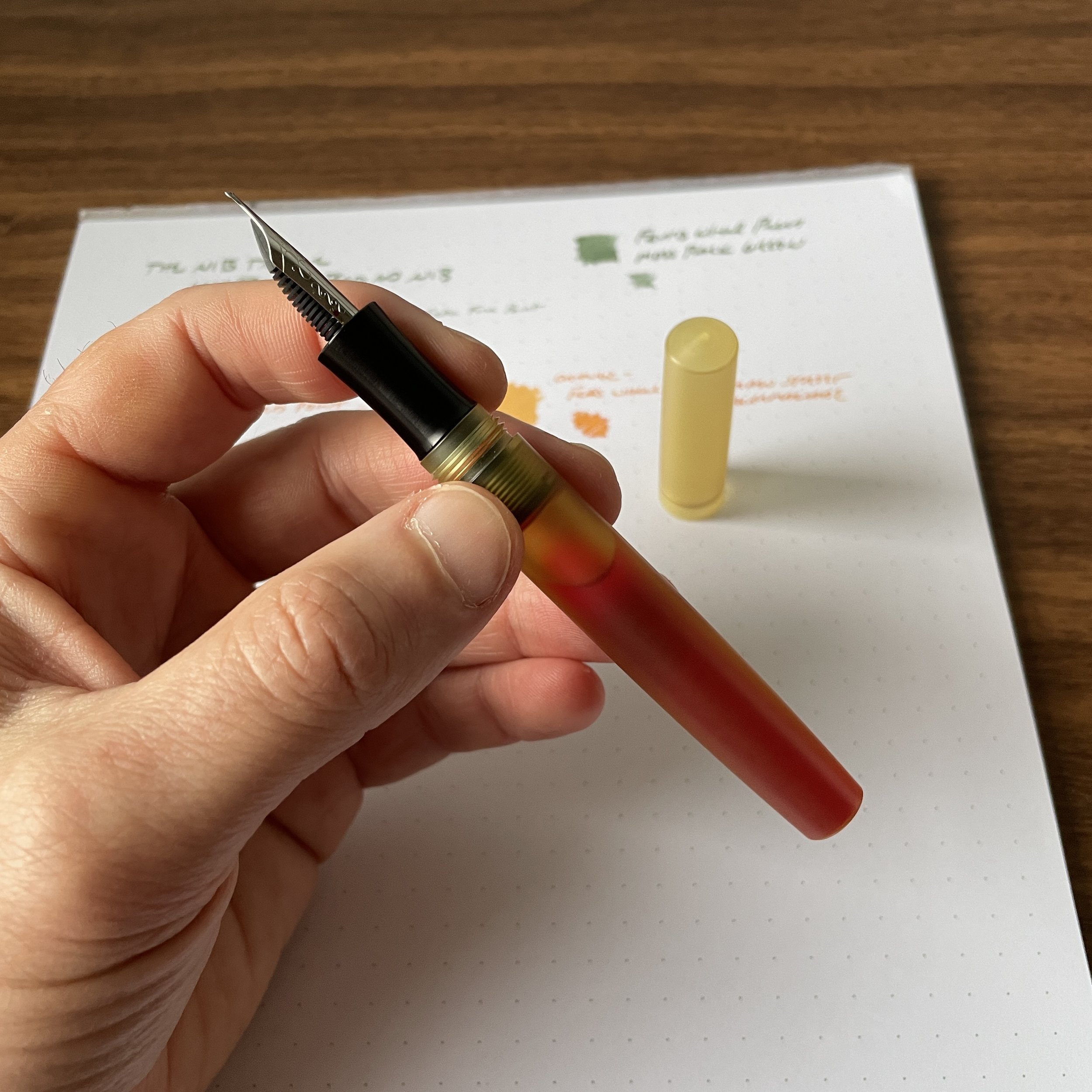
  • Nib Versatility. Designed to take a JoWo No. 6 nib unit, this opens the door to all sorts of customization, as I discussed in a separate article a couple of weeks ago. Currently, I have an “inverted architect” nib in my amber Ultem fountain pen, and a Platinum UEF nib in my Black Ultem (courtesy of specialty housings available from Flexible Nib Factory). Another fun fact: the parts and sections on the Schon Ultem pens are interchangeable, meaning that you can swap the amber section and/or cap onto the black pen, or vice-versa. Ian also sells a section designed to fit a larger No. 8 Bock nib, if you’d like a different sort of writing experience. (You will need to supply your own nib.)

Check out the red o-rings, visible in the amber Ultem cap, section, and barrel. In addition to making the pen eyedropper-ready, it’s a nice design touch that creates a cool look,

The Schon DSGN Ultem fountain pens get more or less an unqualified recommendation from me. The only potential drawback I can see for some people is the size. As with most of Ian Schon’s designs, these are compact fountain pens that may be too small for some people with larger hands, or who prefer a longer pen and don’t want to post the cap. Unposted, the pens measure 4.8 inches. Posting extends the length to roughly 6.25 inches but not everyone likes to post (even though the o-ring inside the cap pulls double duty as a failsafe against leaks AND a means of allowing the pen to post securely).

View fullsize Schon DSGN Ultem Unposted
View fullsize Schon DSGN Ultem Posted

Takeaways and Where to Buy

I have not taken my two Schon DSGN Ultem pens out of rotation since purchasing them in late August at the San Francisco Pen Show. I’ve used the pens both as traditional cartridge-converter fountain pens and as eyedroppers, and it’s hard to envision a more versatile fountain pen for everyday carry, in the sense that the pen can serve as both a durable pocket pen and a full-size “desk pen.” Throw in added points for eyedropper capability and the ability to easily swap out nibs, and the Schon DSGN Ultem fountain pen lands itself very high on my list of favorite releases from 2021.

Schon DSGN lists the Ultem fountain pens under the category of “Engineered Plastics” on the website, and you may have seen that in addition to the standard natural/amber Ultem and Black Ultem fountain pens, Ian now offers a “Peek” fountain pen, which is another engineered plastic that comes in a taupe or beige shade. (I can’t wait to get my hands on that, but I’ve purchased a bunch of pens lately and need to let things lie for a while.) The natural/amber Ultem pen is priced at $250, Black Ultem at $260, and Peek at $275.

If you’d like to read further on other Schon DSGN products, check out my review of the Schon DSGN Pocket 6, which can be found in the “Artisan/Custom Pens” section of the T.G.S. Fountain Pen Review Archive.

I purchased the pens featured in this review with my own funds. This post does not contain paid third-party affiliate links. The Gentleman Stationer is supported entirely by reader contributions and purchases from the T.G.S. Curated Shop. By shopping with us directly, you are supporting original content, pen reviews, pen show events, etc. from The Gentleman Stationer. If you would like to support us even further, please consider checking out the T.G.S. Patreon Program, which offers access to online meetups, exclusive discounts and pre-orders, and more!

In Pens Tags Schon DSGN, Schon DSGN Ultem Fountain Pen, Ultem, Pen Review, Fountain Pen
2 Comments
← Newer Posts Older Posts →
Store Hours and Location
Visit the T.G.S. Curated SHOP
*New* Updated "Best Pens" Guide (2025)
T.G.S. 2025 Holiday Gift Guide
TGS x Roterfaden TGS_25
Hierarchies of Fountain Pen Friendly Paper

Join Our Patreon!
Subscribe to the TGS E-mail List

Featured Posts

Featured
Cover On the Paper Trail Intro Clip.jpeg
Dec 3, 2025
Introducing "On the Paper Trail," a New Podcast/Video Collaboration with Lisa Vanness of Vanness Pens!
Dec 3, 2025
Dec 3, 2025
Iro-Utsushi-Fine-Dip-Pens.jpeg
Oct 1, 2025
The Pilot Iro-Utsushi Dip Pen (and in General, Simple vs. Fancy Dip Pens)
Oct 1, 2025
Oct 1, 2025
Levenger-Annotation-Pad.jpeg
Sep 20, 2025
Five Boutique Paper Brands I'm Watching Closely and Why
Sep 20, 2025
Sep 20, 2025
The Gentleman Stationer RSS

© Digital Divide Media, LLC, 2014-present.

All content is the exclusive property of Digital Divide Media, LLC, d/b/a The Gentleman Stationer, including “The Gentleman Stationer” website and trademark, and should not be reproduced without express written permission.  All rights reserved.

All content containing paid advertising, affiliate links, or sponsored content will be plainly disclosed by a disclaimer when/if featured.

Contact Information

Store Shipping Policy and Return Policy

Privacy Policy

Cookie Policy

Terms and Conditions

Powered by Squarespace