• Blog
  • Shop
  • Resources
  • FAQ (Ask TGS)
  • About
  • Archive
  • Contact
  • Sign In My Account
Menu

The Gentleman Stationer

Vintage Living in the Modern World.
  • Blog
  • Shop
  • Resources
  • FAQ (Ask TGS)
  • About
  • Archive
  • Contact
  • Sign In My Account

The Jinhao X450:  one of the most commonly available eBay fountain pens. 

My Thoughts on Cheap eBay Pens

January 27, 2016

A common question that I get from readers, and one of the suggestions that appeared in response to my New Year's Giveaway was "Write a piece on Chinese Pens."  By "Chinese Pens," most people are referring to pens sold under certain Chinese brand names (Jinhao and Baoer, among others) and can be purchased for very little money on eBay or Amazon Marketplace.  This is something of a misnomer and can be misleading:  Many pens are manufactured in China, including pens sold by well-known, established brands such as Monteverde and Conklin.  Other pen companies use Chinese-manufactured parts.  To avoid confusion, this piece is going to look at the first category (the cheap, mass-produced eBay pens), and give you my thoughts on why I think these pens aren't really worth your time and money. 

Chipped enamel finish on Jinhao X450, purchased on eBay.

I've written about Jinhao pens before, when I reviewed the X450.  My review wasn't exactly glowing.  The main virtue of the Jinhaos (and Baoers, etc.) are the price:  these pens are ridiculously cheap.  You can find them for sale on eBay for as little as $3.99, shipping included. As you might expect, however, you generally get what you pay for.  For under $5, they are, objectively, a "great deal," if you receive a serviceable writer and the merchant doesn't send you pen with chipped enamel finish and a bum cap. (You can guess what happened to me.)  

Sure, you can ask for your money back, throw the pen away, pay another $5, rinse and repeat, but at that point I don't see why you wouldn't spring for a $12 Pilot Metropolitan, which in my opinion is the greatest entry level fountain pen available and could very well be the last fountain pen you ever need.  Even the Pilot Kakuno writes better than the best-writing Jinhao I have tried. Also, one of the main reasons I am drawn to this hobby is because I don't like disposable pens.  When you adopt the mindset that you are only going to purchase $5 fountain pens off of eBay so you don't have to worry about losing or breaking them, or can always throw them away when they stop working, you're forgoing one of the main benefits of using fountain pens: the pen is NOT disposable, but rather becomes something you use daily, and, if you want to foist the expectations onto your children or heirs, something you can pass on and have the next generation use as well.  If you want a disposable fountain pen that writes exceptionally well, just pick up a pack of Pilot Varsities.

I think a lot of people, my past self included, see these inexpensive pens on eBay as a way to quickly build a "collection" of fountain pens and have some daily variety at a budget price. There's nothing inherently wrong with this, but I would venture that you can get more satisfaction--and save yourself a LOT of frustration, by growing your collection slowly and spending just a bit more money on a smaller number of pens.  One or two slightly more expensive pens purchased from a merchant who can service the product is a better long-term bet than 10 cheap semi-disposable eBay pens.

That said, if you like the aesthetics of these pens (and the Jinhao x750 in frosted black is a nice looking pen), I would recommend that you pay slightly more money and purchase the pen from a merchant like Goulet Pens or HisNibs, which typically inspect the pens before they ship them to ensure they are not defective, and will allow you to do an easy return if you are dissatisfied.  (I have not purchased from HisNibs, but the retailer appears to be popular on various pen forums, and the website claims that they fill, test, and, if necessary, adjust all pens prior to shipment.)  

Final Note:  As to the argument that certain pens available on eBay "look exactly like Montblancs" or "look exactly like Lamy Safaris" at a fraction of the price, as a general matter I don't support trademark infringement, and won't recommend that you purchase those pens for that reason.  Nor will I link to those pens directly here.  As to why these pens are so cheap, and the implications of supporting the economic model that allows this sort of lowball pricing to exist, I would recommend that you read this article from Fountain Pen Economics.     

The opinions expressed here are my own, and I understand that many people might disagree with some (or all) of what I have written. The purpose of this blog is discussion, and I welcome any comments or feedback.  As always, thanks for reading!    

DISCLAIMER:  This post contains some affiliate links, through which I may be compensated a small amount if you purchase something from sites linked to in this article.  While I'd greatly appreciate it if you use these links to purchase a pen you are interested in, you are, of course, under no obligation to do so.  Many thanks!      
In Editorial, Pens Tags Jinhao, Chinese Pens, Editorial
10 Comments

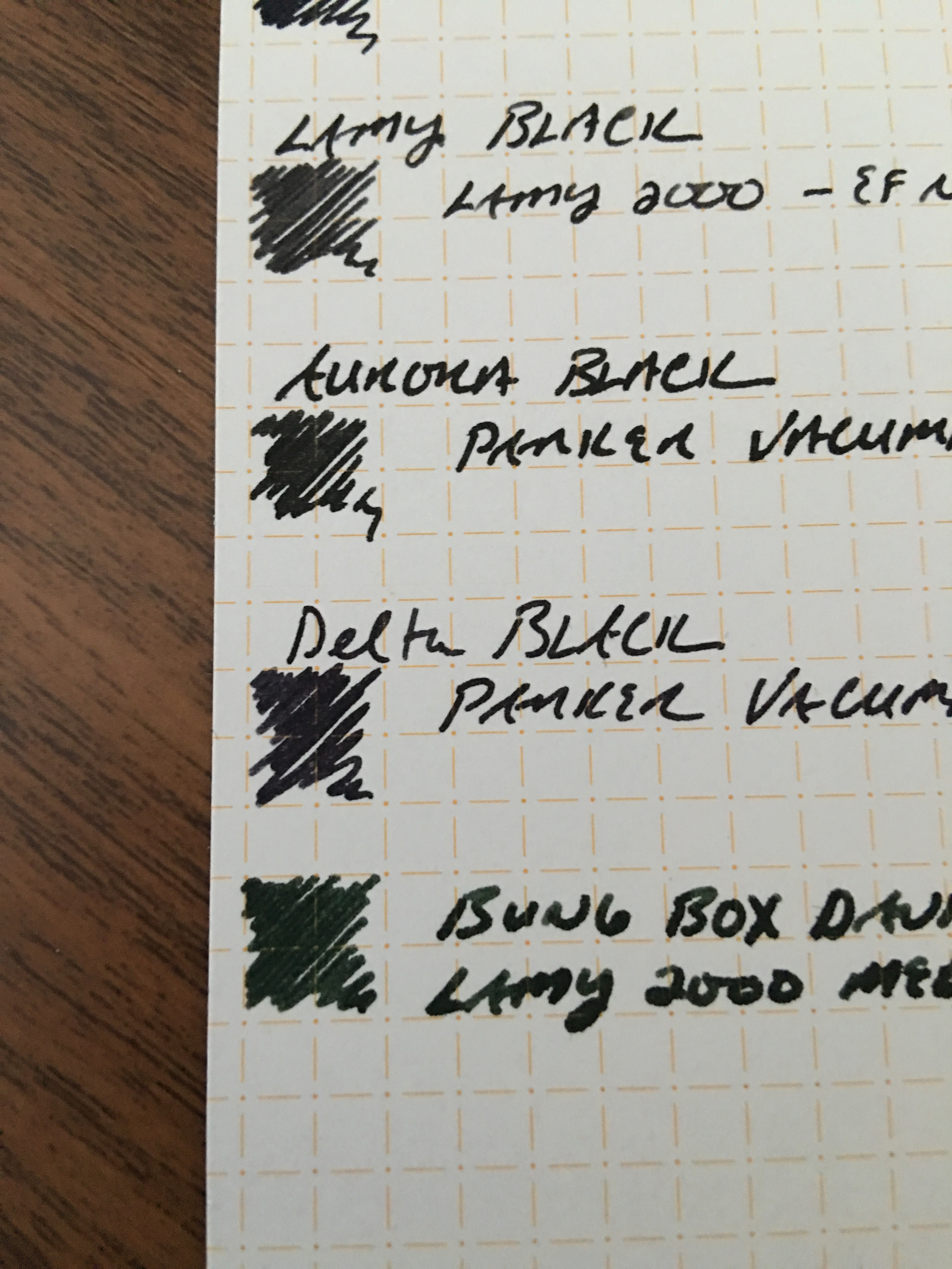
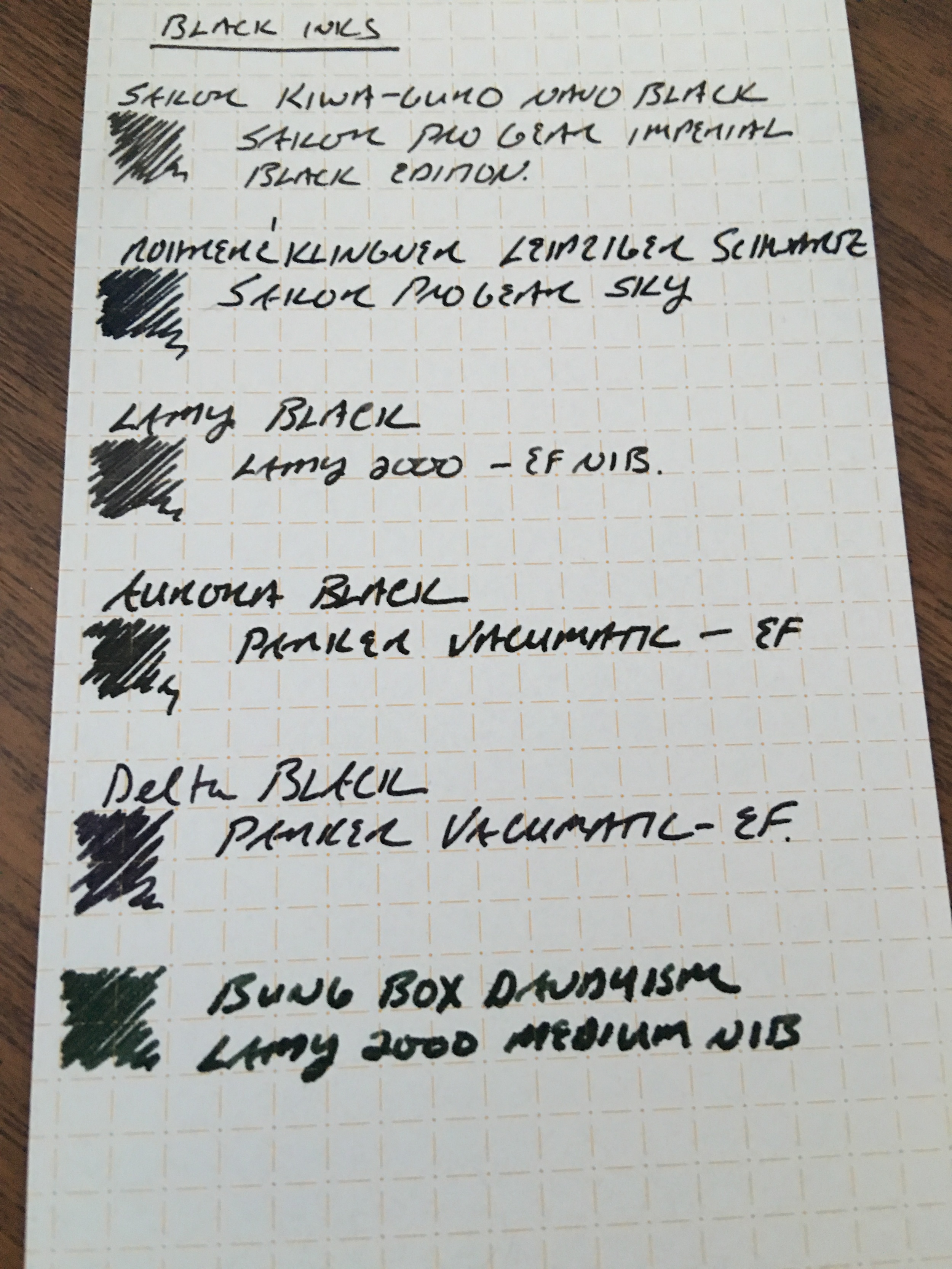
Five Black Inks, from left: (1) Lamy Black; (2) Aurora Black; (3) Delta Black; (4) Sailor Kiwa-Guro; and (5) Roher & Klingner Leipziger Schwartz. 

Five Black Inks

January 23, 2016

Since pretty much everyone in the Eastern United States is snowed or iced in this weekend (well, except maybe you South Georgians and Floridians), I can probably guess what the readers of this blog have been doing.  For my part, I inked up a bunch of pens with every black ink I own to do a comparison.  I don't use a ton of black ink, but when I do, I want something that doesn't smear and isn't gray--nothing annoys me more than something being labeled a black ink and getting home and realizing that what I actually have is a washed out color that looks like water I used to rinse pens in.  So here goes.

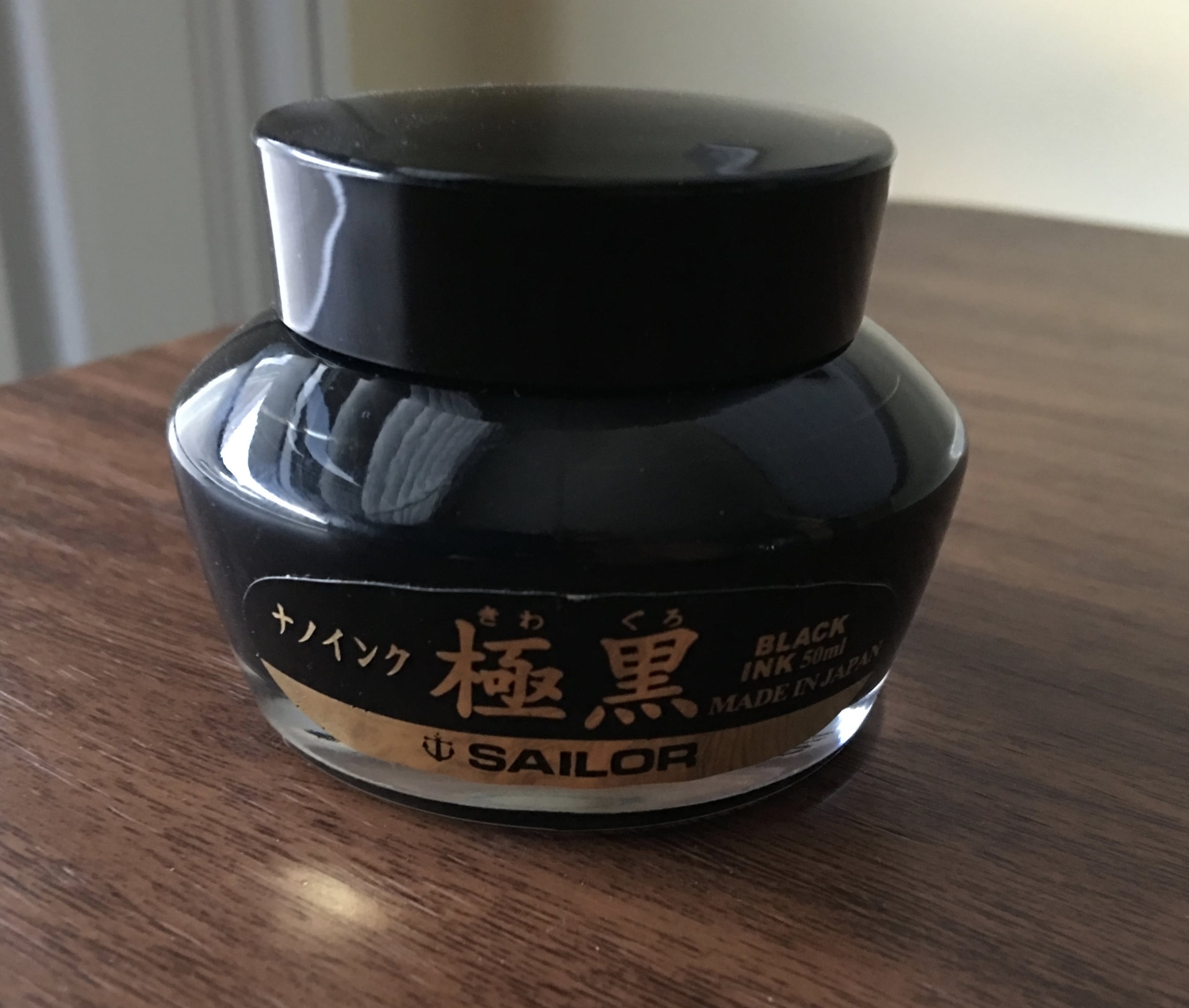
  1. Sailor Kiwa-Guro Nano-Black.  One of my top five fountain pen inks for everyday writing. I'll have to actually do a proper review of this ink one day, but this is my "writes-on-anything-and-is-permanent" black ink.  It's pigmented ink, so you have to be diligent about cleaning it out of your pens on a regular basis, but it doesn't feather or bleed, and best of all, it holds an extra-fine line in my Sailor Pro Gear Imperial Black.  Kiwa Guro appears very dark once it's dry on the paper, and has a matte look to it once it's dry.  I do try to avoid using this ink in pens with very wet nibs.  Because it's a pigmented ink, the pigment can smear if it "pools" on top of the paper, so I use this ink nearly exclusively in my fine and extra-fine Japanese nibs. 
  2. Aurora Black.  The blackest-of-the-black inks.  If you pressed me to name one relatively inexpensive, well-behaved and widely available black ink that works well in all pens, both vintage and modern, I would tell you to go buy a bottle of Aurora black.  For this same reason, if you forced me to pick a single ink--of any color--with which to be marooned on a desert island with a lifetime supply, it would probably be this one.  
  3. Lamy Black.  This is where my list gets interesting, and where I'll preemptively answer the inevitable question: "Why the heck do you have five bottles of black ink, if they are all essentially the same color?"  As most hard-core pen addicts know, however, even though an ink might be labeled "black," that doesn't mean there isn't any variation.  Both Lamy Black and the next entry on this list, Delta Black, are "black" inks, but the Lamy has hints of green, and the Delta has undertones of dark blue/purple.  Lamy inks offer excellent value, and they come in a cool bottle with a roll of blotter paper.  
  4. Delta Black.  I have two bottles of Delta black, and I've paid for neither (at least not directly).  A small bottle of Delta black ink is regularly given away as a "freebie" to pen show attendees, and more often than not a bottle is included with the purchase of higher-end Delta pens.  Many people's reaction is that this is somewhat boring SWAG, but I carry one of these small bottles of Delta ink in my briefcase because it's a great go-to ink in a pinch. The ink behaves nicely and works well in every pen I've tried.  I also really like the black with purplish undertones.    
  5. Roher & Klingner Leipziger Schwartz.  I have a sample vial of this ink that I purchased from Goulet Pens, but I'm waiting for the next R&K Massdrop pick-three, because I'm going to stock up.  I don't know how to even begin to describe this ink, other than as "complex." It's definitely a "black," but on the page it looks completely different from any of the other four inks listed here.  It has the blueish/greenish/purplish undertones of the Lamy and the Delta inks, but it's much darker.  I like it, and it may give Aurora Black a run for its money as the top "black" in my arsenal.          
View fullsize Black Ink Writing Sample
View fullsize Close up of Black Inks
View fullsize Close up

I've cycled through A LOT of black ink in this hobby.  I've used up some bottles; sold off others, and settled on keeping the inks listed here, so I guess you could take this as my "Best Black Inks" list.  On a final note, I expect that some people will be surprised that I have not included Noodler's Black and Noodler's Heart of Darkness on this list.  These are extremely popular inks, and if you are looking for absolute permanence at a value price, you should consider them.  Since I use a lot of celluloid pens, both vintage and modern, I try to stay away from super-saturated ink like Noodler's and Private Reserve.  (I also avoid using pigmented inks such as Kiwa Guro in celluloid pens.)  In my experience, these Noodler's black inks are so saturated with dye that they smear very easily and take an exceptionally long time to dry.  You can dilute them with distilled water to make them manageable, but that's more trouble to me than it's worth.  I do, however, really like Noodler's Dark Matter, which while not "bulletproof", has a cool story behind it, dries fairly quickly and I've found it well-behaved on most papers.    

DISCLAIMER:  This post contains affiliate links, through which I may be compensated a small amount if you purchase an item from certain of the sites linked to in this article.  While I'd greatly appreciate it if you would support the site by using these links to purchase something you are interested in, you are, of course, under no obligation to do so.  Many thanks!   

In Ink Reviews, Editorial Tags Inks, Top 5, Aurora Black, Sailor, Delta Black, Roher & Klingner, Noodler's, Lamy
Comment

Lamy Studio Ruby Red Limited Edition

I Forgot I Had This Pen: The Lamy Studio

January 20, 2016

Have you ever put something down for years—whether it’s a pen, notebook, or something else entirely—only to pick it up later and think “what’ve I been doing with my time, that I would leave this sitting for so long?”  Well, this week I had that experience with this pen, the Lamy Studio. This model is the “Ruby Red” limited edition with a 14K extra-fine nib that I picked up a few years back on the FPGeeks Classifieds section for $90.  That, my friends, was a steal.  The standard Lamy Studio with a stainless steel nib is a fixture on my “Top Pens under $75” list, but Lamy’s 14K nibs deserve more attention. 

Build and Finish

This pen has a nice design.  It’s manufactured from what I assume is aluminum, with a smooth stainless steel section. If you dislike metal sections, you will probably find this pen slippery and difficult to grasp.  Personally, I like the section on this particular pen because the weight of the metal section offsets the cap when posted, giving the pen a nice balance while writing.  The cap posts securely, with an audible "click" that lets you know the cap is firmly attached.    

The Lamy Studio posted.  The pen has a nice size, and is well-balanced posted or unposted. 

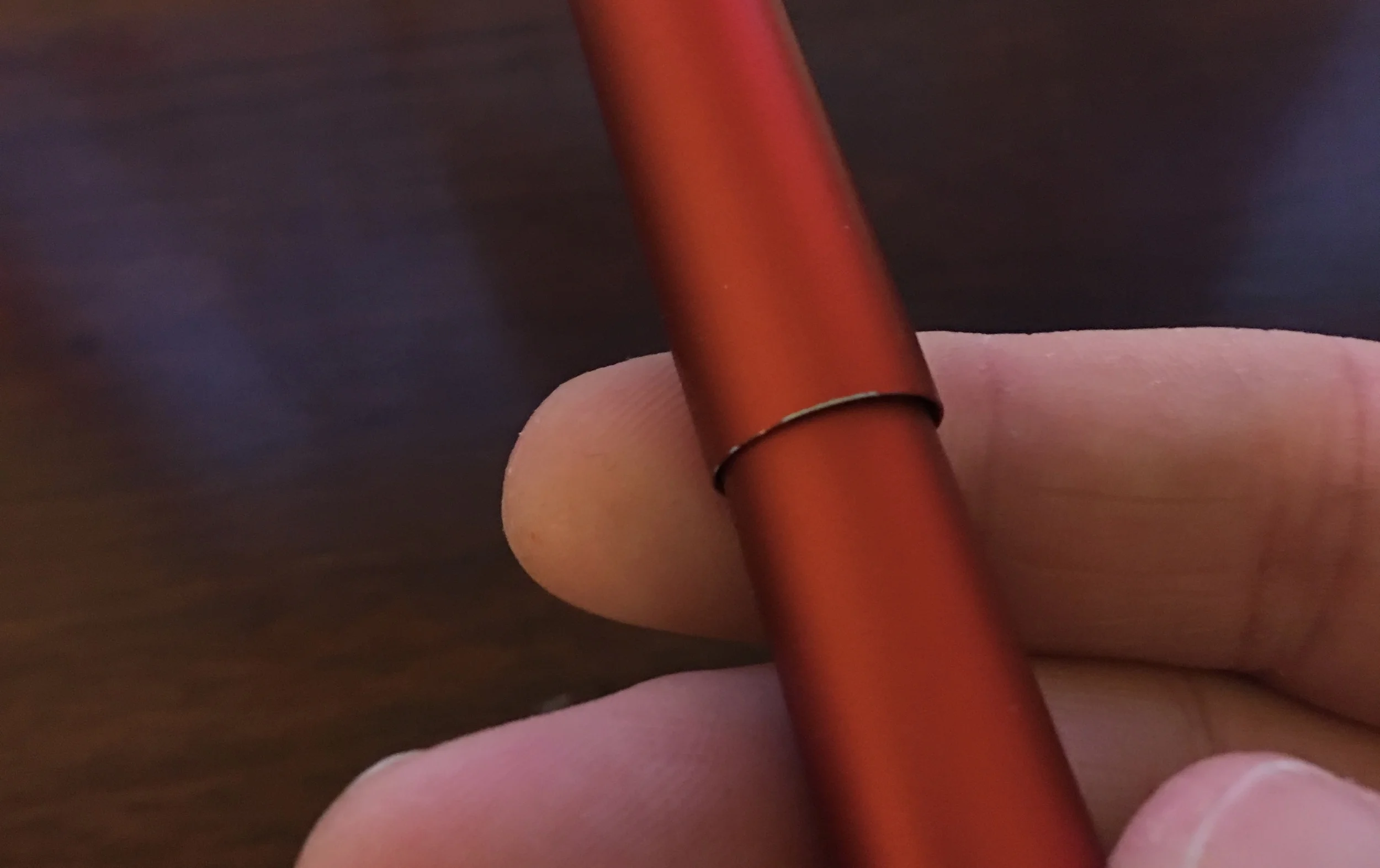
My criticism of this pen is with the red matte finish.  Namely, I'm extremely disappointed that in several very noticeable places, the red finish is rubbing off the pen.  The worst wear is under the clip where it touches the cap, but there are also some problem spots where the cap joins the body.  I’ve included pictures of both.  I don't like to see this kind of quality control issue in a pen at this price point, especially where the pen hasn’t been carried all that much.  The wear under the clip is inexcusable, and strikes me as something Lamy should have foreseen.      

View fullsize Lamy Studio Ruby Red

A couple things to note before you consider buying:  the Studio is a cartridge/converter pen, and takes proprietary Lamy Cartridges. Also, the Lamy Studio takes a different converter, the Z26 Piston, than the Lamy Safari and the Lamy AL-Star, which take the Z24 Piston.  Lamy cartridges and converters are durable and have decent ink capacity.  No complaints here.  

The Nib

The lack of durability—and, dare I say it, poor quality—of the finish on this pen caused me to come close to selling it multiple times.  (I believe one time I actually listed it, but got no takers.) Over the past several months, I've been consciously paring down my pen collection to what I consider a more manageable number, and during that process this pen came up again.  Out of curiosity, I inked it up, and despite the beat-to-heck look of the thing, I can’t see myself parting with this pen.  The 14K nib is that good.  

View fullsize Lamy Studio 14K Nib

When most people think of Lamy's gold nibs, they think of the Lamy 2000, another personal favorite of mine.  Lamy's "standard" 14K nibs are often--and, in my opinion, unjustifiably--overlooked.  The extra-fine nib on my Lamy Studio is relatively wide for an extra-fine nib, and writes more like a “fine” from most other brands.   The nib is, however, springy and smooth.  It’s also slightly stubbish, in that it offers a touch of line variation and gives my writing an italic look and feel. To me, Lamy’s interchangeable stainless steel nibs offer good quality and exceptional value in entry-level pens, but this 14K gold nib has frankly blown me away.  At around $150, both the Lamy 2000 and the Studio make great options for a “first gold-nibbed pen,” though I must say, I prefer the Studio’s extra-fine to the extra-fine on my Lamy 2000.  I suspect it’s because the lack of a hood on the Studio gives the nib the additional springiness, making it very pleasant to write with.     

Lamy Studio Writing Sample:  14K EF nib on Nock Co. Dot-Dash Index Card.  The ink is Lamy Copper Orange. 

Takeaways

The Lamy Studio is definitely a legitimate player in the relatively sparse "best-fountain-pen-under-$75" product category, if you're looking for a reliable, comfortable writer that looks more "professional" than a Safari or an AL-Star.  If you're up for spending a bit more money, I would recommend going for the gold nib.  Setting aside the aesthetic issues with the finish for a moment, this is one of the best-writing pens I own.      

While I’ve not seen it in person, pictures of the current “Wild Rubin” special edition Lamy Studio look similar to the Ruby Red, except the Wild Rubin has a glossy, red lacquer finish.  (I suspect that the red lacquer finish is MUCH more durable than the matte finish on the Ruby Red, so I’d advise you to buy the newer pen rather than track down a Ruby Red on the secondary market.) Pen Chalet currently sells the Wild Rubin with a stainless steel nib) for $79, and Goulet Pens still has 14K version in stock at $164.  Goulet sells the 14K version as part of a set that comes with a Z26 converter and a bottle of Lamy Blue ink.    

Walkthrough Video

I put together a short walkthrough video with the Lamy Studio Ruby Red.  Let me know what you think and if this sort of thing is helpful.  If it is, I will consider additional videos for future reviews. 

DISCLAIMER:  The Gentleman Stationer is now supported entirely through purchases from the T.G.S. Curated Shop and pledges via the T.G.S. Patreon Program. While the Lamy Studio Wild Rubin is no longer available, we carry various versions of the Lamy Studio in our own shop.

In Pens Tags Lamy, Lamy Studio, Pen Review
5 Comments

Monteverde Capless Gel Refill for Montblanc Ballpoint Pens, Featured Here in the Montblanc Classique Ballpoint

Hacking Ballpoint Pens: The Monteverde Capless Gel Refill Review

January 16, 2016

If you’re like me, and are known throughout your immediate and extended family as “the pen guy,” then you have a collection of ballpoint pens that people have given you over the years as gifts.  Some or all of them may be monogrammed or personalized in some way, making them nearly impossible to pass on or sell (setting aside, for the moment, the difficulties in selling gifts that often have sentimental value).    

Case in point:  when I graduated from law school, I was given a Montblanc Meisterstuck Classique ballpoint, with the platinum trim.  It’s a beautiful pen, if you’re into the Montblanc black and platinum/gold aesthetic.  It’s engraved with my initials, fits nicely in my hand, and is extremely comfortable to write with.  The only problem is that I hated the standard Montblanc ballpoint refill.  I found that it skipped a lot and didn’t leave a dark enough line for my taste.  Plus I found the refills obscenely expensive, costing $12 or more (unless you buy them in bulk, which I couldn't justify, seeing that I dislike the way they write).  

Montblanc Classique Ballpoint with Platinum Trim

Enter Monteverde.  Many people may not know this, but Monteverde manufactures a line of “capless” gel refills that fit ballpoint pens from many manufacturers, including Montblanc.  I’ve outfitted the Classique with the fine blue/black Monteverde refill, and I’ve also upgraded a Parker jotter using Monteverde's Parker-compatible gel refill.  Both are great pens, and they now appear in my rotation on a weekly basis.  

One word of caution:  Monteverde’s quality control can be inconsistent.  For example, I have a Waterman retractable ballpoint that I also wanted to convert into a gel pen.  A couple years back, I purchased some of the “Waterman-compatible” gel refills and they simply didn’t fit, despite there being no visible difference from the standard Waterman refill.  Apparently, the Monteverde refill had an ever-so-slightly larger diameter, so somebody must've gotten the measurements wrong at the factory.  (The store I purchased them from ended up allowing me to exchange them for the standard Waterman ballpoint refill, which is actually pretty decent.) Amazon reviews are also mixed.  There are complaints about the Monteverde refills being scratchy, drying up, leaking, and running out quickly, though I have to say that has not been my own experience. (Note:  if you are used to writing with a ballpoint pen, gel refills WILL run out quickly if you write a lot.  There was one complaint from someone who claimed that he wrote a full page by hand every day and was surprised that the gel pen ran out after a month.  That’s par for the course, in my experience.)  In general, take Amazon reviews with a grain of salt—my personal favorite was a one-star review because the refill “does not fit fake Montblanc pens.”  

I have had nothing but good experiences with the Monteverde refills.  I’ve gone through two of them, and each has lasted me a fairly long time when used for light note-taking.  For a pack of 6, they are much less expensive than a standard Montblanc-branded refill.  They also come in blue-black (my favorite) in addition to the standard black and royal blue.

Monteverde Softroll Ballpoint Refill (Parker-compatible) in my Maxmadco Bolt-Action Stainless Steel Pen.

If gel pens aren’t for you, Monteverde’s “softroll” ballpoint refills are also quite nice.  I have the blue-black refill in my Maxmadco stainless steel retractable pen, and I’ve enjoyed it.  The company even makes a Lamy-compatible refill.

In Refills, Pens Tags Refill Guide, Monteverde
8 Comments

Diamine Oxblood is my preferred "dark red" everyday writing ink (and will be my go-to once my Montblanc Alfred Hitchcock runs out.

My Five Best Fountain Pen Inks for Everyday Writing

January 13, 2016

UPDATE: A new version of this “Top Five” list was published on February 26, 2020. Check out the post “Daily Writers: The Best Fountain Pen Inks for Daily Use.”

Over the past few years, we’ve witnessed an explosion in the number of fountain pen inks on the market.  Six years ago, when I first picked up my pen again after a long hiatus, the main players with any sort of color variation in their ink lines were Noodler’s and Private Reserve. For us corporate drones, bottles of staid (and somewhat boring) inks such as Parker, Waterman, and Pelikan 4001 could still be found on the shelves of big-box office supply stores.  Today, the big box stores have more or less abandoned fountain pens entirely (except for disposables and super-cheaps), but the overall landscape has completely changed:  I now count 10 readily available brands of fountain pen ink in my desk drawer alone.  Great, right?  But a major drawback is the paralysis of choice and the potential for overwhelm.

I like to shuffle colors in and out of my pens, but there are five or so inks that I keep coming back to for everyday writing.  By “everyday,” I mean writing at work on cheap copy paper, in my pocket notebooks, and taking notes while I read.  With the exception of one recommendation, most of these inks are readily available and relatively inexpensive.  

  1. Sailor Kiwa-Guro Nano-Black. Expensive, yes; however, the price has come down a bit lately, and this Japanese workhorse will get the job done anywhere, even in a Moleskine. It’s pigmented ink, so just remember to clean your pens out regularly. Some might balk at paying this much for black ink, but given how long a bottle of ink lasts me, it’s not really a consideration. The versatility of this ink makes it a useful travel companion.

  2. Waterman Serenity Blue/Florida Blue. I’ve sung the virtues of this ink before, as it made my list of “Best Blue Inks for the Office.” Want something that’s nice to look at, writes well on any kind of paper, won’t turn any heads, and is inexpensive? Try this.

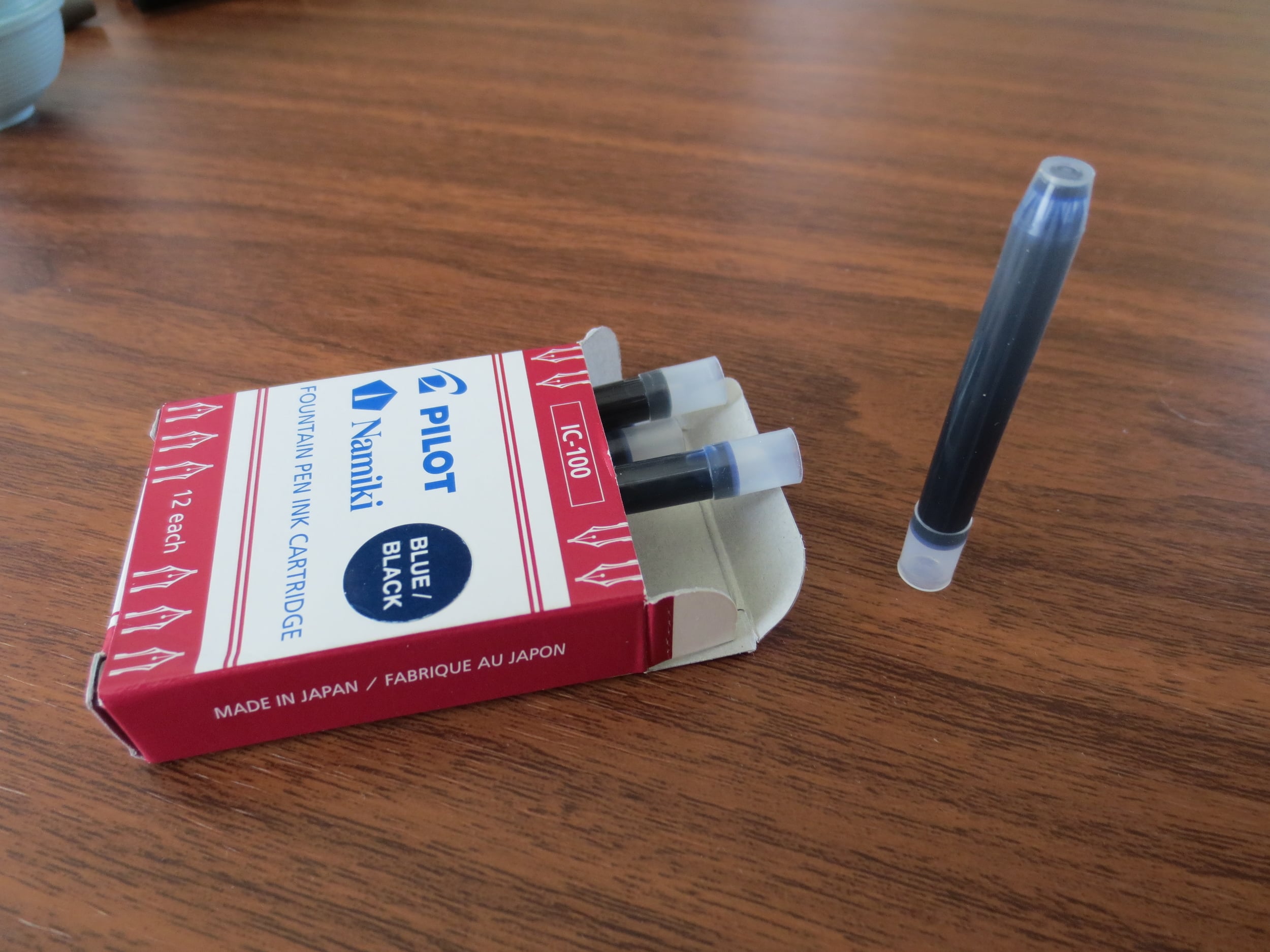
  3. Pilot Blue-Black. Another great ink that’s typically only available in cartridge form in the U.S., though you can easily order it from Japan off eBay or Amazon (in the big 350ml bottles, too). Like Waterman blue, Pilot Blue-Black dries quickly and works well on most papers, but you also get some nice shading and red sheen when the ink dries.

  4. Diamine Oxblood. Ever wish you had a red ink that was dark enough to use for everyday business correspondence? Pick up a bottle of Oxblood. Like the vast majority of Diamine inks, it plays nice with most pens and different grades of paper. When it comes to my personal favorite readily available red ink, it’s a toss-up between Oxblood and . . .

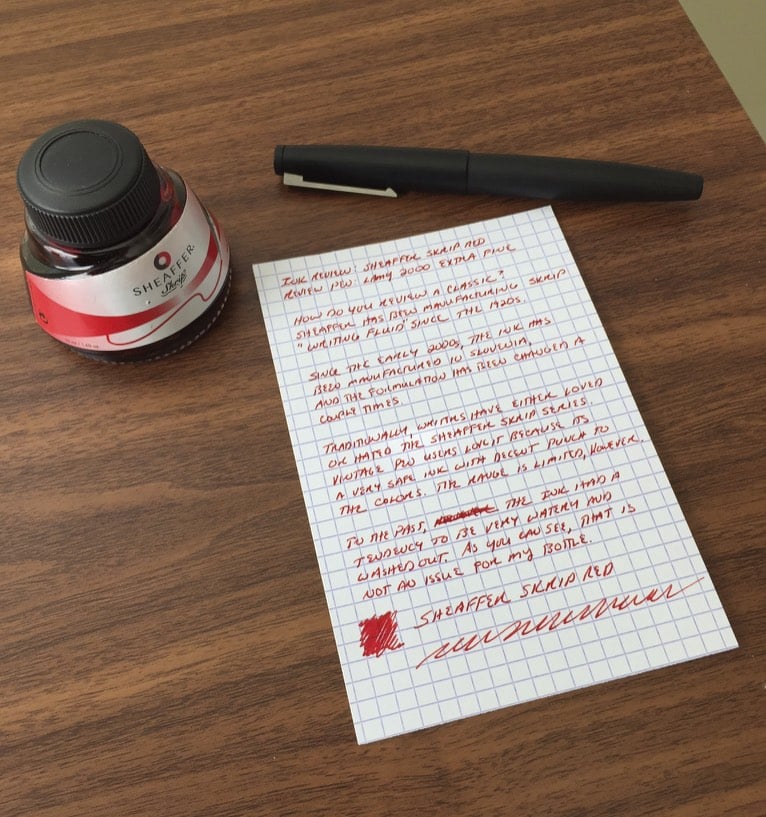
  5. Sheaffer Skrip Red. With its classic fire-engine hue, it’s my favorite “true red” ink. Skip Red is probably one of the few bright red inks that doesn’t stain, and can be considered “safe” to use in most vintage pens (though I’d still advise you to be careful with lighter colored celluloids or demonstrators).

View fullsize Pilot Blue-Black Cartridges
View fullsize Sheaffer Skrip Red
View fullsize Waterman Blue and Blue-Black
View fullsize Sailor Kiwa Guro Nano Black

This list reflects my own opinion. There are an infinite number of “top five” lists floating around out there, but people love recommendations, so here are mine.  What I need from an ink on a day-to-day basis is probably different than what someone else wants, but if this list can be helpful to even a few people out there, it adds value.  This list also shouldn't be confused with my "favorite inks of all time," because that list will include things such as limited editions and vintage inks (and is on the way).  

In Top 5, Editorial Tags Top 5
5 Comments
← Newer Posts Older Posts →
Store Hours and Location
Visit the T.G.S. Curated SHOP
Updated "Best Pens" Guide
On the Paper Trail Podcast
TGS x Roterfaden TGS_25
Hierarchies of Fountain Pen Friendly Paper

Join Our Patreon!
Subscribe to the TGS E-mail List

Featured Posts

Featured
Cover On the Paper Trail Intro Clip.jpeg
Dec 3, 2025
Introducing "On the Paper Trail," a New Podcast/Video Collaboration with Lisa Vanness of Vanness Pens!
Dec 3, 2025
Dec 3, 2025
Iro-Utsushi-Fine-Dip-Pens.jpeg
Oct 1, 2025
The Pilot Iro-Utsushi Dip Pen (and in General, Simple vs. Fancy Dip Pens)
Oct 1, 2025
Oct 1, 2025
Levenger-Annotation-Pad.jpeg
Sep 20, 2025
Five Boutique Paper Brands I'm Watching Closely and Why
Sep 20, 2025
Sep 20, 2025
The Gentleman Stationer RSS

© Digital Divide Media, LLC, 2014-present.

All content is the exclusive property of Digital Divide Media, LLC, d/b/a The Gentleman Stationer, including “The Gentleman Stationer” website and trademark, and should not be reproduced without express written permission.  All rights reserved.

All content containing paid advertising, affiliate links, or sponsored content will be plainly disclosed by a disclaimer when/if featured.

Contact Information

Store Shipping Policy and Return Policy

Privacy Policy

Cookie Policy

Terms and Conditions

Powered by Squarespace