• Blog
  • Shop
  • Podcast
  • Resources
  • About
  • Archive
  • Contact
  • Cart
  • Sign In My Account
Menu

The Gentleman Stationer

Vintage Living in the Modern World.
  • Blog
  • Shop
  • Podcast
  • Resources
  • About
  • Archive
  • Contact
  • Cart
  • Sign In My Account

My Workhorse Pens: Montblanc 146

January 24, 2018

I often get asked, at pen shows or by e-mail, what fountain pens I use on an everyday basis. I do change them up a lot, which is how I manage to keep up the pace on pen reviews, but there are several pens that are “constants” in my rotation.   

What is a “Workhorse Pen”?

The term “workhorse” gets thrown around a lot in pen reviews, casually used to denote a pen that’s not necessarily fancy, but rather intended to serve as a utilitarian daily writer. I’m as guilty of this as any. The problem with such broad categorizations, of course, is that one person’s “workhorse” might be completely impractical for another. For example, the TWSBI 580 is commonly offered as an example of a reasonably priced pen intended as an everyday writer, but it doesn’t work for me as a personal “workhorse” because I can’t post the cap (more on this below).

So before I get started on this new series of pen reviews, I wanted to take a few moments to define my criteria for considering something a “workhorse” - something I’ll keep inked up nearly 100% of the time.

  • The pen must post. Just as the watches that I wear need to have a “date” complication, the pens I use every day need to post. I often have a “busy” desk full of documents that I’m working on, or trying to sort out into some order that makes sense. I can’t worry about where I set the cap to write because it will go missing. I’m speaking from experience here. I have pens that don’t post, but they’ve been living in the Penwell.

  • The pen must be well-balanced. For someone who takes perhaps a dozen pages of handwritten notes per day, my pen can’t cause my hand to cramp. If the pen is lightweight, there’s a broader range of lengths that will work for me, but a pen that’s too long, especially if it’s back-weighted when posted, is a nonstarter.

  • The design must be understated. I spend a lot of time sitting in courtrooms/depositions/boardrooms taking notes, trying to be inconspicuous. I leave any flashy or “unique” fountain pens at home. Sorry, Visconti.

  • The nib can’t be too wet to write decently on cheap paper. Most nibs can be tamed with smart ink selection, but some (i.e. most Omas and Visconti nibs) write far too wet with any ink for me to be able to use them at work.

  • The pen must have a relatively large ink capacity. It pains me to say that I generally can’t use Sailor pens with nibs broader than a “fine”, since the Sailor converter has a ridiculously small capacity. Sure, I can use cartridges or switch pens in the middle of a meeting or deposition, but there’s no good reason why I should have to.  

I really had to work to get this 1980s-era Montblanc 146 medium stub nib to write perfectly. Subsequent Montblanc purchases haven't been as finicky. 

What I don’t worry about when choosing a pen that I think might make a good workhorse? How the nib writes out of the box, and for the most part, price. Temperamental nibs can almost always be tuned or ground by a nibmeister to something more appropriate, and while I’ve never spent $1000+ on a pen, I don’t worry about dropping a fair bit of money on a pen I know I’ll use all the time because I think of it in terms of the cost of long-term ownership. (i.e., The $400 I spent on a used Montblanc 146 - nibwork included - more than evens out over the six or so years I’ve owned the pen, and it's still going strong.)

Workhorse No. 1: Montblanc 146

It’s been years since I reviewed the Montblanc 146, and I’ve owed this iconic flagship a revisit. When I first published my review, I struggled with an iffy, 1980s-era medium nib that Mike Masuyama finally managed to fix. I now love that original pen, and I over the years I’ve picked up two more: a 146 Ultra Black and a 146 UNICEF limited edition.

From Left: The Montblanc 146 UNICEF Special Edition; the Montblanc 146 Ultra Black, and my standard 146 (1980s era). 

Along with the Edison Menlo, Lamy 2000, and Sheaffer Legacy (other great “workhorses” that will get the same treatment here in the coming months), the Montblanc 146 has the perfect shape and functionality for me to use every day. The pen posts, has a well-balanced torpedo/cigar shape, and holds a ton of ink.

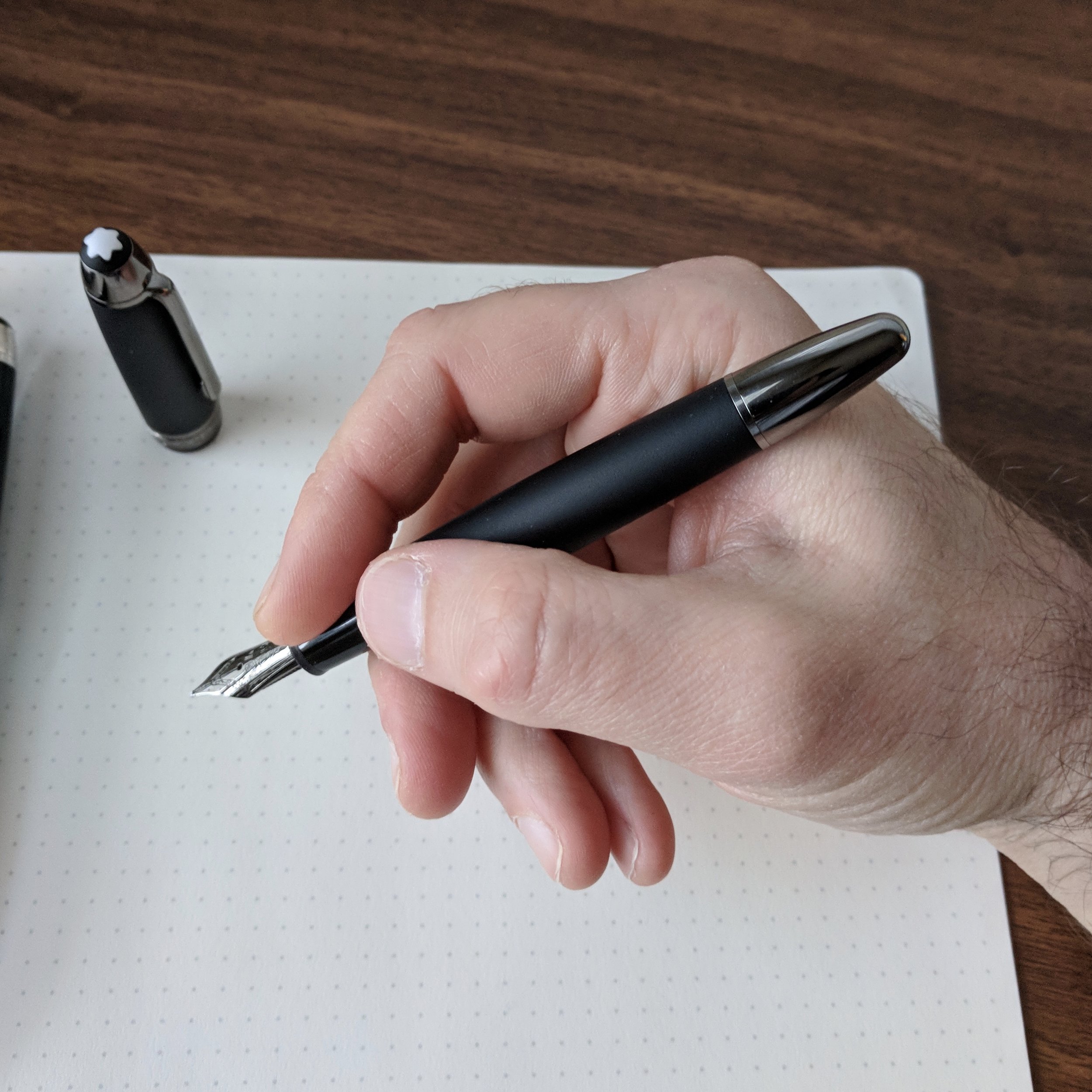
View fullsize Montblanc 146 Posted
View fullsize Montblanc Ultra Black 146 Unposted

Nibs are where Montblanc will get you. Their standard nibs aren’t necessarily bad, but they tend to be over-polished with a bit of a baby’s bottom, meaning that they will hard start occasionally, especially on super slick paper like Rhodia or Clairefontaine. Mike Masuyama has ground most of my Montblancs to a .6mm stub/cursive italic hybrid, which makes for a very smooth writer that still retains a bit of line variation. I generally prefer cursive italic nibs over stubs for everyday use because they aren’t as wet for when you need to write on cheap paper.

The "Snowcap" isn't an uncommon sight in the corporate world, even today. 

I’ll go ahead and address this because I know I’ll get the question: Doesn’t using a Montblanc violate Rule No. 3 (“The pen must be understated?”) Not for my purposes. Montblanc pens are fairly common in the corporate world, so unless you’re going to use something like a Skeleton or one of the crazier Writers Editions, you'll attract little, if any, attention. 
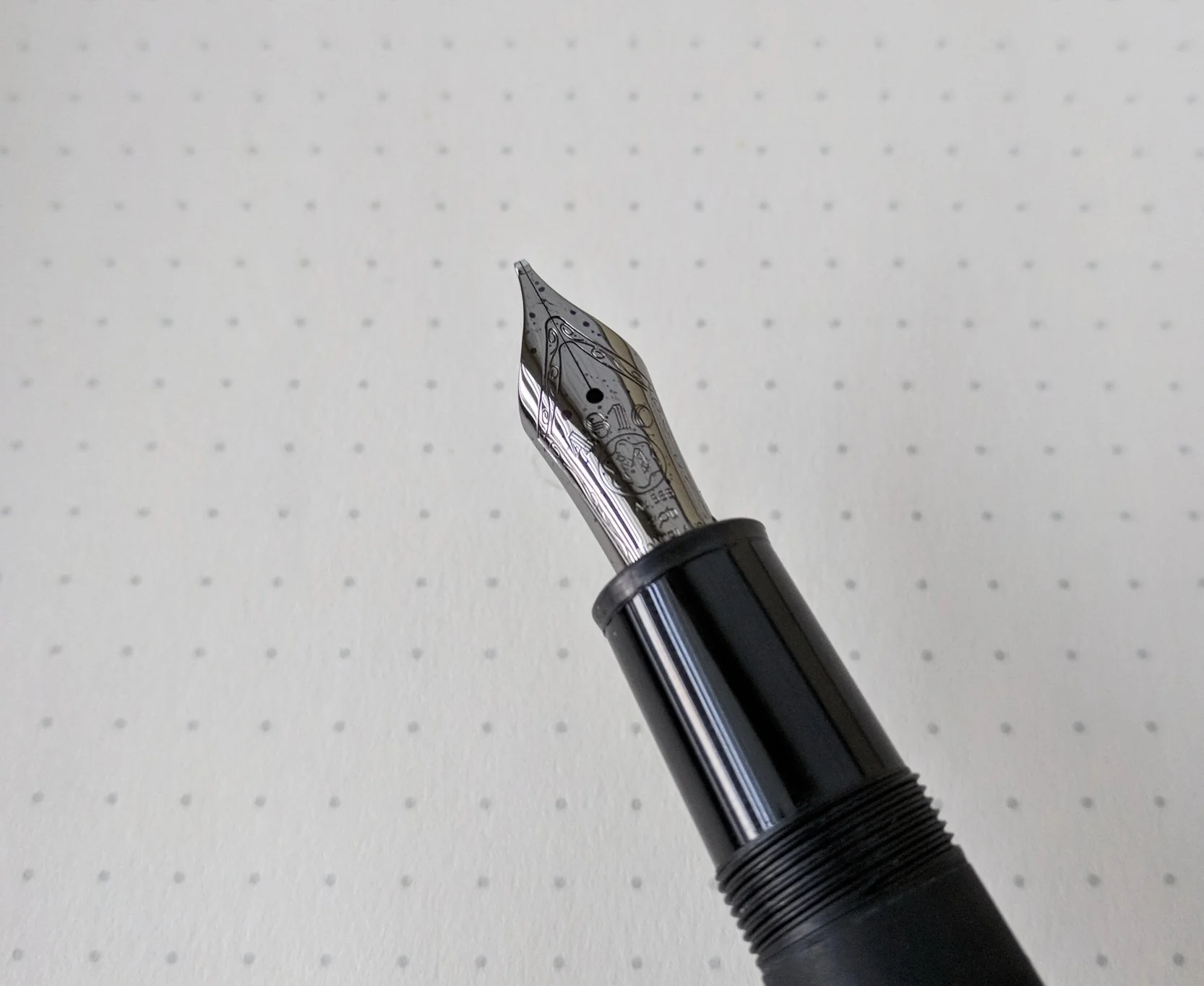
The ruthenium plated nib on my Montblanc 146 Ultra Black. 

The ruthenium plated nib on my Montblanc 146 Ultra Black. 

The 146 also doesn’t have to be a pen that breaks the bank. If you’re looking for a pen in decent working condition, and don’t mind dealing with a few cosmetic blemishes, you can find them for as low as $250 at pen shows, which is around the same price as a new Sailor Pro Gear or 1911. Sure, the special editions will set you back a bit more, but the prices are generally in line with the rest of the market, provided you shop around and don’t pay MSRP at the Montblanc boutique.

Where to Buy

If you’re interested in acquiring a Montblanc 146, you have many options, ranging from the secondhand eBay market to the Montblanc Boutique. If you're new to pens, I'd advise you to proceed slowly, since there's a thriving market for counterfeit Montblanc pens and it's worth it to do your diligence and make sure that you purchase from a reputable seller. Here are some options to get you started:

  • Pen Shows. Where I purchased my first Montblanc 146. You can find exceptional pricing at pen shows (often 10-20% below what retailers sell for online), especially if you're willing to look at a secondhand pen, which is where I'd suggest you start. Larger shows like the D.C. Pen Show will have the best selection.  

  • Anderson Pens. Our sponsor Anderson Pens is an authorized Montblanc retailer that sells both new and gently used pens, including the 146. They sometimes have stock that is not listed on their website. Be sure to reach out and let them know exactly what you are looking for. 

  • Appelboom. Appelboom, another sponsor and authorized Montblanc reseller located in the Netherlands, carries the full range of Montblanc Pens, including the UNICEF and Ultra Black 146 pens pictured here. I purchased a UNICEF 144 Classique from Appelboom and was very pleased with the experience.  

Disclaimer: I purchased all three pens shown in this review with my own funds, for my own use.

Editor's Note: The "Workhorse Pens" series is something new that I tried. Did you like this series? Did I leave anything about the pen out that you wanted to know? Do you have any additional questions about how I use my pens that you'd like me to address in future installments? Should I drop this entirely? Let me know! 
In Pens, Workhorse Pens Series Tags Workhorse Pens, Montblanc, Montblanc 146, Pens
15 Comments

My 2018 Notebook / "Planner" Loadout, Clockwise from Top Left: The Bellroy A5 Work Folio loaded with a Midori MD A5; Roterfaden Taschenbegleiter A5; Baron Fig Confidant with One Star Leather Cover; Nanami Paper Cafe Note B6 with Gfeller Leather Cover.

My 2018 Notebook Setup, Plus a Planner Giveaway!

January 20, 2018

I forwent a Hobonichi Techo for 2018, after three years on the wagon. Why? Both to give myself the opportunity to try something different, but also to pare things back. I had at least seven different notebooks going at once last year, and it not only became mentally exhausting to keep track of what each of these notebooks was for (not to mention where they were located at any given time), but this "system" was extremely bulk to carry around. Since the Hobonichi was the one that received the least amount of practical use, and to be honest was starting to feel more like a daily chore than anything else, it was one of the items that went on the chopping block. 

So what does my setup for 2018 look like? I've narrowed it down to four notebooks that I use on a regular basis. I do use pocket notebooks as well, but primarily for things like quick idea capture, shopping lists, or a scratch pad. 

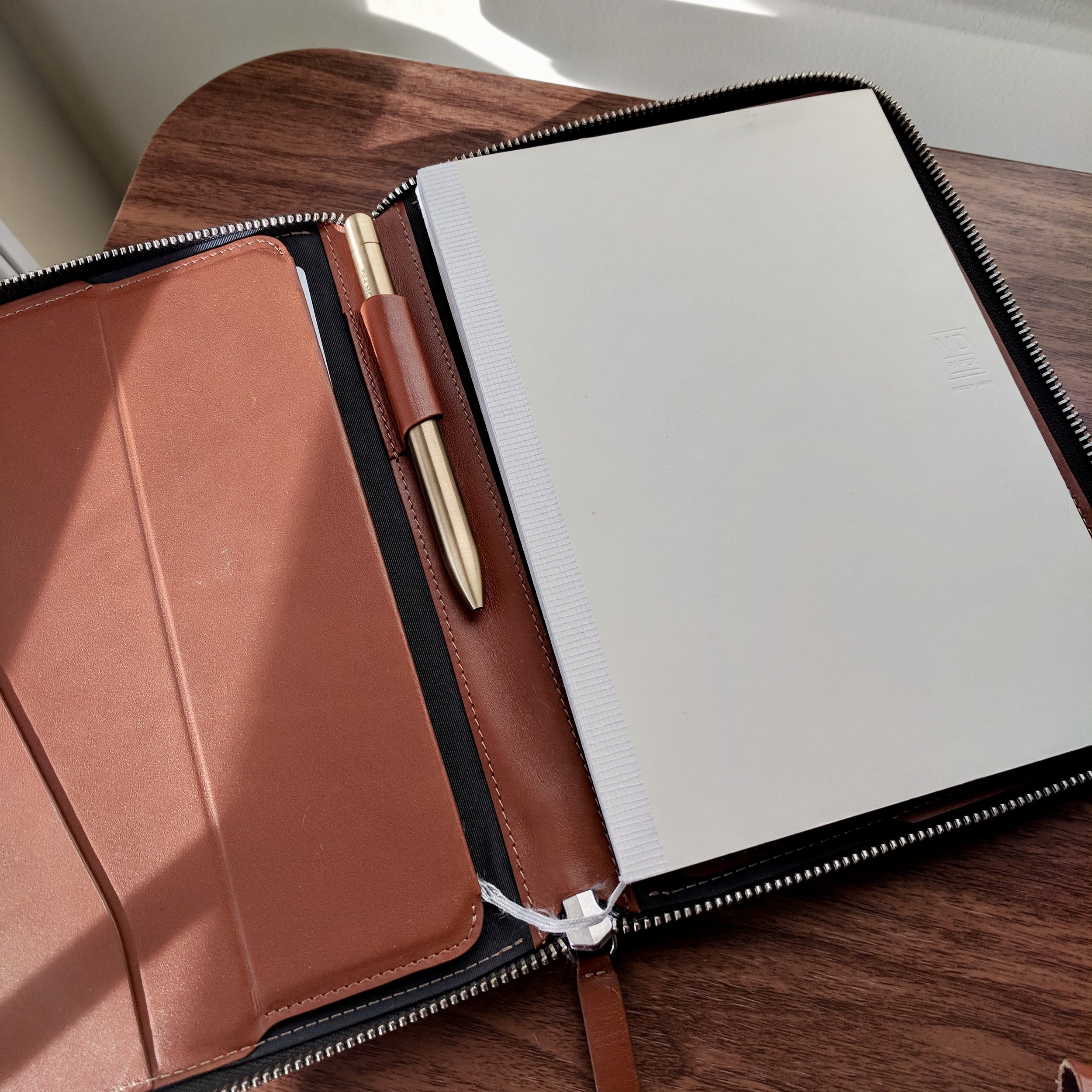
  • Daily Carry for "Day Job" Projects. To track work projects I use a combination of a digital calendar and a loosely defined "bullet journal" that currently lives in a Midori MD A5 notebook. I'm thinking of trying out the Midori Cotton paper next, or moving this notebook to a Nanami Paper Crossfield. This notebook has been traveling with me every day in a zippered A5 Work Folio by Bellroy.

  • Daily Carry for "Personal/Side Gig" Projects. A Roterfaden Taschenbegleiter set up as a three-subject notebook using smaller A5 softcover notebooks from Baron Fig and Nock Co. OK, while technically it's not a "single notebook," it's as close as I'm going to get. The Roterfaden gives me a way to keep track of all of my side projects in one place.

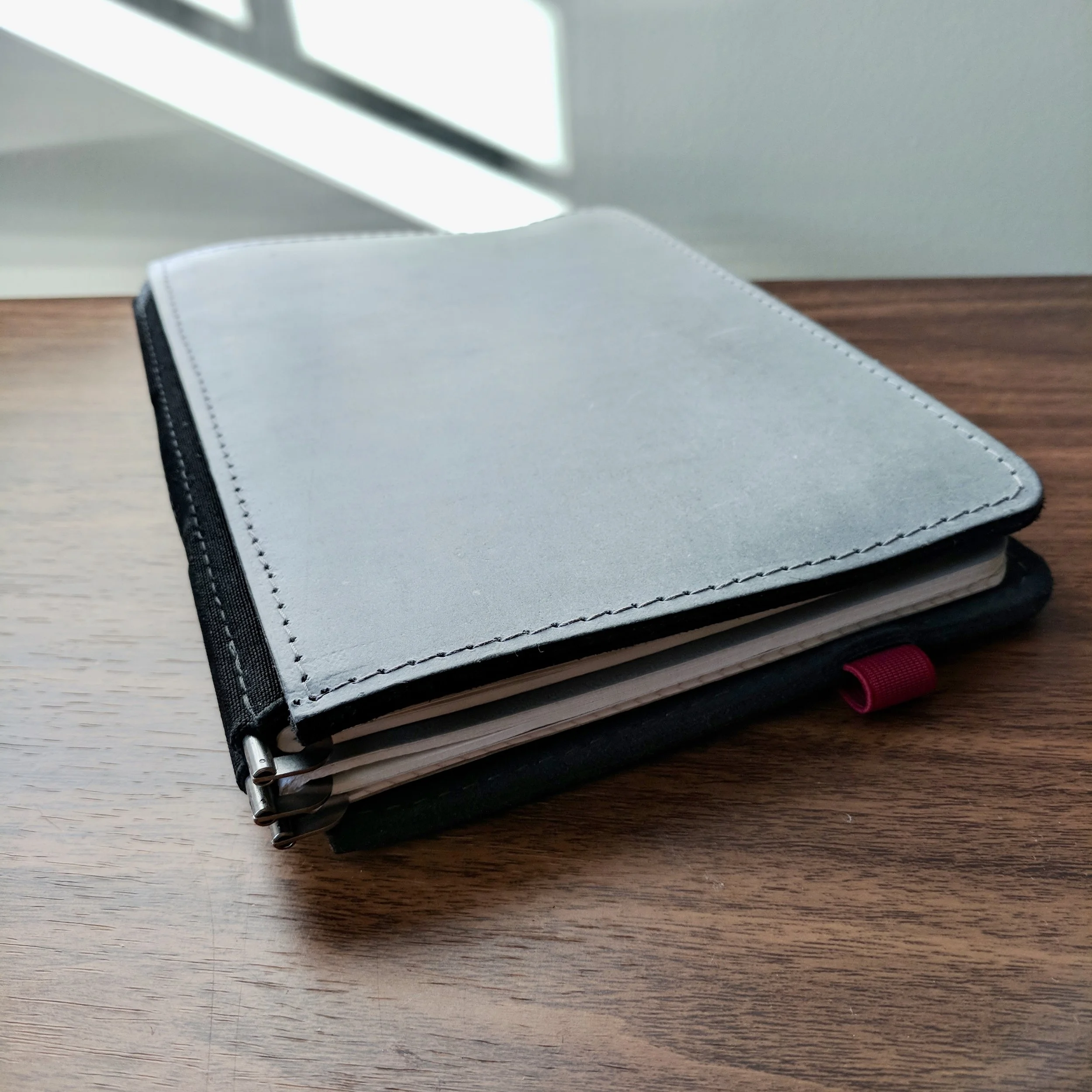
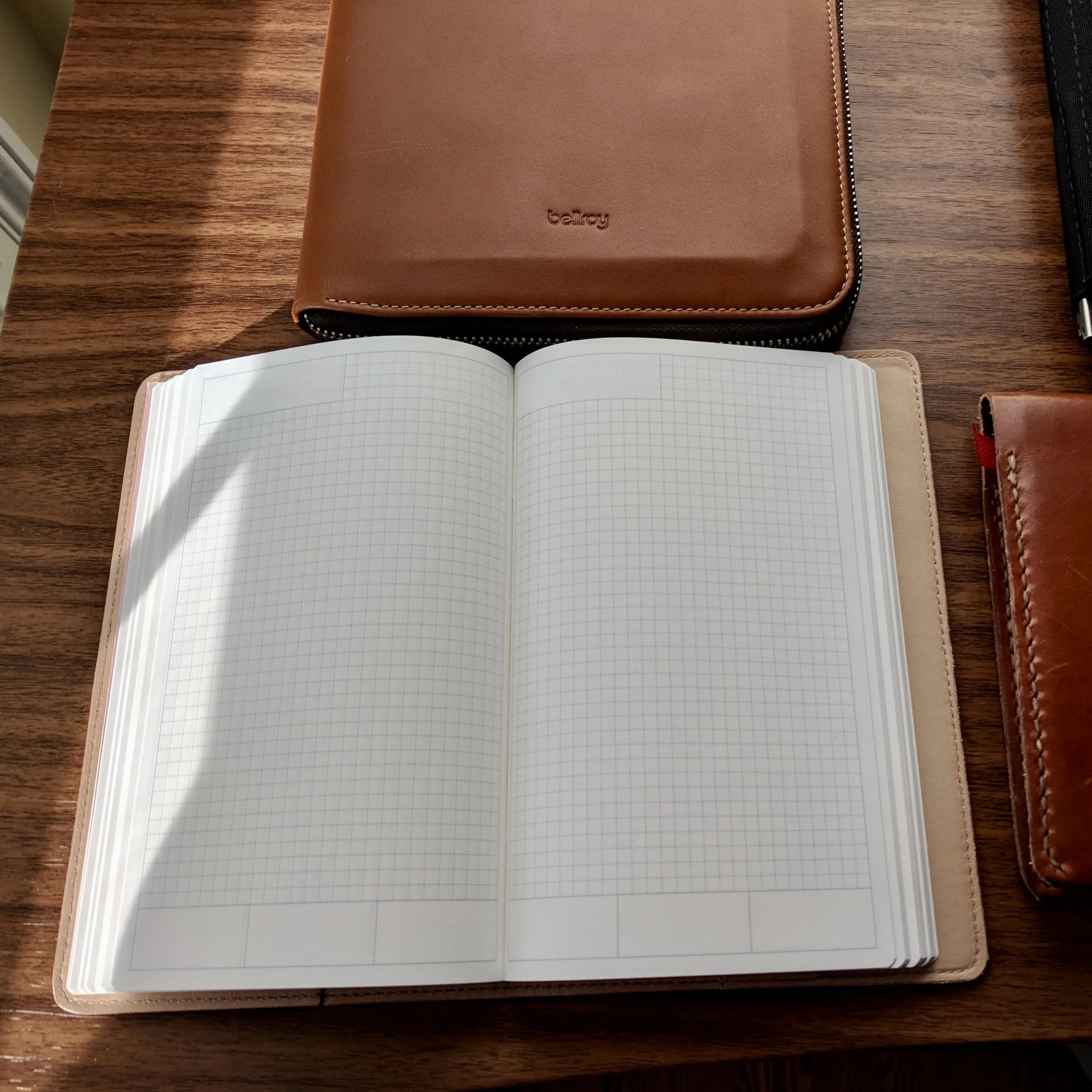
  • Personal Journal. I've been using the Nanami Paper Cafe Note as a substitute for the Hobonichi, and it's both a nice size and a welcome change to be able to write/journal without (in my opinion) the unnecessary pressure of dated pages. I'm sure some people won't agree with me on this, but there are days when (1) nothing happens worth journaling about; or (2) you're just too exhausted or busy. I HATE ending up with blank dated pages, and I'm too OCD to restrain myself from going back and filling them in. The B6 size on the Cafe Note is insanely convenient in its portability, and the Gfeller natural leather covers sold by Nanami Paper are beautiful.

  • Brainstorming Notebook. My Baron Fig Confidant, inside my One Star Leather Cover. This book typically sits at my desk for morning pages/brainstorming sessions, and any ideas that merit further development will eventually find their way into one of these other notebooks. I could also see the Baron Fig switching places with the Midori as a "Day Job" project planning notebook at some point.

View fullsize Nanami Paper Cafe Note B6 Grid
View fullsize Bellroy Work Folio A5 with Midori MD
View fullsize Roterfaden Taschenbegleiter with Single Subject A5 Notebooks

So far, this system has worked nicely for me, and I've stuck with it for two months without a hitch. (I actually started in early December 2017.) However, I also have a couple of paper planners that people have given me, that I won't use in this current system and I can now pass along to you readers in a giveaway! I need to get these out the door before any more time elapses in 2018. The prizes are: 

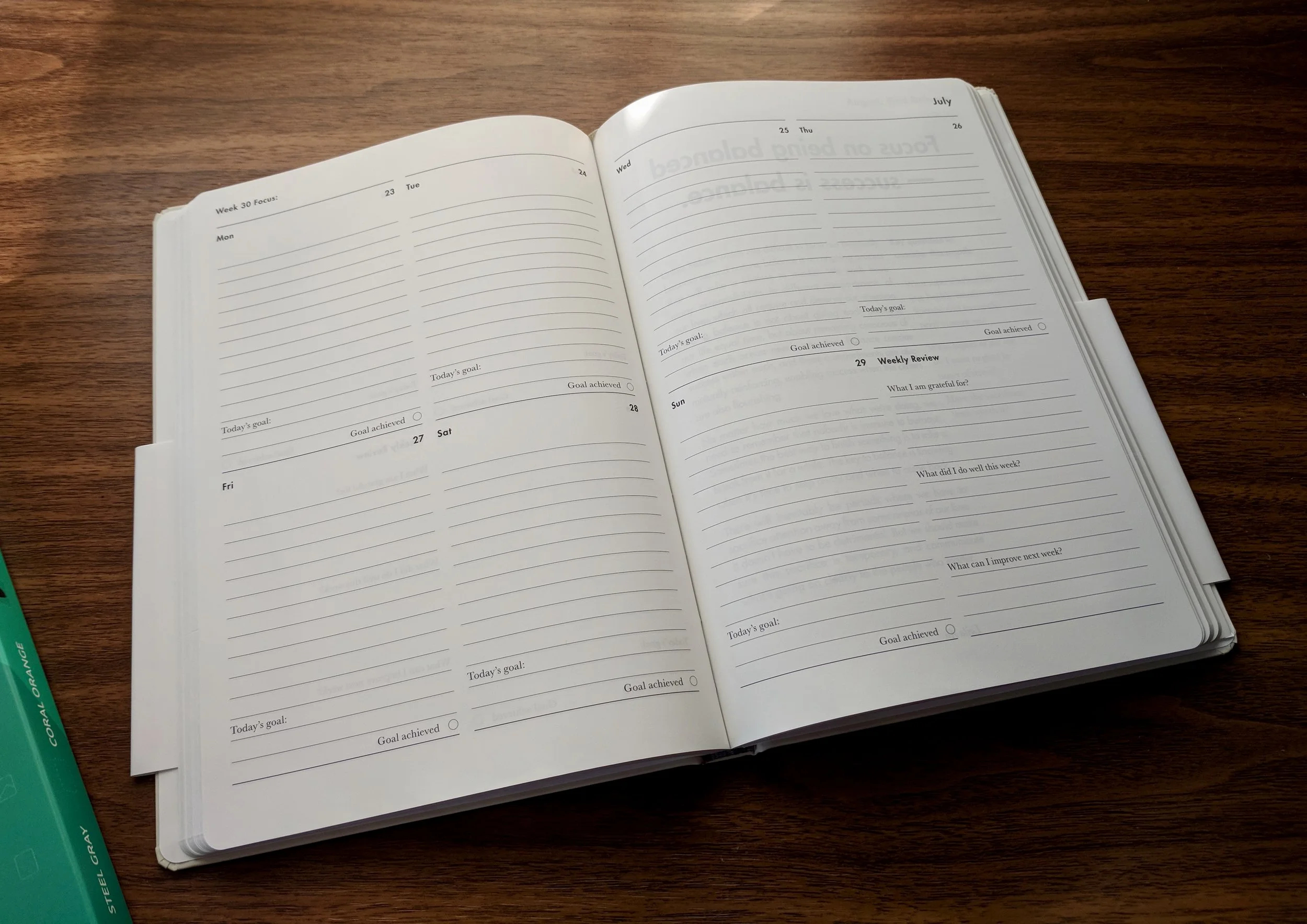
  • Karst 2018 Stone Paper Planner. This Stone Paper planner from Karst surprised me. Having heard not-so-great things about Stone Paper products in the past, mainly due to their inability to play well with liquid inks, my expectations were low, but this Karst version actually handled the two fountain pen inks I tested (Skrip Red and Robert Oster Maroon 1789) with a Tomoe River-like dry time. Ballpoints, gel pens, and even a liquid ink Pilot V5 also worked. This sturdy hardcover planner is set up in a weekly format with four days to a page. Due to the waterproof and tear-resistant properties of Stone Paper, it may be a good option for those who tend to be very hard on a paper planner. I'm looking forward to trying one of their hardcover notebooks.

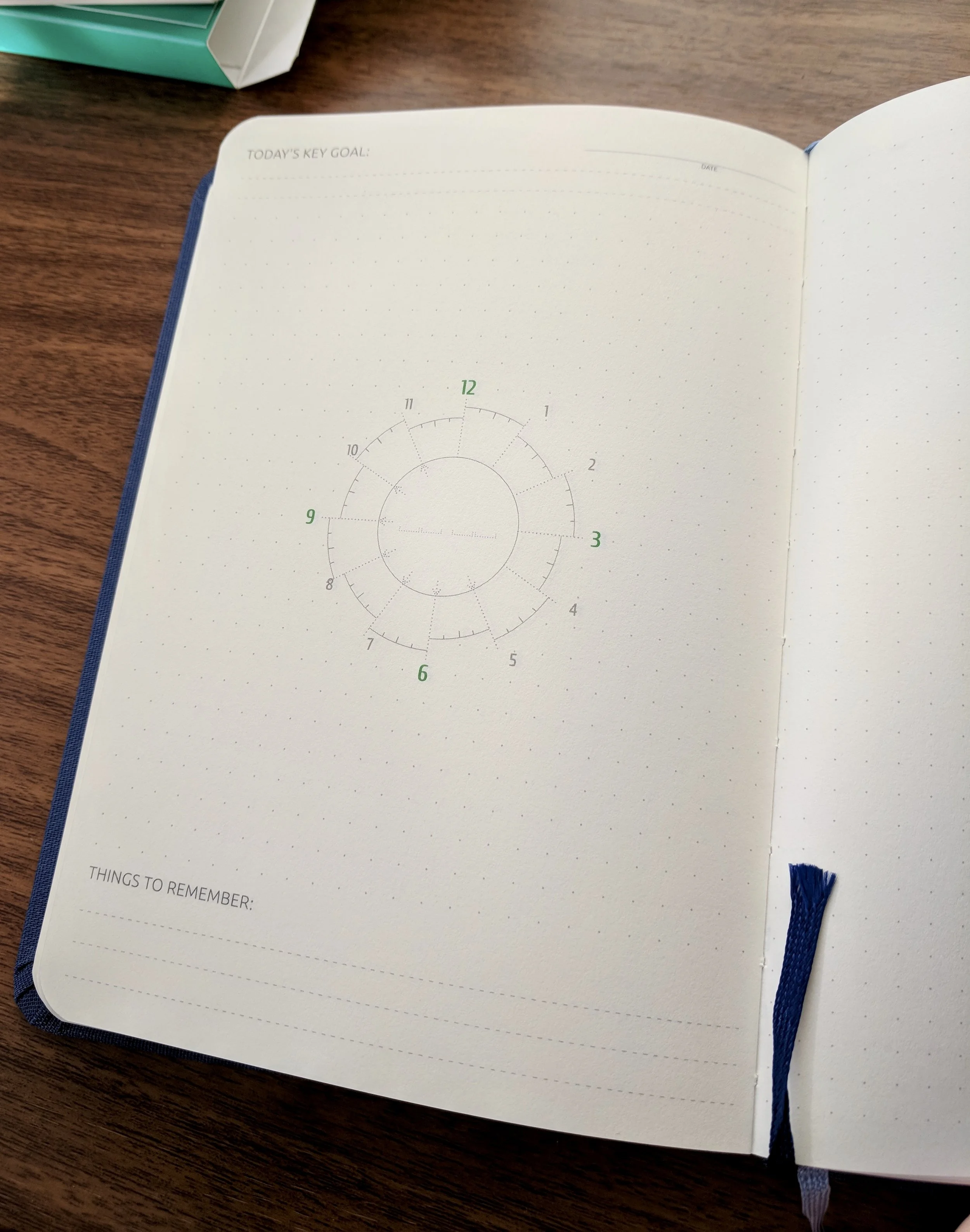
  • Slice Planner. You may recall that I reviewed the Slice Planner last year, which was developed as a hybrid digital-analog planning system that pairs a notebook with an app on your phone. The folks who developed the Slice Planner recently sent me a copy of their updated notebook, with upgraded paper and what feels like a more durable cover. As I mentioned in my previous review, I enjoyed my time with the Slice Planner, and if you can make Chronodex-style planning / time-tracking work for you, it should merit your consideration.

View fullsize Karst Stone Paper Planner Weekly Outlook
View fullsize Slice Planner "Clockface" Diagram

Giveaway Rules / Terms and Conditions

To enter, simply leave a comment on this post. Giveaway closes at 11:59 pm CT on Saturday, January 27, when I will assign a number to all comments and randomly select two winners using a site like random.org. I will post the names of the winners here in next week's Sunday Reading post. Many thanks to both Karst Stone Paper and the team at Slice Planner for providing these two notebooks for review and giveaway. Note that each of these planners may have some small amount of writing on a blank page at the back, which I used to test the paper. Please see the links above for information regarding value, etc. of the respective prizes. 

Disclaimer: This post contains links to paid sponsors and affiliates. The Bellroy Work Folio, Karst Stone Paper Planner, Slice Planner, and One Star Leather Notebook Cover all were provided to me free of charge for review purposes. The Roterfaden and Cafe Note were purchased with my own funds for my own use. 

In Planner Tags Planner, Slice Planner, Hobonichi Techo, Karst Stone Paper, Roterfaden, Nanami Paper, Baron Fig, One Star Leather Goods
51 Comments

Baron Fig Double Release: "Lock & Key" Confidant and Squire

January 17, 2018

Baron Fig has announced their first limited edition of 2018, and this time it's a Confidant/Squire combination! The "Lock" Confidant is a gorgeous dark "forest green" color, with a debossed maze cover and a puzzle insert. The brass Squire - a first for Baron Fig - sports a "key" motif, and the packaging from the pen contains a code that you can use to decipher the puzzle hidden in the Confidant. 

Photo courtesy of Baron Fig. 

The last few limited edition Squire Pens have sold out quickly - as in, within a day or two of release - so jump on this one quickly if you're interested. I've spent the last two days writing exclusively with the brass Squire, and if you like brass pens, this is a good one. The brass will patina quickly: mine has already started to develop after a few hours of use. It's not light by any means, but since the Squire is a shorter pen with excellent balance, you don't necessarily feel the weight of the material. I'd compare the writing experience, in terms of comfort, to that offered by the Kaweco Brass Sport or Supra or the Inventery Machined Pen. 

Photo courtesy of Baron Fig. 

Takeaways and Where to Buy

I won't go on again about how the Baron Fig Confidant and Squire are two tools that I use on a near-daily basis and can readily recommend, because I've written a lot about both. You can purchase the Lock & Key Squire/Confidant set directly from Baron Fig for $77. This gives you a slight discount, as the notebook and pen are priced at $20 and $65, respectively, if you purchase them separately. This particular limited edition Squire costs $10 more than the standard pen, which is more than fair due to the brass construction.  

As I mentioned, I expect at least the pen to sell out quickly, and this one is even more unique than past releases, so don't wait if you want one. Great job by Baron Fig on their first limited release of the year, and I can't wait to see what else they have in the queue. 

Disclaimer: Baron Fig sent me the pen and notebook featured in this review free of charge, for review purposes.

In Notebook Review, Pens, News Tags Baron Fig, Baron Fig Lock, Baron Fig Key, Squire, Confidant
Comment

Pen Review: RIIND Pen

January 13, 2018

There's no shortage of machined metal pens on the market these days. From the Karas Kustoms Retrakt to the Ti2 Techliners to the ultra minimalist Ateleia, it's become a category unto itself. Seemingly every time you turn around, someone is Kickstarting their new idea. So what separates the  best machined pens from the also-rans? To me, it's a mix of functional design, comfort over long writing sessions, and refill compatibility. The RIIND Pen earns a high score in all three categories, and I'd be shocked if this pen didn't receive a lot of attention as it becomes more widely available. 

The RIIND Pen is currently available in three colors: Black, Gray, and Clear Anodized. You can order the black pen with either a black or polished clip. 

Design

What surprised me the most, at least at first, was the size of this pen. Most of the machined pens out there are on the slimmer side in order to cut down on weight. The RIIND measures about 5.5 inches in length, and isn't particularly slender, but the combination of lightweight aluminum construction and good design make this one of the most comfortable metal pens that I've ever used.

At 5.5 inches in length and anodized aluminum construction, the RIIND pen has excellent balance and won't tire your hand out if you decide to use it for long form writing or as your daily workhorse. 

The RIIND website discusses several key aspects of the pen's design that make it stand out: 

  • The "ContinuousCam" Technology: "ContinuousCam" refers to the knock mechanism that rotates 360 degrees to extend/retract the refill. On most pens that use this sort of rotating mechanism, like a Retro 51 Tornado or a Baron Fig Squire, the mechanism only moves a half turn in a single direction, and you're then required to move it back to retract the tip. On the ContinuousCam, you can rotate the knock 360 degrees in either direction, with the tip extending/retracting with every 180 degree turn. While this may not seem like a significant innovation on paper, it makes the RIIND an extremely quick pen to deploy, and eliminates just one more little thing you need to think about before you get down to work.
  • The "Super Clip": I wasn't sure how I'd end up liking the large, sort of funky styling of the RIIND's clip, but at the end of the day it's extremely functional and the design works well for this particular pen. This clip strikes the rare balance between being strong and being easy to use. It slides easily onto shirt pockets and slots in pen cases and bags, but there's enough tension that the pen isn't going to come loose. 
  • The "Texture Grip": Better known to pen fans as "knurling." The grip area on this pen is quite comfortable, and isn't rough or sharp. In my opinion, some texture is necessary on the grip area of metal pens to avoid slippage during long periods of use. It also gives the RIIND pen an industrial aesthetic that I like.   
View fullsize Textured Grip on Gray Pen
View fullsize Tip with G2 .38mm Refill
View fullsize RIIND Branding on Reverse of Pen
View fullsize Super Clip and ContinuousCam

Refills

I didn't pay much attention to refill compatibility until a couple days ago. I'm perfectly happy with the stock Pilot G2 .38mm refill that ships with the pen. People tend to criticize the G2, but personally it's one of my favorites, and I suspect that much of the "criticism" has more to do with the G2's status as a somewhat boring workhorse that's neither trendy nor flashy, rather than poor quality. For example, in terms of getting dud refills that won't write or are super scratchy, I've had MUCH better luck with the .5mm and .38mm G2 than with the Pilot Juice, the Hi-Tec-C, or even the Schmidt liquid ink rollerball refills. But that's my own experience and I digress. Whether you like the G2 or not, the RIIND website states that the pen accepts over 35 different refills without any hacking or modification whatsoever, which includes basically all of my favorite mainstream retractable gel refills. The ones that I tested that worked included: the Uniball Signo 207, the Signo RT, the Pentel Energel, the Pilot Precise RT, the Papermate Inkjoy, the TUL needlepoint, and the Zebra Sarasa Clip. Since the Pilot Juice refill has the same dimensions as the G2, it should work as well, though I don't currently have one on hand. Stick pens such as the Signo DX and the Pilot Hi-Tec-C generally don' t fit, though the Pilot Hi-Tec-C Cavalier refill will fit, per RIIND.

Correction: Clayton at RIIND reached out and pointed me to a list of compatible refills on the RIIND website.   

I love it when you change the refill through the tip, as opposed to having to unscrew the knock mechanism. It's an easy system to use, and reduces the risk of the mechanism breaking. 

Takeaways and Where To Buy

I can highly recommend the RIIND Pen. I've reduced the number of non-fountain pens that I own, and I could be very happy with the RIIND Pen, the Ti Arto, and the Baron Fig Squire as the only non-fountain pens in my tool kit. This set would give you the ability to use pretty much any pen refill in existence, in both retractable and non-retractable formats.  

The RIIND packaging is minimal AND reusable. I love these pen tubes, which come in handy for storing and protecting pens should you need to ship them. 

You can purchase the RIIND Pen directly from the RIIND website. All pens are $99, which is eminently reasonable for a pen of this quality. Currently, RIIND only offers one model in three colors (black, gray, and standard aluminum), but I'm hoping that they have more on the way. I'd love to see color anodized versions, as well as a slightly shorter, pocketable version of this pen, which would immediately make it's way into my daily carry. 

Disclaimer: RIIND Pens loaned me this pen for review purposes. Many thanks to Clayton at RIIND for making this review possible. This post contains affiliate links. 

In Pens Tags Machined Pens, RIIND Pen, Pen Review
Comment

Pen Review: Giuliano Mazzuoli Moka Fountain Pen

January 10, 2018

It’s rare that you find a product that embodies three of your favorite things - coffee, fountain pens, and unique design - but Giuliano Mazzuoli has done it with the Moka, an attractive, pocketable fountain pen inspired by the iconic Bialetti “Moka Pot” stovetop coffee/espresso maker. You may recall my review of the Mazzuoli “Officina” series from last year, in which I looked at both the fountain pen and the ballpoint/clutch pencil combo. While I won’t repeat myself too much here, Giuliano Mazzuoli is a line of Italian-made pens from the eponymous designer. The brand has been around for some time, but recently has become more visible in the United States with both the Officina and Moka series receiving a lot of attention.

Consistent with how much coffee I drink ("too much"), I don't have the smaller, faceted version of the Bialetti that inspired the pen. I own the larger ten-cup model, pictured here. 

While the Moka is a beautiful pen, and I absolutely love the design, the section is too narrow for me and I therefore couldn’t use it for more than the shortest of notes. That said, on a pen of this size, short note-taking is likely it’s intended purpose. If you have smaller hands, or are looking for a pocket fountain pen that doesn’t sport the admittedly banal design of many “pocket pens", the Moka might be a great option for you. The medium nib on my pen was smooth and well-tuned, reminiscent of high-quality German steel nibs from Faber-Castell and Otto Hutt.

There is no scrollwork or adornment on the stainless nib, lending the pen a very clean look that doesn't distract from the faceted body and hourglass shape. 

As with the Officina series, Mazzuoli’s packaging and presentation are top-notch. The Moka comes with a small rubber “grip sheet” (sort of like a jar opener) to help unscrew the section, which has an extremely tight fit.  Also, while the Moka does allow you to post the cap onto threads recessed into the back of the pen - a nice design touch - I didn't really like the look and preferred to use this one unposted. (Note: my photograph of the pen posted came out blurred, which I didn't notice until after I had already returned the pen. Pen Chalet has some shots of the pen with the cap posted on the back.) 

What I referred to as the "jar opener" that was included with the pen to help you open the section. Note that the section has less girth than a standard international cartridge. It's that skinny.

I'd purchase a full-size version of this pen in a heartbeat. Think Lamy Aion with the Bialetti styling! Brushed black aluminum and chrome trim form a great combination, reminiscent of my Otto Hutt Design 06. 

The Moka comes in both aluminum and resin models. The pen featured in this review is crafted from brushed aluminum, and is available in black, ivory, and red. The resin version, dubbed the “Moka Chiaroscuro”, is available in red, black, blue, orange, and white. While one of the various mini converters might fit this pen, I've never found a good one. Therefore, I'd consider the Moka to be cartridge-only.

View fullsize Giuliano Mazzuoli Moka Black
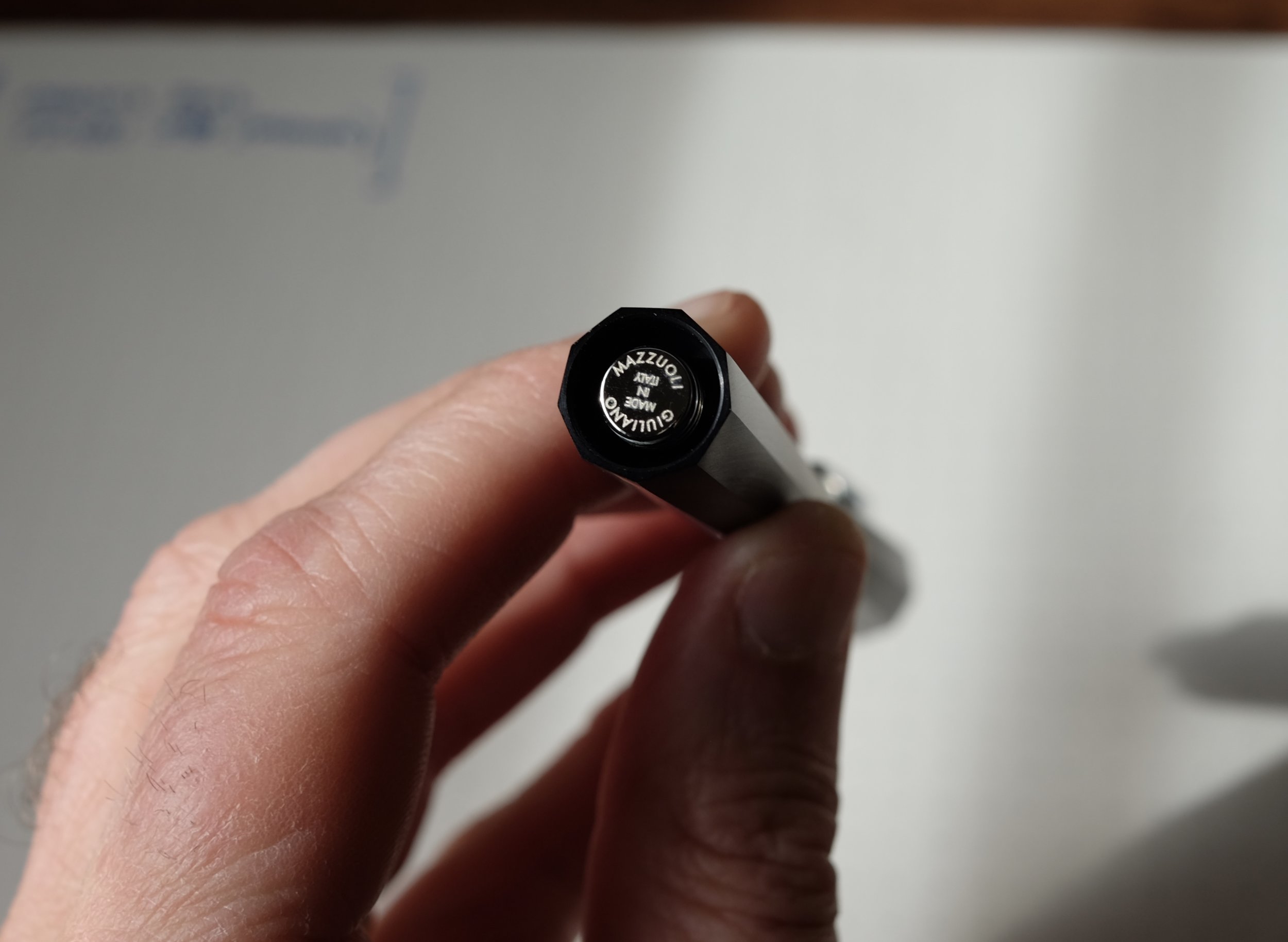
View fullsize Mazzuoli Medallion
View fullsize Mazzuoli Moka in-hand

Takeaways and Where to Buy

Since this pen was a loaner, I didn’t test it extensively “in the wild,” but from what I've seen so far I continue to be impressed with the quality of Mazzuoli pens. As I mentioned, given the slim section, whether this pen could serve as a comfortable daily writer depends on hand size. The nib, however, is quite nice, and having this pen on your desk at work would be quite the conversation-starter.

The Mazzuoli Moka has a MSRP of $156, with most retailers listing the pen for somewhere around $125, such as our site sponsor Pen Chalet. This price seems fair to me, given the quality of both the build and the design. Many thanks to Carol and the team at Luxury Brands for loaning me this pen for review!

Disclaimer: Luxury Brands loaned me the pen featured in this review free of charge, for review purposes. This post contains affiliate links.

In Pens Tags Giuliano Mazzuoli, Pens, Pocket Pens
1 Comment
← Newer Posts Older Posts →
Store Hours and Location
Visit the T.G.S. Curated SHOP
Updated "Best Pens" Guide
On the Paper Trail Podcast
TGS_25 Roterfaden New Stock Available
Hierarchies of Fountain Pen Friendly Paper

Join Our Patreon!
Subscribe to the TGS E-mail List

Featured Posts

Featured
Pilot-Custom-Series-Pens-overview.jpg
Mar 14, 2026
The Pilot "Custom" Series: An Overview of Some of My Favorite Fountain Pens
Mar 14, 2026
Mar 14, 2026
Pentel-Sign-Pen-Cover.JPG
Feb 28, 2026
Pen Review: The Pentel Sign Pen (Craft Design Technology Version)
Feb 28, 2026
Feb 28, 2026
Cover On the Paper Trail Intro Clip.jpeg
Dec 3, 2025
Introducing "On the Paper Trail," a New Podcast/Video Collaboration with Lisa Vanness of Vanness Pens!
Dec 3, 2025
Dec 3, 2025
The Gentleman Stationer RSS

View Cart

© Digital Divide Media, LLC, 2014-present.

All content is the exclusive property of Digital Divide Media, LLC, d/b/a The Gentleman Stationer, including “The Gentleman Stationer” website and trademark, and should not be reproduced without express written permission.  All rights reserved.

All content containing paid advertising, affiliate links, or sponsored content will be plainly disclosed by a disclaimer when/if featured.

Contact Information

Store Shipping Policy and Return Policy

Privacy Policy

Cookie Policy

Terms and Conditions

Powered by Squarespace