• Blog
  • Shop
  • Podcast
  • Resources
  • About
  • Archive
  • Contact
  • Cart
  • Sign In My Account
Menu

The Gentleman Stationer

Vintage Living in the Modern World.
  • Blog
  • Shop
  • Podcast
  • Resources
  • About
  • Archive
  • Contact
  • Cart
  • Sign In My Account

Ink Review: Taccia Ebi (Purple Red) and Uguisu (Olive Green)

April 3, 2019

Taccia is a Taiwanese brand that has grown significantly over the past couple of years, releasing some very nice pens at both a moderate and luxury price point, and just this past year releasing an entire range of inks. Today’s review will take a look at two of the inks: Ebi (described as a “purple red”) and Uguisu (described as an “olive green”). I chose these particular colors because, as you all know, I’m partial to deep reds/burgundies and darker greens. Neither Taccia ink disappoints.

I’d consider Taccia “Ebi” to be a solid burgundy/maroon option, if you prefer your burgundies with a lot of purple. Comparable colors would include Montblanc Burgundy Red (the closest match in my collection) and Sailor Oku-Yama (more pink/red and less purple). Colorverse Dark Energy has a lot more black to it.

“Uguisu” is an ink that’s going to get a lot of use. I’ve had a hard time finding a true “olive green” that isn’t too yellow and/or pale. By far the closest match in my collection is Sailor Jentle Epinard, since both inks have a slight red sheen to them, but the Uguisu is a shade lighter with enough yellow to make it a pure olive. Other comparable colors include Sailor Waka Uguisu (much lighter) and Monteverde Olivine (much darker, with nib crud issues).

Writing sample on Clairefontaine French Ruled A5 notebook. The tester pen for the Ebi was a KACO Retro, and a Parker 51 for the Uguisu.

Because Japanese pen company Sailor has made nibs for Taccia in the past, it begs the question: Are these Sailor inks? No. While these inks are made in Japan, I understand they’re manufactured by another company (Nabayashi), though the range of colors Taccia chose definitely bears some similarity to the Sailor Jentle/Pilot Iroshizuku lineup. The Taccia inks also behave somewhat differently. Both Ebi and Uguisu were slightly wetter than most Sailor inks I have used, though they still worked well on most types of paper, with the exception of the super-cheap recycled copy paper that is always loaded into one of my office printers. (Side Note: does anyone else have a situation at work where one printer has the “good paper” and other has the “terrible paper”? Apparently I have a reputation for backing up the “good printer” with print jobs because I refuse to use the bad one.)

Takeaways and Where to Buy

Burgundy reds and olive greens are always two of my favorite colors, and I found both Taccia inks to be well-behaved. I’ve heard good reports about the brand in general. With Sailor upping their prices per ml by cutting bottle sizes in half, Taccia presents an attractive alternative by selling quality ink that behaves similarly at a lower price point. Vanness Pens currently stocks the entire line, and has 12 of the 13 inks in stock at $12 per 40ml bottle. I also expect that Lisa will be bringing Taccia inks to this weekend’s upcoming Atlanta Pen Show.

Many thanks to Vanness Pens for providing me with these two bottles of Taccia Ink (in exchange for helping to work the table at the Baltimore Pen Show).

I love the box art on the Taccia inks. Ebi on the left, Uguisu on the right.
In Ink Reviews Tags Ink Review, Vanness, Taccia, Taccia Ink
1 Comment

Pen Review: Montegrappa Monte-Grappa

March 30, 2019

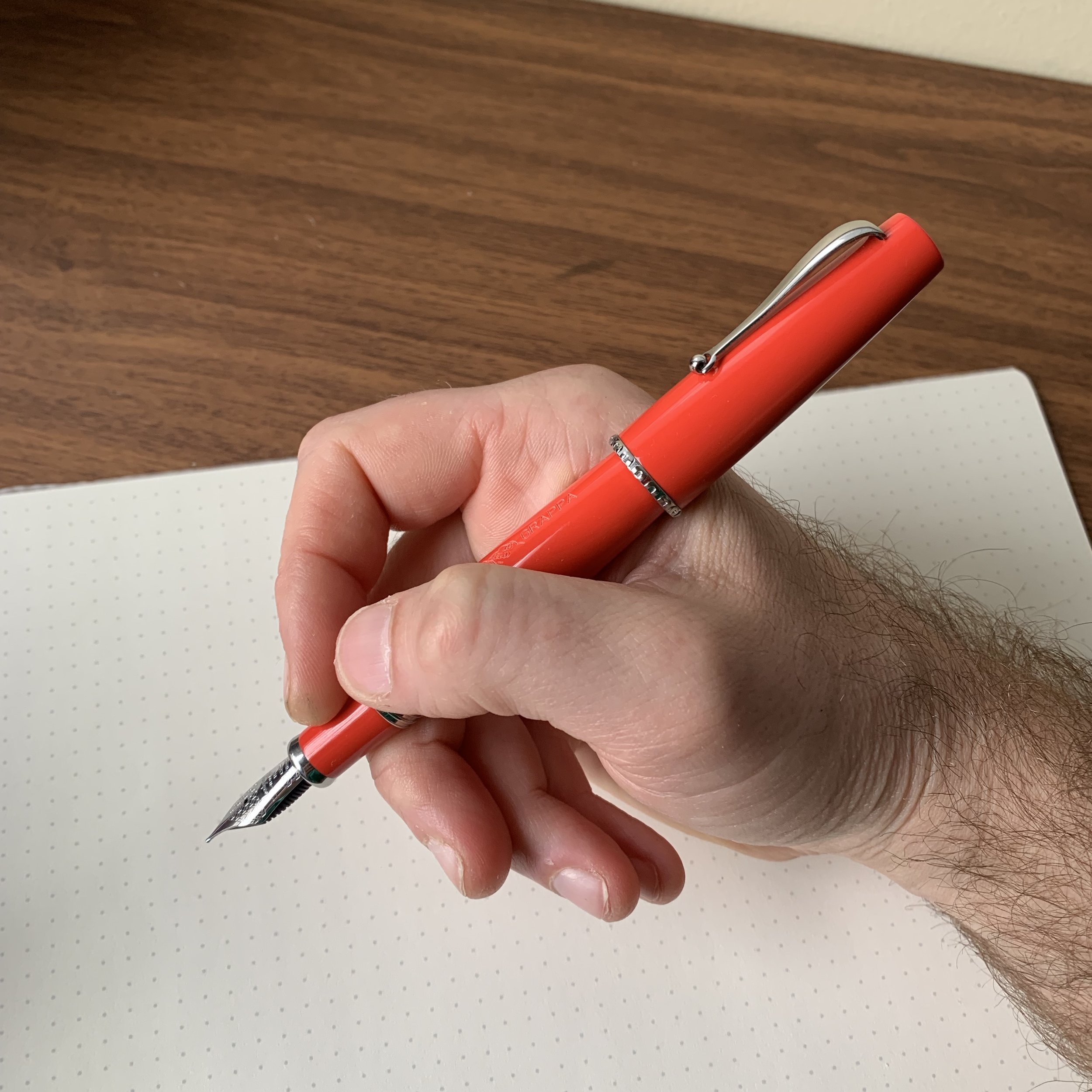
It’s coming up on a year since I received the Montegrappa Monte-Grappa, so after much use, a review is long overdue. This particular pen was released last year around the time of the Atlanta Pen Show, which was the first time I was able to handle one, and upon seeing the “Coral” pen I knew that this was a pen I would eventually add to my collection. I’m a sucker for vintage-inspired pen design, and was a pretty easy mark for Cary at the Kenro table.

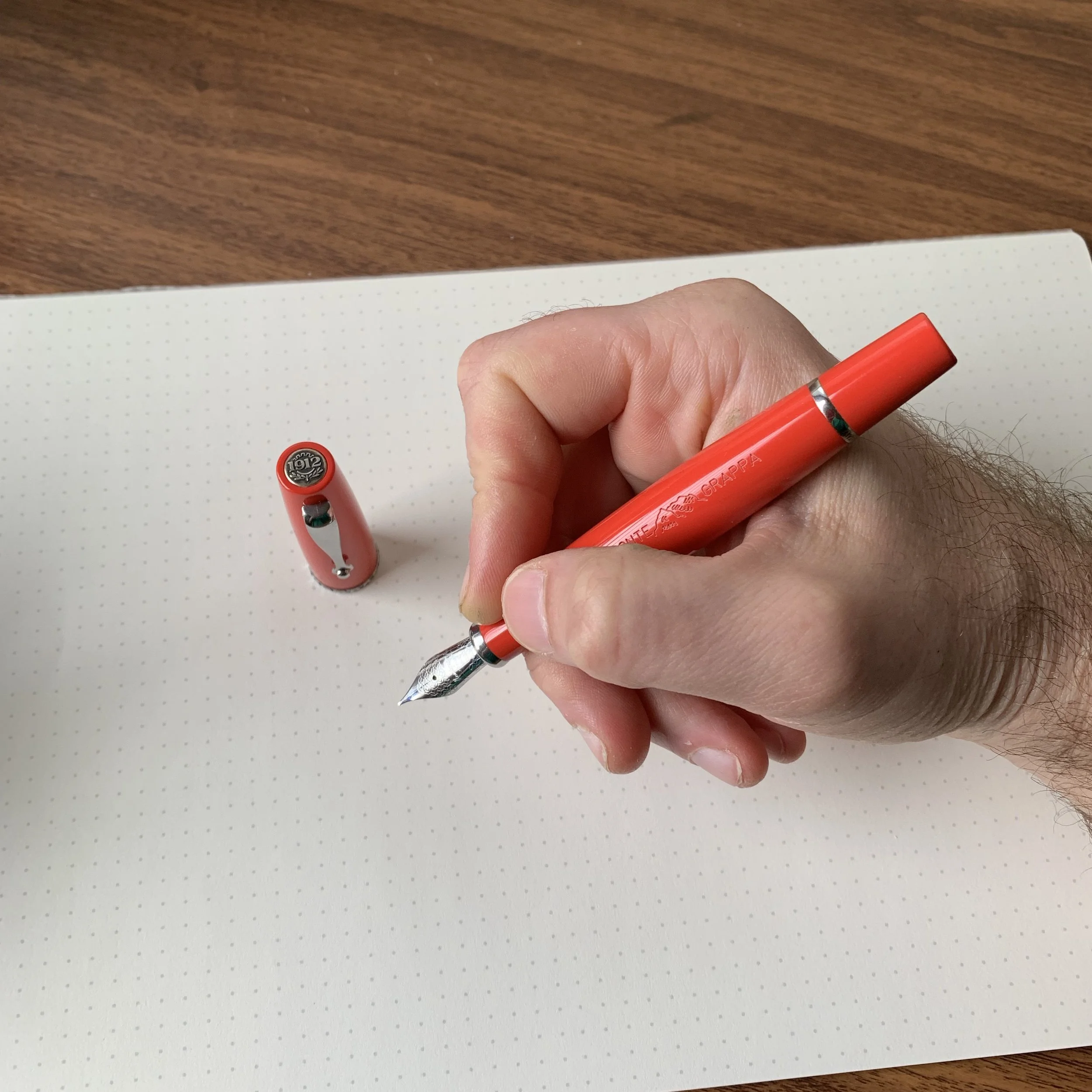
The vintage-style stamping on the barrel is what does it for me with this pen.

Coral, which I would describe as a pinkish-reddish-orange, seems like an odd color to add to the lineup of a modern pen brand, but it has a long history with fountain pens. Many vintage pens, such as the Parker Duofold “Big Red” from the 1920s and, more recently, the Waterman Man 100 Patrician, came in a similar shade. The Monte-Grappa comes in three other standard colors, black, blue, and lavender, but the coral version is by far my favorite.

Montegrappa’s “1912” medallion denotes the history of the brand and the fact that it’s one of the older Italian pen companies (and possibly the oldest - I need to brush up on my history).

The first thing you’ll notice about this pen is that everything screams “vintage,” from the color, to the size and shape, to the barrel imprint. The Monte-Grappa is also one of Montegrappa’s more understated designs (along with the Fortuna series), and I hope it sticks around. A few of my favorite aspects of this pen:

  • Barrel Imprint. The “Monte Grappa” imprint on the barrel looks as though it were lifted directly off a pen from the 1930s. Other than the cap band, this engraving is the only adornment on the pen and it adds charm.

  • Comfortable Shape and Ergonomics. I have always found Montegrappa pens to be very comfortable in the hand. The Monte-Grappa is no exception, with an inverted hourglass shape that tapers towards the nib and the piston knob and allows most of the pen’s weight to sit between your thumb and index finger (assuming you hold the pen in a traditional manner). Balance is important here, because the piston filling system adds heft to the pen. Most people will find the Monte-Grappa most comfortable to use unposted, though I post the pen regularly and don’t have any issues.

  • Montegrappa’s “Ratchet” Piston. A key selling point on this pen was Montegrappa’s decision to incorporate its patented piston-filling mechanism that you typically see only on MUCH more expensive pens (though the Monte-Grappa certainly isn’t inexpensive, as discussed below). Montegrappa makes one of my favorite pistons, because it uses a ratchet mechanism that clicks as you turn it. Once the clicking sound stops, you know not to turn further, preventing damage to the pen.

  • JoWo Nibs! Last but not least, the Monte-Grappa was the first major release to use JoWo nibs, which I find to be a huge upgrade over the previous Montegrappa (Bock?) nibs that tended to cause problems with dryness and skipping in some Fortunas. The new nibs are much more reliable, and I experienced no ink starvation issues. These nibs are still custom-engraved with Montegrappa’s signature “filigree” pattern.

View fullsize Montegrappa Monte-Grappa Unposted
View fullsize Montegrappa Monte-Grappa Posted

Montegrappa’s new JoWo nibs are of exceptional quality and still come engraved with the signature filigree pattern. I opted for a 14k nib here, which writes a true medium line with superb ink flow.

The Monte-Grappa features stainless steel trim, including a metal cap band that has a hammered metal look to it (even though it’s not technically hammered steel).

Takeaways and Where to Buy

I love the look of the Monte-Grappa, and it’s also an excellent functional writing instrument with the potential to be a mainstream “flagship” for the brand. But, as you might expect from Montegrappa, I have concerns that the price point will prevent this pen from getting traction with a broader audience. The MSRP on the Monte-grappa with a steel nib is $395, with pens typically retailing somewhere between $275-315. That’s expensive for an acrylic pen equipped with a JoWo nib, even once you account for the piston-filler. If you want to add a 14k nib, you will pay an additional $250 or so, which is even more expensive. That said, Montegrappa is known for targeting a luxury price point and a well-heeled clientele, and apparently has had much success with their brand strategy, so I don’t expect to see much price movement unless the pen ends up being discontinued.

You can easily find the Monte-Grappa with a steel nib at most retailers who carry Montegrappa. Vanness has the Coral version with a stainless steel JoWo nib currently priced at $275.00. They also have the Blue pen (actually more of a navy and my second favorite), as well as the Lavender version, in stock. The 14kt nib is a bit more difficult to find, but you can order them through Pen Chalet.

Montegrappa has also made a few special/store edition versions of the Monte-Grappa. The first is a limited edition version “La Canzone del Grappa” with a transparent barrel, which comes in two colors, October Green and Black (both of which are more of a flecked tortoise pattern, not solid colors). Another special edition is available from Dromgoole’s in Houston, which is a stunning olive green/tortoise combination.

The Montegrappa Monte-Grappa (center) compared against some other Italian “flagship” pens. From left, the Leonardo Momento Zero in “Pietra Marina” Sea Stone, an Aurora Optima in Emerald, the Aurora 88 Unica Nera, and a Montegrappa Extra 1930 in Turtle Brown.

Disclaimer: I received this pen from Kenro Industries for review purposes, and since I enjoyed it, they kindly agreed to let me keep it.

Tags Pen, Montegrappa, Montegrappa Monte-Grappa
Comment

Kickstarter Alert: 22Pen by Mario Shimodaira

March 29, 2019

I wanted to do a special short post this Friday to let everyone know that there’s just a little more than 24 hours left in the Kickstarter for the 22pen, a unique pocket pen that readers should be sure to check out. The pen holds two D1 refills in a flat format, allowing you to easily switch between two colors without clicking, and also allowing you to easily clip the pen inside a notebook. I have a review unit (in a prototype material) that I just now received, so I don’t have a full review ready to go, but my initial impressions are very favorable and I’m really looking forward to seeing how I can work the 22pen into my daily workflow, especially with pocket notebooks! I backed for the blue version. You can check out the full details of the 22pen here on the Kickstarter page. Many thanks to Mario for sending this pen over for review.

The 22pen may look a bit awkward, but it’s surprisingly easy to use.

The reverse of the 22pen features a clip to attach the pen to the inside of a notebook.

The reverse of the 22pen features a clip to attach the pen to the inside of a notebook.

Disclaimer: I received the pen featured in this post free of charge, for review purposes. I was not otherwise compensated for this review and I’ve backed this project with my own money.

In Pens Tags 22pen, Mario Shimodaira, Kickstarter
1 Comment
Pineider-Arco-Collection-Fountain-Pen

First Impressions: Pineider Arco Collection Limited Edition with 14k "Quill" Nib

March 27, 2019

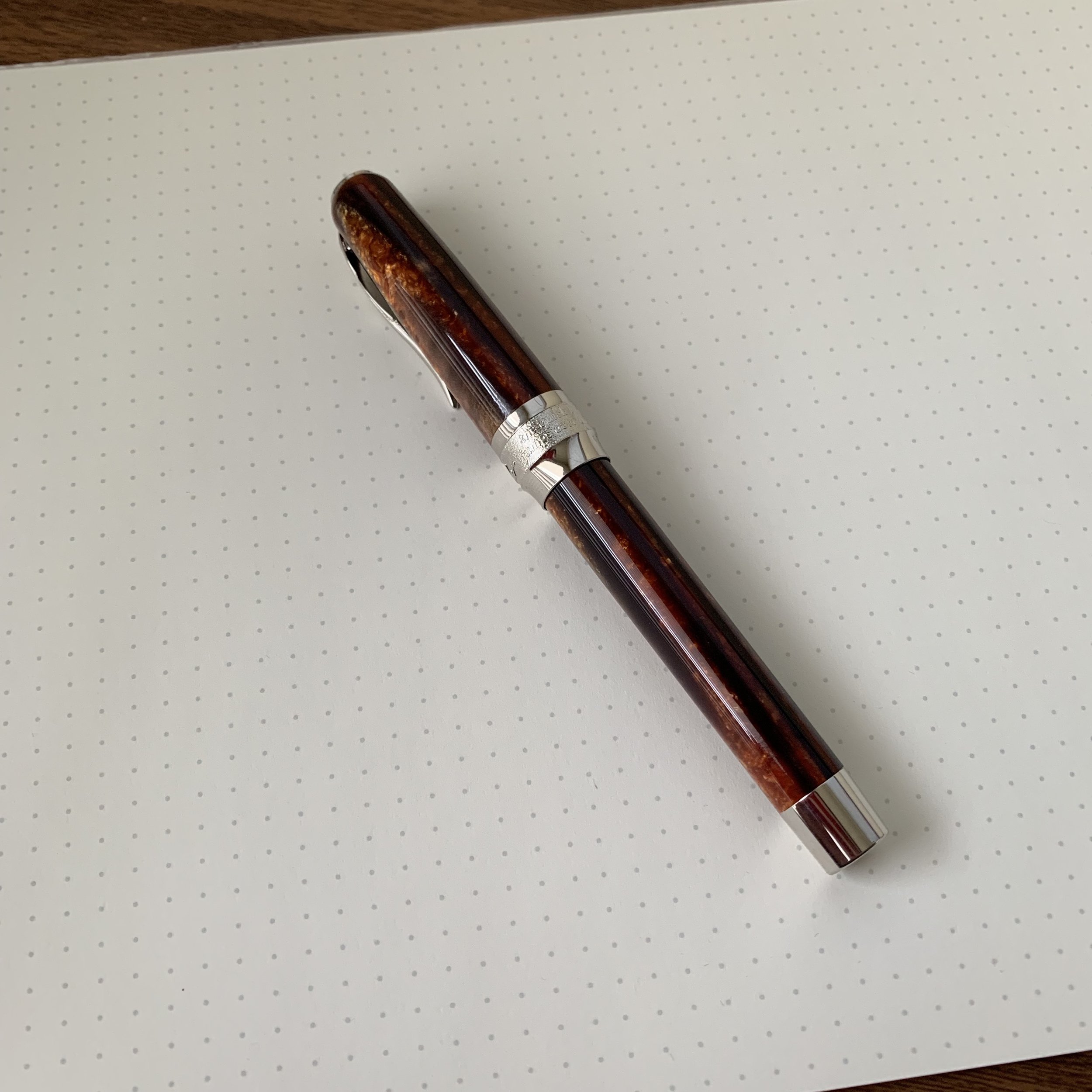
Few materials have captivated the pen community in the same way as Arco celluloid, especially in pens made by the Italian pen manufacturers, and Omas in particular. After Omas folded, legacy company Armando Simoni Club/ASC Pens purchased the remaining Omas celluloid rod stock, and has released a series of pens in both the green and brown Arco celluloid under its own name and in partnership with Leonardo. (I own a Leonardo pen in green Arco Verde celluloid, and it’s gorgeous.)

But the rumor is that once ASC Pens’ current stock of Arco celluloid is gone, it’s gone. Celluloid is extremely time consuming and difficult to make, requiring a large (and expensive) investment of time and materials up front, followed by a years-long period of waiting for the celluloid to cure. As it turns out, however, companies don’t want the Arco “look” to go away (especially given the price Arco celluloid is commanding on the secondary market). This year, Pineider announced and released a limited edition “Arco Collection” pen in which Pineider attempted to duplicate the look of Arco celluloid using a layered acrylic.

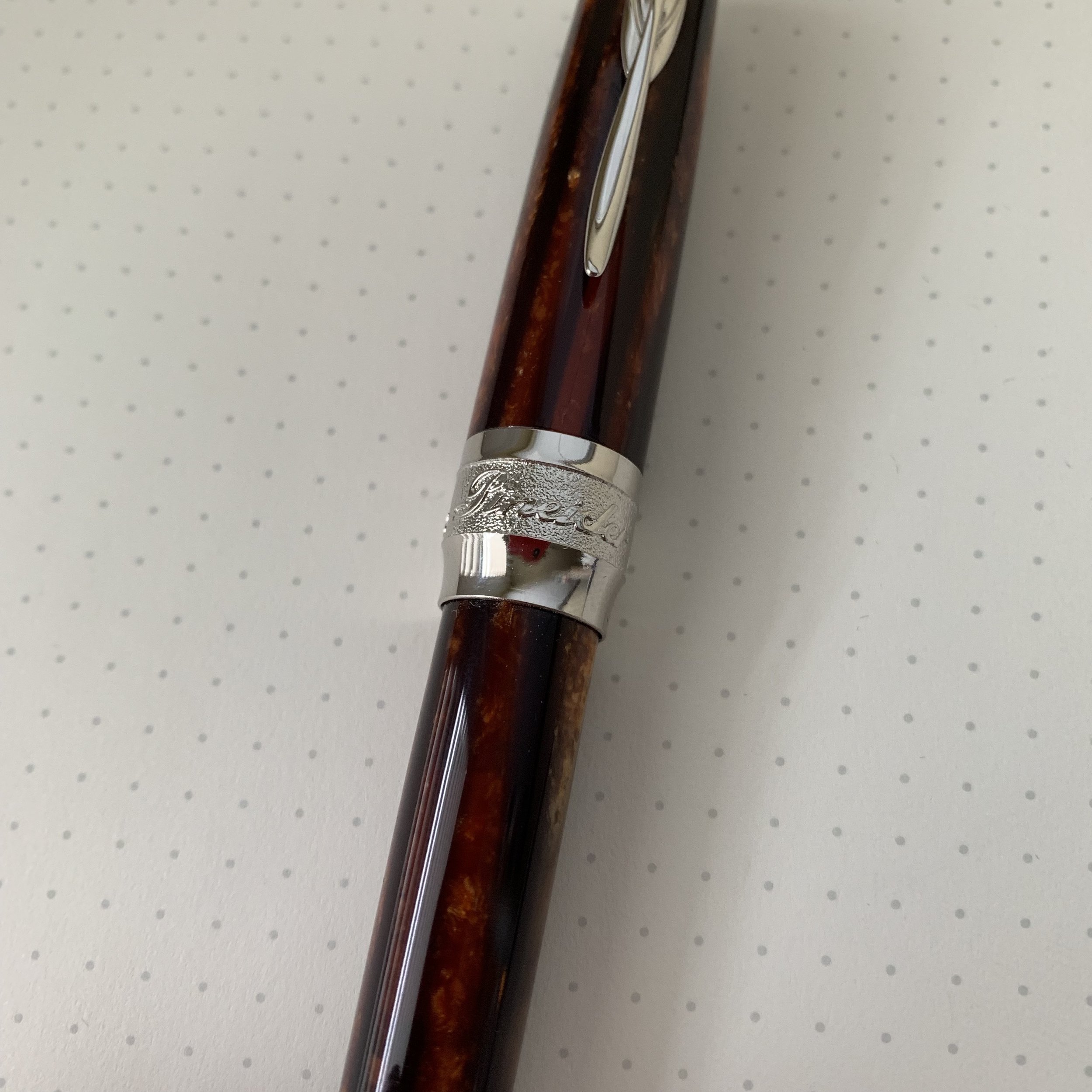
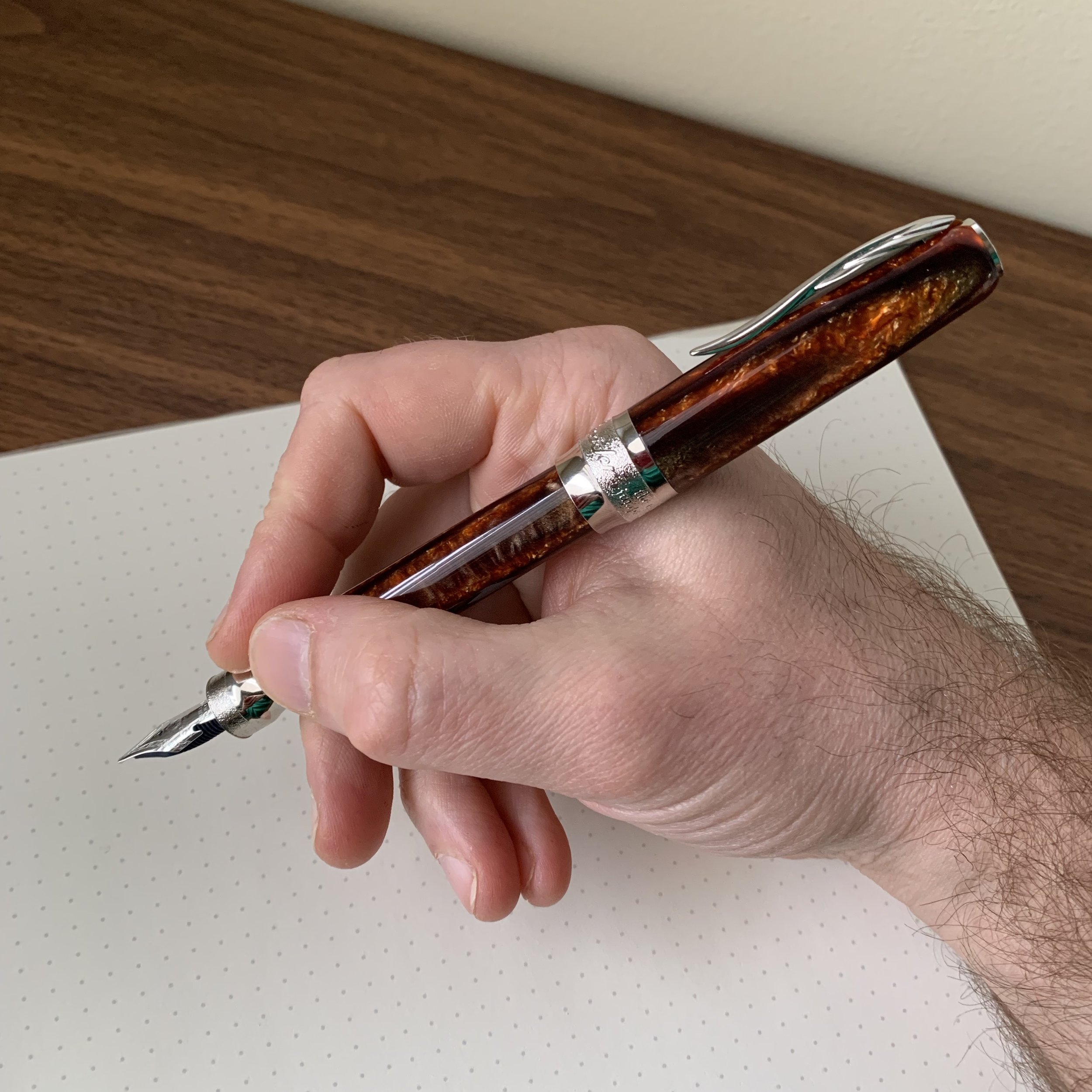
Here you can see the striations in the acrylic. Lovers of vintage Arco celluloid will say it's not the same - and it’s not - but the material is beautiful in its own right. The cap features a twist magnetic closure, with a metal piston knob that all…

Here you can see the striations in the acrylic. Lovers of vintage Arco celluloid will say it's not the same - and it’s not - but the material is beautiful in its own right. The cap features a twist magnetic closure, with a metal piston knob that allows you to post the pen using the magnet in the cap.

Pineider pens present a mixed bag for me. Functionally, the company makes a high-quality product. I previously reviewed the Pineider Avatar, which I enjoyed reviewing but the pen didn’t do it for me in terms of aesthetics, mainly because I found it a bit boring. Last year, Pineider released a new series of pens that I liked better, the La Grand Bellezza “Gemstone” collection, which featured new materials and came equipped with a new 14k “hyperflex” nib that Pineider dubbed the “Quill.” The new Arco Collection pens generally take the shape of the Grand Bellezza models, adding a piston filler and limited edition numbering.

There are 888 Arco collection pens, with each one numbered on the piston knob.

What everyone wants to know, of course, is how the new “Arco” acrylic compares to Arco celluloid. Short answer: it’s beautiful in its own right but not the same. Classic celluloid has a depth to it that’s practically impossible to duplicate, which is why it remains such a coveted material among pen collectors despite its many downsides. (i.e., it stains, it’s fragile, it’s flammable, and it’s expensive… I could go on, but you get the point.) Pineider’s Arco acrylic definitely captures some of the look of classic Arco, but is much darker and doesn’t quite get all of the gold and copper highlights found in the celluloid. There definitely will be a trade-off for the durability and lower price point of an acrylic pen.

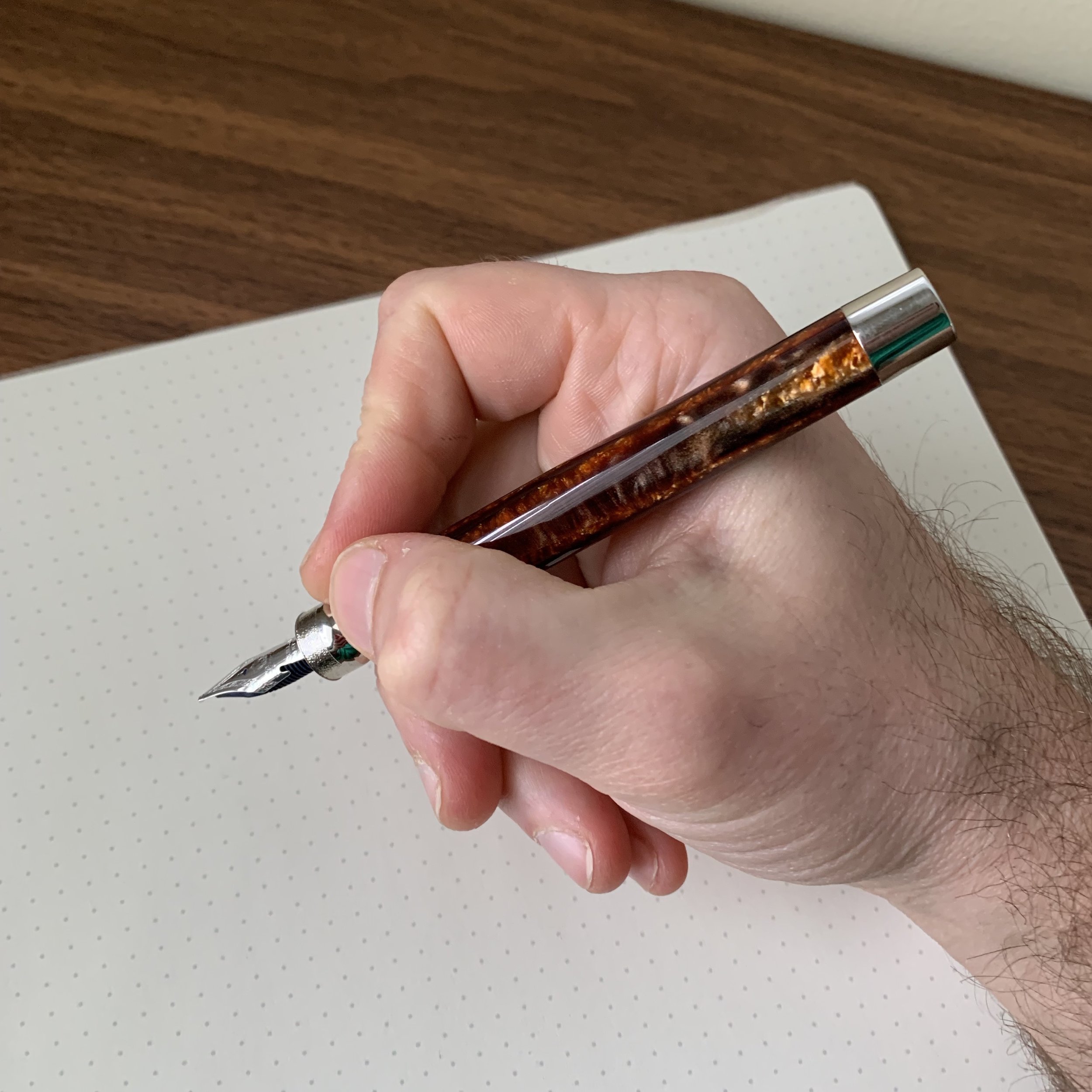
The broad “Quill” nib on this Arco pen is more than a little stubbish.

For me, the Quill nib is what makes this pen (and the other Gemstone/Grand Bellezza pens) really shine. Pineider describes the nib as “hyperflex,” but as is often the case with so-called “flex” pens, there’s more than a bit of hyperbole involved. I’d describe the Quill nib as “true semi-flex,” in that you will get some significant line variation, especially in the narrower nib widths (EF-F). The stubbish broad nib I tested had a nice bounce to it, and really put a lot of ink on the page. To me, the Pineider nib is certainly “flexier” than Aurora’s flex nib, but you still shouldn’t expect a vintage-style flex pen.

Takeaways and Where to Buy

Pineider has my attention more than than they did when they first appeared on the scene. After spending two weeks with the Arco pen, I could see myself picking up one of the Grand Bellezza “Gemstone” pens just to have a Quill nib in my collection, probably opting either for a broad or an extra fine. The standard “Gemstone” pens have an MSRP of just under $500, with an actual retail price that typically sits just under $400. Vanness, however, is currently running a 40% off promotion in which the cost of the Pineider La Bellezza fountain pen with the Quill nib is just $298. That’s a very good price on an excellent pen, especially for a semi-flex nib of this quality.

As a limited edition with a piston filler, the Arco collection pens are more expensive, with MSRP at around $700 and retail price between $500-600. They’re also selling quickly, so you’re probably going to have to hunt around to find one. Vanness Pens is currently sold out, and they may or may not get more, depending on availability.

Many thanks to my sponsors at Vanness Pens for loaning me this Arco Collection pen to review. It made for an enjoyable two weeks between the Baltimore and Arkansas pen shows!

Disclaimer: This post contains links to paid sponsors and affiliates. Vanness Pens loaned me pen featured in this review at no charge.

View fullsize Pineider Arco Unposted
View fullsize Pineider Arco Posted
In Pens Tags Pens, Pineider, Pineider Arco, Vanness, Flex Nib
Comment

Pen Review: Desiderata Soubriquet in Briar Ebonite

March 23, 2019

One of the things I’ve enjoyed about following the pen community and writing this blog over the past five years is watching smaller makers evolve and fine-tune their craft, especially where the products they offer are entirely unique from anything else out there. Pierre Miller, the man behind the Desiderata Pen Company, is one such penmaker. Pierre’s pens first came on my radar four or five years ago at the D.C. Pen Show, back when it was at the old (read: better) location in Tyson’s Corner and he showed up with early versions of his Daedalus pen fitted with Zebra G dip nibs, which was one of the first modern pens I had seen that allowed a user to combine the true vintage-style flex of a dip nib with the portability and larger ink reservoir of an eyedropper fountain pen.

Flex, of course, isn’t really my thing, as readers here are aware. I’m not a calligrapher, and most of my pen usage is daily user, office-style stuff. Flex nibs are fun to dabble with, but I always hesitate to shell out hundreds of dollars for a pen that I can’t use on a daily basis. Desiderata Pens didn’t really reappear on my radar until Pierre started offering the JoWo No. 6 nib option and different filling mechanisms in the “Soubriquet” model. After talking with Pierre at several different pen shows over the last couple of years, I finally picked up a Soubriquet in Los Angeles, and it’s seen steady use in the month since that show.

Sure, I could swap in a Zebra G, but when I can use this pen as an everyday writer with one of my favorite stock stub nibs, it may take me a while to get around to it…

What I Like About the Desiderata Soubriquet

Pierre has extensive notes on his website in which he discusses the story behind the pen and explains the various design choices, which makes for an interesting read and provides a lot of insight into how he designs and makes pens. Here are a few of the highlights, which are also the features that I appreciate the most.

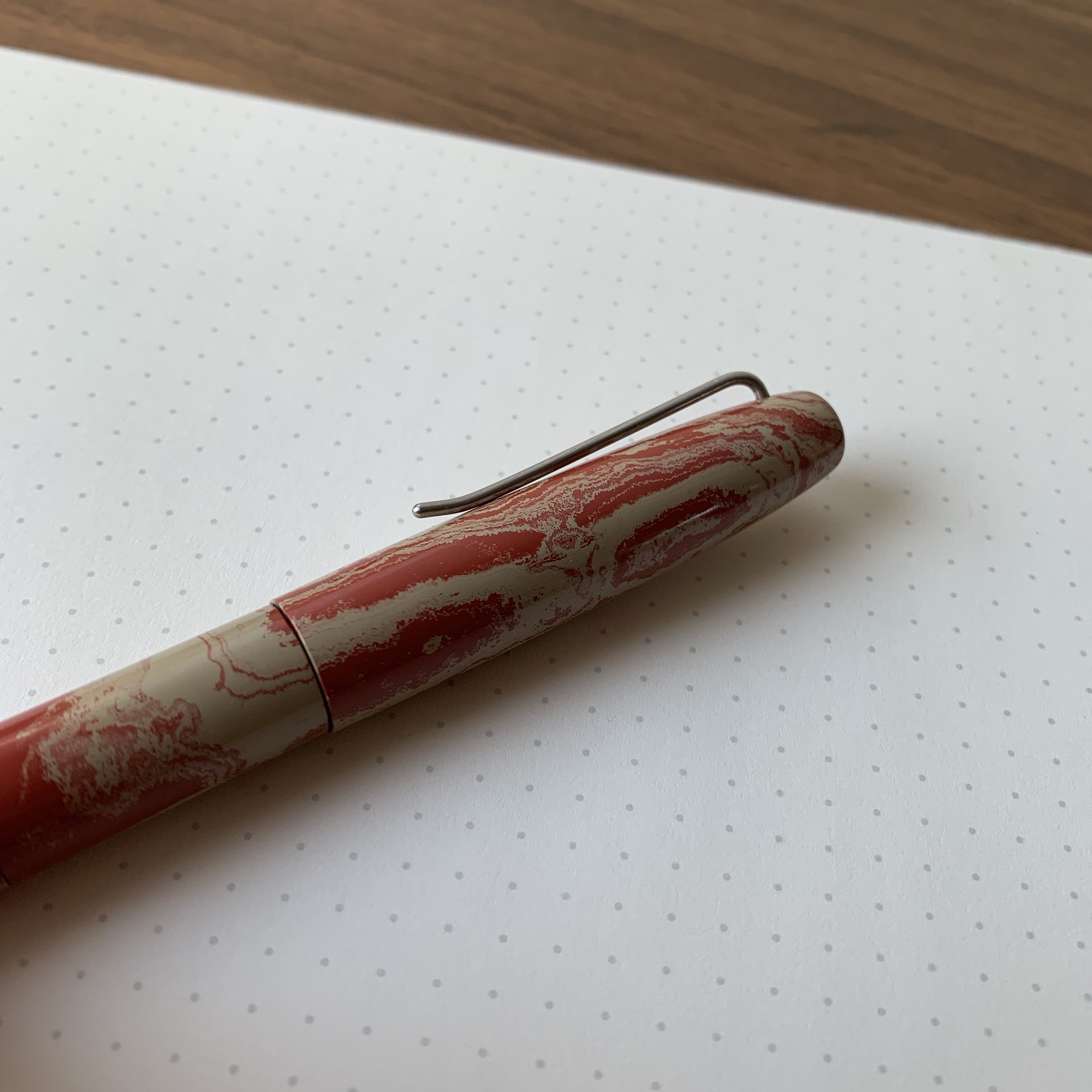
The Soubriquet is the first Desiderata pen to feature a clip, and I like the “wire” design.

The Soubriquet is the first Desiderata pen to feature a clip, and I like the “wire” design.

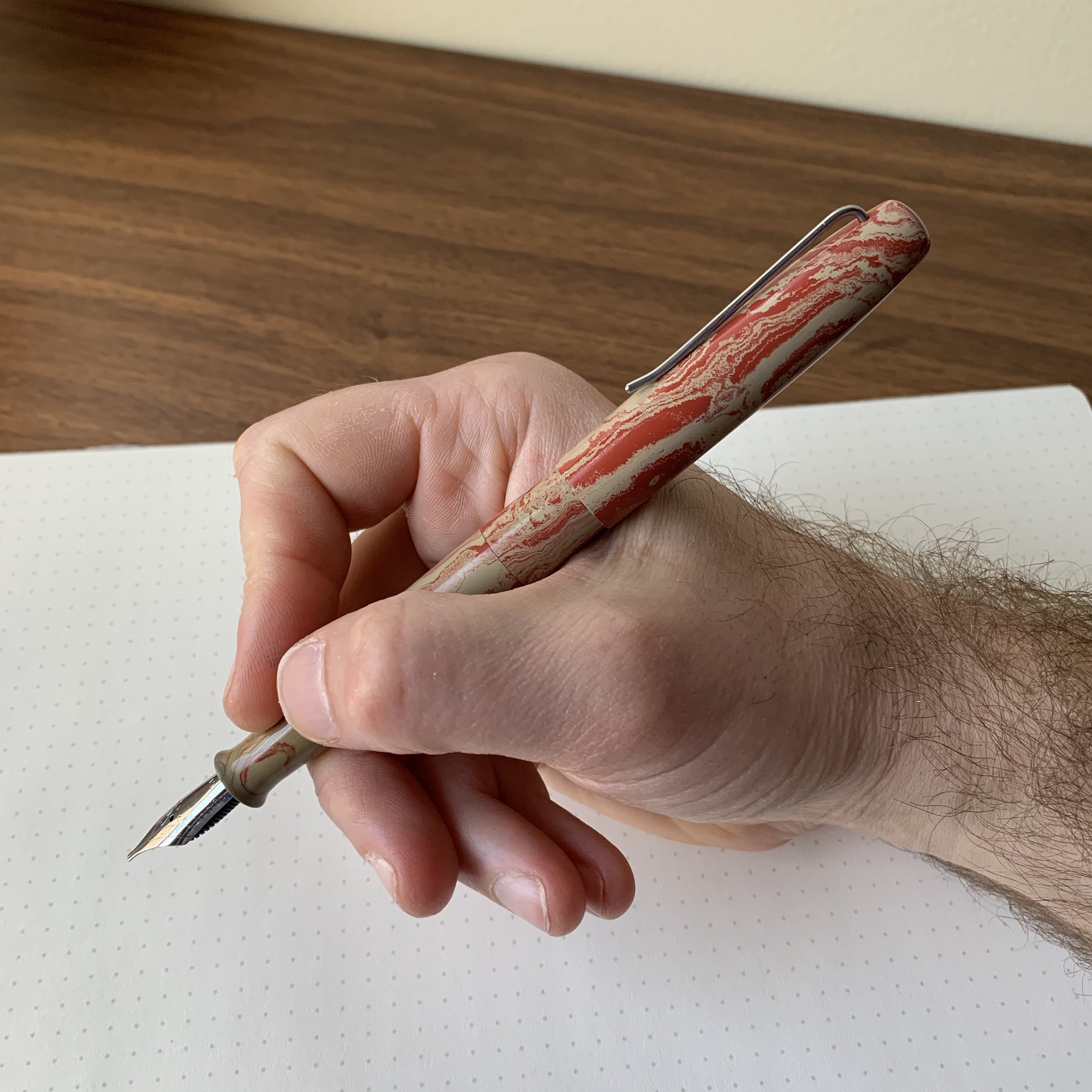
  • Size and Shape. The knock on a lot of modern custom pens is that they tend to be very large, especially when compared to vintage or vintage-inspired designs. The Soubriquet is the product of Pierre’s attempt to design a larger pen without “going overboard,” and he threads that needle quite well. The Soubriquet is about the same size as a Montblanc 146 (though much lighter), which is a great size for me in terms of ergonomics. I can comfortably use this pen posted and unposted, with the cap posting deeply on the tapered barrel. The section also tapers towards the nib, with the threads placed higher up on the barrel just below the ink window. I can’t emphasize enough how comfortable this pen is to write with for long periods of time.

  • Filling System and Ink Capacity. Since I opted for a JoWo 1.1mm stub nib, ink capacity and ink flow can become an issue. The Soubriquet features a “piston vacumatic” filling system, which uses an o-ring instead of a sac and operates like the filling mechanism on the TWSBI Go. Pierre designed the pen to allow one-handed filling, and it works as intended. You simply submerge the pen in ink and depress the plunger until the pen is full. This type of filler is also much easier to flush clean than a sac-based vacumatic pen. I was able to clean ink out of the pen and refill it with a different color in just a couple of minutes. The pen holds approximately 1.5ml, which will keep me writing for quite a while, even with a stub.

  • Clip. Earlier models of Desiderata pens were clipless, but the Soubriquet introduced a thin, wire-style clip made from 304 stainless steel. Despite the slim profile, this clip is VERY sturdy, and I’ve come to appreciate the distinct design element that the clip lends to the pen.

  • Ebonite Material. Pierre works extensively with ebonite, which many readers will recognize as a form of vulcanized rubber that’s been used to make pens (and bowling balls) for well over a hundred years. I’ve been looking to add a mottled/swirled ebonite pen to my collection for a while now, and when I spied the last briar ebonite pen on Pierre’s table, I knew this one was coming home with me. Ebonite has an unparalleled feel in the hand - it emits a warmth and has a softer feel to it than acrylic or other plastics, even though it’s still extremely durable.

The Soubriquet disassembled to show the filling system.

View fullsize Desiderata Soubriquet Unposted
View fullsize Desiderata Soubriquet Posted

Pierre urged me to make sure that everyone knows up front that Desiderata Pens are “small batch” manufacture, meaning that the pens are made in very small numbers in a one man shop. I guess that’s his way of saying that it’s not unusual to find small variances or imperfections on the pens, but other than a few barely perceptible tooling marks, the fit and finish on my Soubriquet is excellent. No issues or complaints whatsoever from me.

A comparison photo, from left: Aurora Optima, Desiderata Soubriquet, Montblanc 146, and Leonardo Momento Zero.

Takeaways and Where to Buy

I’m extremely happy with my Desiderata Soubriquet. I originally approached the purchase as a “tinkering pen” that I might use occasionally to practice handwriting and flex calligraphy, but the JoWo nib unit has worked so well that the pen has not left my daily carry for the past month. I do feel that I need to offer a note of caution: I have used the Zebra G nib in an earlier version of the Desiderata Daedalus that I borrowed, and while it does work well and can be quite enjoyable to use, fountain pens fitted with calligraphy dip nibs require much more frequent maintenance, as the nibs will deteriorate and need to be replaced on a monthly basis, if not sooner depending on how frequently you use the pen. If you are purchasing a Desiderata Pen specifically to take advantage of the Zebra G’s flex capabilities, I’d encourage you to read the resources available on the Desiderata website, and also watch some of Pierre’s YouTube videos in which he shows you how to set up the pen for this sort of writing. Be prepared to tinker with it!

As I mentioned above, I purchased this particular pen directly from Pierre at this year’s L.A. Pen Show, where he had just one of the Briar Ebonite models. The Soubriquet in this particular material is currently sold out, but on the website Pierre has indicated that he will consider requests to make more, so if you’re interested let him know! The Soubriquet runs anywhere from $225-250, which I find reasonable for a custom/small-batch pen with a non-cartridge/converter filling system. Pens ship with the Zebra G calligraphy nib, but JoWo No. 6 nibs are also available upon request, and it’s what I’ve been using since L.A. I likely will swap in the Zebra G in the near future to play around, but I’ve been enjoying this JoWo No. 6 stub so much I’ve not been motivated to change it out.

At the moment, Pierre has several other Soubriquet models available in his Etsy store, with additional Desiderata models for sale on his website. Pierre regularly attends pen shows, and during the last couple of shows he had a variety of Soubriquets in some unique acrylics not yet listed online. (Also, you definitely won’t want to miss the pre-order for the BAMF pen, which should ship within the next few months.)

Disclaimer: I paid for the pen featured in this review with my own money, though Pierre did give me a slight discount on the purchase of a second nib unit.

In Pens Tags Pen Review, Desiderata Pens, Desiderata Soubriquet
Comment
← Newer Posts Older Posts →
Store Hours and Events
Shop T.G.S. Online
Updated 2026 "Best Pens" Guide
No results found
On The Paper Trail: Live In Nashville Event Tickets Now Available!
TGS_25 Roterfaden Restock Notification
Hierarchies of Fountain Pen Friendly Paper

Join Our Patreon!
Subscribe to the TGS E-mail List

Featured Posts

Featured
Pilot-Custom-Heritage-92.jpg
June 6, 2026
Workhorse Pens: Pilot Custom Heritage 92 Fountain Pen
June 6, 2026
June 6, 2026
Kakimori-Inkstand-Before.jpeg
May 30, 2026
Japan Trip Journal: A Visit to Kakimori, Including Custom Notebooks and the InkStand!
May 30, 2026
May 30, 2026
Five-Foundational-Fountain-Pens.jpeg
April 22, 2026
T.G.S. 12th Anniversary: 5 Fountain Pens Everyone Should Experience
April 22, 2026
April 22, 2026
The Gentleman Stationer RSS

View Cart

© Digital Divide Media, LLC, 2014-present.

All content is the exclusive property of Digital Divide Media, LLC, d/b/a The Gentleman Stationer, including “The Gentleman Stationer” website and trademark, and should not be reproduced without express written permission.  All rights reserved.

All content containing paid advertising, affiliate links, or sponsored content will be plainly disclosed by a disclaimer when/if featured.

Contact Information

Website Terms and Conditions

Store Shipping Policy and Return Policy

Privacy Policy and Cookie Policy

Accessibility Statement

Powered by Squarespace