• Blog
  • Shop
  • Podcast
  • Resources
  • About
  • Archive
  • Contact
  • Cart
  • Sign In My Account
Menu

The Gentleman Stationer

Vintage Living in the Modern World.
  • Blog
  • Shop
  • Podcast
  • Resources
  • About
  • Archive
  • Contact
  • Cart
  • Sign In My Account

Desktop Tools: Carl Angel-5 Pencil Sharpener

July 24, 2019

As you might have guessed from the theme of my recent posts, lately I’ve spent a good deal of time time curating my stationery accumulation and related accessories, trying to get a handle on what my “core tools” are. My traveling kit and my journaling setup has remained consistent as of late, and I did a search around my desk at home and at the office to see whether there were any additional key items in my workflow that I had never reviewed. What was the first thing that came up? My Carl Angel-5 pencil sharpener, which I’ve owned for more than 5 years now.

“The Original Quality SInce 1960”. Something tells me the design of this sharpener hasn’t changed much since then.

Carl is a longstanding Japanese office-supply manufacturer, which since 1929 has produced products ranging from hole punches to paper cutters to pencil sharpeners. I can’t speak to their other products, but Carl’s pencil sharpeners are superb, especially for the money. The Angel-5 model has developed a bit of a cult following due to the long point this thing can put on a pencil. We’re talking daggers or vampire-stakes here.

The plastic tray slides out easily. I love the fact that it’s transparent and you can easily see when the sharpener is full.

The Angel-5 is a pretty simple contraption: it’s a single-burr, hand-crank sharpener that has held up well and shows no signs of the grinder dulling despite five years of heavy use. This sharpener’s combination of compact size and durability makes it a perfect choice for home and office desktops, as well as classrooms.

Carl’s kinda angry looking, from this angle. The good thing about the “teeth” is that you don’t have to mount the sharpener to a desk or table. The Angel-5 grips the pencil well and automatically feeds it into the grinder as you sharpen.

The one potential issue I feel compelled to mention is the fact that the “teeth” of the sharpener that grip the pencil will leave marks in the finish. If you sharpen enough, it can give the pencil a “chewed up” look. Since woodcase pencils are by their very nature disposable, this doesn’t bother me as the finish on the pencil is going to get “sharpened away” anyway, but as you might imagine, people have very strong opinions about these things. Carl makes a slightly more expensive model with rubber pads on the grippers that won’t mar the finish. (Link below)

An unsharpened Palomino Blackwing Pearl.

Now THAT is a sharpened pencil! Be careful or you’ll put your eye out with that.

“Teethmarks” from the Carl Angel-5 sharpener. On pencils with thicker finishes, like Blackwings, it’s less noticeable. The sharpener can really tear up cheaper pencils made of softer wood, but who wants to use those anyway?

Takeaways and Where to Buy

If you’re in the market for a relatively inexpensive, high-quality pencil sharpener for the home, office, or classroom that will see heavy use, consider the Carl Angel-5. For less than $20, (including free Amazon same day delivery for eligible Amazon Prime Members), this sharpener is a bargain. The one drawback, as noted above, is that you can’t adjust the length or bluntness of the point, but if you require this functionality you can opt for the slightly more expensive Carl CC-2000, which has five sharpness options. I have a CC-2000 in my office, and while it’s a good sharpener, I prefer the point on the Angel-5. (Note that the CC-2000 is the sharpener that doesn’t leave “teeth marks” on your pencil.)

Disclaimer: I purchased the product featured in this review with my own funds, for my own use. This post contains Amazon affiliate links.

In Accessories, Pencil Sharpener Tags Desk Accessories, Pencil Sharpener, Office Tools, Carl Angel-5, Carl
7 Comments

Pencils that have gone the way of the dodo.

Does It Ever Make Sense to Stockpile Stationery? Maybe Sometimes.

July 20, 2019

I’ve been thinking about this question a LOT lately. And not necessarily because I want to justify my own collection, which actually has diminished significantly in recent years. I’ve not purchased any new pens for months, and have made an honest effort to sell off unused items, work my way through my backlog of paper, and simply be more conscious about acquiring additional stuff. Of course I still tend to accumulate pens, pencils, ink, and paper over time - it’s the nature of product reviewing that you sometimes need to acquire items to review - but it’s become more gradual, I don’t feel as though I’m drowning in clutter, and I’m not losing money. A semi-annual stationery purge helps to keep things in check.

I’m not a collector, in the traditional sense, and I try to buy only those things that I could conceivably use one day. On principle, I discourage FOMO-driven “fear hoarding.” You know the forum threads - “They might discontinue X limited-edition product or run out quickly, and I know I haven’t tried it yet but it’s going to be great because X blogger says so and I went ahead and bought seven bottles/boxes/packs of notebooks because I might never be able to get it or anything like it ever again.” This type of stockpiling isn’t healthy, for your sanity, your wallet, or the stationery industry in general. These purchasing frenzies incentivize brands to churn out dozens of ill-conceived “limited edition” versions of the same product rather than innovate and bring something new to the market. Many “limited editions” aren’t even unique - with respect to something like fountain pen ink, is there any good reason to stock up on a dozen bottles of a single color when the overwhelming majority of people go through a bottle (maybe two) a year at most, and where the size and scope of today’s ink market renders it extremely unlikely that you won’t be able to find a similar, if not identical, color? Stockpiling like this rarely makes sense to me.  

Recent eBay score.

Lately, however, I’ve been wondering whether a good case does exist for stockpiling certain products you use regularly and form a core part of your workflow. Two items in particular prompted this internal debate: (1) the Baron Fig Mastermind desk pad, and (2) the cedar No. 2 pencil. The first, I’ll freely admit, is more fear-driven than the other. To my knowledge, Baron Fig is in no danger of going away anytime soon, but I’ve not found anything similar to the Mastermind that matches its combination of size, paperweight, and format. (The Studio Neat Panobook and the Write Notepads Landscape Notebook are similar, but I love that the Mastermind is a tear-away desk pad, especially since I have to shred most of my notes from work.) There’s no need for me to invest in a lifetime supply of writing pads, but does it make sense to have extra stock on hand to hold me over if it’s ever discontinued and I need to find something else? Since I’ve used the Mastermind every day consistently for the past two years, probably.

The Faber-Castell Mongols from the 1990s often have usable erasers, unlike older Eberhard-Faber branded pencils where the erasers have calcified.

The cedar No. 2 pencil presents a better case for buying up what you can while you can still get it. Much ink has been spilled (or graphite smeared) lamenting the fact that modern pencil production is plagued by inconsistent quality, even within brands, and unannounced design and manufacturing changes. Take the Dixon Ticonderoga, for example. While the original, USA-manufactured cedar Ticonderoga has been a bit over-romanticized, there’s no disputing the fact that since Dixon began outsourcing production to multiple factories around the world, consistent quality has been elusive. I’ve purchased a box of Black Ticonderogas made in Mexico that were some of the worst pencils I’ve ever used - hard, scratchy, and way too light for their No. 2 designation. Another pack of Chinese-made Ticonderogas that I purchased from Target are still among the best pencils in my stash, with a smooth, dark core, while yet another identical-looking box purchased from Office Depot were just “meh.” 

My pencil cup runneth over. Most of these will end up like the Blackwing stub below.

Woodcase pencil-making is, by its very nature, resource-intensive and susceptible to economic pressures that force manufacturers to outsource and cut costs, especially in market segments like school supplies where they can’t raise prices enough to compensate. All of the favorite inexpensive “school” pencils I used growing up (the Dixon Ticonderoga, the Faber-Castell American, the Blackfeet Indian Pencil) have either seen production move overseas or have disappeared entirely from the U.S. market. What’s to say that more brands won’t follow? Sure, it’s a safe bet that Blackwing probably isn’t going anywhere anytime soon - as long as people are willing to pay close to $30 for a dozen pencils - but can you really say the same about Generals, which operates a factory in the uber-expensive New York City metropolitan area and focuses on pencils that sell for around $6 per dozen? Even CalCedar (maker of Blackwing) discontinued the eraser-tipped Palomino No. 2, which I consider one of the best pencils ever made. They used to sell them in bulk for $100 per gross, and failing to pull the trigger on that purchase is one of my great regrets. I won’t make the same mistake with the Forest Choice No. 2.  

Original Blacking MMX, circa 2010.

I guess the point of this musing is to say that if I find a reasonably priced product that I use daily and enjoy, why wouldn’t I purchase it while I can, especially if there’s a real (as opposed to perceived) danger of it going away forever? Building up a nice stock of quality woodcase pencils doesn’t cost very much, and pencils don’t take up much space or deteriorate quickly. A dozen USA-made Ticonderogas from the 1990s or 2000s can be had on eBay for as little as $7, and they’re as usable as ever. Sure, that’s pricier than what you’ll see in stores today, but it’s still much less expensive than a dozen modern Blackwings. That Faber-Castell “American” pencil I mentioned? You can buy a sealed half gross of those for $20 - still less than a dozen limited edition Blackwings. The other good thing about pencils is that if you have school-age kids in the house, those pencils are going to get “stolen”, and you can always donate unused pencils or those that don’t match your personal preferences to school-supply drives, which my office runs every fall. In short, be conscious of what you use, and don’t buy multiples of stuff simply because of FOMO-pressure or because someone like me told you to, but at the same time, don’t let today’s trendy obsession with “minimalism” keep you from ensuring that you have a ready supply of quality writing tools that you need to do the work you love.

Now excuse me while I go finish work on my pencil bunker.

Disclaimer: This post contains links to paid sponsors and affiliates. All pencils pictured in this review were purchased with my own funds for my own use.

Also, please do not flood me with emails about selling pencils or pens. I’ve recently been receiving scores of unsolicited e-mails asking if I will sell “XYZ” pen, pencil, or notebook (typically a limited edition). If I am looking to sell or trade something, I will typically ask for trade offers or post things for sale on a separate page. Thanks for understanding - I can only respond to so much email!

In Editorial Tags Pencils, Editorial
Comment

My 2019 Journaling Setup: Nanami Paper Cafe Note and Midori 5-Years Journal

July 17, 2019

I was on the Hobonichi Techo bandwagon for a while, using everyone’s favorite A6 Japanese planner as a one-page-a-day journal. I actually have three of them filled up from 2016-2018. Although I liked the Hobonichi, I wanted something slightly less structured, that offered me the flexibility to write more than a page on one day, and sometimes skip a day with less “journaling guilt.” Some days absolutely nothing of note happens, right, much less nothing that justifies wasting a full page of precious Tomoe River!

Enter the Nanami Paper Cafe Note B6. I’ve long enjoyed the Nanami Paper Seven Seas series, both the original “Writer” and the “Crossfield,” but a couple years back they released the “Cafe Note,” which is a smaller Tomoe River notebook measuring roughly 4 x 7 inches in what is referred to as the Japanese “Shinsho” size. You can read more about the background of the notebook on the Nanami Paper website, but what’s notable is that this size book was “created for rail commuters that spend a lot of time standing in trains and hanging out in cafes between trains or after work.” In other words, if you’re looking for a highly portable notebook that’s easy to slip into a bag and write with in a coffee shop, on a train or airplane, or anywhere else space is at a premium, consider the Cafe Note.

Small grid ruling with lots of boxes for organizing/summarizing notes? Count me in.

This layout works much better for me than the A6 Hobonichi. For starters, I appreciate that the Cafe Note is rather long and narrow, like these hardback Kunisawa “Find” notebooks, since I do much of my writing and note-taking in list or bullet format. Some people dislike the boxes at the top and bottom, but I find it convenient for organizing my notebook entries by date and topic. Finally, the grid/graph ruling is pretty small, but I have small handwriting so it works for me. Nanami Paper makes a lined version if grid isn’t your thing.

At the end of the day, I did miss having a classic diary or “daily journal” to record the mundane happenings of life. For Christmas my family gave me a Vanness gift card, which I cashed in on a Midori 5-Years Diary. To me, the beauty of this particular journal is how easy it is to use consistently. There’s a page for each day of the month (including February 29 for those years), with each page broken down into five sections containing five lines each. I don’t care how boring the day was, you can always find one thing to record, and I recall that after I had used my old Levenger 5-Year Journal for a few years it was quite enjoyable to write each day’s entry and see exactly what I was doing and/or thinking one or two years earlier. I don’t have a perfect record of daily entries, but I’ve been pretty good so far.

Noticing a trend here, size-wise?

Takeaways and Where to Buy

This particular setup has worked well for me in 2019, and in all likelihood I will continue it next year. The great thing about the Midori 5-Years Diary is - wait for it - that you only have to purchase it every five years, and the Nanami Paper Cafe Note has so many pages that it will also last you a long time. I do use an annual paper planner, the Jibun Techo 3-in-1 A5 Slim, for tracking tasks and logging things, but I plan to hold the review on that particular tool until the 2020 versions are released in the Fall.

I purchased my Midori 5-Year Diary from Vanness Pens, and it comes with either a red or black cover. At first glance, it’s not inexpensive at $42, but then again you’re only purchasing the Diary once every five years, so that’s $8 annually. The Nanami Paper Cafe Note “Slim B6” can be purchased directly from Nanami Paper, priced at $18, which to me represents an exceptional bargain given that you’re getting 384 pages of Tomoe River Paper. A ruled version is also available. If you’d like to add the Gfeller natural leather cover shown in my pictures, you can purchase it separately for $68.

Disclaimer: This post contains links to paid sponsors and affiliates.

In Planner, Notebook Review Tags Journal, Nanami Paper, Midori, Midori 5 Year Diary, Nanami Cafe Note, B6 Notebook, Notebooks
Comment

Pen Review: Esterbrook Phaeton 300R Fountain Pen

July 13, 2019

Since Esterbrook’s “reboot", most of the attention has focused on the Estie, the Company’s first release following its acquisition by Kenro. Currently, Esterbrook only has two pens on the market: the Estie (which comes in standard and oversize versions) and the Phaeton, which I’ll look at today. In my opinion, this somewhat singular focus has served Esterbrook well, and the Estie, which I consider a well-designed, appropriately priced “daily workhorse”-type pen, has received largely positive reviews. Kudos to Esterbrook for pacing themselves and letting their reputation build around the Estie and expanding their offerings by gradually releasing new versions of that pen, as opposed to flooding the market with multiple designs and seeing what sticks. It shows confidence in their strategy.

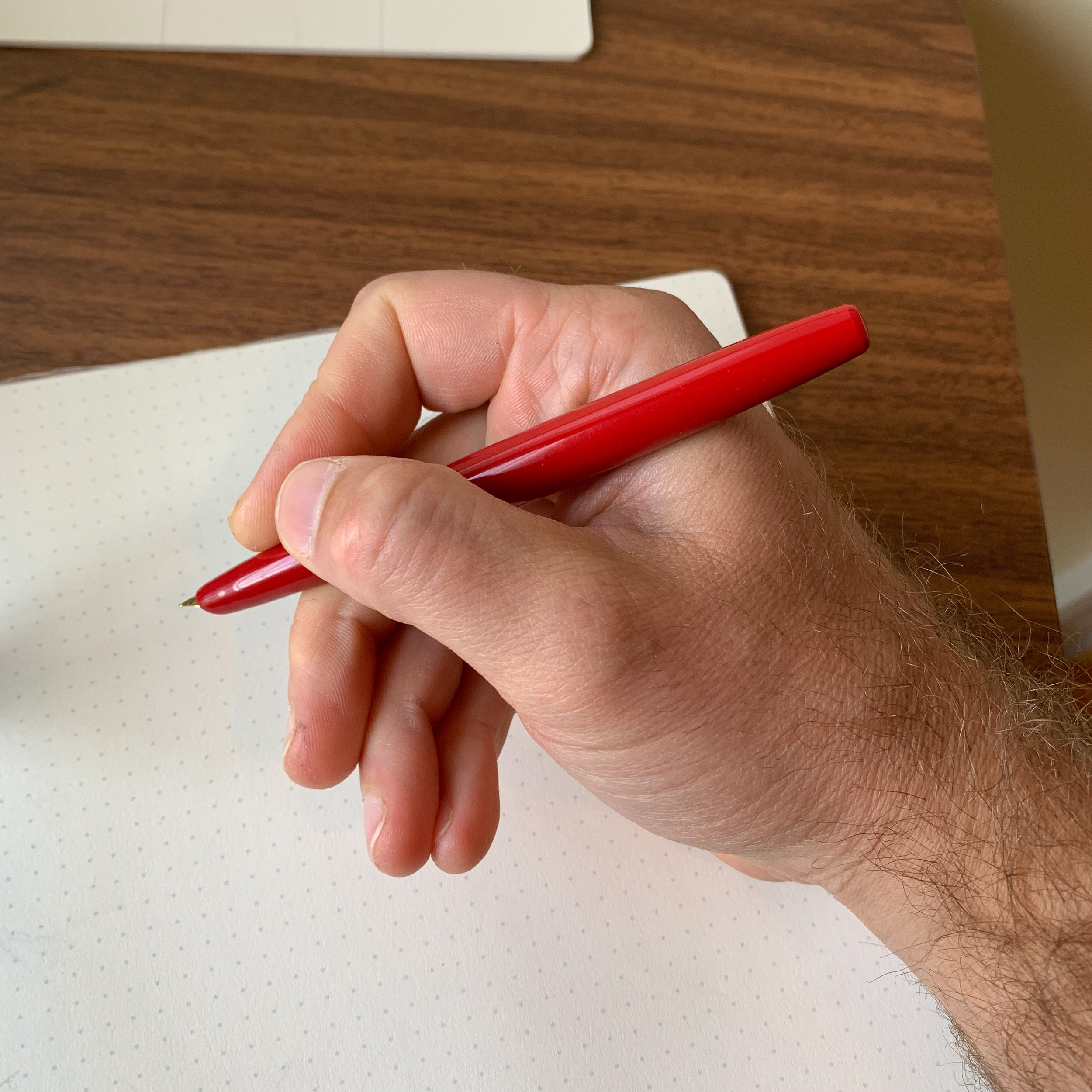
The Esterbrook Phaeton comes in four colors: Signal Red, Mineral Blue, Spruce Green, and Midnight Black. Gold-plated trim only.

Which brings me to the Phaeton (also listed as the “Phaeton 300R”), marketed as a re-release of a vintage hooded-nib Esterbrook, the Phaeton 300, a pen you don’t hear much about save in vintage collector circles. Though I understand Esterbrook’s desire to expand the line across a wider range of price points - particularly the need to offer something in the sub-$100 price bracket - I question whether this current version of the Phaeton was the right move, mainly because this pen faces steep competition from lower-priced alternatives.

I love the practicality of this type of converter - it works better than any Indian-style converter I have used, but man does this thing stink!

For starters, many people have pointed out that the Phaeton bears a striking resemblance to much less expensive offerings sold by Indian fountain pen companies such as Kanwrite. Assuming there is some relationship there, however, I do think that it’s unfair to write the Phaeton off as a pure “rebadge” of a stock pen purchased abroad. There clearly have been some design modifications to the cap and clip, and the nibs and feeds on the Phaetons have plainly undergone more rigorous quality control than you would find on a typical $15 Indian fountain pen. Moreover, it’s no secret that Esterbrook pens are made by contract manufacturers, presumably incorporating stock parts that go into other pens sold by different companies. Esterbrook doesn’t own their own factory, and many other companies do the same thing. The end result for the Phaeton is a good daily writer with a cool vintage vibe, especially if you like hooded-nib fountain pens, as I do. At the end of the day, however, the question is still whether Esterbrook has done enough to this pen to justify the $85 MSRP/$68 street price. That’s where I have my doubts.

I love hooded nibs! Even on relatively inexpensive pens, they seem to write well, and are very practical for those times when you’d prefer to use a pen that doesn’t scream “Fountain Pen!”, such as in a meeting.

Before I talk further about the price-value proposition, a few comments on the Phaeton’s specs and usability. I had no issues whatsoever inking up the Phaeton and getting it writing out of the box. The syringe-filling converter works well, and makes it easy to flush the pen, though you have to deal with the extremely stinky plastic that Indian pen companies use to manufacture these types of converters. (If you’ve ever used a Noodler’s pen, you’ll know exactly what I’m talking about.) The nib writes a standard medium-fine line, which is the only nib size available, and while the pen has some tooth, I found it pleasant to use. In terms of size, the Phaeton will remind you of classic vintage pens such as the Parker 51, Parker Super 21, Aurora 88, and, yes, the original Esterbrook Phaeton. Like those pens, the metal cap is a friction-fit clutch design, which also posts easily. In short, from a pure usability standpoint, the Phaeton is a nice pen that will serve you well as a daily writer.

View fullsize Esterbrook Phaeton Posted
View fullsize Esterbrook Phaeton Unposted

Overall Takeaways and Where To Buy

The Phaeton offers a retro vibe at a not-objectively-unreasonable price point, especially if you wait for a sale or coupon code. The issue I have with this pen is the increasing level of quality competition at the same or lower price, and I’m not sure that I can recommend the Phaeton at $68 over, say, a TWSBI 580 at the same price, a PenBBS 456 vacuum filler priced around $40, or a PenBBS 308 cartridge converter filler or 309 piston filler at an even lower price point. If you want a hooded nib pen, the KACO Retro costs less than $20.

I am glad to see Esterbrook experimenting with lower priced offerings than the $150+ Estie. That said, I don’t necessarily see the Phaeton gaining as much traction, given the relatively high price point as compared to pens of similar - and some would say better - quality. One reason why you may still want to consider the Phaeton, though, is the widespread availability at retail in the U.S. If you’re uncomfortable purchasing pens from eBay or Amazon sellers - a mainstay at this price point - the Phaeton can be acquired from pen retailers such as Pen Chalet or Vanness Pens, both of whom will certainly stand behind the product if you have a problem (as will Esterbrook).

Disclaimer: I received the Esterbrook Phaeton featured in this review from Esterbrook, free of charge, for review purposes. Many thanks to Esterbrook for making this review possible! This post contains affiliate links.

In Pens Tags Esterbrook, Esterbrook Phaeton, Hooded Nib
Comment

Pens and Stationery for Traveling: My Travel Kit in 2019

July 10, 2019

Way back when I first started this blog, I published a short post titled “The Gentleman Hits the Road” where I walked through my travel kit that I used for work. Since I’ve spent so much time on the road this year, I thought it might be a good time to revisit that post and offer some insight into what I’ve been using when I’m away from my desk. There may be some recency bias here, as you’ll recognize several things that I’ve reviewed in the past month or so, but this selection is fairly representative of my work “road carry”, with the exception of pen shows where I’ll obviously take more. Here goes:

  1. Nock Co. Sinclair. The Sinclair remains my preferred travel pen case and general carry-all, mainly because it zips closed and holds all of the pens that I would want to carry with me on a work trip, along with room for a pocket notebook and a few other things. I’ve thinned out my pen cases over the years to where I only have one Sinclair, with black waxed canvas with red interior.

  2. Rotring 800. I like having a pencil on me, but sharpening a woodcase pencil on an airplane or in a hotel or conference room isn’t exactly convenient. My choice of mechanical pencil typically alternates between one of my Rotrings (this time it was the 800) or the Uni Kuru Toga.

  3. PenBBS 355. Even though I don’t carry it with me everywhere and it often never leaves the hotel room, I travel with at least one fountain pen, and preferably one that either has a large ink capacity or uses cartridges so I don’t have to refill from a bottle when I’m away from home. I’ve been extremely satisfied with PenBBS’s take on the syringe filler (or “bulkfiller”), and it likely will be at least another month of steady use before I have to refill this thing.

  4. Baux Pen or Pokka Pen. I’m sometimes torn on whether to actually bother to pack a ballpoint when I’m traveling for work, since most hotels and conference centers will supply a functional ballpoint pen (and sometimes pretty good ones). If I do take a ballpoint, it’s one of the sturdy and portable Baux Pens or the pocketable Pokka.

  5. Nanami Paper Cafe Note. This compact-yet-voluminous B6 notebook has been my constant daily writing companion over the past two years. Since much of my notebook writing takes the form of long lists of bullet points, the longer, narrower format of something like the Cafe Note, the hardback Kunisawa Find pocket notebook, or even the Field Notes End Papers or Front Page works best for me. I still use standard A4 or A5 notebooks, but for specific purposes such as long-form journaling or drafting things longhand.

I was pleased to see that the general format of my travel carry hasn’t changed much over the years, and that my use is fairly consistent. If I ever needed to take a truly extended trip, I might add another fountain pen and consolidate my ballpoint/rollerball/mechanical pencil carry into a multi pen like the Lamy 2000 or the Sailor Pro Gear Imperial Black, but I still try to limit it to no more than three pens/pencils. Packing for trips and making these decisions is all part of the fun!

In Travel, Editorial Tags Travel, Pen Travel, Editorial
Comment
← Newer Posts Older Posts →
Store Hours and Events
Shop T.G.S. Online
Updated 2026 "Best Pens" Guide
No results found
On The Paper Trail: Live In Nashville Event Tickets Now Available!
TGS_25 Roterfaden Restock Notification
Hierarchies of Fountain Pen Friendly Paper

Join Our Patreon!
Subscribe to the TGS E-mail List

Featured Posts

Featured
Pilot-Custom-Heritage-92.jpg
June 6, 2026
Workhorse Pens: Pilot Custom Heritage 92 Fountain Pen
June 6, 2026
June 6, 2026
Kakimori-Inkstand-Before.jpeg
May 30, 2026
Japan Trip Journal: A Visit to Kakimori, Including Custom Notebooks and the InkStand!
May 30, 2026
May 30, 2026
Five-Foundational-Fountain-Pens.jpeg
April 22, 2026
T.G.S. 12th Anniversary: 5 Fountain Pens Everyone Should Experience
April 22, 2026
April 22, 2026
The Gentleman Stationer RSS

View Cart

© Digital Divide Media, LLC, 2014-present.

All content is the exclusive property of Digital Divide Media, LLC, d/b/a The Gentleman Stationer, including “The Gentleman Stationer” website and trademark, and should not be reproduced without express written permission.  All rights reserved.

All content containing paid advertising, affiliate links, or sponsored content will be plainly disclosed by a disclaimer when/if featured.

Contact Information

Website Terms and Conditions

Store Shipping Policy and Return Policy

Privacy Policy and Cookie Policy

Accessibility Statement

Powered by Squarespace