• Blog
  • Shop
  • Podcast
  • Resources
  • About
  • Archive
  • Contact
  • Cart
  • Sign In My Account
Menu

The Gentleman Stationer

Vintage Living in the Modern World.
  • Blog
  • Shop
  • Podcast
  • Resources
  • About
  • Archive
  • Contact
  • Cart
  • Sign In My Account

Five Surprisingly Practical Uses for Washi Tape

November 18, 2020

Rather than dramatically expanding my collection of pens and pencils, I’ve spent time during the past year exploring new types of stationery and desk accessories I had previously ignored. One such product is washi tape - the decorative Japanese masking tape that’s exploded in popularity in recent years. Though I admired all the colorful options and clever patterns, I didn’t see how I could justify purchasing washi tape for my own use. When I started carrying washi tape in the shop earlier this year, I pulled a few rolls out of inventory and was shocked at how much I ended up going through. If you’re someone who has been on the fence, wanting to dip a toe in the expansive pool of tens of thousands of different tapes available, here are five of my favorite things to do with washi tape:

I’ve started flagging pages in my notebooks and journals with folded over pieces of washi tape.

  1. Page Markers. A reader tipped me off to this one back in the spring. If you’re not overly concerned about being able to move the bookmark at a later date, a small piece of washi tape folded over the edge of a page can serve the same purpose as a Book Dart. (Of course, tape is not archivally safe and will technically “damage” your page, so I’d recommend this technique only for your own personal journals or books from your own library.)

  2. Sealing Letters. One of the benefits of the T.G.S. Patreon Program is that I send a handwritten thank-you letter to all supporters. (In fact, the latest batch is getting ready to go in the mail, so if you haven’t received yours yet, I haven’t forgotten about you!) Sometimes I will break out the delightfully old-school sealing wax to ensure the envelopes stay closed, but washi tape can serve the same purpose. I’m also trying to track down some holiday-themed tape to incorporate into my family’s holiday cards.

  3. Journaling and Commonplacing. Maybe “scrapbooking” is the better term, but because I tend to save everything, I have boxes, folders, envelopes - you name it - with all sorts of memorabilia and souvenirs tucked away. I’ve done better in terms of just letting some of this go, but I’ve also started to organize things into my journal and commonplace book. I dislike glue, so I mainly use washi tape to stick things like ticket stubs, small photos, post-its, and clipped periodicals into my journals and notebooks. Ultra-thin washi tape doesn’t add bulk to the page.

  4. Gift Wrap and Packaging. With the holidays approaching, you can do better than standard cellophane tape! As with letters, washi tape can add personality to your gift wrapping while still performing a useful purpose. Those of you who have ordered from the store may notice some washi tape “samples” on your envelopes or interior packaging.

  5. Well…Just Tape. Washi tape may be thin and easy to tear with your hands (no scissors required!) but it’s not flimsy. It’s durable and holds up surprisingly well to pretty much any task where you would reach for standard masking or cellophane tape. And it’s definitely a lot more fun. I’m currently searching for the perfect small tape dispenser that I can use to keep a roll or two loaded and ready to go on my desk.

The selection of washi tape currently in stock from iLootPaperie. Taco Tuesday, anyone?

Whether they like it or not, my family is going to be receiving a lot of washi tape in their stockings this Christmas. If you’re looking for a charming, inexpensive gift, or simply want to add some personality to your day-to-day office supplies, consider giving washi tape a try. The T.G.S. Curated Shop stocks a selection of unique tapes that I’ve personally chosen, priced anywhere from $2-6 per roll. I’m constantly searching for new patterns, so keep checking back for additions.

The T.G.S. Curated Shop is an authorized retailer of all brands that it carries. For in-depth discussion of our curated retail selections, including more gift ideas, check out our 2020 Holiday Gift Guide.
In Editorial Tags Washi Tape, Editorial
1 Comment

Can You Write With a Leadholder? I do!

November 14, 2020

Lead holders or “clutch pencils” are an overlooked and under-appreciated category of stationery, sitting in a strange twilight zone between woodcase and mechanical pencils. Despite many different options on the market, these pencils have garnered a reputation as artist’s or draftman’s tools, unsuitable for writing. That’s actually not the case at all, and I keep several on hand that I use regularly (and almost solely for writing).

Nearly all leadholders use a “clutch” mechanism to hold the lead, meaning that you depress the knock to release the button and the lead drops out via gravity, as opposed to a traditional mechanical pencil in which the lead advances a predetermined distance after each click. After sharpening the lead, you must reopen the clutch and push it back in.

A key difference between a lead holder pencil and a standard mechanical pencil is the diameter of the graphite. Lead holders typically use either 2mm or 3mm leads, whereas your traditional mechanical pencil uses leads with a much smaller diameter ranging from .2mm to .9mm, with the most popular sizes being .5mm or .7mm. If you write with heavier pressure, and find yourself constantly breaking standard mechanical pencil leads, a larger-diameter lead holder pencil will likely suit you better. I also prefer these larger leads because they offer the line variation and legibility of a woodcase pencil. (I’m often told that my handwriting degenerates into an unreadable scrawl when I write with mechanical pencils.)

.2mm lead refills. You refill a lead holder by feeding the lead into the front of the pencil. Most hold one lead at at time.

The downside? The clutch mechanism is a bit clumsier than a standard mechanical pencil, and you need to sharpen a lead holder much like you need to sharpen a woodcase pencil. You typically use a “lead pointer” instead of a standard pencil sharpener, with some lead holders, such as the Caran d’Ache Fixpencil, incorporating a sharpener/pointer into the nock or button. While you won’t have to deal with a large volume of wood shavings, the graphite dust from lead pointers can get messy very quickly. I always try to sharpen directly over a garbage can.

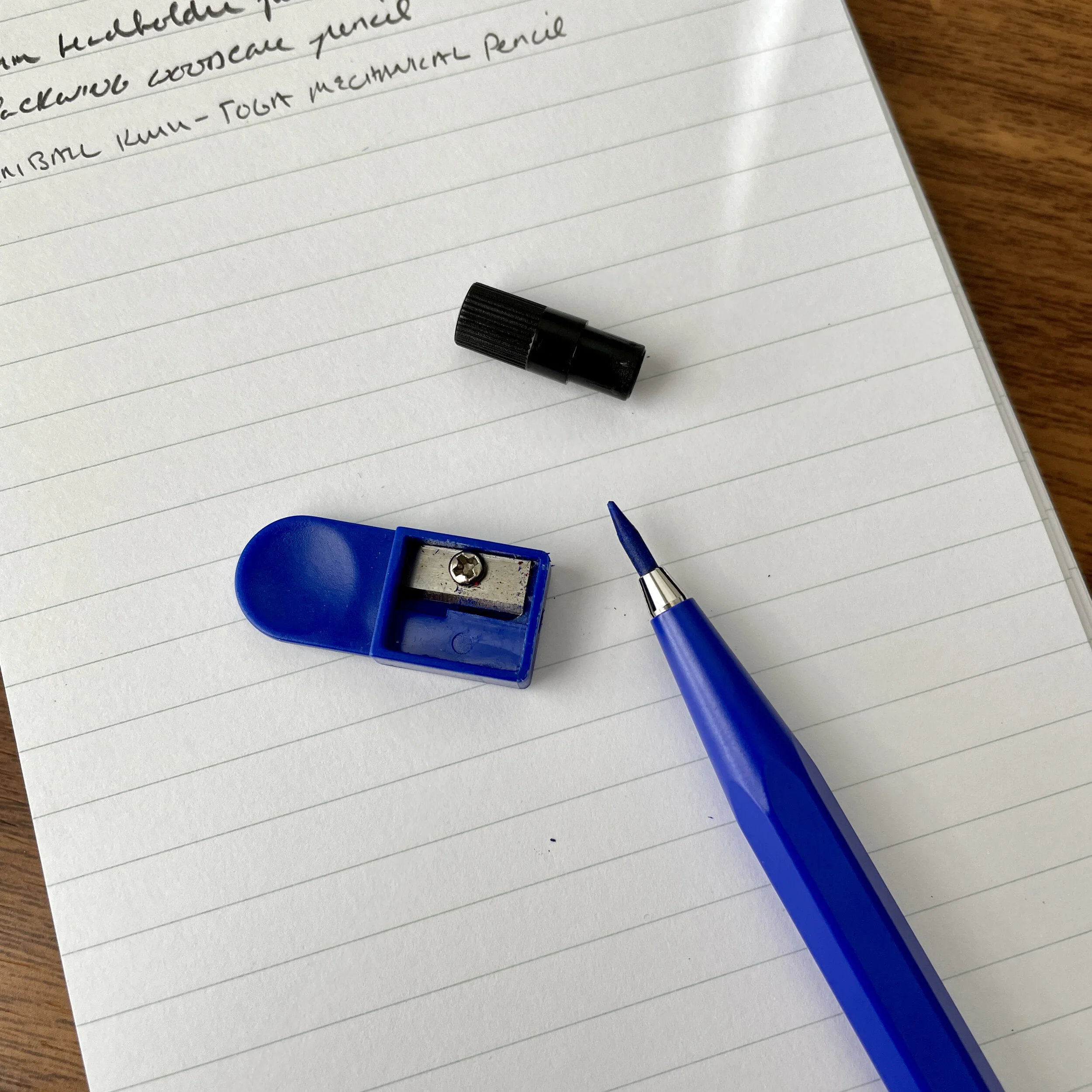
And, yes, some brands make blue and red leads (but these are used mainly for drawing and drafting).

And, yes, some brands make blue and red leads (but these are used mainly for drawing and drafting).

Another consideration when choosing a lead holder is shape and weight. Those intended strictly for drawing and drafting tend to be heavier, and often feature metal knurling on the grip that some find uncomfortable when writing for longer sessions. For this reason, I gravitate towards lead holders that mimic the look and feel of a round or hexagonal woodcase pencil, including Caran d’Ache’s iconic “Fixpencil” pictured above. Fun historical fact: the Fixpencil was originally created as a replacement for standard woodcase pencils due to wartime materials shortages. The idea caught on, and the product has remained in the company’s lineup as one of its longest-running products.

Takeaways and Where to Buy

Despite their niche status, leadholders are fairly easy to find. Your local art or office supply store will likely stock leadholders from brands such as Mars and Alvin. Rotring even makes a lead holder version of its Rotring 88 pencil. I currently have three in my personal collection: a Sierra “Slip-On” that I purchased at Kinokuniya in NYC, the “Sostanza” Kickstarter pencil from a few years ago, and a Caran d’Ache Fixpencil.

Because I find them more versatile and among the most comfortable to use for traditional writing, the Fixpencils are my favorite, and for that reason I’ve chosen to stock them in the T.G.S. Curated Shop. I have both the standard matte black Fixpencil with a black, red, or blue button, as well as the Fixpencil 884 or “JR”, which is the same size and comes in blue, red, and green. The different Fixpencil versions are priced at $24.50 and $22.00, respectively. Refill leads are also available in HB, 2H, and 2B.

The Gentleman Stationer is an authorized reseller of Caran d’Ache products, as well as any other products featured in the T.G.S. Curated Shop.

In Pencil Review Tags Leadholder, Pencils, Caran d'Ache, Caran d'Ache Fixpencil
2 Comments

Worth the Hype? A Close Look at a Montblanc Writers Edition (Virginia Woolf)

November 7, 2020

Though the difference in price and hype is perhaps less pronounced than when the series was first introduced, few limited edition fountain pens attract the same level of attention as Montblanc’s annual “Writers Edition” releases. Typically, Montblanc releases a pen design inspired by the life and work of a particular novelist or poet. For example, this year’s “Homage to Victor Hugo” limited edition features a cap “decorated with gothic arches in relief, and the end of the clip, which is shaped like the clapper of a bell, recall[ing] the the bell ringer Quasimodo and the Bells of Notre-Dame.” Montblanc also engraves the writer’s signature somewhere on the pen, usually on the barrel.

The designs themselves either appeal to you or they don’t. Personally, I find most of the Montblanc Writers Edition pens either (1) too large, or (2) too gaudy, especially those released in recent years. My personal favorites are the older editions, and I have two in my collection: Virginia Woolf (2006), which I review here, and Charles Dickens (2001), which I plan to address in a separate post.

The snowcap on my pen has an off-white patina, and I don’t know whether this is by design or whether it has developed as the pen ages.

The Montblanc Virginia Woolf Writers Edition fountain pen is, to me, a perfect example of a Writers Edition pen that one can easily use for, well, actual writing. At roughly the size of a Montblanc 146, the pen itself is not too large. The Virginia Woolf edition also features a contoured barrel comfortable to use posted or unposted. When I’ve shown pictures of this pen in the past, readers have asked whether it’s a Bonheur, the so-called “pen for women,” and while it’s not, there is a resemblance, particularly with the cap. Due to the similarities, some regard this as a “gendered pen” unsuitable for a man to use, which is of course absurd.

View fullsize Montblanc Virginia Woolf Unposted
View fullsize Montblanc Virginia Woolf Posted

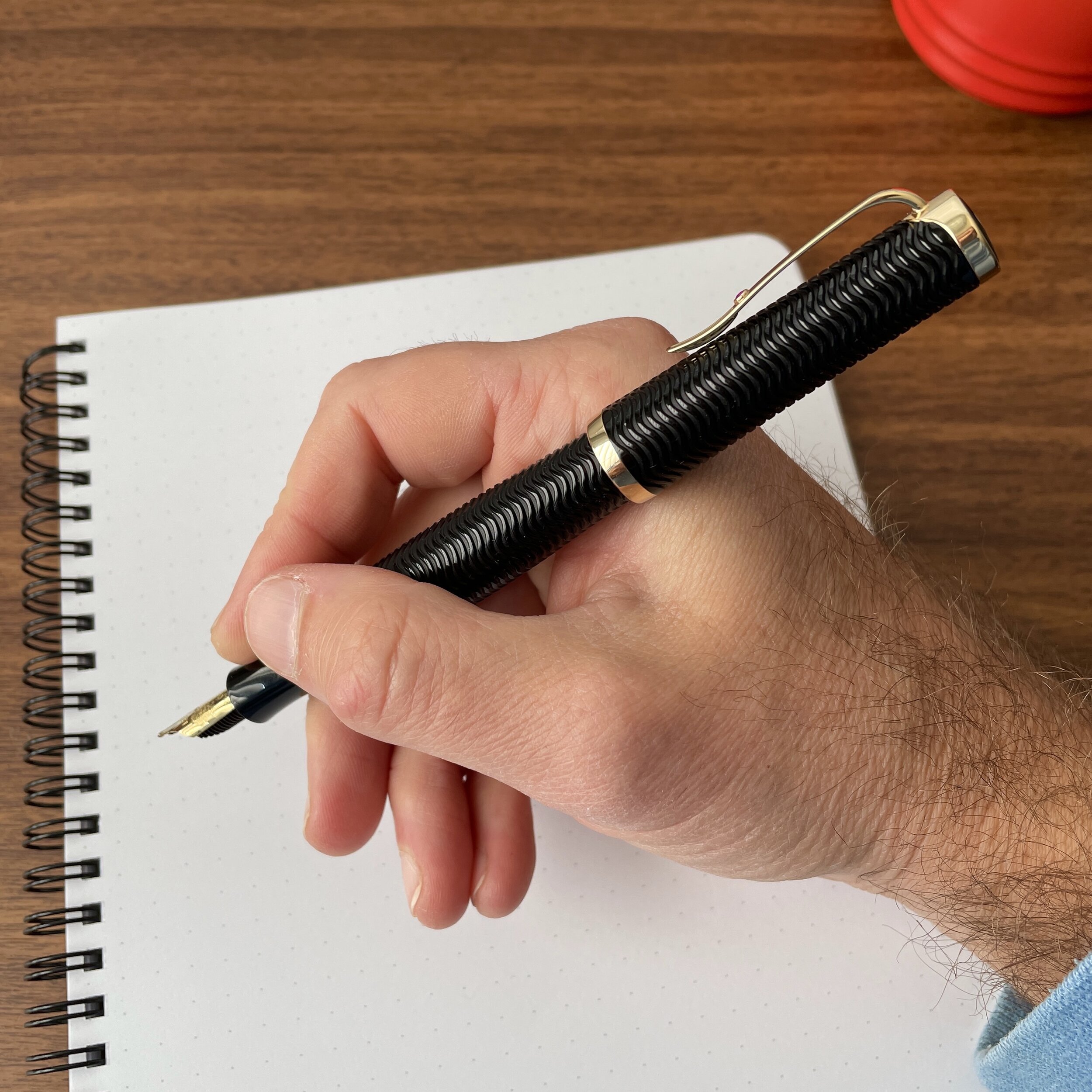
Finally, I appreciate the understated manner in which Montblanc incorporated references to Woolf’s life and work into the pen’s design. The black barrel is engraved with a guilloche pattern, a reference to her novel “The Waves,” and the nib features an engraving of the two elm trees under which she is buried. Her signature appears subtly engraved on the gold piston knob.

The gold blind cap with signature.

Each Writer’s Edition features a custom engraved nib.

Takeaways and Where to Buy

The Virginia Woolf Writers Edition is not just one of my favorite Montblanc Writers Editions, it’s one of my favorite Montblancs in my current collection. I have a hard time leaving this one un-inked. I’ve previously written multiple times about how Montblanc stock broad nibs tend to be stubbish, and this one is no exception. It’s also tuned perfectly, which either shows how Montblanc pays closer attention to the Writers Edition nibs before they go out the door, or that older Montblanc pens in general were subject to better quality control practices. This particular pen wrote exceptionally well out of the box, without any skipping or “baby’s bottom” issues you sometimes see with stock Montblanc nibs.

One of the more polarizing design choices on this pen is the ruby on the clip. I like it, and find that it adds a touch of color to an otherwise very traditional black-with-gold-trim design scheme.

Unfortunately, the Virginia Woolf Writers Edition dates to 2006, so if you’re looking to pick one up you likely need to search the secondary market for used or N.O.S. (new old stock) items. I found this one during a Black Friday sale last year, where a European retailer (I believe La Couronne du Comte) had several older N.O.S. Writers Edition pens available for purchase. Today, many different options exist, but in the U.S. the retailers who typically have the largest selection at any given time are Chatterly Luxuries and The Pen Show. You can always take your chances on eBay, but be aware that Montblanc pens are heavily counterfeited and you should only purchase from a reputable seller. Personally, for pens in this price range (anywhere from $600 to $1500), I would only purchase online from known pen dealers with a reputation for standing behind their products, or else wait until pen shows resume and you can inspect potential acquisitions in person.

Disclaimer: I purchased the pen featured in this review with my own funds, for my own collection. I did not receive a discount on this purchase other than coupon codes available to the public. This post does not contain affiliate links.

In Pens Tags Montblanc, Montblanc Writers Edition, Fountain Pen, Pen Review
3 Comments
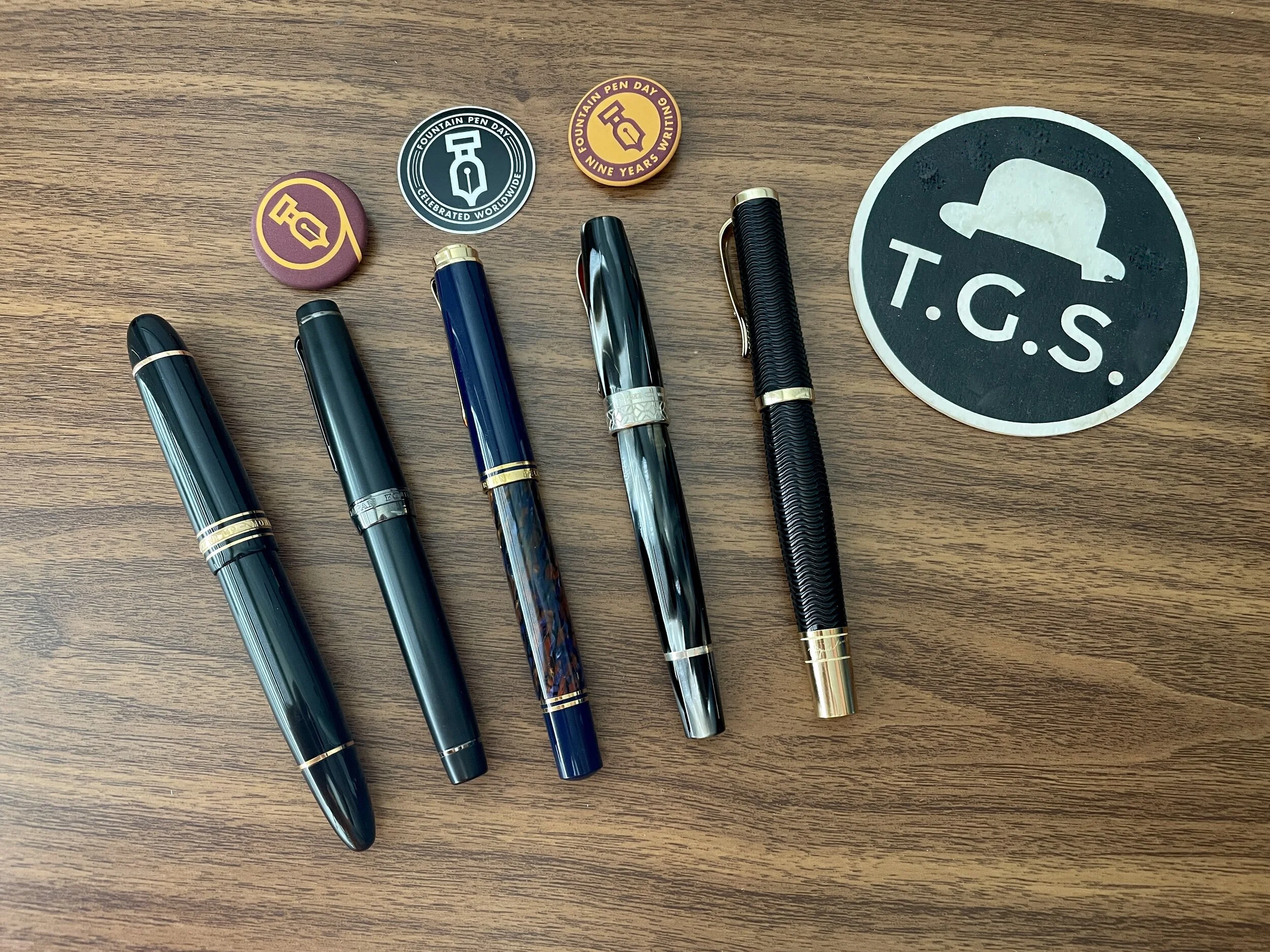
Pens shown from left, in the order they are listed below.

Pens shown from left, in the order they are listed below.

Five Favorites for Fountain Pen Day (and My Own Personal Distraction)

November 4, 2020

Since yesterday started out as extraordinarily unproductive, I spent the morning cleaning out far too many inked fountain pens (seriously, I had no idea how many I had inked up) and filling five of my personal favorites in celebration of Fountain Pen Day, which is this Friday! Here’s what I chose, with a link to the corresponding review and, if possible, where you can still buy the pen if it’s not a special or limited edition:

  1. Montblanc 149 Red Gold. The size of the Montblanc 149 has grown on me over time, and whether or not the pen works for you personally, you can’t deny that it’s an icon. As with another pen on this list, this one features a stock Montblanc broad nib, which actually writes more like a stub, and is in fact one of the best stub nibs in my collection.

  2. Sailor Pro Gear Imperial Black Edition. I’ve let this favorite sit for far too long. Not only is the Sailor “HF" (hard fine) one of my favorite nibs, but the size fits my hand perfectly when the pen is posted. I’ll never let this one go, as this particular pen carries special meaning. And yes everyone, seven years later, the black ion plating on the nib and trim is still intact.

  3. Pelikan M800 Stone Garden. One of my favorite special edition releases from 2018, Stone Garden is still, aesthetically, my favorite M800 and one of the Pelikans I would likely keep if I ever considered seriously downsizing my collection. Oddly enough, this Pelikan still hasn’t sold out at select retailers, sometimes at a discount.

  4. Montegrappa Miya. A relatively recent pickup from this year’s Baltimore Pen Show, I decided to swap in a 14k medium nib in place of the 14k Flex and now this pen is a perfect everyday writer. As I mentioned in my original review, the Miya is one of the most well-balanced luxury fountain pens out there, and I hope Montegrappa decides to do more with this particular shape and design. While this celluloid variant is pricey, Montegrappa has been experimenting with different materials, including acrylics that are paired with stainless steel JoWo nibs.

  5. Montblanc Virginia Woolf Writer’s Edition. I have two of Montblanc’s “Writers Edition” fountain pens, both purchased as N.O.S. years after their initial release. The textured and contoured Virginia Woolf edition won’t be for everyone aesthetically, but again, you can’t argue with the Montblanc stock broad nib. The stubbish nib on this pen is even better than the broad nib on my 149, and I’ve heard rumors that Montblanc pays extra close attention to the Writers Edition nibs (or at least they used to). (Long-discontinued Limited Edition)

How are you planning to celebrate Fountain Pen Day? I’m hoping for a calm evening enjoying my pens and journals. I have a feeling we’ll all need it.

Fountain Pen Day Special

This Friday, I will be running a special promotion in the T.G.S. Curated Shop that will be announced in tomorrow’s Deals & Drops. If you don’t feel like waiting, ALL orders this week will receive a complimentary T.G.S. Stencilboard Bookmark. For other Fountain Pen Day celebration specials, be sure to check the “Sponsors” page on the Fountain Pen Day website for additional specials and promotions.

In Editorial, Events, Top 5 Tags Top 5, Fountain Pen Day, Editorial
1 Comment

Sailor 1911 Compass: A True Entry Level Contender?

October 31, 2020

As bad as 2020 has been, it’s actually been a very good year for pen releases, and I’ve managed to go for a while without a “disappointing” review. Well, here we go. I’ll start off by saying that the Sailor 1911 Compass isn’t a bad pen. It’s fine - comfortable size, decent nib, and attractive colors - but it doesn’t meet the standard of what I personally have come to expect from Sailor, especially at the $40-50 price point.

For my review, I chose the transparent Amber acrylic. From a pure aesthetic standpoint, the 1911 Compass is an attractive pen, and comes available in a wide range of color options, which also include olive green, yellow, green, purple, blue, red, and pink.

Sailor bills the 1911 Compass as an “entry level” pen, with a MSRP of $49 and an actual retail price around $39. For that, you get a colorful transparent acrylic fountain pen with what Sailor describes as a “proprietary” steel nib and clear plastic feed. To their credit, Sailor has opted to include one of their converters with the 1911 Compass, so that you don’t have to eat an additional $8 on top of the price of the pen. However, I’m still not sure that it saves the 1911 Compass as a value proposition.

I get hung up on the nib. Unfortunately for Sailor, much better stainless steel nibs exist at lower price points, and this one simply doesn’t live up to Sailor’s reputation. Platinum has the most experience with pens in this market segment, and the Platinum Plaisir, which retails for as low as $17.50, is in my experience a smoother writer. While the nib on my 1911 Compass isn’t bad, it does sit on the border between toothy and scratchy, and would lose in a head-to-head contest with the Plaisir. On the Compass, as others have noted, you definitely have to rotate the pen a bit to find a sweet spot. I did not notice any ink flow issues, however, even with relatively dry Sailor Rikyu-Cha.

The nib on the 1911 Compass is very simple, with a stamped Sailor “anchor” logo. The design looks more inexpensive than the pen actually is.

You don’t see many transparent plastic feeds these days. It’s a neat addition, but again I’m not sure it alone causes the Compass to stand out. (Note that the feed appears darker here due to the Rikyu-Cha ink color.

The Compass comes in one nib size, Medium-Fine.

Takeaways and Where to Buy

Sailor has proven in the past that they can make exceptional steel nib pens, but this isn’t one of them. Again, the Sailor 1911 Compass is a serviceable writer, and it’s even somewhat attractive, but I have a hard time envisioning a scenario where I would recommend this as an “entry level” pen for a budding fountain pen enthusiast. Typically, I try to avoid making categorical statements about whether a pen is “worth it” or not, but here it’s difficult to justify $40-50 for the Compass where there are pens with better nibs available for about half that, particularly in Platinum’s lineup. Personally, I would prefer to see Sailor focus their efforts on the $75-100 segment, with pens like the Reglus that I reviewed a couple years ago which has a completely different, luxury feel for not that much more money.

Many thanks to site sponsor Goldspot for providing this Sailor 1911 Compass for review. Goldspot carries the entire lineup of Sailor pens, including not only the 1911 Compass but also a range of exclusive editions such as the Pro Gear “British Racing Green,” one of the best-looking Sailor store exclusives that I’ve seen.

Disclaimer: This post contains links to paid sponsors, but the links are not affiliate links in that I do not earn money from referrals.

In Pens Tags Sailor 1911 Compass, Sailor, Pen Review
6 Comments
← Newer Posts Older Posts →
Store Hours and Events
Shop T.G.S. Online
Updated 2026 "Best Pens" Guide
No results found
On The Paper Trail: Live In Nashville Event Tickets Now Available!
TGS_25 Roterfaden Restock Notification
Hierarchies of Fountain Pen Friendly Paper

Join Our Patreon!
Subscribe to the TGS E-mail List

Featured Posts

Featured
Pilot-Custom-Heritage-92.jpg
June 6, 2026
Workhorse Pens: Pilot Custom Heritage 92 Fountain Pen
June 6, 2026
June 6, 2026
Kakimori-Inkstand-Before.jpeg
May 30, 2026
Japan Trip Journal: A Visit to Kakimori, Including Custom Notebooks and the InkStand!
May 30, 2026
May 30, 2026
Five-Foundational-Fountain-Pens.jpeg
April 22, 2026
T.G.S. 12th Anniversary: 5 Fountain Pens Everyone Should Experience
April 22, 2026
April 22, 2026
The Gentleman Stationer RSS

View Cart

© Digital Divide Media, LLC, 2014-present.

All content is the exclusive property of Digital Divide Media, LLC, d/b/a The Gentleman Stationer, including “The Gentleman Stationer” website and trademark, and should not be reproduced without express written permission.  All rights reserved.

All content containing paid advertising, affiliate links, or sponsored content will be plainly disclosed by a disclaimer when/if featured.

Contact Information

Website Terms and Conditions

Store Shipping Policy and Return Policy

Privacy Policy and Cookie Policy

Accessibility Statement

Powered by Squarespace