• Blog
  • Shop
  • Resources
  • FAQ (Ask TGS)
  • About
  • Archive
  • Contact
  • Sign In My Account
Menu

The Gentleman Stationer

Vintage Living in the Modern World.
  • Blog
  • Shop
  • Resources
  • FAQ (Ask TGS)
  • About
  • Archive
  • Contact
  • Sign In My Account
Four Offbeat Blue Inks for the Office: Writing Sample on Clairefontaine Paper

Offbeat Blue Inks: Trying Darker Teals and Turquoises

January 17, 2024

While blue ink is often the “safest” fountain pen ink out there - both for your pens and your reputation at the office - using a standard blue as your daily driver can eventually start to feel stale. I love my Waterman Blue, but given how much writing I actually do on a daily basis, I always try to keep a steady stream of “alternative blues” at the ready to avoid ink burnout. One of my favorite color families to explore are dark teals and turquoises, which add variety and possibly even a touch of sophistication to your notes and/or signatures.

Did you know that it was National Rubber Duck day at the Philly Pen Show last weekend?

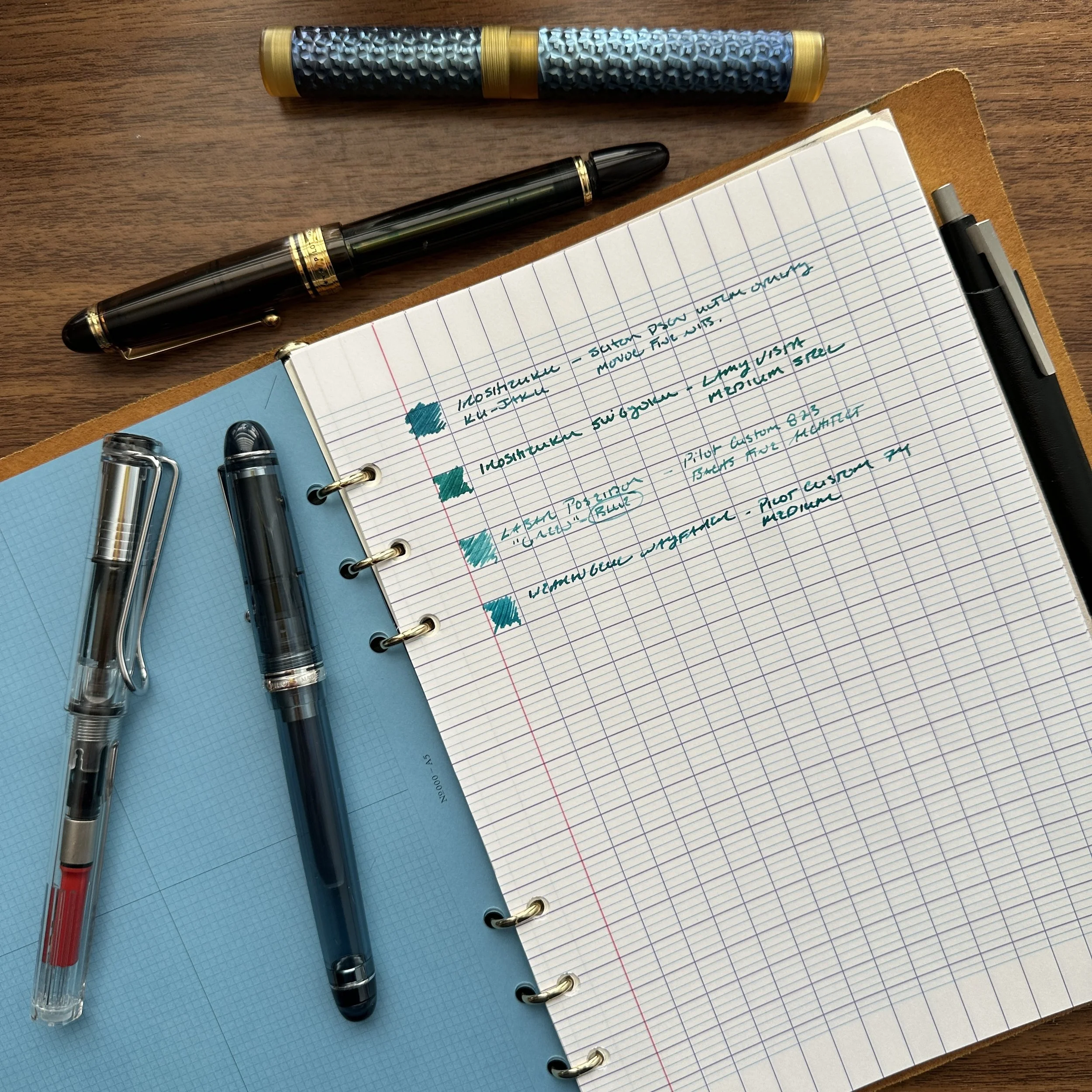
Lately, I’ve focused on four inks for my core “office” rotation: Pilot Iroshizuku Sui-Gyoku, a new release which might be my current favorite from the line; Pilot Iroshizuku Ku-Jaku, an old favorite which shares many of the same tones as Sui-Gyoku, only slightly darker; Laban Poseidon Green, which I consider a blue ink despite how it’s marketed; and Wearingeul Wayfarer, a shimmer ink with subtle pink sparkles that can also be used as a standard ink if you fill the pen without first shaking the bottle.

For my “office paper” writing sample, I chose Clairefontaine Seyes/French-Ruled.

None of these inks would typically be considered exciting, but for work they strike an appropriate balance. “Professional” doesn’t have to mean “boring” - you just have to know where to draw the line. My own rule of thumb is that the ink you use in the office shouldn’t overshadow or distract from the substance of the work you are trying to do. (i.e., You want the person whose memo you are commenting on to focus on the substance of your edits, not the fact that you wrote said edits in fluorescent orange shimmer ink.) On most standard office paper, and to the fountain-pen-uninitiated, these inks will appear blue. When you’re back at your own desk, however, writing on your quality paper of choice, you’ll enjoy the bit of dark red sheen on the Iroshizuku Inks, the shading on the Laban Poseidon Blue, and if you’re really daring, the faintest hint of pink/red shimmer on the Wayfarer!

Writing samples on Tomoe River paper in a Hobonichi A6 Journal.

General Takeaways and Where to Buy

If I recommend an ink for “office use”, it’s because I’ve found the ink to dry relatively quickly, and to resist bleeding and feathering on all but the cheapest of papers. All three meet these requirements, and they’re also relatively inexpensive. The Iroshizuku and Laban inks are priced at under $25 for a full 50ml bottle, and while Wayfarer is a bit pricier at $22 for 30ml, you do tend to pay more for inks with special properties like shimmer. I have to add that I love the look of the Iroshizuku bottles, and have for years kept at least one on my desk at the office as a conversation piece.

If you enjoy our content and are interested in any of the inks featured, we would greatly appreciate your support by visiting and purchasing via our shop. We carry both Pilot Iroshizuku and Laban Greek Mythology Inks in the T.G.S. Curated Shop, and for brands we don’t carry (such as Wearingeul), we would refer you to our friends at Vanness Pens!
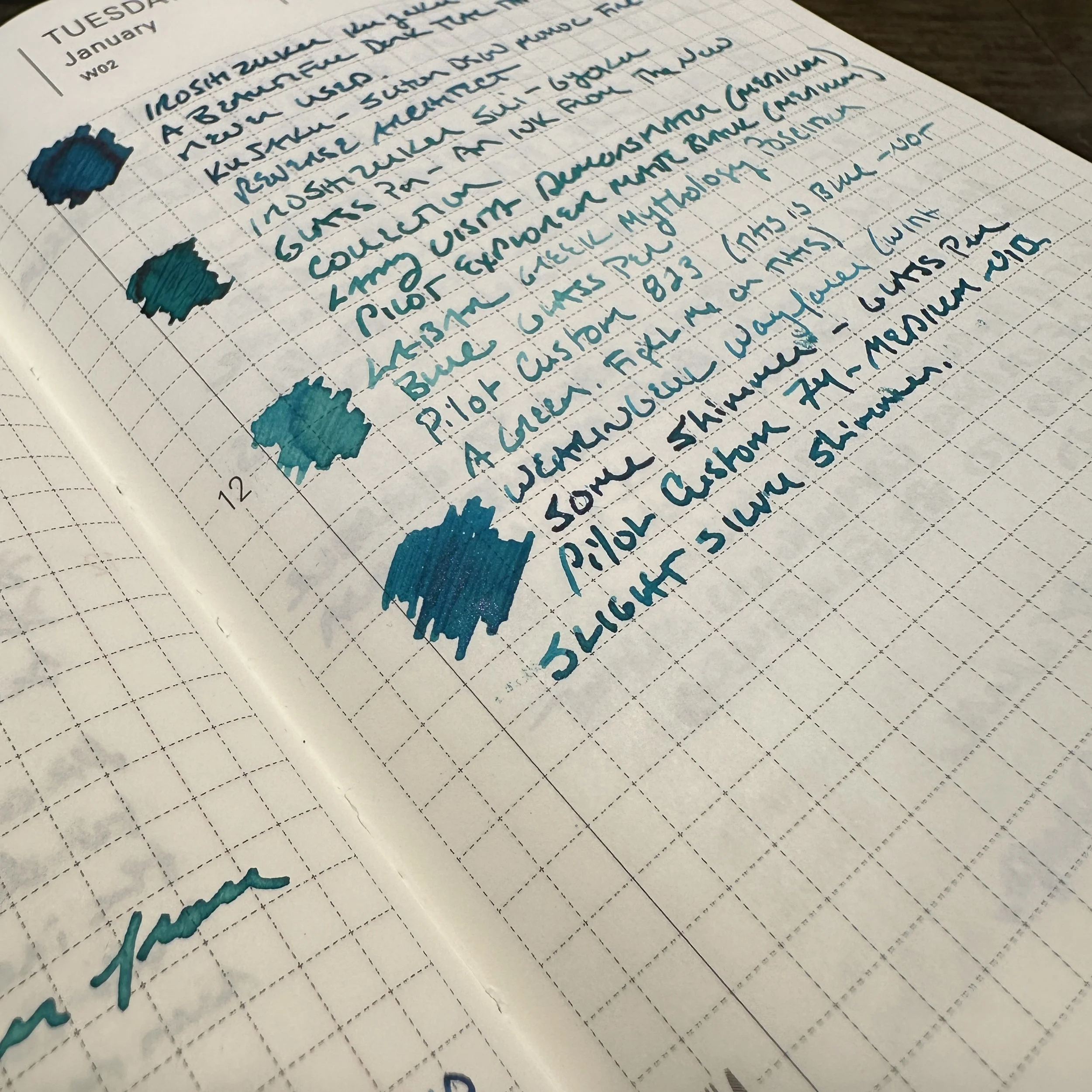
Wearingeul Wayfarer Close-Up Shimmer Shot

Every so slight shimmer can be work-appropriate. Just know your workplace!

Editor’s Note: Why Should You Care About Ink Color?

Whenever I write a post like this one, I receive questions and comments about “why I care what people think” about the ink I use in the office. First of all, let’s be realistic - while there are workplaces that would tolerate the use of glitter/shimmer ink on professional correspondence, many do not. You know your office and what you can get away with. For many of us, simply writing with a fountain pen - and the “messiness” it entails - pushes the envelope in and of itself.

Second, many professions (like law) require the use of certain ink colors for specific purposes, with blue the most common for signatures and official documents. In my experience, standard blue ink tends to be the most universally accepted and to behave the best on the widest range of different paper, including cheap recycled copy paper. Teals and turquoises, such as those shown here in today’s post, have mostly similar ink formulations so the performance does not change dramatically.

The Gentleman Stationer is supported entirely by purchases from the T.G.S. Curated Shop and pledges via the T.G.S. Patreon Program. We greatly appreciate your support!
In Ink Reviews Tags Inks, Workhorse Inks, Inks of Choice
3 Comments

Diving into Diamine Inkvent for the First Time: Days One and Two

December 2, 2023

2023 marks the first year that I’ve acquired a Diamine Inkvent Calendar and had my stuff together far enough in advance to play along here on the blog. This “project” is pure fun for me and a bit out of my comfort zone for the blog, not being known for ink reviews and also as someone who’s admittedly a bit “boring” in terms of the inks they use on a daily basis. So how’s it going? So far, so good, and as expected about 1/3 of the inks have turned out to be colors that I would use semi-regularly.

Note: In order to allow myself adequate time to photograph and video each ink, I’m currently working about five days ahead. So even though we’re technically only on “Day Two” of Inkvent, I’ve already opened and swatched through Day 5.

How Does the Diamine Inkvent Calendar Work?

Like a typical Advent calendar. You receive a box that has 25 numbered “doors” punched into it. If you use the calendar as intended, you open one door for each day of Advent. The calendar contains 25 bottles of different inks behind each door: 24 15ml bottles and one 30ml bottle, with the latter intended to be a “special” ink opened on Christmas Day. Diamine claims these inks are all unique for each year’s Inkvent, and they have started releasing the inks in full bottles about six months later.

What Inks Are In and Inkvent Calendar?

Diamine includes 25 different ink samples featuring “Holiday-themed” inks from across their various lines, including standard ink, Shimmer Inks, and even “Chameleon” inks (shimmer inks that change color depending on the light). This week, Door No. 1 included “Fortune’s Gold,” a gold ink with gold shimmer that leans yellow-green in different light. Door No. 2 contained “Cashmere Rose”, a dusty pink that’s more my style, and will probably end up inked soon as I have several pens getting ready to run dry and will need a refill.

This year, I plan to use a large Col-o-Ring Folio pad to swatch all 25 inks side by side. Many thanks to my friend Ana over at the Well-Appointed Desk for supplying the large Col-o-Ring!

What Are You Going to Do with All That Ink?

Probably keep the ones I like and give away the ones I won’t use, including most of the Shimmer and Chameleon series. It’s not that I don’t enjoy playing around with these inks - I might use them to jot quick holiday messages to friends and family - but afterwards will probably pass them along since inks containing shimmer or heavy sheen don’t receive much long-term use from me.

How to Follow Along with Inkvent 2023

I won’t be posting regular Inkvent updates here on the blog - there’s simply too much ink to do individual reviews, though I might do a general overview at month’s end. I will, however, be doing daily - or as close to daily as I can manage - posts over on Instagram and YouTube, as well as posting more detailed thoughts on the inks on the Patreon Channel. If you’d like to follow along in person with your own Inkvent Calendar, we still have a few available in the shop. Enjoy the holiday season!

The Gentleman Stationer is supported entirely by purchases from the T.G.S. Curated Shop and pledges via the T.G.S. Patreon Program. If you’re looking for gift ideas, check out our 2023 Holiday Gift Guide!

In Ink Reviews Tags Diamine Inkvent 2023, Inkvent, Fountain Pen Inks
Comment

Ink Review: Anderillium Viceroy Butterfly Orange and Atlas Moth Brown

October 23, 2023

Wow, do I have a large backlog of products to review! Before I left on vacation earlier this month, I had somehow ended up with 30 inked fountain pens, most of which I had intended to review (either the pen itself or the ink), but at the end of the day I figured it was best to do a reset and choose 10 or so combinations on which to focus. Today, I’m going to look at two of the inks I selected, both of which come from Anderillium: Viceroy Butterfly Orange and Atlas Moth Brown, from the recently released Lepidopteran Series.

Yes, I know it says “Monarch” - whenever I think of an orange butterfly I think of Monarchs, and apparently the two are easily confused!

As many readers already know, Anderillium is one of the brands that we stock in our own shop (full disclosure!), and we love their inks not just because they represent good value and good quality, but because we also enjoy the company’s carefully thought-out themes - typically based around nature - and their offbeat takes on classic ink colors. The initial two series of Anderillium Inks included the Cephalopod Series (squids and octopuses) and the Avian Series (Birds), so the recently released Lepidopteran Series (moths and butterflies) continues the nature trend.

There is no red ink in the Lepidopteran Series: Viceroy Butterfly Orange is a dark reddish-orange that serves that role. You can check out a picture of the full range of colors - some of which are quite unusual - at the bottom of this post.

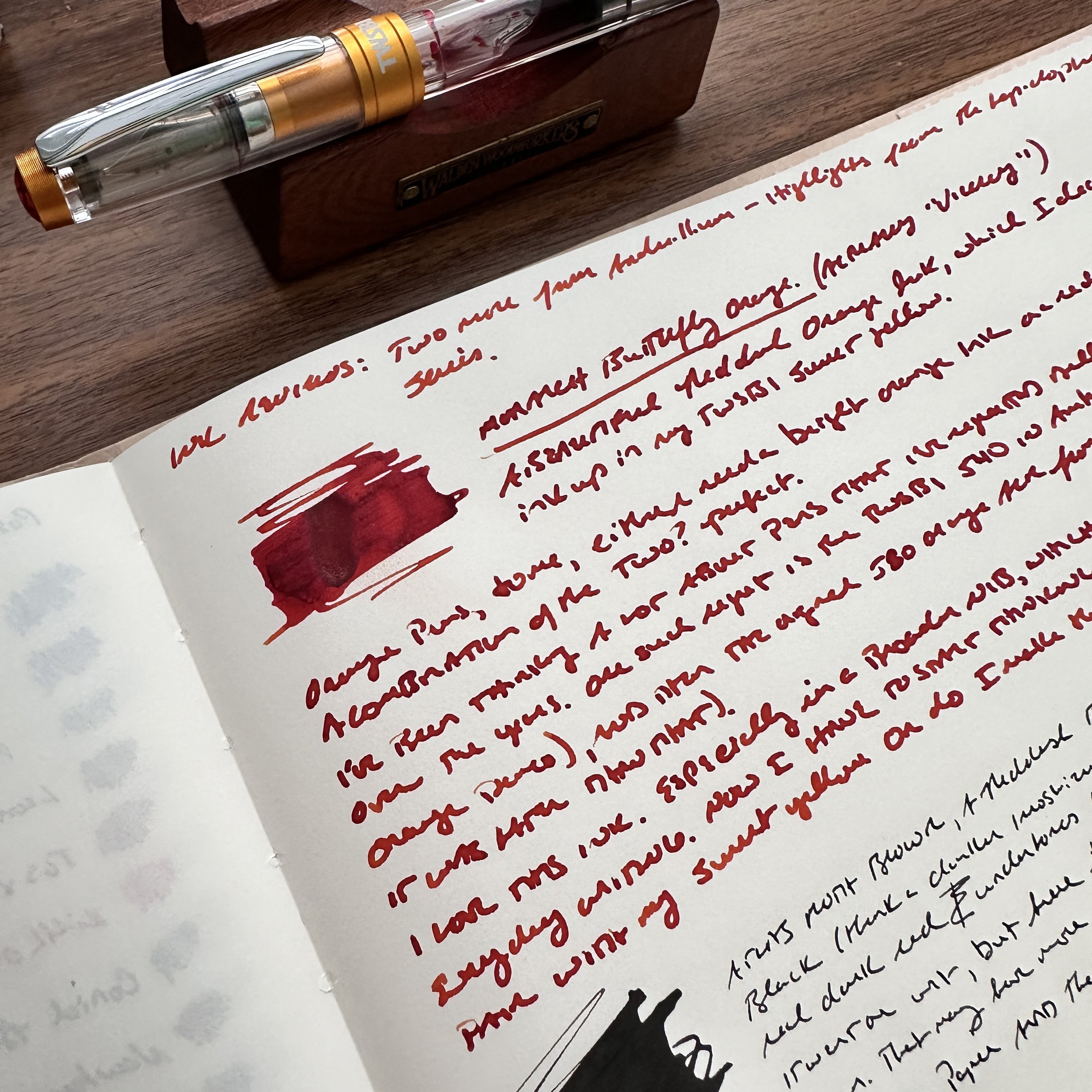
Viceroy Butterfly Orange - which I keep trying to call “Monarch Butterfly Orange” - is a beautiful dark orange that leans heavily red. Unlike many orange inks, I’ve had no issues with nib crud forming, which is a huge bonus for an ink in this color family since orange and yellow dyes can be finicky in that regard. I chose this ink as the perfect pairing for my TWSBI Diamond 580 Sunset Yellow fountain pen. I typically enjoy pairing orange pens with a red ink (and vice-versa), and this particular ink is red enough that it accentuates the lighter orange/gold of TWSBI’s latest Diamond 580 release. This particular pen also sports a broad nib, which gave me the opportunity to test how the Anderillium ink behaved in a pen that lays down a thicker, wetter line. The end result? Viceroy Butterfly Orange is a great ink that dries relatively quickly and resists smearing. Once you consider this alongside the lack of precipitation/nib crud, you have a fabulous orange workhorse.

Atlas Moth Brown is a VERY dark brown. While you can make out the slight brown hue when it dries (particularly in a broader nib or a wet writing sample), in a finer nib this ink appears black. Also be sure to check out the writing sample below, which definitely shows green undertones, and the reverse shot of the page, which shows purple?

Atlas Moth Brown is the “Black” ink from the Lepidopteran Series. While technically a very dark reddish-hued brown, I can really only discern these undertones when this ink is wet. (Those looking for a more traditional brown should check out “Toltype Moth Warm”, which itself isn’t necessarily traditional, but will get you more shading and visible brown tones.) Like the Viceroy Butterfly Orange, Atlas Moth Brown is well-behaved. Though it dries perhaps a touch slower than the Viceroy, I experienced no bleedthrough or feathering in everyday writing except on the cheapest of copy paper. The almost-black hue when dry lends itself quite well to office use, and this ink will see a repeat run through the rotation when I have to return to the office in two weeks. :(

In my Midori MD Cotton ink journal (which I’ve been using for my ink reviews), this ink looks almost green-black. AND then…

On the reverse of the page, the bleedthrough from the swabs appear purple? (This bleedthrough is not reflective of everyday writing. I literally poured ink onto the page with a pipette to see what kind of sheen I could get when the very wet samples dried.) This is a truly interesting one.

Takeaways and Where to Buy

I’ve been extremely pleased with the performance of both inks, having written with them consistently over the past three weeks. The Viceroy Butterfly Orange in particular stands out - strike up another win for Anderillium in the yellow/orange category that includes their excellent Flapjack Octopus Orange (from the Cephalopod Series) and American Goldfinch Yellow (from the Avian Series). Orange inks, and particularly lighter oranges and golds/yellows, can be tricky to get right, as ink makers have to balance legibility with the tendency of orange dyes to precipitate and form nib crud. All three Anderillium inks strike a good balance. The Atlas Moth Brown is what I’d probably characterize as an “interesting black ink alternative,” because it dries so dark. I rarely write with pure blacks, opting for darker versions of other colors that can look black when dry, especially in a finer nib, making them good work alternatives yet at the same time less “boring”.

You can purchase Anderillium Inks, including the two featured here, directly from us in the T.G.S. Curated Shop. As I mentioned above, both of these inks are from Anderillium’s recently released “Lepidopteran Series,” where all the inks are themed around moths and butterflies. Other series from Anderillium include the Cephalopod Series (based on squids and octopuses) and the Avian Series (based on birds). Inks are sold in individual 1.5oz widemouth bottles ($14.50) or in sets of 8 mini-bottles ($50), which allow you to sample the entire line.

I likely won’t re-review these two pens, given that they are simply new colors of two pens that I’ve already reviewed multiple times: the TWSBI Diamond 580 and the Sailor Pro Gear. But I will say that I absolutely adore both of these editions. As I mentioned above, the TWSBI is the recent “Sunset Yellow” release, and the Pro Gear is this year’s “Moonlight over the Ocean”.

The T.G.S. Curated Shop is an authorized retailer of all brands sold, including Anderillium Inks.

In Ink Reviews Tags Ink Review, Anderillium Ink, Anderillium Ink Lepidopteran Series
1 Comment

Cartridges from left: Pilot, Platinum, Sailor, Lamy, and “Standard” International

Proprietary Ink Cartridges: Endearing or Annoying?

June 21, 2023

It doesn't take long for new fountain pen users to recognize that all fountain pen ink cartridges aren't created equal. While there is such a thing as a "standard international" ink cartridge and converter, it’s neither “standard” nor particularly “international”, as that term has essentially come to mean that the standard version "fits pens with JoWo, Bock, or Schmidt nib/feed assemblies." Nearly all of the Japanese brands, as well as some European brands like Lamy, use their own proprietary cartridge/converter format. Today I'll talk a bit about why I tend to prefer the Japanese-style cartridges to the standard international format.

Note: Whenever you buy a new pen from a brand you haven't previously used, ALWAYS check whether you also need a specific converter and/or cartridge to go with that brand.

Pilot pens such as the Custom Heritage 912, the Custom 74, and the Vanishing Point all take the proprietary Pilot Cartridge.

Pilot Makes My Favorite Ink Cartridge, Followed By Platinum

Why these two, you might ask? Capacity. While each format is unique to each brand, these cartridges hold a LOT of ink. Moreover, the "wide mouth" format of the cartridge both ensures better ink flow than the typical international cartridge (which has a narrower opening) and makes the cartridge easier to refill with ink of your choice using a pipette or small eyedropper rather than a syringe. Of course, part of the reason why these cartridges tend to work so well may be due to the proprietary nature itself, with the cartridge engineered to fit the brand's specific nib and feed.

Pilot cartridges are among the easiest to refill, so there’s even an “aftermarket” for things like these small rubber stoppers if you want to refill a full set. (Search eBay or your online marketplace of choice.)

As an aside, there has been a lot of speculation as to why Pilot recently released the Iroshizuku Inks in cartridge form, and why they believe they can price these cartridges at the relatively high price point of $14 for six. Personally, I think it's because a large portion of users write with fine or extra-fine nibs (if not finer). Given that Pilot cartridges hold a decent volume of ink, six of these cartridges could last someone up to a year, especially if they don't write extensively by hand and, for example, use their pen to make occasional notes in a planner. (Standard Pilot cartridges are much less expensive, as are Platinum cartridges, and are sold in boxes of one dozen.)

While Sailor cartridges also feature a proprietary format with a wider opening similar to Pilot and Platinum, and work just fine, they don't hold as much ink. On the other hand, I find that Lamy cartridges have narrower openings similar to the Western-style Standard International cartridge. As a result, the ink doesn't flow quite as well, and Lamy cartridges can be difficult to puncture to the point where I sometimes worry I'm about to break the pen.

Don’t be like me. Use your cartridges.

Takeaways and Lessons Learned Over the Years

At the end of the day, the proprietary systems of cartridges and ink converters can be both a pain to navigate and part of the charm of using fountain pens. Sure, it would be much more convenient to have a single universal format for all brands, and to not have to worry about stocking refills from multiple brands, but over time I've just come to accept that "the cartridge singularity" is not going to happen and learned to love the different shapes and peculiarities of each cartridge. My own opinion is that the Japanese pen companies make better cartridges than Western manufacturers. Not only do I get better performance - mainly ink flow - when I use these cartridges, but the cartridges seem to last longer on the shelf. My insanely busy week/weekend of work saw me cycling through several cartridges on the fly, and the number of half-evaporated cartridges I discovered in my office desk drawer stash (mostly standard short international) reminded me that these things don't last forever. Use 'em if you got em'!

The Gentleman Stationer is supported by purchases from the T.G.S. Curated Shop and pledges via the T.G.S. Patreon Program.

In Ink Reviews, How To, Editorial Tags Fountain Pen Inks, Ink Cartridges
4 Comments

Tones Within Tones: Blue-Black Inks of Choice

June 17, 2023

We’re running a sale this weekend in the shop for Father’s Day - through 11:59pm on Sunday, June 18, take 10% off paper and desk accessories using the coupon code “DAD10” at checkout!

A while back I did an "inks of choice" post in which, for the first time, I discussed my favorite inks by broad color category. This wasn't easy, as many of the colors I love and use on a regular basis aren't easy to categorize. Is it a blue? A blue-black? A dusky purple? Is this a yellow or an orange? A red or a brown? Is burgundy it's own color family? (You get the idea.)

Lately I've been involved in a project at my job that has required me to do more writing than I've done in a long time, given my mostly supervisory responsibilities at this point in my career. This has resulted in (1) a lot of different pens getting written dry; and (2) lots of different pens getting inked up, mainly with unassuming blue-black inks chosen for both performance and the fact that they're less distracting than other brighter options. Whenever I get caught up in a project like this one, and find myself looking at multiple inks in the same color family, I end up struck by how much variation there is among supposedly "identical" inks and ultimately realize that it's a key part of why I have so much fun with this hobby. Here, you have six inks that vary pretty wildly, even within brands. At the same time, it’s fun to see the commonalities that certain brands have, like that Pilot red sheen!

My standard ink testing paper is Midori MD Cotton. It accurately reflects color despite being slightly off-white, and showcases ink properties such as sheen and shading fairly well.

Five Inks of Choice (Blue-Black)

Iroshizuku Tsuki-Yo. Tsuki-Yo won the "Blue-Black" slot in the "Favorite Inks" post, and as I mentioned in that post, the main reason I love Tsuki-Yo so much is because it's not your traditional blue-black ink. Typically translated as "Moonlight", this ink features a navy undertone with reddish sheen - an office-friendly ink with just enough subtlety to make it interesting for fountain pen aficionados.

Iroshizuku Shin-Kai. Shin-Kai is what I would call the "true" blue-black in the Iroshizuku lineup. Typically translated as "Deep Sea," Shin-Kai somewhat resembles standard Pilot Blue-Black, but dries to an almost steel grey with blue undertones and, again, red sheen.

Pilot Blue-Black. Whenever I get a new Vanishing Point or other Pilot cartridge-converter pen, often the first ink to run through that pen is a standard Pilot Blue-Black ink cartridge. This particular ink has a degree of water-resistance, which is one reason why so many people enjoy it. What surprises me the most with this ink is the degree of red sheen this ink exhibits, which is even more pronounced than its Iroshizuku counterparts.

I forget how much red sheen Pilot inks exhibit, until I swatch them next to other brands. The standard Pilot Blue-Black is kind of crazy, though the sheen only really comes out

Caran d'Ache Magnetic Blue. The "Grey-Blue-Black" of this group, albeit with purple (?) undertones when wet, Caran d'Ache Magnetic Blue is the most "traditional" blue-black ink of this group. It exhibits some shading but no sheen.

Platinum Blue-Black. Another standard Japanese blue-black ink that I use primarily in cartridge form, Platinum Blue-Black is more blue than other options, and also shows a good degree of water resistance.

Sailor Nano Souboku. Sailor makes a line of "nano" pigmented inks that are permanent, yet still "safe" for use in fountain pens. I've reviewed Kiwa-Guro (the "Nano-Black") in the past, but I've had this pack of the blue-black Souboku cartridges for more than a year and figured that I needed to put them through the rotation. Souboku looks almost teal when wet, and dries to a lighter blue-black shade than the other inks shown here. I like the Sailor "Nano" pigmented inks because they are permanent and tend to perform well on even the cheapest of office papers.

These three are the more “standard” blue-black inks that I’ve used.

Note: Why so many cartridges, you may ask? During my office reorganization/clean-out project from earlier this year, I came across more than a dozen boxes of cartridges, some of which had to be tossed because the ink had evaporated. Cartridges don't last forever, so if you have them, use them!

The Gentleman Stationer is supported entirely by purchases from the T.G.S. Curated Shop and Pledges via the T.G.S. Patreon Program.

Look Ma! No Bleed-through!

In Ink Reviews Tags Inks of Choice, Blue-Black Inks, Pilot Blue-Black, Iroshizuku, Platinum Blue Black, Caran d'Ache
Comment
← Newer Posts Older Posts →
Store Hours and Location
Visit the T.G.S. Curated SHOP
*New* Updated "Best Pens" Guide (2025)
T.G.S. 2025 Holiday Gift Guide
TGS x Roterfaden TGS_25
Hierarchies of Fountain Pen Friendly Paper

Join Our Patreon!
Subscribe to the TGS E-mail List

Featured Posts

Featured
Cover On the Paper Trail Intro Clip.jpeg
Dec 3, 2025
Introducing "On the Paper Trail," a New Podcast/Video Collaboration with Lisa Vanness of Vanness Pens!
Dec 3, 2025
Dec 3, 2025
Iro-Utsushi-Fine-Dip-Pens.jpeg
Oct 1, 2025
The Pilot Iro-Utsushi Dip Pen (and in General, Simple vs. Fancy Dip Pens)
Oct 1, 2025
Oct 1, 2025
Levenger-Annotation-Pad.jpeg
Sep 20, 2025
Five Boutique Paper Brands I'm Watching Closely and Why
Sep 20, 2025
Sep 20, 2025
The Gentleman Stationer RSS

© Digital Divide Media, LLC, 2014-present.

All content is the exclusive property of Digital Divide Media, LLC, d/b/a The Gentleman Stationer, including “The Gentleman Stationer” website and trademark, and should not be reproduced without express written permission.  All rights reserved.

All content containing paid advertising, affiliate links, or sponsored content will be plainly disclosed by a disclaimer when/if featured.

Contact Information

Store Shipping Policy and Return Policy

Privacy Policy

Cookie Policy

Terms and Conditions

Powered by Squarespace