• Blog
  • Shop
  • Resources
  • FAQ (Ask TGS)
  • About
  • Archive
  • Contact
  • Sign In My Account
Menu

The Gentleman Stationer

Vintage Living in the Modern World.
  • Blog
  • Shop
  • Resources
  • FAQ (Ask TGS)
  • About
  • Archive
  • Contact
  • Sign In My Account

Workhorse Pens: The Case for the TWSBI 580 and the TWSBI 580AL/ALR

April 11, 2020

For a reliable, low cost workhorse fountain pen, you can’t go wrong with any TWSBI. From the original TWSBI 530 to the modern 580, 580AL or 580ALR, ECO, Mini, Vac, Vac Mini, and GO, TWSBI has seemingly perfected the art of making interesting pens with different filling mechanisms at a wide range of price points. I’ve long been a fan of the brand. Even years ago, when TWSBI still suffered from periodic quality control issues, I was willing to give them multiple chances because I believed in their goal: to create a well-made piston filler that could be sold at an accessible price well below $100. Though it took several years of experimenting, the company eventually struck the right balance between cost and quality before finalizing the design of the current model 580, which has not changed in recent years other than to add anodized aluminum accents (i.e., the TWSBI 580AL and 580ALR).

But then came the ECO, an even less expensive piston filling fountain pen with a new rounded barrel that not only decreased manufacturing cost but also eliminated what many suspect were the culprits that caused stress cracking on early renditions of the 580: the “diamond” facets. At only $30, it’s indisputable (to me at least) that the TWSBI ECO is the best “pound-for-pound” piston filler on the market, earning the top spot on my list of Best Fountain Pens for Beginners. While TWSBI originally released the ECO only in black or white, you can now purchase a clear demonstrator, a version with a triangular Safari-like grip (the TWSBI ECO-T), as well as limited edition colors that rotate throughout the year. TWSBI clearly has invested in expanding the ECO segment of its business.

What Does the ECO Mean for the TWSBI 580?

I’ve read and heard a lot of commentary about how TWSBI’s recent focus on the “ECO” line of fountain pens threatens to cannibalize - if it hasn’t already - the market for its original pen. What does the ECO mean for the future of the TWSBI 580? Should anyone still buy the pen? Is the $25 markup over the ECO justified? My answer to those questions is yes.

TWSBI nibs write a true medium, shown here with TWSBI Blue-Black Ink in a Write Notepads Dot Grid Notebook.

The main feature that the TWSBI 580 offers, which the ECO does not, is an interchangeable nib unit. (Perhaps I should say “easily interchangeable nib,” since technically you can swap the nib on an ECO, you just have to pull the nib manually as opposed to unscrewing a nib unit, and you cannot purchase ECO nibs separately.) If you like to use different nib sizes, and don’t want to own five or six different pens, you can purchase a single TWSBI 580 and an handful of individual nib units. This ability to swap nibs also comes in handy if you want to keep a stock of custom nib grinds, such as cursive italics or architects, and rotate them in and out of the same pen.

There are additional functional and aesthetic differences between the 580 and the ECO. While I’m an ECO fan, I prefer the feel of the original 580. The 580 has the heft of a Pelikan piston filler, and although you can’t post the pen, it has excellent balance and a massive ink capacity, suitable for an all-day (or all-week) marathon writing session. If the ability to post a pen is important to you, consider the TWSBI Mini, which has a smaller ink capacity but actually extends to a slightly longer writing length than the standard 580.

Of all TWSBI pens, the Diamond Mini is my favorite to use posted.

Aesthetically speaking, I also prefer the look of the 580 over the ECO. While I don’t dislike the ECO, the oversized, faceted cap will certainly stand out more in a professional environment, which I sometimes have to consider. The standard TWSBI 580 demonstrator, or the TWSBI 580ALR in Nickel, makes for a better “office pen”, at least for my particular workplace.

As much as the ECO’s funky looking cap has grown on me, it’s still a touch “out there” for the office, and the pen itself is a bit long posted.

Takeaways and Final Thoughts

I don’t subscribe to the idea that TWSBI should replace the 580 with the ECO. While the ECO is an excellent pen in its own right, it is a different pen, both in terms of design and functionality, and to be honest, the 580 offers the look and feel a much “higher-end” fountain pen at a mere $25 markup over the ECO. Combined with the 580’s interchangeable nib, that is more than enough justification to keep both pens in TWSBI’s lineup.

At the same time, I do wonder whether there is a rationale for discontinuing the TWSBI 580ALR limited editions. I don’t know how many of these pens TWSBI makes in each run, but with interchangeable nibs, it’s harder to justify owning more than one 580, and at $30 the ECO makes for an easier “catch ‘em all” purchase. Since we’re seeing more of a focus on ECO variants and limited editions, this may be where things are headed.

I’ve written full reviews of both the TWSBI 580 and the TWSBI Eco over the years, and both are fixtures on my “best pens” recommendations lists. Check out those reviews for a more in-depth discussion of specs and details of each pen. UPDATE: As of April 2021, TWSBI pens can be purchased directly from me in the T.G.S. Curated Shop.

Don’t forget to check out TWSBI’s excellent line of inks, especially the standard colors such as Blue and Blue-Black (pictured above). Look for a full review soon.
In Workhorse Pens Series Tags TWSBI, TWSBI Diamond Mini, TWSBI Eco, TWSBI 580, TWSBI Ink, Workhorse Pens
5 Comments

Everyday Writers: Choosing the Best Pens and Pencils for Life

February 22, 2020

If I had to declare a mission statement for The Gentleman Stationer, it would be to help people find the best tools that inspire them, both personally and practically. In the context of pens, you’re mostly talking about selecting the best “everyday writer,” or to use my own preferred term, “workhorse.” This year, for the first time ever, I’ve been asked to host a seminar at the 2020 Baltimore Pen Show, and I couldn’t think of a better and more timely topic. If you’re attending the show and are around at 2:30p.m. on Saturday, please stop by for my class “Everyday Writers: Choosing the Best Tools for Home or Office”. It’s 100% free, and all are welcome.

The past several years have seen an explosion in terms of the variety of pens, inks, paper, notebooks, mechanical pencils, woodcase pencils, pencil sharpeners, pen cases - hell, even run-of-the-mill office supplies like sticky notes and paper clips. In an era where the pen is supposedly “dead” (remember THAT article?), or where handwriting should no longer be taught in schools (that one didn’t last either), I get multiple e-mails a week from readers who express a sense of overwhelm trying to make sense of the ever-expanding variety of nibs, inks, and paper when all they want is a high quality but-not-too-expensive set of versatile writing tools that can be used in everyday life situations.

These everyday writers will be making an appearance at The Gentleman Stationer table at the BWI Pen Show. Stop by and try one out!

These everyday writers will be making an appearance at The Gentleman Stationer table at the BWI Pen Show. Stop by and try one out!

The “Workhorse Pens” Series as a Guide to Choosing an Everyday Writer

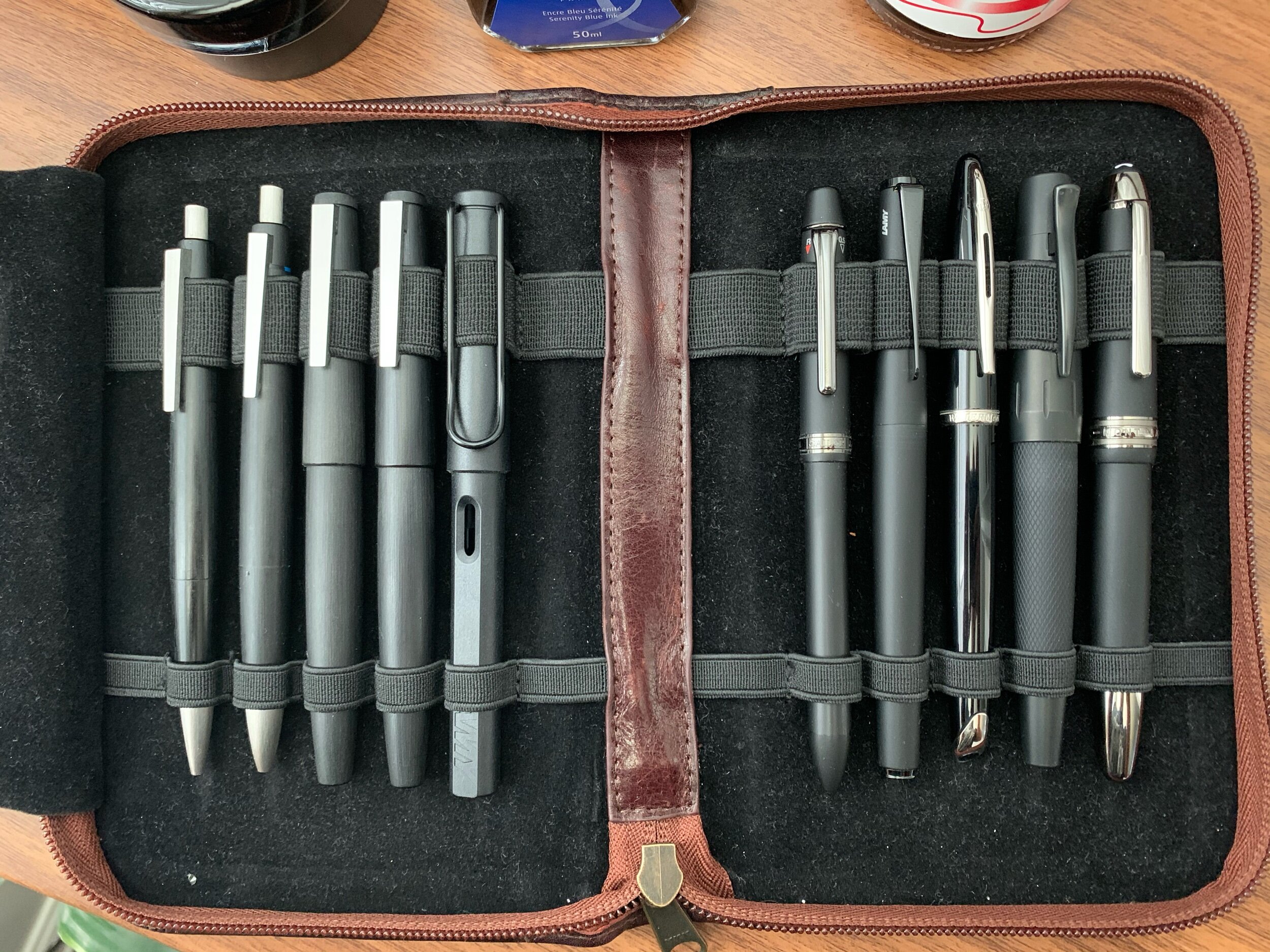
Over the years I’ve written a loosely connected series of articles that I refer to as the Workhorse Pens series, which I like to think of as a catalog of my best fountain pens for everyday writing. So far, these have included the Lamy Studio, Lamy Safari, Faber-Castell e-Motion, Lamy 2000, and the Montblanc 146, with the list expanding as I continue my own personal explorations. I even wrote a separate piece on how you can choose your own workhorse, with some additional pen recommendations. Finally, some of the most popular content published on the blog has included “Five Best Fountain Pen Inks for Everyday Writing,” and “Five Best Pencils for Everyday Writing.” In Baltimore, my goal is to bring this aspect of the blog to you.

I will have most, if not all, of the “Workhorse Pens” available for readers to experience in person, as well as some favorite ballpoints, rollerballs, multipens, and mechanical pencils - all tools that I regularly use in my own life. While I probably can’t bring multiple bottles of ink for testing, I may try to scrounge up some donations from vendors at the show. Woodcase pencils are much more portable and I plan to have some at the table.

I don’t want this class to actually be a class - I’d much prefer it if show organizers abandoned the traditional pen show “lecture” format, complete with a podium and rows of tables, in favor of a roundtable that promotes sharing and discussion. I’m going to do what I can to make the experience much more approachable and hands-on.

I’ll also have blog swag for sale, along with a few other choice items.

I’ll also have blog swag for sale, along with a few other choice items.

What to Expect at the TGS Table at the 2020 Baltimore Pen Show

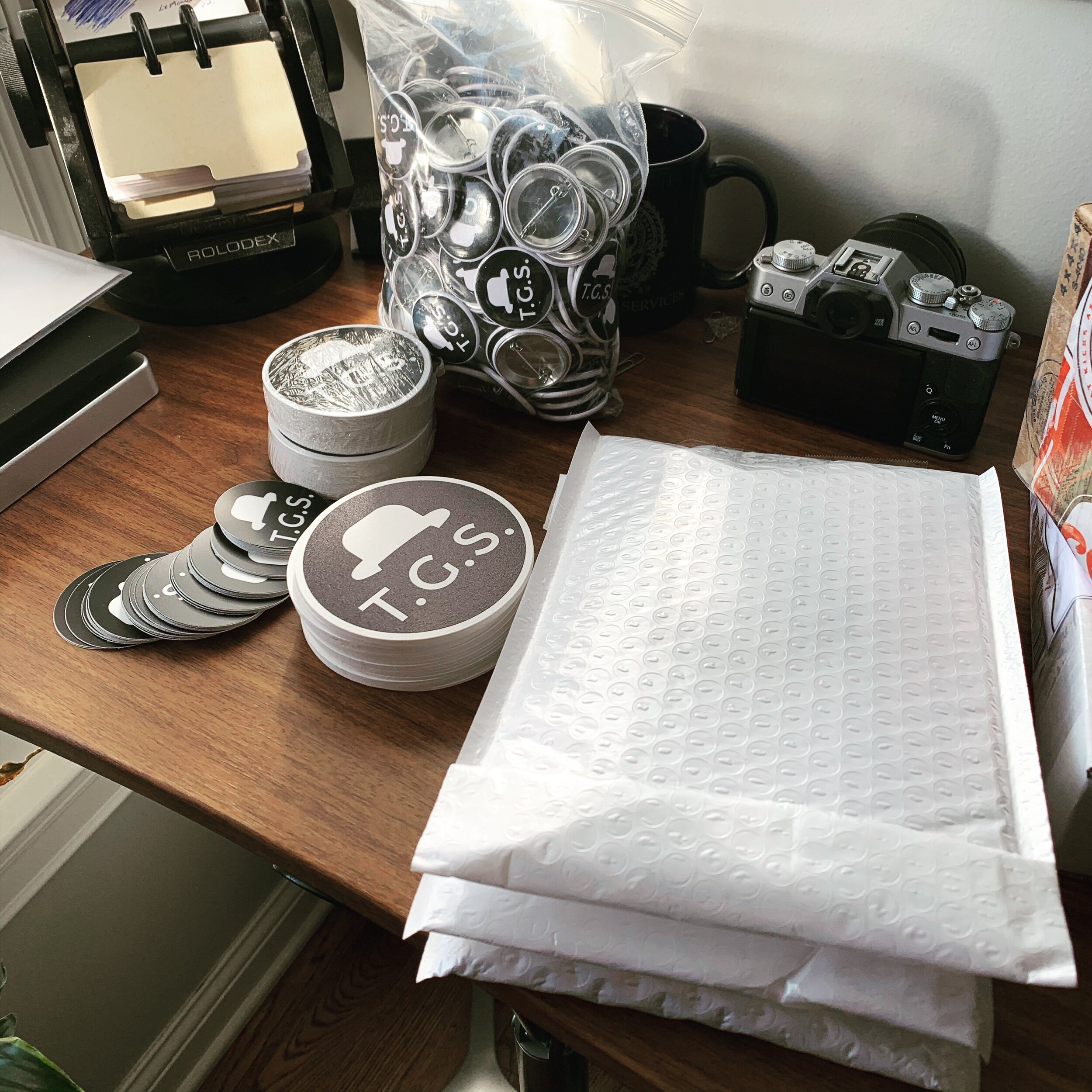
In addition to the class, 2020 marks the first year that I’ve ever booked a table at a pen show, and I honestly have no idea what to expect. First and foremost, I just want a predictable place to sit down and make it easier for people to find me and say hello. I’ll be there to take requests, answer any questions readers may have, or just visit. In terms of things available for purchase, I plan to have some TGS-branded goods (stickers, coasters, and buttons) along with a handful of gently “loved” pens from my collection and possibly some special surprises. While it’s never been my intention to be a full-service stationery retailer, I’ve been on the lookout for opportunities to collaborate with makers and offer my readers a curated set of goods that furthers the philosophy driving this blog. Baltimore may be a start.

I’m looking forward to seeing everyone as pen show season kicks off in full force!

UPDATE: Since I ended up with enough buttons, coasters, and stickers to fill all the Patreon Orders and my suitcase for Baltimore, I have a limited number of full Swag Packs and Stickers ‘N Button backs available for purchase in the TGS Store. If these run out I will restock after the show.

Note: Any pens that remain in the TGS Store as of Wednesday of next week will be packed up and taken to the Baltimore Pen Show for sale. If you have had your eye on anything, grab it now. Also note that this post contains affiliate links.

In Workhorse Pens Series, Pen Shows Tags Baltimore Pen Show 2020, Everyday Writers, Workhorse Pens, Workhorse Inks
Comment

Picking a "Workhorse": How To Choose A Fountain Pen for an Everyday Writer

September 28, 2019

By far the most common question I receive from readers, as well as other people in my everyday life who know that I love pens, is how to choose a fountain pen to use as an everyday writer. Sometimes, they even specify that this will be the only pen they plan to own/use! I basically write for a living, both here and at my day job, so I don’t take this question lightly and it’s also a difficult question to answer, because so much depends on personal preference, not to mention financial circumstances. The truth is that there are a variety of excellent options if what you are looking to do with the fountain pen is actually write. The best choice for you, however, depends upon your particular preferences and circumstances. This post offers my thoughts on different factors you should consider when selecting a pen you plan to use every day.

First, Budget

Be honest with yourself, and don’t feel pressure to stretch financially, because in today’s fountain pen market there are going to be viable options at any price point, even on the extreme low end of the pricing scale. If you are willing to spend as little as $25 you can purchase a reliable pen and avoid serious quality control issues. In any event, even if you have more flexibility, I would think hard before spending more than $200, since using a pen as a daily writer does bring with it the increased risk of loss, theft, and damage.

PenBBS has absolutely blown me away this year. You don’t need to spend a lot of money to get a reliable writer that holds a ton of ink.

Filling System

From the perspective of a writer, a fountain pen’s filling system is more important than many people make it out to be. If I’m busy at work, I can burn through a cartridge or a converter in an afternoon. If I’m in a place where I can’t refill, or don’t want to carry multiple pens, I need a pen that holds a lot of ink. My personal preference is a piston or vacuum filler, since these hold significantly more ink than a converter. Eyedroppers are another option, but for daily use I would highly recommend a Japanese-style eyedropper that uses a valve to prevent ink spilling or burping into the cap when the pen is not in use, especially if the pen will be carried in a briefcase, backpack, handbag, etc. where it’s going to get jostled around.

For those who don’t write a dozen pages or more a day, a cartridge-converter pen should work perfectly well for daily use, and you may find it more convenient to have the cartridge option if the pen runs out of ink at work. Just be aware that many brands (specifically Pilot, Sailor, Aurora, Lamy, and Platinum) take proprietary cartridges, so you will be limited to cartridges and ink colors made by that specific brand, unless you want to refill the cartridges yourself using a syringe or bottle-fill from the converter.

Piston fillers or cartridge-converters? Again, you have multiple options, and the best choice for a daily writer depends on how often you need to refill, and the most convenient option for refilling on the go. From left, the Pilot Custom 74, Lamy 2000, and Pilot Custom Heritage.

Weight and Balance

Once you’ve narrowed your budget and decided what type of filling system you want, the most important consideration becomes how the pen feels in your hand. Remember, you’re going to write with this thing every day, so while looks are important, comfort is key. Two of the most important things I look for in a pen are weight and balance. The two concepts are related, but distinct. By weight, I’m referring to how heavy the pen is. Certain types of pens (particularly metal pens made of copper, stainless steel, or brass) are better suited, in my opinion, for shorter notes and pocket carry, because their heft can make your hand quite tired after several pages. There are exceptions, but I’m dealing in general rules-of-thumb today.

I’ve tried a lot of pens, and none feel better in my hand than the Lamy 2000, which is made of Makrolon, a type of polycarbonate. It’s quite lightweight.

Balance is a different issue, and relates to where the weight of the pen sits. Do you post your pens, like me? If so, make sure that the cap isn’t too heavy because it will back-weight the pen and make writing awkward, even if the pen isn’t that heavy overall. Front-weighted pens (i.e., those with metal sections), typically don’t pose the same problem, since many people, myself included, prefer a pen in which the weight is shifted to the front, which keeps the nib on the paper and offers an additional degree of control over your handwriting. Because weight and balance are such a key consideration, it’s important to be able to either hold a pen in person prior to purchasing, or purchase from an online retailer that permits returns, especially if you’re shelling out a lot of money for a higher-end pen.

Nib Choice

Is the nib the most important part of the fountain pen? Yes and no. If you have a pen that feels great in your hand, but has a crummy nib, the pen isn’t usable, so the nib IS important. However, a bad nib can usually be improved through tuning and/or smoothing. On certain models of pens (TWSBI, Pelikan, Kaweco, among others) you can even switch out the nib and substitute one that’s a different size or even a specialty grind. For that reason, I tend to prioritize the weight, balance, and overall “feel” of a pen over the nib. Unless the nib is absolutely god-awful, it can be adjusted. The size and heft of the pen can’t.

I’ve had great experiences with the nibs on the Leonardo Momento Zero. They’re nothing fancy, but all of mine have arrived well-tuned and they certainly get the job done.

With respect to nibs, what’s most important is choosing the right type of nib for the work you want to do. If you write very small, and your day job (like mine) involves annotating or marking up documents that are often printed on the cheapest recycled paper available, you will likely want to choose something in the extra-fine to medium range and be particular about which inks you use. Those with larger handwriting, and who don’t need to write on cheap paper, have more flexibility to go with a broader nib or even a stub as their daily driver. Unless your day job involves calligraphy, however, I generally advise people to avoid super “soft” or “flex” nibs for everyday writing, as they tend to write far too wet.

Recommendations

Hopefully this short guide is helpful. Readers of this blog won’t be surprised to know that after considering all of the factors above, my own preferred “workhorse” pen is the Lamy 2000. I have several of them, and in addition to the fountain pen regularly carry the rollerball, ballpoint, and 4 Color Ballpoint (multi pen). From a fountain pen perspective, I love the Lamy 2000 because (1) it’s perfectly balanced for my hand; (2) it holds a lot of ink; and (3) I love both the way the hooded nib writes AND how it “disappears” in a crowded meeting room, where you don’t want to be that guy writing with a distracting fountain pen.

When I find a pen model I like, I go all out. Hence my collections of Lamy 2000s and Leonardo Momento Zeroes (pictured here)!

But what works for me may not - and in fact, probably won’t - work for you! While I maintain an annually updated list of pen recommendations, I’ve never published a “ranked” list of “Workhorse” fountain pens because the criteria are so subjective. I won’t rank pens here either, but I will provide several suggestions within particular price brackets. Everything listed here is a pen that I enjoy using and either regularly carry or would have no issues doing so. Where possible, I’ve linked to my own reviews, and otherwise to a retailer I trust.

  • $20-$50:

    • Platinum Plaisir. I’ve come to believe that the Plaisir might be the best “cheap” pen on the market, especially for one that you plan to use regularly.

    • PenBBS 308 or PenBBS 309. The 308 is a cartridge-converter pen; the 309 is a piston filler. The time has come for PenBBS pens to start appearing on recommendation lists alongside TWSBIs. They’re that good.

    • PenBBS 456. PenBBS’s vaccum-filling model, for around the price of a TWSBI Eco.

    • Faber-Castell Essentio. Faber-Castell makes the best bargain-priced steel nibs on the market.

    • TWSBI Eco. If people ask me for a TWSBI recommendation, I often recommend the Eco over the 580 because (1) it posts; and (2) it’s hard to beat the combination of price, availability, and reliability.

    • Kaweco Sport (Standard). If you don’t mind a shorter “pocket pen,” Kaweco Sports are inexpensive, reliable, and come in a wide array of colors. If you prefer chrome trim, check out the “Skyline” model. You can also swap nibs.

  • $50-$100:

    • Faber-Castell Loom. I prefer the Loom to the Essentio because it posts better. It’s only slightly more expensive and uses the same excellent nib.

    • TWSBI 580. If you want a TWSBI that uses interchangeable nibs, opt for the 580 series. If you want a TWSBI with interchangeable nibs that posts, opt for the TWSBI Diamond Mini.

    • Opus 88 Koloro or Opus 88 Picnic. The only eyedroppers I recommend, because they have the Japanese-style valve system that helps prevent “inkcidents.” Be aware that the Omar and “Demo” pens are very large.

  • $100-$200:

    • Lamy 2000. See above. My personal workhorse.

    • Pelikan M200/M205. Another relatively inexpensive piston filler, which comes in a wide array of different colors and patterns, including special and limited editions. Pelikan pens are reliable and will stand up to years of use.

    • Leonardo Momento Zero. A recently released pen out of Italy, available in some exceptionally pretty materials. Lightweight and reliable writers.

    • Pilot Custom 74. An underrated cartridge-converter pen with an exceptional nib. These pens don’t get nearly as much attention as they should. If you absolutely want a piston filler the Custom Heritage 92 is an option for more money.

    • Platinum 3776 Century. A pen that attracts a lot of attention for the collectibility of the limited editions, but also excels as a daily writer. Platinum offers a wide range of nib options for this pen.

  • OK, I want to blow it out ($200+)

    • Sailor Professional Gear (“Pro Gear”). My pick for a high-end cartridge converter pen. Sailor nibs are exceptional, and the Pro Gear is a well-balanced writing instrument, especially posted.

    • Pilot Custom 823. A vacuum-filler that posts well and makes for an comfortable writer despite the larger size.

    • Montblanc 146. Many people won’t carry a Montblanc because they find the branding pretentious. While I agree these pens have become a bit of a status symbol, they’re still great pens, hold a good amount of ink, and despite what people say, the standard Meisterstuck pens aren’t ostentatious.

    • Pelikan M400, M600, or M800. Personally, I think the Pelikan M400 and M600 make better everyday writers because they are much lighter than the M800.

    • Conid Bulkfiller. If you want the ultimate “ink tank” and cost is no object, get a Conid. Bulkfillers come in a wide array of shapes and sizes to suit any preference.

Again, I hope this is helpful! Please reach out through the comments or “Contact Me” link if you have any additional questions, or would like to share any additional information you take into account when choosing your daily writers.

In Guide, Editorial, How To, Workhorse Pens Series Tags Editorial, Workhorse Pens, How To, Pens
12 Comments

My Workhorse Pens: Lamy Safari "All Black" Special Edition

June 21, 2018

The Lamy Safari needs no introduction to readers of this blog. It's a "gateway pen" for a lot of people new to the hobby, and due to its reliability, low price, and overall high quality, tends to stick in the pen case long after many other entry-level pens have been sold off or cast aside in favor of "upgrades." The Safari (along with the slightly pricier AL-Star) also provides a relatively inexpensive way to collect special editions, as Lamy releases a new color of each pen for a limited time each year. 

So what makes the Safari a good "Workhorse Pen"? 

  • The Nib. The medium steel nib on the Lamy Safari is a personal favorite, and represents a true bargain at the price point. The ink flow is nearly always consistent, even if I can't see much of a difference between the medium and fine nibs. Lamy also sells inexpensive replacement nibs that you can swap in to change nib size, including a 1.1mm stub. 

  • Size. The Safari itself is a nice size, posted or unposted. The plastic construction also makes the pen extremely light, which gives it excellent "shirt-pocketability" or, absent a pocket, the ability to clip the pen to the placket. (The wide, funky looking clip is highly functional for this purpose - the pen stays put.) 

  • Value Proposition. The Lamy Safari is a great pen that can be found at $30 or less. Given how nice this black-on-black color combination looks, I really wish that Lamy would make the matte black (as opposed to the current "shiny black") part of the regular line.  

  • Availability. Any specialty pen store will typically sell the Lamy Safari. Recently, Lamy has made a major marketing push that appears to be geared towards bringing its pens into mainstream consumer channels. This includes opening Lamy boutiques in cities around the world, including NYC, and placing retail displays in Barnes & Noble.  

A trio of Lamy stainless steel nibs, from left: the Lamy Safari All-Black plated nib; the Lamy LX nib, and the Lamy AL-Star nib. The medium nib on the Lamy LX definitely seems wider.

The biggest potential drawbacks to the Lamy Safari as a daily workhorse are the nontraditional design (i.e., if you work in a stuffier office environment) and the triangular grip section. As to the latter, depending on how you grip your pen, you'll either be able to use it or you won't. I also wish that Lamy would include a converter, rather than a single cartridge of Lamy Blue ink, with the Safari, as many other companies like Pilot manage to do so with their entry level pens that start at even lower price points. My previous review of the Safari from a few years back addresses these issues in a bit more depth.  

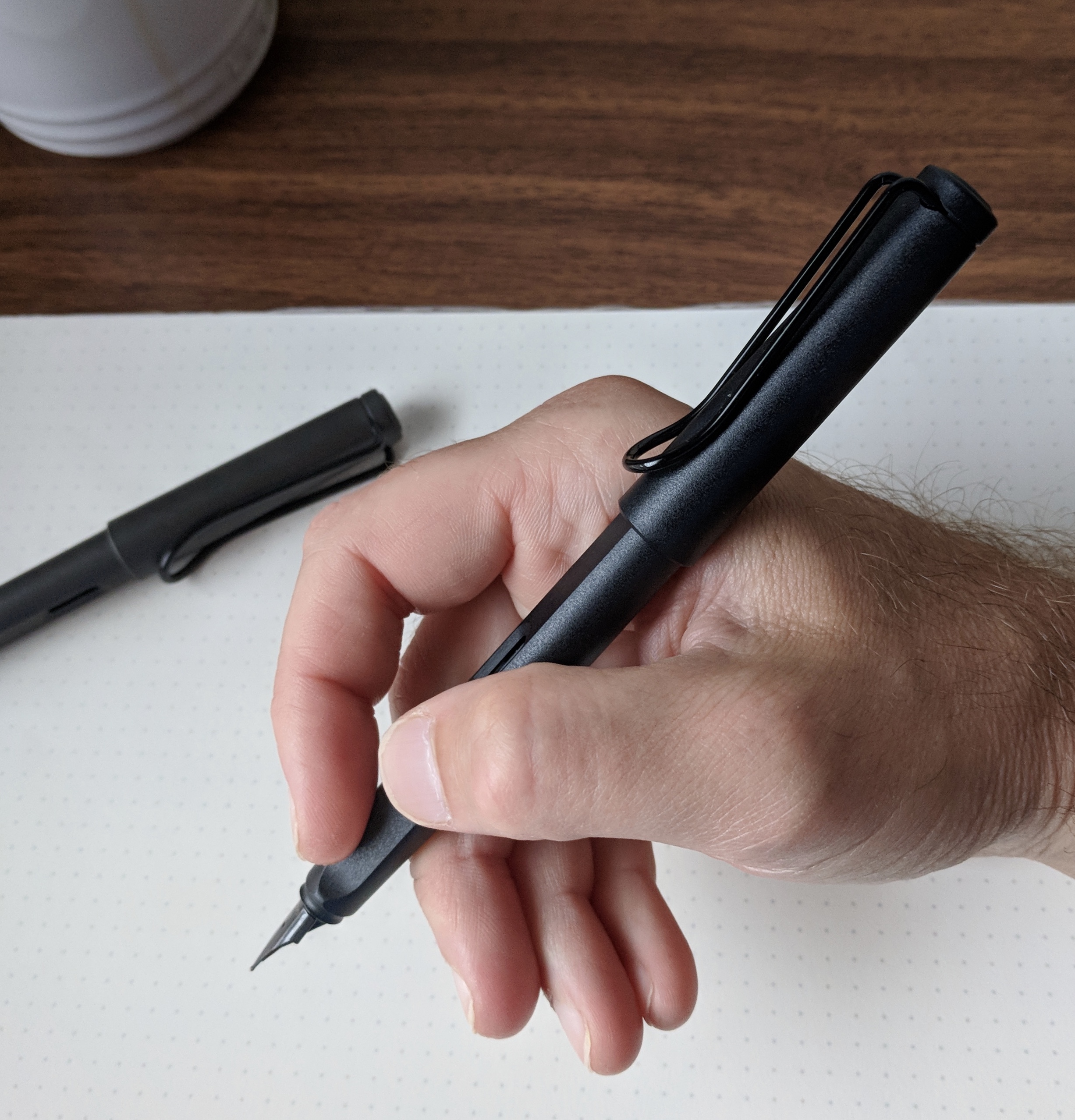
View fullsize Lamy Safari All Black Posted
View fullsize Lamy Safari All Black Unposted

The pen pictured in today's review is this year's special edition Safari, the "All Black." Lamy took some flack this year for going with an "All Black" special edition, especially where they already have a "Charcoal" dark gray model in their regular lineup. I was a bit puzzled myself at the initial announcement, but now that I've had the opportunity to compare the two pens directly, I can confirm that there is a difference. Sure, it's not pronounced, but it's there.  

The Lamy Safari Umber (from the standard lineup) is on the left, and the Lamy Safari All-Black, this year's special edition, is on the right. 

As an aside, I'm not sure why pen companies decided to double down on the black pen/black trim theme this year, but I assume it's because this color combination has been selling really well. Black pens offer an understated look preferred by many professionals, myself included. In addition to the Lamy Safari All Black, I've recently reviewed the Aurora Talentum "Black Ops" and the Sailor Reglus "Night Black."

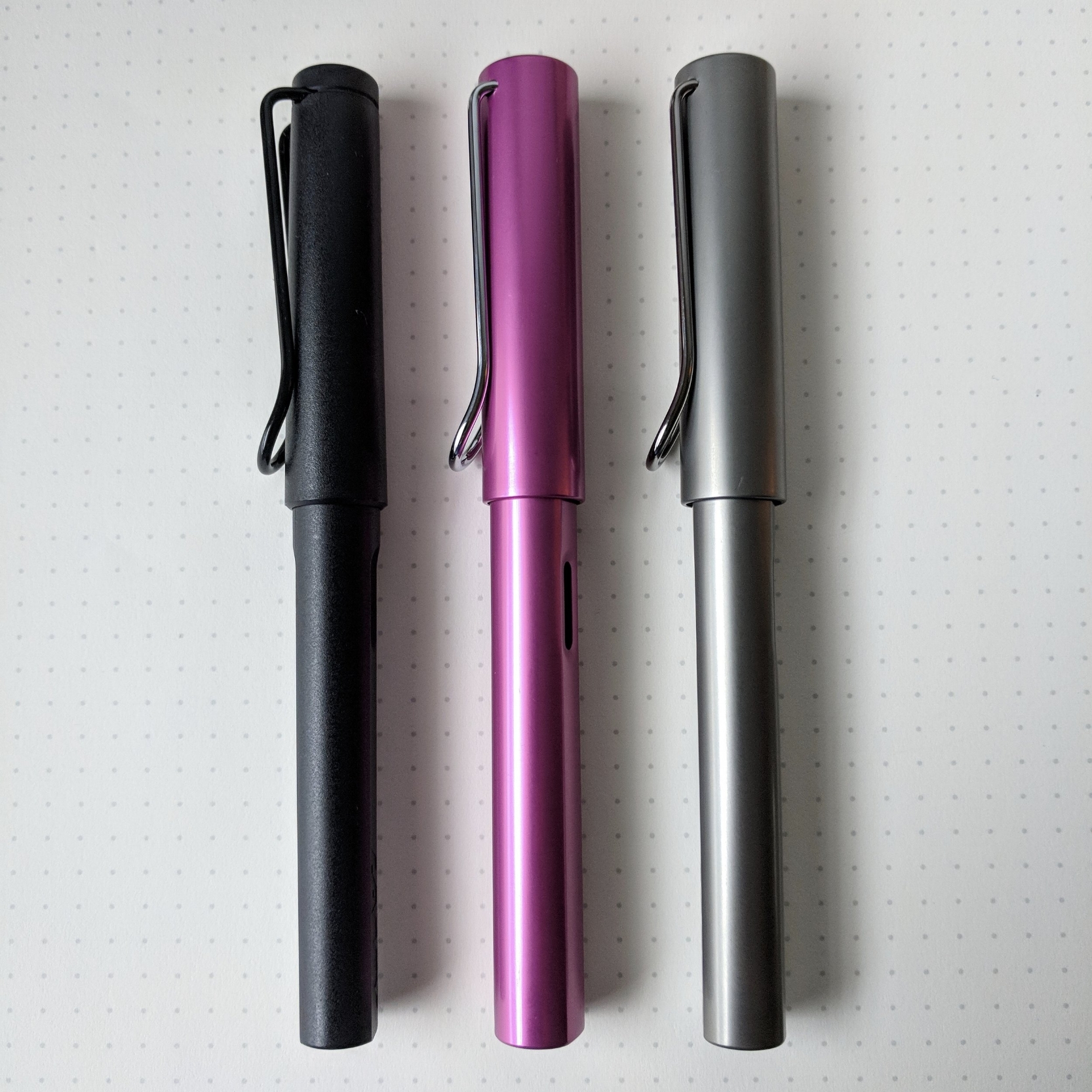
A comparison shot of a few similar models of Lamy pens, from left: Lamy Safari All-Black special edition; Lamy AL-Star Vibrant Pink special edition; and the Lamy LX "Ruthenium." 

A comparison shot of a few similar models of Lamy pens, from left: Lamy Safari All-Black special edition; Lamy AL-Star Vibrant Pink special edition; and the Lamy LX "Ruthenium." 

Takeaways and Where to Buy

I received the pen featured in this review from site Pen Chalet. Pen Chalet carries a wide range of Lamy fountain pens, including the Safari. Currently, they still have the All Black special edition in stock, but eventually they will sell out and Lamy will not make any more, so if you'd like to add one of these to your rotation, pick one up. As I mentioned above, if you don't manage to snag an All-Black, the standard edition "Charcoal" color is a close match, but not exact. 

Disclaimer: I was not paid or compensated for the content of this review, and all opinions here are my own. 

Further Reading

This post is part of a series titled "Workhorse Pens," where I look at those writing instruments that I use most often for everyday writing. Past entries in this series include the Montblanc 146, the Lamy 2000, and the Faber-Castell E-Motion Pure Black.  

In Workhorse Pens Series Tags Lamy Safari, Workhorse Pens, Pens, Pen Chalet
1 Comment

My Workhorse Pens: Montblanc 146

January 24, 2018

I often get asked, at pen shows or by e-mail, what fountain pens I use on an everyday basis. I do change them up a lot, which is how I manage to keep up the pace on pen reviews, but there are several pens that are “constants” in my rotation.   

What is a “Workhorse Pen”?

The term “workhorse” gets thrown around a lot in pen reviews, casually used to denote a pen that’s not necessarily fancy, but rather intended to serve as a utilitarian daily writer. I’m as guilty of this as any. The problem with such broad categorizations, of course, is that one person’s “workhorse” might be completely impractical for another. For example, the TWSBI 580 is commonly offered as an example of a reasonably priced pen intended as an everyday writer, but it doesn’t work for me as a personal “workhorse” because I can’t post the cap (more on this below).

So before I get started on this new series of pen reviews, I wanted to take a few moments to define my criteria for considering something a “workhorse” - something I’ll keep inked up nearly 100% of the time.

  • The pen must post. Just as the watches that I wear need to have a “date” complication, the pens I use every day need to post. I often have a “busy” desk full of documents that I’m working on, or trying to sort out into some order that makes sense. I can’t worry about where I set the cap to write because it will go missing. I’m speaking from experience here. I have pens that don’t post, but they’ve been living in the Penwell.

  • The pen must be well-balanced. For someone who takes perhaps a dozen pages of handwritten notes per day, my pen can’t cause my hand to cramp. If the pen is lightweight, there’s a broader range of lengths that will work for me, but a pen that’s too long, especially if it’s back-weighted when posted, is a nonstarter.

  • The design must be understated. I spend a lot of time sitting in courtrooms/depositions/boardrooms taking notes, trying to be inconspicuous. I leave any flashy or “unique” fountain pens at home. Sorry, Visconti.

  • The nib can’t be too wet to write decently on cheap paper. Most nibs can be tamed with smart ink selection, but some (i.e. most Omas and Visconti nibs) write far too wet with any ink for me to be able to use them at work.

  • The pen must have a relatively large ink capacity. It pains me to say that I generally can’t use Sailor pens with nibs broader than a “fine”, since the Sailor converter has a ridiculously small capacity. Sure, I can use cartridges or switch pens in the middle of a meeting or deposition, but there’s no good reason why I should have to.  

I really had to work to get this 1980s-era Montblanc 146 medium stub nib to write perfectly. Subsequent Montblanc purchases haven't been as finicky. 

What I don’t worry about when choosing a pen that I think might make a good workhorse? How the nib writes out of the box, and for the most part, price. Temperamental nibs can almost always be tuned or ground by a nibmeister to something more appropriate, and while I’ve never spent $1000+ on a pen, I don’t worry about dropping a fair bit of money on a pen I know I’ll use all the time because I think of it in terms of the cost of long-term ownership. (i.e., The $400 I spent on a used Montblanc 146 - nibwork included - more than evens out over the six or so years I’ve owned the pen, and it's still going strong.)

Workhorse No. 1: Montblanc 146

It’s been years since I reviewed the Montblanc 146, and I’ve owed this iconic flagship a revisit. When I first published my review, I struggled with an iffy, 1980s-era medium nib that Mike Masuyama finally managed to fix. I now love that original pen, and I over the years I’ve picked up two more: a 146 Ultra Black and a 146 UNICEF limited edition.

From Left: The Montblanc 146 UNICEF Special Edition; the Montblanc 146 Ultra Black, and my standard 146 (1980s era). 

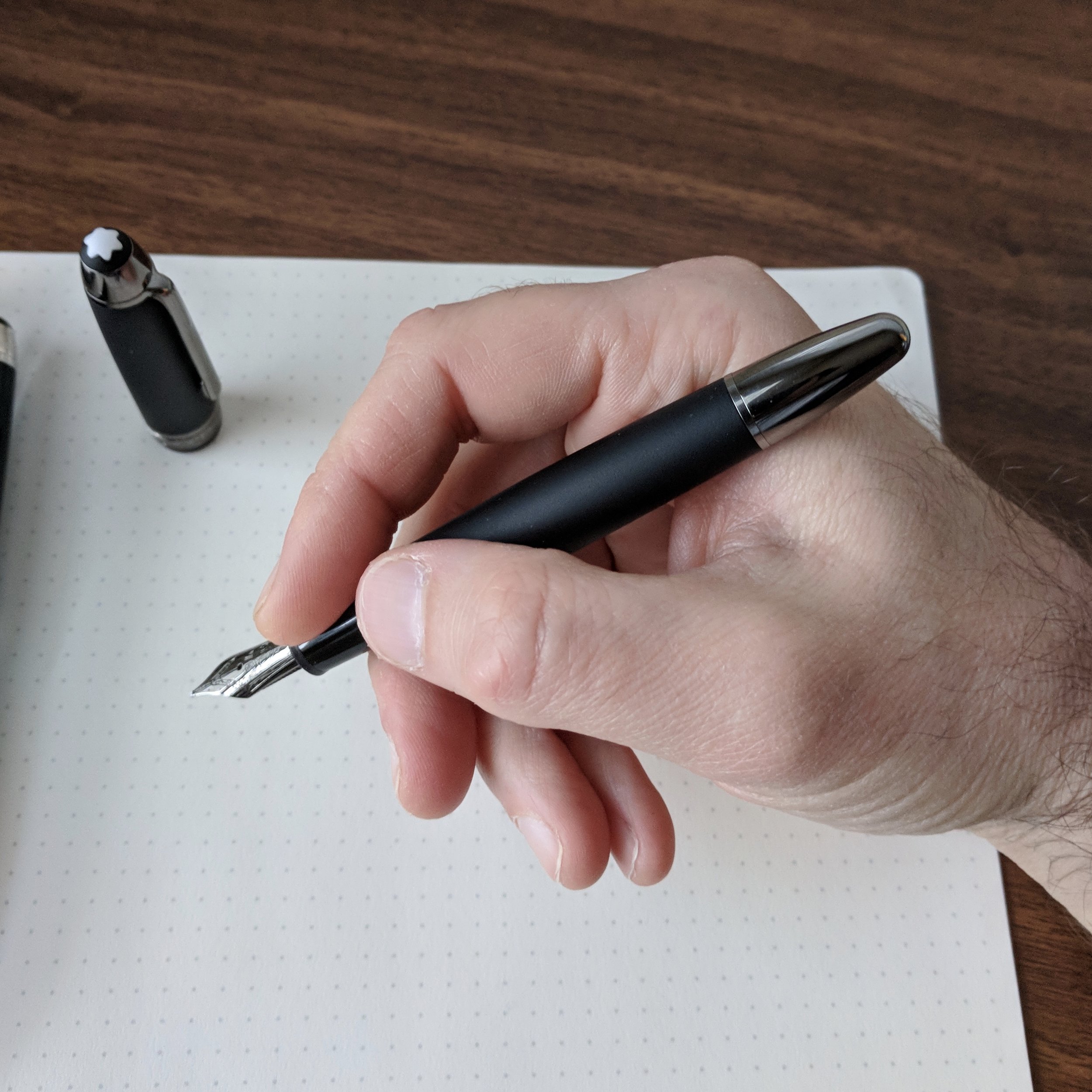
Along with the Edison Menlo, Lamy 2000, and Sheaffer Legacy (other great “workhorses” that will get the same treatment here in the coming months), the Montblanc 146 has the perfect shape and functionality for me to use every day. The pen posts, has a well-balanced torpedo/cigar shape, and holds a ton of ink.

View fullsize Montblanc 146 Posted
View fullsize Montblanc Ultra Black 146 Unposted

Nibs are where Montblanc will get you. Their standard nibs aren’t necessarily bad, but they tend to be over-polished with a bit of a baby’s bottom, meaning that they will hard start occasionally, especially on super slick paper like Rhodia or Clairefontaine. Mike Masuyama has ground most of my Montblancs to a .6mm stub/cursive italic hybrid, which makes for a very smooth writer that still retains a bit of line variation. I generally prefer cursive italic nibs over stubs for everyday use because they aren’t as wet for when you need to write on cheap paper.

The "Snowcap" isn't an uncommon sight in the corporate world, even today. 

I’ll go ahead and address this because I know I’ll get the question: Doesn’t using a Montblanc violate Rule No. 3 (“The pen must be understated?”) Not for my purposes. Montblanc pens are fairly common in the corporate world, so unless you’re going to use something like a Skeleton or one of the crazier Writers Editions, you'll attract little, if any, attention. 

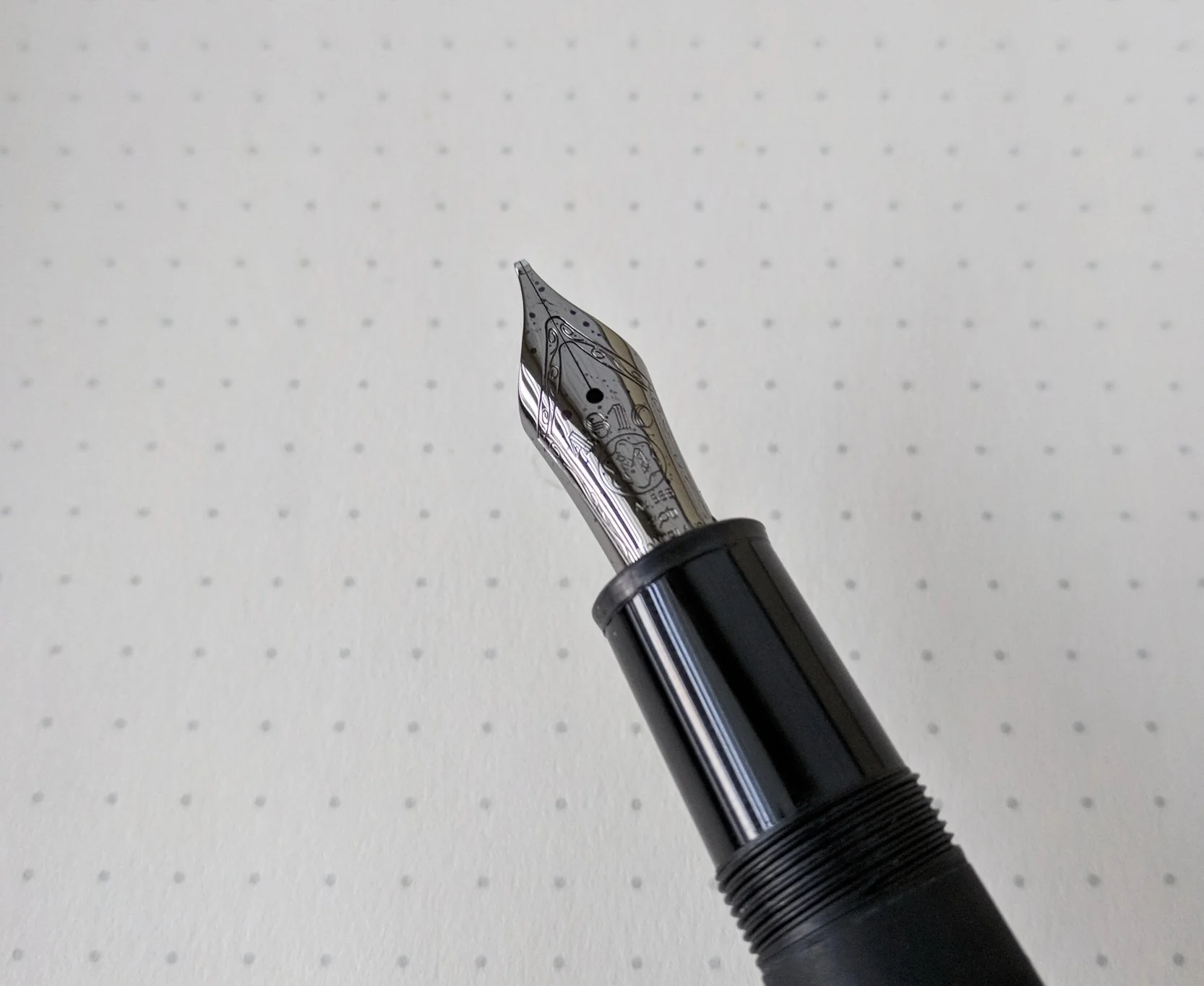
The ruthenium plated nib on my Montblanc 146 Ultra Black. 

The ruthenium plated nib on my Montblanc 146 Ultra Black. 

The 146 also doesn’t have to be a pen that breaks the bank. If you’re looking for a pen in decent working condition, and don’t mind dealing with a few cosmetic blemishes, you can find them for as low as $250 at pen shows, which is around the same price as a new Sailor Pro Gear or 1911. Sure, the special editions will set you back a bit more, but the prices are generally in line with the rest of the market, provided you shop around and don’t pay MSRP at the Montblanc boutique.

Where to Buy

If you’re interested in acquiring a Montblanc 146, you have many options, ranging from the secondhand eBay market to the Montblanc Boutique. If you're new to pens, I'd advise you to proceed slowly, since there's a thriving market for counterfeit Montblanc pens and it's worth it to do your diligence and make sure that you purchase from a reputable seller. Here are some options to get you started:

  • Pen Shows. Where I purchased my first Montblanc 146. You can find exceptional pricing at pen shows (often 10-20% below what retailers sell for online), especially if you're willing to look at a secondhand pen, which is where I'd suggest you start. Larger shows like the D.C. Pen Show will have the best selection.  

  • Anderson Pens. Our sponsor Anderson Pens is an authorized Montblanc retailer that sells both new and gently used pens, including the 146. They sometimes have stock that is not listed on their website. Be sure to reach out and let them know exactly what you are looking for. 

  • Appelboom. Appelboom, another sponsor and authorized Montblanc reseller located in the Netherlands, carries the full range of Montblanc Pens, including the UNICEF and Ultra Black 146 pens pictured here. I purchased a UNICEF 144 Classique from Appelboom and was very pleased with the experience.  

Disclaimer: I purchased all three pens shown in this review with my own funds, for my own use.

Editor's Note: The "Workhorse Pens" series is something new that I tried. Did you like this series? Did I leave anything about the pen out that you wanted to know? Do you have any additional questions about how I use my pens that you'd like me to address in future installments? Should I drop this entirely? Let me know! 

In Pens, Workhorse Pens Series Tags Workhorse Pens, Montblanc, Montblanc 146, Pens
15 Comments
← Newer Posts
Store Hours and Location
Visit the T.G.S. Curated SHOP
*New* Updated "Best Pens" Guide (2025)
T.G.S. 2025 Holiday Gift Guide
TGS x Roterfaden TGS_25
Hierarchies of Fountain Pen Friendly Paper

Join Our Patreon!
Subscribe to the TGS E-mail List

Featured Posts

Featured
Cover On the Paper Trail Intro Clip.jpeg
Dec 3, 2025
Introducing "On the Paper Trail," a New Podcast/Video Collaboration with Lisa Vanness of Vanness Pens!
Dec 3, 2025
Dec 3, 2025
Iro-Utsushi-Fine-Dip-Pens.jpeg
Oct 1, 2025
The Pilot Iro-Utsushi Dip Pen (and in General, Simple vs. Fancy Dip Pens)
Oct 1, 2025
Oct 1, 2025
Levenger-Annotation-Pad.jpeg
Sep 20, 2025
Five Boutique Paper Brands I'm Watching Closely and Why
Sep 20, 2025
Sep 20, 2025
The Gentleman Stationer RSS

© Digital Divide Media, LLC, 2014-present.

All content is the exclusive property of Digital Divide Media, LLC, d/b/a The Gentleman Stationer, including “The Gentleman Stationer” website and trademark, and should not be reproduced without express written permission.  All rights reserved.

All content containing paid advertising, affiliate links, or sponsored content will be plainly disclosed by a disclaimer when/if featured.

Contact Information

Store Shipping Policy and Return Policy

Privacy Policy

Cookie Policy

Terms and Conditions

Powered by Squarespace