Pen Review: Jinhao x450

It seems as though the Jinhao x450 has exploded in popularity, rising from eBay obscurity to be featured as a mainstream "entry level" pen option sold by Goulet Pens, xFountainpens, etc.  SBRE Brown, for those of you who follow his podcast, even mentioned the x450 as one of his "top fountain pens" (speaking strictly as a price/value proposition).  Intrigued, I placed an order on eBay for one in the deep red enamel color.  I believe I paid $.99 and $5.00 shipping.  Even if this turned out to be a dud, I figured, I was only out $6 shipped. 

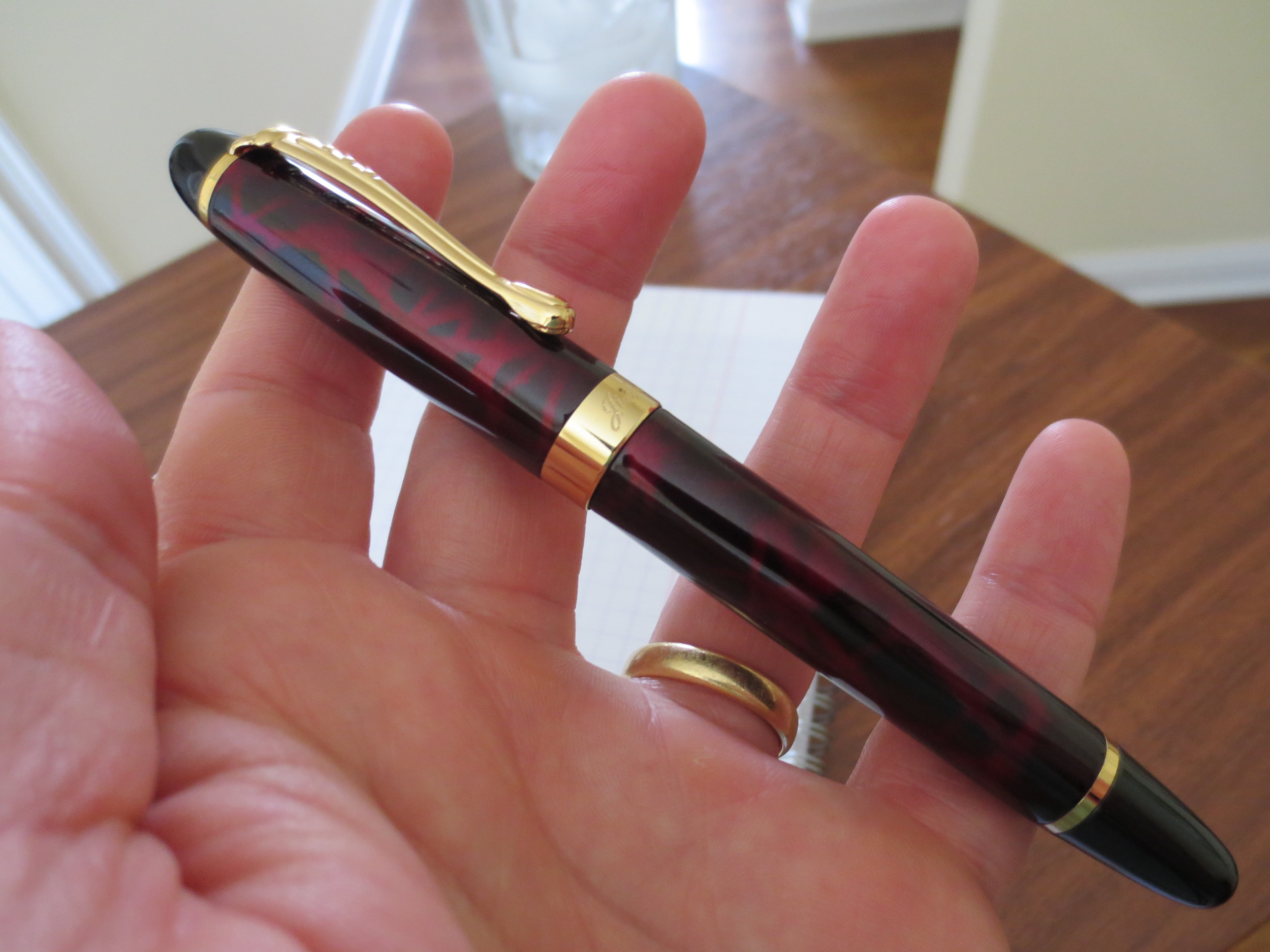
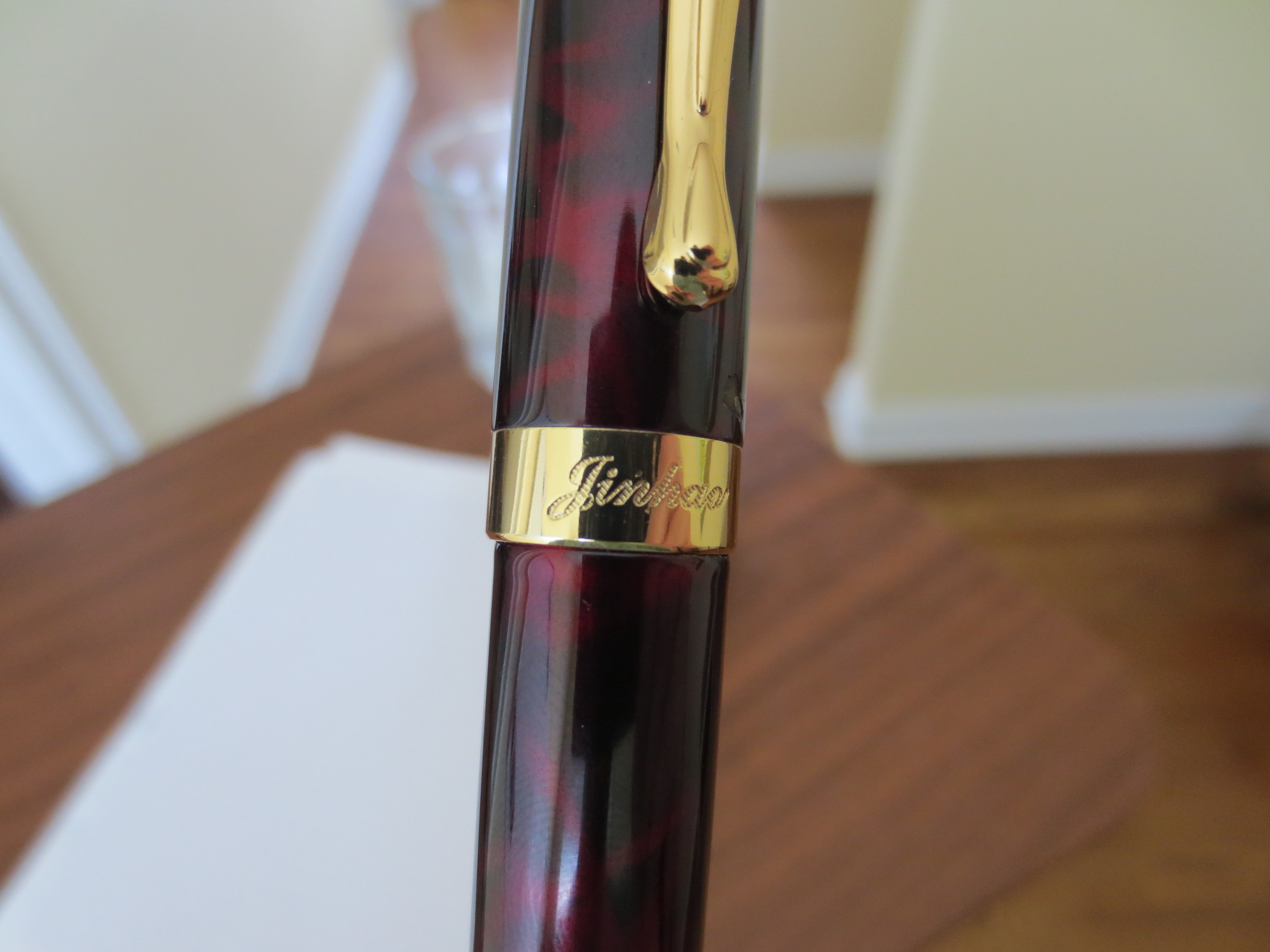
Initial shot of the x450:  It's a decent-looking pen, and the deep red-black swirled color is very pretty.  However, my love for this pen's color was overwhelmed by my disappointment with a glaringly obvious chip in the pen's enamel finish.

Build

The x450 is a heavy pen.  It's enamel/lacquer coated brass, which makes this pen so heavy that you could probably use it as a weapon.  Holding it in your hand and looking at it, the build quality is decent overall, and great for $6.  After a couple days of use, however, it was easy to pick out some flaws.

The biggest flaw in this pen was a chip in the enamel/lacquer on the pen's cap.  I know this is a $6 pen, but come on, people

The chip in the lacquer, pictured above, is a pretty big irritant to me.  I know I only paid $6, and the seller promptly refunded my money when I sent them a picture and requested a refund (they didn't even make me mail the $6 pen back to China, which is not really all that surprising).  I am, however, "mildly" OCD and seeing this chip staring me in the face whenever I carry this pen around with me is bothersome.  Since this pen was effectively free, I considered buying another one and using this one as a knockaround, but there were some other build quality issues preventing me from spending even $6 more.

Interior shot of the Jinhao x450 slip cap.  You can also see the semi-triangular gripping section on the left.  The tolerances on the pen's cap are off, and the grip section may be a nuisance to some people.

By biggest criticism of this pen--and the one that keeps it from being considered a great entry level pen on par with the Metropolitan and even the Safari, is the cap.  The cap on my pen is a friction fit, snap-on/off cap that opens and closes with a nice, satisfying "pop," but rotates and rattles terribly when closed.  It gives one the impression that the cap will fall off at any moment, though this has not happened yet.  The photo above shows that the cap is held on by a plastic internal cap that does not inspire confidence as to its durability.  Despite the nice torpedo shape of the pen, the cap does not post firmly.

Nib/Performance

The stock nib that the Jinhao came with was a nice gold plated medium.  I had no issues with the nib.  It would call it a true western Medium, it wasn't too dry, and the feed performed well.  Where people might have an issue is with the grip section, which has a semi-triangular "finger guide," for lack of a better term.  How I grip a pen corresponds to how this section was designed, so it did not create any issues for me.  Then again, I don't have any issues with the triangular grips on Safaris, so YMMV. 

That said, given that the pen was free, and because I was in the mood to do some experimenting, I ordered a few of Goulet Pens stock #6 nibs, which are on sold as being compatible with the x450 and the x750 models.  I fitted this pen with the 1.1mm stub, and this nib alone is the reason why I still use this pen occasionally.

The Goulet Pens 1.1mm Stub Nib fits perfectly into the Jinhao x450.

Reverse side of the Goulet 1.1 mm stub, showing the plastic Jinhao feed.

The Goulet nib performs well.  I believe I paid $15 for this nib, which raises the price of the pen to about $21.  Given the QC issues with my specific Jinhao, this is still too much money.  I would, however, offer a plug for the Jinhao x750, another pen I purchased on eBay that did not have any of the aforementioned build quality issues, and feels much more sturdy (review forthcoming).  Whether this represents true differences between these two models or simply variances in the quality of individual pens, I can't say.  Goulet Pens is selling both Jinhao models for $9.90, so if you want to pay a bit more, you will get a quality control guarantee given the Goulets' exceptional customer service.  If I had paid $3 more by purchasing from Goulet, I probably could have exchanged pens due to the chipped lacquer/cap problem.

Short bit of a writing sample with the x450.  I didn't do a formal handwritten review of this pen, but may add one in the future. 

I didn't do a formal handwritten review of this pen.  The Goulet Nibs look like JoWo nibs sourced by Brian Gray of Edison Pens, but I could be wrong on this.  They perform very well.  The tines came perfectly aligned, with adequate space between them for ink flow.  Any issues I have experienced with this nib has been the result of the Jinhao feed, which sometimes has issues keeping up with the stub nib if I write fast.  Otherwise, this pen is more than usable.  It's a basic cartridge converter pen, which comes with a generic converter that is a bit on the small side, in terms of ink capacity.  

The Verdict

Overall, "Mehhh."  This pen is fine, and I don't feel as though I wasted money on it.  I use it occasionally, and the upgraded nib makes for a pleasant writing experience.  But I have nicer pens that I like to look at more, and the chip in the lacquer and the rattling cap annoy me.  I far prefer the Jinhao x750.  In the future, I will likely purchase another x750 to outfit with my Goulet Stub (I have a Goulet XF on my current x750) and pass this pen on to someone else.   

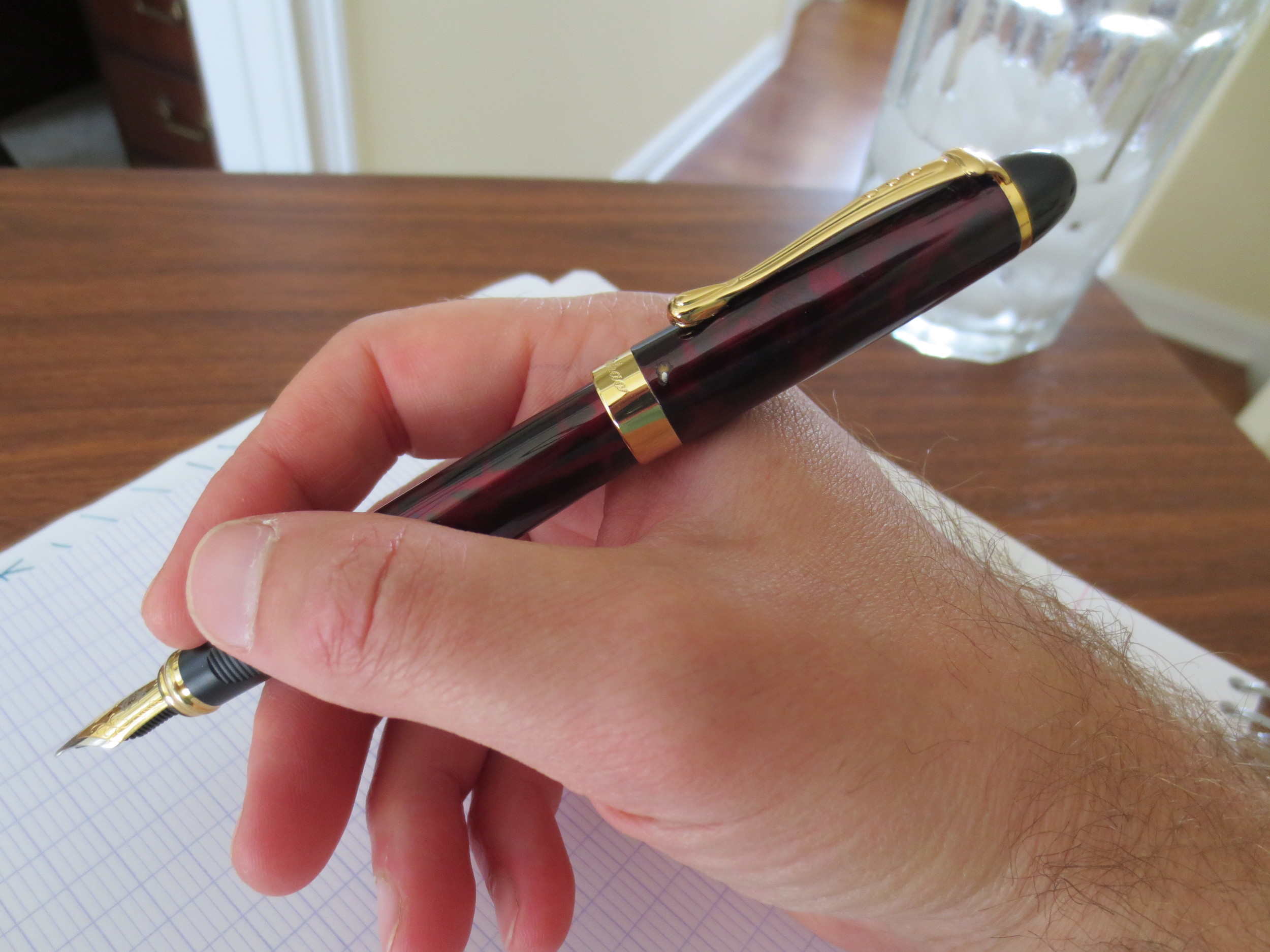
Below please find a gallery of some additional shots of the pen in the hand and posted/unposted. 
EDC Update: Week of June 2, 2014

It's been a while since I updated the EDC feature of the blog, and I've written through all of the pens I had previously inked up, so for today's post I thought I would explain the refresh a bit.  Here's my current daily carry:

This week's EDC, clockwise from the top: (1) Pilot Razor II Ultra Fine; (2) Pilot G2 LImited with black .7mm refill; (3) Zebra F-701 ballpoint with black .7mm refill; (4) Pilot V-Razor Extra Fine; (5) TiPen with Blue Black .4mm Hi-Tec-C Refill; (6) PIlot Hi-Tec-C .4mm in red; (7) Doan Paper Utility Notebook; (8) Waterman Hemisphere with fine nib, filled with Waterman blue black; (9) Pilot Custom 74 Violet Demonstrator with Masuyama extra fine, filled with Pilot Blue-Black; (10) Sailor Pro Gear Imperial Black Edition with fine nib, filled with Sailor Kiwa Guro Nano Black. 

There's some stability in what I've been using recently:  the Pilot Razor II and the Pilot V-Razor are still seeing heavy use.  I'm glad I rediscovered these pens, as they're incredibly handy daily users and the archival black ink works fairly well on all papers I use on a daily basis.  I've also kept the Pilot Custom 74 with the Masuyama Extra Fine in the rotation.  It continues to be loaded with Pilot Blue Black, although I'm thinking of switching this up after my current cartridge runs dry.  I finished my classic Field Notes and moved on to my final Doane Utility Journal, and my Nock Co. cases are still getting heavy use.  (Sassafras pictured) 

Two new additions of note: 

First, last week I received my Sailor Pro Gear Imperial Black Edition back from Mike Masuyama, who was repairing the bent nib.  The drawback to Sailor's super smooth, super fine 21K nibs is that they bend very easily, even with a minor slip or drop (i.e., an inch onto a pad of paper).  As expected, a super-reasonable $30 later the pen is as good as new, and I loaded it up with Sailor's Kiwa Guro Nano Black, which I had not used for a time.  Over the two days that I've used this ink, it's performed flawlessly on a variety of papers, including Doane without the slightest hint of feathering and bleedthrough.  Doane typically handles fountain pen ink pretty well, but this was like writing with a Sakura Pigma Micron.  Now that I think of it, the two pigmented inks are probably pretty similar.  

Second, I inked up another of my favorite pens, a Waterman Hemisphere with a fine nib that was a gift from one of my mentors when I made partner at my firm.  Sentimental value notwithstanding, the pen is an excellent writer, and reminds me to ink up my Watermans more often.  I personally think that they have some of the best gold plated and stainless nibs on the market, in terms of consistency and value.  The Waterman blue black ink is a classic, and works perfectly in this pen.

Enjoy the weekend everybody, and you can probably guess from this post what's in store for the near future!

Ink Review: Montblanc Irish Green

I've worked my way through approximately three quarters of the dozen or so pens I had inked up when I started this blog a month ago.  If you're like me (and I assume most of you reading this are), you'll understand my reluctance to ever flush out a pen when it's still full of ink, even if I've long since grown tired of the color.  It's a completely irrational hesitation, I recognize, because it often amounts to about .2ml of ink from a nearly full 50ml bottle that will take me years to finish, but I digress.....  What I meant to say was that writing all these ink reviews was my way of cleaning out these pens (so I can try new inks, of course).  Now that I'm almost finished, I've got loads of new non-ink review material coming your way. 

I think that Montblanc has some of the nicest ink bottles on the market, up there with Pilot-Namiki Iroshizuku and the Akkermans.  I need to get my hands on some of the vintage Montblanc "shoe" bottles, which have a more rounded shape. 

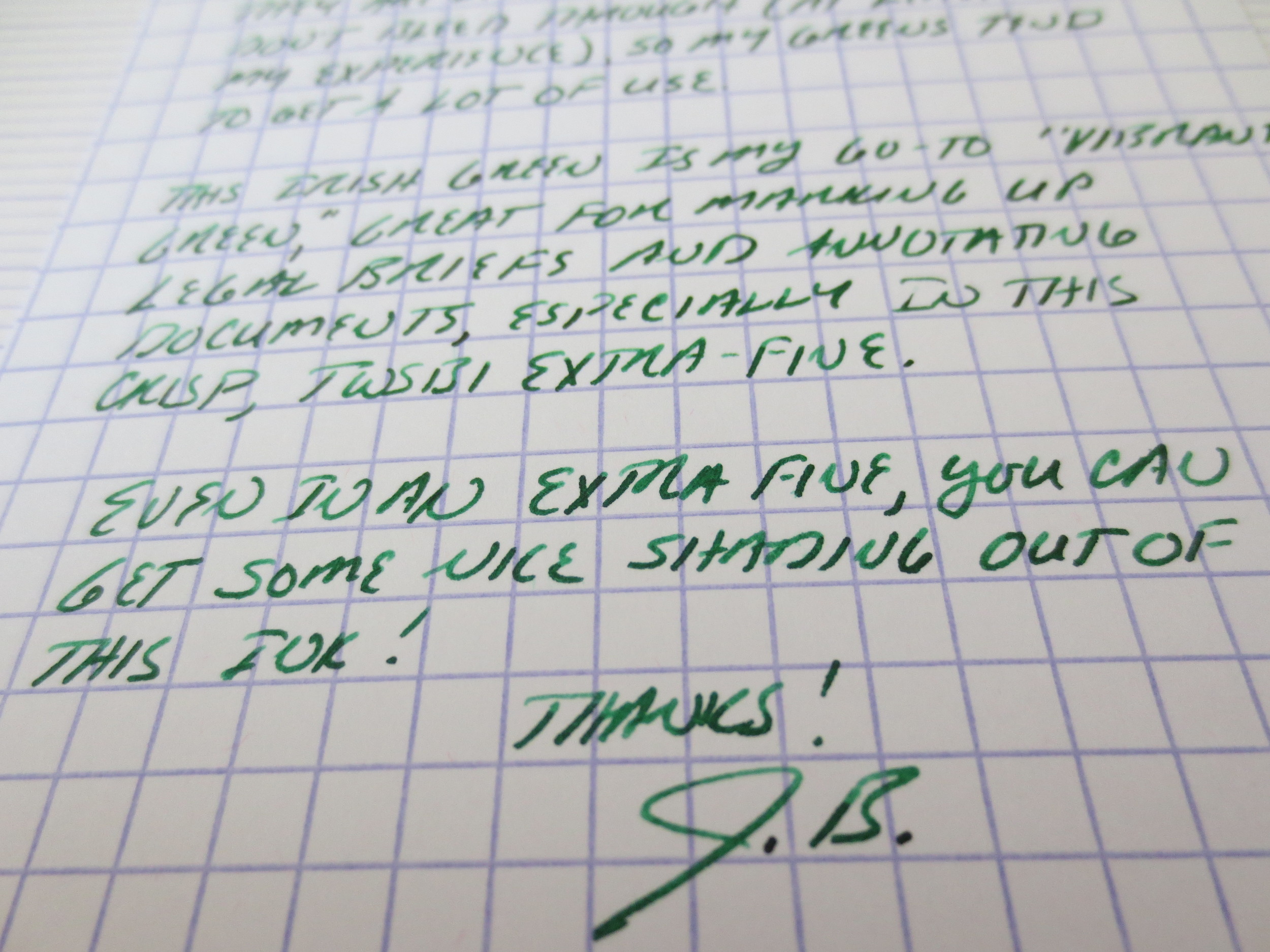
But in the meantime, I present to you Montblanc's Irish Green.  The name is self-explanatory--it's a very bright, "Happy St. Patrick's Day"-type green ink that I would label a "Kelly Green."  No comparison to the Diamine by that name is intended--I've never tried it.  I use this ink for multiple purposes:  annotations, personal/work notes, and even some limited correspondence, although I write very few letters these days.  (Next year I'm going to participate in InkoWriMo, I swear.)  Irish Green is great for pretty much any use.  It's a Montblanc ink, which means that it works well on a wide range of papers without feathering, bleeding, or ghosting (all must-have characteristics for me) and the dry time is almost immediate.  It washes out of a pen very easily.  I've been using this on a clear plastic TWSBI 580 demonstrator, and have had no problems with staining.  Shading is average, but if you use a broader nib than the TWSBI EF that I used to write this review, you will see more.    

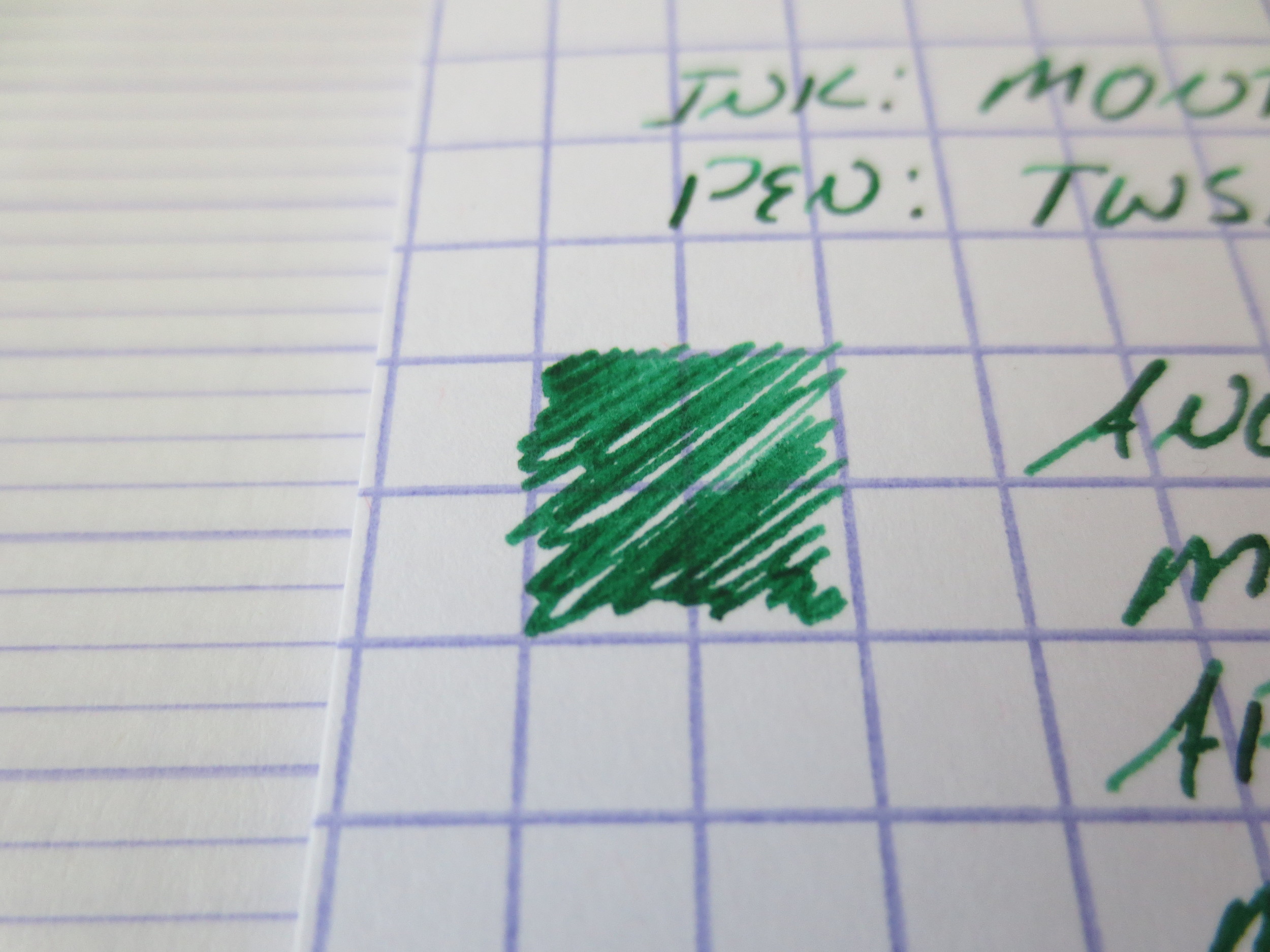
This scan nails it on color replication.  Paper is an Exacompta index card.

N.B. : I was recently shocked to learn that writing people letters in green ink has "negative" connotations (if you consider being labeled a nutter "negative.").  See Here.  Those in Great Britain might want to be more careful than those in the U.S.     

Pen Review: Kaweco AL Sport

The modern Kaweco Sport pen is a workhorse:  it's pocket-sized, durably built, and (generally) affordable enough that you aren't overly worried to stuff it in your pocket and take it on the road with you for work, travel, or just knocking around town.  The popularity of the Sport is such that Kaweco has developed several lines, the "classic" plastic sport pen, the AL Sport, and the AC Sport Carbon Fiber edition.  This review focuses on the AL Sport, in black, which retails for around $75, per my last market check. 

I love the engraving on this pen.  The font is classy looking, and it doesn't feel like it will wear off easily.

Build Quality

The Kaweco AL Sport is a very well-built fountain pen for the price.  The body of the pen is made from machined aluminum.  It is sturdy enough, but the pen will develop a patina and scratches and dings with long-term use, especially if you use this pen as a true EDC "pocket pen" and carry it around in your pocket with keys, coins, etc.  Most people don't mind this, as they feel that it adds to the aesthetic value of the pen.  In fact, Kaweco recently released a "stonewashed" version of the AL Sport, which seems to be a "pre-aged" version of the regular AL Sport with the aluminum coating worn off.  I have not seen this pen offered by U.S. retailers.  The Kaweco Sport line takes international-sized cartridges, and works best as a cartridge pen, in my opinion.  There is a squeeze converter option, but I have had mixed success in getting an adequate ink supply into the converter to last me through a full day, so I either use the cartridges with Kaweco's excellent ink or refill empty cartridges with a syringe.

A size comparison of the Kaweco AL Sport with my Kaweco Lilliput.  Both are pocket pens, but the AL Sport is a more full-size writer when opened and posted.

SIze

The pen closes to true pocket size, but once opened and posted it is a full-size writer.  I actually prefer the AL Sport as a daily carry over the Lilliput, for this reason.  The Lilliput is great, and a neat little pen, but it's so small as to border on "novelty" territory.  The AL Sport is still small enough to fit comfortably into your pants or jeans pocket.  You can purchase a clip, but I've found that the Kaweco clips tend to be too tight to use on my shirt pocket without risking a tear.  Plus, I don't like spoiling the streamlined look of the unadorned pen itself.

Kaweco AL Sport extended and in the hand. 

The Nib

Kaweco's nibs are well-made, functional stainless steel nibs made by Bock.  My extra-fine nib may not be the world's smoothest writer, but it doesn't skip and actually leaves a true extra-fine line, which is rare with German-made nibs.  Nibs in the Sport line are interchangeable, so you can purchase replacements.  The nibs come in sizes EF through BB.  

The Verdict

I love this pen.  I purchased it from jetpens.com about a year ago, and its been in my rotation ever since.  I'm eyeing the carbon-fiber version (in red), but have not been able to make myself take the plunge.  For an excellent review of that version of the Sport, check out Bob's review at My Pen Needs Ink.    

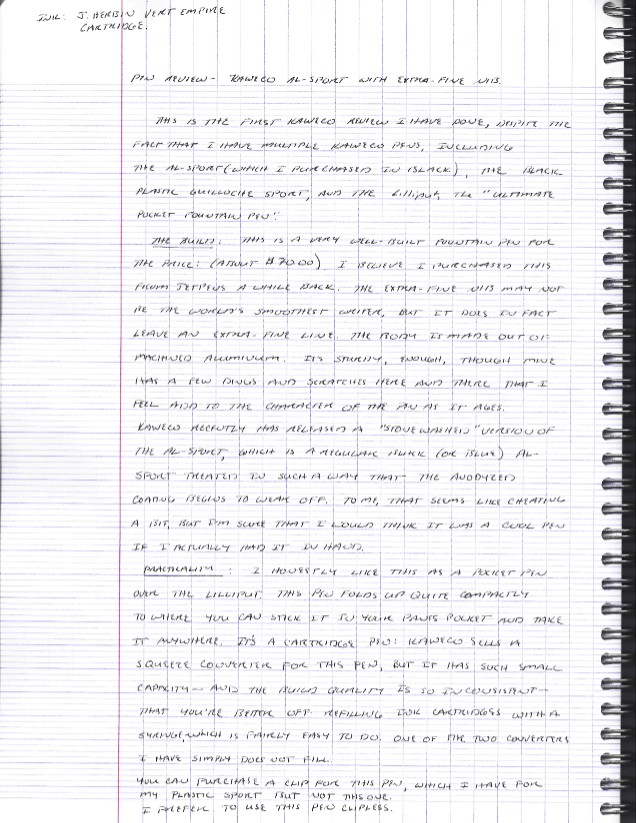
N.B.:  I've attached a handwritten version of this review in the gallery below.  The ink used is J. Herbin's Vert Empire, which does not scan very well and comes out more grey than the grey-green.  I've also included a photograph that's a more accurate reflection of the ink's true color. 

Pen Review: Pilot G2 Limited

I've been on a Pilot pen kick recently.  Somewhere, somehow, I ended up with a "20% off your total purchase at Staples" coupon, so I drove to the mall a couple miles from my house intending to pick up another pack of Razor Points.  Staples didn't have these, but I walked away with some new daily writers that I've been using regularly, including this Pilot G2 Limited. 

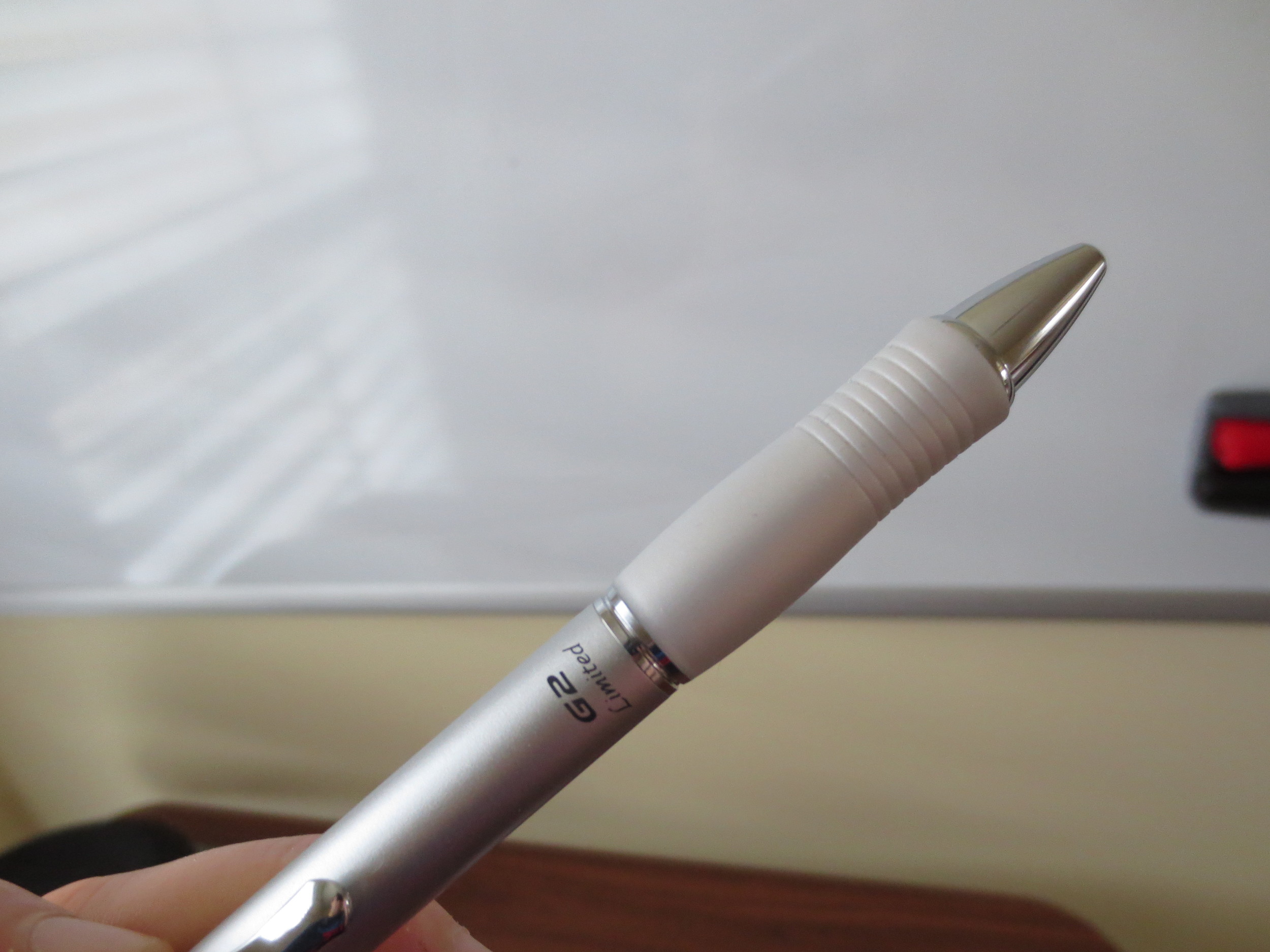
The G2 Limited is intended to be the barrel "upgrade" for those who want something a step up from Pilot's stock G2 plastic pen. Sort of like the Pentel Energel "Alloy" model is to the run-of-the-mill Energel. Those are cool too. Staples was sold out.

Pilot advertises the G2 as the "#1 Selling Gel Pen," which may be self-promotion, but also may actually be true, since these pens are everywhere.  Pilot has issued multiple renditions of the pen, including the "G2 Mini," the "G2 Pro," the "G2 Professional," and even a charity line that includes a breast-cancer fundraising edition.  The model that caught my eye, however, was the silver G2 Limited, which I managed to score for about $8.50, after my discount.

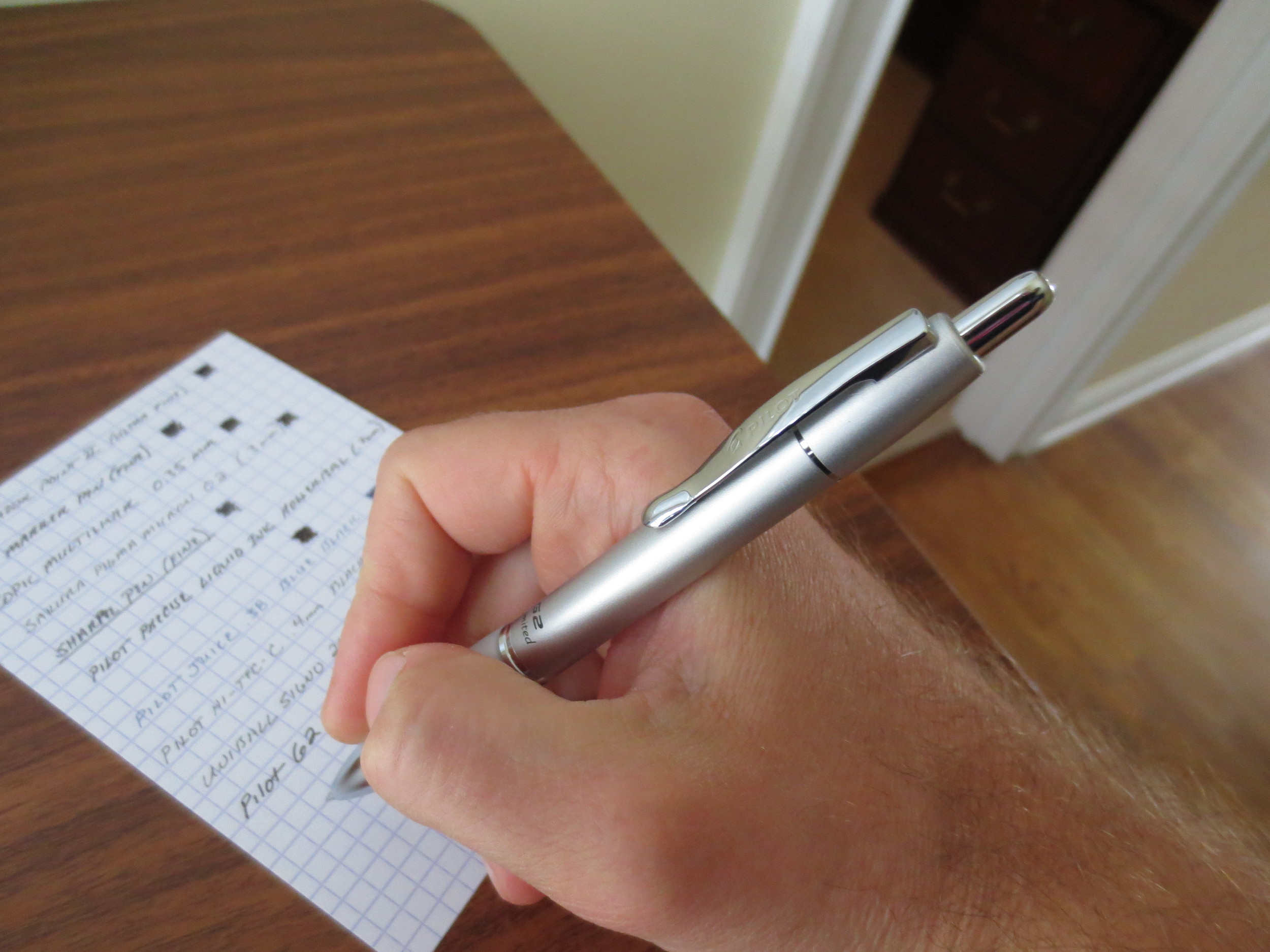
Don't get me wrong, this is an $8 pen.  It's made of plastic.  There's some play in the joints where the parts fits together, but not enough to make it rattle, which is the point at which it would get annoying to me.  The knock is pretty solid and retracts/unretracts the point without sticking or rattling.  The pen comes with the .7mm G2 refill in black.  I typically prefer the .5mm refill in blue (or even the "Ultra Fine" .38mm in either the G2 or Juice line), but I need a black pen at the moment and I've actually come to enjoy the .7mm.  It's incredibly smooth, leaves a very dark line, and in a week of use, I have not seen any of the "blobbing" that people complain about with the .7mm point. 

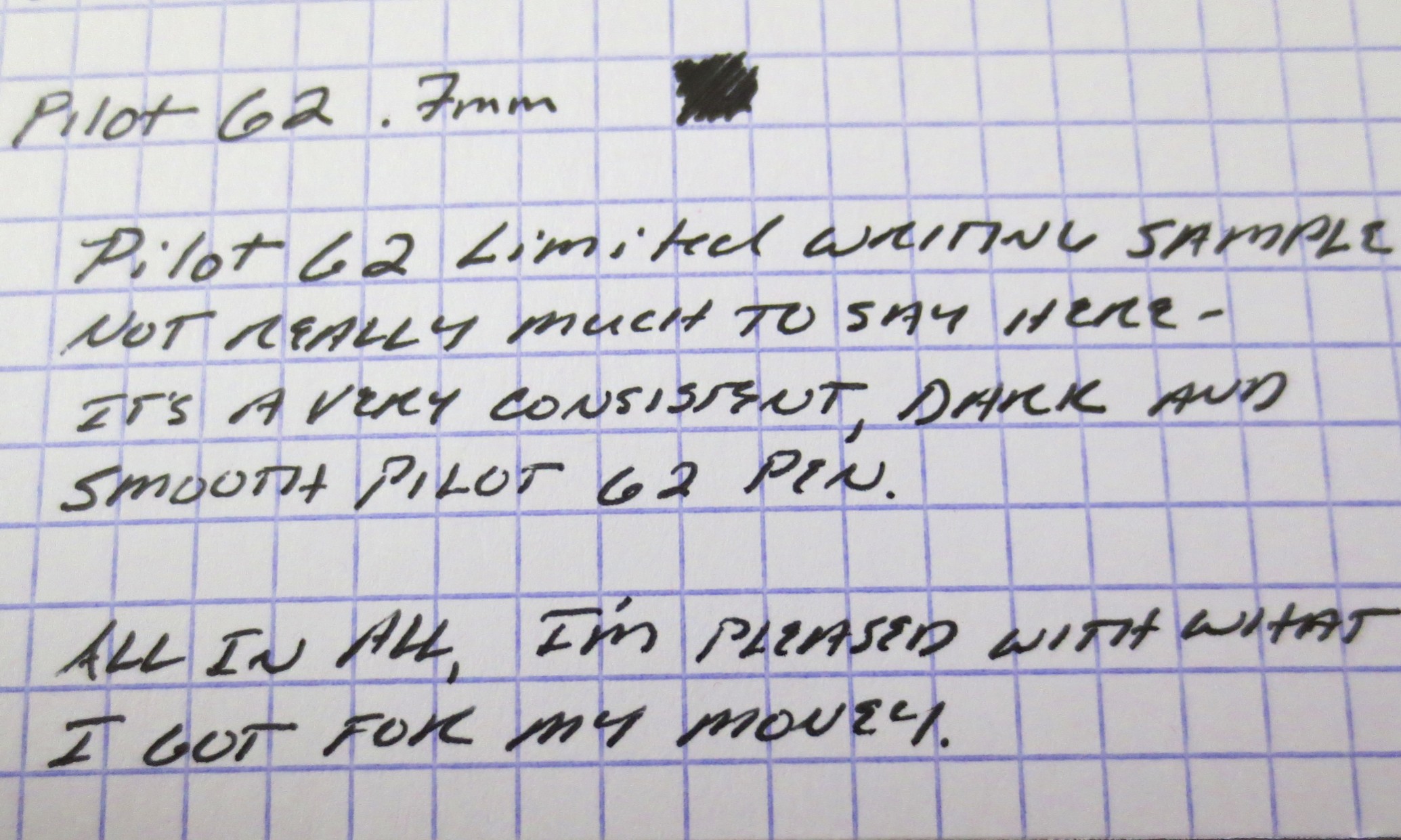
A comparison with some other common gel pens in .38mm, .4mm, and .5mm. I typically opt for a narrower line than the standard .7mm, but this line is clean enough that it's more than usable for me. Check out how dark that black ink is.

People may disagree with me on this, but the smoothness and darkness of Pilot's ink formulations continues to win me over every time.  I prefer the G2 over the Uniball Signo 207 or the Zebra Sarasa, the Hi-Tec-C over the Signo DX, and the Pilot Precise over just about any other liquid ink rollerball on the market (although this last category's not really a hard one to win).  On the fountain pen side, my Vanishing Point and Custom 74 are regularly inked with Iroshizuku or the Pilot/Namiki Blue-Black Cartridges.  I think I made it through high school using the old Pilot Explorers.  I have not managed to scavenge some Acroballs yet, but will do so in my next Jetpens order.

In this same run to Staples, I picked up a Dr. Grip Gel and a Dr. Grip Full Black, after hearing rumors that the line was being discontinued.  The Dr. Grip Gel takes a G2 refill, so it may not warrant a separate review, but the Full Black has a hybrid ballpoint ink that I'm really liking at the moment and am using regularly.  There will be some more Pilot reviews soon.